For decades, for every European and especially every Frenchman, America embodied a debt of the heart and of blood. No political dispute, no economic disagreement could alter this fundamental gratitude, sealed into the soil of Normandy, into the mud of the Ardennes, and into the military cemeteries where thousands of young GIs lie who came to die for our freedom. The transatlantic alliance was not merely a treaty signed on paper; it was a brotherhood of arms and of ideals.
It took the passage and return to power of a single man to break that bond of security and turn more than 80% of Europeans from brotherhood to distrust — at the very moment when another American, wielding not the slightest shred of temporal power, reminds the world what greatness can still mean.
“Peace is not bought with the blood of others, nor bargained for with weapons; it is built through justice, education, and shared dignity.” (Leon XIV)
The Essentials
- During a state visit to France, the American president had refused to bow before the graves of the 1918 soldiers, calling these heroes “losers” — a contempt that has since hardened into doctrine.
- Ukraine abandoned, European allies treated as commercial enemies, Gulf states held as transactional hostages despite investing over $1 trillion in their own defense, Taiwan now expendable: the list of betrayals grows longer.
- The warmest regard, by contrast, goes to autocrats — even hosting in Florida a head of state wanted by the ICC for war crimes.
- Under cover of a war against “the deep state,” the most basic rules of the Republic are trampled, the presidential fortune doubles in office: the classic symptoms of a banana-republic drift.
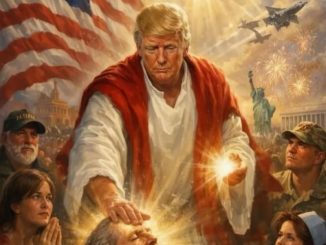
- Attacked by Trump as early as April, even depicted as Jesus Christ on social media, Pope Leo XIV — the first American-born pope — responded without hesitation: “I am not afraid of the Trump administration, nor of spreading the message of the Gospel.”
- That very same day, at the Élysée and at UNESCO, he spoke a language the exact opposite of his compatriot’s: “Peace is not bought with the blood of others, nor bargained for with weapons; it is built through justice, education, and shared dignity.”
- For Europe, the lesson goes beyond the man himself: after years of overpaying by 10% for American arms purchases in the name of one-sided solidarity, reciprocity must now become the rule.
“True power lies in service rendered to the weakest, not in the display of domination.” (Leon XIV)
Contents
by Joël-François Dumont — Paris, September 25, 2026.
Contempt for Memory, the Cult of Abandonment
The symptom of this rupture is not new. We recall with stupefaction that state visit to France where, declining to bow before the graves of American soldiers who died in 1918, the president chose instead to remain in his Paris quarters, privately calling those heroes “losers.” That day, the mask fell: how can one expect fidelity toward living allies from a man who holds his own fallen in contempt?
What was then merely a posture has since become a doctrine of systematic betrayal. Ukraine, abandoned in the face of the Russian aggressor; European democracies, treated as commercial enemies; the Gulf states, though contributing over $1 trillion to their own defense, held as transactional hostages; and now Taiwan, whose fate appears sacrificed on the altar of boundless cynicism.
Meanwhile, the warmest regard is reserved for autocrats and dictators. Hosting in Florida a head of state wanted by an international arrest warrant from the International Criminal Court in The Hague for war crimes, showering praise on the regimes of Pyongyang or Beijing that arm those who have helped kill GIs: such conduct amounts to an absolute moral and strategic abdication.
The Temptation of the Banana Republic
Under cover of a supposed war against “the deep state,” we are witnessing the dismantling of the most elementary rules of the republic and of international law. In what major constitutional democracy does one see a leader multiply transgressions, use the machinery of state to settle personal scores, and indecently grow his private fortune while in office? That is the hallmark of authoritarian regimes and banana republics, not of the free world. One does not double one’s fortune as president — unless one confuses public power with organized crime.
The Absolute Contrast: Peace Against Cynicism
What a striking difference with what world diplomacy can still offer at its noblest! One had only to listen to today’s remarks, live from the Élysée and from the podium of UNESCO, to measure the gulf separating a true head of state from a wheeler-dealer draped in purple.
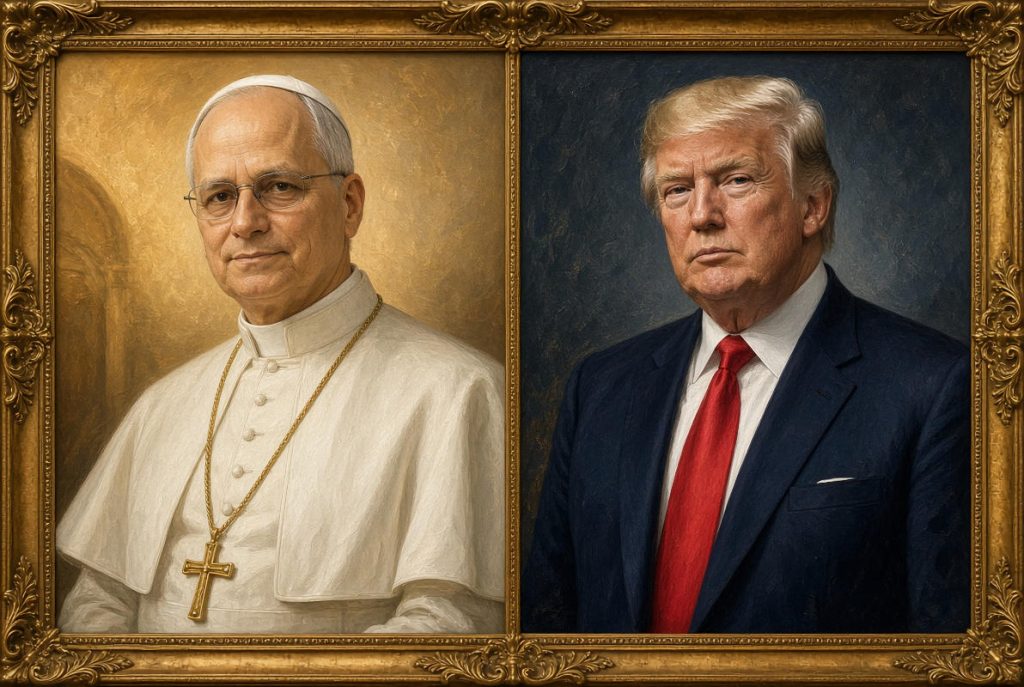
On one side, a man who listens — genuinely, not merely for the cameras. When Trump attacked him in April, going so far as to have himself depicted as Jesus Christ on social media, Leo XIV — for these are indeed two Americans whom everything sets apart, one at the head of a state, the other at the head of the Catholic Church — needed no prompting to respond: “I am not afraid of the Trump administration, nor of spreading the message of the Gospel.”
A month later, after a fresh outburst from Trump, the same composure in reply: “The mission of the Church is to preach the Gospel, to preach peace.” That kind of quiet firmness is not improvised; it is built over a long time, in the conviction that one’s dignity is not up for negotiation. Two sentences, heard this very day at the Élysée and at UNESCO, confirm it better than any commentary could:
On the other side of the mirror, a man who knows neither how to listen nor how to serve — only how to serve himself. Rotten with money and infatuated with his own reflection, he still calls “losers” the men who died so that others, today, could still speak of freedom without shame. Day and night.
The Lesson for the Future and Rediscovered Reciprocity
Even so, Europeans make no mistake in confusing the American people with this buffoon of history. American civil society, its judicial institutions, and millions of its citizens watch this spectacle with the same dismay as we do.
But once this figure is finally relegated to history’s dustbin, European naïveté will be over. Reciprocity must henceforth become the golden rule in our relations with Washington.
For years, Europe agreed to overpay by nearly 10% for American arms purchases in the name of strategic solidarity, all while enduring unfair maneuvers designed to prevent it from building its own defense tools. That era is over. Europe has learned the lesson: to be respected, one must stop being a vassal.
Tomorrow, true fidelity to the memory of the GIs will not consist of bowing before the brutality of a crooked businessman, but of building a Europe that is strong, sovereign, and capable of ensuring its own security. A Europe guided by the pursuit of peace and the rediscovered pride in its own values.
It just goes to show that the day only lasts if we stop being afraid of the night!
Joël-François Dumont
See also:
- « Two Americans: A Head of State, A Head of a Church — Day and Night » (2026-0925)
- « Deux Américains : Un chef d’État, un chef d’Église : le Jour et la Nuit » — (2026-0925)
- « Zwei Amerikaner: ein Staatsoberhaupt, ein Kirchenoberhaupt — Tag und Nacht » (2026-0925)
Analysis: Day and Night
The title of this editorial is not a stylistic flourish — it is a statement of fact. Two Americans, two functions with nothing in common — one head of a state, the other head of a Church — and yet two radically opposed relationships to power: one who confuses it with his personal wealth, the other who holds none of it and never needed any to embody moral authority. The world needs no third term to choose between the two; the deeds speak for themselves, and the words follow without rhetorical effort, because they simply state what was done.
What strikes one in this contrast is not merely a difference in style — one cynical, the other dignified — but a difference in the very nature of the power each wields. The first improvises his foreign policy along the lines of his grudges and his financial interests, changing allies as one changes business partners. The second holds no lever of coercion, no army, no campaign budget to defend — and it is precisely this absence of temporal power that makes his firmness so striking: he had nothing to lose by answering Trump back in April, except his own dignity — and it is exactly that dignity he chose to defend.
One question remains, which this editorial poses without fully resolving it: will Europe manage to turn this observation into a lasting policy, or will it fall back, once the storm has passed, into its old habit of deference? The answer will not be decided in speeches, but in the next arms contracts, the next trade negotiations, the next summits where the courage to say no will, or will not, be found. Day only lasts as long as one stops fearing the night.