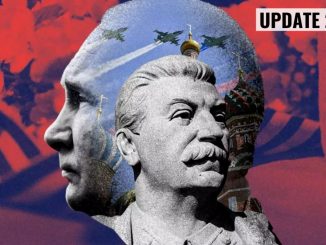
Beyond the establishment of a “vertical of power,” beyond the dominant influence of oligarchs close to the presidential clan, beyond corruption, nepotism, and anti-liberalism, the United States is converging with Russia on another essential point: the hold of eschatological visions on the ideology of the ruling circles. As for Russian ideologues of the apocalypse, they draw inspiration from Shia theology.
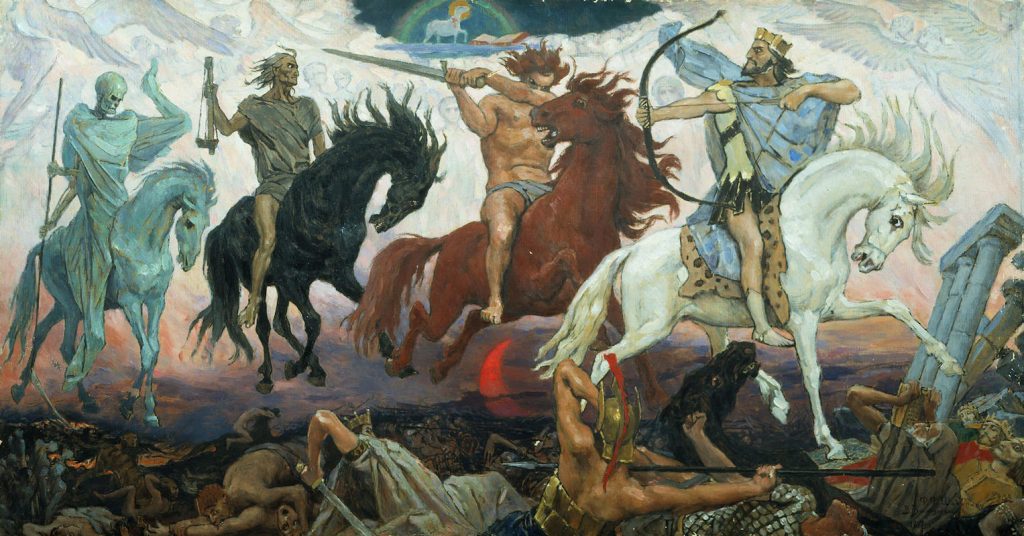
“They are too far removed to know that no god wishes harm upon mankind […] To give assent to falsehood and to obscure the clarity of the truth is forbidden to me by all divine laws.” Plato, Theaetetus.[01]
“We must break with what surrounds us—decisively, seriously, completely, and definitively.” Alexander Dugin
Table of Contents
by Françoise Thom in DeskRussia — Paris, March 24, 2026 —[*]
Eschatology in the United States [02]
Dispensationalism
Dispensationalism, a millenarian movement that emerged in the early 19th Century,popularized by Anglican clergyman John Nelson Darby (1800–1882) and the American theologian C.I. Scofield, expanded in the US from 1920 on. Dispensationalist doctrines are based on a literal interpretation of Scripture, particularly biblical prophecies. They exerted a major influence on much of evangelical Protestantism in the Anglo-Saxon world. Highly successful popularizers, such as Hal Lindsey, author of The Agony of Our Old Planet, helped spread these ideas to a wide audience.
Darby was the first to popularize the idea that God had an earthly plan for his people of Israel and a different, heavenly plan for the Church, the body of Christ. In his view, a dispensation is a period of biblical history. God’s action manifests itself differently in each of these seven periods. The dispensationalist Christians await the restoration of the national kingdom of Israel, a sign heralding the return of Christ. For them, the creation of the State of Israel in 1948 heralds the fulfillment of ancient prophecies. It was perceived as the start of a countdown, the sign of the imminent resurrection of the dead who, united with the Christians still alive, will rise together “into the clouds to meet the Lord in the air” (“rapture”), leaving behind the sinners to face the Last Judgment. The dispensationalist scenario, updated by Hal Lindsey, predicted that the world would then enter a period of tribulation: plagues would multiply, so that desperate people would submit to the global reign of the Antichrist. The captive world would be seduced by this mysterious figure. Having reached the height of global popularity, the Antichrist would go to Jerusalem and, in the rebuilt temple, proclaim himself a god.
Then comes the great confrontation. Gog and Magog: these names appear in Genesis and, above all, in the Old Testament’s Book of Ezekiel. They feature in the apocalyptic prophecy of a global army waging the final battle against Israel. In the updated scenario, a Southern Confederation, formed by Arab and African nations, will place itself under Egypt’s leadership to attack Israel. The King of the North (the peoples of the North, that is, Russia—or the European Union in the current interpretation) will attack the Southern Confederation. Countless armies coming from east of the Euphrates (in the interpretation of today’s evangelists, India and China) will rush in the region. Like a devastating whirlwind, they will sweep away everything in their path and take control of the Middle East. In the end, only two coalitions will remain in the fray—that of the North and that of the East—which will clash in the infamous Battle of Armageddon. Willed by God, this war, during which a third of humanity will perish, will make it possible to defeat Gog and Magog, to annihilate the enemies of the chosen people once and for all, and to witness the birth of a new world. The shockwave caused by this final confrontation will engulf all nations. Then Christ will come as a warrior with his saints to finish exterminating his enemies and establish his thousand-year reign.
In his book The Rise and Fall of Dispensationalism: How the Evangelical Battle over the End Times Shaped a Nation, Daniel G. Hummel argues that dispensationalism has shaped not only American fundamentalism or evangelicalism, but the United States as a whole. Even today, dispensationalism remains “one of the most persistent and popular American religious traditions.” According to Hummel, this conception has spread far beyond the walls of the church, to such an extent that “Americans of all backgrounds” have “a fundamentally premillennialist vision of the future”, the secularized expectation “of a decline in social cohesion and growing existential threats that will culminate in a catastrophe ushering in a new era”.
As a school of theology, dispensationalism has declined sharply over the past 50 years. But as a cultural and political force, its influence is stronger than ever: 55% of American adults believe in the return of Christ. 92% of American evangelical Christians are convinced they will witness the end of the world. The infiltration of the U.S. Air Force by evangelicals began in the 1980s.
The popularized dispensationalism that most Americans know today was shaped, according to Hummel, “not by theologians, but by people with little theological interest or who were theologically illiterate,” which has had deleterious effects on the evangelical movement and on American society as a whole.
The theological void left by the decline of dispensationalism was filled starting in the 1990s by a proliferation of apocalyptic speculations. As early as George W. Bush’s war against Iraq in 2003, Alexander Dugin, a keen observer of American society, noted: “The United States is perceived by many as the ideal embodiment of a modern secular society, at the forefront of technological and scientific progress. This is partly true, but it is precisely in the United States that extremist religious movements and cults are extremely powerful, sometimes integrating even into the highest echelons of American political power… One cannot understand America without taking into account the specific messianic, eschatological, and religious ideology that drives it… In the United States, we are not dealing with a secular and democratic power, but with a regime of hidden radical fanaticism—which resembles other messianic worldviews: Islamism, communism, Nazism, etc.”. The deep-rooted nature of these eschatological conceptions is evident in a remark by President Bush Jr. reported by Jacques Chirac. In 2003, a month before the launch of the American offensive against Iraq, while he was trying to convince the French president to rally to the American cause, George Bush expressed the opinion that “Gog and Magog are at work in the Middle East” and that “biblical prophecies are about to be fulfilled.”
The disintegration of the delusional yet carefully constructed doctrine of dispensationalism has resulted in a plethora of diverse religious movements carrying the debris of the dispensationalist edifice. Having broken away from a common root, these cults intermingle and clash. The past influence of dispensationalism explains the extraordinary penchant for conspiracy theories that the MAGA movement has brought to light. Evangelical Christians, accustomed to reading signs of the imminent end times everywhere, have no trouble convincing themselves of the existence of a “deep state” driven by wicked design. They see Satan everywhere. Most MAGA Christians believe that the world is becoming increasingly evil, that it is irretrievably lost, and that this is God’s will. They have given up on improving it, hence their indifference to climate change. As Fox News host Sean Hannity put it in 2022,: “if [the world] is really going to end in 12 years, to hell with it all! Let’s have a big party for the last ten years, and then we’ll all go home to see Jesus.” Some would even like things to get worse because that would bring Armageddon closer—and therefore the Day of Judgment, the end of the world, the imminent return of Jesus. They want, in a way, to force God’s hand, just as Lenin believed one could accelerate the march of historical determinism. When, in his 2017 inauguration speech, Trump declared: “The American carnage ends here and now,” he was in tune with his audience’s eschatological expectations. He launched his second campaign for the White House by presenting the 2024 election as “the final battle” for America: “I was saved by God to restore America’s greatness.” In the eyes of MAGA supporters, Donald Trump is the Lord’s anointed, the miracle worker; he can hasten the return of Jesus.
The war against Iran reveals just how much this religious undercurrent in American society can shape political choices and provide them with a rationale. This war has the support of Christian nationalists and Christian Zionists.
Christian nationalists
Three in ten Americans identify with Christian nationalism, which opposes the separation of Church and state. The leading figure of this movement is Doug Wilson, Pete Hegseth’s favorite pastor. He does not believe in dispensationalism. For him, the return of Christ will only be possible once the entire world has been Christianized. The ideology of Christian nationalism has infiltrated the highest echelons of the Pentagon. Pete Hegseth is under its influence: “We are the good guys, and Americans know it. That makes my job easy. I serve God, my troops, my country, the Constitution, and the President of the United States… Every day we call upon Heaven, upon the providence of the Almighty…” Close to 30 Democratic representatives in Congress have demanded an internal investigation into hundreds of complaints filed by American soldiers alleging that the U.S.-Israeli war against Iran was presented to them by their officers as a biblical prophecy intended to hasten the return of Jesus Christ. According to one account, an officer reportedly stated: “President Trump has been anointed by God to ignite the fire in Iran in order to bring about Armageddon and mark his return to earth.”
During a speech delivered in Jerusalem in 2018, Hegseth said he hoped that the Third Temple would be rebuilt in Jerusalem on the Temple Mount, which has been occupied by the Islamic Dome of the Rock since the late 7th Century: “There is no reason why the miracle of rebuilding the temple on the Temple Mount should be impossible. I don’t know how it would happen, you don’t know how it would happen, but I know it is possible.” It should be noted that the Church Fathers were divided regarding the construction of a third Temple, following those of Solomon and Herod. For Saint John Chrysostom and Saint Jerome, the true temple is now spiritual.
Christian Zionists
In the eyes of Christian Zionists, every war in the Middle East brings the return of Christ closer. Approximately 10 million Christian Zionists support the construction of the “Third Temple,” in accordance with eschatological prophecies foretelling the coming of the Antichrist and then the return of Christ after the Temple is built.
In their view, Jews must occupy the Holy Land in order to rebuild the Temple, which will enable the coming of Christ. The U.S. ambassador to Israel, Mike Huckabee, a former Baptist pastor and staunch supporter of Israel, has asserted that, according to biblical tradition, Israel has a right to lands stretching from the Nile to the Euphrates, covering a large part of the Middle East: “That would basically encompass the entire Middle East… It would be great if they took it all.” The bustling Paula White, Trump’s spiritual advisor, identifies as a Christian Zionist, though her theology is highly questionable: “Wherever I go, God rules. When I walk on White House grounds, God walks on White House grounds. I have every right and authority to declare the White House as holy ground because I was standing there. And where I stand is holy”. Obviously she fears neither the sin of pride nor that of idolatry: “To say no to President Trump would be saying no to God.” It is no surprise that Trump has just appointed her head counsellor of the newly created White House Faith Office.
Split in the MAGA Movement
Even before the war against Iran, an anti-Zionist current crystallized within the MAGA movement. An early Trump supporter, Tucker Carlson, the former Fox News anchor, an Episcopalian—who also considers himself a warrior engaged in the fight against Darkness—who claimed that “today’s struggles are not political, but pit good against evil,” and that “Satan himself” was running the White House under President Joe Biden,- who had obsequiously interviewed Putin and Dugin, – began to distance himself from Trumpism, becoming a virulent critic of Israel and offering a platform to Nick Fuentes, a notorious anti-Semite. “I’ve always thought it was healthy to criticize and question our relationship with Israel, because it’s senseless and harmful to us,” Carlson stated. In March 2026, Tucker Carlson went even further with a series of sensational statements, leaving Republicans and many others in shock. He suggested that the conflict was part of an alleged plan linked to the reconstruction of the Jewish Temple in Jerusalem. According to him, the attack on Iran was “absolutely disgusting and evil,” and that it would “profoundly upend the status quo” of Trumpism: the White House no longer belonged to the American people, the Trump administration was de facto controlled by Mossad, the Israeli intelligence services, and subject to the influence of a radical religious cult obsessed with the idea of an imminent end of the world. “This is Israel’s war, not the United States’.” Predictably, President Trump pronounced his excommunication: “Tucker has lost his way. He is no longer part of MAGA.”
Jewish eschatology
Judaism believes in the coming of the Messiah (Mashiach) and in the resurrection of the dead. But traditional doctrine prescribes that one should not seek to hasten the advent of the messianic era through practical actions. The prevailing belief is that the Messiah will arrive only when the Jewish people have reached a certain threshold in their spiritual progress. In June 2016, Israel’s Ashkenazi Chief Rabbi, David Lau, stated that he wished to see the construction of a Third Temple, while expressing his belief that the Muslim holy sites located on the Haram al-Sharif/Temple Mount did not need to be demolished to make way for it. Rabbi Lau’s public statement caused quite a stir because, until then, the Chief Rabbinate of Israel had always served as a counterweight to religious nationalist groups advocating for visiting and praying on the Temple Mount/Haram al-Sharif, while awaiting the launch of construction of a Third Temple. Benjamin Netanyahu, who returned to power in December 2022, brought into the government two ministers from the religious far-right and opened new avenues for the Temple Movement. A faction of the far-right would like, beyond reclaiming the Mount, to rebuild the Temple and thus establish a “Third Temple.”Activism related to the Third Temple, which was marginal a few decades ago, remains an extremely small minority current within Israeli religious nationalism. However, its influence has grown since Hamas’s offensive against Israel on October 7, 2023, and the war against Hamas in the Gaza Strip.
Shia Eschatology
Shia Muslims believe that the Twelfth Imam did not die, but went into hiding in 941. It is he, the Mahdi, who will reappear at the end of time, defeat the Dajjal (Satan, now Trump), and restore justice at the end of the world. Iranian leaders view the liberation of Al-Quds (Jerusalem) and Islam’s holy sites as a sacred duty for all Muslims. Only this liberation will enable the Mahdi’s return. Even if the United States and Israel were to eliminate the entire Iranian religious establishment, every Shia Muslim would continue to believe that the “hidden imam” is among them and will reveal himself. Iran’s elected spiritual leaders are merely interim figures awaiting the arrival of the Mahdi.
Dugin or Eschatological Syncretism
In Russia, eschatological tendencies emerged during the crisis of the communist regime and took shape during the Yeltsin years. This movement gained momentum throughout the Putin years and has now reached its peak amid Russia’s setbacks in Ukraine, and as the government attempts to impose the slogan of total war on a reluctant society. The principal prophet of Russian-style eschatology is Alexander Dugin.
But a reading of Dugin’s writings shows that his eschatology in no way reflects any kind of spiritual experience. It is not a matter of belief, but rather the instrumentalization of concepts aimed, on the one hand, at destroying the adversary (the “liberal globalists,” “the collective West”), and on the other, at providing an ideological cover for Moscow’s imperial ambitions. Dugin understood very early on that eschatology could become a powerful instrument of foreign policy. He wrote in 2019: “I am convinced that, over time, spiritual arguments, eschatological analysis, and references to sacred tradition will gain in importance and significance in all our societies. In Iran, this is already a reality. And it is becoming a major reality in Russia and among Western elites: one need only consider the influence of Protestant eschatology on American foreign policy—it is considerable.” Dugin’s eschatology is above all a weapon of war against the West.
Dugin’s affinity for Shia Muslims
Deep ties began to form between Yeltsin’s Russia and Iran starting in 1993. The policy of rapprochement with Iran was implemented surreptitiously, through the Duma, and then more openly when Primakov became foreign minister in 1996 and sought to signal to Washington his dissatisfaction with NATO expansion. In the Kremlin, there was a keen awareness of Iran’s potential to cause trouble to the West.
Dugin was already drawn to the Shia branch of Islam at that time, attracted by the enduring influence of Manichaeism within it. He stated in an interview in July 2019: “Shia Islam is very close to my heart; I simply feel it as something that is close to me.” He says he is not indifferent to the lingering Zoroastrianism in Iran: “It is the idea of the superiority of heavens over earth, of the struggle of the heroic heavenly principle against the satanic earthly principle, and of the battle of the sons of Light against the sons of Darkness. This model is found throughout the ages, right up to modern Shia eschatology’s expectation of the Mahdi…” Just when materialism seemed to have triumphed, Dugin rejoices, we witnessed “the Great July Revolution [1979] in Iran, where religious ideas triumphed and Ayatollah Khomeini proposed a resolutely conservative-revolutionary program, restoring religious and theological motivations to the heart of politics. A similar phenomenon can be observed in Russia. Today, when we speak of our identity, when the concept of national security includes the notion of the superiority of the spiritual over the material, we can certainly speak of eschatology and religious motivations […] There is, as Muslims say, the “greater jihad,” the one waged against one’s own sins and vices. But there is also the “lesser jihad,” the struggle against the political embodiment of evil. And for us, Orthodox Russians, this political embodiment of evil is liberalism, the West, America, and American hegemony.”
In the same interview, Dugin states that, as early as the late 1980s, he advocated “a sort of eschatological alliance between Christians and Shia Muslims, between the two types of culture of expectation in the struggle against the Dajjal (the Antichrist) […] The expectation of the Mahdi is an eschatological anticipation of a radical change in the very ontological foundations of the modern world. For Orthodox Christians, this notion is intimately linked to the messianic dimension of Christianity. It is not only about the expectation of Christ’s return, but also about the creation of the Christian world in the midst of darkness. And this eschatological perspective […] unites Orthodox Christians and Shia Muslims. This does not mean that other Christians or other Muslims must be excluded from this alliance; anyone who understands the urgency of this culture of expectation and is capable of grasping the meaning of modernity through this eschatological lens (and in my view, this is the only possible interpretation of modernity as the final battle between the forces of the Dajjal and those of the Mahdi and Christ) can join this alliance. Such forces exist and are widely represented. I am convinced that this is a spiritual alliance, a symphony between Iranian Shia eschatology and, by extension, between Islamic eschatology and Orthodox eschatology. It is an essential pact. And I see this religious idea manifesting itself today at a geopolitical level. We Russians and Shia Muslims are not merely two ancient civilizations that respect each other, but also brothers in arms, united on the barricades in Syria. Indeed, the Lebanese Hezbollah, Iranian, and Russian troops are now fighting side by side in Syria, battling the Dajjal.” “This opposition to the devil’s temporary power on earth and the final victory of the forces of Light—that is what unites Christians and Shia Muslims.”
In an interview with the radio station Voice of Iran on November 4, 2018, Alexander Dugin outlined the geopolitical contours of this alliance, Eurasia: “The concept of Eurasia can be understood in different ways: from “Greater Eurasia,” which even includes Western Europe, China, Indochina, and the entire Islamic world, to a more restricted variant of Eurasia, encompassing Russia and the post-Soviet space.” “ Eurasianism resembles Khomeini’s idea in many respects! That is to say, the assertion of an independent culture that rejects Western hegemony […] Eurasianism is, above all, a rejection of Western hegemony […]. Today, the concrete application of Eurasian theory is taking shape within the Eurasian geopolitical triangle, along the Moscow-Tehran-Ankara axis. By acting in concert, Russia, Iran, and Turkey, as three empires (once rivals and now restoring their sovereignty and power), can accomplish great things […] By acting in concert, we could resolve many problems in Iraq, Lebanon, Libya, and Yemen. In reality, we have much in common. The interaction of the three empires—Sunni, Shia, and Orthodox—at this new historical turning point could give rise to an entirely new vision of Eurasianism.”
The Eschatological Factor in the Destabilization of the Middle East
Hamas’s offensive against Israel on October 7, 2023, fills Dugin with immense hope. What if this were finally the revolution? The ultimate showdown heralding the downfall of the globalists everywhere in the world? For decades, the USSR had tried to cement a coalition of the Muslim world against Israel and against the liberals supporting Israel. This was already what had prompted the KGB to incite Arab countries to attack Israel in 1967 during the Six-Day War, as a Soviet diplomat later acknowledged: “We thought Israel would be in trouble and that the United States would be drawn into a war against the entire Muslim world. We thought it would be worse for America than Vietnam”2. Undeterred by these failures, Dugin tirelessly pursued the same goal, replacing class struggle with eschatology.
On October 10, 2023, he wrote an article with promising headline and lead: “Al-Aqsa Storm: Is the Middle East Exploding?” “Hamas’s bold offensive against Israel may herald a shift in the balance of power in the global arena. An escalation in Israel could trigger a chain reaction in the Muslim world.”
According to Dugin, the eschatological dimension of these events should not be overlooked: “The Palestinians have named their operation ‘Al-Aqsa Storm,’ suggesting a resurgence of tensions around Jerusalem with the messianic prospect (for Israel) of building a Third Temple on the Temple Mount (which would be impossible without the demolition of the Al-Aqsa Mosque, a sacred site for Muslims). The Palestinians seek to stir the eschatological sensibilities of Muslims, both Shia—who are increasingly sensitive to this issue—and Sunni (who, after all, are not insensitive to themes of the end times and the final confrontation). For Muslims, Israel and Zionism are the embodiment of the Dajjal.[… ] It is clear that anyone who ignores eschatology will understand nothing of contemporary politics. And not just in the Middle East, even if that is where it manifests most strongly. The most important point is that the United States has categorically failed to establish its global leadership. […] Let us imagine that Israel, in concert with the West, launches an all-out war against Islam.
But there is Russia, China, India, the BRICS. And they will certainly not blindly follow the West. They will act independently. And where there is a crack, it breaks. Since the start of the Special Military Operation, we have been fully aware of our weaknesses. And we are drawing conclusions from them. Now it is the others’ turn.”
Day by day, Dugin is becoming increasingly triumphalist. On October 13, 2023, he published an article headlined “The End of Times”: “The current situation in Palestine has instantly nullified all efforts by globalists to appease Muslims and defuse tensions between the Islamic world and Israel,” he gloats. “Hamas has certainly sacrificed its men and the Gaza Strip, but in doing so, it has upended the global balance of power. Washington has already become public enemy number one for a billion Muslims, including those living in the United States and the European Union. As soon as a ground operation begins in the Gaza Strip, the situation will become irreversible. The situation is now extremely tense: the construction of the Third Temple is only possible through the destruction of al-Aqsa, yet this mosque is precisely the symbol of Hamas’s uprising. The genocide of Gazans, which Israel is already perpetrating, only makes sense within the broader context of other eschatological events. Syria, Lebanon, then Iran, and gradually the rest of the Islamic countries will be drawn into this cycle. Russia is staying on the sidelines for now, but that won’t last.”
The prospect of a global conflagration is taking shape (Zavtra, October 17, 2023): “The Palestinian uprising begins in the West Bank and East Jerusalem.[…] Faced with the genocide perpetrated by Israel in the Gaza Strip, Fatah triggers a massive Palestinian rebellion. […] Protests against the pro-American Western liberal elites, who have unanimously sided with Israel, are gaining momentum worldwide. Hezbollah enters the fray, and crowds of Jordanian Arabs cross border barriers. The United States launches preemptive strikes against Iran, which is becoming increasingly involved in the conflict, while Iran strikes Israel. Syria enters the war and attacks the Golan Heights. The entire Islamic world quickly mobilizes. Pro-U.S. states—Saudi Arabia, the United Arab Emirates, and others—are forced to take part in the confrontation alongside the Palestinians. Pakistan, Turkey, and Indonesia join them. Disputes between Salafists and traditionalists, particularly Shia Muslims, fade away. The great jihad of the Islamic world against the West and Israel begins. Russia maintains a neutral stance but does not rush to support Israel, as it is fighting in Ukraine against the West, which is fully committed to the Israeli cause.”
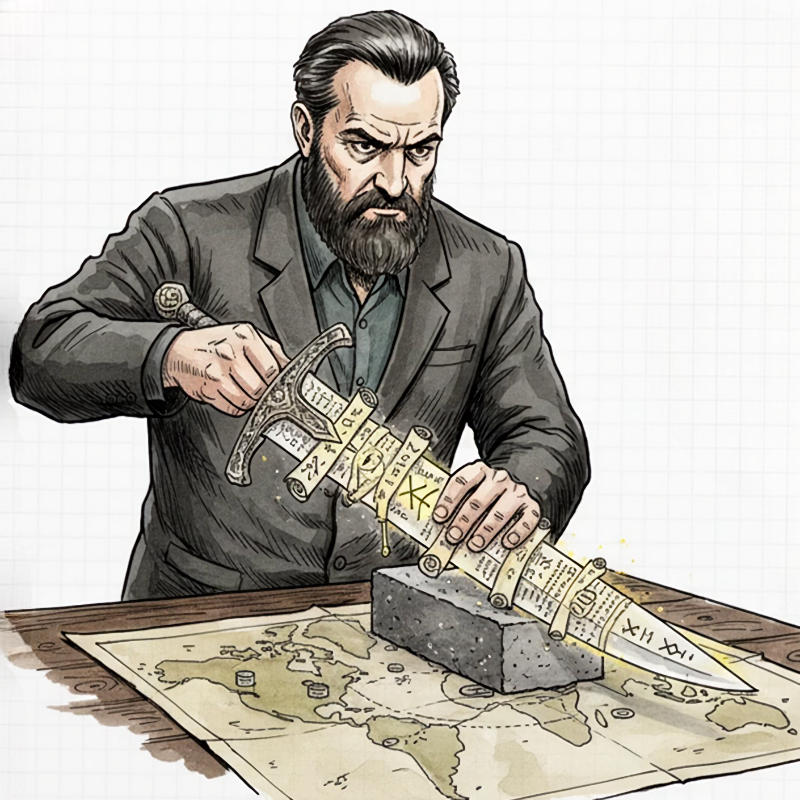
Dugin continues to daydream: “Israel, fighting Palestinian armed groups and acting in self-defense, launches a missile strike on the Al-Aqsa mosque. It collapses. The way is clear for the construction of the Third Temple. But (…) a billion Muslims, 50 million of whom (officially) reside in Europe, rise up, this time in the West itself. Civil war breaks out in Europe. Some Europeans side with the LGBT community, Soros, and the Atlanticist elites, while others form an alliance with Muslims (following Alain Soral’s model) and join the anti-liberal revolution.[…] World War III breaks out, with the use of tactical nuclear weapons. Russia finally takes a stand and sides with Muslims. China quietly attacks Taiwan […]The twilight of history is nigh.”
Dugin’s expectations were disappointed in 2023–2024, but his hopes rise again in March 2026. He expects this time to be the right one. Because of eschatological beliefs on both sides, the confrontation will be to the death, and Dugin is counting on Iran to overthrow U.S. power. Things are looking good. There are no longer any lukewarm supporters in Iran: “The Iranians are more united than ever and ready to wipe Israel off the map. I don’t think they’ll reach America, but they could very well bring about the collapse of Trump and the American world order, thereby fulfilling their mission: to build the multipolar system for which we are also fighting in Ukraine.” In any case, the overall picture is positive: “Right now, our enemies are clearly weakening. They are divided and disorganized: some support Trump and Israel, others do not. European countries are in disarray, wavering between the two camps, and that is a good thing. Panic reigns in the enemy camp. This is extremely advantageous for us, and if it leads to economic collapse and the demise of the current global economy, we can only stand to gain…”
Thus, Dugin staked very early on the destructive potential of eschatology for the international order. He saw that it could provide a powerful lever for destabilization in the Middle East. It is no surprise that eschatology appeals to Kremlin strategists. It serves, in a sense, as a repository for the grievances of defeated nations and their compensatory fabrications. We know how much Putin loves to regale his interlocutors with the catalogue of offenses suffered by Russia since the Pecheneg invasions in the 10th Century. Playing on real or imagined historical grievances is one of the driving forces behind Kremlin policy. Eschatology has the advantage of removing them from history, making them insurmountable, and excluding them from the political arena and the realm of reason. When framed in eschatological terms, conflicts become insoluble and degenerate into a fight to the death. This is why Kremlin ideologues assiduously resort to apocalyptic discourse, whether in a religious guise à la Dugin or in a secular form à la Karaganov: for the threat of a nuclear strike plays exactly the same role. Karaganov believes that European elites must be subdued by instilling fear in them: eschatology, whether nuclear or religious, is the instrument par excellence for achieving this goal. Here again we see a convergence between Russian propagandists and the proselytes of Trumpism.
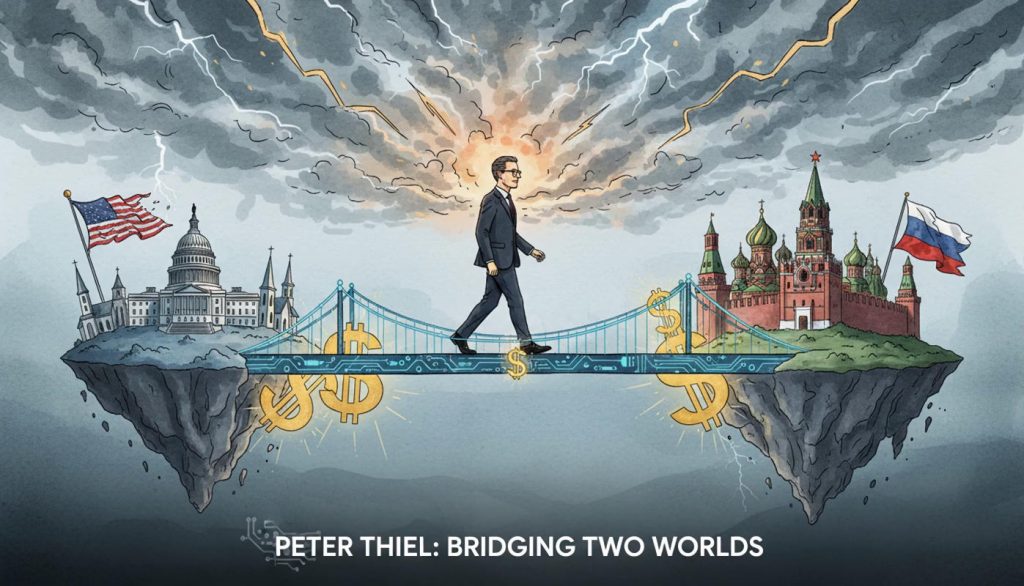
Peter Thiel bridges the gap between American eschatologists and those of the Kremlin. Dugin recounted how this figure caught his attention: “I was hesitant about him, even though I had advised keeping a close eye on [him]. Thiel himself, directly or indirectly, joined the discussion, raising themes characteristic of our school of thought: the reign of the Antichrist, the end times, the Katechon3, the existence of the soul, the role of liberalism and the radical Enlightenment in general, regarded as the devil’s ideology […]. Even before COVID, Thiel’s emissaries came to see me, proposing to initiate a major dialogue on the geopolitics of the future, the role of land and sea, oil and gas, spirit and matter. I realized that he held significant stakes in one of our major commercial banks. He was interested in Eurasianism and, curiously, in traditionalism and eschatology… Since I could not be invited to the United States due to sanctions, Thiel promised to come to Russia, but the COVID-19 pandemic, the Cold War, and Trump’s election campaign […] turned everything upside down. The dialogue was postponed indefinitely”.
Dugin’s influence on Thiel is obvious: the same rejection of liberal globalism that Thiel equates with the Antichrist, in a very Dugin-esque style. The same underlying nihilism, disguised as an obsession with the Apocalypse. Finally, the same desire to ideologically subvert Europe by attacking the foundations upon which European civilization rests: humanism, universalism, and the Enlightenment. In January–March 2026, Peter Thiel embarked on what was called an “Armageddon tour” in Europe. In France, he was welcomed on January 26, 2026, by the Academy of Moral and Political Sciences. The Vatican showed more wisdom. The University of St. Thomas Aquinas made it known in a terse statement that Peter Thiel’s seminar could not be held within its walls. In Rome, the profound stakes of Thiel’s endeavor were understood. As historian Alberto Melloni asserts, if Rome remains faithful to its constitutive universalism, it is one of the adversaries to be defeated. Thiel had “the ambition to impose on the Church of Rome a theological regime change.”It would have been blasphemous to welcome him to the University of St. Thomas Aquinas, given that St. Thomas teaches that “truth is the correspondence of the thing and the intellect” and that the Good is “that toward which all things tend.”
Françoise Thom
[*] Reprinted with kind permission of Françoise Thom & DeskRussia
Footnotes
[01] 151 d
[02] The New York Times, September 12, 1970
[03] Editor’s note: The return of Christ to earth, the parousia, will not occur until the katechon, that figure “who restrains” the unleashing of evil, is effectively at work. This is what the Apostle Paul affirms in his Second Epistle to the Thessalonians.
Decryption
Françoise Thom explores a disturbing convergence between radical wings of American power and the Kremlin’s mystical imperialism: the grip of eschatology (end-times doctrine) on geopolitics. In the U.S., Evangelical “dispensationalism” and Christian Zionism push toward an apocalyptic clash in the Middle East to hasten Christ’s return. Mirroring this, Alexander Dugin theorizes an alliance between Russian Orthodoxy and Iranian Shiism, united in a “lesser jihad” against the liberal Antichrist. The analysis reveals how these millenarian visions remove conflicts from the realm of reason, transforming them into insoluble metaphysical struggles. Whether through theology or nuclear threats (the “secularization” of the apocalypse by Karaganov), this “politics of the worst” seeks to shatter the international order in favor of a purifying chaos, supported by nihilistic figures like Peter Thiel.

- « How Eschatology Wreaks Havoc in the United States and Russia » in Desk Russia (2026-0324)
- « США и Россия: разрушительная сила эсхатологии » — (2026-0322)
- « USA und Russland: Die verheerenden Auswirkungen der Eschatologie » — (2026-0322)
- « États-Unis et Russie : les ravages de l’eschatologie » in Desk Russie — (2026-0322)
- « The Epstein Case, a Godsend for Russian Propaganda » in Desk Russia — (2026-0303)
- « Der Fall Epstein: Ein Glücksfall für die russische Propaganda » — (2026-0301)
- « Дело Эпштейна: находка для российской пропаганды » — (2026-0301)
- « L’affaire Epstein, une aubaine pour la propagande russe » in Desk Russie — (2026-0301)
- « La lutte finale du président Poutine » in Desk Russie — (2026-0131)
- « President Putin’s Final Battle » in Desk Russia — (2026-0202)
- « Der letzte Kampf von Präsident Putin » — (2026-0131)
- « Последняя битва президента Путина » — (2026-0131)

Desk Russia would like to remind you that Françoise Thom will be presenting a series of five lectures titled “The Kremlin’s Instruments and Methods of Power Projection: From Lenin to Putin” as part of the Alain Besançon Open University. For more details and to register (in person).