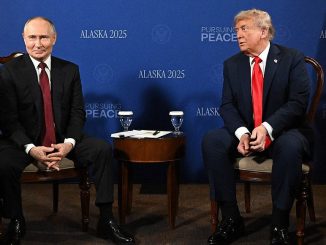

There are mirror effects that history holds up to us, which we would prefer to ignore. Between Vladimir Putin’s chilling speech in February 2022 and Donald Trump’s thunderous address in January 2026 regarding Venezuela, there is no moral equivalence, but a disturbing operational symmetry.

In this incisive text, Jérôme Denariez does not linger on the froth of ideologies. He descends into the engine room to decipher a shared “grammar of power.” On one side, the “Russian World”; on the other, the “Donroe” doctrine. Two sides of the same coin where international law is no longer a limit but a vocabulary, where the economy is a weapon of conquest, and where the sovereignty of others becomes an adjustment variable.
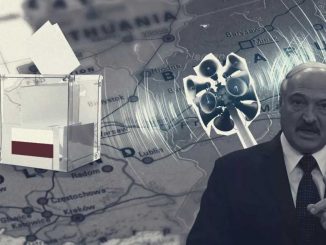
Illustration © European-Security
Faced with this return of the imperial repressed, a question haunts the analysis: how long can Europe remain on the balcony of History, commenting on the spectacle of its own powerlessness?
Two Speeches, One Grammar of Power, and Europe on the Balcony
Table of Contents
By Jérôme Denariez — Paris, January 5, 2026.
Introduction
There are texts whose value lies less in what they describe than in how they force us to reread the world. On February 21, 2022, Vladimir Putin spoke before the tipping point. In early January 2026, Donald Trump comments on the operation in Venezuela as announced, claiming capture, transition under guardianship, and the return of hydrocarbon production for the benefit of all, he says—primarily for the Venezuelan people. In both cases, the interesting point is not the emphasis. It is the mechanics.
We are facing a rhetoric that is becoming classical again, in the rawest sense of the term. Force is not a deviation; it is becoming a variable again. Law is not a guardrail; it is becoming a vocabulary again. The economy is not a consequence; it is becoming an objective again. And the domestic front—political, social, symbolic—is not background noise. It is becoming the engine again.
The following exercise is not a “moral” parallel between two leaders. It is a comparative analysis of two discourses of power. Two ways of explaining, authorizing, and normalizing a shift. Two ways of telling the world that we are no longer playing within the same regime of constraints. And the same European question, returning like a boomerang: What do we do when the system starts turning again without asking for our opinion?
A Point on Method
Comparing speeches does not mean pretending everything is equal. It is about identifying invariants, figures, sequences, and voluntary blind spots. It is a Strategic Intelligence reading in the operational sense—less academic, more useful. We look at the construction of the narrative as an instrument. We look at what the narrative makes possible.
Re-inscribing the Act in a Long History
Putin, on February 21, 2022, unspooled a genealogy. He reconstructed a past to produce a future. Ukraine is not a neighbor; it is a historical anomaly. The Ukrainian state is not a sovereign reality; it is a construct, and therefore a contestation. The long view serves to downgrade the adversary. If the other is not fully legitimate, intervention becomes a “restoration.”

Trump proceeds differently but achieves the same effect. He summons the Monroe Doctrine, then asserts it is “outdated,” as if the era demanded an augmented version. And he almost renames it in passing—Donroe—as if renaming equaled reactivation. The effect is clear. We are no longer talking about influence; we are talking about primacy. We are no longer talking about neighborhood; we are talking about the hemisphere. We are no longer talking about balance; we are talking about assumed domination.
In both cases, long history is a framing weapon. It serves to move the act from the realm of choice to the realm of necessity.
Transforming Aggression into an Act of Justice
Putin piles up arguments that, end to end, are meant to make the unacceptable acceptable. He does not “take”; he “protects.” He does not “conquer”; he “preempts.” He does not destroy an order; he “corrects” a drift. Above all, he places the action within a logic of existential security. He links security and economic space, inscribing the crisis in a logic of reconquering sovereignty. In reality, he lays his hand on the richest part of Ukraine, particularly mineral resources, and has not hesitated to loot Ukrainian granaries. But the speech does not speak of loot. It speaks of survival.
Trump performs the same register shift. The operation is described as an arrest, an act of justice, an “apprehension mission” in the military words cited. Maduro is an “outlaw dictator,” a “terrorist,” a kingpin. Venezuela’s sovereignty becomes secondary to a superior sovereignty—that of the United States and its citizens. The core of the sleight of hand is here: if the act is presented as an extension of justice, then the military act can claim legal respectability, even while breaking free from it.
This is not just communication. It is a neutralization technique. A portion of the Western public is used to thinking in terms of law and morality. Both speeches offer a bridge. We are not waging war. We are enforcing order.
International Law as Language, Not Constraint
This point deserves emphasis because it is central. International law has become a paradoxical object. Everyone claims it. Everyone cites it. Everyone brandishes it. But since it is not coercive, or rarely so, everyone tramples it when it suits them. This is not a revelation. It is a structural hypocrisy.
Putin, in 2022, plays with law by reconfiguring it. Recognition, treaties, “assistance,” self-determination invoked opportunistically. The law is a backdrop for legitimation, not a referee. The implicit message is brutal: If the balance of power is unfavorable, the law is merely a consolation. If the balance of power is favorable, the law becomes a tool.
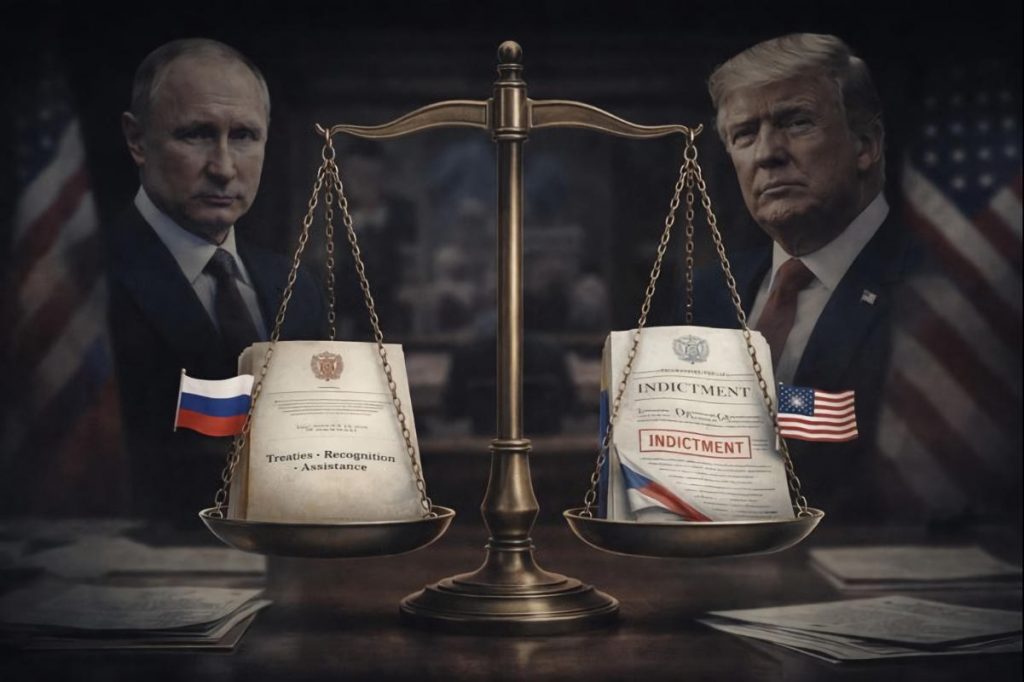
Trump, in this speech, does something similar but mirrored. He speaks of “indictment,” of American justice, of tribunals, of criminal liability. He claims total extraterritoriality. Then he announces an “administration” of the country until a “safe, proper, and judicious” transition. Here again, the law serves to dress up a trusteeship. International law itself is not discussed as a constraint. It appears at best as noise that is swept away by the rhetoric of protection, security, fighting crime, and regional stability.
For a European reader, the lesson is uncomfortable. International law remains a reference, but it is not enough. It is a grammar, not a lock.
Sovereignty Becomes a Word of Variable Geometry
In both speeches, the other’s sovereignty is relativized. For Putin, Ukraine is presented as dependent, manipulated, captured by external forces. A captured sovereignty is no longer sovereignty, so intervention becomes “liberation,” “denazification” in other sequences, or the restoration of a historical space.
For Trump, Venezuela is described as an adversary base, a platform for narco-terro-rism, an exporter of gangs, a continental threat.
A sovereignty that “threatens” is no longer sovereignty, so intervention beco-mes prophylaxis. And when he invokes Monroe, then « Donroe », he installs a hierarchy. There is a sovereignty that counts more because it merges with the regional order.
This point also explains the ease with which both speeches shift toward administration.
Jérome Denariez — Photo © All Rights Reserved

Putin speaks of reorganization, security, borders. Trump speaks of “running the country.” They do not settle for a military objective. They claim a capacity to govern.
The Economy Is No Longer a Secondary Subject; It Is at the Center
We can discuss justifications endlessly. The result, however, is economic.
Putin links security and economy by naturalizing the idea that a viable political space is also a controlled economic space. The sovereignty he claims is also a sovereignty over flows, resources, infrastructure. And the facts, once the war began, showed a direct interest in the richest zones, access points, industrial capacities, mineral resources, and harvests. This is not a “detail” of war. It is a logic.
Trump, in his sequence, does almost the reverse. He states the economy frontally. Venezuela is under-exploited. It is poor because it does not produce. It will become rich again because we are going to produce. And the announced tool is the American majors. They invest, they repair, they exploit, they reimburse themselves, they “recover the fruits,” and the American state presents this as a restoration of order and reparation, including as reimbursement for damages suffered.
The key strategic intelligence point is that the economy is not “after.” It is a legitimation engine. It serves to make the trusteeship acceptable. Future prosperity is promised to make present dispossession bearable.
Domestic Pressure as Fuel
We too often forget this point, because it is less noble and more determinant. Both leaders speak to the world, but they speak primarily to the home front.
Putin, in 2022, needs to lock down a narrative. He needs to position himself as a historical guarantor, a restorer of order, a protector. He needs to make escalation inevitable, thus non-negotiable. In a political system where opposition is neutralized, domestic pressure is not electoral in the Western sense. It is linked to legitimacy, regime coherence, the loyalty of the apparatus, and mobilization.
Trump operates in a media democracy where victory is also measured in images, in rhythm, in the capacity to dictate the agenda. He needs victories. He needs demonstrations. He needs a narrative of competence, strength, and success, especially when he insists on past humiliations and the return of respect. Military hyperbole is a tool of domestic policy. When he explains that no equipment was lost, that no soldier was killed, that it is operational perfection, he feeds a promise. That of a strong, effective state that acts.
This is not a psychological detail. It is a strategic mechanism. Domestic politics often dictates the calendar, the tone, the choice of targets, and the level of acceptable risk.
The Domino Effect as Horizon, and Empire Logic as Language
Putin does not hide a zonal ambition. The February 2022 speech is not just about Ukraine. It is about a regional architecture. About a “Russian World.” About strategic depth. About nostalgia for empire or the USSR, depending on the reading. The operational point is simple. Ukraine is a door, a lock, a signal. And the signal is also aimed beyond.
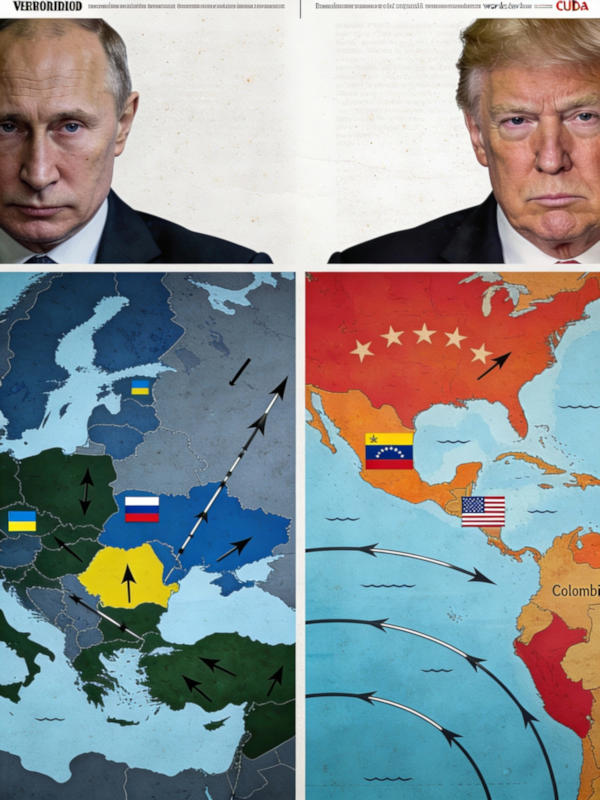
Trump, in his sequence, installs a hemispheric logic. He speaks of Venezuela, but he widens the scope. He mentions Cuba. He mentions Colombia, even in a brutal and casual mode. And he implicitly inscribes the whole thing in a project of ideological and geopolitical reordering. We have Argentina as a reference for possible alignment, Cuba as a “case” to be handled, and a narrative of regional stabilization where Mexico and Colombia can become political—if not military—targets through pressure, sanctions, conditionality, or international police operations.
There is a system coherence here. The objective is not just to neutralize an adversary. It is to reconfigure an environment. And the environment is not a concept. It is a set of roads, flows, diasporas, resources, energy dependencies. Cuba, dependent on Venezuelan oil, mechanically becomes more fragile if Caracas changes hands. The domino is not just ideological. It is energy-based and logistical.
The Staging of Competence as a Deterrent Weapon
Both speeches insist on mastery. With Putin, it is less technical, more historical. He says “I understand,” “I see,” “I know,” “I foresee.” He seeks to appear as the one who has read the West, who anticipates its reactions, who is not impressed.
With Trump, competence is staged as spectacular. There is the vocabulary of precision, of “flawless,” of total control. There is the display of assets—air, sea, land, intelligence. And above all, there is a phrase that counts beyond the scenery: “This must serve as a warning.” This is not a comment. It is a doctrine of strategic communication. Here too, the message is double. Externally, we deter. Internally, we unite. We show that the State can, therefore it must.
The Breaking Point Between the Two: The Geography of the Narrative
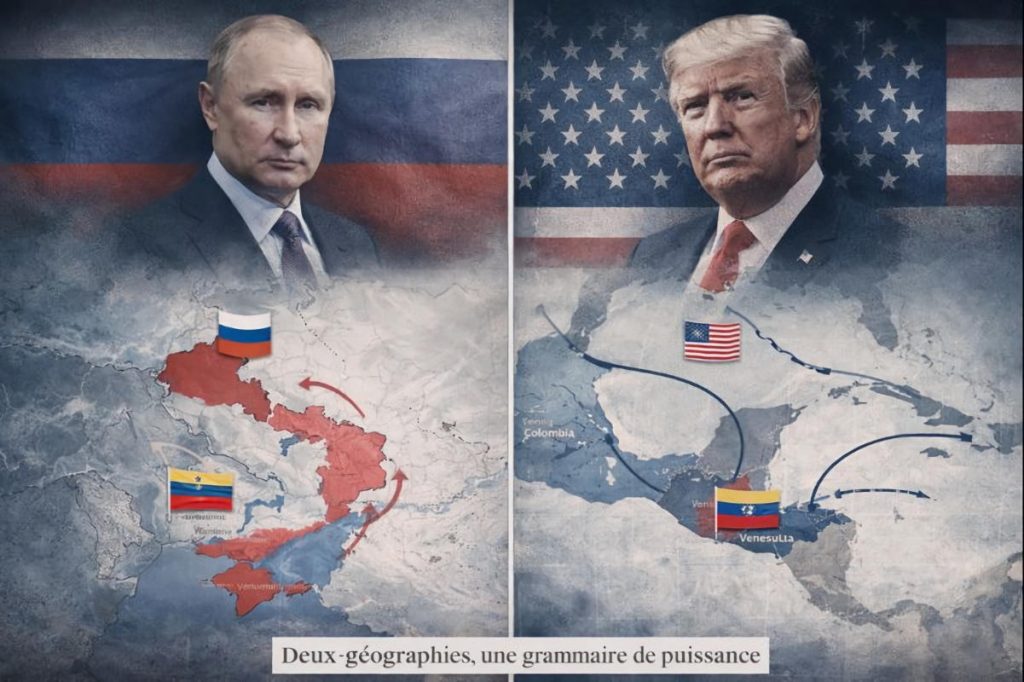
The major difference, and it is structural, lies in the moral geography each speech constructs.
Putin constructs a terrestrial depth. Borders, peoples, history, continuity, buffer zones (glacis), security. He subscribes to a continental logic where physical proximity and perceived encirclement determine the strategic obsession.

Trump constructs an inland sea. A hemisphere to “hold,” routes, flows, ports, coasts, cartels, migrations, sanctions, energy resources. It is a maritime and police logic, but presented as civilizational. We find Monroe, thus the idea that the hemisphere is a reserved space. And with Donroe, we take it a step further. It is no longer the prevention of European interference. It is the affirmation of indisputable American domination.
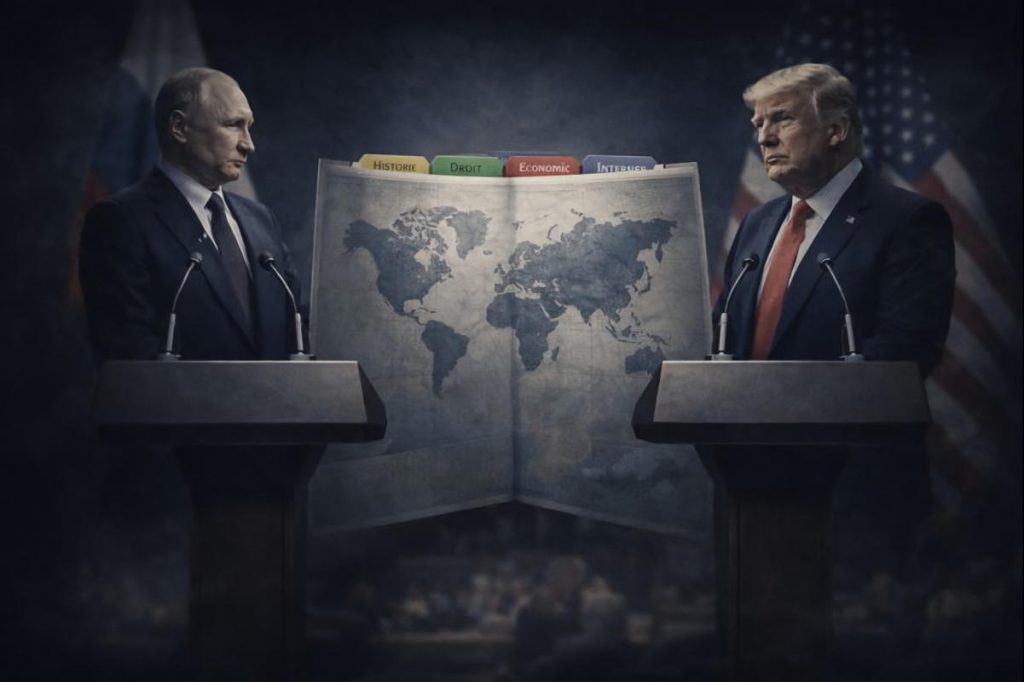
In other words, we do not just have two temperaments. We have two strategic geographies. Two ways of converting the world into a legitimate theater of operations.
What This Says About the Era: The Return of Power Strategies, Unvarnished
The lesson, if we agree to look coldly, is that power strategies are not “back” as an anomaly. They are becoming the backbone again. They simply take on different guises, adapted to their audiences.
In this framework, international law is a language, often useful, but rarely coercive. Sovereignty is a proclaimed value, but modular. The economy is a legitimation engine. Domestic pressure is an accelerator. And the domino effect is a way of thinking about regional order.

What these two speeches reveal is a world where the actors who count no longer apologize. They announce. They warn. They administer.
European Conclusion: Spectators or Actors?
For Europe, the conclusion is uncomfortable because it is simple. We are spectators in a world where power strategies are back. The question is not to lament. The question is whether Europe will wake up.
Waking up does not mean aping empires. It means regaining a capacity for action consistent with our interests. It means relearning to think in terms of power balances, dependencies, vulnerabilities, influence, and options. It means ceasing to believe that law alone suffices to stabilize a system when the major players have decided to play differently.
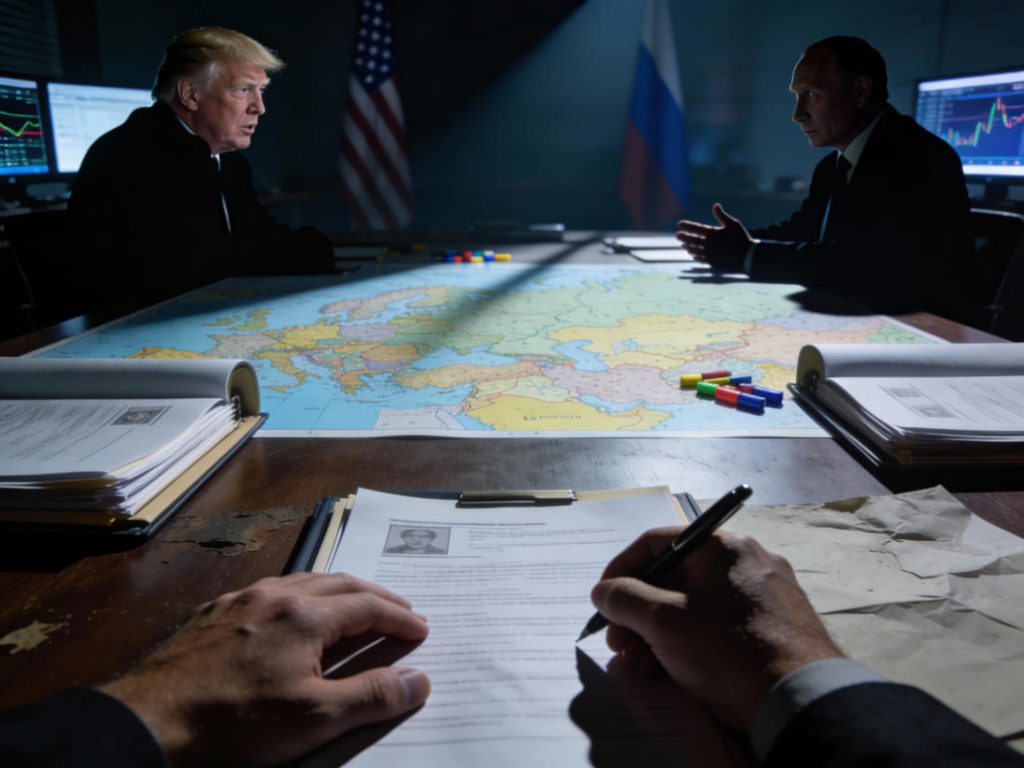
If we want to avoid permanent humiliation, we must first accept a diagnosis. One does not obtain a place in the world through the purity of principles. One obtains it through a combination. Economic power, technological autonomy, energy resilience, political cohesion, credible military capacity, and above all, will. Without this, we will commentate. The others will decide.
And in the coming world, commenting will not be neutral. It will be choosing not to choose.
Jérôme Denariez
See also:
- « Donroe » contre « monde russe » — (2026-0106)
- « Donroe » vs. « Russian World » — (2026-0106)
- „Donroe“ gegen „Russische Welt“ — (2026-0106)
Decryption: The Twilight of the “Madmen” and the Dawn of the Predators
By juxtaposing Jérôme Denariez’s cold analysis and this account of the Venezuelan trap, one conclusion forces itself upon us: the “monopoly on madness” has changed camps. Donald Trump has not only devalued Vladimir Putin; he has rendered the diplomatic software of the 20th century obsolete. We are entering the era of “unapologetic predation” where international law is nothing more than background noise for diplomats in need of symposiums, and where the economy is no longer the fruit of peace, but the spoils of war.
This “Useful Chaos” reveals a profound mutation: unpredictability has become the West’s heavy weaponry. By transforming Russia into an assisted regional power and securing the Venezuelan oil vault, Trump is not just doing real estate business. He is cleaning up his rear before the true confrontation of the century: the face-off with China. Venezuela was just an appetizer; the goal is to arrive facing Beijing with a low barrel price and a neutralized Russia.
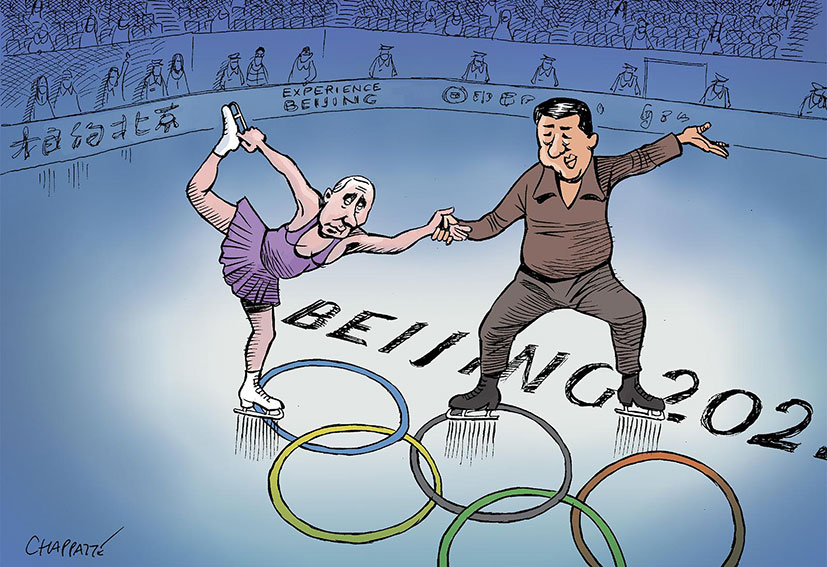
For Europe, the warning is existential. We have stayed on the balcony too long, convinced that our legal politeness was enough to stem the world’s violence. The “Donroe” doctrine signals the end of playtime. If Europe persists in commentating on the match instead of playing in it, it will end up as the ball. The time for “Tea Time” on the volcano is over; we are going to have to learn to walk on lava.