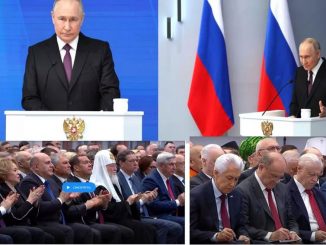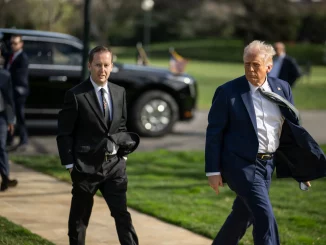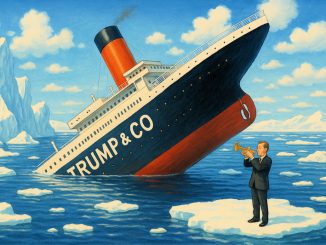
The new National Security Strategy made public by the White House does not merely record a strategic rupture; it materializes the worst nightmare of European chancelleries: the cold and calculated betrayal of their historic ally.
Donald Trump’s America is not simply withdrawing from Europe; it is establishing a mafia-like logic of state racketeering, demanding that its vassals continue to play the cash cow to the tune of 5% of their GDP, while stripping them of any real security guarantee. In doing so, the occupant of the White House fulfills beyond all expectations the wishes of Vladimir Putin, his new de facto partner, with whom he now intends to carve up the international order to transform geopolitics into a vast money-making machine, free from all legality and morality.[02]
Between two staged scenes of a presidency transformed into a reality TV studio and grotesque talking points about his alleged concern for “saving lives,” Trump insults the intelligence of the free world. If he dreams of recognition, let him be content with a football trophy invented for his ego, for the only title he truly deserves—the Nobel Prize for Betrayal—unfortunately does not exist. The only unknown now remains the backbone of the U.S. Congress: will it have the courage to stop this madness, or will it choose, as in 1919 by rejecting the Treaty of Versailles, to roll over shamefully, thus paving the road to a new global conflagration that would bring misery to humanity?[16]
Faced with this moral shipwreck, History now waits to see which European leader will finally have the courage to stand up and say no to this buffoon who, in his narcissistic delusion, takes himself for America’s savior when he is nothing but a caricature of it.
Table of Contents
by Joël-François Dumont — Paris, December 5, 2025
Introduction: The End of the American Atlas
This document, dated November 2025, marks a radical break with traditional American diplomatic doctrine since 1945. It officializes the end of a geopolitical order and the definitive rupture of the transatlantic bond as we know it. Far from being a simple strategic realignment, this new National Security Strategy enacts the ideological and moral divorce between Washington and the Old Continent, replacing value-based alliances with a strictly transactional approach summarized by the slogan “America First.”[01]

The Trump administration no longer seeks to lead the “Free World”; it announces that it will henceforth serve only its strict interests. The document lays down a clear principle: the United States will no longer hold up the world order at arm’s length. It is the end of the image of Atlas supporting the world: Washington now positions itself as an isolated superpower, treating its alliances as revocable commercial contracts.
I. Europe: Between Civilizational Scorn and Conditional Disengagement
The section dedicated to Europe, titled “Promoting European Greatness,” draws a severe, even apocalyptic, conclusion. The Trump administration portrays Europe no longer as an indispensable ally, but as an entity undergoing “civilizational erasure,” incapable of defending itself, and politically unstable.[02] This is no longer the language of a partner, but that of a court-appointed liquidator observing the bankruptcy of his associate.
The text introduces unprecedented mistrust regarding the reliability of NATO allies on a demographic and racial basis. It suggests it is “more than plausible” that certain member countries will become majority “non-European” in the coming decades, questioning their future alignment with the United States.[03] Consequently, Washington sets drastic conditions:
- Conditional NATO and the Unreachable Threshold: The United States demands via the “Hague Commitment” that allies now spend 5% of their GDP on defense,[04] a threshold unreachable for most current European economies. This resembles a pretext to justify withdrawal or make Article 5 optional.
- Alliance Reversal in Ukraine: The stated goal is not Kyiv’s victory but a “speedy cessation of hostilities” to reestablish “strategic stability with Russia.” The document openly criticizes the “unrealistic” expectations of European leaders and minimizes the Russian existential threat to Eastern Europe.[05]
- Political Interference: The administration declares its intent to “cultivate resistance” to Europe’s current trajectory and support “patriotic” opposition parties against governments deemed unstable.[06]
II. Asia and Taiwan: The Primacy of the Economy and Pragmatic Deterrence
In Asia, the strategy is dominated by economic competition with China, described as a peer that has abused the opening of American markets. Military security is envisioned there as a tool serving U.S. economic prosperity:
- Taiwan and Semiconductors: The island is deemed a priority mainly for its dominance in semiconductor production and its strategic geographic position locking the “First Island Chain.”[07] The United States maintains its status quo policy but insists on a drastic increase in Taiwanese defense spending.[08]
- Japan and South Korea: As with NATO, the document demands increased burden-sharing. Washington asks its Asian allies not only to spend more but to grant the U.S. military expanded access to their ports and facilities to lock down the South China Sea.[09]
- Total Economic Warfare: The goal is to rebalance trade and prevent China from dominating critical supply chains, using tariffs and forcing allies to align with American standards.[10]
III. The Middle East: From Gendarme to Traveling Salesman
The section dedicated to the Middle East marks the end of the Carter Doctrine. The Trump administration operates a strategic downgrading of the region, considered no longer as a vital heart, but as a market and a zone to be stabilized at minimal cost.[11]
- Disengagement and Energy Independence: The document asserts that American energy independence renders massive presence for oil obsolete. The region must no longer be a “constant irritant.”[12]
- The “Dictator Doctrine”: It is the end of moral lessons. Washington accepts leaders “as they are” and ceases pressuring Gulf monarchies for societal reforms.[13]
- Punitive and Technological Approach: The strategy favors violent, punctual strikes (such as the cited “Operation Midnight Hammer” against Iran) rather than long occupations.[14] The objective is now to sell American technology (AI, nuclear) to Gulf countries to counter Chinese influence.[15]
In light of this moral shipwreck, history now waits to see which European leader will finally muster the courage to stand up and say no to this jester who, in his narcissistic delusion, considers himself the savior of America, when in fact he is merely a caricature of it.
Joël-François Dumont
Sources:
[01] « National Security Strategy of the United States of America », The White House, Novembre 2025, p. 25.
[02] Ibid, p. 25.
[03] Ibid, p. 25.
[04] Ibid, p. 27.
[05] Ibid, p. 2 et p. 12.
[06] Ibid, p. 27.
[07] Ibid, p. 25.
[08] Ibid, p. 19.
[09] Ibid, p. 23.
[10] Ibid, p. 24.
[11] Ibid, p. 24.
[12] Ibid, p. 20-21.
[13] Ibid, p. 27.
[14] Ibid, p. 28.
[15] Ibid, p. 28.
[16] Ibid, p. 28.
Note: Page numbers refer to the PDF document “2025-National-Security-Strategy.pdf”.
See Also:
- « Towards the End of the Political West » — (2025-1205)
- « La nouvelle stratégie de sécurité nationale des États-Unis » — (2025-1205)
- « Auf dem Weg zum Ende des politischen Westens » — (2025-1205)
Decryption: Towards the End of the Political West
Beyond regional analysis, this document reveals three profound mutations that redefine global architecture for the coming decade and confirm the “betrayal” perceived by Europeans:
- From Protectorate to “State Mercenaryism”: Article 5 of NATO is emptied of its automatic substance to become a conditional commercial service. By setting the contribution threshold at 5% of GDP, Washington transforms the security guarantee into a permanent leverage of blackmail: protection is no longer an ally’s duty, but a luxury service.[04]
- The Shift to “Ethnic Realism”: By linking the future reliability of a NATO ally to its demographic composition (the fear of “majority non-European” countries), the White House reintroduces an identity-based dimension into international relations. It is the end of Western universalism as the cement of the Alliance.[03]
- The Active Fragmentation of the European Union: This document theorizes the bypassing of the EU. By supporting “patriotic” opposition movements, the United States favors a “divide and conquer” strategy, preferring to deal with isolated nations rather than a unified trade bloc.[06]