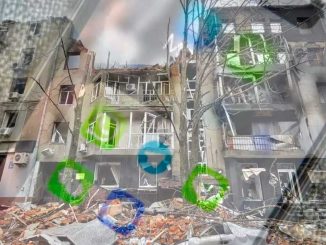
As historic negotiations between Lebanon and Israel open in Washington—the first of such magnitude in decades—hope is mingled with legitimate mistrust. While the announcement of a dialogue may offer a glimmer of hope for ending the population’s suffering, the profiles of the actors involved demand the utmost caution.
A Diplomatic Turning Point Under High Tension
Conducted under the aegis of the tandem formed by Donald Trump and Benjamin Netanyahu, these discussions seem driven more by power calculations than by a surge of diplomatic humanism.
In this theater of shadows, where strategic interests often override the rights of peoples, what can truly be expected for Lebanese sovereignty? It is in this shifting context that reading Levant Time becomes an indispensable compass to avoid getting lost in the pretenses of power. In this era of global shifting, reading Levant Time becomes an indispensable compass to avoid losing oneself in the pretenses of power.[01]
Table of Contents
by Joël-François Dumont — Paris, April 17, 2026
Lebanon in the Heart of the Turmoil: A Suspended Present
Today, Lebanon no longer merely dresses its wounds; it fights for its very breath, caught between systemic collapse and the deafening echoes of regional conflicts. The streets of Beirut, once vibrant with unparalleled creative energy, now bear the scars of a multidimensional crisis where uncertainty has become the only constant. Yet, beneath this leaden shroud, Lebanese resilience is no empty word: it is found in the refusal to forget and the fierce will to preserve a unique model of pluralism.

“Lebanon is ‘greater than itself,’ said Emmanuel Macron last March at the Arab World Institute. In fact, Lebanon is a stroke of genius of history that has made it the crucible of a way of life characterized by harmony between two major religious faiths that are antagonistic in many respects, but whose reconciliation, as it ultimately took place in Lebanon, has succeeded in becoming “a model of freedom and pluralism for the East and the West,” according to John Paul II.”[02]
Levant Time: A Window into Lebanon’s Soul
Levant Time has established itself as a high-quality window into Lebanon—a dream country unjustly condemned to endure successive nightmares. While the Lebanese state has seen its structures crumble, a flame remains intact: that of its independence. To understand this complex destiny, certain voices are essential. Alongside L’Orient-Le Jour, the analyses provided by Levant Time offer indispensable clarity. By sharing their publications, we invite you to discover a free and bold voice, essential for grasping the stakes of an Orient that refuses to be extinguished.
From the Cedars to the Levant: Decoding Dreams and Nightmares with Levant Time
Levant Timeis a gem in today’s media landscape. What makes it “exceptional” is not only the fact that it publishes in five languages, but also its rare ability to maintain an intellectual perspective while the subject (Lebanon and the Middle East) is often covered through the lens of raw emotion or tragic urgency. Let’s look at a few examples from its recent publications:
“Lebanon, Guardian of Hope” – By Fady Noun [03]
In Fady Noun’s writing, Lebanon is not merely a land of turmoil, but emerges as a spiritual and philosophical concept. The author invites us to look beyond the ruins to discover what, in the Lebanese soul, refuses to die: a unique ability to hold onto hope where everything else calls for resignation.

This article is a plea for pluralism and dignity, reminding us that the Land of the Cedars is a testing ground for the possibility of coexistence, even amidst the ashes. It is a profound reflection on resilience that transforms suffering into a moral strength, making Lebanon a beacon for those who refuse to succumb to darkness.
“Disaster as Image” – By Rita Barotta [04]
In this piece, Rita Barotta offers a striking analysis of how tragedy is perceived, consumed, and sometimes distorted by the world’s gaze. She explores the power of the image of disaster, not merely as a simple testimony, but as a language in its own right that challenges our relationship to reality and to the suffering of others.
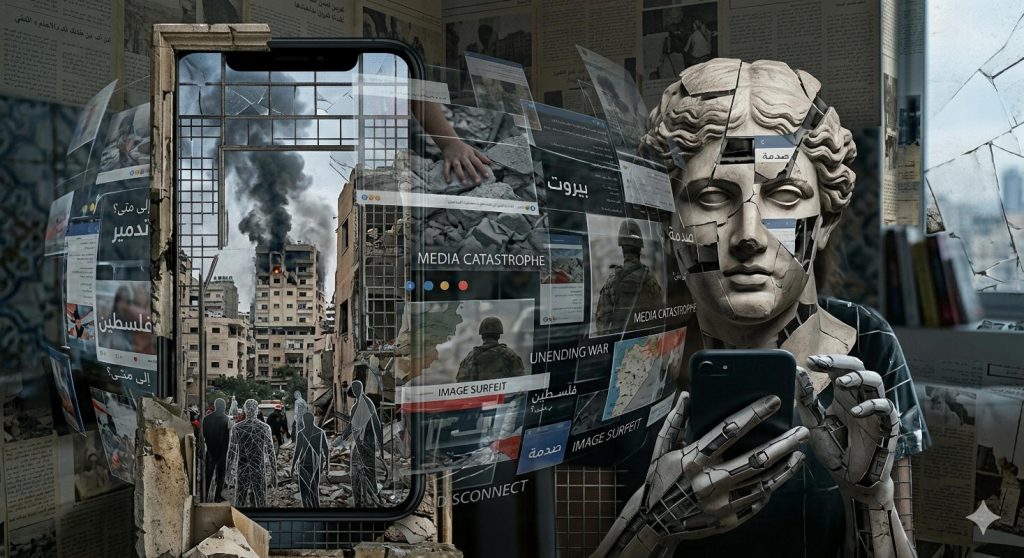
With surgical precision, the author dissects the aestheticization of suffering and the numbness that threatens our societies in the face of repeated trauma. It is a brilliant piece that reminds us that behind every cliché of distress lies a human truth that we must never reduce to a mere visual icon.
“The Forgotten Ones of the Iran War” – By Michel Touma

In this relentlessly rigorous editorial, Michel Touma breaks the silence on the long-term consequences of regional strategies and diplomatic laxity.
He delivers a lesson in geopolitics that rejects half-measures and expedient com-promises, highlighting the sacrifice of entire populations on the altar of an expansionist ideology.
To conclude this masterful analysis, the author offers two paragraphs of rare historical power:
Michel Touma [05] — Photo © DR
“The tragedy currently unfolding for the Iranian people and the peoples of the region is the direct result of the inexcusable leniency shown, for over 45 years, by certain Western leaders and circles in the face of the bellicose and expansionist strategy patiently put in place by the Islamic Revolutionary Guard Corps. Seeking to “compromise” with the remnants of a regime that remains steeped in a theocratic ideology from a bygone era, and seeking to revive such leniency toward such a regime, would amount to betraying the humanist and universal values championed and defended by the West.
During the final phase of World War II, there could be no question of considering a “settlement” with the survivors of the Nazi regime under the pretext of ending hostilities. It was imperative to completely eradicate the entire regime in order to prevent it from reemerging. Similarly, preserving the roots of the Khomeinist project would amount to breathing new life into it and condemning the countries of the region to suffer once again, in the not-too-distant future, the horrors of another destructive war whose economic repercussions would undoubtedly extend far beyond the narrow confines of the Middle East alone.”
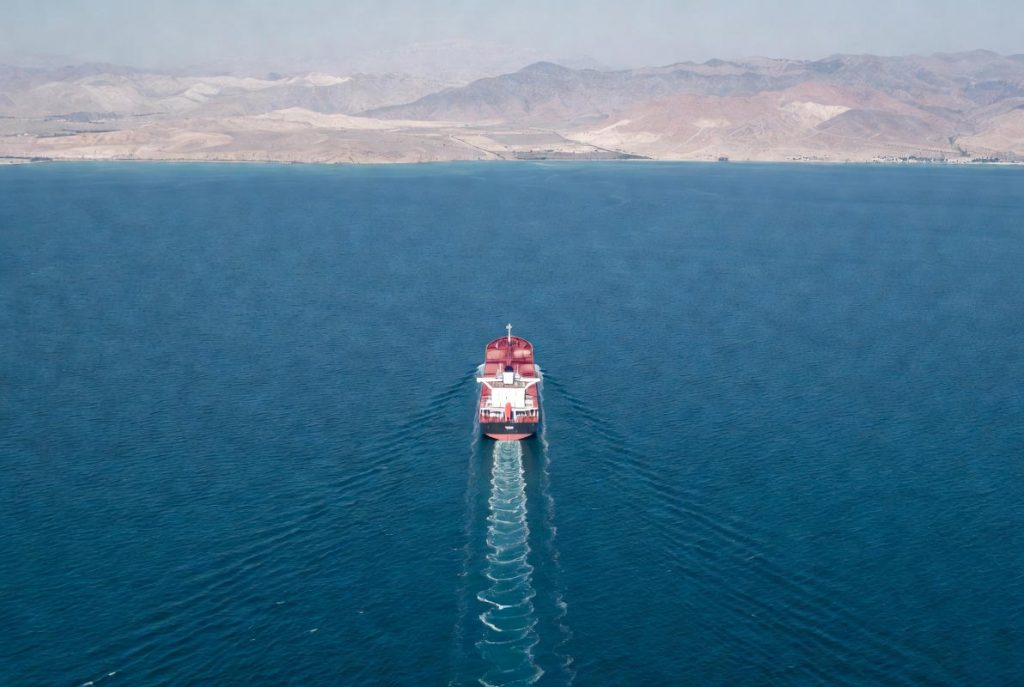
“The Strait of Hormuz and the Montego Bay Convention” by CA (2s) Jean-Patrick Dayras [06]
In this paper—one of the few to address international law on this matter, which should be sufficient to serve as an authoritative reference—Admiral Dayras emphasizes, in particular, that referring to the Iranian mullahs’ regime “reopening” the strategic Strait of Hormuz implies recognition of Iranian sovereignty over the strait, which constitutes a clear violation of the Montego Bay Convention. If this Convention is ignored, the author notes, all straits will then become tolled maritime passageways, which would inevitably cause global shipping costs to skyrocket.
“Wilayat al-Faqih: Khamenei or the Death of a Theological Fiction” [07]
Under the title “Wilayat al-Faqih: Khamenei or the Death of a Theological Fiction,” Michel Hajji Georgiou provides a historical and analytical overview of the origins of the politico-religious doctrine of wilayat al-faqih, established by Ayatollah Khomeini upon his rise to power in 1979. Michel Hajji Georgiou notes in particular that the wali el-faqih, who in Iran’s case is none other than the Supreme Leader of the Islamic Republic, represents the cornerstone of a theological-political construct unique in the history of Shi’ite Islam. The author emphasizes that to understand the structural fragility of the wilayat el-
faqih, one must go back well before Khomeini, more precisely to the 16th-century Safavid Empire and to the distinctly Persian idea of a royal authority tinged with divinity.
Joël-François Dumont
[01] Levant Time is an exceptional multilingual media platform dedicated to analyzing the geopolitical, security, and cultural issues of the Middle East. A true intellectual bridge between East and West, the site stands out for its rigorous editorial approach, which prioritizes in-depth analysis and freedom of expression, thereby offering an indispensable alternative to conventional news streams. Levant Time aims to provide in-depth coverage of current events across the entire Levant and Middle East region, going far beyond the situation in Lebanon alone to shed light on the geographical areas that have been shaking the region for decades.
[02] See “Lebanon, Guardian of Hope” by Fady Noun — (2026-0415)
[03] See “Disaster as Image” by Rita Barotta — (2026-)
[04] See “The Forgotten Ones of the Iran War” by Michel Touma — (2026-0407).
[05] Michel Touma, an iconic figure in Lebanese journalism and former editor-in-chief of L’Orient-Le Jour, is the CEO of the Levant Time platform. He founded this media outlet in late 2025 with a team of seasoned colleagues to uphold free, liberal, and independent speech in the Middle East. A true “gem of the web” broadcasting in five languages (French, English, Arabic, Spanish, and Portuguese), Levant Time now brings together the region’s finest writers to offer in-depth analysis to an international audience.
[06] See “The Strait of Hormuz and the Montego Bay Convention” by Rear Admiral Jean-Patrick Dayras, French Navy, a former naval aviator; specialist in air-sea operations and commando interventions and former expert with the International Maritime Organization (IMO).
[07] “Wilayat al-Faqih: Khamenei or the Death of a Theological Fiction” by Michel Hajji Georgiou.
See Also:
- « Le Liban au cœur du monde : Quand Levant Time éclaire l’horizon » — (2026-0417)
- « Lebanon at the Heart of the World: When Levant Time Illuminates the Horizon » — (2026-0417)
- « Libanon im Herzen der Welt: Wenn Levant Time den Horizont erhellt » — (2026-4017)
Decryption
The alliance between European-Security and Levant Time marks a turning point in modern geopolitical analysis. More than a partnership, this union merges European strategic depth with an insider’s grasp of the Levant. While Lebanon remains the pulse of this dialogue, Levant Time serves as a wide-angle lens on the entire Middle East. This collaboration delivers a no-nonsense breakdown, vetting facts through the filters of history and foresight. By bridging multilingual perspectives, we provide our listeners with a comprehensive and nuanced global framework. It is an invitation to look past immediate crises to grasp the underlying power shifts in a transforming region. We pull no punches, combining expert precision with a strategist’s long-term vision. This is the essential briefing for those looking to understand the forces reshaping our global landscape.
Descodificación
La alianza entre European-Security y Levant Time representa un hito en el análisis geopolítico actual. Más que una colaboración, esta unión fusiona la pericia estratégica europea con un conocimiento íntimo de la realidad del Levante. Aunque el Líbano sigue siendo el núcleo de esta reflexión, Levant Time se consolida como una ventana panorámica hacia todo el Medio Oriente. Esta asociación propone un desglose sin concesiones, donde los hechos se analizan bajo el rigor de la historia y la prospectiva. Al cruzar perspectivas bilingües y multiculturales, ofrecemos a nuestra audiencia una clave de lectura global y matizada. Es una invitación a mirar más allá de las crisis inmediatas para comprender los equilibrios profundos de una región en transformación. Hablamos claro y directo, con la precisión del experto y la visión del estratega. Una cita esencial para entender las fuerzas que moldean nuestro mundo.