A ceasefire has just been signed between the United States, Iran, and Israel around the Strait of Hormuz. It was supposed to end a crisis. Yet, almost immediately, it has become one of its main focal points. Negotiations are underway, while accusations of violating the terms of those negotiations are already flying. The reopening of a strait is announced, yet its transit conditions are still being debated. The strikes stop, but the war does not disappear—it simply changes its vocabulary.
Clausewitz famously stated that war is the continuation of politics by other means. Still, one must look at which politics are actually continuing: the politics of press releases, or the politics of stocks, flows, access, and thresholds that each actor silently defends.
A two-part analysis by Jérôme Denariez. In this first installment, Jérôme Denariez deciphers the sequence through an unprecedented framework: stocks, flows, access, and thresholds. He demonstrates why China, despite its apparent withdrawal, might emerge as the most decisive player.
Table of Contents
By Jérôme Denariez — Paris, July 2, 2026.
When War Continues Through Clauses, Thresholds, and Flows
This text is the first part of a diptych.
This week, I propose a reading framework: how to understand a sequence where a memorandum supposed to usher in a ceasefire almost immediately becomes an object of conflict; where parties negotiate while simultaneously accusing each other of violating the conditions of that negotiation; where strikes cease without the war truly disappearing.
Next week, we will return to the facts: the diplomatic sequence, China’s role, the negotiations around Hormuz, the anxiety of the Gulf States, the Lebanese agreement already contested by Hezbollah, the tensions between the Vance and Rubio lines, and the consequences for Israel, Iran, the United States, and Europe.
But before deciphering the events, we must lay out the map. Because this sequence cannot be read merely through air strikes, press releases, or official statements. It must be read through stocks, flows, access, and thresholds.
The Memorandum as an Object of Crisis
A memorandum is not a treaty. It is often a placeholder text, a provisional framework, a way of saying that parties have agreed to try to agree. Yet, the entire strangeness of the sequence unfolding between the United States, Iran, Israel, and the Strait of Hormuz lies precisely in this point: this memorandum is presented as a way out of the crisis, even as it already becomes one of the primary objects of the crisis itself.
A ceasefire is announced. Instantly, each side accuses the others of violating its conditions. Negotiations are discussed. Their existence, scope, or legitimacy are contested. It is claimed that the strait is reopened. Yet, the technical, legal, or financial conditions of its transit are already being debated. De-escalation is proclaimed. Yet, strikes, threats, and the testing of routes, proxies, and thresholds continue.

Clausewitz’s formula has lost none of its power: war is the continuation of politics by other means. But this sequence forces us to extend the formula. After the strikes, we must examine which politics are actually continuing—the ones articulated in press releases, or the ones that stocks, flows, access, and thresholds still make possible.
Contemporary warfare does not always end with a capitulation, an occupation, a treaty, or a stabilized front line. It can also shift into a more ambiguous object: a memorandum, a corridor, a deconfliction mechanism, an inspection, a reopening clause, a promise of withdrawal, a timeline, a frozen asset, or a maritime route.
Portrait of General Carl von Clausewitz by Karl Wilhelm Wach (1787-1831).
This is what makes this sequence so revealing. The United States has struck. Iran has not capitulated. Israel is not reassured. The Gulf States are demanding guarantees. Lebanon becomes a regional clause. Hormuz remains a critical passage, but also a lever. And China, which is not at the visible center of the stage, appears in almost all the dependencies that structure the background.
The memorandum, therefore, does not close the conflict. It reclassifies it.
It allows Donald Trump to claim a victory, markets to breathe, oil to recede, diplomats to speak of a framework, and stakeholders to buy time. But it also allows everyone to continue their own war under a less frontal vocabulary. Washington speaks of freedom of navigation. Tehran speaks of compliance with transit conditions. Israel speaks of a residual threat. Hezbollah speaks of resistance. The Gulf States speak of the security of flows. Oman and Qatar speak of mechanisms. China observes the dependencies.
The same text, therefore, does not mean the same thing to everyone. This is precisely why it becomes unstable.
Striking Is Not Concluding
In a classical military reading, power is measured by strikes, bases, missiles, aircraft carriers, intelligence systems, and alliances. These elements remain decisive. However, they are no longer sufficient to explain the resolution of a crisis.
A strike can destroy a site. It does not guarantee the normal resumption of a maritime flow. It can weaken an adversary. It does not necessarily eliminate their capacity to cause harm. It can produce a narrative of victory. It does not automatically transform that narrative into a political order.
Infographic © European-Security
This is the core ambiguity of the Iranian sequence. From the American perspective, the goal was to strike hard enough to restore credibility, but to exit quickly enough to avoid getting bogged down. From the Iranian perspective, the goal was to absorb enough of the blow to survive, while retaining enough levers to prevent the American victory from turning into a normalization without concessions. From the Israeli perspective, merely weakening Iran was not enough; the neutralization of the threat had to be made irreversible. Yet, that is not what a memorandum produces.
Therefore, the text organizes a transaction of thresholds rather than a peace.
For Trump, the threshold is largely economic and political: avoiding a lasting spike in oil prices, reassuring the markets, reopening Hormuz, showing that America has struck, and then transforming the de-escalation into a domestic achievement. The war is then read like a profit-and-loss operation: price per barrel, stock market indices, trade flows, Iranian assets, American purchases, and the narrative of victory.
For Iran, the threshold is entirely different: surviving the military shock without abandoning what still gives it strategic depth. Enrichment, stocks, proxies, Lebanon, Iraq, Hormuz, and the ability to make any normalization costly remain key levers. Tehran does not need to defeat the United States militarily. It only needs to demonstrate that the United States cannot, on their own, transform military superiority into an operational peace.
For Israel, the stake is more existential. A pause is not a neutralization. An inspection is not a destruction of capacity. A de-escalation is not a guarantee. Israel does not only look at what has been struck. It looks at what remains: nuclear material, expertise, rebuilding capacity, regional networks, Hezbollah, missiles, drones, and Lebanon. Where Washington might see a marketable exit from a crisis, Israel might see an uncompleted threat.
As for the Gulf States, they do not primarily read the sequence in terms of victory or defeat. They read it in terms of continuity. Their thresholds are those of terminals, insurance, routes, infrastructure, oil prices, American guarantees, and
Stocks, Flows, Access, Thresholds
This is where the framework becomes useful. War does not only reveal who can strike. It reveals who holds what must keep circulating, who possesses the critical stocks, who controls access, and who sets the thresholds not to be crossed.
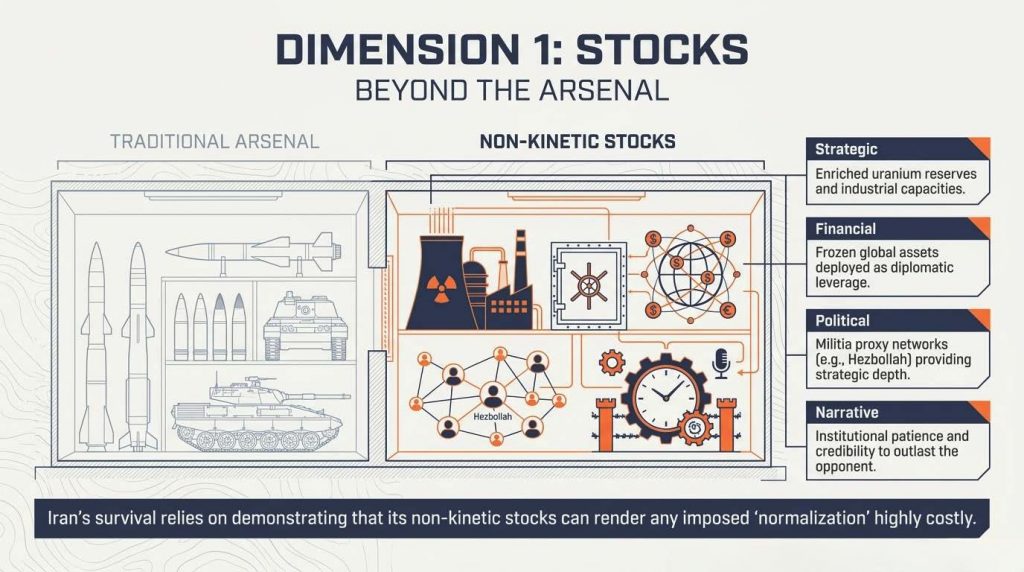
Stocks are not only military. They can be nuclear, energetic, financial, industrial, political, or narrative. Enriched uranium is a stock. Missiles and drones are stocks. Oil reserves, ammunition, frozen assets, industrial capacities, militia relays, political credibility, and the institutional patience of a country are also stocks.
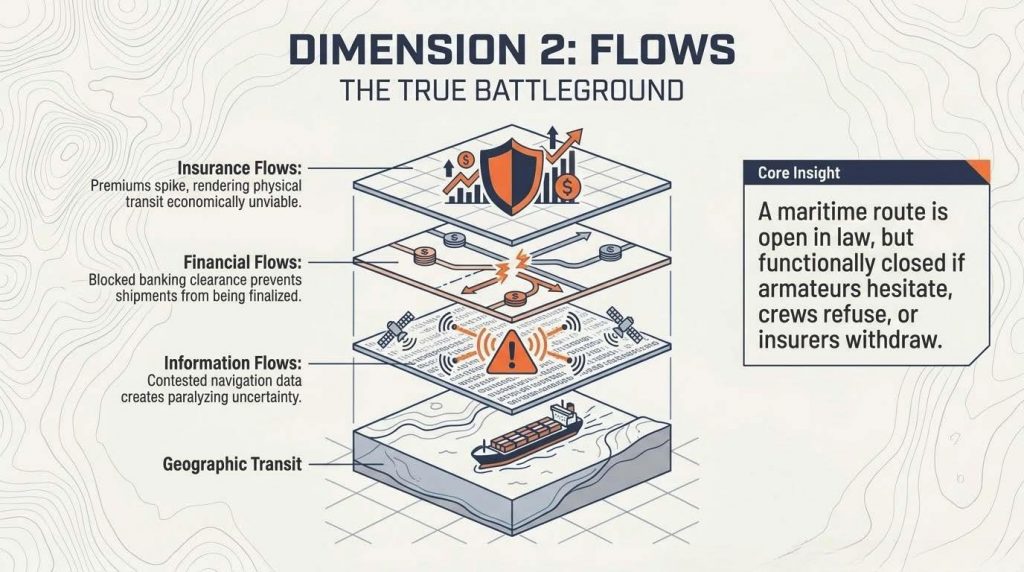
Flows are not only commercial. They are maritime, insurance-related, banking, diplomatic, informational, and energetic. A strait that is open by law can remain closed in practice if insurers hesitate, if shipowners slow down, if crews refuse, if routes become litigious, or if each passage requires some form of political validation.
Access is not only geographical. Hormuz is an access point. Inspections are an access point. Frozen assets are an access point. Critical technologies, bases, payment systems, markets, raw materials, AI models, and data are also becoming forms of access. What seemed available by default can suddenly become conditional.
Finally, thresholds are often more decisive than declarations. At what oil price does the U.S. administration consider the crisis domestically dangerous? At what level of strikes does Iran deem a response necessary? At what level of residual threat does Israel refuse de-escalation? At what point of risk do the Gulf States seek to speak directly with Tehran? At what moment does China consider that regional disorder threatens its own flows?
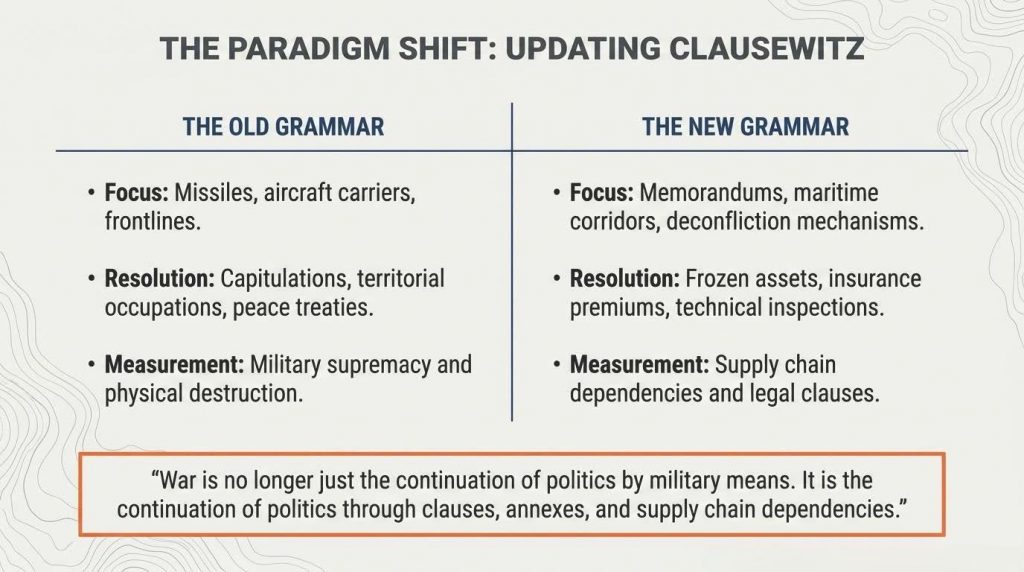
This grammar is less spectacular than that of air strikes. Yet, it is more durable. It tells us what a war leaves behind when the military noise subsides: capacities, constraints, dependencies, and conditions of circulation.
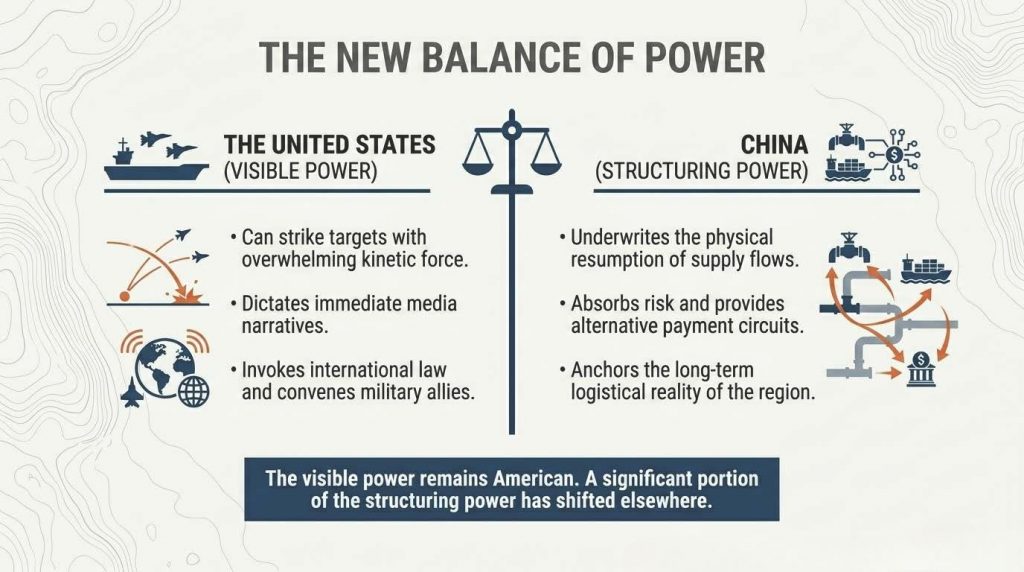
Visible Power versus Structuring Power — Infographic © European-Security
China Steps Out of the Background
It is within this framework that China emerges as a central actor, even when it remains in retreat.
This Chinese presence is not merely an afterthought or a hindsight reconstruction. It appears within the sequence itself. Prior to the signing of the memorandum, Donald Trump engaged in discussions with Xi Jinping regarding Hormuz and the Iranian conflict. The American president then claimed that Xi wanted the strait to remain open because China depends heavily on regional oil. A few days later, Trump would again thank Xi for remaining neutral, for not complicating the war by delivering heavy weapons to Iran, and even for likely contributing to the resolution of the crisis.
One must remain cautious: chronology alone does not establish causality. But it indicates at least one thing. When its energy and maritime interests become too exposed, China does not stay entirely in the shadows. It does not need to claim authorship of a text to weigh heavily on the conditions that make that text possible.
It is an anchoring power.
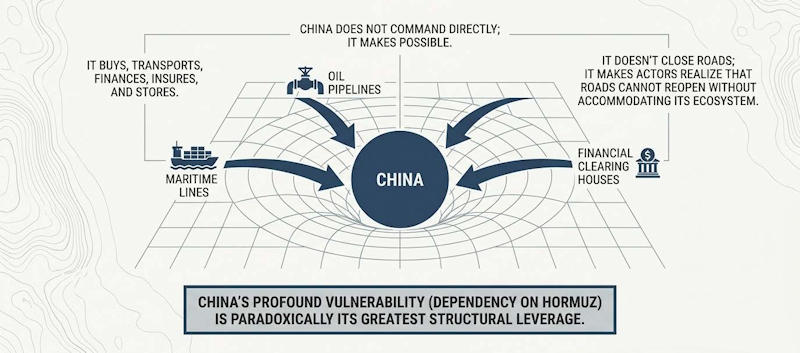
China, an Anchoring Power — Infographic © European-Security
China is not omnipotent. It is itself vulnerable because it depends on Hormuz, on maritime routes, on Gulf hydrocarbons, and on a baseline stability in global trade. However, this vulnerability becomes a lever as soon as everyone understands that the flow must be preserved. China does not necessarily control the strait; it is simply one of those actors without whom its sustainable reopening, financing, insurance, and normalization become significantly more difficult.
Therefore, it does not need to be at the center of the photo to be at the center of the sequence. It buys, transports, processes, finances, insures, produces, stocks, and bypasses. It depends on Hormuz, but Hormuz also depends on Chinese demand, on its capacity to absorb certain risks, on its relations with Iran, on its payment systems, on its shipowners, on its critical raw materials, and on its place in the real economy.
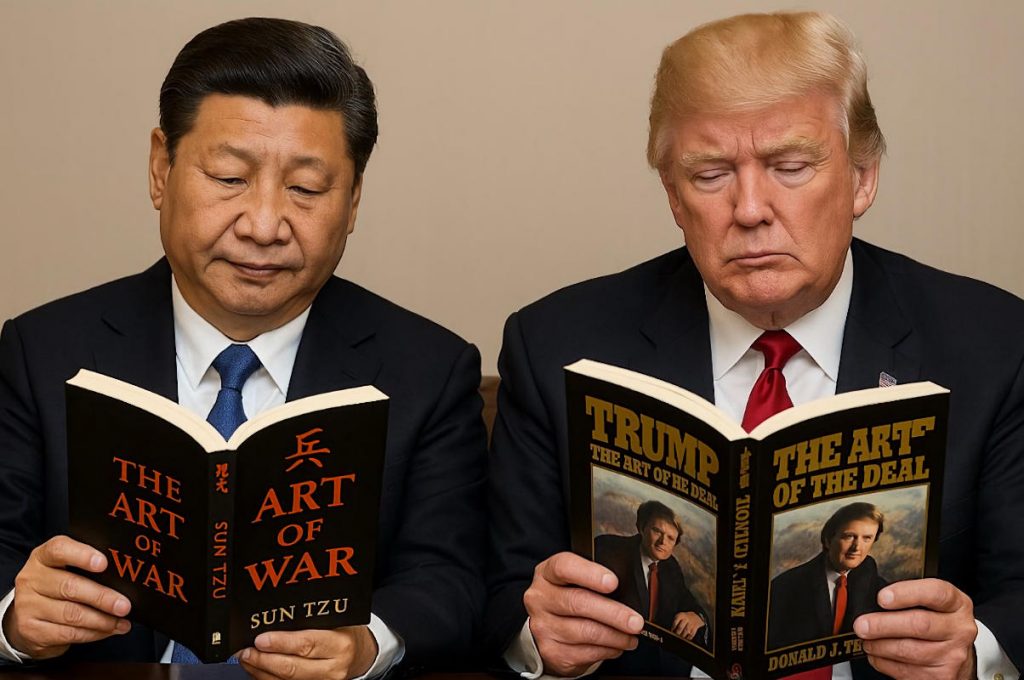
An anchoring power is not necessarily the one that proclaims peace. It is the one that becomes indispensable for the resumption of flows. It does not always command directly. It makes things practicable. It does not always sign. It sets conditions. It does not necessarily close a route. It can simply contribute to making it understood that this route cannot reopen without taking into account the ecosystem it structures.
In 1973, Alain Peyrefitte wrote: “When China awakens, the world will tremble.” Fifty years later, China no longer always needs to make the world tremble. Sometimes, it is enough to let everyone discover that they depend on its purchases, its routes, its critical raw materials, its industrial capacities, its arbitrations, and its silence.
This is perhaps one of the great lessons of this sequence. The United States can still strike. They can still dictate a portion of the narrative. They can still rally markets, allies, institutions, and international law. But they cannot, alone, normalize a strait, neutralize a nuclear capability, discipline proxies, reassure Israel, guarantee the Gulf, stabilize Lebanon, and prevent China from anchoring a portion of critical flows to its own interests.
Visible power remains American. A portion of structuring power is shifting elsewhere.
When War Enters the Annexes
The memorandum, therefore, does not settle the crisis. It reveals the thresholds beyond which each party temporarily agrees not to go any further. It does not only state what was achieved. It shows what was left undecided.
This is perhaps the most Clausewitzian lesson of the episode. War does not disappear when the strikes stop. It changes form. It enters the annexes, the corridors, the inspections, the insurances, the frozen assets, the maritime routes, the proxies, the resolutions, the press releases, and the deconfliction mechanisms.
We sometimes believe that an agreement puts an end to a war. It also happens that it organizes its continuation under an administrative vocabulary.
In such a world, power no longer consists merely in winning a battle. It consists in making others dependent on one’s conditions of circulation.
It is less spectacular than an air strike, but far more durable.
Jérôme Denariez
See Also:
- « Clausewitz à Ormuz : le mémorandum impossible » — (2026-0702)
- « Clausewitz at Hormuz: The Impossible Memorandum » — (2026-0702)
- « Clausewitz an der Straße von Hormus: Das unmögliche Memorandum » — (2026-0702)