
With surgical precision, Françoise Thom provides more than just a situational analysis; she offers an X-ray of a political monstrosity reaching its terminal stage. In this essay, Thom analyzes the imperialist and expansionist ideology of the Russian Empire, which persisted through the Soviet and post-Soviet eras. This messianic, expansionist, and militaristic drive, reaching its zenith under Putin, is inseparable from the doctrines of the Third Reich, further weaponized by the formidable political subversion techniques perfected by the Bolsheviks.
Total War, or the Logical Suicide of the Russian System
Françoise Thom dissects this implacable mechanics where the economy, minds, and culture are fully mobilized in the service of void and resentment. She sweeps away the illusions of those who still hope for diplomatic rationality: the Kremlin does not wage war for territorial gains, but to perpetuate a tyranny that can now only exist in a permanent state of exception.
This is indispensable and chilling reading to understand why, in the face of this totalitarian headlong rush, any compromise is nothing but a deadly delusion.

In this enlightening text, the historian demonstrates that an ideology inspired by theories popular in post-WWI Germany and under the Third Reich has been discreetly driving the trajectory of the Putin regime since its inception. This is, of course, the concept of total war. Françoise Thom warns us of the peril:
Europe is facing a conquering country under the sway of Third Reich doctrines, further armed with the formidable techniques of political subversion well-honed by the Bolsheviks.
This is indispensable and chilling reading to understand why, in the face of this totalitarian headlong rush, any compromise is nothing but a deadly delusion. (Editor’s Note)
Table of Contents
High-tech dehumanization and brutalization
by Françoise Thom in Desk Russia [*] — Paris, December 15, 2025
The return of forms of absolutism, yet without an aristocracy—I mean without internal distances—makes possible catastrophes whose scale still eludes our imagination. However, one can sense them… — Ernst Jünger, October 25, 1941 [01]
There are outrages that strike the world as a whole, in its structure and its reason for being; the man of the Muses, in turn, ceases to be able to devote himself to beauty; he must dedicate himself to freedom. — Ernst Jünger, November 30, 1941 [02]
The cruelty of modern times is unique in that it ceases to believe in something indestructible within man. — Gerhardt Nebel, February 2, 1942 [03]
An article published on February 11, 2019, signed by Vladislav Surkov—one of the architects of the Putinist system and an expert in orchestrating the aspirations of Kremlin leaders—merits our attention.

Surkov notes that the “new type of State” built in Russia is only in its infancy. Russia “has returned to its natural state, the only one possible for it: a great community of expanding peoples gathering lands.”
It is an openly “military-police” state following the continuity of the three successful models of the Russian State: those of Ivan III, Peter the Great, and Lenin. This “power machine has allowed the continuous rise of the Russian world for centuries.”
Vladislas Sourkov – Photo kremlin.ru
Thanks to the discredit of politics and the chaos within Western minds and societies, the Putin regime “has considerable export potential,” for it is the reign of force that speaks its name.
A short time later, Surkov revealed another side of the Kremlin’s ambitions. In a futuristic article published on October 11, 2021, titled “Desert Democracy and Other Political Wonders of 2121,” he asserts that parliamentary representation is no longer necessary since the population’s wishes can be communicated instantly via the Internet. In short, political representation should be relegated to the dustbin of history and replaced by algorithms. Only the IT specialists and the siloviki (security elites) will remain in control, directing the giants of Artificial Intelligence from behind the scenes. “The digitalization and robotization of the political system will result in the creation of a high-tech state and a democracy without men […] in which the hierarchy of machines and algorithms will pursue objectives beyond the understanding of the people who serve them.” Thus, AI seems to hold the promise of the final liquidation of freedom—the Putin regime’s dream from the very beginning.
The Two Faces of “Total War”
These two writings summarize a paradoxical aspect of the ideology crystallizing in Kremlin circles: a mixture of archaism and futuristic technicality, converging in a project of dehumanization. They also illustrate the reversal occurring around the central concept of “total war” in Putinist ideology.
Dugin, drawing on the theories of Carl Schmitt,—once the official jurist of the Nazi regime—attributed to “globalists” the project of a “new world order” leading to “total war,” and saw Russia as “a gigantic empire of resisters, acting outside the law but guided by the great intuition of the Earth, the Continent, that ‘Great, Very Great Space’ which is the historical territory of our people.”
Today, Russians no longer think of themselves as resisters warring against the liberal globalist order.
Aleksandr Dugin

They feel they have won the decisive battle: the reversal of American hegemony.
The conception of “total war” emerging in Putin’s Russia increasingly resembles a carbon copy of the one Ludendorff laid out in Der Totale Krieg, a bestseller published in 1935 (Russian ed. 1936).
The German general detailed the lessons he learned from the defeat of 1918.[04] The ideas developed by Ludendorff were “in the air” in 1920s-1930s Germany.


In 1930, Ernst Jünger published an essay, Total Mobilization, reflecting on the implications of WWI.
Jünger believed that the “close alliance” between “the genius of war and the spirit of progress” would cause everything in man “that was not a cog in the State” to disappear, including freedom. Man’s destiny was to be integrated into the colossal machinery of the State working for war.[05] And, ultimately, “military order imposes its model on the public order of the state of peace.”[06]


Ludendorff, who as early as 1916 advocated for the “enlistment of the entire people in the service of the war economy,” attributed the collapse of November 1918 to the betrayal of politicians (the “stab-in-the-back” legend) [in reality, the armistice was decided by the German high command, Ed. Note].
Putin and the KGB attribute the 1991 collapse of the USSR to the betrayal of certain CPSU leaders and political maneuvering within the Party under Gorbachev.
The convergence between Russian ideologues like Dugin and the thinkers of the German Conservative Revolution (1918–1932) is explained by similar conclusions drawn from a common experience: defeat and the chaos that followed. The German Conservative Revolution was anti-bourgeois, anti-democratic, and anti-liberal. It rejected Western humanism and held parliamentarism in contempt. What mattered was man’s capacity for sacrifice—a notion Russian Eurasianist ideologues express through the term “passionarnost.”
The ideology inspired by theories popular in post-war Germany and under the Third Reich has discreetly driven the trajectory of the Putin regime since its inception.
The obsession with unity embodied by the leader, the rejection of pluralism in all forms, the loathing of individualism, and the attraction to the “Total State” denote the influence of Nazi Germany’s jurists, whose ideas Dugin popularized.


Ernst Forsthoff, a jurist who joined the National Socialists, opposed the “Total State” to the “Liberal State,” which he criticized for being “minimized and annihilated by its fragmentation, due to legal guarantees determined by laws stemming from private interests.”[07] For him, only a State capable of controlling all elements of society could ensure the nation’s salvation.

In Carl Schmitt’s eyes, a truly total State is a strong State that “allows no force to arise within it that is hostile, hindering, or divisive”[08]—exactly the Putinist conception. The crucible of the Putin regime is war; let us not forget that.
It was the Second Chechen War that brought Putin to power, allowing Russian public opinion to be turned and channeled toward the great-power objectives of the Chekist camarilla installed at the top of the State by Putin.
Since this initial impulse, the Putin regime has gradually shed the democratic ornaments it tolerated in its early days, and its militaristic tropism has become increasingly assertive. Russia goes from war to war: Chechnya first, then Georgia, then Ukraine, the “collective West,” and finally Europe.
Starting in 2012, Putin broke the implicit contract made with Russians at the beginning of his reign: “You do not interfere in politics; I improve your standard of living.” Under the shock of the winter 2011–2012 protests, he set out to ruin the Russian middle class, which he found too rebellious. He pivoted toward a major confrontation with the West, which he now sees as his mission. Enormous sums were allocated to rearmament. Putin began to hoard in anticipation of future war—investments that were denied to the country’s civilian economy.

As political scientist Kirill Rogov pointed out, “one would search in vain for another leader capable of inflicting the damage Putin managed to deal to the Russian economy (which was doing quite well) in such a short time.” One gets the impression that the Russian president is following Ludendorff’s recommendations to the letter:
“Total policy must already in peacetime prepare to sustain this vital struggle of wartime.” The economy must be militarized starting in peacetime. Banking, industry, and agriculture must have only one goal: autarky and the production of war material. The State must have absolute control to guarantee that the army lacks nothing.
- Like Ludendorff, Putin considers the spiritual unity of the people (seelische Geschlossenheit, “cohesion of souls” in Ludendorff) essential.
- Like him, he worries that “military power” might be compromised by the “decline in births.”
- Like him, he believes in the influence of malevolent “occult powers” (the Jews and the Roman Church for Ludendorff). Steeped in social Darwinism like Ludendorff, Putin is incapable of imagining a compromise peace. He is convinced that war—this “earthquake testing the foundations of all buildings” (Jünger)—automatically grants victory to authoritarian regimes over liberal ones: cornering democracies into war is equivalent to forcing them to abandon their freedoms or perish.
In 2012, Putin therefore launched a policy of programmed impoverishment for Russians (excluding oligarchs). In his mind, the plummeting standard of living of his subjects can only benefit them because it will detach them from the deleterious influence of the West. Lenin had already understood this: an alternative reality is easier to impose on a miserable population obsessed with survival than on a prosperous people of citizens capable of holding power accountable. To top it off, Duma deputies have advanced the idea that the population’s impoverishment could help solve the demographic problem. For it is “well known” that “the higher the standard of living, the fewer children people have.”
On March 10, 2020, the Duma declared Putin’s previous terms annulled to allow him to be re-elected until 2036. The violation of the constitution heralded the violation of Ukraine. Propaganda began to trumpet that a great clash with the West was inevitable. Putin had lost all legitimacy, and his only option left was to transform himself into a war leader to justify his absolute power for life. For in the event of war, “the people must be ready to follow their leader, no matter where he goes, and to do everything to bring the war to a victorious end” (Ludendorff). Putin sees himself very much as a Feldherr, a war leader in the style of Ludendorff—very different from talkative politicians, accountable to no one, combining full political and military powers to ensure unity of command, and having the right to sacrifice an entire army or a province without having to justify himself before a parliament.
Planned Brutalization
Bernanos saw it coming: “Modern war, total war, works for the totalitarian State; it provides its human material. It forms a new species of men, softened and broken by the ordeal, resigned to not understanding—’not seeking to understand,’ as their famous saying goes—reasoners and skeptics in appearance, but terribly ill at ease in the freedoms of civil life which they have unlearned once and for all, and which they will never relearn again.”[09]
On February 24, 2022, when he launched his offensive against Ukraine, Putin certainly did not expect a long war. The unexpected resistance of the Ukrainians and their successes in 2022 were highly humiliating for the Russian army. But, as always, Putin recovered and pivoted toward a war of attrition. Russia is slowly drifting toward the practices of “War Communism.” To be sure, Putin has not forgotten that it was economic collapse that doomed the USSR. His support for technocrats trying to save the Russian economy, such as Elvira Nabiullina, the head of the Central Bank, shows that he has no desire to return to the inflation of the 1990s. But he is being sucked into the dynamic of total war because he sees it as a way to secure his power for life, even if it irresistibly pulls Russia back toward Bolshevik methods. Asset seizures and the redistribution of holdings have multiplied since 2022. Ration cards are reappearing; constraints on free pricing are increasing. The administration of the war effort is insidiously replacing civilian structures.
Putin has understood that over time, war acts on minds in the exact same direction as his propaganda: it instills a disgust for democracy and parliamentarism, a contempt for reason, cynicism, suspicion, a sense of helplessness, passivity, and an obsessive preoccupation with the immediate necessities of existence—food and sleep. It atrophies the moral sense and narrows intelligence. War is an operation of planned brutalization (ensauvagement), both in Russia and in Ukraine.[10]
Ukrainians are fighting for human dignity. The Russian army is one of the instruments through which the Russian regime brands out this feeling in those who encounter it. The last vestiges of morality are swept away, including the sense of family that the regime claims to defend against the decadent morals of the West. People are paid top dollar to sign up to kill people whom the propaganda otherwise presents as Russians. 99% of soldiers fight for money. Mothers push their sons to sign a contract with the Ministry of Defense and brag on television about the car that generous death benefits allowed them to acquire (the families of soldiers killed at the front receive compensation of 7 million rubles, about $75,000). Some encourage their friends to sign a contract to collect the 500,000-ruble referral bonus.
“Black widow” startups are appearing here and there. Enterprising pimps scour areas frequented by the homeless, seduce a drunkard with a bottle of vodka, lead him to the military recruitment office where he signs a contract, and then marry him to a woman in their network. Our man having been promptly killed in a “meat grinder” assault, the happy bride shares the millions in death benefits with her partner. Soldiers on the Pokrovsk front are left to their own devices, abandoned by their officers, without water or food, without warm clothing. Officers engage in the racketeering of their men, who are forced to pay them staggering sums to escape those meat grinder assaults. Those who have just signed a contract are fleeced from day one. “If you don’t pay, you die,” the officer tells them. Officers beat soldiers, seize the credit cards of the dead, and empty their accounts.[12] They extort bribes from the wounded by threatening to send them back to the front. Minor injuries can be certified as serious for a fee. Man is capable of anything for money: such is the main message of the Putinist gospel. Abroad, it is the Trump administration that is taking it upon itself to provide the proof.
De-Europeanization

In 1863, at the time of the Tsar’s repression of the Polish insurrection, when tensions with Europe threatened to escalate into armed conflict, the Slavophile Ivan Aksakov harbored the hope that war would make possible the return of old Russia by ridding it of the dross of Europeanization accumulated since Peter the Great. War is seen by Slavophiles as a means of Russianizing imperial power. In today’s Russia, war fulfills the same role.
Nationalist journalist Mikhail Demurin echoes the concerns of past Slavophiles when he points to the link between expansionist war, the autarkic ambition that has occupied Kremlin-aligned ideologues for years, and the thirst for internal purging: “The military operation that our country is conducting against the fascist regime that seized Kiev in 2014 is increasingly taking on the character of a political operation of internal cleansing. One by one, it bursts the abscesses that formed on Russia’s body thanks to the efforts of the West in the 1990s and which were not cleaned in the 2000s.”
Putin and the “turbo-patriots” welcome the fact that war allows for large-scale purging: “Every people, the Russian people especially, will always be able to recognize the scum and the traitors, and spit them out like one would spit out a fly that flew into one’s mouth… I am sure that such a real and necessary self-purification of society will only strengthen our country, our solidarity, our cohesion, and our ability to meet any challenge,” Putin declared on March 15, 2022. Deputy Alexander Borodai goes in the same direction. In the end, the important thing is not having conquered a few territories: “The essential thing is that our society has shaken itself up and purified itself.” War eliminates Europeanized populations from Russia through emigration and forms a new elite more to Putin’s taste, chosen from the veterans of the war in Ukraine—men hardened by unpunished crimes, ready for anything.

The Return of Terror
Ludendorff listed the measures to be taken to ensure national cohesion in wartime: “The most rigorous censorship of the press, the harshest laws against the betrayal of military secrets, the prohibition of meetings, the arrest of at least the leaders of the ‘discontented,’ the surveillance of railway traffic and radio.” The Kremlin leaders possess instruments of surveillance and control that our general could not have dreamed of. Thanks to technological progress, the State can tighten its grip on all areas of public life and erect a digital Gulag.
The so-called “spreading of false news” and “discrediting” of the armed forces are now punishable by prosecution. Laws targeting “foreign agents” have been tightened. Internet searches for “extremist content” are also subject to prosecution. Since December 2022, all companies collecting biometric data from citizens are required to transfer it to the State Unified Biometric System (EBS). The law does not prohibit law enforcement from accessing this data. Thus, a technological base is created for the widespread use of facial recognition systems, already actively employed to identify and arrest protest participants and “enemies of the State.”
Between 2025 and 2026, the Ministry of Digital Development plans to spend 2 billion rubles (over 20 million euros) to create a unified AI platform to process surveillance video across Russia. Another electronic system, the registry of persons subject to military service, aggregates personal data from other government databases and is enriched by information provided by employers and banks. A draftee is automatically banned from leaving the country and faces other restrictions, such as a ban on driving, until they report to the military commissariat. In August 2025, upon the launch of the State messaging service, MAX—to which law enforcement has full access—Roskomnadzor (the agency responsible for Internet censorship) blocked audio and video calls on Telegram and WhatsApp. Since 2024, the FSB has increased arrests of regime notables and, since 2025, has even gained the right to operate its own prisons, escaping the supervision of the Ministry of Justice.
“War Will Erase Everything” (Russian Proverb)
Putin seems to think18th Century French memorialist Manon Roland, that ”it is through the accumulation of crimes that impunity is ensured.” War allows for social engineering experiments that would be impossible in peacetime, for example, getting rid of human ballast. Here again, we see parallels with the ideology and practices of the Third Reich.
In October 1939, Adolf Hitler signed a document, backdated to September 1, 1939, which read as follows: ”Reichsleiter Bouhler and Dr. Brandt are charged with expanding the powers of some doctors to be named. These doctors will be able to grant a merciful death to patients who have been judged incurable according to the most rigorous assessment possible.”
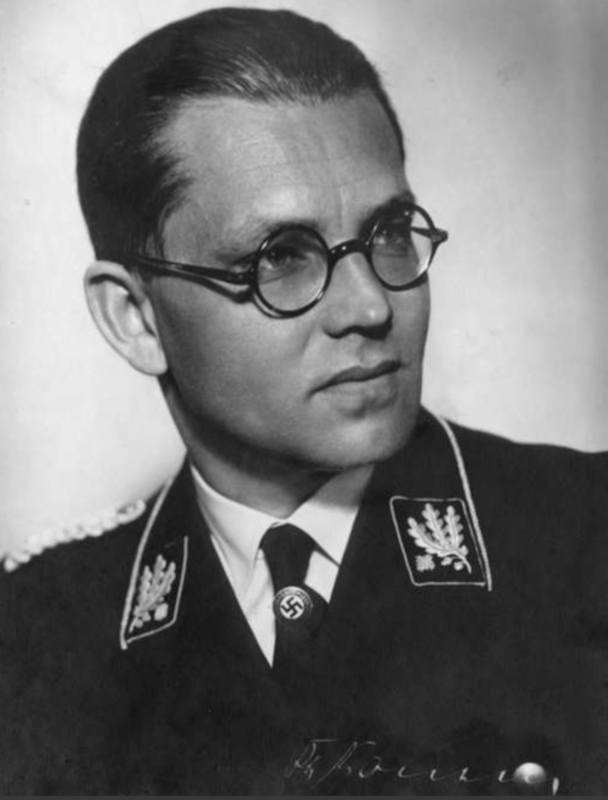
Approximately 300,000 mentally ill people and others with disabilities were murdered under the guise of “euthanasia” in the German Reich and the occupied territories. The aim was to ”purify the body of the people of those who are nothing but dead weight,” to rid it of “lives unworthy of being lived.”[13]
Reichsleiter Philipp Bouhler
— Photo Stiftung Topographie des Terrors
Putin, for his part, dispatches to “assault troops” a “rabble of alcoholics, drug addicts, criminals, the disabled… these people are sent into the meat grinder.” He shares the social Darwinist conception of Nazi ideologues: evidenced by his staggering remarks to soldiers’ mothers, explaining that without the war, their sons would likely have died of alcoholism or in an accident, whereas those who fell in Ukraine did not perish in vain. In short, the Russian president suggests he has done them a favor by liberating them from their “lives unworthy of life” (Lebensunwertes Leben). A fine conception of the Russian people for a man who constantly accuses Europeans of being “Russophobic”! The idea of raising the retirement age by 10 years follows the same logic: fewer useless mouths to feed. Furthermore, propagandist Mardan suggests abolishing pensions: “Those who had children will have something to live on in old age. The others can just die.” In Nazi Germany, writes French historian Johann Chapoutot, ”the procreation of children became a political imperative,” a Dienst am Führer “encouraged by the state and propaganda8.” The same is true in Putin’s Russia.
Putin also shows concern for what the Nazis called “racial hygiene,” as the government targets ethnic minorities and populations from the poorest regions in a disproportionate manner. 80% of mobilization orders in Crimea in September 2022 were addressed to Tatars (who make up only 20% of the population). In Buryatia, it is not “partial” mobilization, but “total” mobilization. Men from minority groups are four times more likely to be killed in Ukraine than ethnic Russians, and a hundred times more than Muscovites.
The Darwinian calculation also appears in the war of attrition against Ukraine. The goal is eventually to exchange the “ballast” of the Russian population for control over the Ukrainian population, judged to be more enterprising and combative. Ukrainian POWs report that Russians have offered them the chance to switch sides and “occupy Europe together.” But for this, the national spirit in Ukraine must be eradicated. Ludendorff recommended terrorizing civilians through bombing so they would beg their government to stop the war: “It is a war of annihilation.” This is exactly what the Russians are doing. Their goal is no longer to defeat the opposing army, but to break the enemy nation’s will to live. The war of attrition aims to eliminate the Ukrainian national elites, so that only the corrupt, the cowardly, and the opportunists who can be integrated into the “Russian world” remain in the country.
It is understandable why Putin seeks to prolong the war: it is a time bomb under the young Ukrainian state. It is an incubator for collaborators, as shown by the French, Chechen, and Georgian cases. In France, hatred of parliamentarianism, which blossomed in the trenches, fueled extreme parties, both the far right, such as Action Française, and the left, which was increasingly tempted by communism. One must read Louis-Ferdinand Céline’s Journey to the End of the Night to understand the state of mind of Ukrainian soldiers at the bottom of their freezing trenches, trying to survive from one day to the next for weeks and months on end. Admittedly, for them, the war is far from absurd, as it might have seemed to the combatants of the First World War, since it is a matter of national survival. But under heavy enemy artillery fire, seeing the Russian hordes closing in around them, they too can reach the “generally resigned nihilism” observed in the poilus by a French military doctor. They too could despise and hate those who were hiding away at the rear, the politicians and their fine speeches, their venality. They too could suspect betrayal. The war of attrition, reinforced by the barrage of psychological warfare, paves the way for the forced Russification of a Ukraine bled dry.
Habituation to War
While the majority of the Russian population seems increasingly tired of the “special military operation” and stubbornly refuses to embark on “total war,” it seems that part of the Russian elite can no longer conceive of their national existence outside of war. They dream of installing Russia in war. Pyotr Tolstoy, the vice-president of the Duma, cannot hide his excitement at the bright prospects of the sacrifices to come: “Everyone needs to realize that mobilization and a world war to the death await us. Some will lose their jobs, some will lose their businesses, many will be maimed, and even more of our compatriots will be carried off by death. War is our national ideology!” Ludendorff advocated massive support for large families to guarantee the “battalions of 1950.” Alexander Dugin sees just as far ahead. In his view, the soldiers who will sacrifice themselves for Russia in 20 years’ time must be born today. Deploring the fact that Russian women have their first child at the age of 30, he exclaims: ”It’s too late. Far too late! I never tire of repeating it: Russia will be at war for at least 40 years, perhaps 50 or 60 years. The soldiers who will fight for Russia in 20 years should be born now, this year, next year, the year after. We need to start giving birth to our heroes right now…”

War is no longer a limited phenomenon; it is becoming the normal modus operandi in Russia. Through war, Putin’s regime seems close to achieving its ultimate goal: the complete elimination of human freedom, in accordance with Ernst Jünger’s concept of “total mobilization”: a “radical requisition” that “requires the reorganization of even the most internal market and the most tenuous nerve center of activity.” It involves “increasing restrictions on individual freedom […] with the aim of eliminating everything that is not a cog in the state machine.” Russian leaders would like to be able to say of their compatriots what Ernst Jünger observed in Total Mobilization: “Here we see the astonishing spectacle of millions of men who, renouncing all personal freedom, rush enthusiastically into the furnace, as if obeying a magnetic call.” But nothing helps; money remains the main motivation in Russia. Putin’s propaganda kills even fanaticism.

The “War of the Whole People”
One wonders what ideological toxins Putin’s regime has used to paralyze the Russian population to the point of making it accept without batting an eyelid a bloodbath unprecedented since World War II. A repressive arsenal does not explain everything. The corrosion of intelligence and the erosion of morality induced by the policy of dumbing down the people, pursued by Putin’s regime since its inception, are bearing fruit.
The invocation of union sacrée masks the Russian authorities’ intention to “drag” all Russians into the crimes committed in Ukraine. It started at the top. On February 21, 2022, Vladimir Putin convened a Security Council meeting which, in an unprecedented move, was filmed and then broadcast on Russian television and the internet. The aim was to show the unanimity of the Russian dignitaries summoned to approve their leader’s decision to recognize the self-proclaimed republics of Donetsk and Luhansk, in reality to give their consent to Russia’s invasion of Ukraine. We remember the hesitations of Sergei Naryshkin, the head of foreign intelligence, who, visibly paralyzed, stammered, evoking the possibility of giving Ukraine a “last chance” to follow the peace process, while Vladimir Putin rebuked him like a schoolboy caught out of line. Now, the entire Russian people are being made to understand that there is no turning back, that they must follow Putin into the abyss: such is the role of the massacres in Bucha, much like when Hitler’s regime, in the fall of 1943, leaked information about the Holocaust to the Wehrmacht to signal to the military that all bridges with the West had been burned. “We have so much on our conscience that we must win, otherwise our entire people will be wiped out,” Goebbels wrote in his diary (June 16, 1941). RT Editor Margarita Simonyan, one of the stars of Putin’s propaganda machine, takes up Goebbels’ argument and strives to convince her compatriots that all Russians, from the greatest to the smallest, are in the same boat, and that all will be considered guilty by the West if Russia loses the war: “The Hague will even go after the street sweeper who cleans the cobblestones behind the Kremlin.”
Starting on September 21, 2022, propaganda was ordered to launch the slogan of “the war of all the people.” We are back to one of Ludendorff’s key ideas. Total war is “the struggle of the people for their lives.” At stake is the survival of the entire people. “In conducting the war, it is necessary to deploy and maintain to the utmost the intrinsic and material forces of the fatherland (and today, I would add, especially the spiritual forces).”Sergey Kirienko, the first deputy chief of staff of the presidential administration, formulated the new line: “Russia has always won its wars provided that they were fought by all the people. It has always been this way. We will win this war: the hot war, the economic war, and the psychological and informational war that is being waged against us. But for this to happen, everyone must be involved in the war.” Russians are being fed the idea that their survival as a state and civilization depends on the outcome of the war: “The goal of this war, which is already quite open, is an attempt to eliminate Russia as an independent sovereign state,” Kirienko insisted. Russia is drifting imperceptibly into a religious war. An official from the Ministry of Justice solemnly explains that anyone who is not aware of the “spirituality” of what is happening [the war against Ukraine] has no place in Russia. The Ukrainians are paving the way for the Antichrist, the propagandists hammer on. Russia’s role is to save humanity, and to do so it must win, even if it means resorting to nuclear weapons, explains political scientist Sergei Karaganov. “Our mission is to fight Satan,”screeches propagandist Vladimir Solovyov. The theme of a war against “the collective West” is gaining momentum. And this is a centuries-old conflict, since Europe has always wanted to destroy Russia. The analogy with Third Reich propaganda is striking: “The confrontation with the USSR is presented and experienced by the Nazis as the final episode in a racial gigantomachy that has spanned centuries of history, a battle of Titans pitting the Aryan race against its Jewish enemy and its minions,” writes Johann Chapoutot.
Ludendorff’s theories, so popular in Nazi Germany, ultimately contributed to a very large extent to the defeat of the Reich. Indeed, Ludendorff’s contempt for politics was one of the causes of Germany’s defeat in the USSR. If Hitler, like Stalin, had played the subversion card from the outset of his offensive, for example by proclaiming an independent Ukrainian state and dissolving kolkhozes, instead of relying on brute force, things might have turned out differently. Today, we are facing a Russia that has adopted the methods of total war, but is careful not to neglect the political instrument, thanks to which the Kremlin has succeeded in bringing the Trump administration over to its side. In Europe, its propaganda is swelling the ranks of right-wing nationalist parties, which still do not understand that they are being manipulated and remotely controlled by Moscow to scuttle their nation, just like Donald Trump’s United States. For the Russia they are turning to denies nations the right to real, not folkloric, existence, as shown by its relentless war against Ukraine. It projects itself as a hegemonic power on the European continent, dominating in the manner of empires, through corrupt elites it has co-opted and controls. This is the danger we face: a conquering country under the sway of Third Reich doctrines, armed with the formidable techniques of political subversion well honed by the Bolsheviks.
Françoise Thom
[*] Editorial Note: This article by Françoise Thom was originally published by Desk Russia. It is reproduced here with the kind permission of the author.
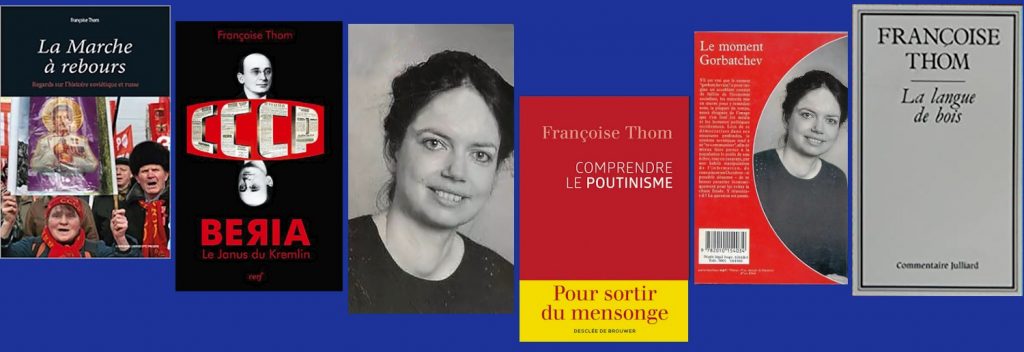
In early January 2026, Françoise Thom will publish a new book, La Guerre totale de Vladimir Poutine (Vladimir Putin’s All-out War), published by À l’Est de Brest-Litovsk. You can already pre-order it on the publisher’s website.
Footnotes
- Ernst Jünger, Premier journal parisien, Christian Bourgois éditeur, 1980, p. 58.
- Ibid., p. 71.
- Quoted in: Ernst Jünger, op. cit., p. 98.
- Quoted in: Johann Chapoutot, Nazism and All-out War: Between Mechanics and Mysticism, Sens public, March 7, 2005.
- Georges Bernanos, France Against the Robots, in: Scandal of Truth, Éditions Robert Laffont, 2019, p. 1067.
- Testimony of Captain Oleg Miller.
- Ibid.
- Quoted in: Johann Chapoutot, Nazism and All-out war: Between Mechanics and Mysticism, Sens public, March 7, 2005.
See also:
- « La guerre totale, culmination du poutinisme » — (2025-1115)
- « Total War, the Culmination of Putinism » — (2025-1115)
- « Der totale Krieg: Die Kulmination des Putinismus » — (2025-1115)
- « Тотальная война, кульминация путинизма » — (2025-1115)
Decryption: The Spiral of the Void
What Françoise Thom highlights in this masterful text is the definitive end of our illusions regarding the nature of the Russian regime. For a long time, we believed we were dealing with a State guided by rational interests, negotiable red lines, and classical diplomacy. This was a fatal error. The article demonstrates that Putinism has entered its terminal phase: that of “total war.” It is no longer a strategy; it is a physiology. The regime now survives only through destruction—that of Ukraine, of course, but also that of Russia itself, transformed into a prison-barracks where the economy, culture, and minds are sacrificed to the military Moloch.

The message is terrifying but salutary: there is no turning back. Putin has burned his bridges. To hope for a compromise, a “gray peace,” or a return to business as usual is to fail to understand that we are facing a nihilistic machine that requires perpetual conflict to avoid collapsing upon itself.
The conclusion is self-evident: one does not negotiate with a metastasizing cancer. Faced with a Russia that has chosen collective suicide as long as it drags the West down with it, our only option is absolute firmness. Any weakness, any hesitation to name this totalitarianism for what it is, will not be perceived as an outstretched hand, but as an invitation to destroy us. The war is total because the enemy does not seek our defeat; he seeks our disappearance.
- « Total War, the Culmination of Putinism » — (2025-1117) in Desk Russia
- « La guerre totale, culmination du poutinisme » — (2025-1115) in Desk Russie
- « Der totale Krieg: Die Kulmination des Putinismus » — (2025-1115)
- « Тотальная война, кульминация путинизма » — (2025-1115)
- « Economic Relations, an Underestimated Weapon in the Kremlin’s Hybrid War Against the West. II. Contagion » in Desk Russia — (2025-0929)
- « Les relations économiques, une arme méconnue dans la guerre hybride du Kremlin contre l’Occident. II. La contagion » in Desk Russie — (2025-0928)
- „Wirtschaftsbeziehungen als verkannte Waffe im hybriden Krieg des Kremls gegen den Westen (2) Die Ansteckung“ — (2025-0928)
- ‘Economic Relations, an Underestimated Weapon in the Kremlin’s Hybrid War against the West – I. The Leninist Imprint’ in Desk Russia — (2025-0911) —
- « Les échanges économiques, une arme méconnue dans la guerre hybride du Kremlin contre l’Occident (1) L’empreinte léninienne » in Desk Russia — (2025-0907) —
- „Wirtschaftsbeziehungen als verkannte Waffe im hybriden Krieg des Kremls gegen den Westen (1) Das leninistische Erbe“ — (2025-0907) —
- ‘Cesspool and chaos: the Russian connection in the Epstein Affair’ in Desk Russia — (2025-0730) —
- « Le cloaque et le chaos : la Russian connexion de l’affaire Epstein » in Desk Russie — (2025-0728) —
- „Die Kloake und das Chaos: Die russische Verbindung der Epstein-Affäre“ — (2025-0728)
- « Клоака і хаос: російський зв’язок у справі Епштейна » — (2025-0728) —
- « La paille et la poutre : une réponse européenne aux idéologues trumpo-poutiniens » in Desk Russie — (2025-0708) —
- ‘The Pot Calling the Kettle Black: A European Response to Trump and Putin Ideologues’ in Desk Russia — (2025-0708) —
- ‘A Disaster of the First Magnitude’ in Desk Russia — (2025-0706) —
- ‘Toward a Putin–Trump Pact? in Desk Russia — (2025-0430) —
- « Vers un pacte Poutine-Trump ?» in Desk Russie — (2025-0429) —
- ‘Russia’s Plan for the United States’ in Desk Russia — (2025-0413) —
- « Le projet russe pour les États-Unis » in Desk Russie — (2025-0329) —
- « Vladimir Putin’s Twofold Revenge’ in Desk Russia — (2025-0304) —
- « La double vengeance de Vladimir Poutine » in Desk Russie — (2025-0303) —
- ‘The Lessons of Trumpism for Europeans: How to Avoid a ‘Self-Putinization’ of the EU’ in Desk Russia — (2025-0225) —
- « Les leçons du trumpisme pour les Européens : comment éviter une autopoutinisation de l’UE » — in Desk Russie — (2025-0223) —

Desk Russie would like to remind you that Françoise Thom will be presenting a series of five lectures entitled ‘The Kremlin’s instruments and methods of power projection from Lenin to Putin’ as part of the Université Libre Alain Besançon. .For more details and to register (in person)