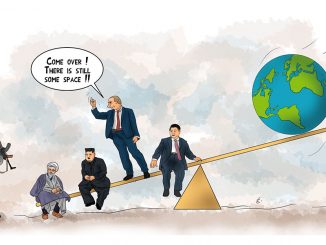

Since the return of Donald Trump, Europe is not merely going through a diplomatic crisis; it is experiencing a moral and existential humiliation. Every morning, the Old Continent wakes up with a hangover, suspended on the digital wanderings of a man who despises it.
This is no longer diplomacy; it is a daily torture where our leaders, paralyzed, seem to accept the unacceptable: the abandonment of their allies, the trampling of their values, and the vassalization of their interests, all while waiting for a smile from the executioner. How did we reach this degree of submission?

“Where danger grows, so too does that which saves” (Hölderlin)
Table of Contents
I: The State of the Affairs
Since the election of Donald Trump, Europe has been living a daily ordeal. Our leaders are suspended on every tweet from his social network (the term “social” seems ill-chosen to describe this platform); we wait for tomorrow to hear the opposite of what he said the day before. Even if the character seems very limited in his vocabulary, in default of erudition, his flaws are immense. Full of himself—the term narcissism seems to exonerate him from other mental turpitudes that psychologists have diagnosed without risk of error—liar, cheater, hedonist, egoist: in two words, we summarize Donald Trump. And yet, we have not even seen in detail the depth of a character who, for years, claimed to be a close friend of Jeffrey Epstein, even calling him a “terrific guy.”[01]
1. Humiliation
The facts are there. Europe sees itself betrayed day by day, Ukraine abandoned to a predator who is certainly less lecherous but more structured and methodical, managing a mafia-like army of killers ready to do anything to preserve their system. Witnessing Trump’s daily verbal flatulence is painful, but it is even harder to see our European leaders on their knees, mouths agape, asking for more while praising the qualities and genius of a buffoon who dreams of equaling his role model, the alpha male Vladimir Putin.
All those who knew America and Americans seemed convinced that a world democracy was capable of handling this. We imagined the all-powerful Congress blowing the whistle to end recess, finding its footing again, and reinvesting in its domain: legislating to maintain America. What we see does not give that impression. Accepting the idea that such a character can scare intelligent people is beyond our comprehension. All our leaders have folded. Every day he demeans them, insults them, and they ask for more.

What we see does not give that impression. Accepting the idea that such a character could frighten intelligent people is beyond our comprehension. All our leaders have given in.
A former intelligence official familiar with the file gave a surprising answer when asked if Trump was or had been a Russian agent. No, he said, because the character is too unpredictable and unmanageable to be a classic spy. However, as an “agent of influence” or an “asset,” yes, the Russians invested in the character because his ego and his fortune (which they helped consolidate) could “be useful tomorrow.”[02][03]
AI Illustration © European-Security
The Roots of the Divorce: Anthropology of a foretold breakup: (2) Analysis
To understand this enigma, we must no longer look at the tweets of the day, but reopen the history books. Four names come to mind for having examined this grave subject. They offer us the geopolitical, anthropological, and spiritual keys to our vassalization.
This divorce is no accident; it was written in the stars. Four great minds had theorized this inevitable separation.
Everyone who knew America and Americans seemed convinced that a global democracy was capable of handling this. We imagined the all-powerful Congress calling time on the recess, finding its footing again and re-investing itself in its proper domain: legislating while maintaining America.
I. The Great Minds: The Prophecy of Abandonment
1. Charles de Gaulle: Cold Realism

The General had seen it all. For him, the “cutting of the cord” was not a risk, but a deferred certainty. He knew that nations have no friends, only interests. His formula on the fragility of alliances remains famous:
“Treaties, you see, are like young girls and roses: they last as long as they last.”[04]
De Gaulle understood that American protection was an umbrella that Washington would close as soon as the storm no longer threatened its own soil:
“The great American people… will never sacrifice their fundamental interests to ours. They will help us if it is in their interest, they will abandon us if it is in their interest.“[05]
2. Alexis de Tocqueville: The Prophecy of Divergence
As early as 1835, Tocqueville already saw America drifting away. He perceived that this people, starting from a different point, would follow a solitary and titanic trajectory.
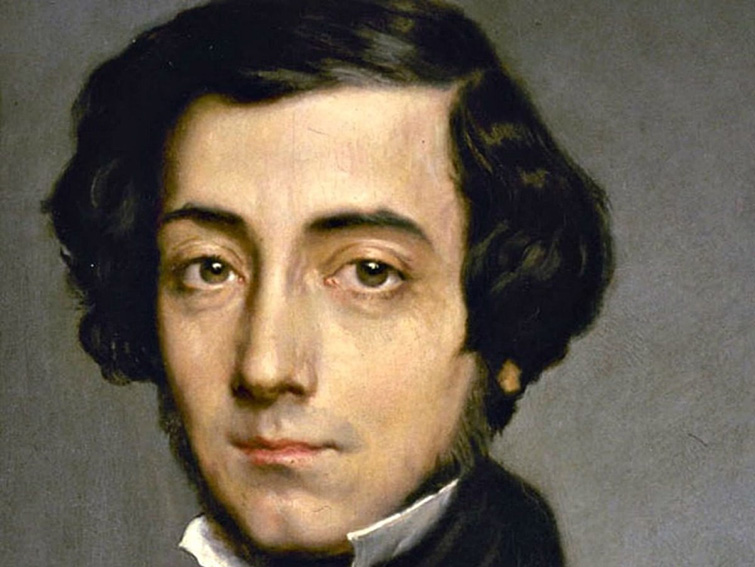
“There are now two great nations in the world, which starting from different points, seem to be advancing toward the same goal: the Russians and the Anglo-Americans… Each of them seems marked out by the will of Heaven to sway the destinies of half the globe.”[06]
Tocqueville teaches us that America is a continent-island. Its destiny inevitably pushes it to turn away from the European peninsula to focus on itself. Its destiny inevitably pushes it to turn away from the European peninsula and focus on itself or on the Pacific. Implicitly, this heralded the marginalization of Europe. If America holds “half the world,” it no longer needs its European motherland.
3. Régis Debray: Voluntary Servitude and exit from history
If the first two explain America’s departure, Régis Debray explains Europe’s paralysis. For him, the problem is not the master, but the slave who refuses to be free. He describes a Europe that has become a “theme park,” preferring the comfort of submission.

“A protectorate that takes itself for a power is like a eunuch who takes himself for a Don Juan.”[07]
Europe accepts humiliations because it fears the void. It has become “Gallo-American,” mentally colonized.
4. Emmanuel Todd: The Anthropological Divorce
Finally, Emmanuel Todd provides the final key. Anthropologist Emmanuel Todd turns the tables. For him, America is not “letting us go” out of indifference, it is “vampirizing” us in order to survive. He demonstrates that America is no longer this protective “big brother,” but a predatory and unstable power.

“The United States has become a problem for its allies… America can only live by siphoning off the rest of the world.”[08]
America needs conflict to maintain its financial hegemony, while Europe needs peace to maintain its social prosperity. Divorce is therefore written into our cultural genes.
We could also add François Mitterrand, Paul Valéry, and Oswald Spengler to this list of prophets..
5. François Mitterrand
At the end of his life, Mitterrand, despite being a loyal ally of the US during the Cold War, shared with Georges-Marc Benamou a very dark and prescient vision of transatlantic relations. He sensed this “break” coming in economic and civilizational terms.

“France doesn’t know it, but we are at war with America. Yes, a permanent war, a vital war, an economic war, a war without apparent casualties. […] The Americans are very tough, they are voracious, they want unchallenged power over the world.”
6. Paul Valéry
Bien qu’il soit poète et philosophe, Paul Valéry a écrit des textes politiques d’une acuité tranchante après la Première Guerre mondiale. Il a compris le premier que l’Europe, en s’appuyant trop sur l’extérieur, allait devenir une simple province du monde, et que l’Amérique (le Nouveau Monde) prendrait le relais avant de se désintéresser de ce « petit cap ». Das la crise de l’esprit, Valéry écrit :
Paul Valéry — Photo Henri Manuel

“Will Europe become what it really is, namely a small cape of the Asian continent? Or will Europe remain what it appears to be, namely the precious part of the terrestrial universe, the pearl of the sphere, the brain of a vast body?”
7. Oswald Spengler

Finally, let us quote the German philosopher, in his major work The Decline of the West, who theorizes that civilizations are like living organisms: they are born, they mature, and they die.
For Spengler, “Faustian” (European) culture would exhaust itself and give way to a cold, technical “civilization” embodied by Americanism.
The underlying idea is that America is the continuation of Europe, but a continuation that has completely emancipated itself from its roots to become pure will to power, thus severing its spiritual ties with the Old Continent.
Oswald Spengler — Photo Wikipedia
II. The Anthopological Shock (Why they don’t understand us)
Why this dialogue of the deaf? Emmanuel Todd explains it by referring to the family unconscious. The misunderstanding between Europe and America is not just a question of politics, it is a question of mental structures inherited from our families.
The misunderstanding between Europe and America is not just political; it is a question of mental structures inherited from our families.
America: The Absolute Nuclear Family
The Anglo-Saxon world is based on a specific model: pure individualism. Children leave home early, and crucially, parents have the right to disinherit their children (total testamentary freedom). Political consequence: If one accepts inequality in the family, one accepts inequality in society. America does not see its allies as “brothers” (eternal solidarity) but as temporary partners that can be abandoned if necessary. It does not carry the gene of fidelity.

The Franco-German Couple: The Deadlock
Europe itself is divided by its family unconscious:
- Germany (Stem Family): Values authority and discipline. Traumatized by History, it needs a strong “father” (America) to feel safe.
- France (Egalitarian Family): Values equality and universalism. It dreams of autonomy, but clashes with a Germany that prefers to submit to Washington rather than risk the European adventure.
III. The Biological Destiny (The War of the Wombs)

Strength lies in numbers.
- Germany (The Retirement Home): With an aging population, Germany refuses inflation and war. It wants stability at all costs to pay its pensions, making it docile toward America and blind to dangers.
- Russia (Survival): The war in Ukraine is a desperate attempt to recover Slavic populations before the Russian demographic collapse.
- The United States (Predation): Life expectancy is dropping in the US, a unique fact in the West. To maintain its power, America must “siphon” European wealth and brains.
IV. The Spiritual Crisis (The “Stage Zero”)
Finally, the divorce is moral. Emmanuel Todd explains that the collapse of Protestantism has left America in a “Stage Zero” of religion.

- Narcissism: Without a common moral framework (God, the Bible, or Reason), America sinks into the cult of the Self. Truth no longer exists; only feelings matter.
- Madness: “Trumpism” or “Wokism” are not policies, but hysterical substitute religions.
- The Gap: Europe, an old skeptical and tired land, looks with horror at this America that has become a giant, unpredictable sect.
Conclusion: The future lasts a long time
We are at a crossroads. America is moving away, driven by its geography, its demography, and its internal crisis. Europe has a choice: remain the world’s museum, submissive and humiliated (the “Happy Vassalization”), or agree to cut the cord to finally become an adult.
As the poet Hölderlin said: “But where the danger is, also grows the saving power.”
Joël-François Dumont
Sources
[01] New York Magazine, “Jeffrey Epstein: International Moneyman of Mystery,” 2002. Donald Trump stated: “I’ve known Jeff for fifteen years. Terrific guy… It is even said that he likes beautiful women as much as I do.”
[02] The Guardian, “Donald Trump spying allegations: more likely useful idiot than Putin’s agent,” Jan 29, 2021. Analysis based on former KGB major Yuri Shvets.
[03] Michael Morell (Ex-CIA Director), Op-Ed in The New York Times, Aug 5, 2016. Morell states Putin made Trump an “unwitting agent” of the Russian Federation.
[04] Alain Peyrefitte, C’était de Gaulle, Vol II, Éditions de Fallois/Fayard, 1997. Remarks made July 2, 1963.
[05] Alain Peyrefitte, C’était de Gaulle, Vol I, Éditions de Fallois/Fayard, 1994.
[06] Alexis de Tocqueville, Democracy in America, Vol I (Conclusion of the first part), 1835.
[07] Régis Debray, L’Europe fantôme, 2019, and in Civilisation, Gallimard, 2017.
[08] Emmanuel Todd, The Defeat of the West (La Défaite de l’Occident), Gallimard, 2024.
See Also:
- « L’Europe ou la chronique d’une servitude volontaire : (1) Le constat » — (2025-1212)
- « Europe or The Chronicle of a Voluntary Servitude: (1) The Finding » — (2025-1212)
- « Europa oder die Chronik einer freiwilligen Knechtschaft: (1) Die Festellung » — (2025-1212)
Decryption: The courage to stand alone
Europe’s current humiliation by a predatory America isn’t fate; it is a necessary wake-up call. We are witnessing the brutal end of an illusion: that of a unified West under eternal benevolent guardianship. Donald Trump isn’t just “dropping” us; he is forcibly freeing us from our voluntary servitude. The cord is cut? Good. It is the moment of truth for the Old Continent. Either we accept becoming the world’s museum, powerless and visited, or we turn this abandonment into independence. We have the economy, the culture, and—thanks to French demographics—the biological future. We only lack the political courage to say “No.” Giving up now would be a crime against History. Being orphaned isn’t a weakness; it is the first day of adulthood.