
-
Historical Perspectives

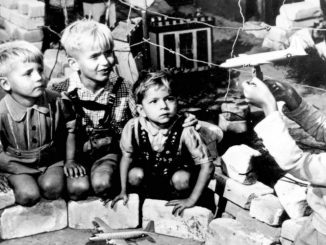
Berlin-Tegel 1948: The French Stroke of Genius

From occupiers to protectors, the French forces in Berlin fundamentally changed the game. Initially sidelined after WWII, France carved out its own sector, becoming a key player. They weren’t just soldiers; they were city-builders and denazification agents. Then came the 1948 Soviet blockade, their defining moment. While the U.S. and Britain owned the skies, France made its stand on the ground. Their audacious move: building an entire airport, Tegel, in a stunning 90 days.

[…]

Dépôt de gerbe par le détachement FANY à Ravensbrück — Photo © Joël-François Dumont
Historical Perspectives

The liberation of Ravensbrück and Sachsenhausen

The 80th anniversary of the liberation by the Red Army of the iconic concentration camps of Ravensbrück and Sachsenhausen was celebrated in the presence of a dozen survivors of the Nazi hell. The largest number of women deported to Ravensbrück came from Eastern European countries, which were classified as Slavic subhuman countries. While the Ravensbrück camp was converted into barracks, those in Sachsenhausen and Buchenwald became special camps, set up in May 1945 in the SBZ (Soviet occupation zone in East Germany). Officially, this was to cleanse the rear of the Red Army of enemy elements, but in reality it was to deport, without trial, any opponents considered potential enemies. In these Spezlag camps, prisoners were slaves cut off from the world. In these camps of silence, more than 1,100,000 people died and were buried in mass graves or cremated before the USSR transferred them to the GDR. Some, such as the Bautzen concentration camp, served as prison annexes for the STASI (‘Stasi-Knast’) until the fall of the Wall.

[…]