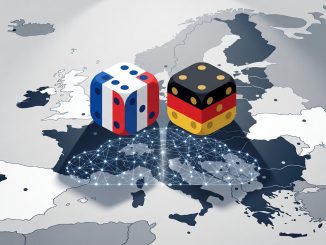
Deux dés, deux couleurs, un même continent sous leurs pieds — la France et l’Allemagne jouent chacune leur partie, sans jamais perdre de vue qu’elles restent reliées, qu’elles le veuillent ou non — Illustration IA © European-Security
Historical Perspectives

France-Germany: Quo Vadis? 2025-2026 (7)

In 2026, Trump’s America dismantled in a single year what fifty years of transatlantic diplomacy had patiently built. Facing it, Europe — and Germany in particular — watches the void open up without yet daring to fill it.
If I had to sum up this piece in a single drawing, I would choose this excellent cartoon by Patrick Chappatte, published in Der Spiegel, which says almost everything in one satirical image. Trump, baseball bat in hand, has just reduced the Press and the University to rubble — the very pillars of what used to be called the free world. In his other hand, a flag: “Leader of the Free World.” He holds it out, almost with contempt. “Want this? I don’t need it anymore.” Facing him, a helmeted man, the word “Germany” stamped on his helmet, hesitates, hands trembling, unable to make up his mind to take it.

[…]

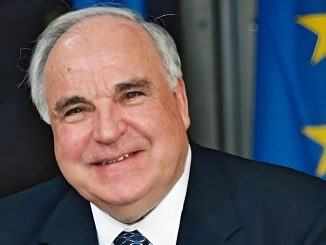
Bundeskanzler Helmut Kohl_Bundesregierung © Stutterheim
Historical Perspectives

France-Germany: Love Me, Love Me Not 1990-2025 (6)

One night in the Caucasus, in July 1990. One night in front of the Reichstag, three months later. Between the two, Germany became a fully sovereign state again — and nothing about the Franco-German relationship would ever be quite the same.
It is warm, that July night in 1990, in the mountains of the Caucasus. Around a wooden table set up in the open air, Helmut Kohl, Hans-Dietrich Genscher and Mikhail Gorbachev talk, relaxed, almost like old friends — the scene looks more like a dacha gathering than a diplomatic summit. And yet it is here, in an atmosphere that betrays nothing of the stakes involved, that one of the most consequential agreements of the late twentieth century is struck: Gorbachev yields. A reunified Germany will be allowed to remain in NATO. The USSR, in the throes of collapse, no longer has the means to impose neutrality.

[…]

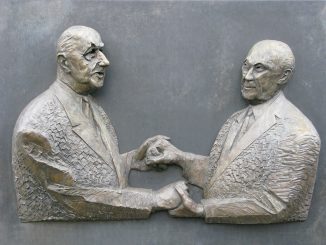
Plaque à la mémoire de De Gaulle et d'Adenauer devant la KAS à Berlin — Photo © Joël-François Dumont
Historical Perspectives

France-Germany: The Axis and Its Trials 1958-1989 (5)

Twenty-five years separate the meeting at Colombey from the fall of the Wall. Twenty-five years during which two countries, reconciled on paper since 1963, would learn to trust one another in practice — through crises, strategic divergences, and one pair of leaders after another. The fifth installment of this series traces how the Franco-German axis held together, until a seismic event no one saw coming fractured it one last time.

[…]

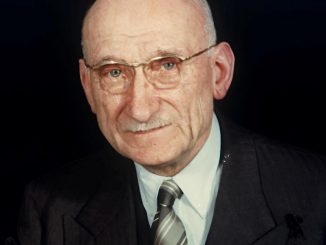
Robert Schuman en 1958 Photo © European-Union
Historical Perspectives

France-Germany: From Ruins to an Emerging Europe, 1945-1959 (4)

Amid the rubble of 1945, no one would have bet a pfennig on Franco-German reconciliation. And yet, in less than five years, a bilingual former Lorrainer and a handful of visionaries would lay the first stone of an edifice that neither Briand nor Stresemann, a generation earlier, had managed to build. The fourth installment of this series traces how Europe was born from its own ruins — not without a first, stinging failure.

[…]

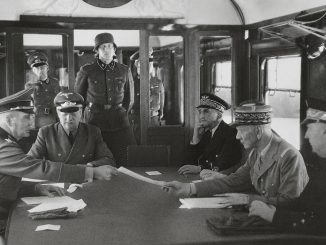
Bundesarchiv_— Le 22 juin 1940, l’armistice est signé en forêt de Compiègne — Photo Bindesarchiv
Historical Perspectives

France-Germany: The Paroxysm, 1914–1945 (3)

From the assassination in Sarajevo to the ruins of 1945, Franco-German antagonism reaches its paroxysm: two world wars, a peace that humiliated instead of pacifying, and the rise of a criminal ideology that carried the logic of revenge all the way to annihilation. The third installment of this series traces how the “Diktat” of Versailles unwittingly prepared the revenge of 1940 — and how Europe touched bottom before it could, at last, begin to climb back up.

[…]

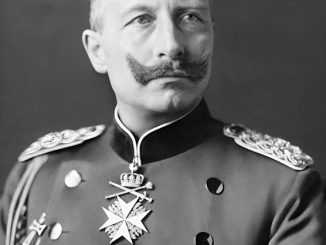
Empereur Guillaume II par Thomas Heinrich Voigt
Historical Perspectives

France-Germany: The March Toward the Abyss 1871-1914 (2)

Between the Treaty of Frankfurt and the summer of 1914, France and Germany did not go to war with one another. Yet these forty-three years of armed peace were precisely the period in which the mechanism that would tip the whole of Europe into catastrophe was methodically forged. In this second installment of the series, we trace how a desire for revenge, a cult of power, and an alliance system that grew uncontrollable together turned a local assassination into a world war.

[…]

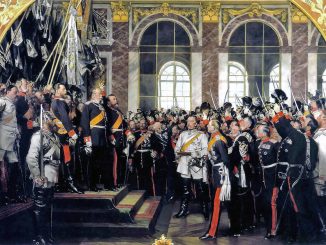
Proclamation à Versailles dans la galerie des glaces de l'empire d'Allemagne (18 janvier 1871)
Historical Perspectives

France-Germany: The Machinery of Hatred 1805-1871 (1)

How could a single Napoleonic battle sow, in Prussia, the seeds of an antagonism that would poison Europe for more than a century? The first instalment in a series devoted to the Franco-German relationship, this article traces the birth of German national sentiment in humiliation, and its first great revenge: the unification of Germany by “blood and iron,” at France’s expense.

[…]

-
Historical Perspectives

Berlin-Tegel 1948: The French Stroke of Genius

From occupiers to protectors, the French forces in Berlin fundamentally changed the game. Initially sidelined after WWII, France carved out its own sector, becoming a key player. They weren’t just soldiers; they were city-builders and denazification agents. Then came the 1948 Soviet blockade, their defining moment. While the U.S. and Britain owned the skies, France made its stand on the ground. Their audacious move: building an entire airport, Tegel, in a stunning 90 days.

[…]

Dépôt de gerbe par le détachement FANY à Ravensbrück — Photo © Joël-François Dumont
Historical Perspectives

The liberation of Ravensbrück and Sachsenhausen

The 80th anniversary of the liberation by the Red Army of the iconic concentration camps of Ravensbrück and Sachsenhausen was celebrated in the presence of a dozen survivors of the Nazi hell. The largest number of women deported to Ravensbrück came from Eastern European countries, which were classified as Slavic subhuman countries. While the Ravensbrück camp was converted into barracks, those in Sachsenhausen and Buchenwald became special camps, set up in May 1945 in the SBZ (Soviet occupation zone in East Germany). Officially, this was to cleanse the rear of the Red Army of enemy elements, but in reality it was to deport, without trial, any opponents considered potential enemies. In these Spezlag camps, prisoners were slaves cut off from the world. In these camps of silence, more than 1,100,000 people died and were buried in mass graves or cremated before the USSR transferred them to the GDR. Some, such as the Bautzen concentration camp, served as prison annexes for the STASI (‘Stasi-Knast’) until the fall of the Wall.

[…]