Between 1924 and 1929, a German journalist who had gone into voluntary exile in Paris warned his country, with almost unbearable precision, of the Reichswehr’s clandestine rearmament and the resurgence of a militarism the Weimar Republic believed it had buried along with the Empire. He died in 1935, aged 45, without knowing that the two Germanys born of his country’s defeat would each, in their own way, turn him into a symbol — East Germany in particular, which engraved his face on a postage stamp and later on a coin.
Key Points
- Kurt Tucholsky (1890-1935), German journalist and satirist of Jewish origin, was Paris correspondent for Die Weltbühne and the Vossische Zeitung from 1924 to 1929.
- A declared antimilitarist, he relentlessly denounced the “officer spirit” (Offiziersgeist), which he considered intact beneath Weimar’s republican garb.
- In March 1929, Die Weltbühne published an article by Walter Kreiser exposing the Reichswehr’s clandestine air rearmament, in violation of the Treaty of Versailles — a scandal that led, in 1931, to the conviction for treason of Carl von Ossietzky and Kreiser himself.
- His most famous line, “Soldaten sind Mörder” (“Soldiers are murderers,” 1931), earned him a highly publicised trial; the court ultimately ruled that it did not constitute an insult to the Reichswehr.
- In 1929, together with photomontage artist John Heartfield, he published Deutschland, Deutschland über alles, an antimilitarist broadside whose title turns the opening line of the German national anthem into an accusation.
- His books were burned by the Nazis in May 1933; he was stripped of his German citizenship the same year and took his own life in Sweden on 21 December 1935.
- East Germany turned him into an officially celebrated progressive figure — a postage stamp in 1970, a commemorative 5-mark coin for his centenary in 1990, DEFA films — while West Germany took longer to fully rehabilitate him.
Contents
by Joël-François Dumont — Berlin, 10 September 2026.
Introduction
Born on 9 January 1890 in Berlin into a bourgeois Jewish family — his father was a banker — Kurt Tucholsky grew up in a Wilhelmine Germany where antisemitism, without being state doctrine, already permeated the military and administrative elites he would fight all his life.
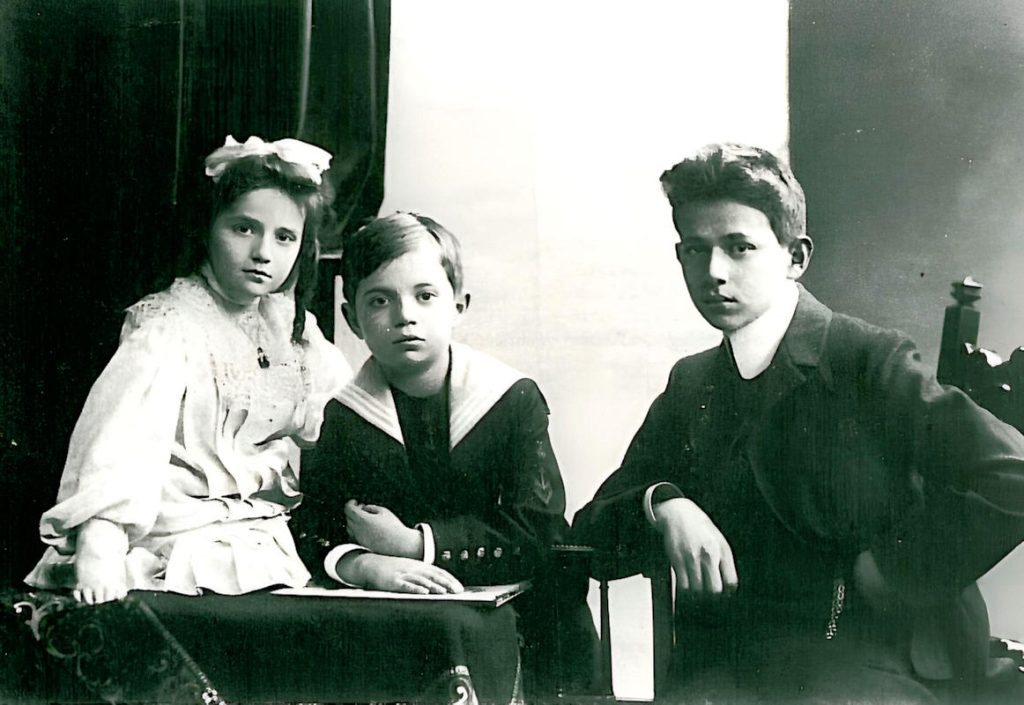
In 1899, he was enrolled at the French Lycée of Berlin — founded in 1689 by Huguenot refugees, whose teaching, conducted in French right up to the Third Reich, produced generations of what Le Monde would later call “mediators” between the two countries. Long before Paris, then, it was on the benches of this school that Tucholsky learned a language and a culture he would rediscover, as an adult, as a correspondent. Mobilised on the Eastern Front during the Great War, he was baptised Protestant in 1918, at Drobeta Turnu Severin, in Romania — a common act of assimilation among German Jewish intellectuals of his generation, following the model of Heinrich Heine a century earlier. This baptism would offer him no protection whatsoever: Nazi persecution, based on ancestry rather than declared faith, targeted him in 1933 precisely as a Jew, regardless of his actual religious practice.
A German Watching His Country From Paris
In the spring of 1924, Kurt Tucholsky signed a correspondent’s contract with Siegfried Jacobsohn, founder of Die Weltbühne, and left for Paris — where he would remain, with a few brief returns, until 1929. There he also wrote for the Vossische Zeitung, Berlin’s oldest liberal daily. The choice was no accident: Tucholsky consciously followed the example of Heinrich Heine, exiled in Paris a century earlier, hoping that his mere presence might contribute to Franco-German reconciliation.
From Paris, under his usual pseudonyms — Peter Panter, Theobald Tiger, Ignaz Wrobel, Kaspar Hauser, each associated with a different register (reportage, satirical poetry, polemic, aphorism) — he observed Germany with a clarity that proximity to Berlin no longer allowed him. In December 1926, upon Jacobsohn’s death, he took over as editor of the Weltbühne for a few months and had to return temporarily to Berlin, before leaving again.
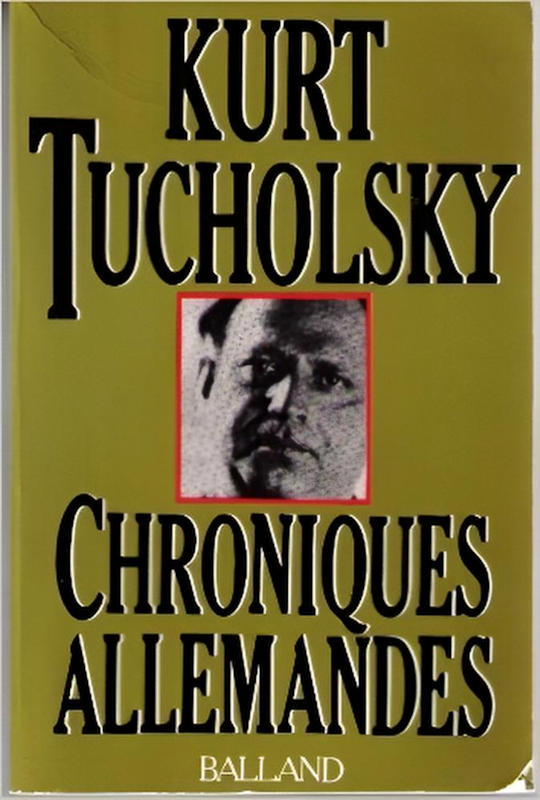
Parisian Chronicles: A Hundred and Twenty Texts on France
Tucholsky’s stay in Paris was not confined to observing Germany from abroad. Between 1924 and 1929, he produced more than a hundred chronicles devoted to French life and culture in their own right — everyday life, manners, the spirit of a city he discovered with unabashed tenderness. As early as June 1924, he wrote: “What makes the atmosphere of this city unique is its humanity.”

The project goes beyond mere travel writing. A recent doctoral thesis (Aix-Marseille, 2021) demonstrates this well: Tucholsky consciously placed himself in the tradition of Franco-German mediators, following in the footsteps of his model Heinrich Heine, and shifted his fight for peace onto new ground — no longer simply denouncing German militarism from within, but combating among his readers the stereotype of France as the “hereditary enemy” and of Paris as a den of decadence. In 1927 he published a travel notebook, The Pyrenees Book, the fruit of a walking trip across the Pyrenees; this entire French vein culminates in a piece he soberly titled Merci, France — at once a declaration of love and a farewell, as his stays on French soil grew rarer after 1928 in favour of his Swedish exile.
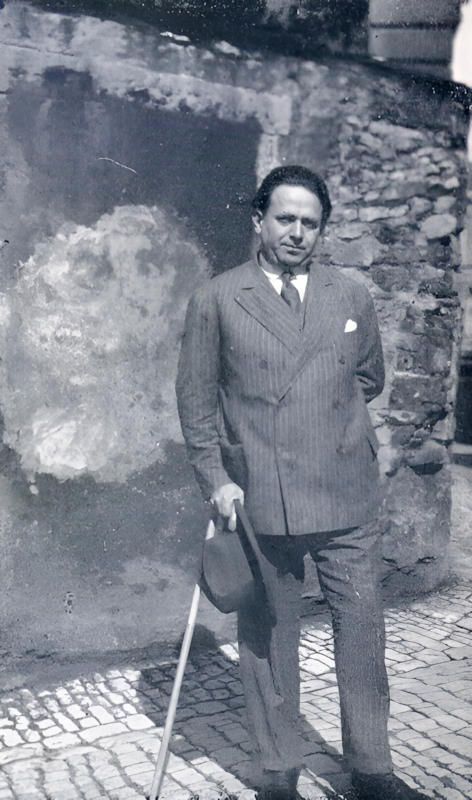
This work of rapprochement did not unfold in a political vacuum. The exact years of Tucholsky’s presence in Paris (1924-1929) coincide almost to the day with what history remembers as the “spirit of Locarno”: the treaties signed in October 1925 by the Frenchman Aristide Briand and the German Gustav Stresemann; Germany’s entry into the League of Nations in September 1926 — the moment when Briand coined his now-famous line, — “Away with rifles, machine guns, cannons! Make way for conciliation, arbitration, peace!” — then the Nobel Peace Prize awarded jointly to the two statesmen in December 1926, and finally the Kellogg-Briand Pact of 1928, which outlawed war as an instrument of policy. Two socialists of very different temperament, one carried by high diplomacy, the other armed only with his pen, were at bottom working toward the same reconciliation, without ever crossing paths.
Kurt Tucholsky
History would not grant them the time to find out whether their wager would hold. Stresemann died in October 1929, almost exactly when Tucholsky closed his Parisian chapter to settle in Sweden; Briand died in 1932, a year before Hitler came to power. The journalist who had believed, from a Parisian café, in the possibility of another Germany, would watch the edifice patiently built by the diplomats collapse within a few years — and he himself had only three years left to live after Briand’s death.
A few biographical details complete the portrait. In April 1924, he left Berlin, his wife Mary Gerold — a physician, whom he had married that same year — and his beloved car, a Stoewer, to settle alone in Paris; the couple, who reunited intermittently, would discover on the ground that they could not live together for good, and separated permanently in 1927 — though this did not stop Mary, long after Kurt’s death, from looking after his archives and editing his work. A few weeks before his departure, on 24 March 1924, he had been initiated as a Freemason in a deliberately “irregular” Berlin lodge, one that did not require belief in a supreme being — already a sign of his rejection of orthodoxies, progressive ones included. In Paris, his chronicles were not confined to high politics: as an avowed flâneur, he portrayed the small people of the neighbourhoods — grocers, street vendors, ragpickers, seamstresses — with an observer’s tenderness that his biting irony, in his German texts, rarely allows to show through. From this period also comes an anecdote that sums up the man rather well: a soldier on the Eastern Front during the Great War, he is one day handed a rifle too heavy for him; he leans it against a hut and walks away, never picking up a weapon again — the incident, he recounts, “ended well, and without a rifle.”
The Designated Enemy: The Officer Spirit
Tucholsky never presented himself as an absolute pacifist in the doctrinal sense of the term — he defined himself as a left-wing democrat, socialist and antimilitarist. What he fought with obsessive consistency was not the army as such, but what he called the Offiziersgeist: the survival, within a Republic supposedly having broken with the Empire, of a military caste that continued to consider itself above civil law and democratic control.
The poem he published in Die Weltbühne after the assassination of Minister Walther Rathenau in 1922 already sums up his entire programme: “Steh einmal auf! Schlag mit der Faust darein! Schlaf nicht nach vierzehn Tagen wieder ein!” (“Get up for once! Strike with your fist! Don’t fall back asleep after a fortnight!”) — a direct rebuke to a Republic that grows indignant, then falls back asleep, instead of structurally defending itself against its internal enemies.
The Weltbühne Trial: Rearmament Exposed
It was in March 1929, almost at the end of his Parisian period, that Tucholsky’s fight found its most concrete demonstration. Die Weltbühne published an article by journalist Walter Kreiser, “Windiges aus der deutschen Luftfahrt,” exposing the Reichswehr’s clandestine air rearmament — a direct violation of the Treaty of Versailles, which forbade Germany from possessing a military air force.
The affair took years to reach the courts, but its outcome was resounding: in November 1931, Carl von Ossietzky — by then editor-in-chief of the magazine — and Walter Kreiser were sentenced to eighteen months in prison for treason. The Weltbühne trial became a landmark case in the conflict between press freedom and military secrecy in Germany, and Ossietzky, who remained imprisoned after the Nazis came to power, would receive the 1935 Nobel Peace Prize from his cell — the very year of Tucholsky’s death.
“Soldiers Are Murderers”
In 1931, Tucholsky wrote the line that would remain most associated with his name: “Soldaten sind Mörder” (“Soldiers are murderers”). It earned him a prosecution for insulting the Reichswehr — a trial that Tucholsky, already worried for his safety, did not attend in person in July 1932. The court ultimately ruled that the phrase, in its context, did not constitute an insult to the German army.
1929: Deutschland, Deutschland über alles, the Illustrated Broadside
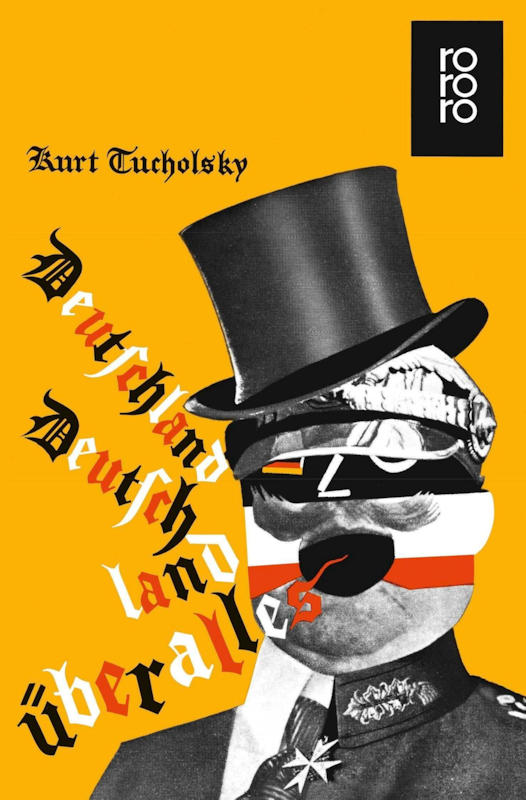
In the same year as the Weltbühne scandal, 1929, Tucholsky published the work that would remain his most radical gesture: Deutschland, Deutschland über alles, a “picture book” of over 230 pages, built around nearly two hundred photographs and photomontages, whose cover and layout were the work of John Heartfield — already famous for his ferociously caustic anti-Nazi collages. The title itself was a bold stroke: it takes the opening line of the Deutschlandlied, the national anthem adopted in 1922 under Weimar and later appropriated by the Nazi regime from 1933 onward, and turns it into an indictment.

The book denounced not only the prevailing militarism; it targeted just as much the anti-democratic drift of the late Weimar Republic and the compromises of German capitalism with the most reactionary powers. Heartfield’s photomontages — including the famous “Berlin saying” adorning the cover — mock the military and warmongers of every stripe with a mixture of fierce humour and documentary precision. The work is today considered one of the earliest and most accomplished critiques of Weimar militarism formulated from within the Republic itself.
It would not long outlive its publication. As early as May 1933, Deutschland, Deutschland über alles was among the very first books delivered to Nazi book burnings — condemned both for its content and for its author’s Jewish origin. It is precisely an original copy of this work — the cover page, with Heartfield’s photomontage — that the Deutsches Historisches Museum in Berlin preserves today in its LeMO collection.
1933-1935: Flight, the Bonfire, the End
After Hitler came to power in January 1933, Tucholsky — settled in Sweden since 1929 for health reasons — would never set foot in Germany again. In May 1933, his books were among those the Nazis delivered to bonfires organised across the country; a few months later, he was stripped of his German citizenship. He stopped writing for publication as early as 1932, his health deteriorated, and on 21 December 1935 he took his own life in Hindas, Sweden, by an overdose of sleeping pills — at 45, without having witnessed the catastrophe he had been one of the few to foretell with such precision.
Joël-François Dumont
See also:
- « Kurt Tucholsky: The Voice That Was Right Too Soon » — (2026-0910)
- « Kurt Tucholsky : La voix qui avait raison trop tôt » — (2026-0910)
- « Kurt Tucholsky: Die Stimme, die zu früh recht hatte » — (2026-0910)
- « Saxony-Anhalt: The Russian Disinformation Campaign Ahead of the Vote » — (2026-0908)
- « Saxony-Anhalt: The AfD Landslide » — (2026-0907)
Sources
On Tucholsky, his biography, and his writings:
Bundesarchiv — Kurt Tucholsky collection · LeMO/Deutsches Historisches Museum — Kurt Tucholsky biography · Wikipedia (EN) · Wikipedia (FR)
On Tucholsky’s French chronicles and his role as a Franco-German mediator:
Doctoral thesis, Aix-Marseille 2021 — “Les chroniques franco-allemandes de Kurt Tucholsky (1924-1929): une médiation ambivalente” · contreligne.eu — “Images et stéréotypes: Kurt Tucholsky, journaliste à Paris” · Babelio — Chroniques parisiennes 1924-1928
On Briand, Stresemann, and the spirit of Locarno:
Chemins de mémoire — Aristide Briand · Nobel Peace Prize — 1926 Laureates · Cairn.info — “1925-1928. Le rapprochement franco-allemand”
On Tucholsky’s personal life and Freemasonry:
Cairn.info — “Kurt Tucholsky: Allemand, juif, socialiste et franc-maçon” · Maitron · JeSuisMort.com
On Deutschland, Deutschland über alles and John Heartfield:
LeMO/DHM — Thematic page · National Gallery of Art (Washington) · “Kurt Tucholsky, John Heartfield and Deutschland, Deutschland über Alles,” History of Photography, vol. 33 · de Proyart, avant-garde catalogue · Internet Archive — digitised original edition (1929) · johnheartfield.com
On the East German “Friedensstaat” paradox:
Bundesstiftung zur Aufarbeitung der SED-Diktatur — “Bewaffneter Friede” · bpb.de — “Militarisierung der DDR” · bpb.de — “Militarisierung der Gesellschaft” · Konrad-Adenauer-Stiftung — “War die DDR ein ‘Friedensstaat’?” · jugendopposition.de — “Von wegen Frieden”
On the 1970 postage stamp:
Deutsche Briefmarken-Zeitung
On his schooling at the French Lycée of Berlin:
Wikipedia (FR) — “Lycée français de Berlin”
Analysis — Two Germanys, Two Uses for One Dead Man
Tucholsky’s posthumous fate tells, in its own way, the divided story of post-war Germany. East Germany claimed him early and unambiguously: as early as 1950-1951, his texts appeared in the “Library of Progressive German Writers”; state television devoted documentaries to him (1962, 1963) and a biographical TV film in 1975; an official exhibition was dedicated to him in 1978-1979; in 1970, a postage stamp bearing his likeness appeared in the “Important Personalities” series; in 1990 — the very year of reunification, in almost the last breath of the East German state — East Germany still minted a commemorative 5-mark coin for his centenary.
This appropriation was not without ideological logic: a left-wing antimilitarist, a fierce critic of Wilhelmine elites and of Weimar’s class justice, ticks almost every box of the antifascist narrative East Germany built about itself. But it also flattens a man more unruly than this portrait suggests — Tucholsky, while claiming allegiance to the left, already refused in his lifetime the conformist demands of doctrinaire communists, once replying to those who criticised his taste for tailored suits: “Besser ein Anzug nach Maß als eine Gesinnung von der Stange” (“Better a tailor-made suit than an off-the-rack conviction”).

There is something even more troubling. East Germany defined itself as a “Friedensstaat” — a “peace state,” in contrast to a supposedly militarist West Germany. In fact, this self-designation stood in flat contradiction to one of the most militarised societies in Europe: nearly two million people active or in reserve within armed or paramilitary formations in the 1980s (the National People’s Army, border troops, the Stasi, riot police, factory militias); compulsory military service from 1962, refusal of which jeopardised one’s studies and career; militarisation beginning as early as kindergarten, with six-year-old children singing songs in praise of the people’s army; and, from 1978 onward, a compulsory school subject, Wehrkunde, devoted to military education. Genuine pacifism, meanwhile, was carried not by the state but by its opponents: the movement “Schwerter zu Pflugscharen” (“Swords into Ploughshares”), born in East German Protestant parishes precisely in reaction to this compulsory military instruction, was monitored and repressed by the regime — before becoming one of the crucibles of the peaceful revolution of 1989.
Celebrating an antimilitarist who died in 1935, while building one of the most militarised societies on the continent under the banner of peace, is not a mere surface inconsistency: it is the mark of a regime that needed a risk-free antimilitarism — that of a dead man who could never object to the barracks, the conscript, or the Wehrkunde.
In the West, recognition came more slowly and more cautiously — the Federal Republic of the 1950s and 1960s, still populated by former military and administrative cadres of the Nazi era, sat uneasily with a man who had described in advance, with such acuity, the persistence of German militarism across regimes. It would take until 1988 for the Kurt-Tucholsky-Gesellschaft to be founded in the West, tasked with perpetuating his legacy — and until 1995 for a prize bearing his name to be created.
This double memorial genealogy is more than an archivist’s curiosity. It sheds light, nearly a century later, on a German debate that has lost none of its relevance: that of rearmament, its democratic transparency, and the relationship a society maintains with its own militarist tendencies — a debate readers of this dossier will find, in a very contemporary form, in the pages devoted to the Zeitenwende and to Germany’s rearmament today.