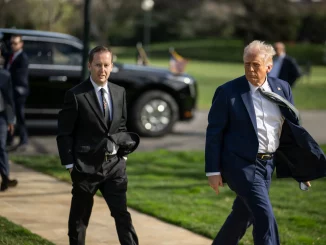
Three days of red carpet, a two-month tariff truce, and a verdict that runs through the entire international press: the Xi-Trump summit in Washington (24-25 September 2026) will be remembered as an exercise in diplomatic staging, all but empty of substance. Beijing nonetheless walks away with a very real benefit — without conceding anything. On the Chinese side, the essence of the gesture came down to two offerings: a promise to invite 100,000 young Americans to China over five years, and the loan of two pandas to a zoo in Atlanta. For a man who boasts, with planetary modesty, of being the champion of deals of every kind, this new “deal” looks just as thin as the previous ones. Hardly cause to declare victory — which explains why the White House took care to keep the press at arm’s length.
The essentials
- The only tangible outcome: a two-month extension of the tariff truce; nothing structural on rare earths, tariffs, or AI governance.
- Beijing leaves with two symbolic gestures — 100,000 American students invited to China over five years, two pandas loaned to a zoo in Atlanta — without yielding anything on its industrial, military, or technological policy.
- For the first time, Trump kept the press largely at a distance from his meeting with Xi — a sign, according to several observers, that he had nothing concrete to announce.
- Xi Jinping comes out ahead according to several Washington think tanks: the honours of a state visit, images of equal-footing diplomacy for his domestic television, without any real concession.
- Taiwan and Europe emerge as the two great collateral losers of a world now reduced to a Washington-Beijing duopoly.
- In the background, America’s own security apparatus is eroding (diesel prices up 60%, approval ratings at rock bottom) while Trump devotes himself to his personal prestige projects — a ballroom, a triumphal arch.
- In the Middle East as in Europe, Washington’s traditional allies have stopped waiting for its green light and are seeking their own balance — the Mecca pact (Saudi Arabia, Pakistan, Turkey) is the clearest signal of this.
Contents
1. Heavy on pomp, light on substance
The verdict is unanimous, from Washington to London to Paris. The Washington Post put it plainly: the summit was “heavy on pomp but light on substance.” The Financial Times said much the same of the only tangible achievement, a two-month extension of the tariff truce: “that’s not a strategy.” Nothing moved on the structural files — rare earths, tariffs, AI governance. Xi argued for keeping AI “under human control“; Trump responded on Truth Social that he wanted to stay “exactly at the current stage” — a flat refusal of any joint governance.
A telling detail: very few senior Chinese business leaders were part of the official delegation, unlike previous visits — a sign, according to several observers, that the business world remains cautious despite the televised embraces.
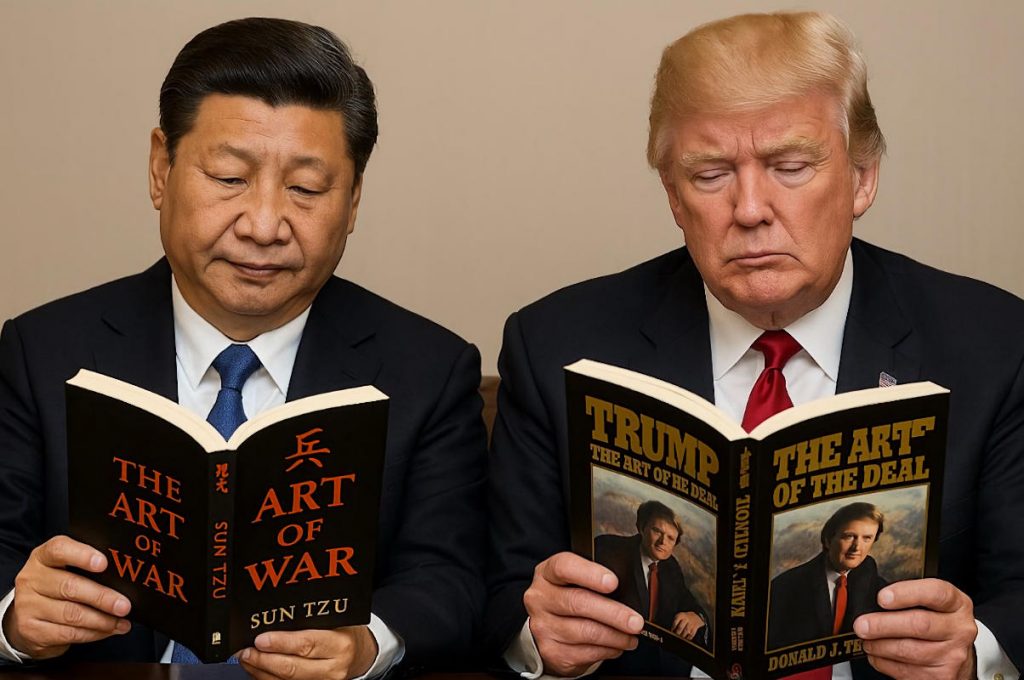
2. Sun Tzu versus the Art of the Deal: two methods, one winner
This is the angle the Guardian explores best: on one side, a Trump focused on rhetoric and immediate political wins; on the other, a methodical Xi unspooling his own long-term vision — the need to “coexist in peace” and avoid the “Thucydides trap,” the risk of conflict between an established power and a rising one that he is fond of invoking. The result, according to several Washington think tanks cited by the Guardian: Xi Jinping comes out of the summit a winner, with the honours of a state visit and images of equal-footing diplomacy for his domestic television — without having had to give up anything on his industrial, military, or technological policy.
In China, the People’s Daily devoted its entire front page to the event: for the Communist Party, the image matters more than the content of the negotiations — it feeds an already well-established narrative, that of a China treated as an unavoidable superpower by an America on the defensive.
3. Taiwan, Europe: the real losers of the duopoly
Two collateral victims stand out. First, Taiwan: Beijing circulated the narrative that Xi had gotten Trump to explicitly “oppose” the island’s independence — promptly denied by Taipei, which denounced an attempt to “distort reality.” But the real cause for concern for the Taiwanese press lies less in the Chinese readout than in Trump’s own words: his statement that he would not want to see “someone declare independence” is read in Taipei as a direct warning to President Lai Ching-te — a rhetorical victory handed to Beijing without Washington even having to formally renounce its commitments.
Then there is Europe and the United Kingdom. The British press draws a blunt conclusion from this summit: the world is now reduced to a direct Washington-Beijing confrontation, in which traditional allies are relegated to spectators of bilateral dealmaking. The warning, voiced in particular by the Economist and the BBC, is unambiguous: Europe and the UK can no longer rely on the American strategic umbrella, and must accelerate their own economic and defence autonomy.
4. After the show, the bill: a slap, or a tidal wave?
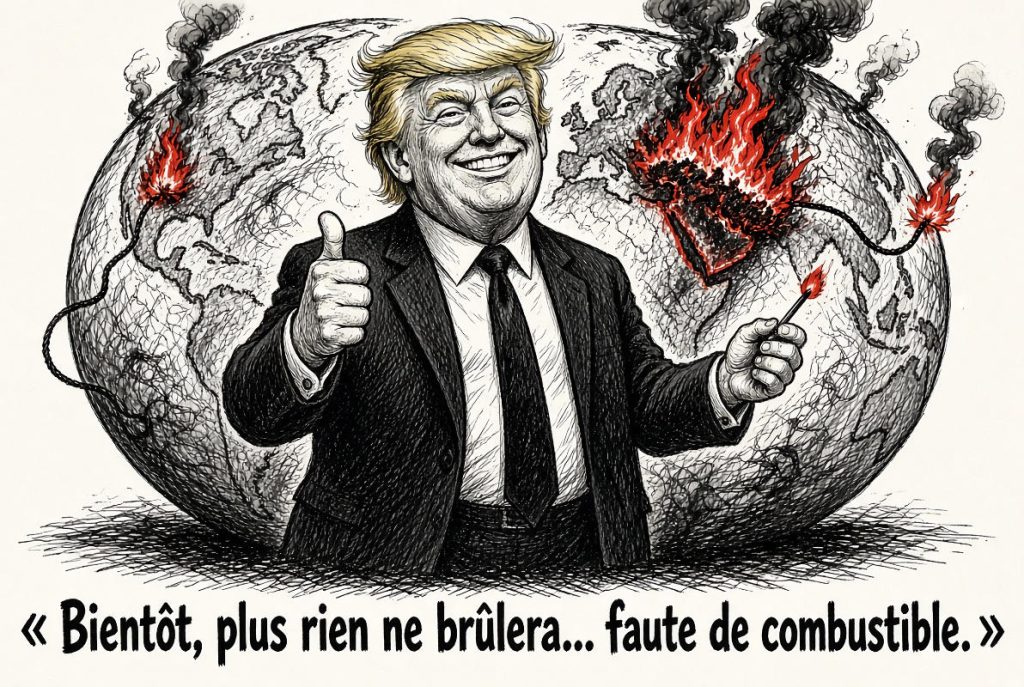
One detail escaped no one: for once, Trump avoided the press during this summit, keeping it largely at a distance from his meeting with Xi — he who, ordinarily, never misses a chance to hold forth in front of the cameras. Having nothing concrete to announce, exposing himself risked, at best, achieving nothing at all. But this silence says a great deal, on its own, about the scale of the global disaster that this same man — the self-proclaimed champion of the deal, the man who fancies himself a peacemaker — has sown everywhere he has laid a hand since returning to power.
The diesel affair is the most tangible illustration of this for the average American voter. The price of diesel, already up 60% since the outbreak of the war against Iran, was brushing $6.05 a gallon by late September — an all-time high. To try to curb the spike, the Trump administration is now weighing an outright ban on US diesel exports. The problem: oil industry professionals themselves warn that this measure, meant to relieve farmers, could instead push domestic prices up rather than down — the fix threatens to worsen the very ill it claims to cure. Republican Senator Chuck Grassley (Iowa), farm country if ever there was one, has had to publicly demand this very embargo — a sign of the panic spreading even within the president’s own party.
Electorally, the numbers do not lie. According to late-September polling averages, Trump’s approval oscillates between 33% and 39% depending on the pollster, with a net rating hovering around -25 points — worse than George W. Bush’s score on the eve of the 2006 wave that cost Republicans control of both chambers of Congress. More telling still: his approval among independent voters has fallen to 34%, below the 36% threshold that preceded the 2018 Democratic wave — 41 House seats lost. Even his own camp is beginning to desert him: net approval among Republican voters dropped from +54 to +43 points in a single month, according to one pollster. So, an electoral slap at the November midterms? Given these numbers, the word already seems too weak. It is a tidal wave, rather, that the man behind The Art of the Deal should be bracing for — he who, in Washington, seemed to prefer letting Xi Jinping re-read his own strategy rather than face questions about his own.
On the margins of the summit, one anecdote may sum up the mood of the host better than any analysis. During the state dinner, Trump offered his Chinese guests what he himself called a “special treat“: a tour of the construction site of his future White House ballroom — whose every design choice he loves to discuss, presenting it readily as part of his legacy — before showing Xi, an “expert on stone” in his own words, the new helipad under construction on the South Lawn. Not far away, near Arlington National Cemetery, another project is well underway: his 76-metre triumphal arch, whose construction the administration now justifies on military grounds — sniper positions, drone storage — in order to bypass the need for congressional approval.
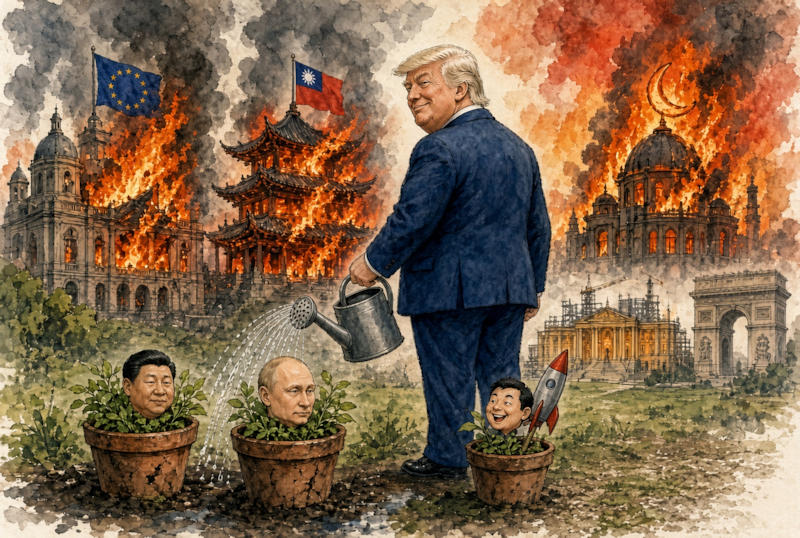
While America’s allies in Europe, Asia, and the Middle East watch the house burn, how much longer can Donald Trump keep up this campaign of deconstruction — one that ultimately benefits his “friends” Putin, Xi Jinping, and, let’s not forget, “Rocket Man”?
François de Vries
See also;
- « Tout en vitrine, rien en cuisine » — (2026-0926)
- « Viel Schein, wenig Sein » — (2026-0926)
- « Heavy on pomp, light on substance » — (2026-0926)
Decoding — The wolf in the sheepfold
This vacuum, which the world’s press describes with one voice, did not stay empty for long. In the Middle East, Saudi Arabia, Pakistan, and Turkey formalised, on 7 August, the Mecca defence pact — built on the mutual defence agreement signed a year earlier between Riyadh and Islamabad, which several officials from both countries have hinted covers a form of extended nuclear deterrence. Three middle powers find themselves allied here without Washington being either the pivot or even a witness: Pakistani nuclear power, Saudi financial and oil power, NATO’s second-largest army on the Turkish side.
Nawaf Kabbara, in a sharp analysis published by our colleagues at Levant Time, offers an image worth borrowing as is: he had already, back in 1988, compared the Middle East to a joint-stock company, with the United States alone chairing the board. “The company still exists,” he writes today, “but the chairman of the board is no longer able to decide alone.”
What the Mecca agreement signals, in his view, is not necessarily a fourth hegemonic project alongside Israeli, Turkish, and Iranian ambitions, but a project of balance: neither Iranian hegemony nor Israeli supremacy, but several powers that now refuse to let a single actor dictate the rules of the regional game alone — and which, notably, need not align with any major bloc to achieve this, moving freely between Washington, Beijing, and Moscow.
In Europe, the movement is of the same nature, if not the same scale: the British press itself, as we have seen, is now pressing London and Brussels to build their own strategic autonomy rather than continuing to bet on an increasingly unreliable American umbrella. An ally seeking a new balance is an ally that has stopped trusting the old one.
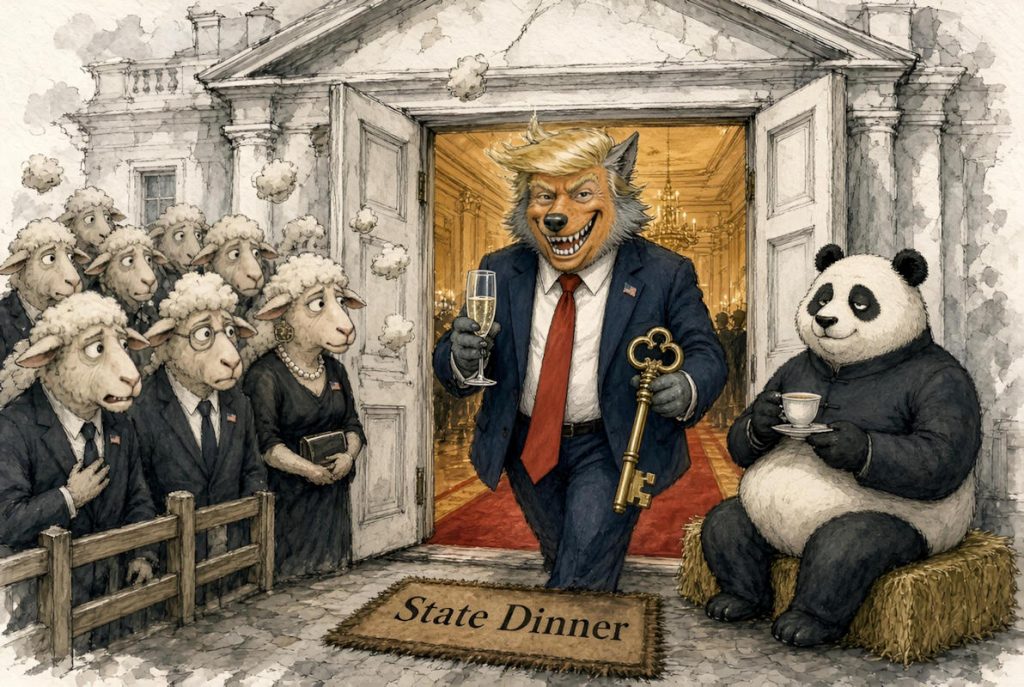
The paradox is complete: at the very moment when its own security and military apparatus is eroding — paralysed by vanity projects rather than strategic vision, disavowed even within its own ranks, forced into constant back-pedalling on diesel as on Iran — Donald Trump has thrown the door wide open to those America itself designates as its strategic rivals. He received Xi Jinping with great pomp, courted Putin, and let an almost friendly silence hang over North Korea. The wolf did not need to force its way into the sheepfold: the shepherd, busy admiring his own building projects, opened the gate for it himself.