On September 20, 2026, Germany suffered an electoral shipwreck of a brutality unseen since 1949. France has not yet had its own September 20 — but it already shows every symptom, simply spread over a slower calendar: a radical left gaining ground method by method rather than election by election, a radical right split between de-demonization and one-upmanship, and two outside patrons, one in Washington, the other in Moscow, applauding on both sides of the Rhine. “Fluctuat et mergitur”: Paris’s motto, with one word reversed, could just as well apply to Berlin. The question raised at the close of the first piece deserves an answer: the same vertigo grips both countries. It simply doesn’t move at the same speed.
The Essentials
- Mélenchon himself theorized the parallel as early as July 2026, hailing Die Linke’s breakthrough ahead of the SPD as the German equivalent of what LFI does to the PS.[01]
- Süddeutsche Zeitung documents that Berlin’s Linke has “perfected for the urban space” the AfD’s rural field method — presence, listening, absence of platform — applied to an opposite-facing resentment.[02]
- Sahra Wagenknecht’s BSW, conceived as a bridge to disillusioned but immigration-hostile left-wing voters, failed twice in fifteen days (Mecklenburg, Berlin) after claiming it could “bring down Merz.”[03]
- On the French side, the RN and Reconquête reacted in scattered fashion to the AfD’s breakthrough: embarrassed silence from Le Pen and Bardella, open celebration from Zemmour.[04]
- Jeanette Süss (Cerfa/Ifri) establishes that the RN, unlike the AfD, chose de-demonization to become “salonfähig” — a path German coalition logic structurally slows compared to France.[05]
- The Kremlin publicly attributes the AfD’s success to the end of cheap Russian gas purchases; a Putin economic envoy is said to have begun preparations for a meeting with the party’s leaders.[06]
- Andreas Rosenfelder (Welt) invokes the scenario of Michel Houellebecq’s Submission to describe Germany’s geographic fracture — blue countryside, dark-red metropolises — and cites King’s College’s warning of a possible “coming civil war.”[07]
Contents
1. Die Linke and LFI: the same method, a head start on the German side
On July 17, 2026, when a poll first placed Die Linke ahead of the SPD, Jean-Luc Mélenchon tweeted the parallel without hesitation: “Just like in France with LFI, the new radical left is replacing the old left clinging to the center.”[01] It is he himself, then, who theorizes the structural resemblance — a radical left party supplanting the historic social-democratic party, on both sides of the Rhine.
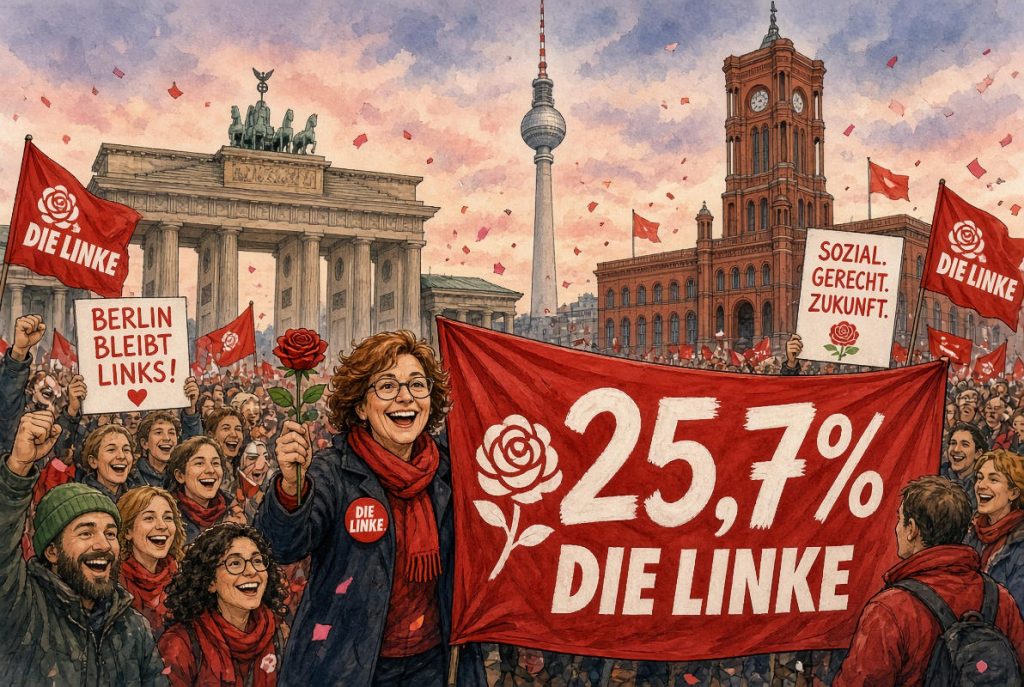
But it is Süddeutsche Zeitung, in its analysis of Elif Eralp’s Berlin breakthrough, that pushes the comparison furthest — toward a more unsettling conclusion than Mélenchon’s. Tim Frehler writes that Berlin’s Linke has “perfected for the urban space what the AfD has known how to do for years in sparsely populated regions” — being present, meeting people, talking about their problems rather than politics. Le Monde, however, offers a useful methodological clarification: the direct source of inspiration is not the AfD but Bernie Sanders’s American campaigns — an app identifies in advance the buildings with high “electoral potential,” activists canvass on the ground, and feedback is then centralized. Frehler’s parallel thus rests on the outcome (a field presence the AfD already mastered), not on the lineage Die Linke itself claims. And the parallel doesn’t stop at method: “Just as the AfD offered a refuge to anti-vaxxers, the Linke offered a comfort zone to Gaza critics of Israel and intifada activists.”[02] Meredith Haaf, in the same paper, puts the thesis even more bluntly: the Linke is the AfD’s exact political opposite, “but in strategy and method, it resembles it more and more.”[08]
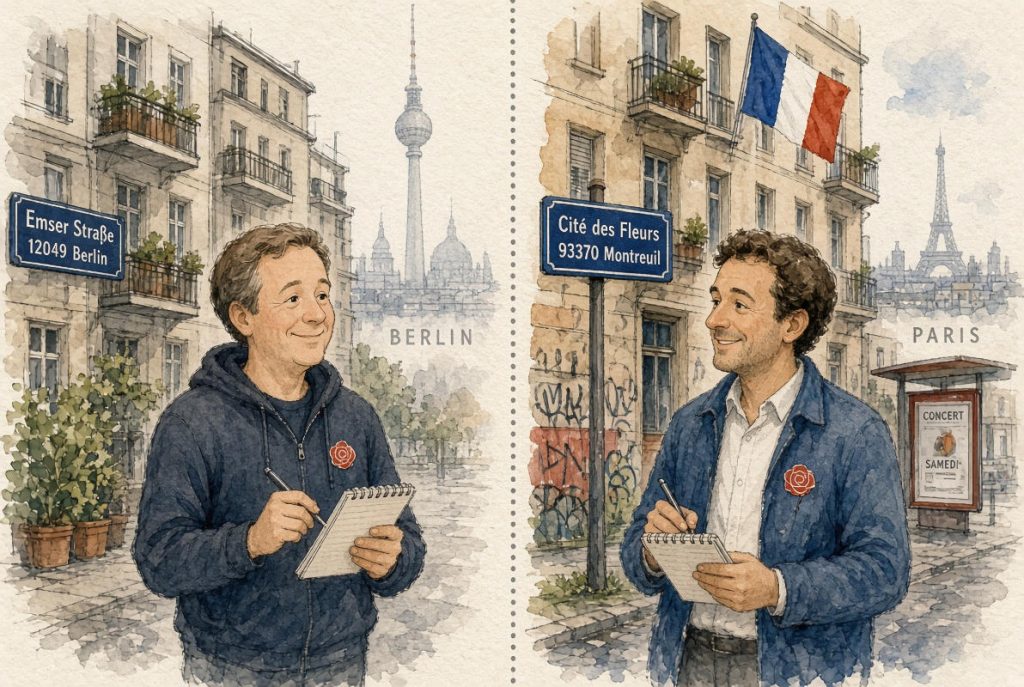
The French shorthand has its limits. The LFI–Die Linke comparison holds on the methodological axis — but not on the electoral one. Die Linke did indeed supplant the SPD; LFI, in France, remains largely rejected in public opinion: an April 2026 survey showed 81% of French people would be unhappy with a Mélenchon victory, and 73% consider it unlikely they would ever vote LFI.[09] The resulting strategic problem is specifically French:
LFI is arithmetically necessary in the first round and electorally disqualifying in the second — an equation Die Linke, in Berlin at least, appears to have solved.
2. The Wagenknecht Operation: the cautionary tale that should alarm France’s radical left
The BSW was born in January 2024 out of a split from Die Linke, with a precise bet: capture a disillusioned left-wing electorate while also winning back part of the right on immigration — one in five BSW voters came from the right.[10] This is precisely the bet some in France sometimes attribute to a radical left tempted by identity-based sovereigntism.
The result, fifteen months later, is a textbook failure. Taz sums up the contrast in a biting formula: “Große Klappe, zu wenig dahinter” — all bark, no bite.[11] Having narrowly entered the Saxony-Anhalt Landtag on September 6, the BSW falls back below 5% on September 20, in both Berlin and Mecklenburg-Pomerania. The contrast is all the crueler given that Wagenknecht, in both Länder, gave speeches bordering on delusions of grandeur: “Wer BSW wählt, kann Kanzler Friedrich Merz stürzen” — voting BSW could topple the federal chancellor himself.[11]
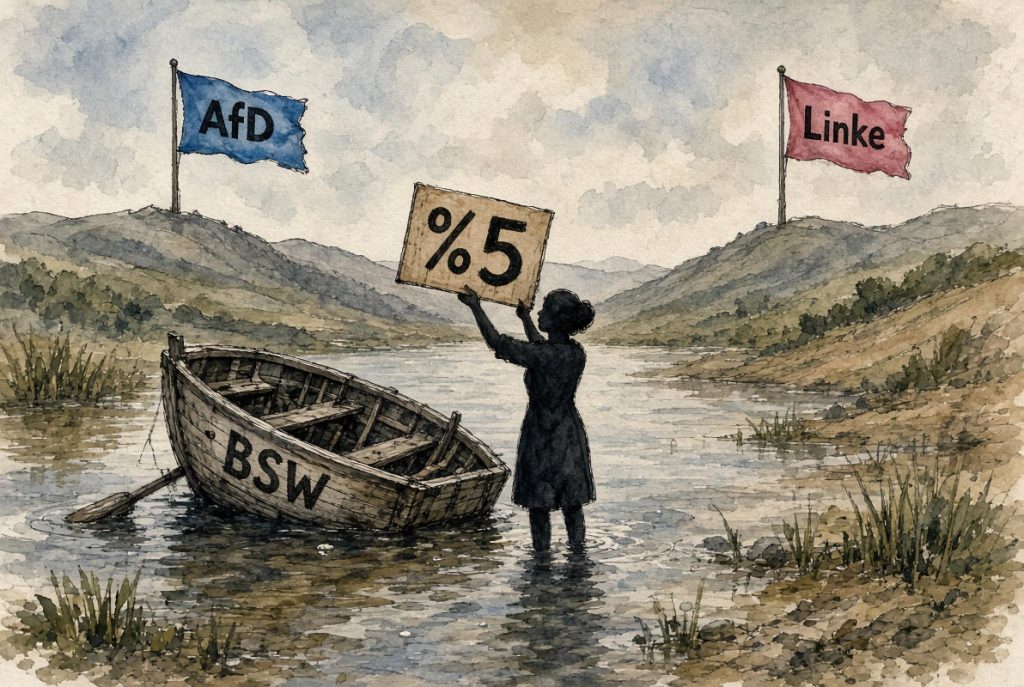
More revealing still: in Thuringia, Wagenknecht explicitly floated the idea that the BSW might support an AfD government under an independent state premier.[12]
It is the complete trajectory of the failed bet — from anti-system martingale to electoral prop for the far-right party it claimed to be fighting. Jan van Aken’s (Die Linke) remark comparing the BSW to the Pirate Party — “we won’t even remember it in two or three years” — finds its first empirical confirmation in these two elections.[13]
3. RN-AfD: the refused mirror
The RN’s reaction to the AfD’s breakthrough on September 6 is a document in itself. Marine Le Pen and Jordan Bardella stayed silent, while Éric Zemmour and Reconquête openly celebrated the result — revealing an acknowledged rift within the French far right over how to handle the AfD.[04] The RN and the AfD had already broken ties in the European Parliament after Maximilian Krah’s remarks downplaying Waffen-SS crimes — a strategic rupture, not merely a tactical one.
But this cordon sanitaire has its limits, even on the German side: what the CDU displays in Berlin gives way in Strasbourg. In the European Parliament, the EPP regularly relies on the “Venezuela majority” — EPP, Meloni’s ECR, the RN’s Patriots, and the AfD’s ESN — to unravel the Green Deal or toughen migration law. François-Xavier Bellamy goes so far as to describe setting up a WhatsApp group with AfD and Patriots staffers to prepare a joint text on deportations.
The already-noted internal rift within the French far right sharpens further: RN lawmaker Franck Allisio distanced himself after the AfD’s September 6 victory (“We have nothing to do with them”), while Fabrice Leggeri (Patriots) instead argues for ending the cordon sanitaire, “to take election results into account.”
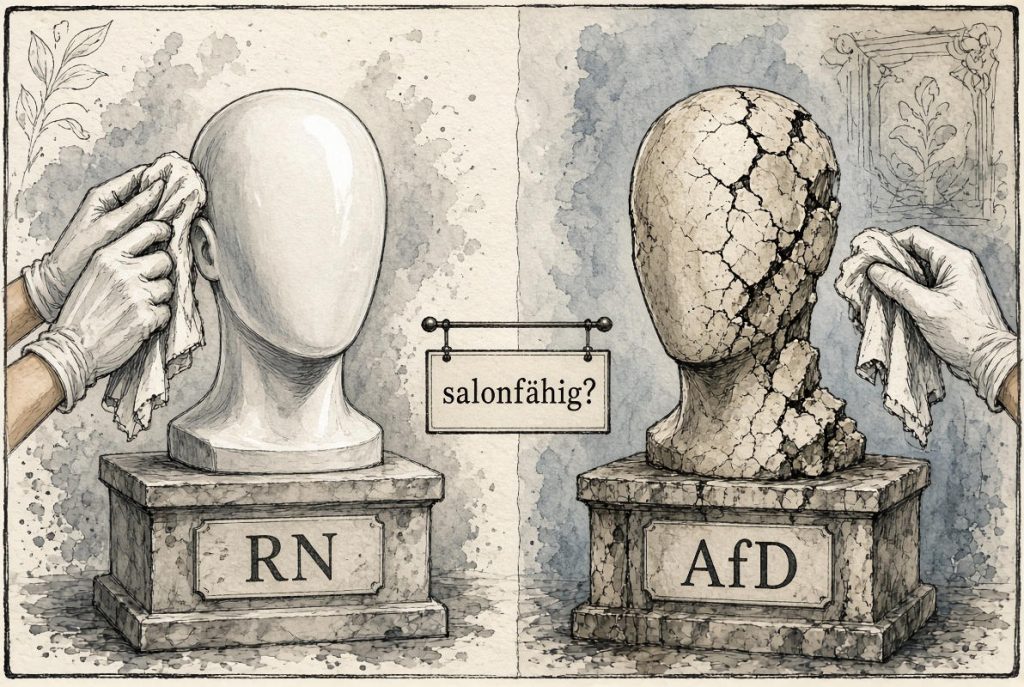
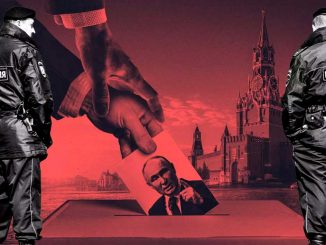
Jeanette Süss, a researcher at Cerfa (Ifri), interviewed by Le Figaro, offers the most useful reading key in the whole dossier: the RN, by distancing itself from the ethno-racial positions and rhetorical excesses of its early days, managed to become “salonfähig” — presentable — a path theoretically available to the AfD in time, but one its current, more radical stance and less flexible platform make far harder to follow.[05] She adds a decisive structural point: Germany’s coalition-based system mechanically complicates the “respectabilization” of a party every other one refuses to share power with — whereas in France a single runoff can be enough to take power without a coalition. This is precisely what explains the speed gap between the two countries: French electoral mechanics accelerate what German institutional mechanics slow down.
4. The Trump-Putin Triangle: two beneficiaries, two narratives
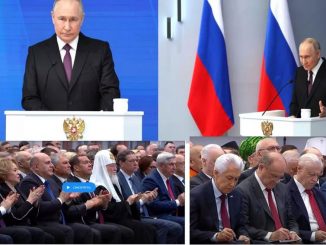
On the night of the results, Kremlin spokesman Dmitry Peskov attributed the AfD’s success to Germany’s decision to stop buying cheap Russian gas in favor of costlier American energy — an economic rather than ideological argument, but one whose effect amounts to the same thing: legitimizing the AfD’s surge as a rational reaction rather than a drift.[06] More significant still: two sources told Reuters that Putin’s economic envoy and AfD leaders had begun preparations for a meeting.[06]
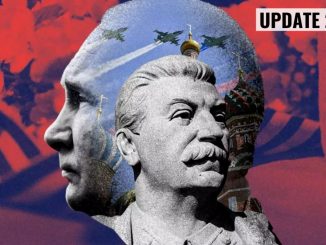
The Christian Science Monitor spells out Russia’s strategic stake: the AfD does not merely have reservations about aid to Ukraine — it wants to end it outright, and advocates restoring pre-war economic ties with Russia.[14] Putin’s bet, the American magazine notes, has long rested on the belief that he can outlast the West, banking on the erosion of European priorities by domestic politics.
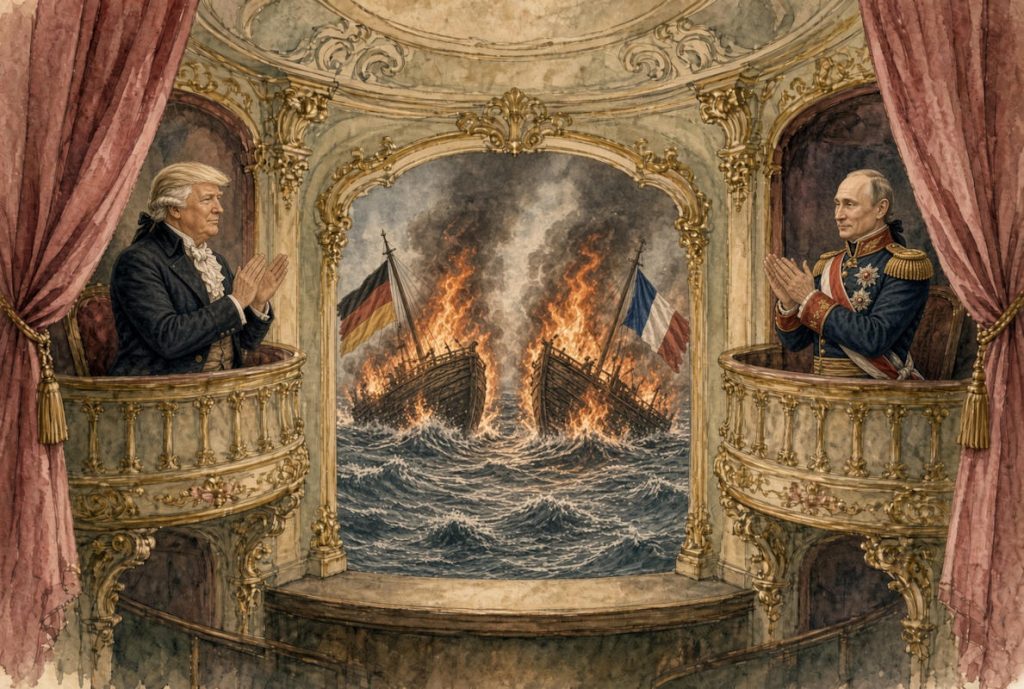
On the MAGA side, the mechanics are even more explicit: Donald Trump shared, without comment, projections showing the AfD in the lead; Elon Musk offered a curt “Gut gemacht!“; and Viktor Orbán — even as his own party had just lost power in Hungary — spoke of “a giant election night for Germany and for Europe.” Telling detail: the AfD remains a pariah even within the European far right, with Marine Le Pen and Giorgia Meloni having broken with it in the past, deeming it too radical — which, seen the other way round, could bolster their own positioning as the “reasonable” version of right-wing populism ahead of coming elections in France, Spain, and Italy.[15]
5. Was Houellebecq Right? Geographic fracture as a shared grammar
This is the most ambitious piece in this whole run of German coverage. In a Welt commentary, Andreas Rosenfelder directly invokes Submission, Michel Houellebecq’s 2015 novel, and its scenario of a final confrontation between an Islamo-left bloc and an identitarian-nationalist party.[07] Rosenfelder observes that in Germany today, rural areas vote massively blue (AfD) while high-immigration urban centers turn dark red (Linke) — and asks whether these fault lines aren’t already tracing those of the “coming civil war,” a warning he attributes to David Betz, professor of strategic studies at King’s College London.
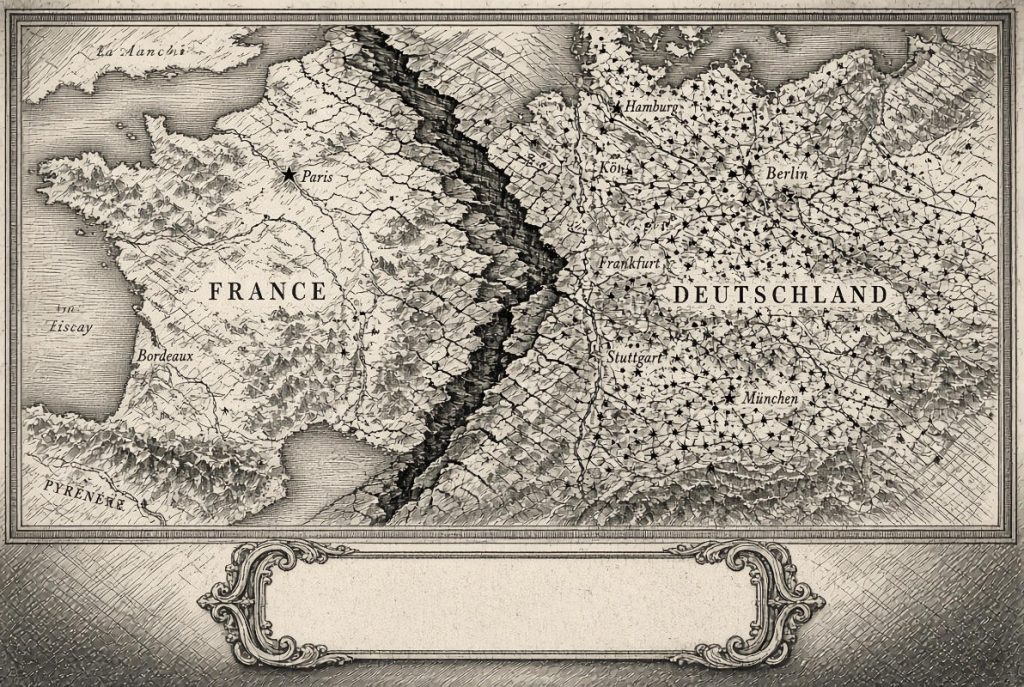
Confessional data, gathered the same day by Welt, empirically supports this reading: 51% of Berlin’s Muslim voters backed Die Linke, against 30% and 27% respectively of Catholic and Protestant voters who backed the CDU.[16] This is not merely a matter of generation or income — it is a polarization that follows identity and confessional lines on both sides of the spectrum.
It remains to be seen whether this grammar transposes as-is to France. The rural-urban divide exists there too, but the centralization of French presidential power — unlike German federalism, which gives each Land its own tipping-point experience — could produce a more brutal and faster effect once it shows up nationally, rather than Land by Land as in Germany since September 6.
6. What the press of both countries is saying — and not yet saying
German media itself has folded the French comparison into its diagnosis. Michaela Wiegel, FAZ’s Paris correspondent, quotes François-Xavier Bellamy (LR) drawing the parallel himself: “Germany is currently experiencing what we know from France.” Wiegel traces for her German readers the warning trajectory of the French Républicains: Valérie Pécresse’s 4.7% score in 2022, the party’s worst result since 1958 despite a partial embrace of RN rhetoric, then Éric Ciotti’s split — a double-edged warning that Wiegel spells out explicitly: copying the far right’s rhetoric did not prevent the Républicains’ collapse; it may even have hastened it.[17]
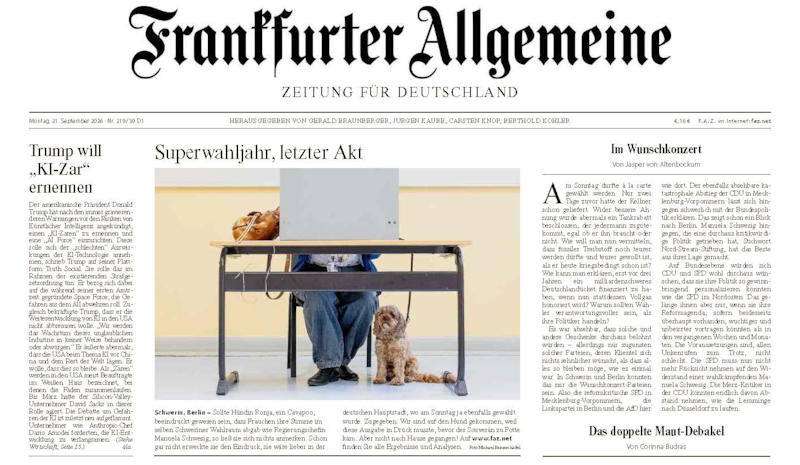
What French media, conversely, has not yet fully articulated is the symmetry of the electoral mechanism documented by Süddeutsche Zeitung — the question of whether LFI is methodically “perfecting for the urban space” what the RN practices in rural and peri-urban areas.
It is an angle German media dared to tackle head-on for its own country; French media, more cautious on this ground, has not yet done so for its own. Not yet!
Joël-François Dumont
Press review of September 22, 2026: German elections of September 20 (Berlin and Mecklenburg-Western Pomerania)
- “CDU: Sehen Sie das auch? (1)” — (2026-0922)
- “Fluctuat et mergitur (2)” — (2026-0922)
Press review of September 11, 2026: German elections of September 6 (Saxony-Anhalt)
- “CDU: The revolt Ahead of Schedule” — (2026-0911)
- “Saxony-Anhalt: The Russian Disinformation Campaign Ahead of the Vote” — (2026-0908)
- “Saxony-Anhalt: The AfD Landslide” — (2026-0907)
Notes
[01] Jean-Luc Mélenchon (@JLMelenchon), X, July 17, 2026.
[02] Süddeutsche Zeitung, “Die Methode AfD,” Tim Frehler, Sept. 22, 2026.
[03] taz, “Große Klappe, zu wenig dahinter,” Rainer Rutz, Sept. 21, 2026 — quoting Sahra Wagenknecht.
[04] Euronews, “AfD victory exposes divisions in France’s far-right as National Rally stays silent,” Sept. 7, 2026.
[05] Jeanette Süss (Cerfa/Ifri), interview with Nicolas Barotte, Le Figaro, Sept. 22, 2026.
[06] Reuters, cited by Daily Maverick, “Kremlin says AfD’s victory in Germany due in large part to lack of cheap Russian gas,” Sept. 21, 2026.
[07] Andreas Rosenfelder, “Houellebecqs Szenario,” commentary, Die Welt, Sept. 22, 2026.
[08] Süddeutsche Zeitung, “Die Linke in Berlin,” Meredith Haaf, Sept. 22, 2026.
[09] The Conversation, “Alliance ou rupture avec Mélenchon: l’équation insoluble de la gauche,” Sept. 2026.
[10] Wikipedia EN, “Alliance Sahra Wagenknecht — For Reason and Justice,” accessed Sept. 2026.
[11] taz, “Große Klappe, zu wenig dahinter,” Rainer Rutz, Sept. 21, 2026.
[12] Wikipedia EN, “Next Thuringian state election,” accessed Sept. 2026.
[13] Yahoo/Observatoire de l’Europe — quoting Jan van Aken.
[14] Christian Science Monitor, “How Putin could benefit from the far right’s victory in Germany,” Sept. 2026.
[15] Focus, no. 38, Sept. 11, 2026 — cf. “CDU: La révolte avant l’heure,” European-Security, Sept. 11, 2026.
[16] Die Welt, “Linke punktet bei Muslimen,” Anna Kröning, Sept. 22, 2026.
[17] Michaela Wiegel, “Déjà-vu in Frankreich,” FAZ, Sept. 22, 2026.
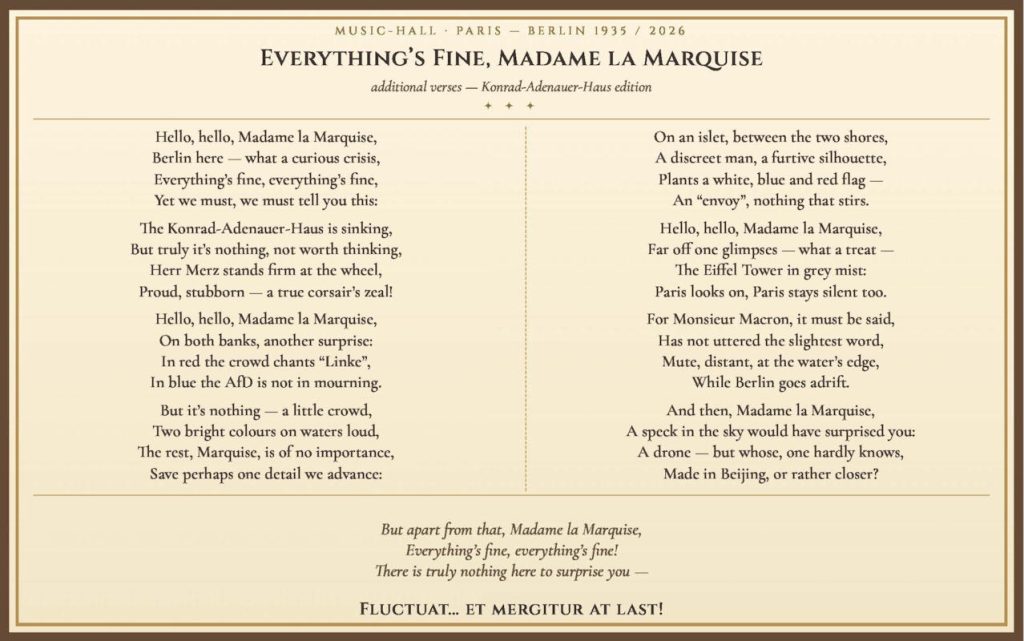
Everything’s Fine, Madame Marquise (additional verses — Konrad-Adenauer-Haus edition)
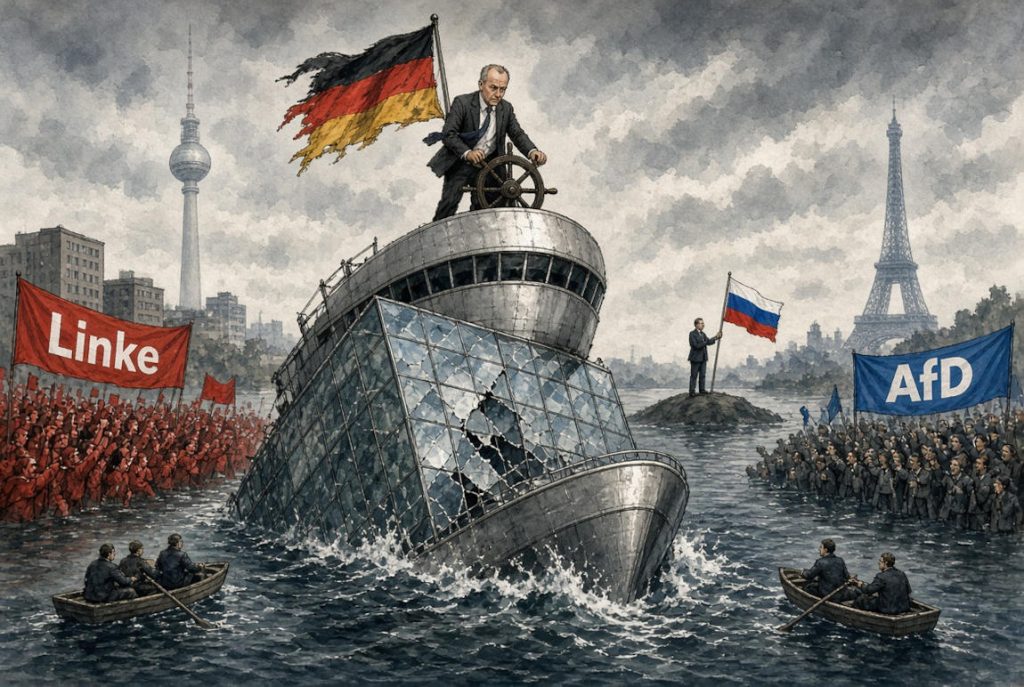
Analysis: Fluctuat et mergitur
Paris’s motto promises it is battered by the waves yet never sinks. In Berlin, that promise no longer holds — while in Paris, it has never yet been tested by a genuine electoral shipwreck.

The mechanism, however, is rigorously the same on both sides of the Rhine: a radical left learning to talk to people rather than lecture them; a radical right torn between polishing itself for the long haul and staying raw to convince; and two outside patrons — one in Washington, the other in Moscow — who need do nothing more than applaud at the right moment.
What differs, then, is not the nature of the vertigo but its speed of propagation. Federal Germany experiences its upheaval Land by Land, within a coalition mechanics that absorbs each shock before it generalizes — which explains why it took three elections and two weeks for Berlin to understand what Saxony-Anhalt had already told it on September 6. France, by contrast, concentrates its power in a single election, a single man or woman, a single night: the day the vertigo strikes there, it will have neither a Land nor a regional laboratory in which to test itself first. It will strike all at once, like a tsunami rather than a tide.
This speed gap is no longer merely an electoral curiosity: it worries people as far away as Brussels. “The Franco-German tandem remains an absolutely essential driving force for Europe. If one member of the tandem weakens, that slows the decision-making process even further,” warns MEP Bernard Guetta — before adding, more gravely still: “I see, in France, in Poland, in several other European countries, a rising fear, a rising distrust of Germany. That worries me more than anything else.”
Socialist MEP François Kalfon broadens the point to the economy: on China, he says, “the Germans are on the front line against the threat, but their industrial base has been Sino-German for fifty years. This is a tipping point for them” — a structural dependency dating back to the 1970s-80s (Volkswagen set up in China as early as 1984, long before Beijing’s WTO accession) — and one that, better than any other factor, explains German reluctance to toughen its stance toward China — a Germany that, Kalfon regrets, has remained “very national on defense and space,” while France pushes for a common response.


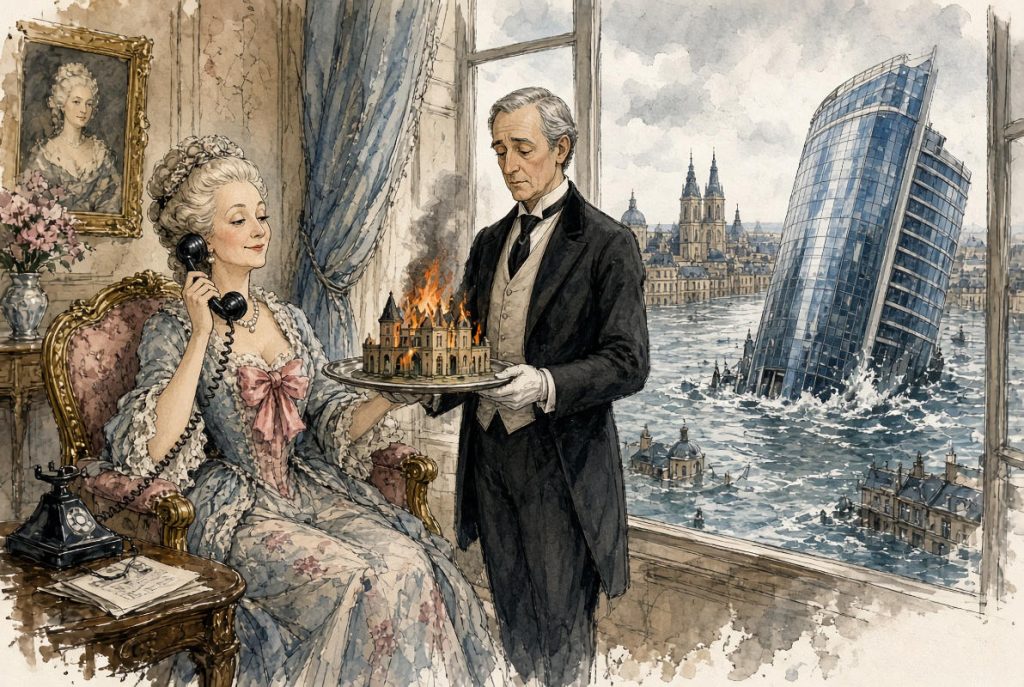
“Just some passing ripples? You reassure me, my good Günther, faithful butler” — the marquise, whose feet are not yet in the water, remains serene on the telephone while, through the window, the two houses burn side by side beneath their respective flags: for now, no one wants to get up and look outside — AI Image © European-Security
It may be the only real lesson Paris can draw from Berlin this week: not that it would be safe, but that it will not get the gradual warning Germany, however haltingly, ultimately benefited from. It remains to be seen whether one can learn from a shipwreck one has not yet had the leisure to watch coming from afar.