There are meetings at the Élysée that make less noise than they should, and others that make a great deal of noise for, in the end, not very much — or rather, for something else entirely. Saudi Crown Prince Mohammed Bin Salman’s visit to Paris falls squarely into that second category, and Hedy Belhassine takes visible delight in picking it apart.
On paper, the story of the day was a €6 billion leisure park in Cergy-Pontoise, presented with great fanfare by the President as the biggest deal since Disneyland Paris. In substance, some twenty agreements were signed that day — and curiously, it was the sole manga-and-video-game project that made headlines, while Israel’s recognition conditioned on a Palestinian state, the Iranian and Yemeni threat to the Kingdom, the Turkish-Pakistani-Saudi defence pact, and the near-rupture in Riyadh-Abu Dhabi relations all slipped completely under the radar.
Belhassine doesn’t stop there: he digs up a forgotten ghost, that of Gaith Pharaon — a colourful Saudi financier who, in the 1980s, already owned a 55-hectare plot in… Cergy-Pontoise, where he had built an amusement park, Mirapolis, liquidated two years after its inauguration by Jacques Chirac. A curse that may well repeat itself — unless, as the author suggests between the lines, the real strategic project lies elsewhere: in a certain “Prometheus Plan,” priced at €620 billion.
Hold on tight — the irony here is wielded like a blade.
The Essentials
- During Crown Prince Mohammed Bin Salman’s visit to the Élysée, roughly twenty cooperation protocols were signed; only three drew media attention — the Jeddah port deal (CMA CGM), the renewal of French funding for the AlUla site, and above all a €6 billion leisure park project in Cergy-Pontoise
- Largely overshadowed: Israel’s recognition conditioned on the creation of a Palestinian state, the Iranian and Yemeni threat bearing down on the Kingdom, the mutual defence agreement signed in Riyadh with Turkey and Pakistan, and the near-diplomatic rupture between Saudi Arabia and the UAE
- The author recalls that the cliché of the “uncultured, manipulable Saudi” ignores a solid scientific and industrial reality (internationally renowned surgeons, chemists, biologists; a supercomputer more powerful than the CNRS’s)
- A striking historical parallel: the plot targeted in Cergy-Pontoise was already, in the 1980s, the property of Saudi financier Gaith Pharaon, who had built the Mirapolis park there — inaugurated by Jacques Chirac in 1987, liquidated two years later
- The theme park industry is structurally high-risk: successes (Disney, Compagnie des Alpes) are the exception, bankruptcies the norm — including for several wealthy Arab investors in the past (Khashoggi, Gaddafi, Rifaat al-Assad, in Spain)
- The author suggests the real stakes of the Franco-Saudi relationship may lie elsewhere: in the “Prometheus Plan,” a project costed at €620 billion meant to lift France to third place worldwide in artificial intelligence, modelled on the Shah of Iran’s financing of the Eurodif programme in 1974
Contents
by Hedy Belhassine (Hedy Belhassine’s Blog) — Paris, September 1, 2026.
Following a meeting at the Élysée with the Saudi Prince, the President triumphantly announced the launch of a €6 billion leisure park project in Cergy-Pontoise. A decryption.
In the mind of France’s elites, the people of Arabia are uneducated camel-drivers, easy to manipulate. They have the money, we have the ideas. Let’s do business. They’ll get taken for a ride.
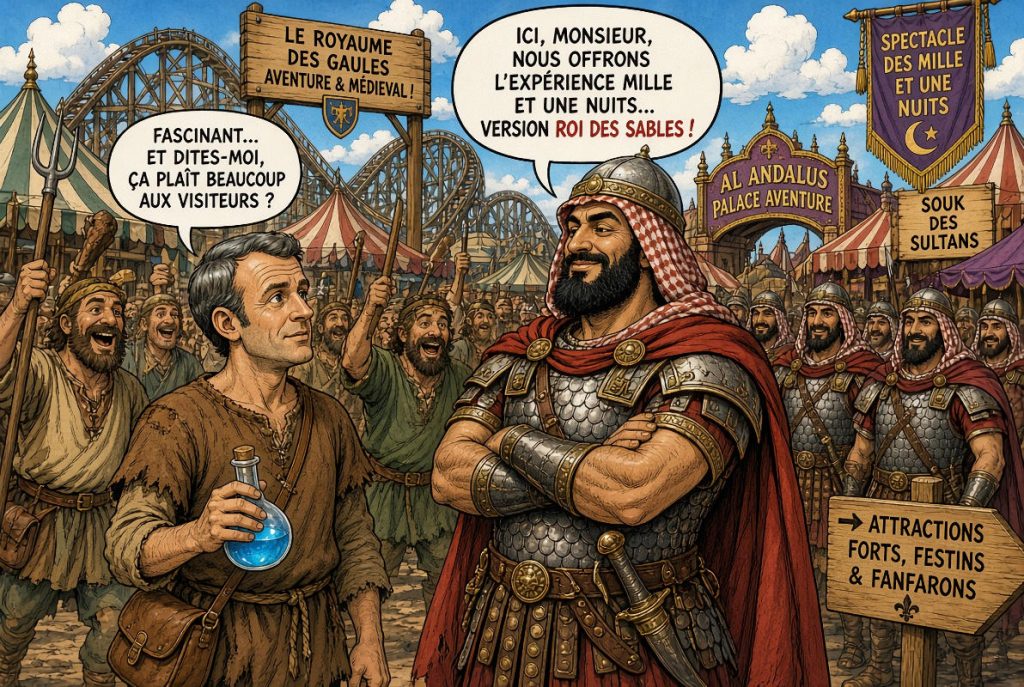
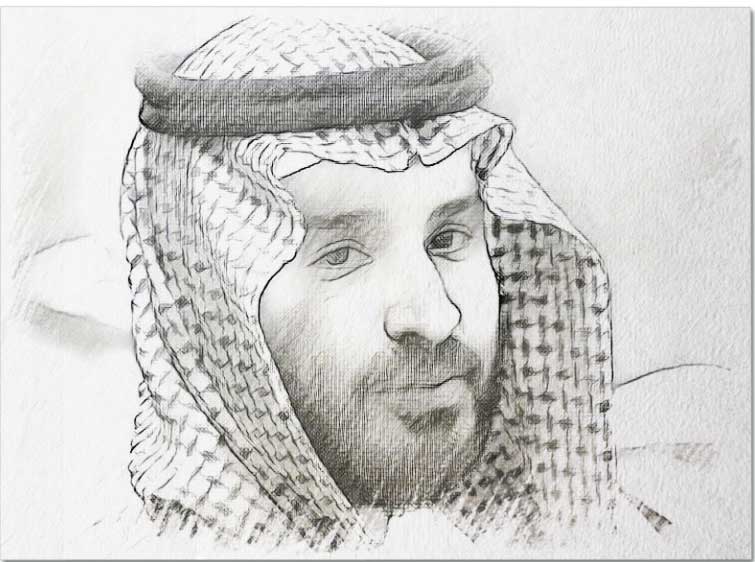
Admittedly, Saudis can appear reckless and whimsical when squandering money on costly frivolities. Crown Prince Mohammed Bin Salman, owner of extravagant yachts, purchased a painting hastily attributed to Leonardo da Vinci for half a billion dollars. In his hand, gold flows like sand. He has always been spoiled, he is capricious and cruel, he has no notion of the value of human life or of objects. He is the Louis XIV of Arabia. Just as Louis spent hours frolicking in his vegetable garden or dancing in the Hall of Mirrors, this one is hooked on video games and manga. And yet, like the Sun King, the desert king is far from a fool. He is the state. The country moves forward and prospers at his command. He is surrounded by a court of shrewd, seasoned advisers. Most are young prodigies from good families, trained at the best American, British and French schools, but there are also venerable, highly experienced elders. All are unfailingly loyal to him.
Arabs Are Not What People Think
Unlike the Frenchman, the Saudi will never flaunt his skills, his knowledge, his expertise. Humility and modesty are virtues taught from a young age. Ask him the size of his fortune, and he will smile, raise his eyes, and reply that only God, who willed it so, knows.
This country is not just a population of the newly rich; it also has its share of the wretched — but also scholars who, in every discipline, equal or surpass our own. Who knows the achievements of Professor Abdullah Al-Rabeeah, a paediatric surgeon, of the chemist Adha Al-Mutairi, of the biologist Hayat Sindi? Who knows that researchers at King Abdulaziz University (KACST) have access to a supercomputer more powerful than the CNRS’s, and have developed lasers and jammers to destroy drones — technologies we urgently need?
And yet the caricature of Saudis persists. “Tintin in the Land of Black Gold” (a bestselling manga of the last century) durably shaped the minds of its readers.
The Smokescreen
So during Bin Salman’s latest visit to Macron, the well-informed media commented on only a handful of the twenty-odd cooperation protocols signed. CMA CGM’s deal on the port of Jeddah, to counter Chinese ambitions. The renewal of the generous, no-strings-attached funding France grants for the development of the archaeological-touristic-cultural site of AlUla, “The Fabulous Franco-Arabian Tale.” And, above all, a mega-manga leisure park project in the Paris suburbs.
Left in the shadows: the trivial-sounding exchanges on Israel’s recognition by Saudi Arabia, conditioned on the creation of a Palestinian state. Ignored: the Iranian and Yemeni threat squeezing the Kingdom of the Sauds in a vice. Overlooked: the recent mutual defence agreement signed in Riyadh with the Turkish president and the Pakistani prime minister. Unnoticed: the near-diplomatic rupture between Saudi Arabia and the United Arab Emirates. Swept aside: US disengagement, the redeployment of defence systems, nuclear energy, the wars in Sudan, Iran, Lebanon, Gaza — so many topics neglected by official communiqués.
A Historical Aside on the Pharaon Project’s Revival
Let’s return to the headline-grabbing news: €6 billion invested in a Cergy-Pontoise leisure park, “unprecedented since Disneyland Paris!” declared Emmanuel Macron. In this long saga, which began before either Bin Salman or Macron was born, we find the curse of Pharaon — named after a collector of gigantic bankruptcies.
Let me open a parenthesis, observed at close range in my turbulent youth.
In May 1968, students turned France upside down. To appease them, Education Minister Edgar Faure promised to build a new university at Vincennes, open to non-baccalaureate holders by the start of the new school year. Promise kept — the buildings rose from the ground in a matter of weeks. It was an unprecedented technical feat, achieved thanks to architect Paul Chaslin, founder of Geep Industrie, Europe’s leading industrialised-construction group. This socialist activist, close to Michel Rocard and a friend of Stéphane Hessel, had revolutionised the building trade. His “YZ” metal-frame system dramatically reduced construction times. Public contracts poured in. But Chaslin’s 200 engineers and 2,000 workers, operating under self-management, set a poor example for employers and for Raymond Barre’s government. The state paid in dribs and drabs; the company filed for bankruptcy.
A saviour immediately stepped forward: Gaith Pharaon, a multi-degreed Saudi, son of the king’s personal physician. At the time, Saudi Arabia’s construction sector was booming. Pharaon understood that building fast meant earning more. The French company he acquired allowed him to erect, in record time, two office-and-hotel complexes in Jeddah and Riyadh, the REDEC Plazas. His investment qualified for French state buyer’s credit. As the icing on the cake, he skimmed an intermediary’s commission off his own company and all its subcontractors. It was the jackpot every property developer dreams of. Pharaon, very much in favour at the French Treasury and Prime Minister’s office, used his position to broker the sale of several other aeronautical and military equipment contracts to Saudi Arabia. He grew richer by the day. Private jet, 60-metre yacht, offices on Place de la Concorde in Paris. He also branched into film production, hotels, and above all banking — in France, in Berlusconi’s Italy, in Ben Ali’s Tunisia, in the United States…
Pharaon’s Curse
Meanwhile, the construction firm Geep Industries — renamed SNCI, and by now methodically stripped bare — filed for bankruptcy. Its assets were liquidated at a good price. Pharaon likely picked up several properties, among them a plot of several hectares in Cergy-Pontoise.
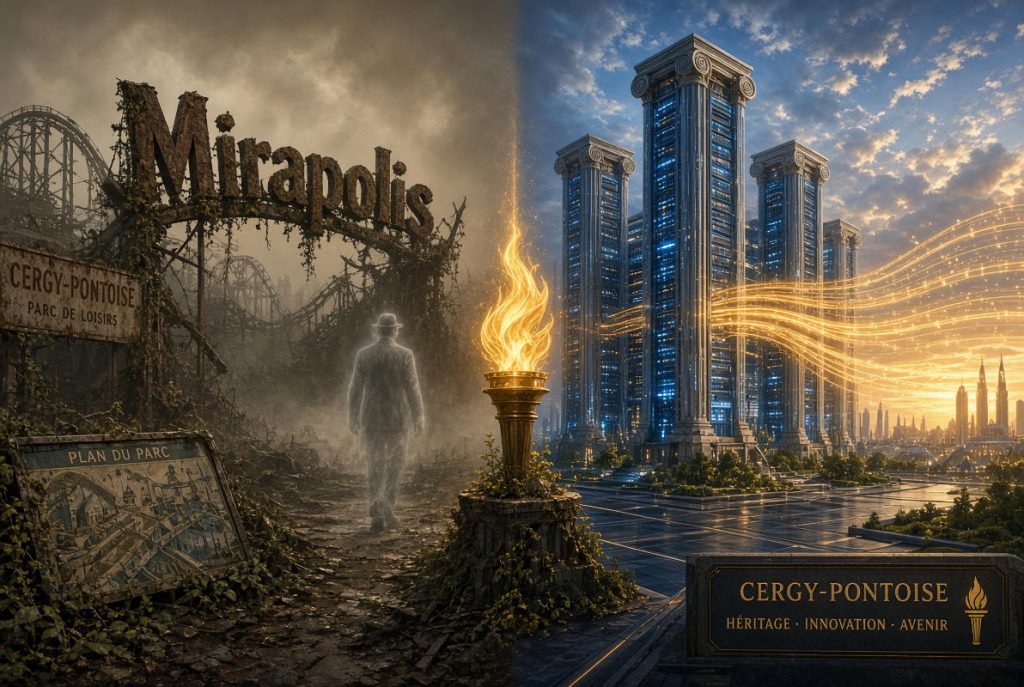
It was by contributing this plot that, in 1987, he assembled a financing consortium for a leisure park inaugurated by Jacques Chirac: Mirapolis. “Gargantua’s Petrodollars,” ran Le Monde’s headline. Two years later, it went into judicial liquidation.
The business world was slow to realise that Gaith Pharaon was a financial fox and a formidable lawyer rolled into one.
In the United States, his affairs turned sour. The FBI launched a manhunt spanning the globe, never catching up with him — for whenever he wasn’t cruising international waters aboard his floating palace, he enjoyed the protection of his king and of the Saudi intelligence services, to whom he was close.
He died peacefully in 2017, in one of his homes in Lebanon.
Today, his children head major businesses in Saudi Arabia, Pakistan, the United States and France. Did they retain, through trustees, inherited ownership of the Mirapolis wasteland in Cergy-Pontoise? Officially, this 55-hectare plot of land belongs to a Belgian lawyer. Will he let himself be expropriated without a fight? Will he contribute the land to an investment with uncertain returns?
The Theme-Park Mirage
The theme-park industry is a mirage churning through enormous sums of money. Once the attendance break-even point is reached, it generates colossal profits. But bankruptcies far outnumber successes. You need the deep pockets of an industry giant like Disney. In France, Astérix, Futuroscope, Walibi… belong to Compagnie des Alpes, itself state-owned via the Caisse des Dépôts et Consignations. Most parks posting double-digit results are family businesses: Bennet (wildlife-themed), de Villiers (historical theme). In Germany, the Mack family owns the country’s largest theme park. In the Netherlands, Efteling is held by a non-profit association.
The business devours advertising budgets and demands precision management, constant vigilance to guarantee ride safety and reliability — its unpredictable attendance defying every forecast in the event of a weather shift or a fatal accident. Many Arab megalomaniacs, egged on by “experts,” have tried to fulfil their childhood dream: Rifaat al-Assad, Adnan Khashoggi, and even Gaddafi once came a cropper in Andalusia.
From Pharaon to Prometheus
One may doubt Saudi Arabia’s sincere willingness to venture into such an undertaking outside Arabia. Likewise, while his dynasty has carefully erased all trace of the Prophet’s life in Mecca and Medina, one wonders why Prince Bin Salman keeps funding the development of the Nabataean archaeological site of AlUla. The answer is probably “because it pleases the French President,” and because it allows for indirectly rewarding a few of the Kingdom’s loyal French friends.
The Dragon Ball project in Cergy-Pontoise is where diplomatic stakes, a shared fondness for video games and manga, a 55-hectare wasteland in the Paris suburbs, and a bottomless sovereign wealth fund all collide. Like Pharaon’s Mirapolis-Gargantua before it, this mega-manga project will likely fizzle out.
Yet there exists a far more ambitious prospect — one that could free France from its dependency on artificial intelligence, now as vital as electricity or oil, and lift it to third place worldwide, behind the United States and China.
It is the discreet Prometheus Plan. Its cost is estimated, at a rough guess, at €620 billion. You read that right. It’s pharaonic! Its authors recommend “a coalition with a partner who will help finance it in exchange for guaranteed access.”
After all, in 1974 France did turn to the Shah of Iran to help finance the Eurodif nuclear programme, to the tune of one billion dollars at the time (€6.7 billion today). Things turned out badly, for reasons we all know.
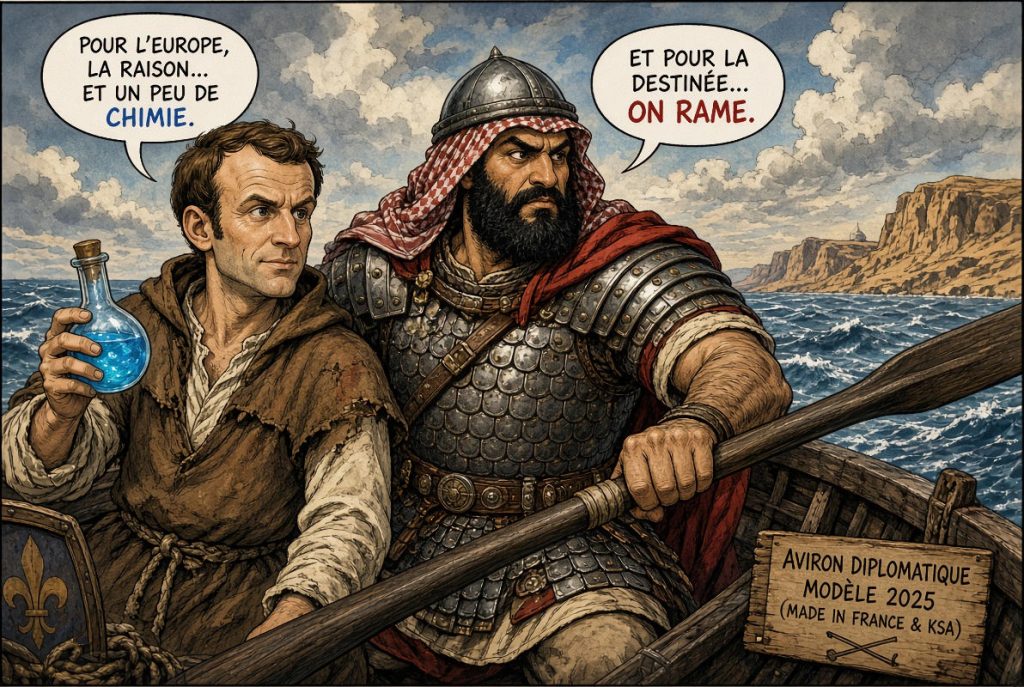
So let us allow ourselves to dream that the Saudi Prince did not come to the Élysée merely to play digital hopscotch on a suburban wasteland. €620 billion for France’s independence and Saudi Arabia’s security — now there’s a project worthy of Macron’s and Bin Salman’s ambitions!
The President, soon to be freed from his high office, may just have found a job worthy of his talents.
Hedy Belhassine
See also:
- « Macron and Ben Salman’s Amusement Park » — (2026-0901)
- « Der Vergnügungspark von Macron und Bin Salman » — (2026-0901)
- « Le parc des loisirs de Macron et Ben Salmane » — (2026-0901)
Decryption: The True Nature of the Franco-Saudi Relationship
Hedy Belhassine’s talent lies in this pivoting move: starting from a piece of celebrity gossip — a manga-themed park in the Paris outer suburbs — to climb, through historical capillarity, toward a far weightier question: the true nature of the Franco-Saudi relationship, and what it serves to conceal.
The rhetorical device is skilful. By exhuming the story of Gaith Pharaon — the Saudi financier who, in the 1970s, took over a struggling French industrialised-construction firm (a direct heir to the accelerated building effort at the University of Vincennes after May ’68), before stripping it of its substance, skimming commissions at every level, and then building on its ruins a doomed amusement park — Belhassine does not settle for a colourful anecdote. He raises an underlying, almost legal question: who owns that 55-hectare plot today? The Pharaon heirs, via trust structures, or genuinely the Belgian lawyer officially identified as its owner? We will likely never know — and that may be precisely the point.
The heart of the demonstration, however, lies in the contrast he draws between the smokescreen (the park, AlUla, the communications strategy) and the real stakes, carefully passed over in silence by official statements: the reshuffling of regional alliances (Ankara-Islamabad-Riyadh), the internal fragility of the Saudi regime vis-à-vis its neighbours, and tensions with the UAE. These are, ultimately, matters of security and sovereignty.
The final flourish — suggesting the real strategic stake of the Macron-MBS relationship might lie in Saudi financing of the Prometheus Plan, rather than a manga theme park — is admittedly speculative, and the author himself half-concedes as much (“let us allow ourselves to dream”). But the parallel with the Shah of Iran’s financing of the Eurodif nuclear programme in 1974 is not gratuitous: it reminds us that France has, in the past, already bet on foreign financing for a strategic infrastructure deemed vital — a bet that, as Belhassine notes with masterful understatement, “turned out badly, for reasons we all know.”