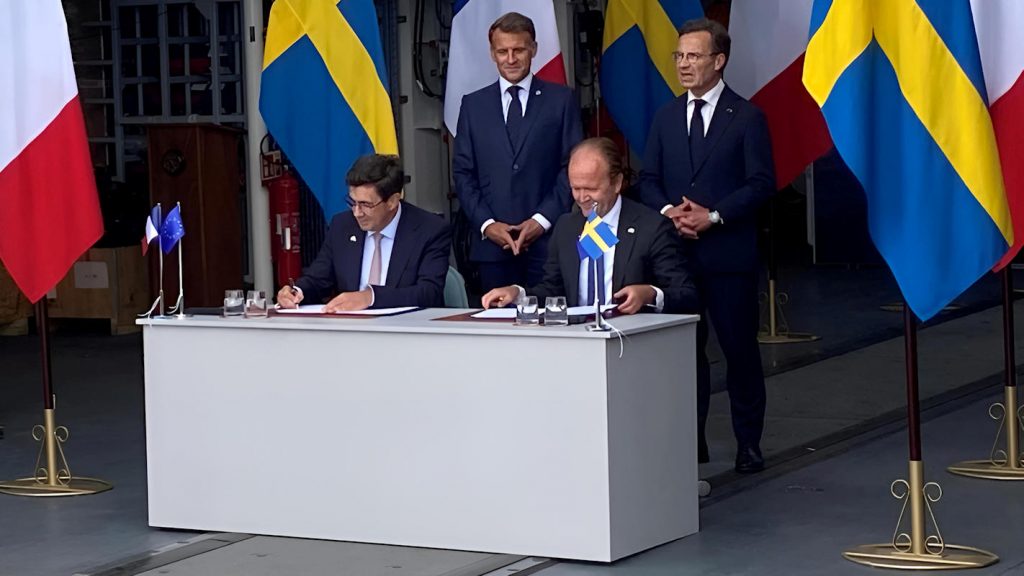
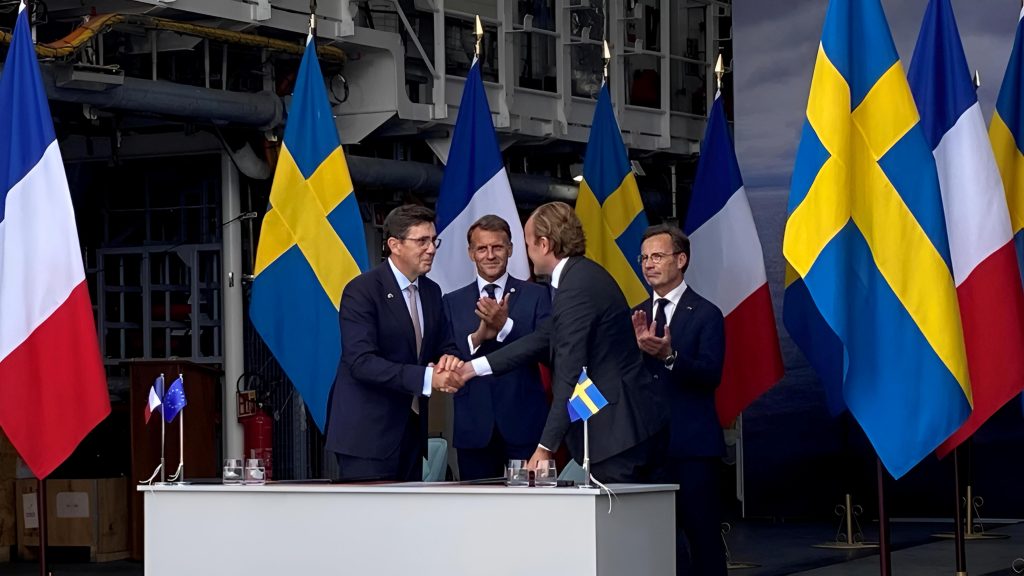
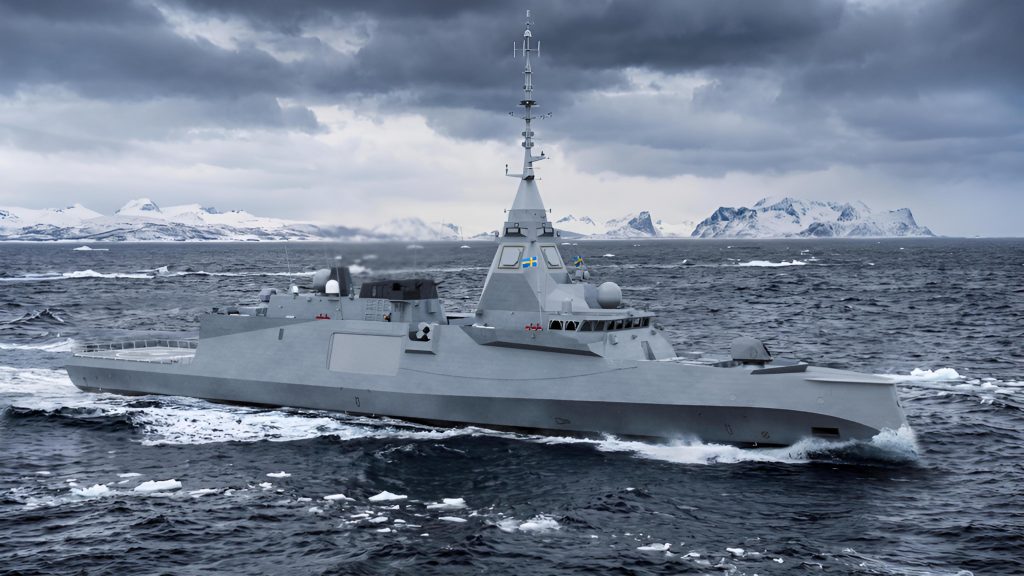
On Monday, August 31, aboard the frigate Amiral Ronarc’h moored in Stockholm, Emmanuel Macron and Ulf Kristersson sealed a ten-year-old Franco-Swedish defence partnership set to run for decades to come — four frigates, a strategic framework agreement, a nuclear steering group, French troops in the Swedish Arctic. In France, the event remained largely off the media radar. In Scandinavia, it made headlines, sparked debate, and, at times, controversy. A press review.
The Essentials
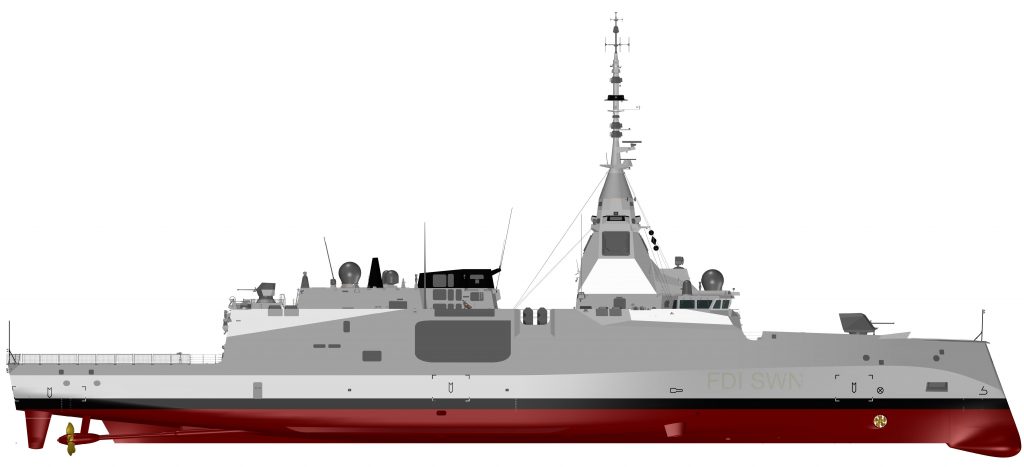
- On August 31, 2026, France and Sweden signed a €4.3 billion contract in Stockholm for four FDI frigates (Luleå class), along with a separate defence cooperation framework agreement
- In France, only Le Figaro, Ouest-France and Le Télégramme devoted in-depth coverage; Les Échos and La Tribune stayed silent; Le Monde settled for an AFP wire on signing day despite serious coverage back in May
- In Sweden, coverage was dense and critical, including a direct clash in Svenska Dagbladet between a naval-drone designer and the Navy’s Chief of Staff
- Norway had chosen the British Type 26 exactly one year earlier, to the day
- The naval deal sits within a wider Arctic troop deployment largely ignored in France
What the Scandinavian Press Saw That Paris Didn’t Report
Contents
I. France: Choosing the Trivial
On a partnership worth €4.3 billion, a ten-year bilateral relationship, and a military deployment in the Arctic facing Russia, the silence of the French press was striking — at a moment when the drumbeat of war is real and incidents in the Baltic near-daily. A silence all the more unbearable.
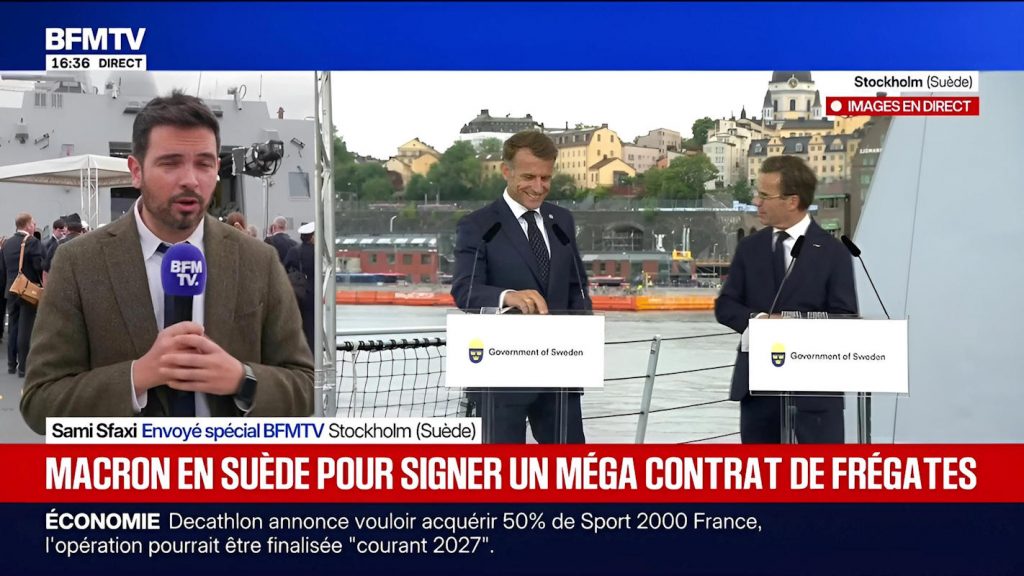
Beyond AFP wires and BFM, only three general-interest titles devoted an in-depth article to the story. Le Figaro,[01] written by Nicolas Barotte, delivered a precise, well-informed piece: Aster 30 missiles, the option of naval cruise missiles “should talks with manufacturer MBDA succeed,” a nuclear steering group convened as early as April 23, deployment to Boden of a combined-arms sub-unit of fewer than 200 soldiers, and a quote from Swedish General Michael Claesson worth the detour: “Some people in Scandinavia wonder: ‘Why are the French going to freeze in Finnish Lapland?’ But France has excellent equipment and remarkable experience.”
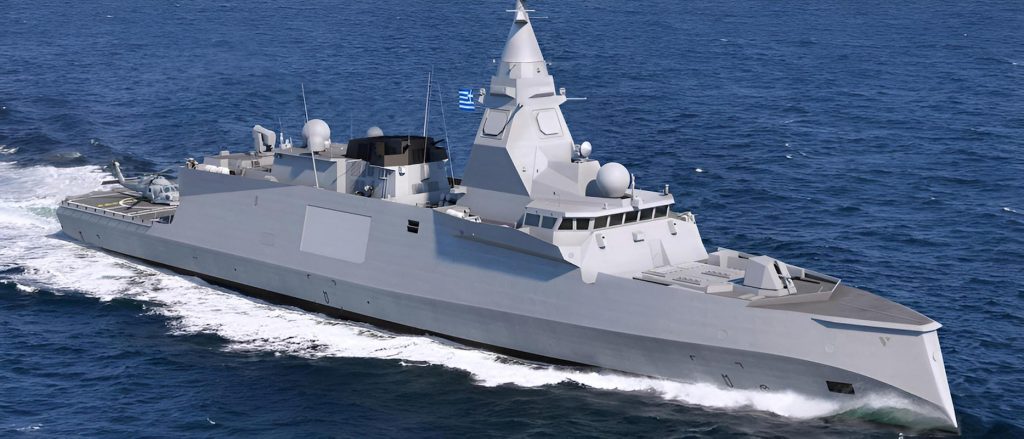
Ouest-France,[02] written by André Thomas, also covered the story in depth — logically enough, since the four frigates will be built in Lorient, at the Naval Group facility employing 2,600 staff and sustaining 1,100 subcontracting jobs. The article adds a detail Le Figaro only mentioned conditionally: the naval cruise missile MdCN would be “considered a done deal” — the first-ever export of this weapon, the French equivalent of the Tomahawk. A quote from Alexandre Sheldon-Duplaix: “With the FDI, Sweden regains a blue-water capability it had lost. As for the MdCN, it’s a clear message sent to Russia.”
Le Télégramme,[03] written by Pierre Coudurier, also devoted an in-depth article — another regional paper, Breton like Ouest-France, documenting what the Paris press largely let slip. The article situates the deal in a longer sequence: a “strategic partnership” had already been signed on January 30, and Sweden joined France’s nuclear-sharing initiative on March 2 — two dates absent from most other accounts. An additional detail: the 57mm and 40mm guns fitted to the future Luleå-class ships will come from BAE Systems Bofors. The article also prices the French-side GlobalEye contract at around €1.3 billion.
Specialist defence blogs showed no let-up in vigilance. Opex360 / Zone Militaire,[04] run by Laurent Lagneau, tracked the story in two stages with a rigour the general press never matched: an article as early as August 29 on France’s cruise-missile offer, detailing the FDI’s full technical specifications, followed by a detailed account of the signing itself, complete with full quotes from both heads of state. Macron speaks of a “choice of European sovereignty in defence capability” and concludes: “We have thus strengthened Europe’s industrial and technological defence base.” A detail only Opex360 notes: it was exactly one year to the day before this signing that Norway had preferred BAE Systems over Naval Group for its own frigates.
The starkest contrast remains that of the economic dailies. Les Échos and La Tribune, which normally follow the defence industry closely, published nothing that day on a €4.3 billion contract for one of France’s industrial flagships.
Le Monde, [05] had in fact followed the dossier seriously three months earlier, when the exclusive negotiations were announced in May — but on the signing itself, the paper settled online for reprinting the AFP wire, word-for-word identical to France Info; and the following day’s print edition says nothing about it either. A sharp gap between the interest shown upstream and the silence observed at the decisive moment.
Meanwhile, the hypothesis of a referendum on the Islamic veil — with no bill and no legislative timetable — dominated most of the airtime and column inches.
II. Sweden: Dense, Critical Coverage
SVT,[06] Swedish public television, covered the event live from the morning, with a strong technical angle: its political correspondent raised the possibility that France might also offer naval cruise missiles — “that would give the Swedish armed forces a completely different capability from what exists today.”
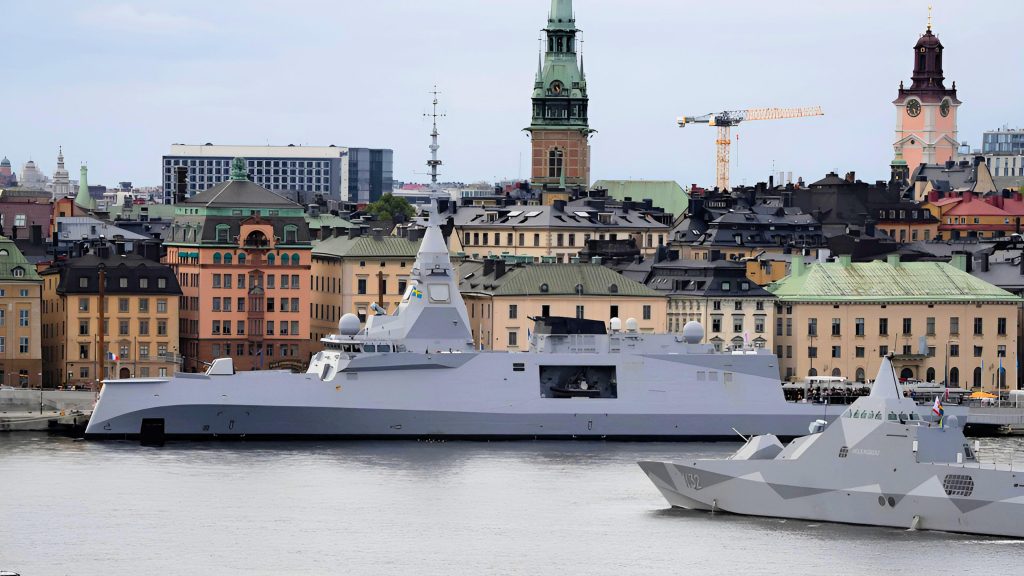
Nyheter24,[07] took a more critical tone, giving a platform to Swedish experts who question whether large frigates are even the right fit given the drone warfare seen in Ukraine, where the Ukrainian navy has sunk billion-dollar Russian warships using cheap surface drones. Asked directly about this aboard a Combat Boat 90, Kristersson had to defend the choice: “We need both: small, fast, unmanned vehicles, and large platforms that can carry very heavy weapons systems.”
The debate finds its sharpest challenger in the pages of the Svenska Dagbladet,[08] where one of the designers of the Swedish naval drone Barracuda directly confronts decision-makers: “Have you even followed our war? Imagine two of these in the Baltic Sea. Load them with ten suicide drones. It takes fifteen minutes, and you have no frigates left.” The charge is aimed squarely at Admiral Johan Norlén, Chief of the Swedish Navy, who defends the FDI choice in the same paper: “The frigates are part of a system — for naval capability as much as air defence. It can also free up resources for the air force.” He adds: “We are not alone; we act together with our allies in the Baltic Sea.” Norlén had already set out the doctrinal shift back in May: “With NATO membership, the navy’s role has changed. We must now also secure and protect maritime transport — to ourselves and to our allies.”
Dala-Demokraten,[09] in a scathing editorial titled “Nuclear weapons give Ulf Kristersson a VIP ticket to the Élysée Palace,” pointed to an awkward contradiction: in spring, Kristersson had publicly stated the frigate purchase was not linked to the “nuclear dialogue” with Paris — a few hours later, Macron himself presented it, at Île Longue, as part of a broader partnership that included deterrence.
The Swedish government,[10] in its official statement, stresses the structural dimension of the agreement: beyond the frigates, a separate framework agreement was signed to build a “long-term strategic platform” — the frigates will triple Sweden’s naval air-defence capability.
III. The Norwegian Contrast
Norway faced the same choice and decided differently: Oslo passed on the French FDI in favour of the British Type 26,[11] citing anti-submarine depth and strategic proximity to London. The specialist blog Corporal Frisk,[12] sums up the divergence with a memorable line: the Swedish deal is “the most significant French military contract to Sweden since Bernadotte” — a reference to the Napoleonic-era marshal who became King of Sweden, and who, “after swiftly conquering Norway, ushered in an era of peace and prosperity unprecedented in the country’s long history.” A French “gift” to Stockholm whose irony will be lost on no one, given that Bernadotte went on to join the coalition against Napoleon at Leipzig in 1813.
IV. The Arctic Dimension, Largely Overlooked in France
NordiskPost,[13] links the naval deal to a broader development: France will deploy troops to Boden, in Sweden’s far north, as part of the NATO FLF Finland,[14] framework — a Swedish-led multinational rapid-response force, alongside the UK, Denmark, Italy and Norway.
Officially established on June 6, 2026 under direct SACEUR command, the force is built around a Swedish battlegroup of roughly 600 troops based in Boden, expandable to 1,200, with a multinational headquarters in Rovaniemi, Finland. The French contribution amounts to roughly 200 troops on rotation.15]
V. Denmark and Finland: Relative Silence
No dedicated coverage was found in the Danish or Finnish press of the August 31 signing itself. Their attention had focused earlier on the launch of the FLF Finland framework in June-July.
François de Vries
See also:
- « Qui perd gagne dans le grand Nord ? » — (2026-0901)
- « Who Loses Wins in the Far North? » — (2026-0901)
- « Wer verliert, gewinnt im hohen Norden? » — (2026-0901)
Sources
[01] Le Figaro, “France strengthens its military cooperation from the Arctic to the Baltic,” Nicolas Barotte, September 1, 2026 ↑
[02] Ouest-France, “The alliance between France and Sweden grows stronger,” André Thomas, September 1, 2026 ↑
[03] Le Télégramme, “Four frigates seal the Franco-Swedish idyll,” Pierre Coudurier, September 1, 2026 ↑
[04] Opex360 / Zone Militaire, “La Suède confirme l’achat de quatre Frégates de défense et d’intervention”; see also “La France a proposé des Missiles de croisière navals à la Suède” ↑
[05] Le Monde had followed the dossier as early as May 20, 2026: “Sweden and France, privileged defence partners”, by Anne-Françoise Hivert and Olivier Pinaud. On the signing itself, the online edition settled for the AFP wire, identical to France Info‘s. Print edition of September 1 (27 pages) checked: subject absent. September 2 edition still to be verified. ↑
[06] SVT Nyheter, “Macron besöker Sverige – rykten om kryssningsrobotar” ↑
[07] Nyheter24, “Köpeavtal för franska fregatter undertecknat” ↑
[08] Göteborgs-Posten, “Svenskt köp av franska fregatter ifrågasätts”, citing statements originally published in Svenska Dagbladet; see also Cornucopia.se, “Bra köp av franska Amiral Ronarch-klassen”, May 19, 2026, for Admiral Johan Norlén’s full statement on post-NATO doctrine ↑
[09] Dala-Demokraten, “Kärnvapnen ger Ulf Kristersson en VIP-biljett till Elyséepalatset” ↑
[10] Regeringen.se, “Sverige och Frankrike fördjupar försvarssamarbetet” ↑
[11] Foreign Policy Research Institute, “Win-Win: The UK-Norwegian Type 26 Deal” ↑
[12] Corporal Frisk, “A Frigate for Sweden” ↑
[13] NordiskPost, “Sweden and France are getting much closer on defence” ↑
[14] The Barents Observer, “NATO activates forward land forces presence in Lapland” ↑
[15] Jane’s, “NATO summit 2026: France to contribute troops to Forward Land Forces Finland” ↑
Speech by President Macron aboard the FDI frigate Ronarc’h
Stockholm, August 31, 2026 — Only the spoken word is authoritative.
Thank you very much, Prime Minister, dear Ulf.
Ministers, ladies and gentlemen, in your respective ranks and capacities.
I want first of all to thank the Prime Minister for inviting me to Stockholm today, to this ceremony so important for our two countries, through which we are sealing a major strategic partnership in the field of defence. You have just recalled it, and thank you, Commander, for hosting us aboard this frigate.
Indeed, we are sealing a major and reciprocal cooperation, respectful and ambitious. Following France’s decision last December to acquire the Swedish GlobalEye surveillance and command aircraft produced by Saab, Sweden made the choice in May to acquire four French Defence and Intervention Frigates produced by Naval Group and equipped with Aster missiles, to give the Swedish Navy first-rate capabilities by 2030. This shows how what we are signing today is, of course, equipment with the best technology. These are fully integrated defence and combat systems, with the most modern sensors and capabilities, but it is also strategic cooperation between our two countries.
I must say that after the State visit made in 2024 to Sweden, I am pleased to return to Stockholm and to measure the exceptional leap that the renewal of our strategic partnership has produced. I want to warmly thank the Swedish government and you yourself, Prime Minister, for your trust and your clear vision. This choice goes well beyond a commercial contract. It is an act of political trust that marks a historic step in cooperation between our two countries, and all those who contributed to it deserve our great thanks today.
The government-to-government framework agreement signed by our ministers a moment ago reflects this commitment and covers all our areas of defence cooperation — operational, capability, and industrial — and opens the way to a structuring defence agreement between our two countries. This reciprocal Franco-Swedish signal is also a choice of European sovereignty in defence capability. Because, as you have just recalled, underlining its importance for your own shipyards, we are thus strengthening Europe’s industrial and technological defence base at a time when Europeans must take greater responsibility for their own security, consolidating NATO’s European pillar.
Through this cross-purchase, and through all the other projects we have begun discussing and will continue together, we clearly see that we have the capacity to better integrate our industrial bases, to create a European defence ecosystem that is more resilient over time, more independent, more competitive, and that allows Europe to be fully sovereign today and tomorrow.
Sweden and France, within the European Union and within NATO, thus prove that European sovereignty is built together. The success of this partnership with Sweden encourages us to hope that other allies will join us, in particular to build on today’s signing, in order to truly build an interoperable European fleet of frigates. That is the goal, if we want to define a more effective European standard, industrially and operationally. Greece has joined this club, and we hope other European countries will follow this path.
Today’s signing of these agreements, and the exchanges, everything we have built in recent years, also mark our shared determination to commit to Baltic, Nordic, and Arctic security. We demonstrate this through the deployments underway in the region. In the Arctic, we take part together, alongside our Danish friends, in Operation Arctic Sentry, precisely to reduce tension in the Arctic zone — a subject of the utmost importance for all of us Europeans and for the sovereignty of our Danish friends. And we take part, alongside our Finnish friends, in the FLF, for which Sweden is the framework nation. The French armed forces are very proud to contribute to this effort under Swedish command.
And by equipping Swedish frigates with Aster missiles and possibly naval cruise missiles, France is not just delivering ships — it is also providing a capability to protect the territories of our allies. All these joint operations, these joint capabilities, also give substance to what is called the reinforcement of advanced nuclear deterrence, on which we are also working together. Indeed, this missile defence I have just mentioned, in which we are working jointly through this agreement, directly contributes to reinforcing advanced deterrence. We proposed it a few months ago. Sweden wished to be associated with this advanced deterrence. And we are working together on this subject, which is an important contribution to the strategic stability of our Europe.
Fundamentally, we are building an unprecedented strategic framework. We are giving ourselves the means to act together. We have joint exercises and deployments. We have joint capabilities, and we have Franco-Swedish industrial cooperation. This shows the strength and importance of this European pillar of defence, and how much Franco-Swedish cooperation is becoming an essential element of this European pillar.
During this visit, we will also discuss with the Prime Minister the other bilateral issues linking Sweden and France, from energy to space, from innovation to education. I thank the students who were with us a moment ago, as well as our European and international commitments to continue strengthening this European sovereignty. This is what we are doing by strengthening our joint action in support of Ukraine, notably within the coalition of the willing, but also within the operations we are conducting against the shadow fleet. I want to say in this regard that Sweden and France are among the nations that have contributed the most to this effort — through strengthening our competitiveness and unity in the face of the economic, commercial, industrial and technological shocks we must confront, with increasingly aggressive competitors, and also through strengthening our actions to protect our democracies and our youth, in order to affirm European digital regulation that ensures respect for our values, the health and flourishing of our young people, and the integrity of our electoral processes.
In 2027, we will celebrate the tenth anniversary of the Franco-Swedish strategic partnership. I want to tell you here how determined I am to continue developing our relationship of trust and closeness in all areas, and defence in particular. My wife and I were honoured to be invited on a State visit to Sweden in 2024, also to mark our ambition to go even further with your country; we will be very pleased to invite the Swedish sovereigns on a State visit to France early next year to continue this shared endeavour. Prime Minister Ulf, thank you so very much for your trust and the partnership decided upon. We have significantly strengthened it over the past eight months through these reciprocal decisions. Today’s signings are an important step for Sweden, for France, and for our Europe. Thank you.
Source: Press service of the French Embassy in Stockholm.
Decryption: Two Sovereignties Answering Each Other
One must resist reducing this agreement to a naval contract, however considerable. What is unfolding between Paris and Stockholm goes beyond the sale of four frigates: it is the meeting of two military-sovereignty cultures that, for two centuries, took radically opposite paths — only to arrive, in 2026, at the almost paradoxical conclusion that they complement each other better than they conflict.
France built its sovereignty on complete autonomy: an independent nuclear deterrent, a defence industry covering the full spectrum, a refusal of any strategic dependence — historically, even toward its own allies. Sweden built its sovereignty on the opposite principle, but just as uncompromising: armed neutrality, an industrial self-sufficiency designed to depend on no outside protector, a non-alignment that held for two centuries, until the invasion of Ukraine. Two doctrines born of two geographies and two histories — yet both founded on the same underlying refusal: dependence.
It is precisely this symmetry that makes their current rapprochement so solid. Unlike what is seen with Germany — where budgetary asymmetry creates a risk of one-way dependence — the Franco-Swedish relationship works because neither partner has ever needed the other to survive. Sweden isn’t buying French frigates because it couldn’t do without them; it is buying them because it chose, in full command of its own means, to complement a doctrine of self-sufficiency that has proven itself since Gustav Vasa. This is a partnership between two full sovereignties, not between a power and its dependent.
Nuclear: the next frontier, and the most perilous
This is where the dossier becomes genuinely vertiginous. The “nuclear steering group” convened as early as April 23, Macron’s reference to “advanced deterrence” in his speech at Île Longue, Sweden’s joining that framework the very same year it entered NATO — all of this traces a trajectory with no equivalent elsewhere in Northern Europe, including among Washington’s historic allies.
But Sweden is no ordinary country on this question. It was, for decades, one of the most consistent standard-bearers of the Non-Proliferation Treaty, and part of its public opinion — as the Swedish press itself repeatedly points out — has not had the debate the gravity of the subject demands. Should this cooperation one day lead to a temporary deployment of French nuclear-capable aircraft on Swedish soil, as Macron has floated for other allies (the UK, Germany, Poland, the Netherlands, Belgium, Greece, Denmark), that would be a far more significant shift than any frigate contract: the first time a Scandinavian country, a former paragon of neutrality, would accept on its soil a component of a third nuclear power’s deterrent.
Two centuries after Sweden offered a French marshal a crown — before watching him turn against his own native country at Leipzig — Paris and Stockholm are replaying history in reverse: it is no longer France exporting a man, but a model of sovereignty negotiated as equals. What remains to be seen is whether public opinion in both countries will keep pace with what their leaders have just set in motion — and whether the most sensitive subject, the nuclear one, will find the democratic debate it demands before becoming a fait accompli.