Debates about the war economy are often reduced to a question of volume: how many shells, drones, armored vehicles, billions? This reading is necessary, but insufficient. The war in Ukraine shows that a defense industrial base does not run on a single rhythm. It must simultaneously maintain platforms designed to last decades, mass-produce consumable equipment, modify systems within weeks, replace an unavailable supplier, finance ramp-ups in output, and keep producing even as its own industrial depth becomes a target.
The problem is therefore no longer simply having a defense industrial base, but knowing whether several industrial economies, timeframes and decision chains can remain coherent under the same war. Two levels must be distinguished: the system’s reaction speed — scaling, adapting, substituting, financing — and the conditions under which that speed must be achieved, given that depth can be struck, that a third party can control the activation of a technology, and that several crises compete for the same resources.
The Essentials
- A modern defense industrial base no longer runs on a single rhythm: it must simultaneously maintain platforms built to last decades, mass-produce consumables, and adapt within weeks — three arms economies obeying three distinct clocks
- Four dimensions measure this resilience: time to scale, time to adapt, time to substitute, and financial endurance — the last being the least visible but often the most binding
- Sovereignty stops being a snapshot of industrial heritage and becomes a dynamic capacity: producing, maintaining, replacing, adapting, financing, activating and learning as conditions worsen
- Ukraine functions as an industrial laboratory where feedback between the front and developers circulates almost in real time, at the cost of heavy dependence on certain foreign technology suppliers
- France’s updated military programming law (16 August 2026) adds €36 billion over 2026-2030 and targets 3.5% of GDP by 2035; but extra funding alone does not guarantee the transformation of the production base nor the financial endurance of SMEs
- The German risk is cumulative rather than immediate: an investment gap that repeats every year eventually shifts production lines, skills and suppliers for good, without any single technological break signalling it
- The war in Ukraine shows that industrial depth — energy, logistics, digital networks — has itself become a target, forcing a rethink of resilience in spatial terms: dispersion, redundancy, the ability to produce under attack
- Possessing a capability no longer guarantees its activation: the Starlink episode shows that a third party can condition a system’s actual use, even when the hardware, the operator and the doctrine are national
- Theatres remain geographically distinct but their capability chains are increasingly coupled (Russia-Iran, Indo-Pacific-Europe), forcing trade-offs between several crises drawing on the same resources
- The author’s conclusion: sovereignty is no longer binary (sovereign/dependent) but is measured in degrees, according to the real capacity to act when the context deteriorates
by Jérôme Denariez — Paris, 1 September 2026.
Contents
Producing, replacing, reconfiguring, activating and learning at the pace of war
The article thus proposes reading the resilience of a defense industrial base through several clocks, but also through the depths and interfaces that enable — or prevent — them from functioning.
Sovereignty can no longer be seen as a snapshot of industrial heritage. It becomes a dynamic capacity: producing, maintaining, replacing, adapting, financing, activating and learning as initial conditions deteriorate.
This architecture can no longer be thought of theatre by theatre. Crises remain geographically distinct, but they increasingly share the same stocks, suppliers, technologies and learning. A tension in the Indo-Pacific, the Middle East or Europe can thus alter an ally’s industrial and military choices almost simultaneously.
1. Three arms economies, several clocks
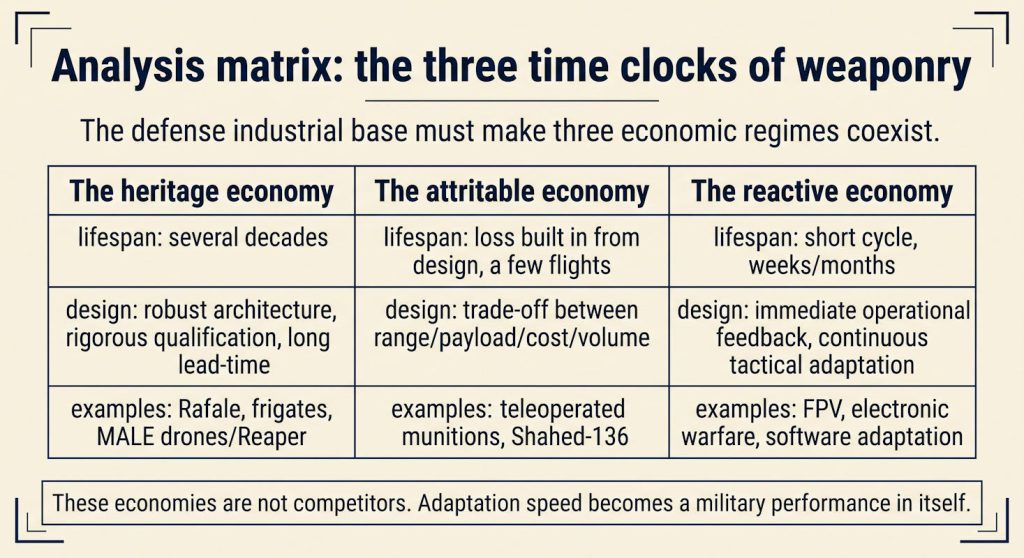
A modern army aggregates equipment that follows neither the same cycles nor the same economic logic. A fighter jet, a cruise missile, an FPV drone and an artillery shell belong to the same defense system, but not to the same economy. These three economies correspond to three time regimes: the long time of the platform, the industrial time of mass, and the short time of adaptation. These are what force a defense industrial base to run on several clocks.
The platform economy
The first economy is that of heavy platforms: combat aircraft, surface ships, submarines, armored vehicles, satellites, command systems. Their development consumes years of study, complex architectures, deep supply chains and investments that must be amortised over decades.
The performance sought is cumulative: survivability, range, interoperability, stealth, computing power, capacity for evolution. Unit cost is high, but the platform is meant to endure.
This economy cannot be replaced by consumable logic. A Rafale or a frigate does not become useless because a drone costing a few thousand euros can produce a spectacular effect.
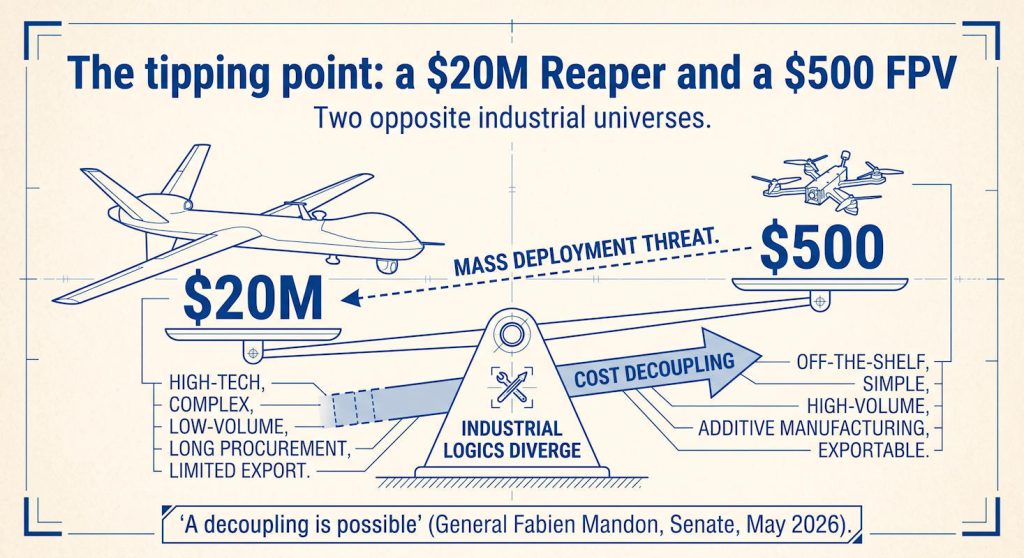
They are, on the contrary, nodes within larger systems. The risk would be to artificially pit sophisticated hardware against cheap mass, when war now demands that both work simultaneously.
The mass economy
The second economy is that of consumable or rapidly renewable equipment: munitions, attack drones, decoys, simple sensors, distributed electronic-warfare assets. Here, value does not depend solely on unit performance. It depends on the ability to produce in bulk, to take losses without collapsing, to replace quickly, and to accept that part of the capability is designed to be consumed.
High-intensity war thus restores strategic value to industrial cadence. A theoretically excellent munition made in only a few dozen units does not meet the same need as a slightly less capable system produced by the thousand. The question is not choosing one or the other, but knowing which combination of effects must be sustained over time.
The adaptation economy
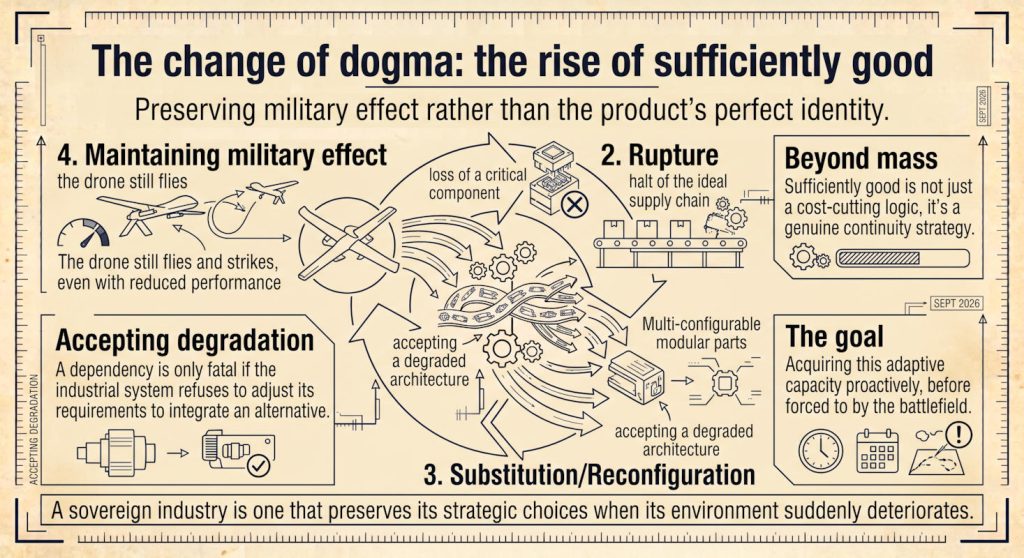
The third economy is more recent in its visibility, even though it has always existed: that of adaptation. It concerns software, kits, payload modifications, component substitution, new operating methods and the integration of civilian technologies. Its horizon is sometimes measured in weeks or months.
Ukraine has pushed this logic very far: deployed equipment comes back from the field with almost immediate feedback; jamming changes, communications change, payloads change, signatures change. A system’s effectiveness is no longer just that of its initial design. It depends on the speed at which it can be reconfigured.
2. Measuring the speed of resilience
The three economies describe industrial logics. To measure their resilience, four dimensions can be proposed. Three are explicitly temporal; the fourth measures the financial capacity to sustain acceleration.
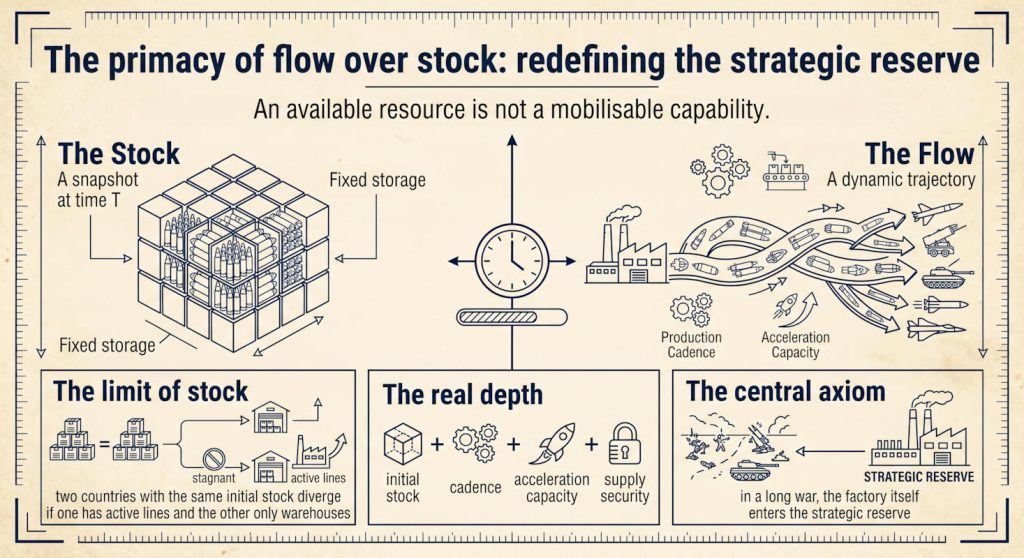
Time to scale measures the time needed to increase production. Time to adapt measures the speed at which a capability can be modified in response to a new threat. Time to substitute measures the ability to replace a component, technology or supplier that has become unavailable. Finally, financial endurance measures the ability to sustain this acceleration: working-capital needs, safety stocks, investment, recruitment and capital outlay before orders are even fully paid.
This fourth dimension is often the least visible. A company may have the technical skill and the order in hand, yet lack the cash needed to double its stocks, hire, or fund a new production line. A war economy is therefore not decreed by state budgets alone. It requires a financial architecture capable of turning an order into production.
“A voted budget is not a factory. A notified order is not yet a cadence. An industrial capability only exists once it can be financed, produced, maintained and regenerated.”
3. From stock to flow
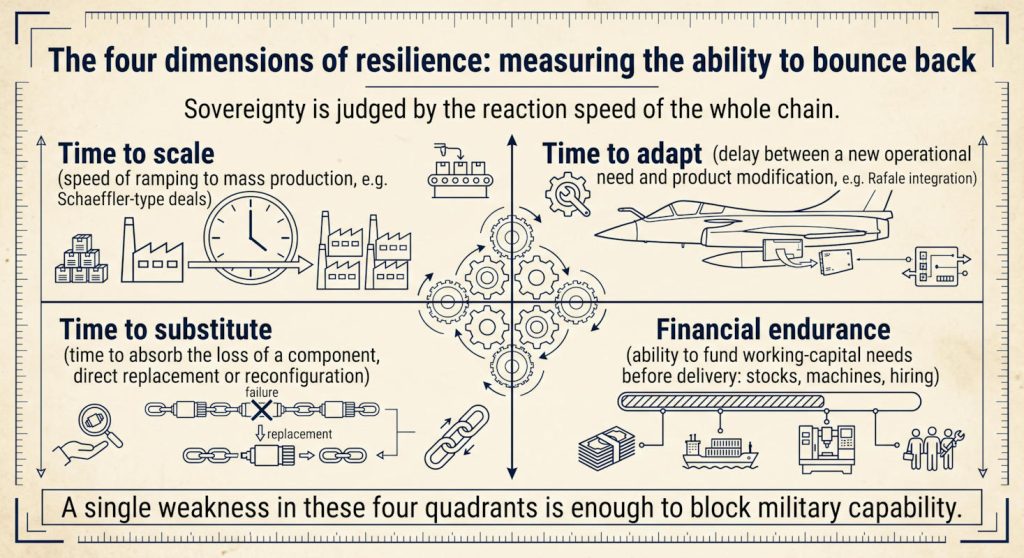
The distinction between stock and flow has become central. An inventory measures what exists. A war measures what can be committed, lost, repaired, and then committed again.
This reading applies to munitions as much as to platforms. Owning a hundred pieces of equipment does not mean being able to commit them all at once. Being able to commit them once does not mean being able to do it again. A fleet grounded for lack of parts, a stock with no replenishment chain, or a system dependent on foreign software do not represent the same capability as an apparently identical set whose flows are under control.
Nominal sovereignty consists of owning or nationally producing a piece of equipment. Dynamic sovereignty consists of being able to keep producing, replacing, repairing, modifying and using that equipment once initial conditions disappear.
This distinction explains why certain dependencies nest at interfaces: semiconductors, engines, connectivity, ground stations, second-tier subcontractors, software libraries, export rights or financing capacity. A platform can be national while a critical function remains foreign.
4. Ukraine as an adaptation loop
Since 2022, Ukraine has become an industrial laboratory as much as a theatre of operations. The ecosystem combines public production, established manufacturers, startups, civilian engineers, foreign financing and extremely short feedback loops. Private investment has also accelerated: European funds have begun taking stakes in Ukrainian communications, software and drone companies, at a time when defense venture capital there was almost non-existent before the war.[01]
This model does not mean Ukraine has resolved every question of sovereignty. It reveals, rather, a particular ability to circulate information between the front, developers and decision-makers. Where a classic organisation seeks to stabilise a requirement before launching a program, Ukraine accepts that the requirement evolves while the system is already in production.
The downside of this agility is obvious: heavy dependence on certain foreign technology suppliers, sometimes fragmented industrialisation, difficulty financing the leap from prototype to mass production, and the risk that essential interfaces rest on a handful of individuals. But it is precisely this tension that makes the model interesting: it should be neither idealised nor reduced to a mere collection of drones.
5. France can accelerate — but not on every clock
France’s defense industrial base remains one of the few in Europe capable of covering an almost complete spectrum. It retains top-tier know-how in aerospace, naval, space, missiles, sensors, electronics and deterrence. It has also shown, since 2022, that it can shorten certain cycles.
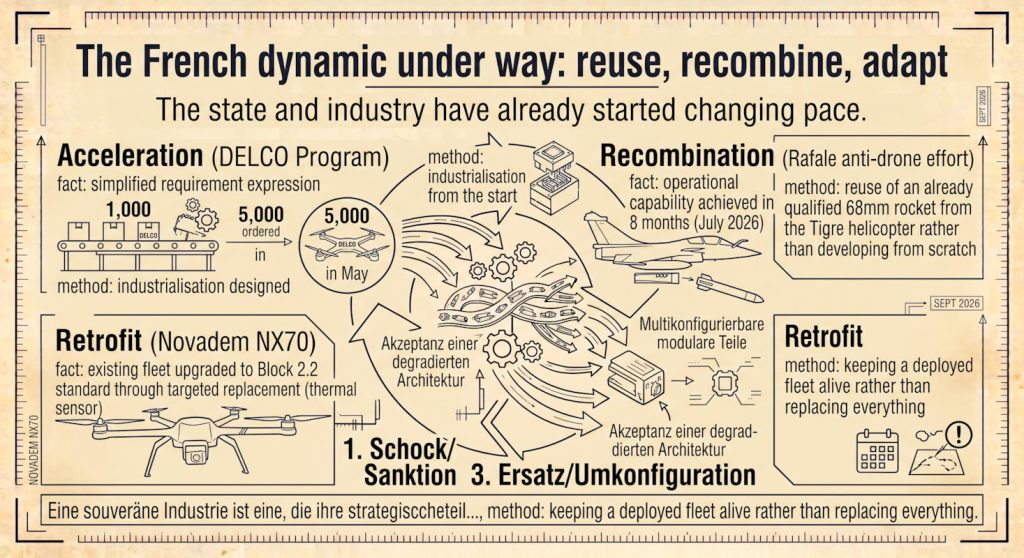
The DELCO cases, anti-drone adaptations, and initiatives around Novadem, Delair, Schaeffler, Valeo or ENDURANCE show that loops exist that run far faster than those of major programs. They also show that the border of the defense industrial base is becoming more porous: civilian companies hold skills in mechanics, electronics, batteries, vision, automation or software that can become relevant once urgency changes how a need is framed.
The question is therefore not replacing major prime contractors with a diffuse fabric of startups or civilian suppliers. It is organising the interfaces between these two worlds. A long-lived platform must be able to absorb short cycles without being entirely redefined at every innovation. An SME must be able to join a program without waiting years to know whether its investment will pay off.
6. The price of a complete model
The law updating military programming, signed on 16 August and published in the Official Journal on 18 August 2026, adds €36 billion in resources over 2026-2030. It sets a target of 2.5% of GDP devoted to defense by 2030, then 3.5% by 2035.[02] The trajectory matches the floor set at the NATO summit in The Hague: 3.5% for conventional military spending, within a broader 5% target including a wider security and infrastructure component.[03]
The effort is considerable. Yet it answers only part of the diagnosis. Extra funding can pay for orders, accelerate certain programs and rebuild stocks. It does not, by itself, guarantee the transformation of the production base, financing for SMEs, recruitment of scarce skills, or the ability to quickly substitute a critical supplier.
The stakes lie less in whether France is spending more than in measuring what that spending transforms: industrial depth, cadence, availability, adaptation loops and freedom of action.
7. The limits of European specialization
Europe is logically seeking to pool part of the effort. The SAFE regulation allows up to €150 billion in loans, particularly for joint acquisitions, with a European-content requirement. EDIP complements this movement with a more structural logic of support for the common industrial base.[04]
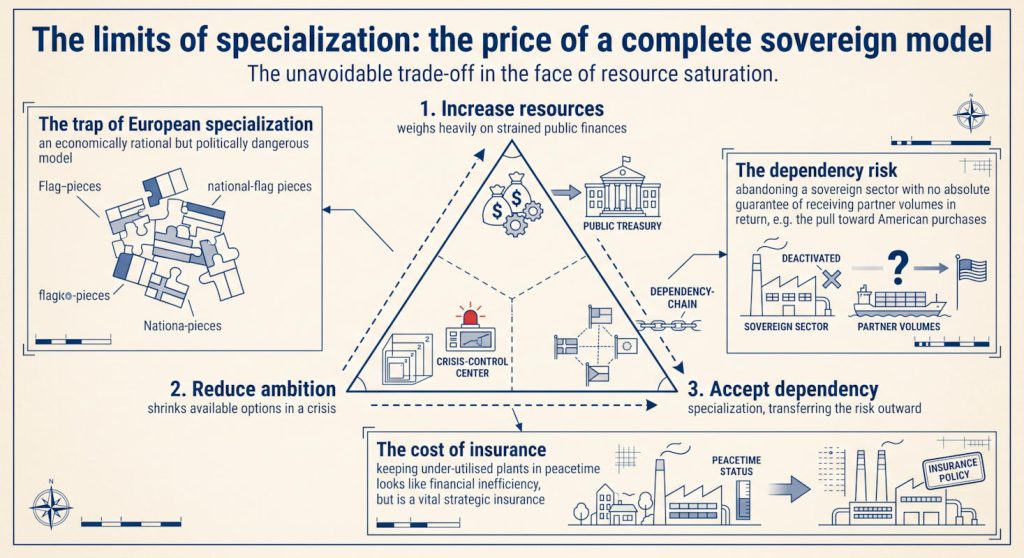
Specialization can produce real gains: avoiding twenty identical production lines, consolidating volumes, and making certain production runs economically viable. It can also shift dependency. If a single state concentrates a capability because it has the domestic market, the capital and the orders needed, its partners become dependent on that state’s political priorities and on its own industrial availability.
European sovereignty therefore cannot be a simple division of labour. It requires reciprocal purchase commitments, priority rules, multi-year visibility, and mechanisms that prevent a specialization that is efficient in peacetime from becoming a breaking point in a crisis.
8. The German risk is a cumulative risk
The German question illustrates this potential asymmetry. The special fund of €100 billion created in 2022 had already launched a catch-up dynamic. The constitutional reform passed in March 2025 changed its nature: defense, intelligence, cybersecurity and civil-protection spending above 1% of GDP was exempted from the debt brake, while a separate €500 billion fund was created for infrastructure.[05]
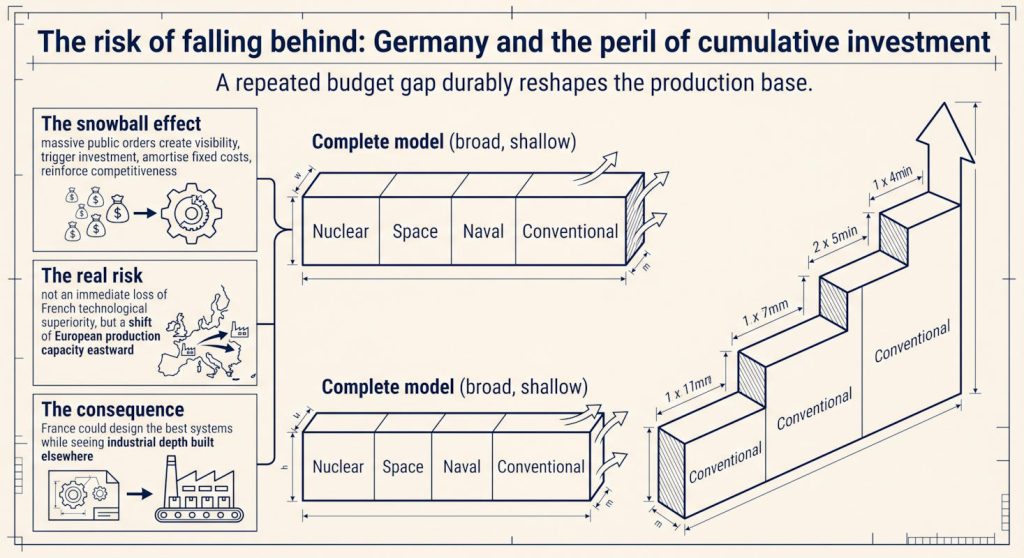
The point is not to present Germany as an industrial adversary. It is to note that Germany now has budgetary depth and investment capacity that can draw in production lines, skills and suppliers. A larger budget does not automatically become superior military capability. But over several years, it can become superior production capability.
The risk is cumulative: more orders allow more investment; more investment reduces lead times; shorter lead times attract new customers; volume then finances the next round of innovation. Conversely, a less capitalised manufacturer may remain technically excellent while progressively losing the battle of cadence.
Analysis — Does the law answer the diagnosis?
On time to scale and time to adapt, French law is consistent with identified needs: it ring-fences funding for drones, munitions and ground-based air defense. On financial endurance, the mechanism remains more indirect. Budget envelopes are not, in themselves, cash-flow or guarantee mechanisms that let an SME absorb a sudden ramp-up in output.
The real test will therefore play out in conversion. France is not primarily losing its technological mastery; it risks losing ground in its ability to turn a financial resource more constrained than that of some partners into durable industrial depth.
9. When clocks meet depth
The four preceding dimensions describe the speed at which a capability can be produced, adapted, substituted and financed. The events of August 2026 show that one must now also look at the space in which this resilience has to operate. The front line remains a physical reality where troops, artillery and territorial conquest are concentrated. But it no longer suffices to delimit the war.
On 18 August, Ukraine’s air force announced that Russia had launched 76 jet-powered Shahed drones between 7:00 and 18:30, mainly against the Kyiv region; more than 70 were reportedly shot down or jammed.[06] The episode matters as much for its timing as for its volume. Large waves are no longer confined to the night. Air pressure can now occupy an entire day and further blur the line between ordinary civilian activity and a combat sequence.
Two days later, a massive attack combined drones, cruise missiles, ballistic missiles and hypersonic weapons. Moscow said it had targeted facilities producing drone components, a military depot and a logistics hub in the Kyiv region.[07] Industrial, energy and logistics depth is thus no longer merely what feeds the front. It becomes part of the front itself.
“The front line still fixes the armies. It no longer delimits the war.”
This shift changes the notion of industrial survivability. A factory no longer only has to produce fast enough. It must be able to keep producing when its power supply, telecommunications, warehouses, rail lines, a supplier or the site itself are struck.

Industrial resilience thus becomes spatial: dispersion, redundancy, distributed stocks, rapid-repair capacity, the ability to relocate production, digital continuity and physical protection of personnel. Dynamic sovereignty now includes the ability to keep functioning under attack.
10. Strike for strike: the war of flows
This depth is reciprocal. Ukraine no longer confines itself to seeking effect at the point of contact. It runs a campaign of deep strikes against Russian air bases, refineries, industrial facilities, air-defense systems and logistics networks.
On 15 August, a Ukrainian strike notably targeted the Progress industrial centre in Samara, operated by Roscosmos, in a sequence in which Kyiv claimed the use of domestically produced long-range capabilities. Data cited by the Associated Press show that the pace of Ukrainian deep strikes has tripled since January.[08]
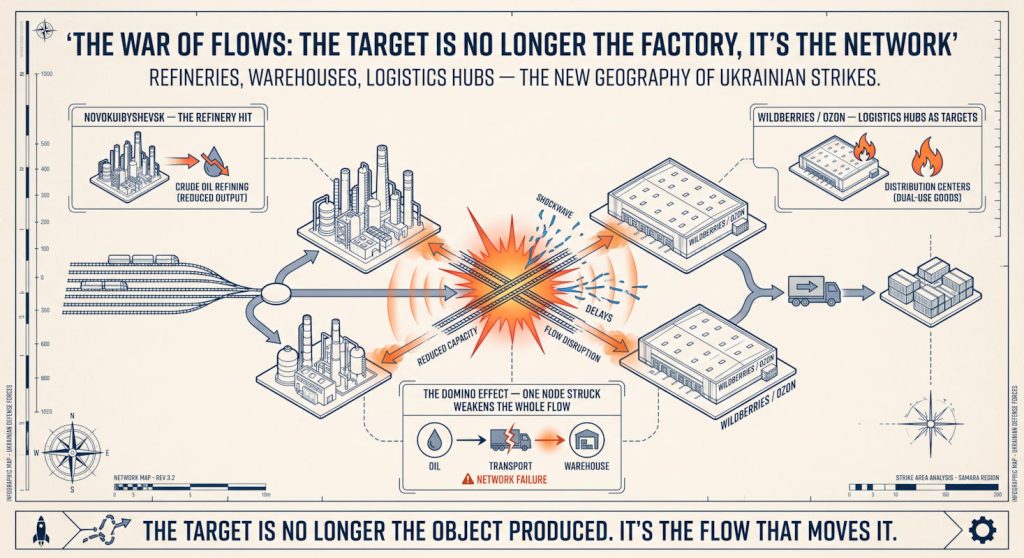
Wildberries’ infrastructure illustrates this shift even more clearly. Since July, warehouses belonging to Russia’s leading online-retail platform have been struck repeatedly. Kyiv says these hubs also serve dual-use flows relevant to the war effort; Moscow naturally disputes this reading. Regardless, the choice of target is telling: it is no longer only an arms factory that gets hit. It is a circulation infrastructure linking suppliers, storage, transport and end users.[09]
European-Security
In a distributed war economy, the target is therefore no longer just the object produced. It can be the flow that gets it to the right place at the right time. Production, energy, storage, transport, data, communi-cations and launch form a single capability chain.
On 22 August, this logic widened further. A wave of Ukrainian drones hit the Novokuibyshevsk refinery in the Samara region, claimed as a target by Kyiv, along with an Ozon logistics centre in Chapayevsk, whose activity was suspended. Moscow said it had shot down 457 drones overnight. After the repeated strikes on Wildberries, hitting a second major distribution network confirms that commercial infrastructure can be treated as a link in the logistics chain when it supports flows useful to the war effort.[10]
The same day, Vladimir Putin himself framed this confrontation in economic terms: presenting the struck Russian refineries and warehouses as economic targets, he announced reprisals against Ukraine’s most sensitive economic sectors. The war of flows is therefore no longer just an analytical reading of targets; it is becoming, increasingly, an explicitly assumed campaign logic.[11]
This pressure now reaches the capital region. According to Moscow’s mayor, 2,652 drones were detected heading toward the Moscow region between 15 and 22 August; 493 were reportedly destroyed as they approached the capital, with most of the rest, according to the authorities, neutralised further out. These figures are Russian and cannot be independently verified. Their significance lies less in precisely measuring the number of Ukrainian vehicles than in showing the scale of detection, air-defense and electronic-warfare assets Moscow says it must mobilise in its own depth. Temporary restrictions imposed at several airports during certain waves also materialise the operational cost of this pressure.[12]
Analysis — Moscow is not under siege, but it is no longer a sanctuary
Headlines announcing a capital “under siege” go too far. Nothing supports talk of a siege in the military sense, or of a collapse of the Russian apparatus. But the change in scale is real: war now imposes protection and continuity costs at the political and economic heart of the country.
The fuel market provides a tangible indicator. In August, filling stations in Moscow and the surrounding region reintroduced purchase limits and saw long queues, amid strong demand but also repeated disruption of refineries by Ukrainian strikes. To protect the domestic market, the authorities banned or limited several exports and began importing refined products.[13] On 25 August, Reuters reported that an extension of the diesel export ban into September was under consideration, as several refineries remained offline after attacks.[14]
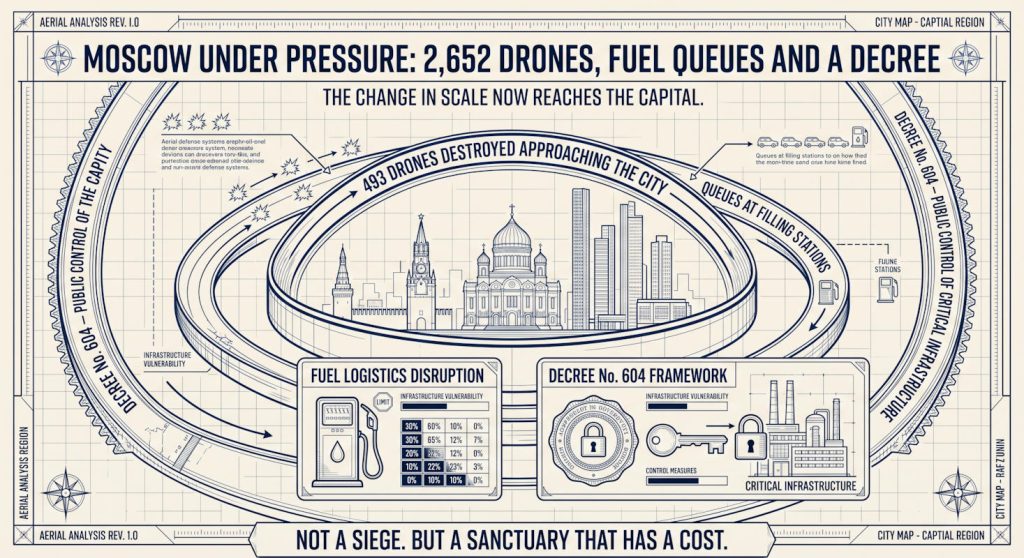
The most structurally significant signal is institutional. Decree No. 604, signed by Vladimir Putin on 24 August, authorises the government, on presidential instruction, to temporarily place critical-infrastructure assets under public management when an operator is judged unable to protect them or restore service quickly enough, particularly in the face of drone attacks. Energy, industry, communications, transport and logistics are explicitly covered.[15]
A campaign of strikes thus ends up altering not only flows, but the governance rules of the economy that carries them.
“Moscow is not under siege. It is no longer a sanctuary.”
This distinction matters: it prevents conflating systemic disruption with defeat. Russia retains considerable capacity to strike, adapt and repair. But its rear now requires a growing allocation of resources and exceptional mechanisms. Depth becomes an additional clock: the time needed to protect, repair, reroute and reorganise.
11. Cadence against cadence
Deep strikes, however, only carry strategic value if they go beyond the register of a one-off feat. Operation Spiderweb in June 2025 had struck a significant part of Russia’s strategic aviation. According to US officials, up to twenty aircraft were hit and around ten destroyed; the US Department of Defense subsequently confirmed at least ten strategic bombers lost.[16]
The effect is considerable when the platforms hit are difficult or impossible to reproduce quickly. It does not, however, mechanically eliminate Russian strike capacity. Remaining aircraft can be dispersed, bases protected, missions reorganised, and other vectors — missiles or drones — take on a greater share.
The right unit of measure is therefore not simply the number of targets destroyed. It is the ratio between two speeds: the speed at which one side degrades a capability, and the speed at which the other repairs, relocates, protects, substitutes or regenerates it.
This logic seems to guide the current Ukrainian campaign precisely. In early August, the SBU claimed more than a hundred successful strikes on strategic targets over forty days: defense companies, air bases, ground-based air defenses, command posts, refineries and logistics infrastructure. It notably claimed the destruction of a Tu-95MS.[17]
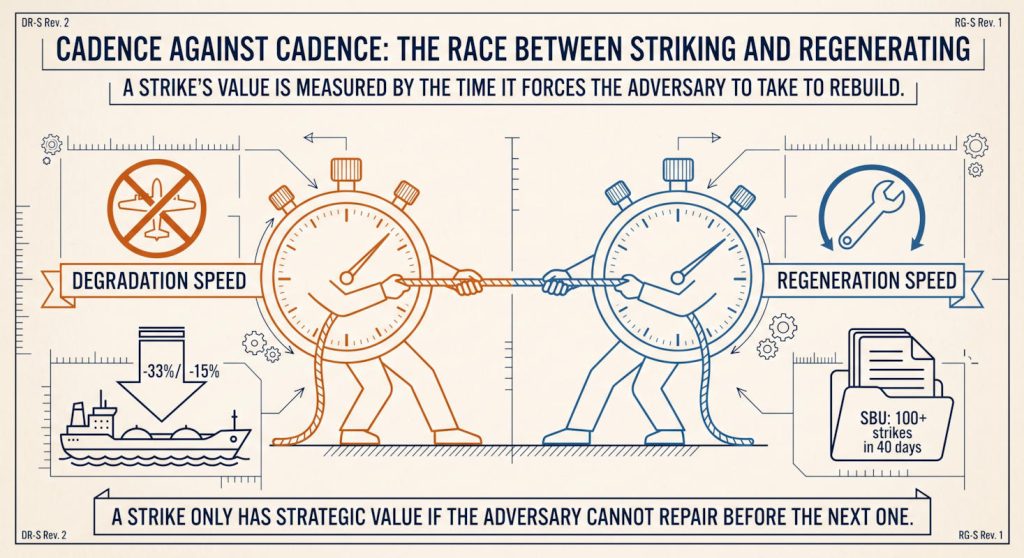
The figure matters less here than the qualitative shift: Ukraine is seeking to move from the exceptional operation to repeated pressure. A spectacular strike imposes a cost. A succession of strikes forces the adversary to durably change how it allocates resources.
Effects are also becoming visible in the flows themselves. Russian seaborne exports of oil products had already fallen 33% in July compared with June, amid lower production and export restrictions aimed at protecting the domestic market. Over the first half of August, oil exports from Russia’s western ports then ran roughly 15% below plan, mainly due to disruption at Novorossiysk linked to intensifying Ukrainian attacks. Moscow had to reorganise part of its shipping routes, notably rerouting Kazakh volumes to preserve capacity for Russian crude. The strike-repair-reroute-substitute sequence thus makes observable exactly what time to substitute measures.[18]
“The strategic value of a strike is not measured only by what it destroys, but by the time it forces the adversary to take to rebuild lost capacity — and by the possibility of striking again before they manage it.”
A refinery repairable within weeks, a bomber that cannot be reproduced, a relocatable warehouse, a replaceable radar and a distributed logistics chain do not share the same regeneration clock. An effective campaign must therefore select targets according to this clock as much as according to their visible value.
12. Owning a capability does not mean being able to activate it
Ukraine’s depth reveals another dimension of sovereignty: the right to activate a capability.
In August 2026, Kyiv sought authorisation to use Starlink on drones intended to strike ballistic launchers up to roughly 200 kilometres inside Russia. The operational logic is clear: faced with a shortage of Patriot interceptors, the aim is to hit the launcher before it fires rather than wait for the missile.[19]
But the chain does not depend solely on the Ukrainian state. The drone may be Ukrainian, the operator Ukrainian, the target identified and the doctrine decided in Kyiv; one of the technical conditions essential to the operation still depends on the rules of a private American satellite network.
This situation forces an even broader notion of sovereignty. Producing a piece of equipment is not enough if a third party can limit its use, its connectivity, its updates, its data libraries or its export conditions.
“A capability is only fully sovereign if one also controls the conditions of its activation.”
This observation applies well beyond Starlink. It concerns licensed components, proprietary software, standards whose keys are not controlled, targeting chains, commercial data, certain cloud services and, more broadly, any external brick that can become a technical veto right.
13. Fedorov: when the human interface becomes a strategic asset
The case of Mykhailo Fedorov makes this dependence even more visible. Before heading the Ministry of Defense, he had been the man behind Ukraine’s digital transformation and one of the leading promoters of new technologies in the war effort. He had also built a direct relationship with SpaceX and Elon Musk, along with other American technology players.
His dismissal in July obviously does not make the drones, the startups, SpaceX’s services or the ministry disappear. But it raises a governance question: what becomes of a system’s performance when one of its densest human interfaces leaves the organisational chart?
On 21 August, Reuters reported that Fedorov was preparing a trip to the United States to raise funding for new defense-tech projects and Ukrainian startups. His team said no political meetings were planned. Reuters also noted that he remained in discussions with Elon Musk about Starlink, with no meeting between the two then scheduled.[20]
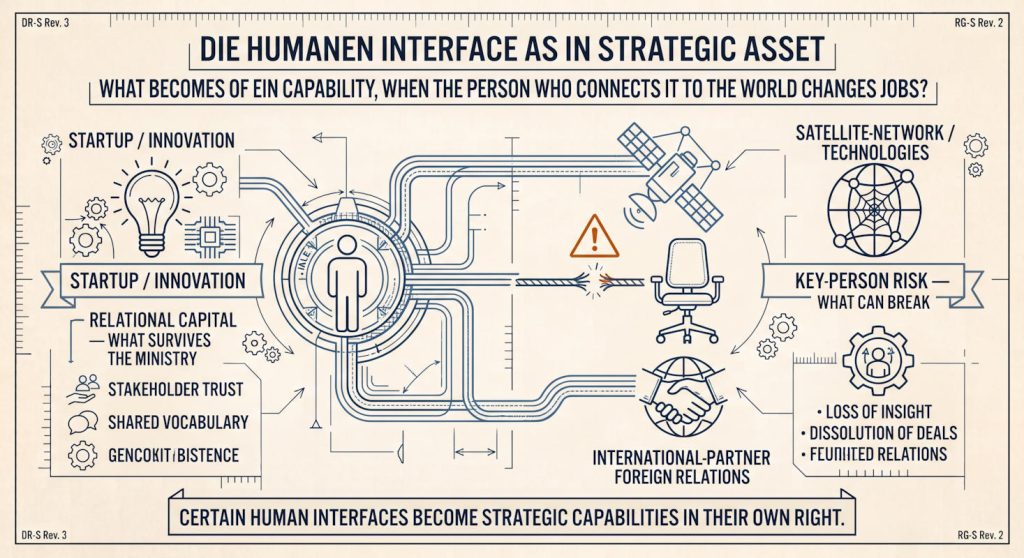
The fact is remarkable: part of the strategic function continues after the institutional function ends. Relational capital, trust built with manufacturers, knowledge of the startup ecosystem, and the ability to translate an operational need into a funded project can all outlive the ministry.
It is at once a sign of resilience and a risk. An ecosystem mature enough to keep functioning outside the state is more robust. But an architecture that relies too heavily on a handful of personal relationships creates key-person risk. The right model, then, is not to eliminate these human interfaces; it is to institutionalise them enough that they remain transferable, without bureaucratising them to the point of losing their speed.
“In a war of rapid adaptation, certain human interfaces become strategic capabilities in their own right.”
14. Depth spills beyond the belligerents: pressure below the threshold
The depth of the war no longer necessarily stops at the two belligerents’ borders. As Ukrainian strikes increasingly rely on technologies, financing, production and infrastructure located in allied countries, Moscow also seeks to remind everyone that this support can carry a cost.
The signal is not always a directly attributable attack. In the Black Sea, Romania had to neutralise two Gerbera-type drones drifting near the Neptun Deep gas project in August; their origin was not established, and Ukraine indicated they were not Ukrainian.[21] At the same time, Poland and the Baltic states stepped up protection of critical infrastructure against fears of sabotage, disinformation or false-flag operations.[22] The accumulation of such episodes demands surveillance, protective resources and, above all, a constant judgment call on their nature: accident, jamming-related drift, provocation or hostile action.
Russian rhetoric accompanies this pressure. On 18 August, Russia’s embassy in London warned that British support for Ukrainian deep strikes would have “consequences” and that the stronger the UK’s involvement, the higher “the price” to be paid; Sergei Lavrov separately said direct British involvement could be seen as participation in the war.[23]
It would be excessive to conclude that every incident near NATO stems from a single plan decided in Moscow. But this uncertainty is precisely one of the mechanisms of below-threshold pressure: it forces the adversary to protect, investigate, attribute and arbitrate without the degree of certainty that would allow a classic military response.
For the defense industrial base, the consequence is direct. A European factory producing a drone bound for Ukraine, a port through which munitions transit, a cable, an energy terminal or a digital network can all belong to Ukraine’s capability chain without being located in the war zone. The industrial depth supporting a belligerent can therefore be subject to coercion without a conventional strike being necessary.
“The war of flows then meets the war below the threshold.”
15. When theatres couple
Another shift is taking shape: fronts are not necessarily drawing closer geographically, but their capability chains are beginning to couple. Europe, the Middle East and the Indo-Pacific remain different theatres. Yet the same resources — intelligence, air defense, munitions, satellites, components, financing and strategic attention — increasingly have to be arbitrated between them.
Japan provides an example. On 13 August, Vladimir Putin visited Iturup, one of the South Kuril Islands claimed by Tokyo, drawing a Japanese protest. A few days later, Moscow in turn summoned Japan’s ambassador and raised the possibility of countermeasures, in a context where Tokyo supports sanctions against Russia and Ukraine.[24] It would be reductive to read every Russian move in the Kurils solely as an operation meant to distract American attention: the Sea of Okhotsk and Russian access to the Pacific have their own strategic logic. But the systemic effect is clear: Washington and Tokyo must factor Russia into a regional equation already dominated by China and North Korea.
This pressure comes as Japan is rapidly reconfiguring its security apparatus. Its 2026 White Paper presents defense investment as a lever for technological and industrial power, calls for funding startups and using more commercial components, while Tokyo prepares a new national security strategy and strengthens its long-range strike capabilities.[25] At the same time, the country has just launched its most significant intelligence reform since 1945: the creation of a National Intelligence Council and a National Intelligence Bureau in summer 2026, followed by plans for a genuine foreign-intelligence service from 2027.[26]
The coupling is even more visible between Russia and Iran. Russia initially imported the Iranian Shahed family before industrialising and modifying certain versions under the Geran designation. Experience accumulated in Ukraine then fed an adaptation race on engines, trajectories, jamming and interception methods. In August 2026, Western intelligence reported by NBC News and analysed by the Critical Threats Project indicated that Moscow was in turn transferring drone components, munitions and explosives to Iran; US officials also assessed that Tehran had used Shahed versions improved through Russian experience and benefited from Russian intelligence in its strikes.[27]
The loop thus becomes more complex than a simple arms sale: a technology can be born on one theatre, industrialised on a second, modified by the feedback of a third, and then reappear elsewhere. The battlefield becomes a distributed testbed, and learning circulates along with the hardware.
This circulation does not, however, amount to a perfectly coordinated Russia-Iran-China-North Korea bloc. The interests, priorities and dependencies of these states remain different. What is becoming strategic is less the existence of a homogeneous axis than the growing circulation of capabilities and constraints among partners able to force Western states to arbitrate several theatres at once.
“Theatres remain geographically distinct. Their capability chains are increasingly less so.”
For a European defense industrial base, this shift changes the scale of the stress test. A crisis far from Europe can absorb American interceptors, divert a fleet, make a component scarce, raise the price of an explosive, change a supplier’s priorities, or accelerate the learning curve of a weapon that Europe will later encounter on its own theatre. The question is therefore no longer just about sustaining a long war; it is about holding up when several crises draw on the same industrial chains at the same time.
16. Several clocks, several depths, several interfaces
Clocks describe the speeds at which capability must evolve: the long time of the platform, the industrial time of ramping up cadence, the short time of adaptation, the financial time of working-capital needs, and the tactical time of regeneration.
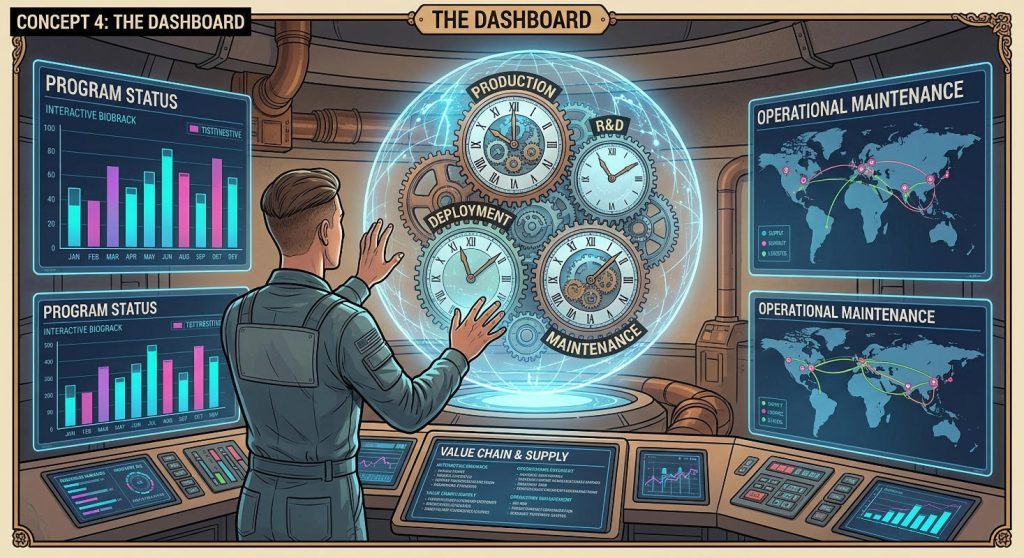
Depths describe the spaces in which this capability must survive: the front, rear bases, industrial sites, energy networks, logistics, digital platforms and civilian suppliers. Protecting them can end up changing the rules of the economy itself when the state imposes restrictions, reorganises flows, or temporarily takes control of infrastructure judged insufficiently protected. Interfaces describe the dependencies that enable the capability to be activated and recomposed: state-industry, civilian-military, national-European, public-private, hardware-software and, increasingly, human-technology relationships.
The coupling of theatres adds a further trade-off constraint: several crises can simultaneously draw on the same stocks, manufacturers, data, infrastructure or allied resources. Dynamic sovereignty thus becomes the capacity to maintain coherence between clocks, depths and interfaces despite local disruption and competition between crises.
17. A systemic stress test rather than a catalogue of capabilities
This architecture shifts the question posed to France and to Europe. It is no longer enough to ask: what can we produce? One must also ask: what can we keep producing, at what pace, at what depth, with what substitutes, under what financial constraints, and with what activation dependencies?

A stress test of the defense industrial base should vary several hypotheses simultaneously: munitions consumption above plan, destruction of a site, a supplier failure, an embargo on a component, saturation of a logistics network, the need to double a cadence, a sudden spike in working-capital needs, a cyberattack, an energy shortfall, the loss of a satellite infrastructure, the departure of a key individual — but also the simultaneous outbreak of a crisis on another theatre absorbing part of the same stocks, suppliers or allied resources.
The answer does not lie in multiplying precautionary stocks. Some stocks are necessary, but no economy can duplicate everything. Resilience rests on a combination: reserves, redundancies, substitution capacity, modularity, standards, contingent financing, prepared partnerships and skills capable of rapidly recomposing the system.
Conclusion — Producing at the pace of war
The return of industrial war to Europe first put volumes back at the centre of the debate. Stocks, munitions, supply chains and lead times had to be rediscovered. The war in Ukraine now shows a further step: mass is only one of the clocks.
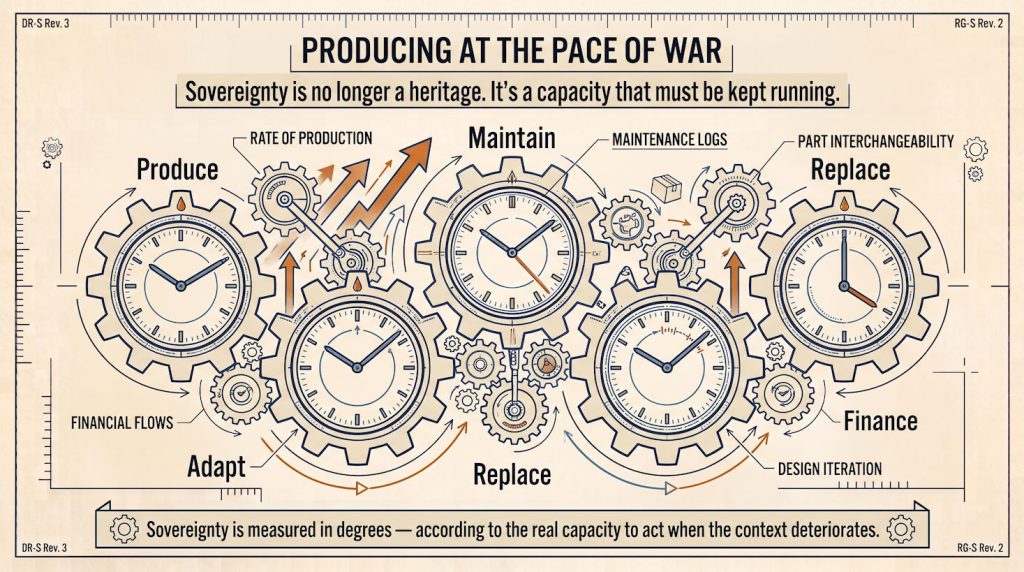
A durable military power must therefore keep these clocks turning under constraint: maintaining platforms, producing mass, adapting, substituting, financing and regenerating. It must simultaneously protect the depth in which these functions operate, control the conditions of activation, and preserve the interfaces that accelerate learning, including when several theatres draw on the same chains.
Sovereignty is therefore no longer a binary quality — sovereign or dependent. It is measured in degrees, according to the real capacity to act when the context deteriorates.
France’s defense industrial base retains a considerable advantage: a broad technological spectrum, top-tier prime contractors, specialised SMEs and a culture of sovereignty. The challenge is to better synchronise its clocks, protect their depth, and secure the interfaces of activation.
Producing, replacing, reconfiguring, activating, learning and arbitrating: this is the condition under which sovereignty stops being a heritage and becomes a capacity again.
Jérôme Denariez
See also:
- « Une BITD, plusieurs horloges » — (2026-0901)
- « A Defense Industrial Base, Several Clocks » — (2026-0901)
- « Eine Verteidigungsindustrie, mehrere Uhren » — (2026-0901)
Notes and sources
[01] Intelligence Online, “European investors target Ukrainian defense groups,” 24 July 2026. Working paper shared with the author. The paper notably highlights the rise of venture capital in Ukrainian defense and cites investments from Final Frontier and Varangians.
[02] Légifrance, JORF No. 0191 of 18 August 2026, Law No. 2026-791 of 16 August 2026 updating military programming for 2024-2030.
[03] NATO, The Hague summit, 24-25 June 2025: target of 5% of GDP by 2035, including 3.5% on conventional military spending and 1.5% on broader security.
[04] Council of the European Union, Regulation (EU) 2025/1106 of 27 May 2025 establishing the SAFE instrument; European Commission and first implementing decisions 2025-2026.
[05] Bundestag vote of 18 March 2025; Bundesrat vote of 21 March 2025: constitutional reform of the debt brake and creation of a €500 billion infrastructure fund over twelve years.
[06] Air Force of the Armed Forces of Ukraine / Ukrainska Pravda, 18 August 2026: 76 jet-powered Shahed drones launched during the day, 07:00-18:30, mainly against the Kyiv region; more than 70 reported shot down or jammed.
[07] Reuters, 20 August 2026, “Russia strikes drone component facilities, other targets in Kyiv, defence ministry says”; Guardian and FT, 20 August 2026, on the combined attack on Kyiv and other regions.
[08] Associated Press, 15 August 2026, “Ukraine attacks Russia’s Samara industrial site as Kyiv ramps up long-range strikes”; the article notably cites a threefold increase in Ukrainian deep strikes since January, according to ACLED.
[09] Reuters, 4 August 2026, “Ukraine strikes 3 more Russian warehouses…”; Associated Press, 17 August 2026, “Ukraine takes aim at Russia’s economy and morale by attacking online retailer”; ISW, 16 August 2026, on the strikes against Wildberries hubs.
[10] Reuters, 22 August 2026, “Ukrainian drones kill at least 10, hit warehouse of Russian online retailer Ozon”: a strike on an Ozon logistics centre in Chapayevsk and on the Novokuibyshevsk refinery; Moscow claims 457 drones shot down overnight.
[11] Reuters, 22 August 2026, “Putin says Ukraine opened ‘Pandora’s box’ with strikes on economic targets”: Vladimir Putin describes the struck refineries and warehouses as economic targets and announces reprisals against Ukraine’s most sensitive economic sectors.
[12] RBC / statements by Moscow mayor Sergei Sobyanin, 22 August 2026: 2,652 drones reported heading toward the Moscow region between 15 and 22 August, of which 493 were reportedly destroyed as they approached Moscow; temporary restrictions reported at airports during several waves. Russian figures not independently verified.
[13] Reuters, 19 and 20 August 2026, “Moscow’s fuel stations limit sales amid shortages” and “Frustrated Moscow drivers face long queues to refill as fuel shortages return”: reintroduction of purchase caps and queues in the Moscow region; Reuters links the strain to seasonal demand and refinery disruption from Ukrainian strikes, and notes Russian export and import restrictions on refined products.
[14] Reuters, 25 August 2026, “Russia to extend diesel export ban through September, sources say”: possible extension of the diesel export ban into September as domestic shortages persist and several refineries remain offline after attacks.
[15] Decree of the President of the Russian Federation No. 604 of 24 August 2026, published 26 August 2026, “on measures to ensure the security of critical infrastructure”; Reuters, 24 August 2026, “Putin allows Russia to take control of infrastructure deemed vulnerable to drone attacks.” The text allows temporary management of critical assets where protection or restoration is judged insufficient, particularly against drone attacks.
[16] Reuters, 5 and 7 June 2025, on Operation Spiderweb; Department of Defense, Operation Atlantic Resolve Quarterly Report to Congress, April-June 2025: at least ten Russian strategic bombers lost, according to the DIA.
[17] Security Service of Ukraine, statement of 4 August 2026; Interfax-Ukraine and ISW, 4 August 2026: more than 100 successful strikes claimed against strategic targets over forty days, including the destruction of a Tu-95MS.
[18] Reuters, 4 August 2026, “Russian July seaborne oil product exports drop 33% m/m, data from sources shows”: a 33% drop in seaborne oil-product exports in July versus June, linked to lower production and export restrictions; Reuters, 19 August 2026, “Oil exports from Russia’s western ports drop 15% below plan, traders say”: exports roughly 15% below plan over the first half of August, mainly due to disruption at Novorossiysk; reorganisation of certain Russian and Kazakh oil flows.
[19] Financial Times, 21 August 2026, “Ukraine seeks Elon Musk’s help to hit Russian missile launchers”: Ukrainian request to use Starlink-equipped drones against ballistic launchers up to roughly 200 km inside Russian territory.
[20] Reuters, 21 August 2026, “Ukraine’s ousted defence minister plans US trip to raise project funding”; Ukrainska Pravda / Suspilne, 20 August 2026: a trip linked to fundraising for defense-tech projects, with no political meetings announced; Reuters notes that Fedorov remains in discussions with Elon Musk about Starlink.
[21] Reuters, 11 August 2026, “Romania destroys drones drifting near major offshore gas project in the Black Sea”: two Gerbera-type drones neutralised near the Neptun Deep project; origin not established, with Ukraine stating they were not Ukrainian.
[22] Reuters, 10 August 2026, “Poland and Baltics shield infrastructure, fearing a Russian false-flag strike”: stepped-up protection of critical infrastructure in Poland, Lithuania, Latvia and Estonia against risks of sabotage, disinformation or false-flag operations.
[23] Reuters, 18 August 2026, “Russia warns Britain of ‘consequences’ for supplying drones to Ukraine” and “Russia’s Lavrov says Britain risks being seen as party to Ukraine war.” Russia’s embassy in London says the stronger British involvement, the higher the “price” to be paid.
[24] Reuters, 13 August 2026, “Putin visits disputed island near Japan, drawing Tokyo’s ire”; Reuters and Associated Press, 18 August 2026, on the summoning of Japan’s ambassador in Moscow and the mention of possible countermeasures amid Japanese sanctions and support for Ukraine.
[25] Reuters, 4 August 2026, “Japan casts military buildup as path to economic prosperity”; Japan’s Ministry of Defense, Defense of Japan 2026. Tokyo explicitly links military buildup, industrial base, dual-use technologies, startups and preparation of its next national security strategy.
[26] International Institute for Strategic Studies, Robert Ward, “Japan’s sweeping intelligence reforms,” 6 August 2026: creation of the National Intelligence Council and the National Intelligence Bureau in summer 2026, a three-stage reform, and plans for a foreign-intelligence service in 2027.
[27] Critical Threats Project / Institute for the Study of War, “Iran Update Special Report,” 18 August 2026, drawing on reporting from NBC News and Western officials: Russian transfers of drone components, munitions and TNT to Iran; Iran reportedly using Russian-upgraded Shahed variants and Russian intelligence in strikes against US forces.
Decryption: The real question is not industrial, it is institutional
What this body of evidence ultimately demonstrates fits in one sentence: producing more is no longer enough if no one is responsible for holding together clocks that follow neither the same rhythm, nor the same budget logic, nor the same actors. The platform is thought of in decades, mass in months, adaptation in weeks, financial endurance day by day. No ministry, no procure-ment agency, no general staff is today structured to arbitrate these four timeframes at once — each falls under a different administration, a different budget cycle, and often a different culture.
That is where the question the article poses without naming it head-on lies: who, in France as in Europe, has the mandate to arbitrate between these clocks when they collide — when accelerating time to scale means sacrificing SMEs’ financial endurance, or when protecting industrial depth ties up funds normally earmarked for production? Parliament votes a budget. The general staff sets operational priorities. The procurement agency manages programs. The finance ministry holds the purse strings. No one holds a synchronised overview.
A second question also remains open: the coupling of theatres — Ukraine, the Kurils, Iran — means France and Europe must now plan their strategic stocks anticipating simultaneous demand across several fronts. No military programming law, however generous, has yet built this hypothesis in as a central scenario rather than a peripheral risk.
Finally, the key-person risk illustrated by the Fedorov case raises a governance question rarely addressed by industrial general staffs: how many French and European capabilities today rest on personal relationships rather than institutionalised processes — and what would be left of those capabilities if the people involved changed jobs tomorrow?
“France knows how to run each clock separately. The real, unresolved question is who is responsible for synchronising them.”