The vote taking place in Saxony-Anhalt on September 6 looks, on the surface, like a routine midterm consultation — a settling of domestic political scores. It is nothing of the sort. What it really puts to the test is the continent’s capacity to survive as a strategic power, at a moment when every European chancellery claims to defend sovereignty while quietly organizing its dependence.
Key Takeaways
- The Finding: On the eve of the vote in Saxony-Anhalt, political discourse overwhelmingly invokes a superficial “sovereignty,” while the budgetary and capability choices of national chancelleries perpetuate continental fragmentation and strategic dependence on non-European powers.
- Key Analysis: The impasse facing a genuine European Defense Technological and Industrial Base (EDTIB) stems not merely from ideological posturing, but from a fatal desynchronization among several “clocks”: the operational urgency of the Eastern Flank, France’s ambition for integrated autonomy and industrial leadership, and Germany’s economically driven nationalist rearmament.
- Recommendation / Conclusion: In light of the eroding Franco-German axis and the illusion of the American umbrella, European sovereignty will not be rebuilt through abstract institutional promises, but through pragmatic and agile coalitions rooted in action and industrial competence (exemplified by the Franco-Swedish strategic partnership).
Europe Facing Its Own Mirror
Table of Contents
by Joël-François Dumont — Berlin, September 5, 2026.
Introduction
With hours remaining before polls open, the political climate conveys the impression of a Europe at a crossroads, torn between external crises (an attrition war on the continent, major uncertainties surrounding the American alliance, economic and energy pressures) and growing internal divisions. While candidates uniformly invoke sovereignty or the national interest, what do these speeches truly conceal when confronted with the reality of military, industrial, and strategic choices?
Continuing to advocate abstract sovereignty while blocking the emergence of a common European defense shield and industry condemns the continent to remain a helpless spectator of its own destiny.
This perspective aims to revisit the fundamental stakes of this vote, contextualize polling numbers, and decipher the real rift in European visions: continental sovereignty versus timid nationalisms. The fundamental question remains:
Do we want a Europe equipped with the real instruments of its power and independence, or an aggregation of isolated and vassalized nations?
1. Understanding the Numbers: What Do 24-Hour Pre-Election Estimates Really Mean?
The figures and voting intentions projected on the eve of the election are not an oracle, but a snapshot of a complex local political dynamic that must be deciphered with rigor and method.
Methodological Sidebar: From the Saxony-Anhalt Regional Election to the Reshaping of European Balances
| Analytical Focus | Approach & Evaluation Scope |
| Study Objective | Assess the gap between political rhetoric on “European strategic autonomy” and the reality of capabilities, budgets, and industrial/military dependencies on the eve of the vote. |
| Evaluation Scope | European Union Member States, EU institutions (Commission, EDA), NATO, and major bilateral alliances. |
| Key Performance Indicators (KPIs) | Share of intra-EU vs. extra-EU military acquisitions (especially US); Real evolution of defense budgets (R&D and procurement allocations); Level of interoperability and standardization of armed forces. |
| Sources & Data | European Defence Agency (EDA) data, parliamentary reports, defense industry reviews (EDTIB), and official foreign policy statements. |
| Biases & Limitations | Defense data confidentiality, heterogeneity of national accounting methods, and short-term geopolitical volatility. |
From the Saxony-Anhalt Regional Election to the Reshaping of European Balances
- Margin of Uncertainty and Volatility: On election eve, undecided voters and actual turnout remain the primary adjustment variables. High abstention traditionally favors disciplined electorates, whereas last-minute mobilization alters seat distribution at the margin (yet remains crucial for crossing the fatal 5% threshold).
- The Campaign Dynamics Trap: Estimates often reflect national protest motives (a “sanction vote” against the federal government or European directions) at the expense of long-term community stakes.
- European Projection: Beyond national party scores, the crucial stake lies in the reshaping of political groups at the Union level. These balances will determine the EU’s capacity to legislate, block, or accelerate on major defense, Ukrainian support, and foreign policy files during the upcoming term.
2. Sovereignty in Question: An Overused Concept Facing the Lessons of History
The word “sovereignty” has imposed itself across virtually all political platforms, from the radical far-right to moderates. Yet behind this misleading lexical consensus lie two irreconcilable visions illuminated by recent history.
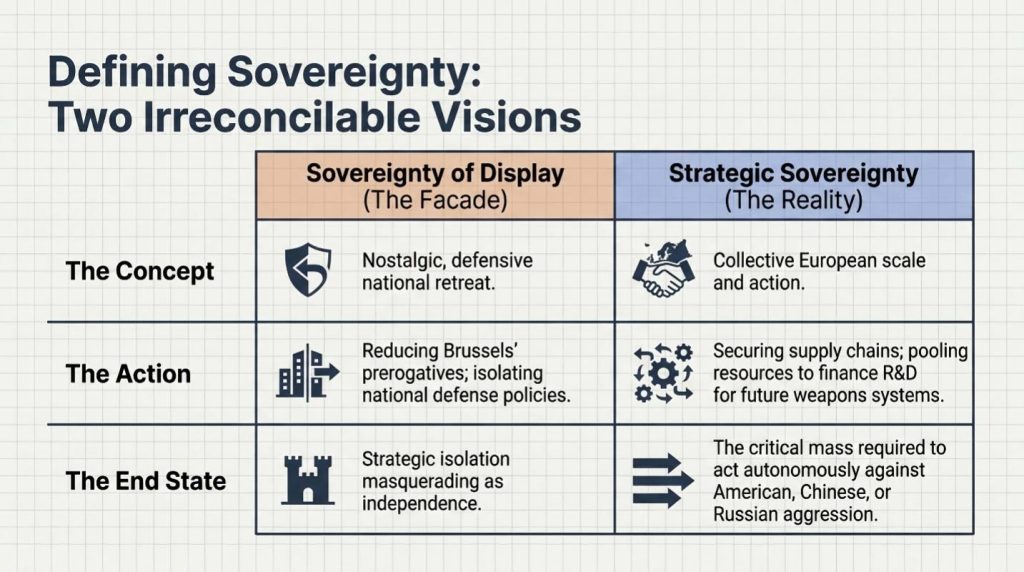
Two Antagonistic Visions of Sovereignty
- Surface Sovereignty (National Retreat): For populist and opportunistic sovereigntist movements, demanding sovereignty means restoring purely national margins of maneuver, reducing Brussels’ prerogatives, and weakening common policies. It is a defensive, nostalgic vision confusing genuine independence with strategic isolation.
- Strategic Sovereignty (European Scale): Facing American, Chinese, or Russian power, no single European nation possesses the critical mass to impose standards, secure supply chains, or fund future weapons systems R&D. True contemporary sovereignty is not a return to the 19th century, but the collective capacity of Europeans to act autonomously on the global stage.
The Franco-German Trajectory: From Historical Entanglement to Contemporary Disillusionment
As highlighted in our series on Franco-German relations from 1806 to 2026:[01]
- From the “chain reaction of hatred” (1805–1871) to the climax of two World Wars, Europe paid a heavy price for unbridled national rivalries.
- Post-1945 reconstruction and the engine of the Élysée Treaty (1963) rested on a tacit balance: economic and industrial supremacy for Germany; diplomatic, military leadership, and nuclear deterrence for France.
- The post-reunification era (“Je t’aime, moi non plus 1990–2025”) and the recent sequence (“Quo vadis? 2025–2026”) shattered this foundational compromise.

France—which invested heavily after 1990 in the European integration of Poland and Central Europe (agriculture, EU/NATO enlargement)—saw its eastern and Germanic partners exhibit near-exclusive preference for American or South Korean equipment. Berlin’s recent pivot—unilateral rearmament of 500 billion euros, backing of defense giant Rheinmetall, bypassing bilateral cooperation—confirms that Germany now seeks to directly negotiate its vassalage with Washington by becoming NATO’s military pivot in Europe, thereby marginalizing the project of European autonomy advocated by Paris.
This shift is not merely a matter of industrial opportunism: the geographic proximity of the Russian threat and growing uncertainty over the American guarantee weigh on Berlin just as much as on the rest of the Eastern Flank. But Germany has chosen to respond with a national logic rather than through integration with Paris — it is this choice, more than the rearmament itself, that is the real problem.
3. The Trial by Fire: “One EDTIB, Multiple Clocks” and the Lack of Appeal for a Unified Defense
On the military and industrial battlefield, the contradiction between political speeches and concrete actions appears most brutally. The resurgence of hard power on our continent demands a robust European Defense Technological and Industrial Base (EDTIB). Yet the European response remains fragmented and weakened by structural divergences.
Explanatory Diagram: The Dissonance of European Defense
| Step | Level / Factor | Mechanism & Manifestation | Major Impact |
| 1 | Political Discourse | Affirmation of “Europe as a Power”; repeated calls for strategic autonomy and industrial sovereignty. | High public expectations and superficial display of unity. |
| 2 | Security Imperative | Heightened geopolitical pressure (war in Ukraine, US strategic realignments). | Short-term imperative for immediate rearmament. |
| 3 | Procurement Reality | “Off-the-shelf” purchases of non-European equipment (primarily US) to fill capability gaps immediately. | Weakening of the European Defense Technological and Industrial Base (EDTIB). |
| 4 | Result / Sovereignty | Perpetuation of external strategic dependence despite overall increases in national defense spending. | Pretense: Increased expenditures without proportional gains in true autonomy. |
Diagnostic of Temporalities: “Multiple Clocks”
As Jérôme Denariez emphasizes in his analysis “One EDTIB, Multiple Clocks”,[02] the EDTIB stalemate stems not merely from political ill will, but from a fundamental desynchronization among continental actors:

- The Baltic and Polish Emergency Clock: Facing Moscow’s direct threat, Eastern flank nations operate on a 24-to-48-month horizon. This constraint drives them toward “off-the-shelf” American or South Korean purchases—immediately available, but destructive to continental industrial sovereignty.
- The French Industrial Ambition Clock: Centered on 15-to-20-year development cycles (Rafale, FCAS/SCAF, SSBNs), French doctrine targets integrated strategic autonomy and complete mastery of key technologies—a requirement judged too slow or demanding by neighbors.
- The Rhenish Mercantilism Clock: Germany leverages its rearmament to revitalize a stagnating industrial base (converting automotive capacity to military output), favoring national champions over collapsing Franco-German programs (FCAS, MGCS).
The Emergence of German Military “Sovereigntism” and the Rupture of the Rhenish Model
Berlin’s abandonment of its “civilian power” status marks the end of the post-1990 compromise; Germany now seeks to build Europe’s most powerful conventional army to establish itself as NATO’s indispensable pillar.
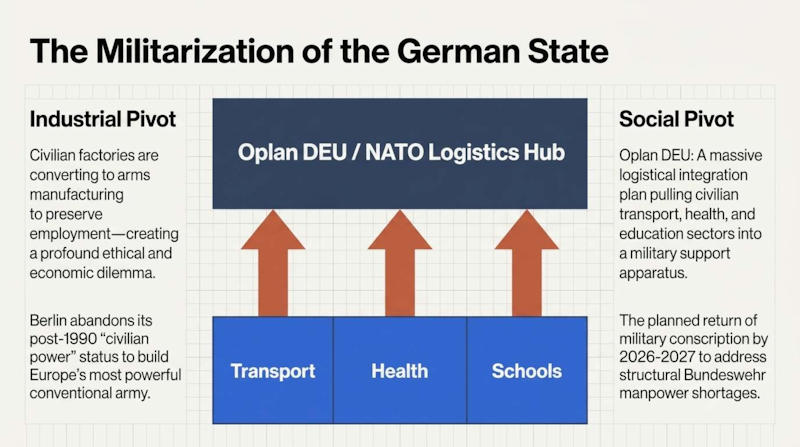
Facing the decline of its export model (Russian energy and automotive exports), the state is injecting hundreds of billions of euros into defense to support the economy. This massive rearmament follows a national industrial logic favoring giants like Rheinmetall, marginalizing Franco-German cooperation in the process.
The Militarization of Society and Civil Acculturation
This economic shift coincides with a profound transformation of the social and industrial fabric, where civilian factories convert to military production to preserve jobs, creating major ethical dilemmas. To meet Bundeswehr recruitment goals, the government is preparing a progressive return to conscription by 2026–2027 while deploying the Oplan DEU plan. By integrating transport, healthcare, and schools into this NATO logistical framework, Germany is orchestrating a comprehensive military acculturation of its society.

The Illusion of the American Umbrella and the Great Political Refusal
Even as political developments in Washington cast major doubt on the durability of US security guarantees, a majority of European governments continue funding the trans-Atlantic military-industrial complex.
Building a genuine EDTIB would require explicit political decisions that chancelleries still refuse to enact:

- Strict European preference in defense procurement funded by EU resources.
- Joint procurement at 27 to guarantee competitive industrial volumes.
- Genuine interoperability and harmonization of operational doctrines.
4. Seeking Other Horizons: Pragmatic Partnerships for the New Europe of Defense
Facing repeated deadlocks in the Franco-German axis and Paris’s legitimate frustration with partners demanding guarantees without granting European preference, a reconfiguration is imperative. This drives the strategic analysis “Seeking Other Horizons” and the study of the Franco-Swedish partnership (“Winner Takes All in the Far North”).[03]
The Swedish Model and Northern Synergies
Sweden—recently integrated into NATO yet possessing an excellent defense industrial culture (Saab, Gripen, A26 submarines, artillery, electronic warfare)—embodies this pragmatic alternative.

The Franco-Swedish strategic partnership demonstrates that equal bilateral cooperation is viable when based on technical competence, a shared vision of sovereignty, and industrial agility superior to bureaucratic structures.
By partnering with dynamic, competent nations possessing true operational cultures—such as Sweden, Czechia, Canada, or Finland—France outlines an “Europe of defense through competence and action,” transcending empty theoretical promises.
Conclusion: Words Fade, Deeds Remain
With Europe confronting an existential threat at its borders and the risk of major strategic isolation, the time for fragmentation and rhetoric is over. Declarations of “European solidarity” cannot mask the reality of defense budgets exported outside the continent.
The vote in Saxony-Anhalt, like budgetary and industrial choices made in Berlin, Warsaw, or Paris, forces Europeans to face their responsibilities.

While political discourse is easy, only concrete actions will rebuild continental power. Continuing to buy externally what we should produce together is to consciously accept vassalage. Conversely, choosing a sovereign EDTIB backed by pragmatic alliances between action-oriented nations gives Europe the means to write its own future rather than suffer the one foreign powers intend to impose.
Joël-François Dumont
[01] See: « France-Germany: The Machinery of Hatred 1805-1871 (1) » — (2026-0814) ; « France-Germany: The March Toward the Abyss 1871-1914 (2) » — (2026-0816) ; « France-Germany: The Paroxysm, 1914–1945 (3) » — (2026-0819) ; « France-Germany: From Ruins to an Emerging Europe, 1945-1959 (4) » — (2026-0820) ; « France-Germany: The Axis and Its Trials 1958-1989 (5) » — (2026-0821) ; « France-Germany: Love Me, Love Me Not 1990-2025 (6) » — (2026-0824) ; « France-Germany: Quo Vadis? 2025-2026 (7) » — (2026-0826) ; « France-Germany: Searching for Other Horizons (8) » — (2026-0829).
[02] « A Defense Industrial Base, Several Clocks » — (2026-0901)
[03] « Who Loses Wins in the Far North? » — (2026-0901)
See also:
- « Sovereignty, Defense, and Pretenses on the Eve of the Vote » — (2026-0905)
- « Souveraineté, défense et faux-semblants à la veille du scrutin » — (2026-0905)
- « Souveränität, Aufrüstung und Augenauswischerei am Vorabend der Wahl » — (2026-0905)
Analysis: The Hour of Strategic Choices
By holding a mirror to Europe, the analysis conducted on the eve of the vote reveals a profound rift between sovereignty proclaimed from political podiums and capability dependencies maintained by design.
While the security crisis at continental borders demanded urgent rearmament, the response provided by chancelleries—led by Berlin—has cemented European fragmentation. By prioritizing non-European off-the-shelf purchases and weaponizing military spending for national industrial competition, Germany broke the historical equilibrium of the Franco-German axis. The deadlock is not merely political; it reflects a structural inability to align divergent temporalities: Eastern operational urgency, French integrated autonomy, and Rhenish mercantilism.
Yet this impasse marks the beginning of an inevitable realignment. Facing the persistent illusion of a trans-Atlantic umbrella subject to Washington’s political whims, the future of continental defense can no longer rely on large multilateral programs paralyzed by bureaucracy. The rise of pragmatic partnerships based on industrial competence and reciprocity—such as the Franco-Swedish rapprochement—outlines a new European defense framework. By leveraging these action-driven coalitions and enforcing strict community preference, the continent will regain its capacity for initiative.
Today’s vote is not an end in itself, but a historical turning point. Tomorrow, Europe must decide whether to remain a collection of isolated client states or build, through political willpower and technological sovereignty, the real instruments of its strategic freedom.