Twenty-five years separate the meeting at Colombey from the fall of the Wall. Twenty-five years during which two countries, reconciled on paper since 1963, would learn to trust one another in practice — through crises, strategic divergences, and one pair of leaders after another. The fifth installment of this series traces how the Franco-German axis held together, until a seismic event no one saw coming fractured it one last time.
Key Points
- September 1958: de Gaulle and Adenauer meet for the first time at Colombey — two men who had lived through both wars, personal trust preceding any institutional agreement.
- 22 January 1963: signature of the Élysée Treaty — immediately followed by a gesture that limits its scope, the preamble added by the Bundestag.
- The 1970s: Willy Brandt’s Ostpolitik introduces a fundamental divergence between the two capitals, as Paris watches the opening to the East with unease.
- 20 January 1983: François Mitterrand addresses the Bundestag in Bonn — a strong gesture of solidarity, running against part of his own political camp.
- September 1984: Mitterrand and Kohl, hand in hand at Verdun — the symbolic high point of reconciliation.
- 9 November 1989: the fall of the Wall catches everyone off guard, Paris included.
Contents
by Joël-François Dumont — Paris, 22 August 2026
Introduction
The fourth installment of this series ended on a promise: that of a meeting, in September 1958, between two men whom everything seemed to set apart, yet whom history had just brought together. This fifth installment tells what came next — no longer the construction of an economic architecture, as with the ECSC, but the test of time facing a political relationship. For signing a treaty is not enough to guarantee trust. It would take twenty-five years, several generations of leaders, and at least two major crises for the Franco-German axis to prove its solidity — before an event no one had anticipated came, one last time, to put it to the test.
1. Colombey, September 1958: The Founding Encounter
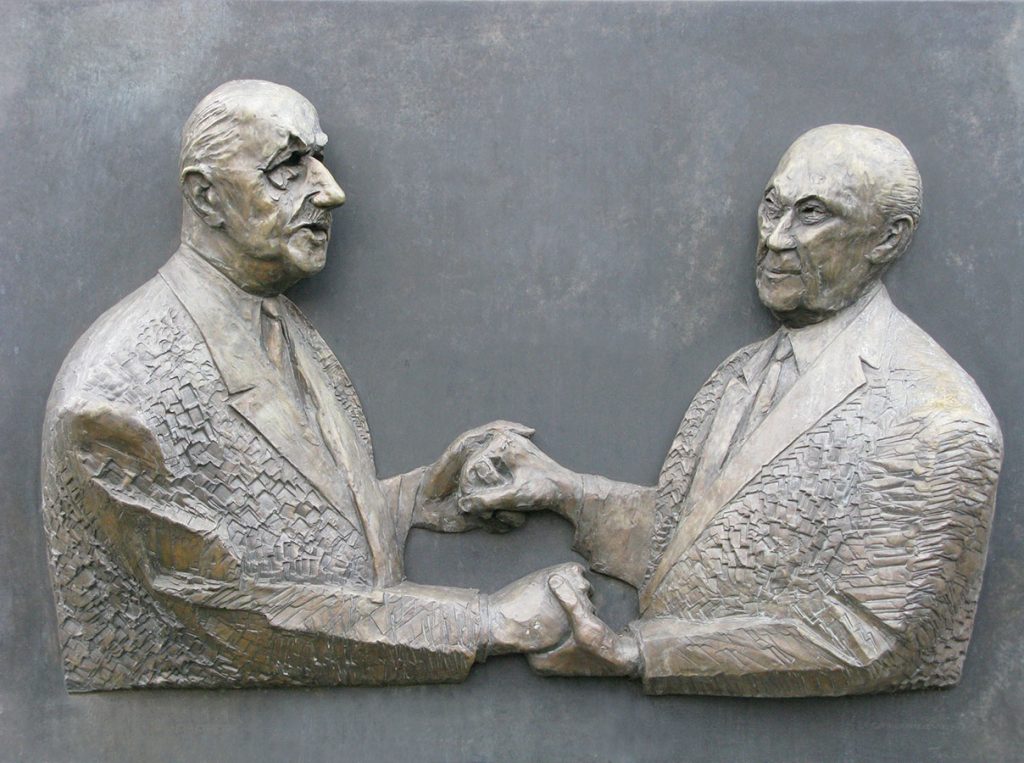
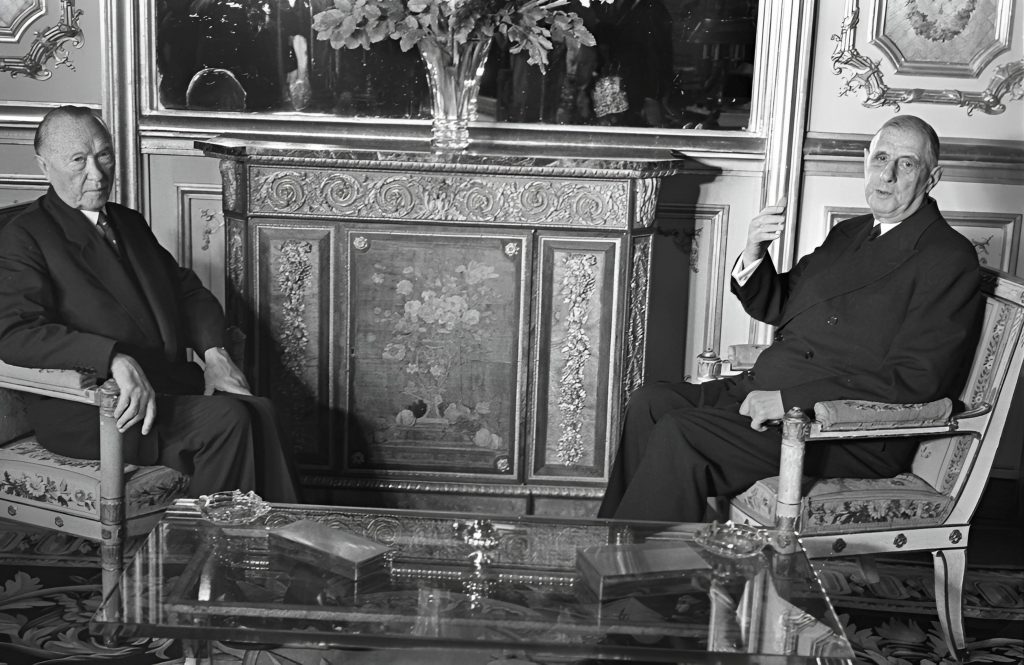
De Gaulle and Adenauer met for the first time on 14 and 15 September 1958, at La Boisserie, the General’s country home in Colombey-les-Deux-Églises. The choice of location was no accident: de Gaulle received his guest at home, in intimacy, rather than amid the pomp of a Parisian palace. Adenauer spent the night there — to this day, he remains the only foreign head of government ever to have slept at La Boisserie.[01]
The two men shared this in common: they had lived through both wars, in their flesh and in their convictions. Adenauer, mayor of Cologne under the Weimar Republic, removed from office by the Nazis as early as 1933, embodied a Germany that had paid the price of its own history. De Gaulle, the man of 18 June, embodied a France that had refused defeat. Their meeting was thus not that of two technocrats negotiating an agreement, but that of two statesmen sizing each other up, each deciding — in his own way, each with his own ulterior motives — to place his trust in the other.
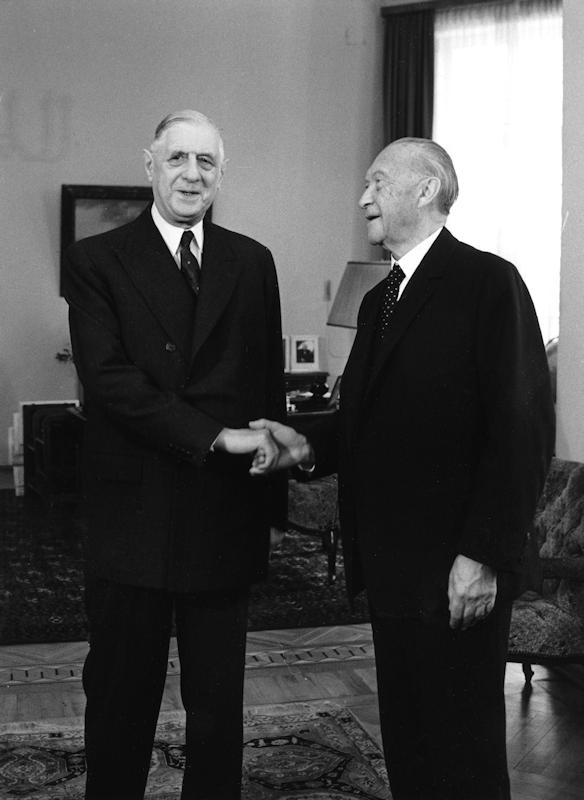
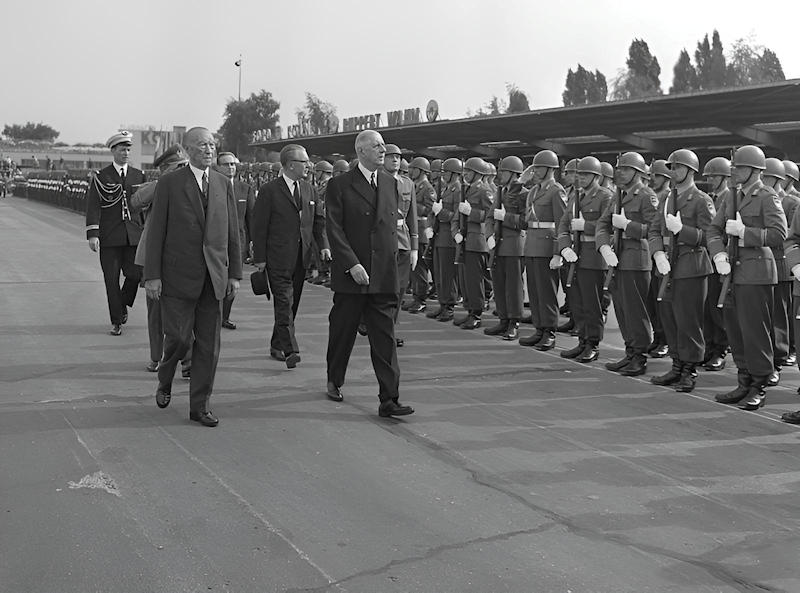
De Gaulle and Adenauer in Bonn, 4 July 1963 — the regular consultations provided for by the Élysée Treaty take shape within the first months: January’s handshake becomes an institutional practice — Photo Bundesarchiv © Ludwig Wegmann
Trust, however, was not yet complete. During those two days at La Boisserie, de Gaulle had indeed raised his idea for a three-power directorate within NATO — a triumvirate bringing together only the Western powers victorious in 1945: the United States, the United Kingdom, and France — without ever including Adenauer in it.[02] The Chancellor, returning to Bonn in the euphoria of the meeting, received confirmation of this only days later, and the warmth of his homecoming cooled at once. The lesson was not lost on Adenauer: de Gaulle would never be a simple partner, even for him. But the essential point already held: both men knew they could work together despite everything.
This personal trust, built before any written agreement, would become the foundation on which the institutional formalization of the relationship would rest five years later.

The relationship the two men held so dear was not built solely behind the closed doors of La Boisserie. Adenauer, weary of being watched in his every move by American intelligence — the CIA had infiltrated the Auswärtiges Amt itself — had chosen to maintain a permanent, confidential channel with de Gaulle in Paris. He appointed a man from within his own circle, a man of complete trust who would report to him alone, face to face. His choice fell on a BND officer, Colonel Dr. Heinrich Bucksch. General de Gaulle, for his part, kept the Quai d’Orsay no better informed — he knew better than any-one how much Germany remained an American preserve, and that the CIA had it under watch.
General de Gaulle, at the Élysée, along-side the German ambassador, in conversation with Colonel Heinrich Bucksch — Photo Presidence de la République
One day, years after our first meeting, the Colonel shared with me an anecdote I have always savored. After his first one-on-one meeting with the General, back at the embassy, the ambassador and the military attaché were waiting for him, eager to know more. “So?” the ambassador asked. Colonel Bucksch answered, simply: “Very interesting. I’m taking the night train this evening at eight, I have an appointment with the Chancellor tomorrow morning at nine.” Not another word. I had long wondered why this exceptional man had never been promoted to general — that day, I understood why.
The secret was well kept on both sides of the Rhine. Little wonder, then, that Ambassador Pierre Maillard himself — adviser on German affairs at the Élysée for so many years — had never heard of Colonel Bucksch, and was visibly shaken the day I went to interview him at his home in Boulogne and told him that this “major feature” on the Franco-German relationship over time, prepared for the Revue Défense,03] would also include a piece written by the Colonel’s own son, Georg Bucksch [04]— a man who clearly took after his father.
Unlike so many of our politicians, General de Gaulle spoke little. He knew, better than anyone, the need to “keep his secrets secret” — a phrase Charles Pasqua, a former Resistance fighter, made his own during the war. One evening, as Minister of the Interior, gathering all the former heads of the DST to celebrate the 50th anniversary of the institution on Rue Nélaton, Pasqua closed his remarks by saying: “Ladies and gentlemen, there is one rule from which we never depart: ‘Keep your secrets secret.'” Proof, if any were needed, that Charles Pasqua did in fact speak English.
2. Ludwigsburg, September 1962: De Gaulle Addresses German Youth
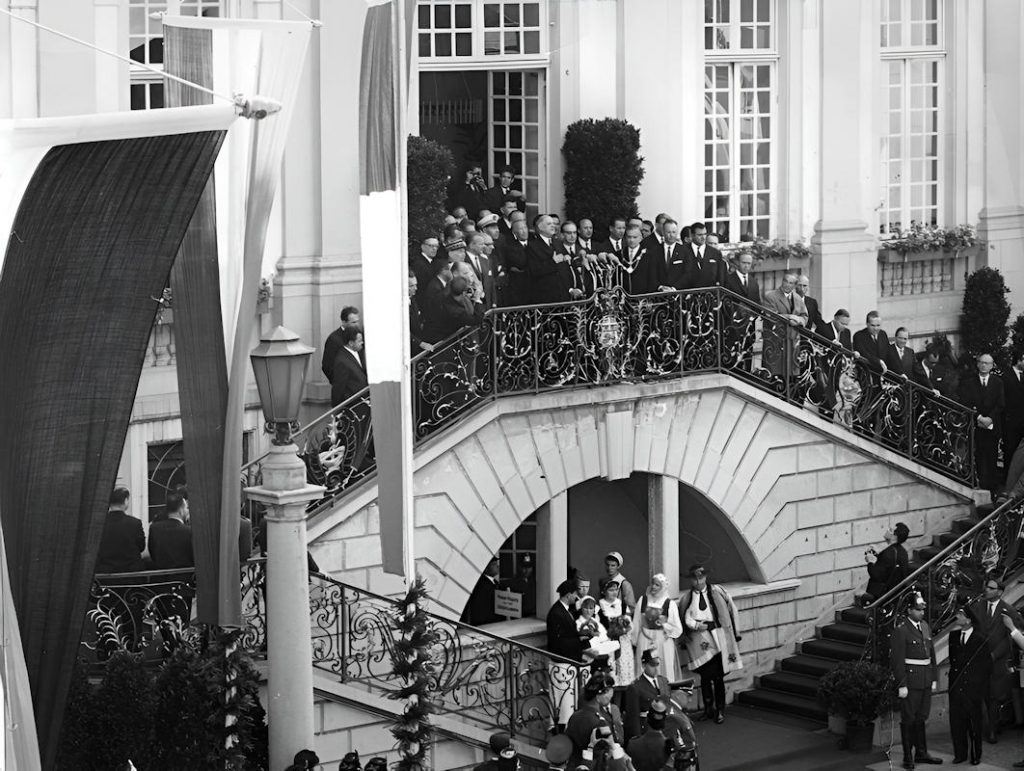
Four years after Colombey, a gesture would help pave the way toward the signing of the treaty. In September 1962, de Gaulle undertook a triumphant tour of Germany, cheered wherever he went. Its high point was his address to German youth, delivered at Ludwigsburg Castle, largely in the language of his hosts.
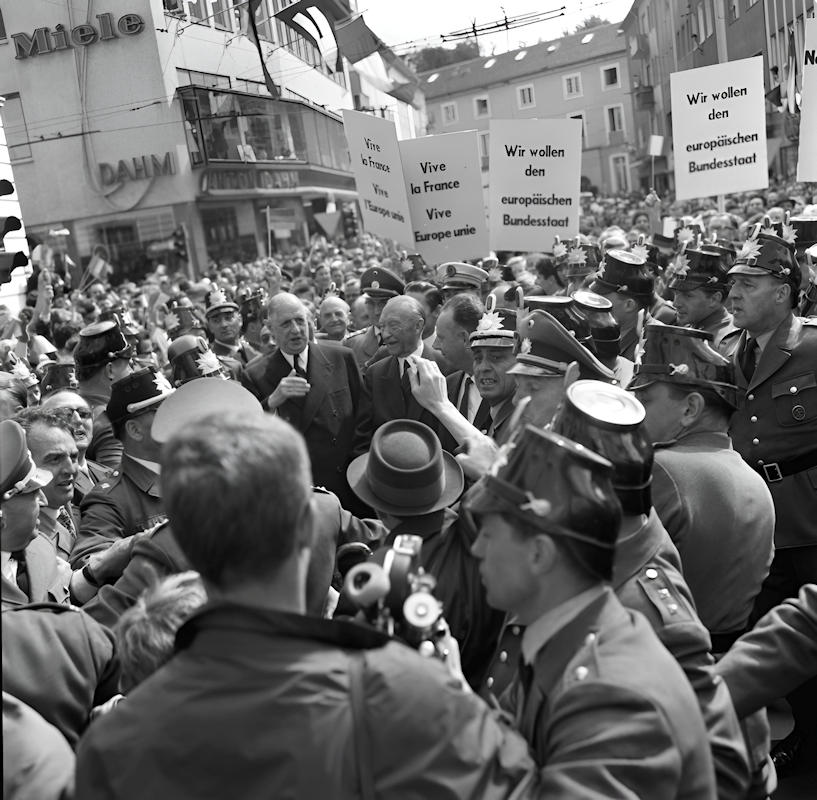
On Bonn’s market square, on 5 September, he told the cheering crowd:
“It is a great joy and a great honor for me to be received in your country. […] Seeing you gathered around me like this, hearing your demonstrations of welcome, I feel more strongly than ever the esteem and the trust I hold for your great people — yes! — for the great German people. You may be assured that in France, where people are watching and following what is happening here in Bonn, a wave of friendship is rising in minds and hearts and spreading. Long live Bonn! Long live Germany! Long live Franco-German friendship!”[05]
The French president told the young Germans he was proud they were “the children of a great people,” while candidly acknowledging the “great faults” and the “great misfortunes, condemnable and condemned,” that this people had committed over the course of its history. It was a risky formula: it required naming the past without turning it into a weapon, and addressing a generation that had not chosen that history, without absolving it entirely.
This speech, which has gone down in history, owed nothing to improvisation. It was the diplomat Pierre Maillard, adviser on German affairs at the Élysée, who had prepared it, patiently rehearsing de Gaulle’s German with him ahead of the great day. Invisible work behind the scenes, without which the public gesture would not have carried the same weight.
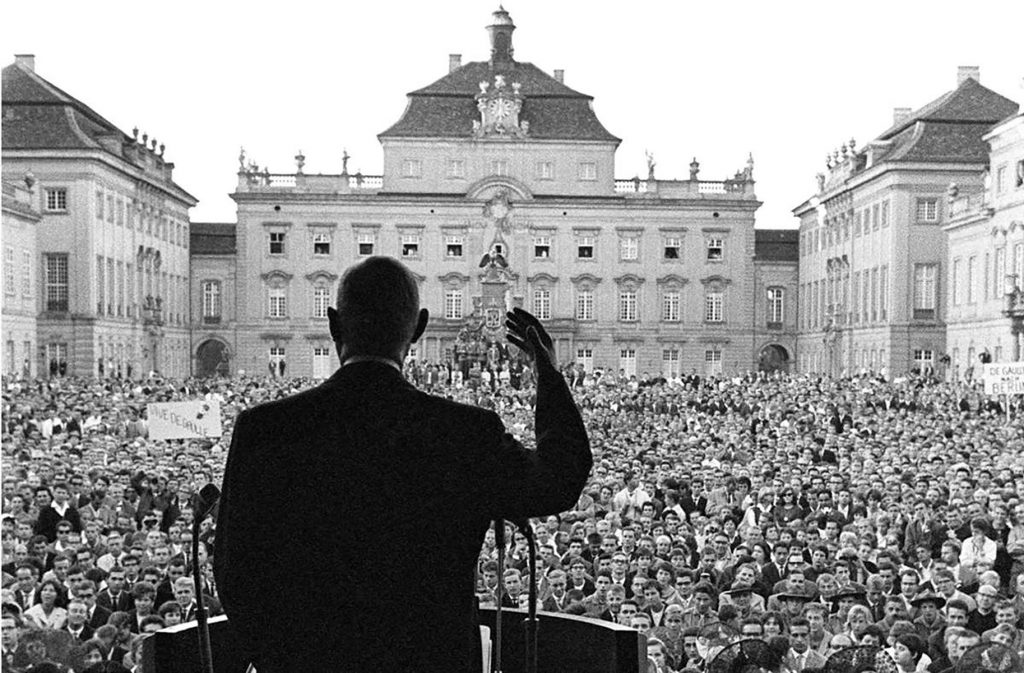
This act of public diplomacy, charged with emotion, prepared minds on both sides of the Rhine for what would follow six months later. It was also a reminder that reconciliation, to endure, could not remain the affair of heads of state alone: it had to reach a generation that had not known the war, and that would have to carry this relationship forward long after de Gaulle and Adenauer had left the stage.
3. The Élysée Treaty and Its Contested Preamble
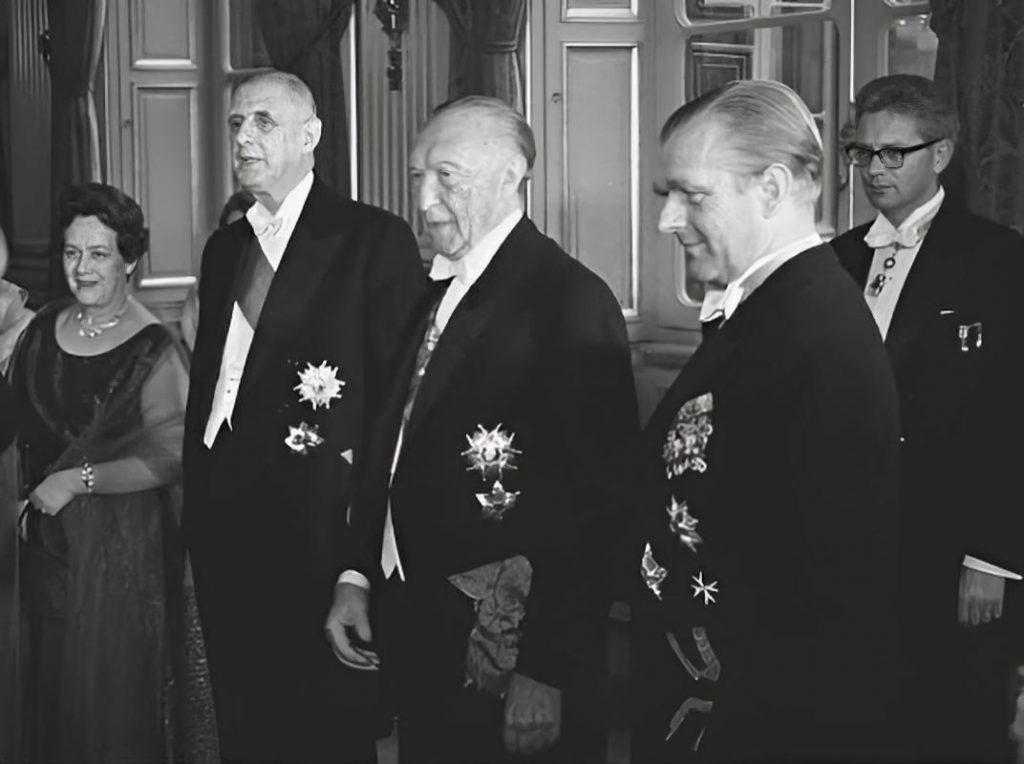
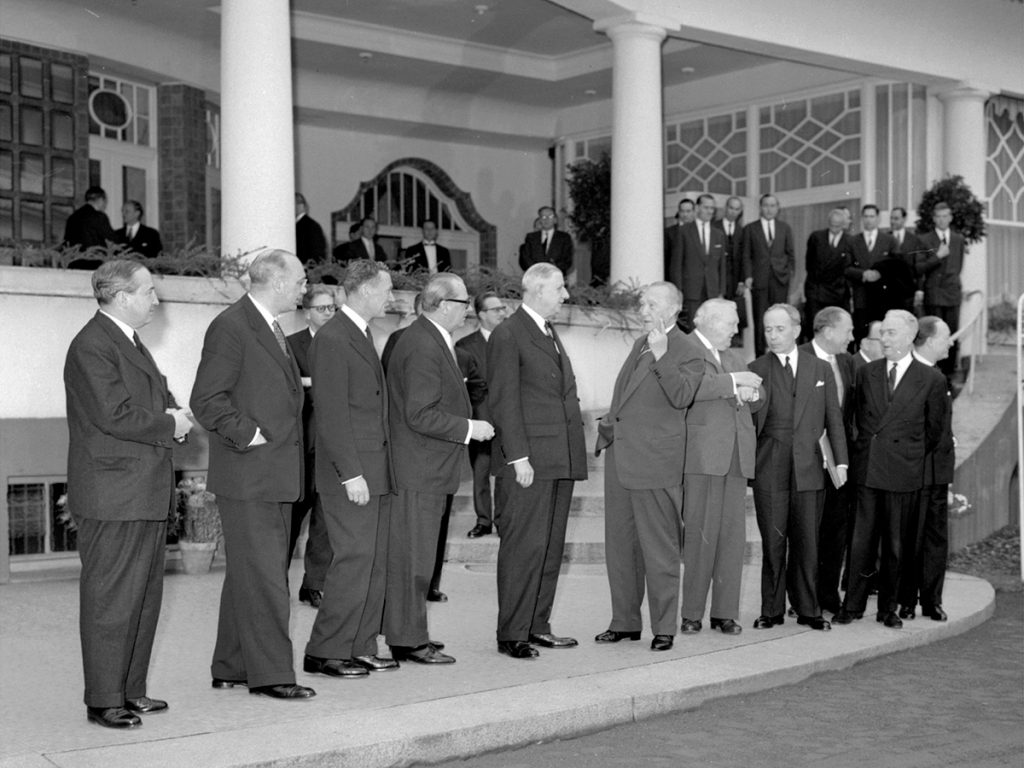
On 22 January 1963, de Gaulle and Adenauer signed, at the Élysée Palace, the treaty that bears its name. The text provided for regular consultations between the two governments on foreign affairs, defense, and education — an ambition that, on paper, went far beyond a simple cooperation agreement.
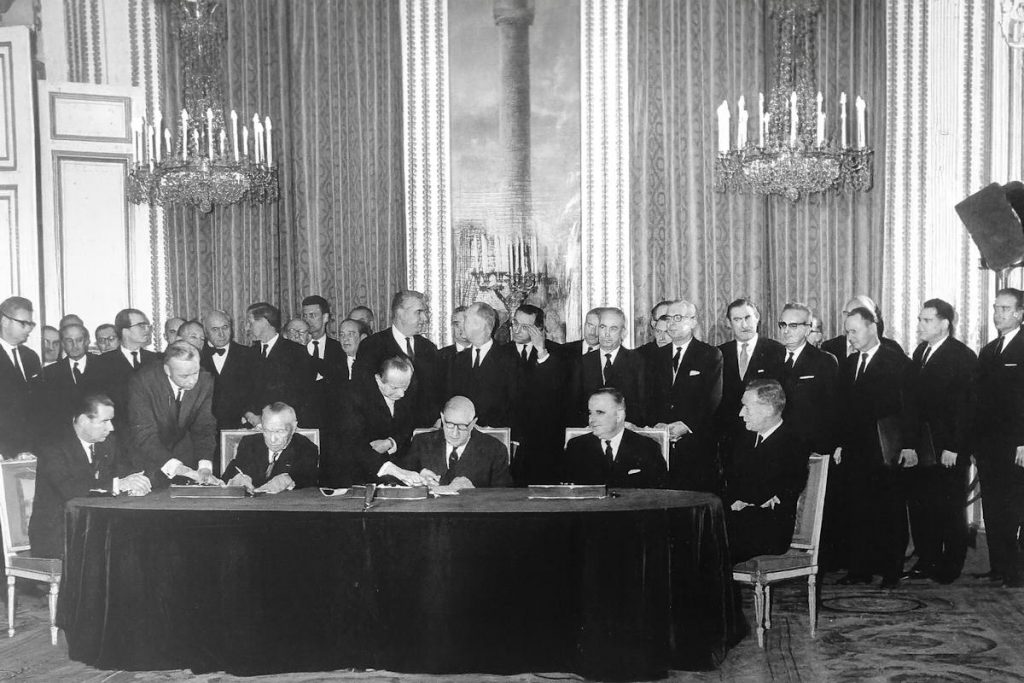
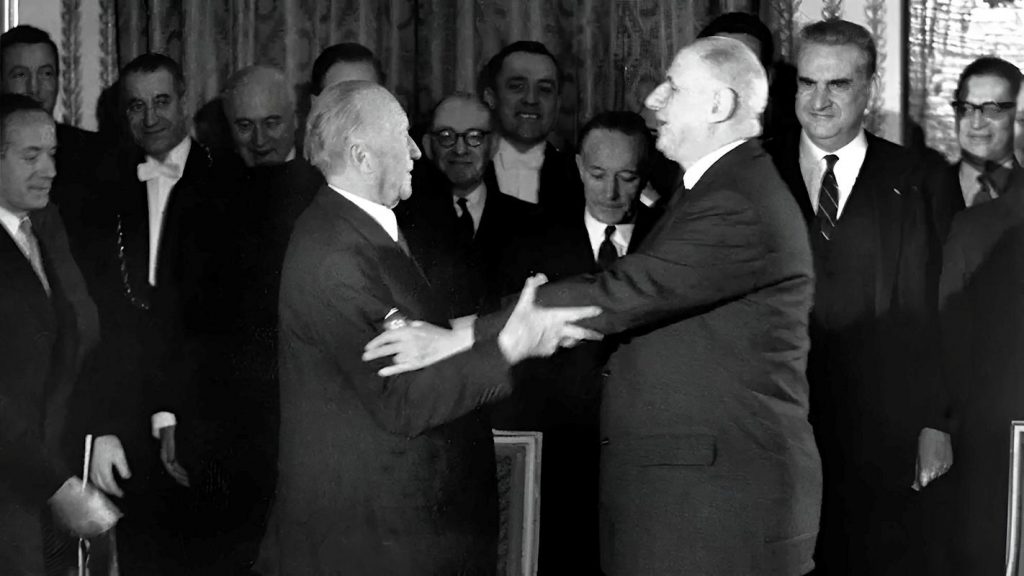
But de Gaulle’s ambition of a Franco-German axis relatively independent of Washington quickly ran up against German political reality. In ratifying the treaty, the Bundestag attached to it a preamble reaffirming the Federal Republic’s loyalty to the Atlantic Alliance and to the goal of a European integration open to the United Kingdom — two points on which de Gaulle, at the time, was considerably more reserved.
This gesture, seemingly a matter of protocol, spoke volumes about the structural limits of the nascent relationship: France and Germany could build an axis, but each did so within different strategic constraints — one leaning toward a form of independence, the other firmly anchored under the American umbrella. The Élysée Treaty did not erase this divergence; it simply taught the two countries to live with it.
4. Ostpolitik, or the First Divergence
In the late 1960s, Chancellor Willy Brandt launched Ostpolitik: a policy of opening toward Eastern Europe and the Soviet Union that led, notably, to de facto recognition of the borders resulting from the Second World War and to a gradual normalization of relations with East Germany.
This shift introduced, for the first time since Colombey, a fundamental divergence between the two capitals. Paris viewed this German opening to the East with genuine caution: the idea of a Germany once again engaging directly with Moscow, even within a peaceful and democratic framework, stirred reflexes older than the Élysée Treaty itself.
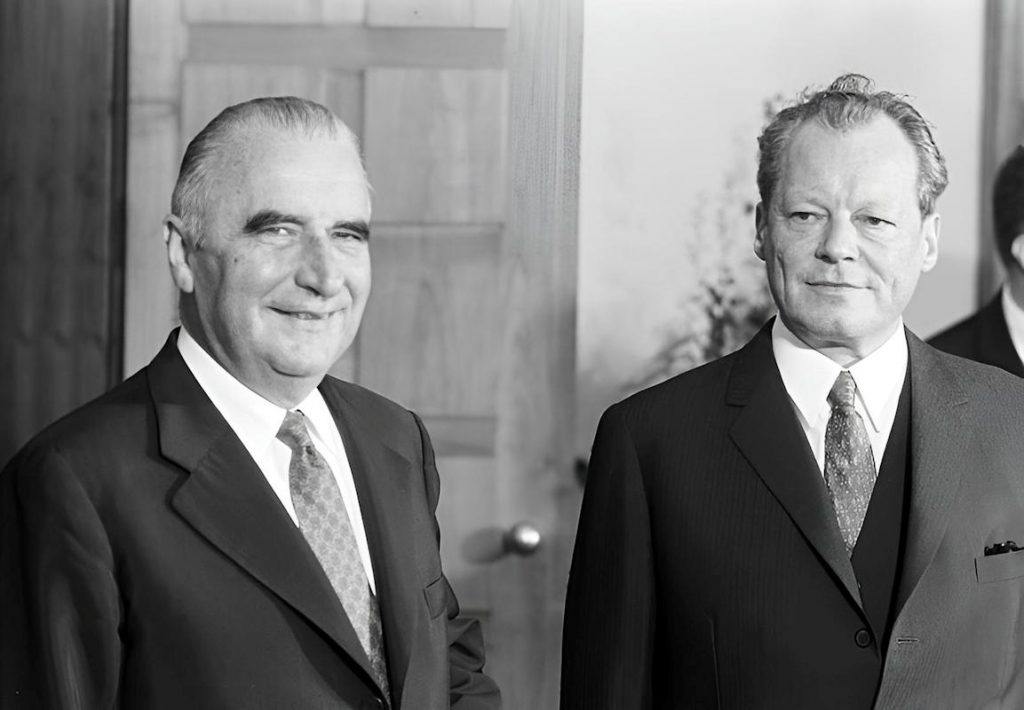
The episode nonetheless remained contained. The Franco-German relationship, under Pompidou and then under Brandt, continued to advance on other fronts — notably the building of the European Community — without this strategic divergence calling the axis itself into question. It was a first test, successfully passed, of the two countries’ ability to keep a substantive disagreement from degenerating into rupture.
5. Giscard and Schmidt: The Economic Axis
The partnership formed by Valéry Giscard d’Estaing and Helmut Schmidt, beginning in 1974, arguably marked the high point of Franco-German economic cooperation for the period. The two men, who knew and genuinely appreciated one another, established the European Monetary System in 1979 — a distant precursor to what would become the single currency — and institutionalized summit-level dialogue among the world’s leading industrial powers with the creation of the G6 and G7.
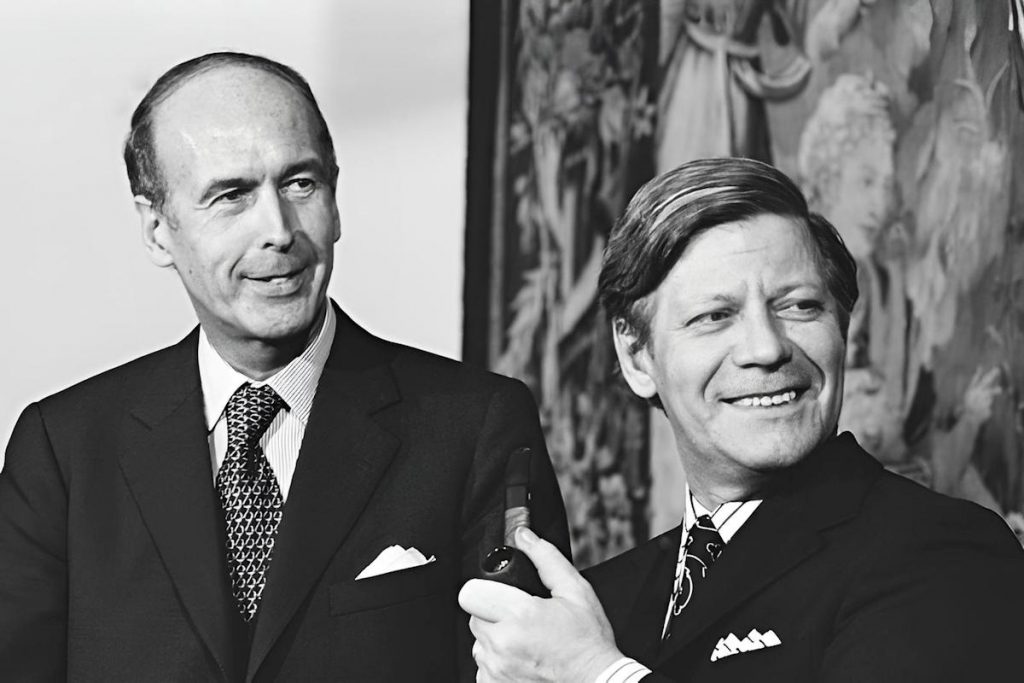
This period illustrates an axis that had found its cruising speed: less spectacular than the founding meeting at Colombey, less solemn than the signing of the Élysée Treaty, but deeply effective in its capacity to produce concrete results. It was also the period when the Franco-German relationship ceased to be solely the affair of two charismatic heads of state and became a well-oiled institutional routine.
6. 20 January 1983: Mitterrand at the Bundestag
On 20 January 1983, François Mitterrand, a Socialist president elected less than two years earlier, addressed the Bundestag in Bonn. There, against the current of part of the European left and of his own political camp, he defended the deployment of American Pershing missiles in response to Soviet SS-20s, under NATO’s dual-track decision.[06]

The gesture was a bold one. Mitterrand, under no particular obligation to take this political risk, chose to do so in the name of solidarity with a German partner then swept by a powerful pacifist movement hostile to the deployment of the Euromissiles. He was accompanied that day by Jean Lecanuet — a detail that has drawn little comment, but that testifies to a wish to place the speech above purely French partisan divides.
This was a moment when France took a risk for Germany, rather than the reverse. It is worth remembering, in order to measure, six years later, the full scale of the contrast.
7. Verdun, 1984: The Symbolic High Point
On 22 September 1984, Mitterrand and Chancellor Helmut Kohl met at Verdun, on the very ground of one of the deadliest battles of the First World War — the one that, in the first installment of this series, embodied the machinery of hatred at its most extreme. The handshake between the two men, before the Douaumont ossuary, became one of the most widely reproduced images of Franco-German reconciliation.
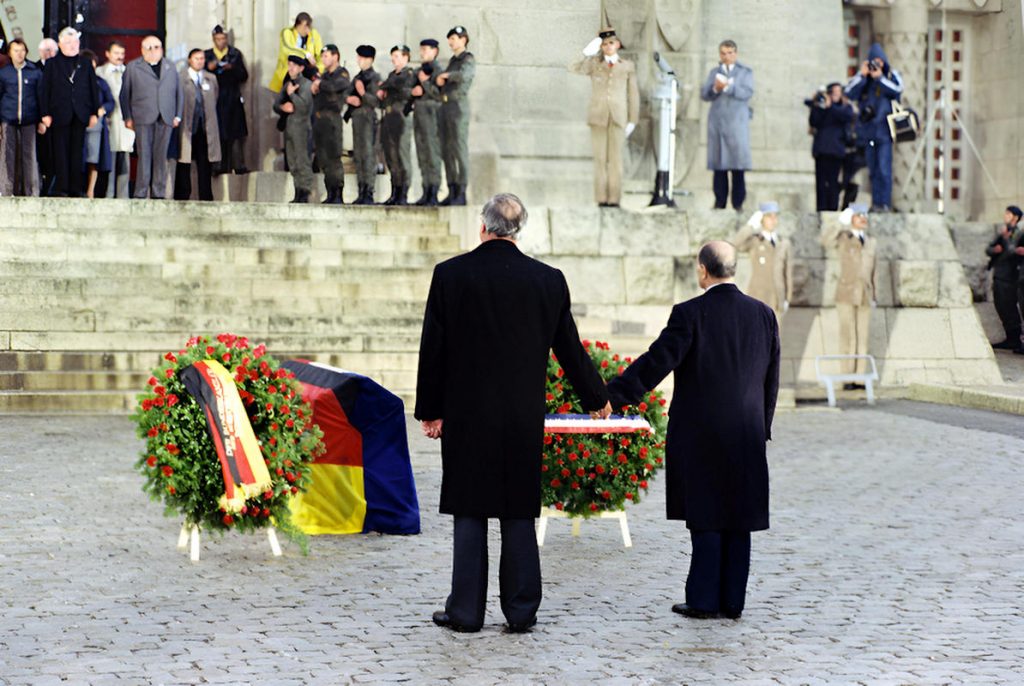
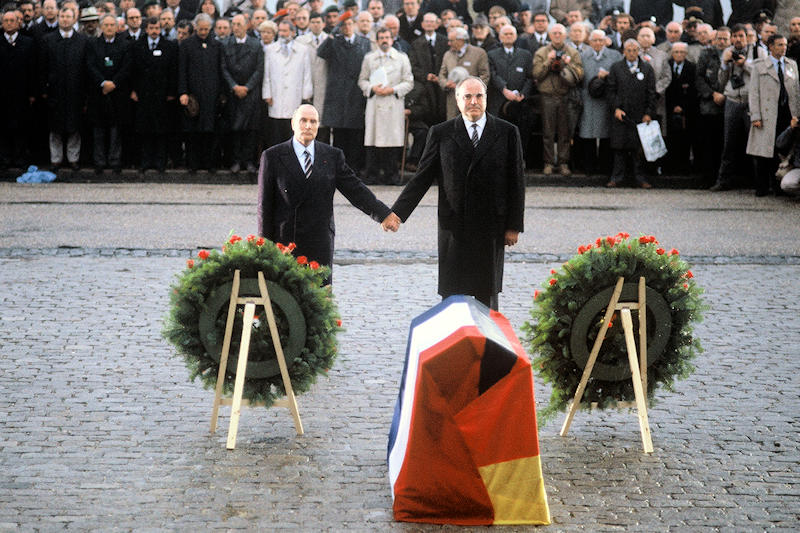
This gesture was not merely symbolic. It accompanied concrete projects: the Franco-German Brigade, whose creation was decided shortly afterward, foreshadowed what would later become the Eurocorps. After Colombey, after the Élysée Treaty, after the tests of Ostpolitik and the risk taken in 1983, Verdun 1984 marked the point at which the Franco-German relationship appeared to have reached full maturity — to the point of transforming the site of a massacre into a symbol of restored fraternity.
8. November-December 1989: The Seismic Shock and French Denial
Mitterrand’s reluctance did not date from 1989. As early as 1952, still a young minister under the Fourth Republic, he had publicly warned: “German unity means war.[07]” Thirty-seven years later, the fall of the Wall would put that long-held conviction to the test of events.
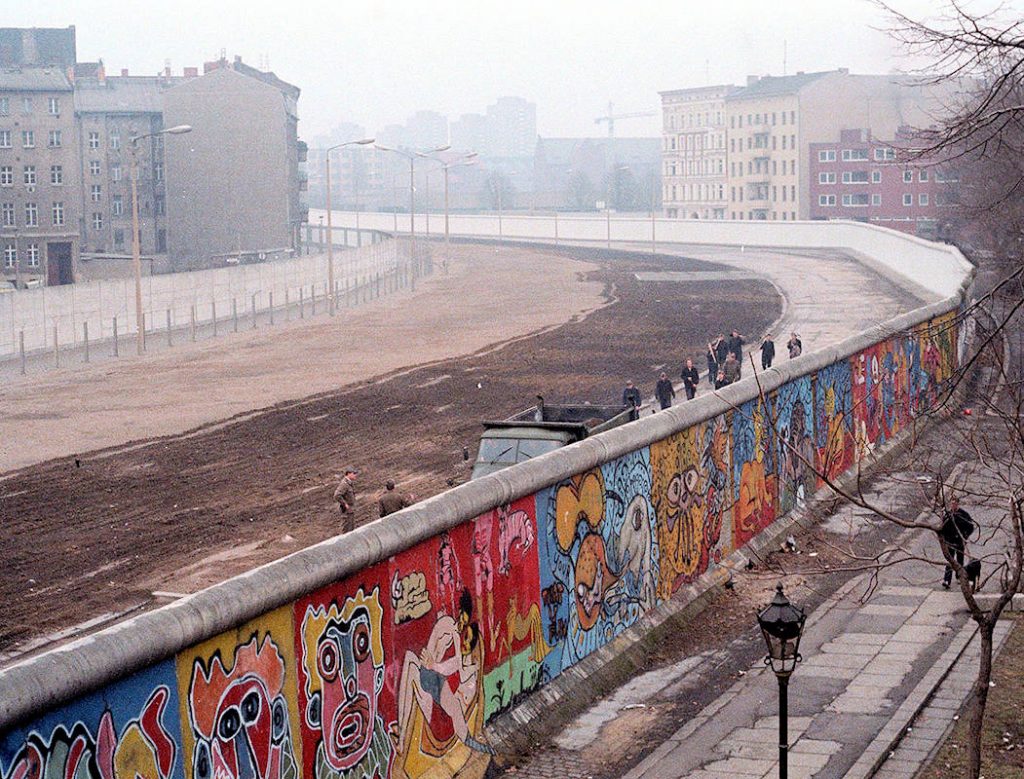
Nothing in the autumn of 1989 had prepared Europe’s chancelleries for the speed of events. On 9 November, the Berlin Wall fell. On 28 November, barely three weeks later, Chancellor Kohl presented his ten-point plan for German unity before the Bundestag — a move that caught most of his partners off guard, Paris included. The journalist Louis Wiznitzer, Paris correspondent for Le Monde, reported the word then circulating at the Élysée: “Verrat.[08]” Betrayal.
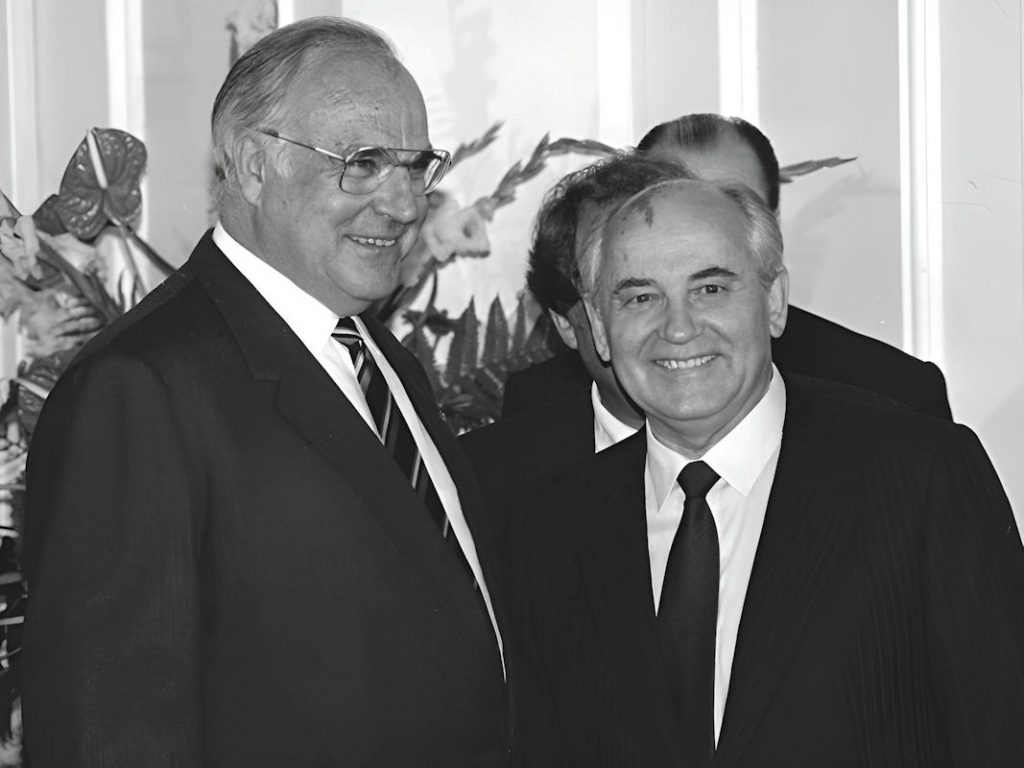
In early December, Mitterrand traveled to Kyiv — a choice of location that Gorbachev himself would later claim credit for, at their joint press conference, as his own proposal — where he met the Soviet leader and reminded him, not without ambiguity, of the victor status still held by the four Allied powers of 1945.[09] The meeting nonetheless left a bitter aftertaste: Gorbachev’s adviser Vadim Zagladine would later speak of Mitterrand’s “disappointment” at the close of the talks. A few days later, he proposed a Franco-British alliance to British Prime Minister Margaret Thatcher. When Kohl subsequently appeared before his European partners to seek their support for German unity, he was met with icy reception.
On 19 December, the very day before Mitterrand’s arrival in East Germany, Kohl traveled to Dresden. Before the ruins of the Frauenkirche, he uttered, for the first time in public, the word everyone had been waiting for: “Mein Ziel bleibt — wenn es die geschichtliche Stunde zulässt — die Einheit unserer Nation“[10] (“My goal remains — if the historic hour allows it — the unity of our nation”).»
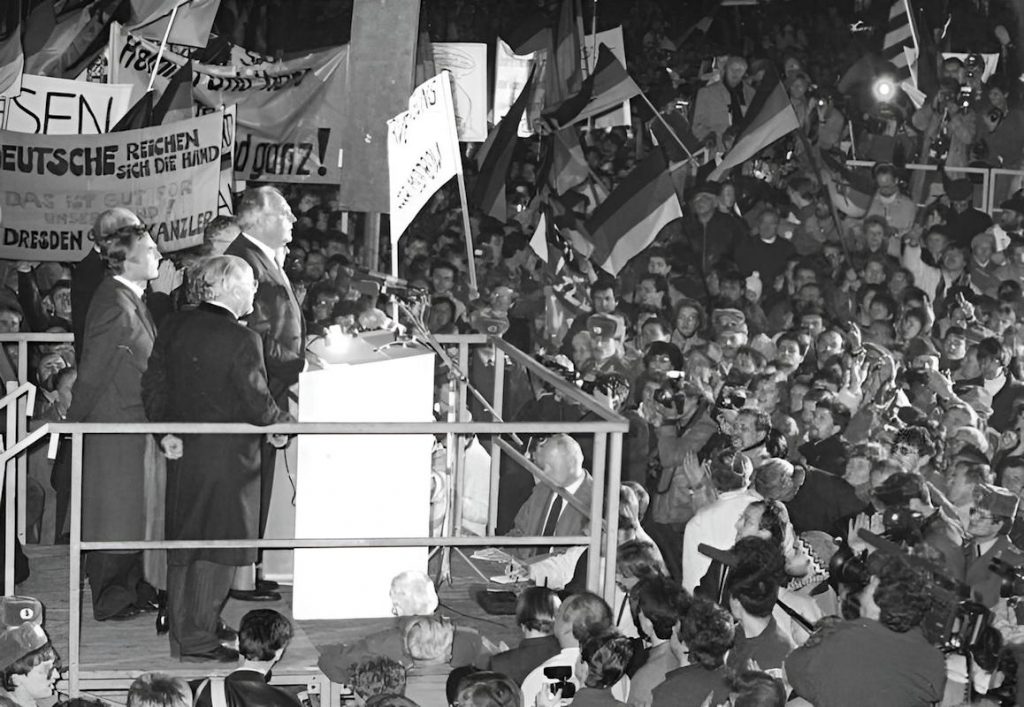
Mitterrand thus arrived in East Berlin the day after a gesture that had already, in part, pulled the rug out from under him: what could he still hope to achieve, other than to delay what Kohl had, the day before, just made publicly irreversible?
The French reaction stood in stark contrast to the enthusiasm shown that same year toward Poland and Czechoslovakia as they emerged from the Soviet bloc — this was, rather, a moment of denial. On 20 December 1989, Mitterrand traveled to East Berlin, where he met Hans Modrow, who had become head of the East German government on 13 November — amid a climate of collapsing state power, in which Egon Krenz, already sidelined from real decision-making, remained a visible presence in the background. He came away convinced that the majority of the East German people aspired to democratic renewal, but within the existing state framework — a reading that would very soon be contradicted at the ballot box.
Earlier that day, I had asked the French President what he hoped to achieve from his talks with the East German leadership. He answered with a quip — but everything was in his eyes. I was, at that moment, with a German colleague, with whom I had been speaking in that language. A few minutes later, Mitterrand found himself alone, face to face with Krenz; Brigitte Sauzay, his interpreter, was engaged in conversation nearby with an East German official. It was at that instant that the President, having noticed I spoke German, asked me to translate a question to Krenz: “What can I do to help you?” Krenz raised his arms in a gesture of helplessness. “I don’t know,” he replied. Moscow had already decided; the end of East Germany was sealed. There was, that day, nothing left to save. It was at that precise moment that I told myself a turning point was about to change a great many things — and that the coming reunification would open a horizon more favorable to Germany than to France.
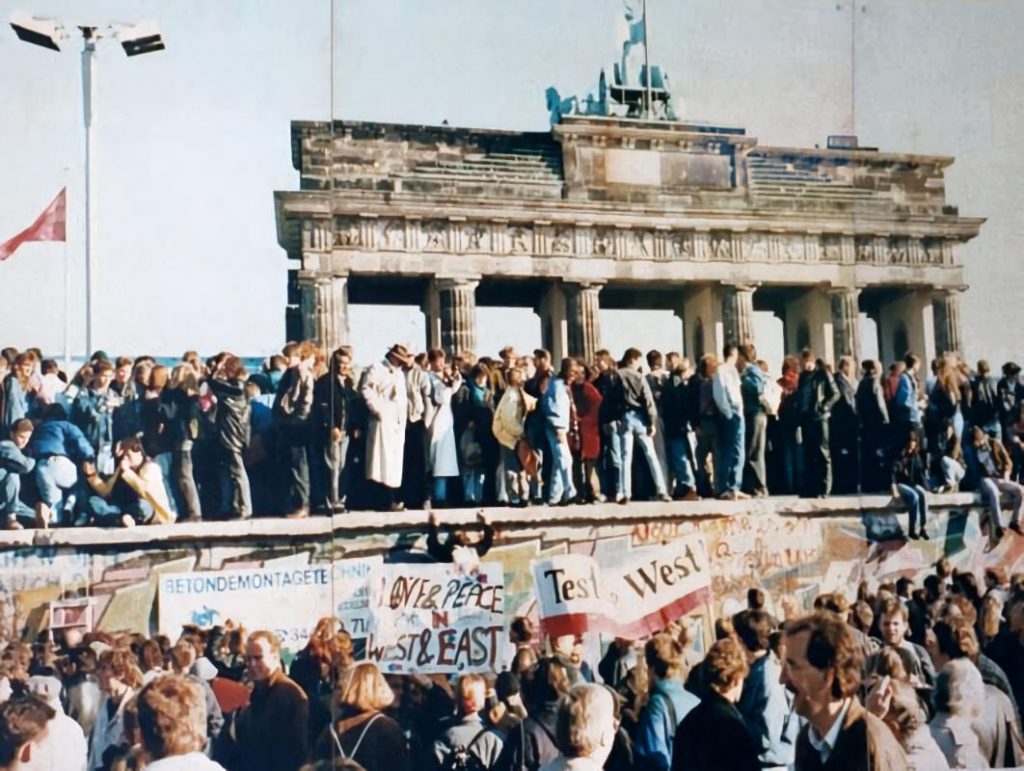
Two days later, on 22 December, Kohl and Modrow together inaugurated the symbolic reopening of the Brandenburg Gate, closed for twenty-eight years.
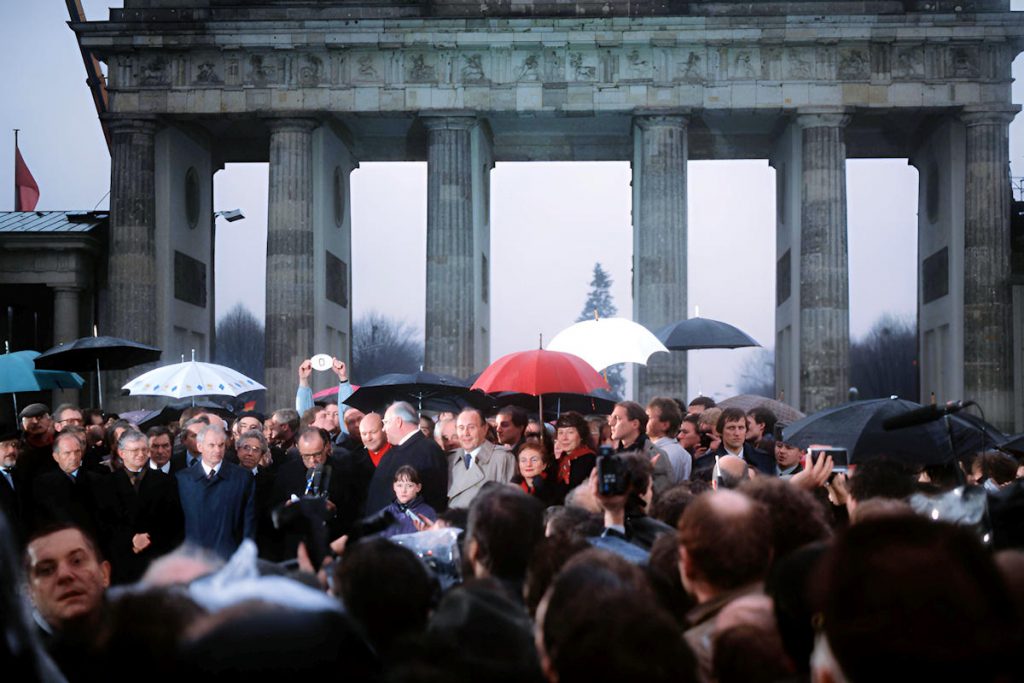
At the time, one did not yet pass through the Gate itself, but through the breaches opened elsewhere in the Wall:[11] this gesture on 22 December was, too, another step ahead for Bonn over Paris — almost a final seal placed on Mitterrand’s three days of effort, made in vain.
Far from genuinely accompanying the movement set in motion by Bonn, this visit fit within a pattern of denial that Foreign Minister Roland Dumas would push even further in the months that followed — going so far as to hope, still in December, that Gorbachev would “set East Germany straight” rather than see it disappear.[12] The contrast with the gesture of January 1983 — a president then taking a political risk for Germany — was total: six years later, it was France that refused to see, while Germany was already writing history.
The Franco-German axis, built stone by stone since Colombey, thus entered its most uncertain decade — the one in which reunification, which the sixth installment of this series will follow in detail, would test just how far the trust built over a quarter-century truly went.
Joël-François Dumont
[01] Fondation Charles de Gaulle, “Visite du chancelier Adenauer à La Boisserie, 15 septembre 1958.”
[02] Yvonne Blomann, “Deutsch-französische Beziehungen,” Konrad-Adenauer-Stiftung.
[03] Georg Bucksch, “De Gaulle – Adenauer: une communauté de destin,” Revue Défense.
[04] Konrad-Adenauer-Stiftung, “5. September 1962.”
[05] “La relation franco-allemande à l’épreuve du temps (1)” — (2010-0223)
[06] Bundeskanzler-Helmut-Kohl-Stiftung, biographical entry on François Mitterrand.
[07] Louis Wiznitzer, Le grand gâchis: faillite de la politique étrangère de François Mitterrand, Paris, First, 1991.
[08] Joint press conference of François Mitterrand and Mikhail Gorbachev, Kyiv, 6 December 1989 (vie-publique.fr); and Guerres mondiales et conflits contemporains, Cairn.info, on Zagladine’s account.
[09] Speech by Helmut Kohl in Dresden, 19 December 1989 (Bundesarchiv/official text).
[10] Encyclopædia Universalis; Encyclopædia Britannica; Wikipedia, on the reopening of the Brandenburg Gate.
[11] Roland Dumas, Le fil et la pelote, Paris, Plon, 1996, p. 384.
[12] Bundeskanzler-Helmut-Kohl-Stiftung, biographical entry on François Mitterrand.
See also:
- « France-Germany: The Machinery of Hatred 1805-1871 (1) » — (2026-0814)
- « France-Germany: The March Toward the Abyss 1871-1914 (2) » — (2026-0816)
- « France-Germany: The Paroxysm, 1914–1945 (3) » — (2026-0819)
- « France-Germany: From Ruins to an Emerging Europe, 1945-1959 (4) » — (2026-0820)
- « France-Germany: The Axis and Its Trials 1958-1989 (5) » — (2026-0821)
- « France-Germany: Love Me, Love Me Not 1990-2025 (6) » — (2026-0824)
Analysis: When Trust Falters
“The sobriety of speech heightens the relief of one’s bearing. Nothing enhances authority better than silence — the splendor of the strong, and the refuge of the weak.” — Charles de Gaulle, The Edge of the Sword, 1932
The first four installments of this series followed a precise pattern: that of a counter accelerating, first toward revenge, then toward peace. This fifth installment follows a different one, less linear: that of trust, which is not built all at once but through a succession of trials — some successful, like the gamble of Ludwigsburg, Ostpolitik, or the 1983 speech; others more ambiguous, like the denial of December 1989.
What strikes one, in hindsight, is that the Franco-German axis was never truly tested by a disagreement between equals, but rather by moments when one of the two countries got ahead of the other — Germany with Ostpolitik, France with the 1983 speech, then Germany again with reunification. Each time, the partner left behind had to choose between falling in line or falling behind. In 1969 as in 1983, the axis held. In 1989, for the first time since Colombey, it was France that fell behind — a choice whose consequences the sixth installment of this series will fully assess, right up to the relationship as it stands today.
“Our social outlooks, our political commitments, and, who knows, perhaps our characters: everything should, a priori, have kept us apart,” François Mitterrand would write late in life about Helmut Kohl. “We really weren’t made for one another at all,” Kohl would confirm some years later, at a Konrad-Adenauer-Stiftung conference[12]. That this Socialist president and this Christian-Democrat chancellor managed to carry the Franco-German relationship and European construction to an unprecedented level in the 1980s and 1990s was anything but a given. Today, rightly, they are counted among the founding fathers of Europe.