One night in the Caucasus, in July 1990. One night in front of the Reichstag, three months later. Between the two, Germany became a fully sovereign state again — and nothing about the Franco-German relationship would ever be quite the same.
Two Nights, One Turning Point
It is warm, that July night in 1990, in the mountains of the Caucasus. Around a wooden table set up in the open air, Helmut Kohl, Hans-Dietrich Genscher and Mikhail Gorbachev talk, relaxed, almost like old friends — the scene looks more like a dacha gathering than a diplomatic summit. And yet it is here, in an atmosphere that betrays nothing of the stakes involved, that one of the most consequential agreements of the late twentieth century is struck: Gorbachev yields. A reunified Germany will be allowed to remain in NATO. The USSR, in the throes of collapse, no longer has the means to impose neutrality.
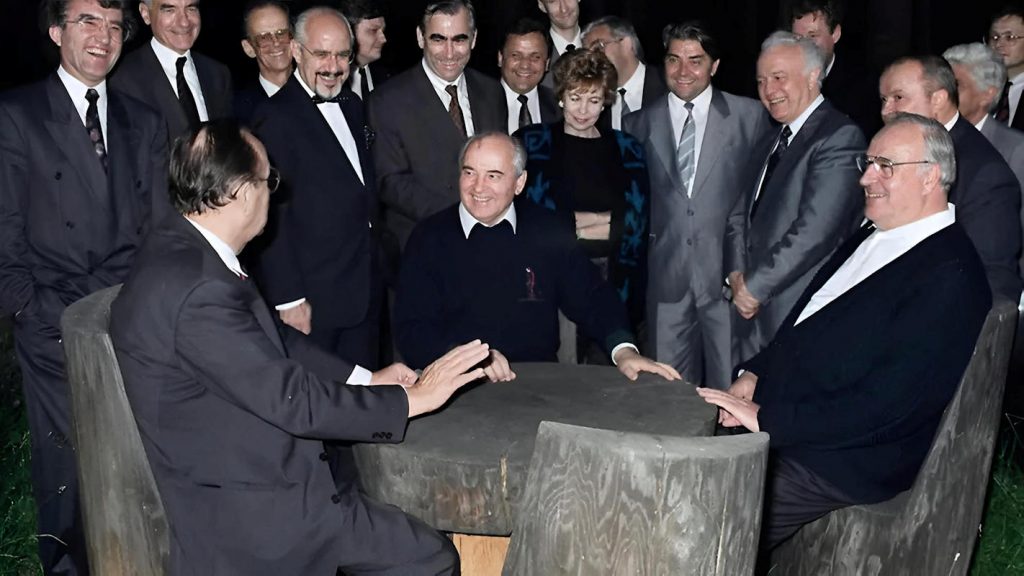
No one in this photograph seems to grasp what has just tipped over. Kohl smiles. Gorbachev smiles. It looks like a family gathering.
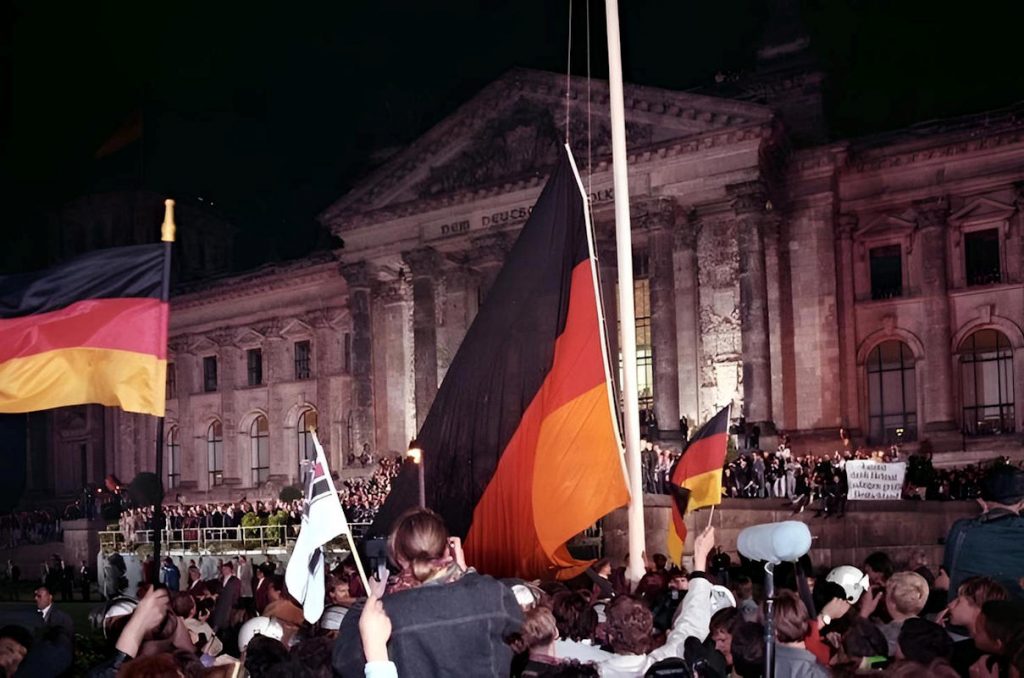
Two nights. Two photographs. And, between the two, something that would never quite be said aloud, neither in Paris nor in Berlin: France had just lost — without a word, without a treaty, without even realising it at the time — the one thing that had made the Franco-German relationship bearable for her since 1949: a Germany that needed her.
The previous instalment of this series ended on the night the Wall fell, on Mitterrand in East Berlin, on a man who had fully grasped what was tipping over — and who, precisely because of that, kept multiplying his initiatives: Kyiv, London, right up to that now-famous line about History accelerating, which “will never stop laughing in our faces.” When the ground gives way beneath you, you don’t stay cautious: you reach for something to hold on to.
![Portrait de François Mitterrand] François Mitterrand — le sol se dérobe, et il le sait — Photo Konrad-Adenauer-Stiftung © Rainer Unkel](https://european-security.com/wp-content/uploads/2026/08/Francois-Mitterrand_AS_Rainer-Unkel_1-1024x686.jpg "- Francois Mitterrand AS Rainer Unkel 1")
This instalment picks up where the previous one left off — no longer on the fall of a wall, but on what was quietly built in the months that followed. For reunification did not merely redraw the map of Europe. It changed, more deeply and more lastingly than either side of the Rhine has ever cared to admit, the very nature of the bond between France and Germany.
The Preamble That Foretold Everything
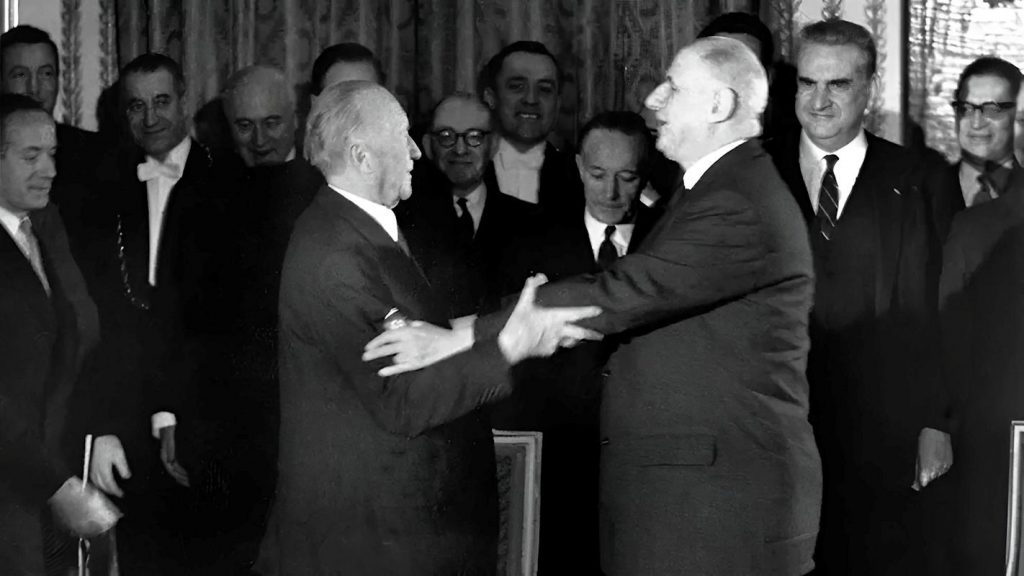
On 22 January 1963, de Gaulle embraces Adenauer before the cameras. A deliberately strong gesture, meant to mark the dawn of a new era.
But the euphoria is short-lived. In May 1963, the Bundestag adds a preamble to the treaty stating that the relationship with the United States remains the essential basis of German foreign policy.
For de Gaulle, according to Georg Bucksch, the blow was felt as a betrayal.[01]

Photo Présidence de la République
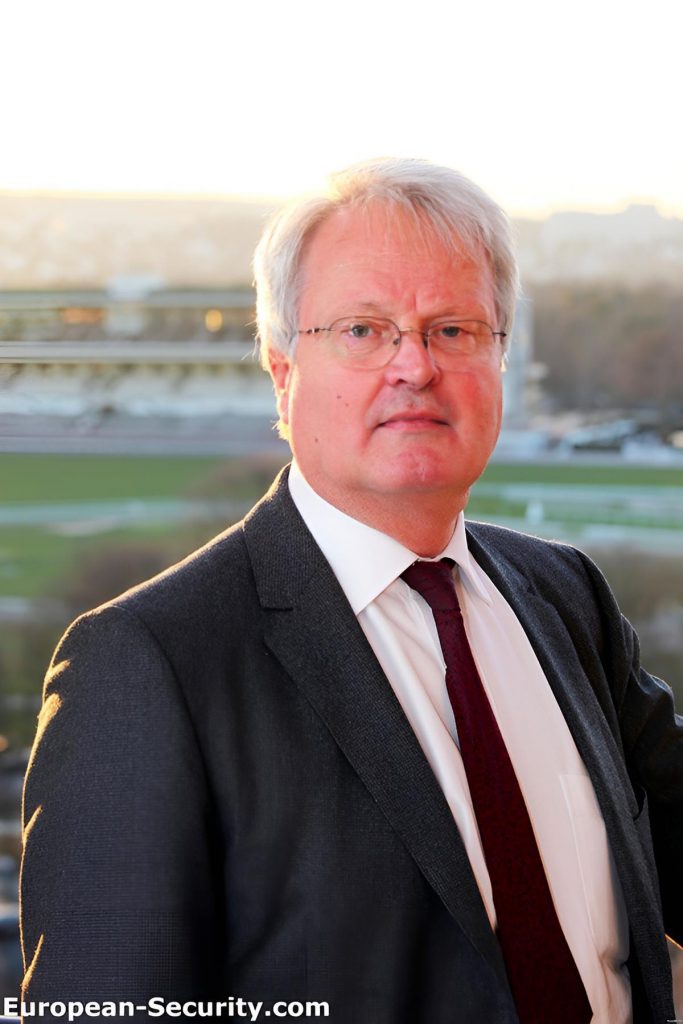
At the time of General de Gaulle, the relationship with Germany was meant to be a priority — without being exclusive. To secure a secret channel with Paris, Chancellor Adenauer had chosen a man who was both a great servant of the state and a discreet one: Colonel, Dr. Heinrich Bucksch, on the general staff, who moved to Paris with his wife and their two children. His son, Georg, grew up in the shadow of a father whose profession allowed no exception to secrecy. A trained lawyer, he began his career at Eurocopter before ending it as global head of human resources for the EADS group. But when you have grown up in that kind of environment, you cannot help having shared, in spite of yourself, this Franco-German adventure. One day, for the IHEDN’s Défense review, he agreed to open up — and to explain how the famous preamble had drained the Élysée Treaty of all its momentum, an act experienced by de Gaulle and Adenauer as a genuine betrayal.
This preamble was no mere procedural adjustment. It drained the treaty of its political substance and confined it, in practice, to the fields of culture and youth alone — the “future Franco-German engine” deprived, from birth, of much of its power.
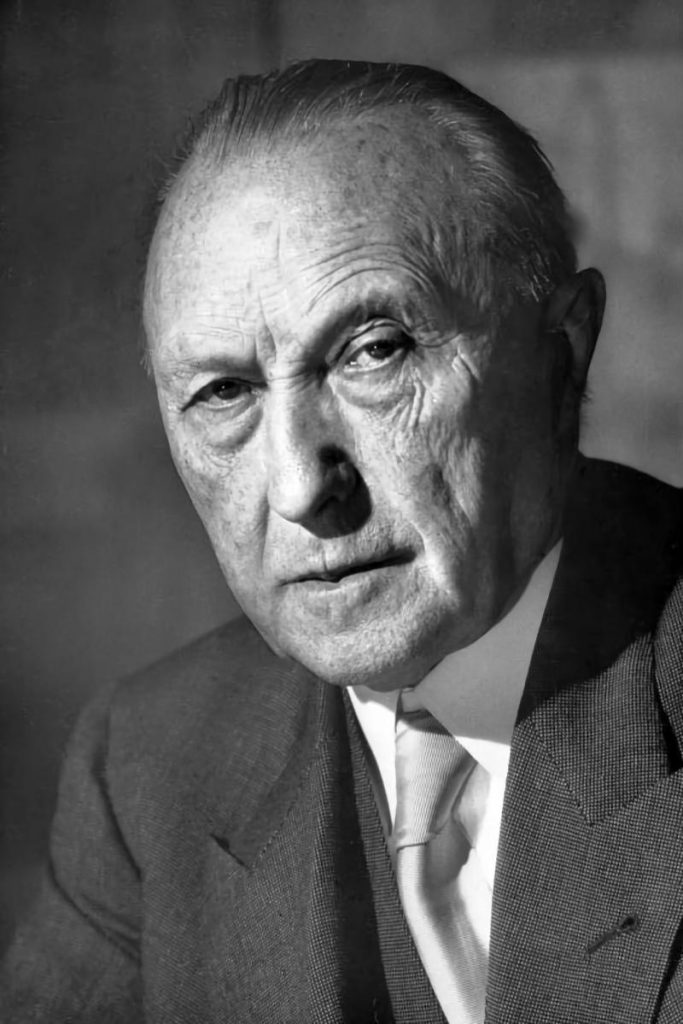
Why did Adenauer, who had staked so much on this relationship, let it happen? Georg Bucksch’s testimony offers an unflinching answer: Germany in 1963 did not have the means for independence. Barely twenty years after defeat, it remained dependent on Marshall Plan aid, on American protec-tion against the Soviet threat, on a generational gratitude toward Washington that no French friendship, however sincere, could erase. What was missing, he writes, were “the financial means, the political will, and the historical maturity” to act otherwise.[01]
Chancellor Konrad Adenauer — Photo Bundesarchiv/Katherine Young
That phrase deserves to be dwelt on. For this was not an accident of 1963. It was a pattern. The “hard core” proposed by the CDU in 1994 would come to nothing concrete. Thirty years later, Franco-German defence cooperation — FCAS, MGCS — would still be limited to ad hoc partnerships, never to genuine integration. The preamble of May 1963 was not an incidental hiccup: it was already the entire programme.
The Thread of Warnings
Georg Bucksch’s text does not stop at that observation. Scattered through its pages is a series of quotations that, fifteen years before Trump, already said it all.
Adenauer himself recounts a remark by Secretary of State John Foster Dulles, blunt and unambiguous: “In Europe, one does not conduct French policy or German policy — one conducts American policy.”[01] The line dates from the 1950s. It has not aged a day.
Ten years later, in 1965, Adenauer reports to Ambassador François Seydoux another conversation, even sharper. He had suggested that Western Europe unite, even under French leadership. The reply from McGeorge Bundy, adviser to Kennedy and then Johnson, leaves no room for doubt: “For the next fifteen years, America will provide the direction of Europe.”[01] Have those fifteen years ever come to an end?
One must go back further still to find the origin of this renunciation — to 1944, when de Gaulle proposes a Franco-British alliance to Churchill. The Prime Minister’s reply, quoted by Georg Bucksch, is a barely veiled admission: an alliance “in principle,” certainly, but “in politics as in strategy, it is better to persuade the strong than to march against them.“[01] London had chosen its camp twenty years before Bonn would have to choose its own.
Georg Bucksch closes his text with a cry, more than a conclusion: “De Gaulle, Adenauer, wake us up! Churchill’s persuasion regarding America is no longer enough for us!”[01] Written in 2010, that sentence reads today as if written for 2026.
One last idea remains, borrowed from de Gaulle himself according to the colonel’s son, and worth turning back on itself: “An independent France is a more reliable partner than a dominated France, because it is conscious of its national interests and its destiny.“[01] Substitute “Germany” for “France.” The phrase has never rung truer.
The CDU took sixty years never to acknowledge what the whole world already knew in 1963: it had, before it even came into force, drained of substance a treaty its own leaders had just signed. It voted its own reservation into the text. It never had to apologise for it. It should.
From Visionaries to Managers
Kohl and Mitterrand hold hands at Verdun in 1984. Twenty-five years later, there is no longer a single image of that kind that imposes itself on the collective memory. That is no accident of timing. It is the mark of a change of era.
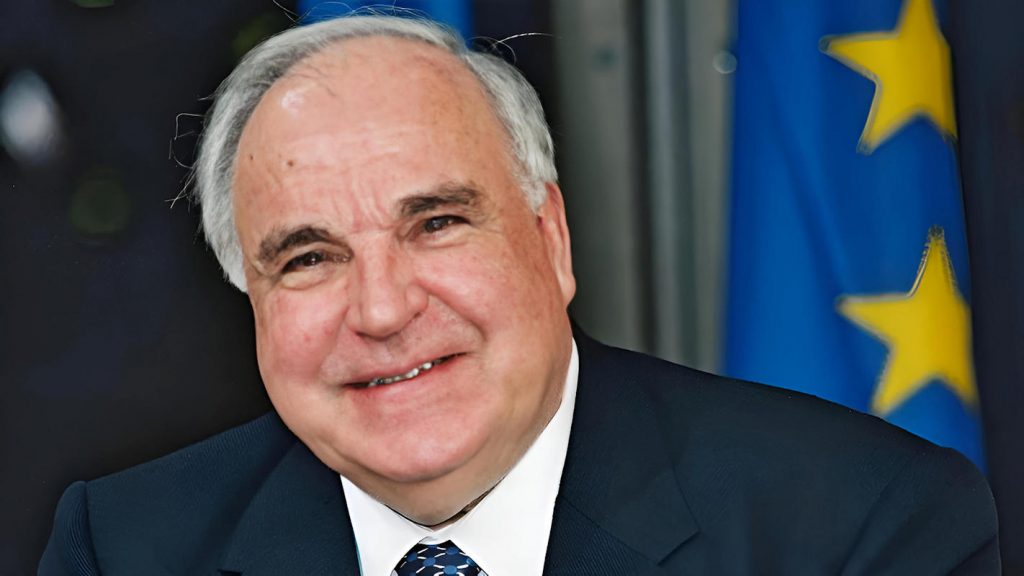
Kohl remains, to the end, in the lineage of de Gaulle and Adenauer — the man who would carry through reunification while reassuring Mitterrand, who would sign Maastricht knowing that the euro was the price of unity. Mitterrand, in 1989, hesitates, tries Kyiv, tries London, before falling into line; but to the last he remains animated by an idea of Europe. The two men disagree, sometimes deeply — but they share a common purpose.
What follows has little to do with that.
Angela Merkel governs Germany for sixteen years, from 2005 to 2021. Asked what vision she had for her country, the German-studies scholar Hélène Miard-Delacroix answers, in le Point, that “clearly,” she had none — unless one counts as a vision what the Germans call durchwursteln, an untranslatable expression that literally means “pushing the meat into the sausage,” in other words muddling through, preserving what has already been gained without ever risking anything.[02] Can she then be called a manager? “That, indeed, is what she was — a manager of Germany’s inheritance and achievements,” the same piece answers — she continues the labour reforms launched by Schröder, keeps the export orientation of the Mittelstand, practises a multilateralism that never puts itself forward. Her method: “Economy in all things. When she could say something in five words, she never used six” — the complete opposite of a certain French style, verbose and theatrical.[02]
That economy of means came at a price. For sixteen years, defence and security were the two fields in which Merkel refused any personal investment, “not even the bare minimum.” Nord Stream 2 was carried through to completion despite warnings from Central Europe. The Bundeswehr, once the best-equipped army in Europe, became a giant with feet of clay.
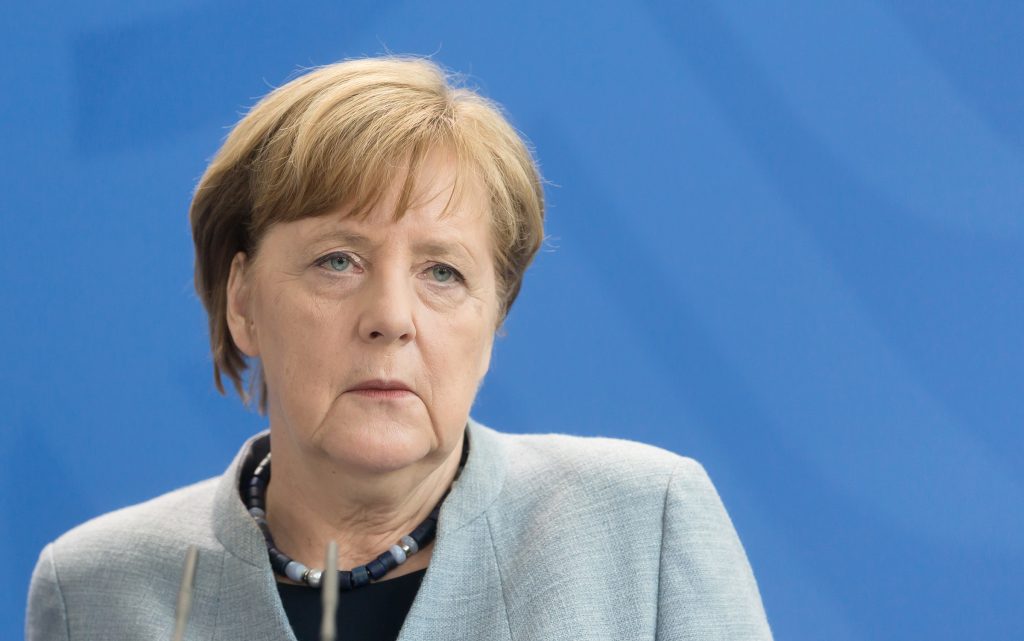
Justice must be done here to stability itself: for a country that still carries, deep down, the fear of Weimar’s instability, sixteen years without a government crisis are not nothing. But stability and the absence of vision can perfectly well coexist — worse, they can feed one another. We see the result today: an army to be rebuilt in a hurry from 2022 onward, an energy dependence on Russia that must be painfully undone, a capability gap that neither money nor a successor’s declared willpower can close in a few years.
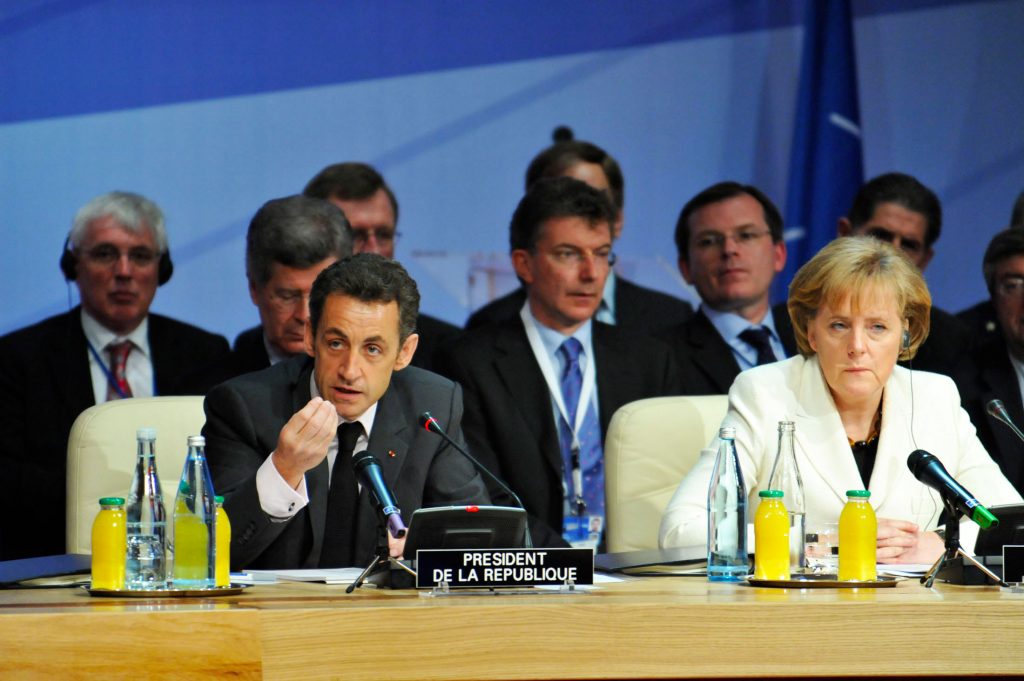
On the French side, the period is no more glorious. Sarkozy, then Hollande: neither carries a design comparable to that of their predecessors. On 22 January 2022, the CDU congress marks the break with the Merkel era by electing, with 95% of the vote, her fiercest historical opponent as its leader. Nicolas Baverez, in le Figaro, sums up the unease: Germany, he says, has been thriving “on the rent of Gerhard Schröder’s reforms,” its European leadership “exercised by default, preferring to react too little and too late rather than to anticipate” — something that would prove particularly disastrous during the euro crisis.
The contrast with the previous generation is stark. De Gaulle, Adenauer, Pompidou, Giscard, Schmidt, Mitterrand, Kohl: even in their sharpest disagreements, they were moving toward something. Merkel, Sarkozy, Hollande: they manage what remains.
Cooperation in the Plural
Before combat aviation, there was electricity. For years, Berlin — through its Environment Minister Barbara Hendricks — demanded the closure of Fessenheim, France’s oldest nuclear plant, deeming it too old to remain in service. Paris eventually gave way: both reactors were shut down in 2020.
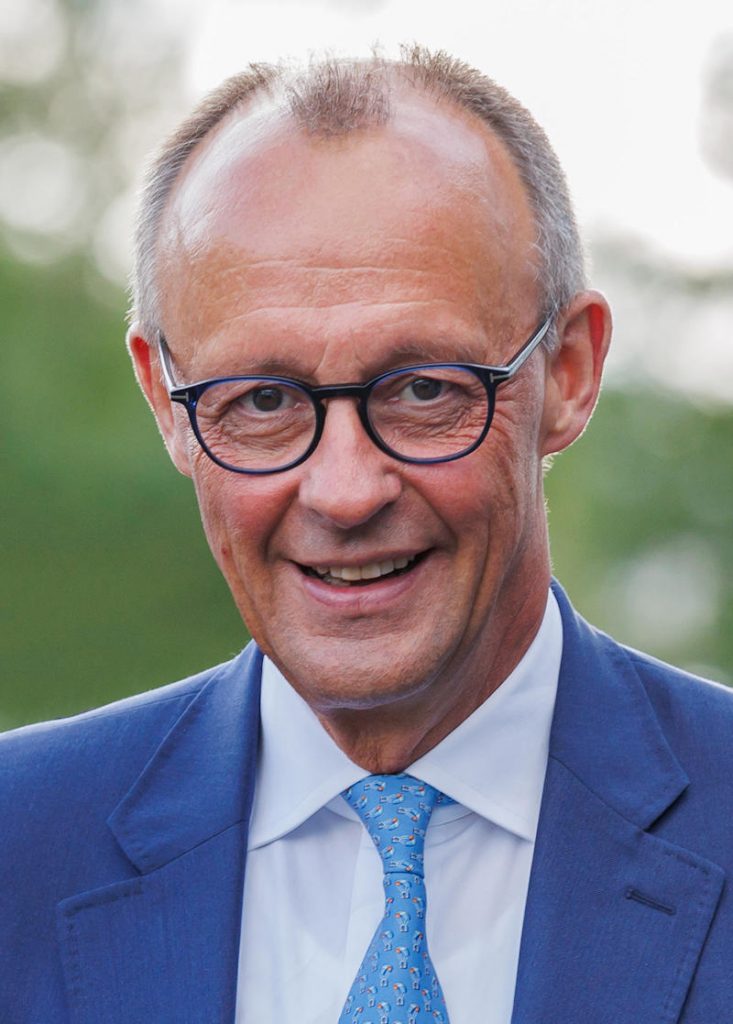
Twenty years after abandoning civil nuclear power itself, for domestic political reasons, Germany swings back into a massive return to coal — and on 14 January 2026, Chancel-lor Friedrich Merz himself will call this nuclear phase-out a “grave strategic error,” leading to “the most expensive energy transition in the world.” In the meantime, France, for its part, will have lost Fessen-heim.
This muted dispute over EDF, which lasted more than a decade, is the true starting point of a slow separation, one that would later repeat itself, identical in its logic, across every major industrial file: FCAS, the MGCS main battle tank, naval construction.
Friedrich Merz, Federal Chancellor — Much talk, few bold acts. Long the loyal vassal of the Americans, today paralysed by the US disengagement and Trump’s methods — and still buying F-35s — Photo © Steffen Prößdorf
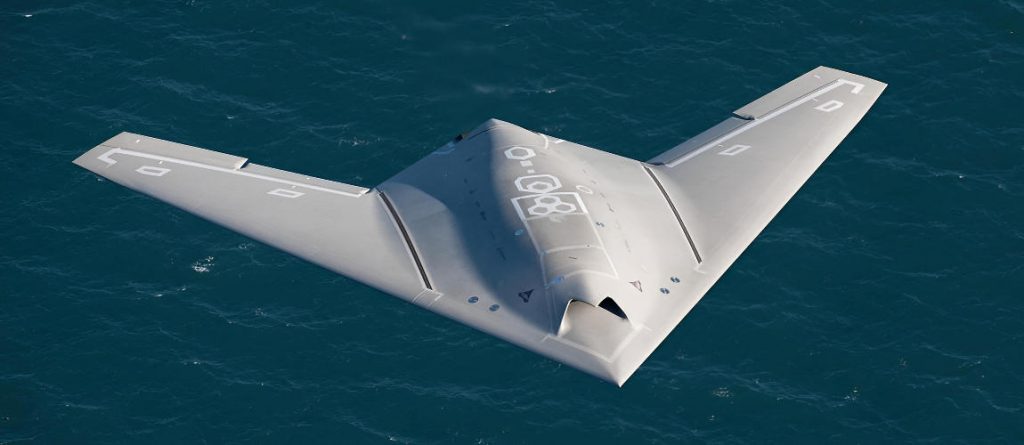
On 28 July 2026, Safran announced the end of EUMET, the joint venture with Germany’s MTU set up to power the future Franco-German combat aircraft — a month after the abandonment of the FCAS programme itself, with Airbus taking the lead of a purely German consortium. The MGCS main battle tank follows a comparable trajectory, poisoned by the same questions over intellectual property sharing — up to the point where KNDS chief executive Tom Enders publicly asked whether France was being “treated like China” in the programme. And the navy, which might have thought itself spared, suffers from the opposite ailment but at just as high a cost: fear of a “naval FCAS” is pushing Europe toward fragmentation rather than cooperation — 25 different classes of frigates and destroyers across the Union, against 2 in the United States.
Dassault Aviation’s chief executive, Éric Trappier, gave this logic its sharpest formulation: the engine, he told the Senate, “is what gives us our independence and our sovereignty.” This is exactly what this body of work calls a “family tool” — not the object itself, but the intact capacity to design it and reproduce it without depending on the goodwill of a third party.
A single counter-example shows that none of this was inevitable: the Neuron demonstrator, developed in the 2000s with six European partners, succeeded precisely because neither of the two largest contributors ever disputed industrial leadership with the other. That is the exact opposite of what has played out over electricity, FCAS, MGCS, and today, at sea.
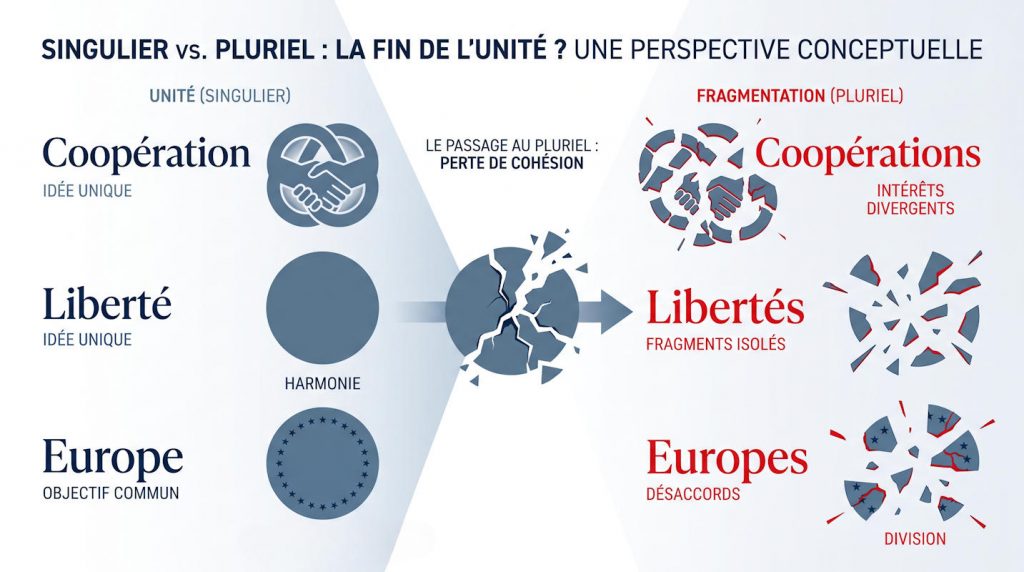
Franco-German defence cooperation was therefore never built as integration. It was repeated, sector by sector, as a series of ad hoc joint ventures that last only as long as budget constraints do not force a choice. To conjugate in the plural is already to announce the rupture: cooperations, never cooperation.
Joël-François Dumont
Sources
[01] Georg Bucksch, « De Gaulle – Adenauer: une communauté de destin » — (2010-0221)
[02] « Allemagne: La CDU tourne la page Merkel » (quoting Hélène Miard-Delacroix and Nicolas Baverez), European-Security — (2022-0123)
[03] « The SCALP Naval Syndrome: Autopsy of a European Capability Shipwreck » — (2026-0729)
[04] « FCAS: The divorce Is Final — Safran closes the Last Door » — (2026-0804)
See also:
- « France-Germany: The Machinery of Hatred 1805-1871 (1) » — (2026-0814)
- « France-Germany: The March Toward the Abyss 1871-1914 (2) » — (2026-0816)
- « France-Germany: The Paroxysm, 1914–1945 (3) » — (2026-0819)
- « France-Germany: From Ruins to an Emerging Europe, 1945-1959 (4) » — (2026-0820)
- « France-Germany: The Axis and Its Trials 1958-1989 (5) » — (2026-0821)
- « France-Germany: Love Me, Love Me Not 1990-2025 (6) » — (2026-0824)
- « France-Germany: Quo Vadis? 2025-2026 (7) » — (2026-0826)
Decryption: Autopsy of a Ghost Marriage
We must abandon a comforting lie, repeated for sixty years in official statements on both sides of the Rhine: there has never been a Franco-German couple. There has been a need, on the French side, to believe that one existed — and a Germany which, from 1963 to 2026, has systematically refused to pay the price of that fiction whenever it came to choosing between Paris and Washington.
The preamble of May 1963 was not an incident along the way. It was the admission, barely a month after the signing of the Élysée Treaty, that Germany was not entering into a couple: it was entering a coexistence under American tutelage, with France as a mere second-tier partner. De Gaulle felt it as a betrayal because it was one. The CDU never apologised for it because it never had to — France chose, again and again, to act as though nothing had happened.
Then came 1990, and the mask no longer needed to be worn. A reunified Germany no longer needed France to offset its historical guilt, nor her sponsorship to reclaim a seat among the great powers. It simply became itself — fully sovereign, fully free in its choices. And its choice, from Kohl to Merz, through sixteen years of Merkelian durchwursteln — that art of pushing the meat into the sausage without ever aiming beyond the next bite — has always been the same: manage, never build.
France, for her part, has done no better. Sarkozy and Hollande built nothing that deserves to stand alongside Colombey, the Élysée, Verdun. The couple died out without anyone daring to utter the word divorce — we preferred to speak of “cooperations,” in the plural, that word which, as always, signals loss rather than bond. FCAS, MGCS, the naval programme: three separate autopsies of the same refusal — the refusal of integration, one that leads straight back to May 1963.
The tragedy is not that Germany chose its own interests. All states do, and de Gaulle himself would have found nothing to object to in that — the independence he demanded for France, he could not deny to others. The tragedy is that France went on calling “couple” what had never been more than a self-interested coexistence, and paid the price for it in naivety, in abandoned programmes, in illusions maintained long past their expiry date.
There remains the question this body of work poses from Bucksch all the way to Trump: where are the statesmen? De Gaulle spoke of the void in History, that space only genuine will could fill. What we have today is the opposite — an overabundance of politicians, at best cautious managers of an inheritance they have failed to make bear fruit, at a moment that called for precisely what they lack most: the courage to say that the couple never existed, and the ambition to build, in its place, something that can finally stand on its own.
Georg Bucksch, a worthy son of a father who was, himself, a great servant of the state in the shadows, calls for the return of statesmen into the light. With him, let us pray that one day we find, at the helm, men of the calibre of de Gaulle, Adenauer, or Churchill.
Fortunately, we still have great servants of the state.