In Metz, the city of Robert Schuman, Leo XIV closed his trip to France with a speech on Europe. This second piece does not summarize the press — it rereads the texts: what the pope says about Europe, about peace, about barbarism, and what he implies without naming anyone.
The Essentials
- May 2025: Patrick Chappatte had already drawn Leo XIV launching “Fac Americam magnam iterum (really)!” from the balcony of Saint Peter’s. Sixteen months later, in Metz, the pope extends the gesture in a European version.
- The pope never names anyone — neither Trump nor Putin — yet he criticizes both with the same methodical precision: contempt for one’s given word, the illusion of rearmament, the rejection of might-makes-right.
- On Ukraine: the war is there, the country is not named. The pope reuses the word “useless,” employed by Benedict XV in 1917 to describe an earlier massacre.
- On Trump: no name either, but an implicit jab on AI, the war in Iran, and a line on the instrumentalization of God that the White House reportedly took issue with.
- A striking coincidence of timing: the day before the Metz speech, the US ambassador to China revealed that Trump had offered to sell weapons to Xi Jinping, while Washington was freezing a sale to Taiwan described as a “very good negotiating chip.”
- No outlet we consulted linked these various fragments — rearmament, AI, Russia — into a single, deliberate method. That is the assembly this piece proposes.
Contents
by Joël-François Dumont — Paris, 29 September 2026.
The Pope, America, and the European Spirit
The first piece, “Happy as Leo XIV in Europe! (1),” gathered the press’s crossed perspectives. Here, the word itself.
On May 11, 2025, a few days after the first American pope’s election, the excellent Patrick Chappatte drew for the Neue Zürcher Zeitung a Leo XIV on the balcony of Saint Peter’s, arms raised before the crowd, launching in Latin: “Fac Americam magnam iterum!” The asterisk pointed to the translation, “Make America (really) Great Again!” — and the whole wit of it sat in that “(really)” [01]. Sixteen months later, it is in Metz that the cartoon finds its sequel, in a European version.
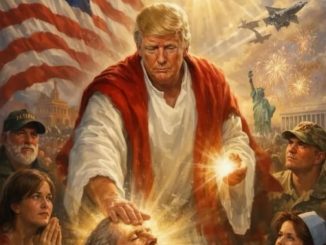
Leo XIV in Metz: Make Europe Great Again — Illustration © European-Security
The Frankfurter Allgemeine Zeitung noted the irony: it took a citizen of the United States becoming head of the Catholic Church to rehabilitate Europe [02]. We would add one of our own. It took a first American, inopportune to say the least, to weld Europeans together and push them to take charge of their own destiny, after they had felt abandoned, if not betrayed, by their historic ally. Now here is a second American who dreams, for his part, of making America great again — but with ideas at the opposite end of the spectrum from Donald Trump’s, to call him by his name. In the meantime, Leo XIV proposes to reawaken the European spirit to halt the barbarism he sees gaining ground in relations between states [03]. “Follow my pontifical staff!” he seems to be telling Europe.
The President of the European Central Bank, held up in Brussels, could not travel to Metz. But asked by La Croix L’Hebdo about the speech, Christine Lagarde gave an answer worth every commentary combined: “First, I take note of this exhortation from Leo XIV: ‘Do not be afraid of the future.’ It echoes John Paul II’s ‘Be not afraid.’” She also cites, almost in mirror of the pope, “nearly eighty years of peace within the Union’s borders, since the Schuman Declaration of May 9, 1950” [16]. A Norman herself, touched that an American pope should evoke his own Norman roots: the Europe Leo XIV describes, it turns out, speaks to those who lead it as much as to those who listen to it.
Decoding: Criticizing Without Naming
A Pope Who Names No One
Reading the trip’s texts in order, a method takes shape, the same toward two men: never a name, but phrasing precise enough that each one recognizes himself. A Daily Sabah report notes it bluntly: in Metz, the pope singled out no leader [04]. The press has picked up each piece of the puzzle. As far as we know, none of the articles we read put it back together.
A weighty witness confirms this reading from within French Catholic circles itself. Jean-Marc Sauvé, former Vice-President of the Council of State and former chairman of the Ciase, does not mince words: “The pope sketches the outlines of a common future in a positive way, without defining himself against adversaries. Even though it is clear that his speech is anti-Trump and aimed at all extremists.” [15] This is no longer a press reading: it is confirmation, by one of the Republic’s highest-ranking jurists, that no one in Metz needed a name to understand the target.
The rule is not absolute, however. In the return flight, asked directly about the AfD’s breakthrough in Saxony-Anhalt, the pope answers without hesitation: “This is not an authentic expression of Christianity.” It is the only exception we found in the entire trip — and it refines the rule more than it contradicts it: the pope names a party when the question concerns the instrumentalization of faith, but never a sitting head of state.
The Rule of Law Against the Rule of the Strongest
The clearest thread is that of law. The pope recalls that international law cannot be imposed by force: it rests on the old principle pacta sunt servanda — agreements must be honored. He makes multilateralism the best antidote to the will to dominate, then notes that relations between states are becoming “ever more barbaric”: the given word is held in contempt, people boast of lies and deceit [03].
He goes further, quoting his own predecessor: “As Pope Francis always recalled: ‘the concept of law, and the equally essential and complementary concept of duty, no longer seems sufficiently emphasized.’” A reminder that escaped every outlet we consulted, even though it gives the rest of the speech its true meaning: the rights Europe invokes are only valid if matched by the duties that go with them.
No one is named, but the reading extends well beyond Metz. UPI reports, citing The Times, that analysts saw in this a response to Donald Trump’s verbal attacks on Europe, NATO, and the European Union [05]. Renaud Girard, in his column for Le Figaro, ties the message to a rejection of “the logic of empires” that free themselves from the law, naming Putin, Xi Jinping, and Trump in the same sentence [06].
Putin: Ukraine Without Naming It
The war is there, Ukraine is not. The pope speaks of a new massacre, “useless,” an adjective he borrows from Benedict XV, who used it in 1917 in his letter to the leaders of the warring peoples [03] [07]. A quote from a predecessor, a war over a century old, and not a single proper name: the Irish Times points out that the pope referred to Ukraine without naming it directly [08].
What follows is a call to patience: dialogue, courage in negotiation, a willingness to give up certain positions in the name of a higher good — peace [03]. The wording addresses both camps at once, and the pope takes care to guard himself on both sides: the search for peace, he says, must not be confused with naivety, but one must also beware the illusion that rearmament is the answer, drawing on his own message of January 1, 2026 [03] [09]. Neither cover for rearmament, nor complacency toward the aggressor: it is a central position, and it protects him.
Trump: America Without Naming It
CNN writes that it is hard not to see him as a counterweight to Trump: the pope has spoken out against America’s war in Iran, calls for guardrails on artificial intelligence, and warned in Paris against a “paradise of machines” [10]. In Metz as at the interreligious meeting, he also recalled that the name of God cannot be used to justify violence or oppression — a line for which, Yahoo News reports, the White House took issue with him [11]. So it targets Moscow, or Washington, depending on who’s reading. In April, Donald Trump had publicly called him “WEAK on Crime, and terrible for Foreign Policy”; Leo XIV had replied that he was not afraid [11].
Then, almost on cue, the news caught up. On Sunday, September 27, the day before the Metz speech, the US ambassador to China, David Perdue, said on Fox News that Trump had asked Xi Jinping whether he wanted to buy American weapons, without specifying when [12]. The next day, the very day of Metz, Trump pushed back, suggesting Perdue was probably talking about Taiwan [13]. The context is well known: since the Beijing summit in May, Washington has frozen a record $14 billion arms sale to Taiwan, which Trump called “a very good negotiating chip” against China [13]. Nothing links these events to the pope’s speech, beyond the coincidence of timing. But one reads all the more clearly what the pope says about contempt for the given word, when an ally’s security is itself being negotiated like a commodity.
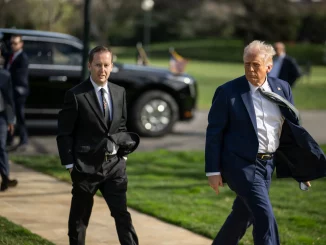
Leo XIV and Donald Trump — AI Photo © European-Security
Two Americans: Night and Day
The pope and the president are both American, and that is perhaps what makes the contrast so stark: where one multiplies allusions to the respect of law and of one’s given word, the other treats an ally’s security as a bargaining chip. “Two Americans, a Head of State, a Head of a Church: Night and Day” [14].
What the Press Did Not Build
Every newspaper grasped one fragment: rearmament here, artificial intelligence there, Russia elsewhere. As far as we know, none of those we read linked these pieces into a single method, applied with equal caution to both men. It is a choice of pontifical communication that deserves to be named as such: criticizing without ever offering a handle.
Joël-François Dumont
Notes
[01] Patrick Chappatte, editorial cartoon, May 2025 (exact date and link to be taken from his website). ↩
[02] Frankfurter Allgemeine Zeitung, Tuesday, September 29, 2026, editorial by Thomas Jansen, p. 1. ↩
[03] Speech by Leo XIV, Metz, September 28, 2026, “To the Roots of Europe for Peace and Unity.” — Official text in French (vatican.va) · English version ↩
[04] Daily Sabah, September 28, 2026, “Pope Leo calls on Europe to defy decline in global civility.” — Read the article ↩
[05] UPI, September 28, 2026, “Pope lauds Europe, EU in ‘increasingly uncivilized world’” (citing The Times). — Read the dispatch ↩
[06] Le Figaro, Tuesday, September 29, Renaud Girard’s column, “Pope Leo XIV’s international message in France,” p. 17. ↩
[07] Benedict XV, Letter to the Leaders of the Belligerent Peoples, August 1, 1917 (cited in footnote 8 of the Metz speech). — Text (vatican.va) ↩
[08] The Irish Times, September 28, 2026, “Pope Leo praises multiculturalism as far right gains strength across Europe.” — Read the article ↩
[09] Leo XIV, Message for the 59th World Day of Peace, January 1, 2026 (cited in the Metz speech). — Text (vatican.va) ↩
[10] CNN, September 28, 2026, “Leo’s visit across France offers a more personal glimpse of the pope.” — Read the article ↩
[11] Yahoo News, September 28, 2026, “Pope Leo leans into statesman role, urging peace in an era of renewed war.” — Read the article ↩
[12] Associated Press (via Fox19), September 28, 2026, “Trump asked China’s president if he wanted to buy US arms, ambassador says.” — Read the article ↩
[13] PBS News / Associated Press, September 28, 2026, “Trump says Perdue ‘was probably talking about Taiwan’ in saying Trump offered Xi arms sales.” — Read the article ↩
[14] “Two Americans: A Head of State, A Head of a Church: Night and Day,” European-Security.com, editorial, September 25, 2026. ↩
[15] La Croix L’Hebdo, no. 352, week of October 2, 2026 — Jean-Marc Sauvé, interviewed by Bernard Gorce. ↩
[16] La Croix L’Hebdo, no. 352, week of October 2, 2026 — Christine Lagarde, interviewed by Jean-Claude Bourbon and Marie Dancer; Fabienne Keller, interviewed by Laurent Larcher. ↩
Analysis
A question remains that neither the press nor this piece can settle in the pope’s place: why this method, precisely, and why now?
One could see it as an elementary diplomatic choice — a head of state of the Holy See, who must go on speaking to everyone, including those he disapproves of, has no interest in slamming doors by naming his targets. But that would reduce Leo XIV to a calculation of prudence, when the approach also has a theological coherence of its own: criticize the act without excommunicating the person, name the sin without judging the sinner, always leave a door open to repentance rather than rupture. It is an old tradition of the Church, one this American pope seems to have fully absorbed into his style, where others before him sometimes gave in to invective.
Not everyone hears it the same way, however. Fabienne Keller, a Renaissance MEP, praises the speech but declines to follow it on one point: “I don’t think we are today in [an arms race]. We are rather in a situation of catching up. […] Europe must regain sufficient protective capabilities to guarantee its sovereignty.” [16] She also defends, against the pope’s position, French nuclear deterrence. It is a useful reminder: however skillful Leo XIV’s method, it does not necessarily carry the argument on substance — even among the most committed Europeans.
There may be a third reading, a more uncomfortable one for his European readers: by naming no one, the pope also refuses to pick a side between Washington and Moscow — which is not the same thing as refusing to judge. The law he invokes, the lying he denounces, the barbarism he observes: these are criteria, not proper names, and that may be precisely what makes them applicable to both at once, without distinction of degree. A reading that will sit poorly with those in Europe who would have wanted a sharper condemnation of one side over the other.
What remains is that the message got through, on both sides: a White House that protests a line on the instrumentalization of God, a Figaro columnist who names himself what the pope only suggests. In the end, no one needed to be told who the target was.