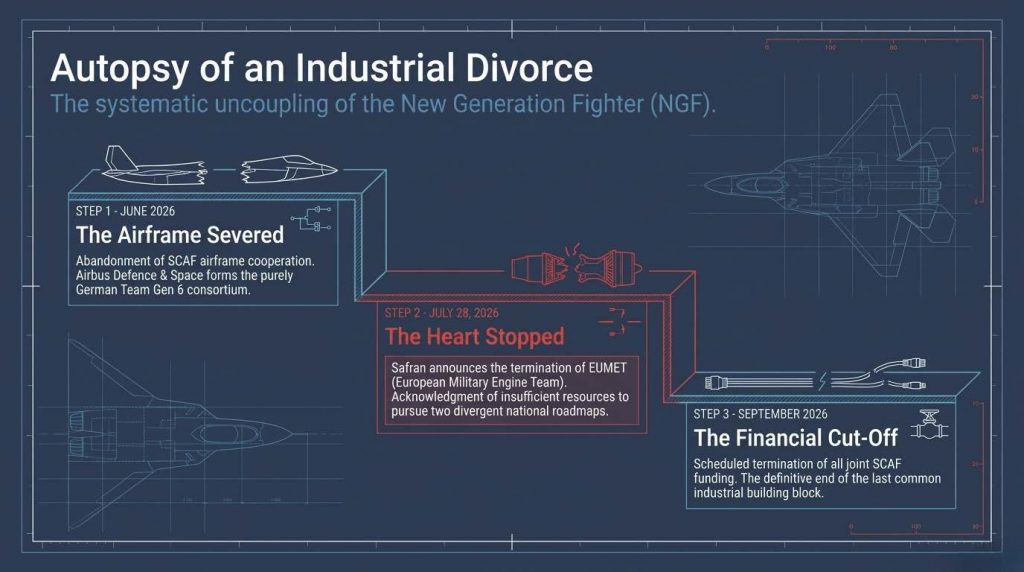
After the airframe (June 2026), it is now the engine’s turn to seal the rupture. On 28 July 2026, Safran announced the end of the EUMET joint venture, created with Germany’s MTU to power the future Franco-German combat aircraft. This is no longer a simple scheduling delay or a technical disagreement: it is the last piece of an industrial puzzle coming apart, sub-system by sub-system. This piece closes the FCAS trilogy opened in July — with a single sentence, from Éric Trappier, that sums up everything this body of work has tried to demonstrate.
Key Takeaways
- On 28 July 2026, Safran announced the end of the EUMET joint venture (with Germany’s MTU), created to power the Franco-German NGF — for lack of resources to develop two separate engines.
- FCAS funding will stop for good in September 2026, marking the end of its last shared industrial building block.
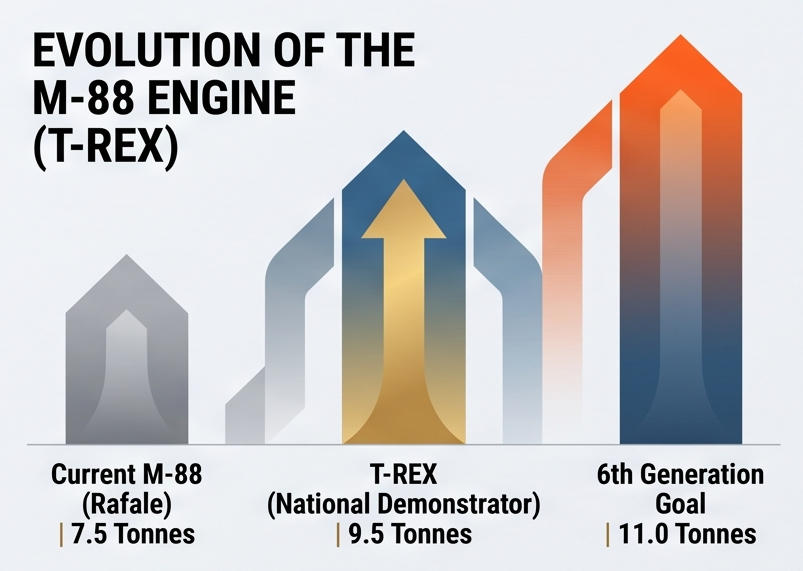
- Dassault Aviation CEO Éric Trappier is pushing for a French demonstrator as early as 2031-2032, powered by an evolution of the M-88 engine (the “T-REX”, boosted from 7.5 to 9.5 tonnes of thrust).
- “The engine is fundamental: it’s what gives us our independence and our sovereignty” — Trappier’s formula sums up, in an industrialist’s own words, exactly what this body of work calls the “family tool.”
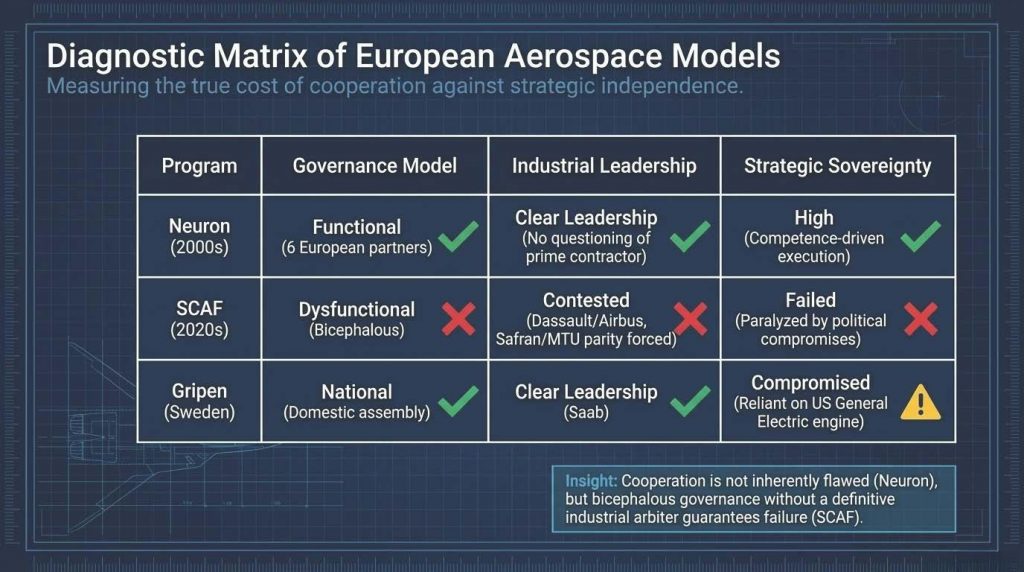
- The Neuron programme (2000s, six European countries) shows that cooperation can succeed — when it respects clear industrial leadership rather than a two-headed governance.
- The Swedish Gripen, often cited as a European success, is still powered by an American General Electric engine: even a successful “family tool” can remain incomplete.
- The same pattern is reportedly resurfacing elsewhere: German decision-makers, courted by Italy to join the GCAP programme, would reportedly set the same condition that killed FCAS — “a revision of leadership.”
Table of Contents
by Joël-François Dumont — Paris & Berlin, August 2, 2026.
1. After the airframe, the engine
In June 2026, the abandonment of the Future Combat Air System (FCAS) sealed the end of cooperation on the airframe itself: Airbus Defence & Space took the lead of a purely German consortium, Team Gen 6, to develop a German-designed combat aircraft. One unknown remained: propulsion. For FCAS, the question did not arise — Safran Aircraft Engines had been designated prime contractor for the New Generation Fighter (NGF) engine, drawing on its experience with the Rafale’s M-88 and the Turenne 1, Turenne 2 and ADAMANT studies conducted with the DGA, with Germany’s MTU as main partner. To placate the Bundestag, the two manufacturers had even created a joint venture under German law, EUMET.
On 28 July 2026, this last piece gave way in turn.
2. EUMET: a marriage of convenience, never a merger
Safran’s CEO, Olivier Andriès, left no room for ambiguity: “We only have the resources to develop one combat aircraft engine. And we will obviously prioritise the French roadmap.”[01]

FCAS-related funding will stop in September 2026. Whether French and German specifications will remain aligned remains, in his own words, “an open question” — a polite way of saying it probably will not.
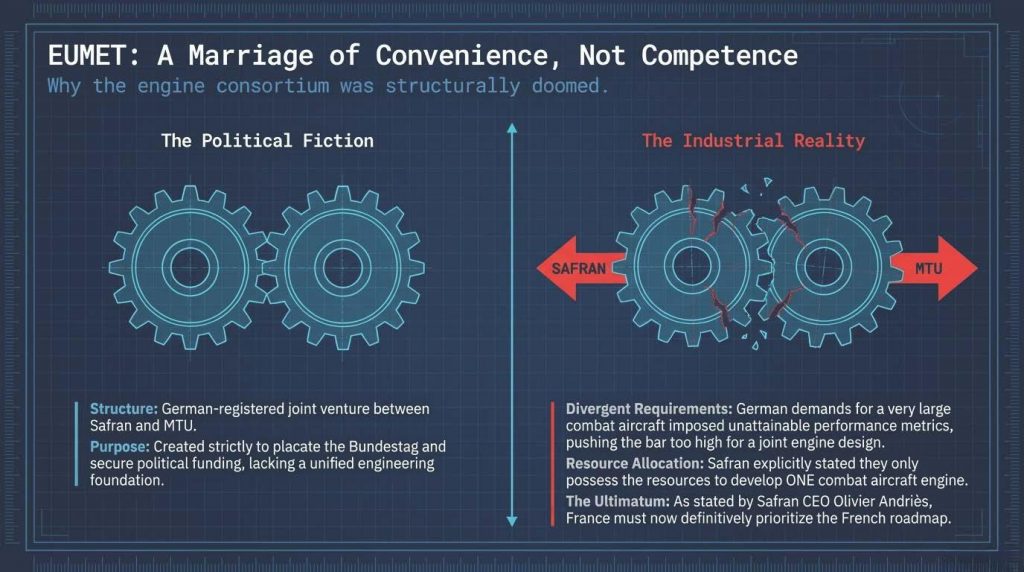
The pattern has become familiar throughout this trilogy: a joint venture created not to merge two bodies of expertise, but to buy social and political peace on the German side — EUMET, like the two-headed Dassault-Airbus governance on the NGF before it, lasted as long as budget constraints did not force a choice. As soon as a choice had to be made, it did not survive.
3. “It’s what gives us our independence”: the sentence that closes the file
This body of work coined, a few weeks ago, the expression “family tool” to describe the weapon systems a nation spends generations building — the accumulated expertise, the right to manufacture at home what one needs to defend oneself.
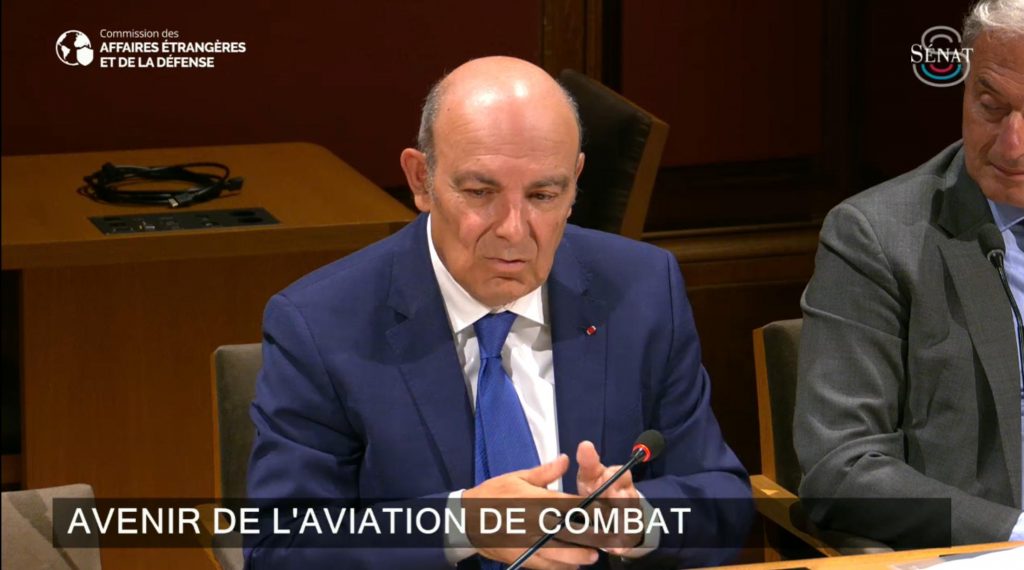
On 1 July 2026, before the Senate’s Foreign Affairs and Defence Committee, Éric Trappier gave the clearest possible formulation of it, speaking of the future French combat aircraft’s engine: “The engine is fundamental: it’s what gives us our independence and our sovereignty.”[01] There is no better definition of what this body of work calls the family tool. A tank, an aircraft, a missile, an engine: it is never the object that matters, it is the capacity to design it, evolve it, and reproduce it without depending on a third party’s goodwill. Trappier added, on Germany’s choice of a “very large combat aircraft” requiring a far more powerful engine: “That raised the bar even higher for Safran“[01] — an elegant way of saying that German requirements had, once again, tried to load the French manufacturer with a specification it had not set. On the substance of his disappointment, the admission remained personal as much as industrial: “We are failing, and I am somewhat sad and disappointed that we could not define, with our two partners, an aircraft able to fly in 2030.”[02]
4. Neuron and Gripen: what successful cooperation requires — and what it does not guarantee
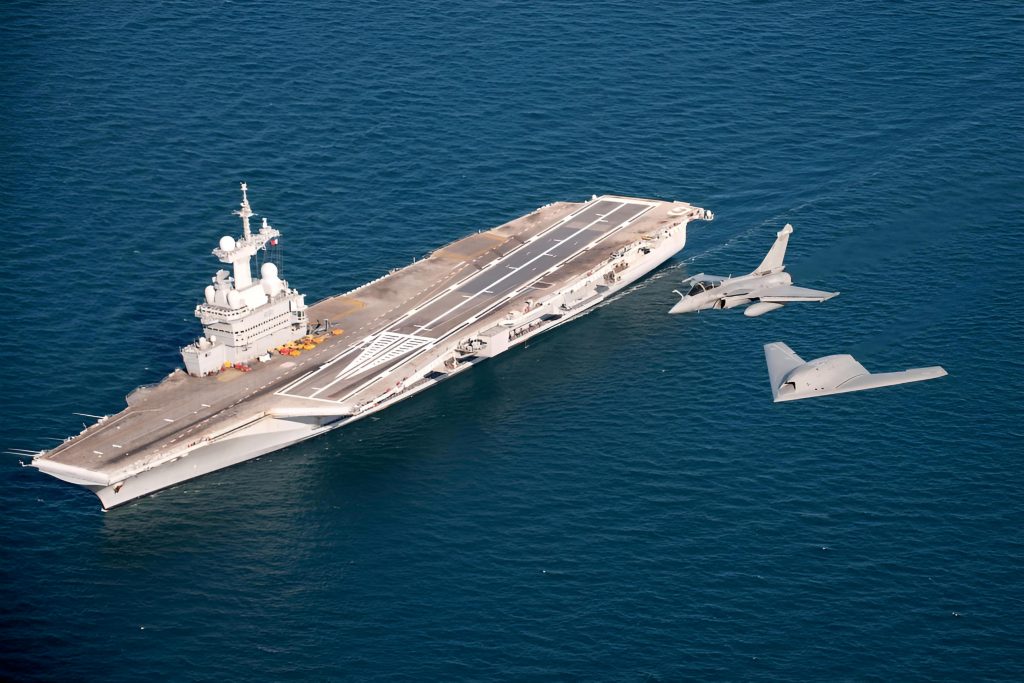
Dassault Aviation’s CEO did not close the door on future cooperation altogether — but on precise conditions. He cites the Neuron programme, a stealth combat drone demonstrator run in the 2000s with six European partners, where each country contributed according to its own expertise “without ever questioning industrial leadership“[02] — the exact opposite of the two-headed governance that swallowed FCAS. “Expertise needs to be put forward, he summed up. What matters is serving our armed forces, not pleasing ourselves.”[02] On any non-European partners, he was as precise as he was discreet: “the names, I’m keeping to myself.”[02]
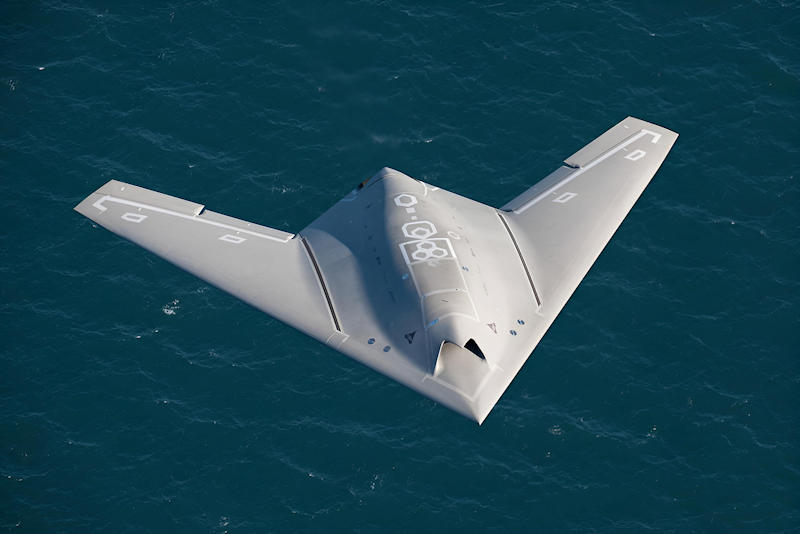
Neuron thus demonstrates that European cooperation is not doomed in itself — only its poorly governed version, where two manufacturers split a leadership neither truly accepts to relinquish.
Successful cooperation alone does not immunise against dependence
The Swedish Gripen offers the reverse illustration: a fighter regularly cited as a European sovereignty success, designed and assembled in Sweden — but powered by an American General Electric F414 engine, “which changes everything.”[03]
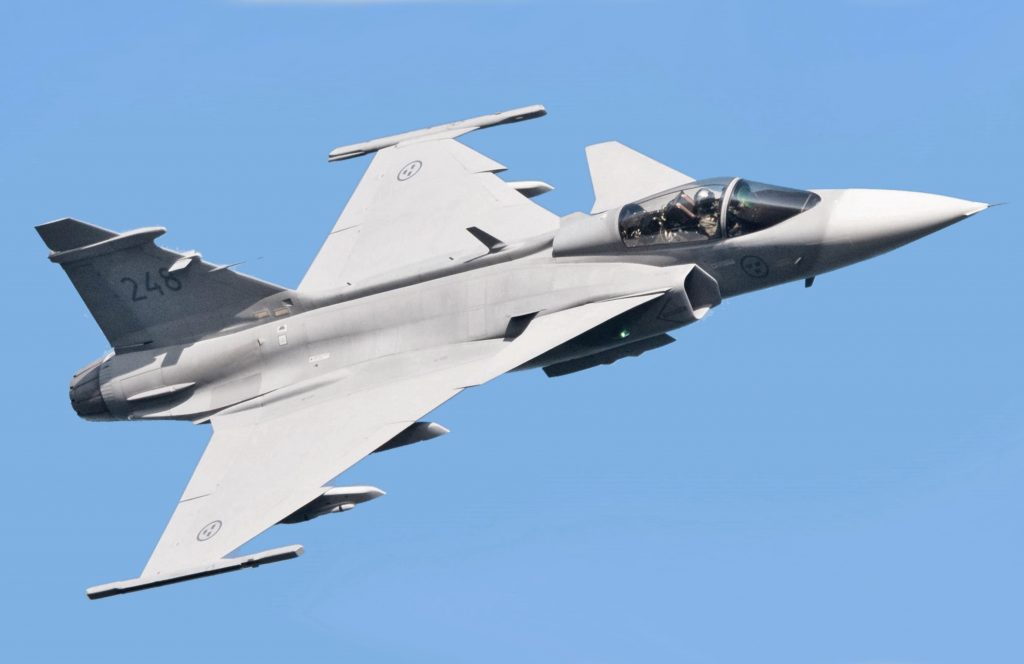
Before the senators, Trappier laid out the principle that holds for France as much as for Sweden: “Without a national engine, there is no sovereignty and no independence.” [03] A family tool can therefore be partially successful — the airframe, the prime contractorship, the assembly — and still remain incomplete if the system’s core, here the engine, belongs to someone else.
This is exactly the risk France is trying to avoid by refusing to power its future combat aircraft anywhere but at Safran.
5. The symptom repeats: Germany and the GCAP
This body of work has documented, piece after piece, one and the same German reflex: accept cooperation, but only on condition of keeping control. The same pattern appears to already be replaying elsewhere. According to several reports circulating the day after Safran’s announcement, German decision-makers, courted by Italy to join the Global Combat Air Programme (GCAP) — the British-Italian-Japanese combat aircraft programme — would reportedly already be setting as a precondition “a revision of leadership over the programme.”[04]
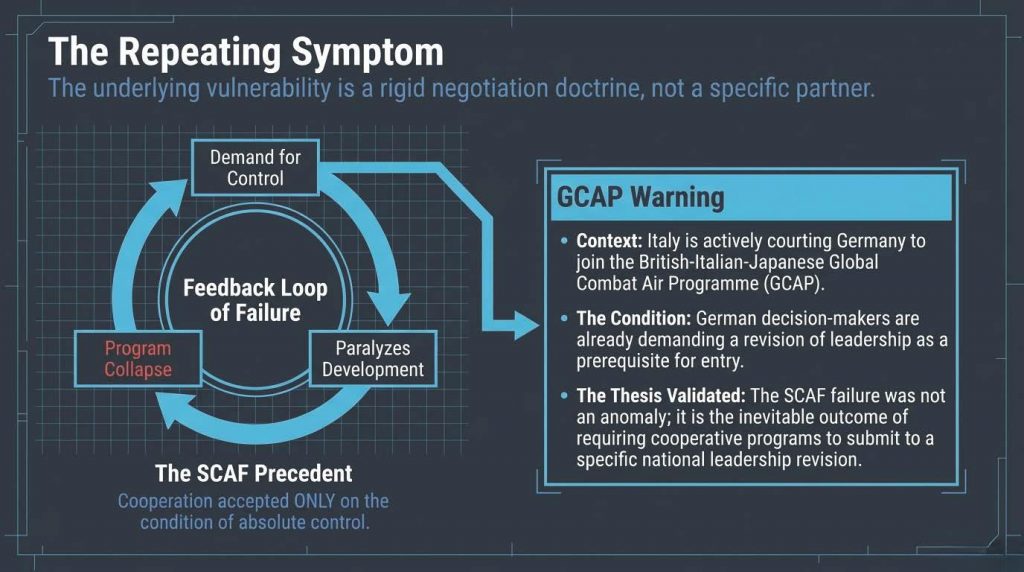
If confirmed, this would validate this trilogy’s central thesis: the problem was never FCAS as such, nor even Germany as an industrial partner. The problem is a negotiating principle that repeats itself, independent of the programme or the partner: cooperate, yes — but only while leading. Neuron shows another path exists; it remains to be seen whether Germany, on the GCAP as before on FCAS, will choose to take it.
Conclusion: the trilogy ends, the body of work continues
With EUMET’s end, nothing is left to wind down in FCAS: not the airframe, not the engine, nor — since this body of work’s previous piece — the illusion that a “naval FCAS” could have succeeded where the original failed. What remains is the question posed as early as this series’ first piece: what gets built instead?
Éric Trappier has his answer: a French demonstrator, without delay, to “test the trade-offs before locking in the operational system,” a first flight targeted for 2031-2032, powered by the current M-88 or its T-REX version (9.5 tonnes of thrust, up from 7.5 today), ahead of an even more powerful sixth-generation engine, this time targeting around 11 tonnes.[01][03]
“We need to jump in now, so as not to be at the mercy of American developments and to preserve industrial expertise,” he insisted. “There is a time to procrastinate and a time to decide.”
The time to procrastinate, for France, does indeed seem over. What remains to be seen is whether the rest of Europe’s naval sector — the subject of this body of work’s previous piece — will draw the same lesson before it is, as that piece’s conclusion put it, definitively too late.
Joël-François Dumont
Sources
[01] Laurent Lagneau, “Safran, in turn, announces the end of the Franco-German next-generation combat aircraft engine project,” Zone Militaire (opex360.com), 28 July 2026.
[02] Thibaut Chereau, “‘Plan B is a super-Rafale’: at the Senate, Dassault Aviation’s CEO gives his account of FCAS’s failure…,” L’Usine Nouvelle, 1 July 2026.
[03] “Le sens des mots,” Aerobuzz, July 2026 — on the American propulsion of the Swedish Gripen and the future French engine targeting 11 tonnes of thrust.
[04] Press reports in comments under Laurent Lagneau’s article (opex360.com), 28 July 2026 — German decision-makers and conditions set for joining the GCAP.
See also :
- « FCAS: The Divorce Is Final — Safran Closes the Last Door » — (2026-0802)
- « Le syndrome du SCALP Naval : Autopsie d’un naufrage capacitaire européen » — (2026-0728)
- « The SCALP Naval Syndrome: Autopsy of a European Capability Shipwreck » — (2026-0728)
- « The Recomposition of Global Military Shipbuilding » — (2026-0724)
- « The Price France Pays Three Times » — (2026-0719)
- « Combat Cloud: Are the Dice Already Loaded Ahead of the July 17 Summit? » — (2026-0716)
- « FCAS: The Foretold death of a Franco-German Myth » — (2026-0714)
Decoding: The last lock to give way
If a final proof were needed that the syndrome documented by this trilogy was not a governance accident but a principle, it arrived the very day this series’ previous piece was published: the engine, ultimate symbol of the “family tool” in the words of a French industrial leader himself, did not survive any better than the airframe it was meant to power.
What is striking is not that cooperation failed — this body of work has documented that since July — but the speed and inevitability with which each sub-system, one by one, followed the same path: governance without an arbiter, mounting demands, a joint venture for show, rupture.
Neuron reminds us, however, that none of this was inevitable: European cooperation works when it respects each partner’s expertise without disputing leadership. And the Gripen reminds us, in reverse, that a family tool can be complete in its airframe and still remain incomplete at its core. The lesson, for anyone following this body of work since its first piece, no longer needs demonstrating: it needs applying, engine included. The real question, in 2026, is no longer whether the divorce is final. It is whether the next generation of French weapons will be built on this body of work’s lessons — or whether it will repeat, alone this time, the same governance errors that killed FCAS as a couple.