France does not always lack resources. What it sometimes lacks is a system capable of making them available, allocating them, and integrating them before the emergency takes that job on itself. But in the ordeal, the country showed real courage and solidarity.
The Southwest had not seen a season this devastating since the fires of 1949, which killed 82 people and burned through 52,000 hectares in the Landes — the summer of 2026 has already surpassed that toll in area burned. In the face of this scale, European and international solidarity brought real relief: several countries across the continent sent reinforcements, and Australia itself, thousands of miles away, dispatched a Chinook helicopter fitted with an 11,300-liter water tank, a Bell 412 reconnaissance aircraft, and twenty-four firefighters from the New South Wales rural fire service.

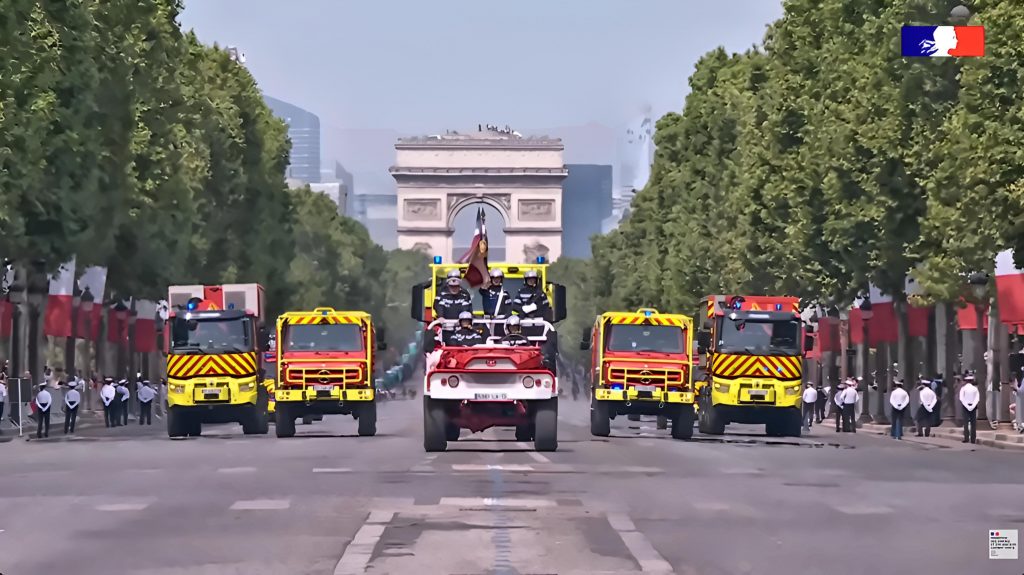
Alongside our firefighters, true soldiers of the flames, the mobilization was total: from companies to farmers, from residents to tourists, not to mention the military, the police, and forest rangers. Without these professionals, without these volunteers, the toll would have been heavier still.
In its misfortune, France did not lose its honor.
The Essentials
- A predictable industrial delay is not a crisis: the additional Canadairs promised in 2022 could not, in any case, have arrived before 2028-2033, whatever budget policy had been followed in the meantime.
- The cancellation of €52.7 million decided in February 2024 did not remove any aircraft from the sky in 2026; it postponed the moment when the fleet would regain depth — an immediate saving that prolongs a fragility for years.
- An aircraft in inventory is not an available capability: Canadair availability fell to a critical level during the summer of 2024, with maintenance — not the number of aircraft owned — being the real variable.
- The A400M shows how urgency turns into a decision what normal times kept in endless deliberation: the technology and the tests had been ready since April 2025, yet the agreement was not signed until July 17, 2026.
- Adding up Canadairs, Dashes, helicopters, A400Ms, and drones does not spontaneously form a coherent system: a permanent function is needed to link observation, decision-making, aerial assets, ground intervention, maintenance, and support.
- Governance of fire prevention is fragmented among many legitimate actors; the problem is not this plurality but the absence of an authority tasked with arbitrating between their competing objectives.
- A crisis does not create new resources: it imposes a common objective, reallocates existing resources, and integrates capabilities that had until then been scattered — what the author proposes to call the fifth “i,” integration.
- The narrative of “solidarity” describes the actors’ motivation, not the function they perform; by merging industrial capacity, logistical capacity, and integration function under a single moral word, it masks the real organization at work.
- Masks in 2020, propellant powder at Eurenco, Canadairs in 2026: the same structure repeats itself — a rarely used capability is deemed costly, degrades, and then a subsequent crisis reveals its unavailability.
Table of Contents
by Jérôme Denariez — Paris, August 4, 2026
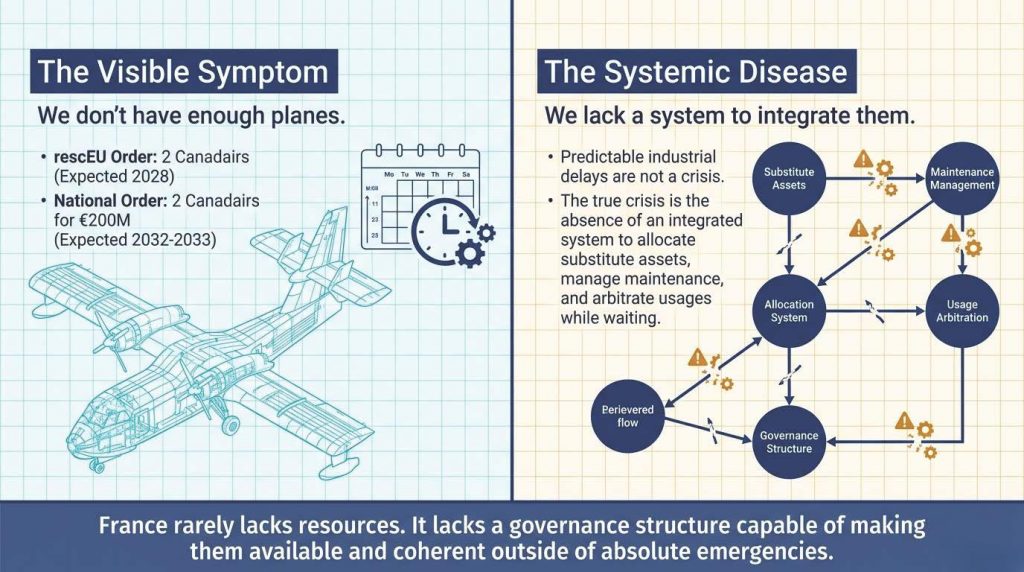
France is not the only country waiting for its new Canadairs. All of Europe must contend with the restart of an industrial supply chain that had been shut down for several years. De Havilland Canada did not officially launch the DHC-515 program until March 2022,[01] after securing the necessary commitments from several European states. It was not enough to simply reopen a workshop: a supplier chain had to be rebuilt, staff hired and trained, the aircraft’s upgrades industrialized, and a production line that had been dormant for nearly a decade set back in motion. The contracts signed with the six European countries concerned cover a total of twenty-two aircraft.[01]
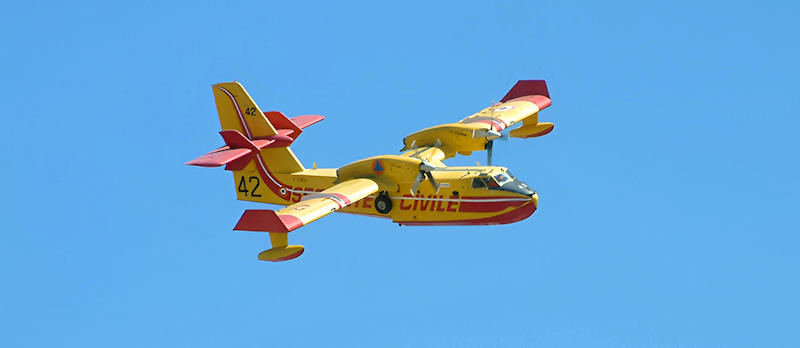
In August 2024, France signed the order for two aircraft co-financed under the European rescEU mechanism.[02] They are officially expected in spring and November 2028, though the inherent difficulty of restarting the industrial line invites caution about that timeline. Two additional aircraft, financed from national funds, were ordered on June 4, 2026, for nearly €200 million.[03] They are not expected to be delivered before the end of 2032 or 2033.
It was therefore highly unlikely that France would have all the aircraft promised after the 2022 fires in hand by the summer of 2026. The point is not to blame the Government for failing, alone, to obtain what the manufacturer was not yet capable of delivering to all its European customers. The real question is what we organized during the period when we knew these aircraft would not be available.
Countries facing the same delay did not all handle their transition the same way. For its 2026 campaign, Spain presented an architecture combining fifteen amphibious aircraft, a firefighting kit for the A400M, four Chinook helicopters, and two Cougars, in addition to the already operational assets of its military emergency unit.

France, of course, did not settle for just its twelve Canadairs. Its arsenal also includes eight Dashes, water-bombing helicopters, six Air Tractors, coordination aircraft, and departmental resources. It can be supplemented by the armed forces and by the European civil protection mechanism. By the end of July 2026, Civil Security counted sixty-five aerial vehicles capable of contributing to firefighting, with widely varying functions and conditions of use.
France was therefore not left without a solution. But a sum of seasonal resources does not necessarily amount to a capability trajectory. A trajectory requires defining in advance the expected level of availability, the functions each type of aircraft must fulfill, the substitution capabilities, the critical dependencies, the cost of maintaining them, and the authority responsible for arbitrating between their different uses.
A predictable industrial delay is not a crisis. The absence of a coherent system to get through it can become one.
What the 2024 Cancellation Says — and Does Not Say
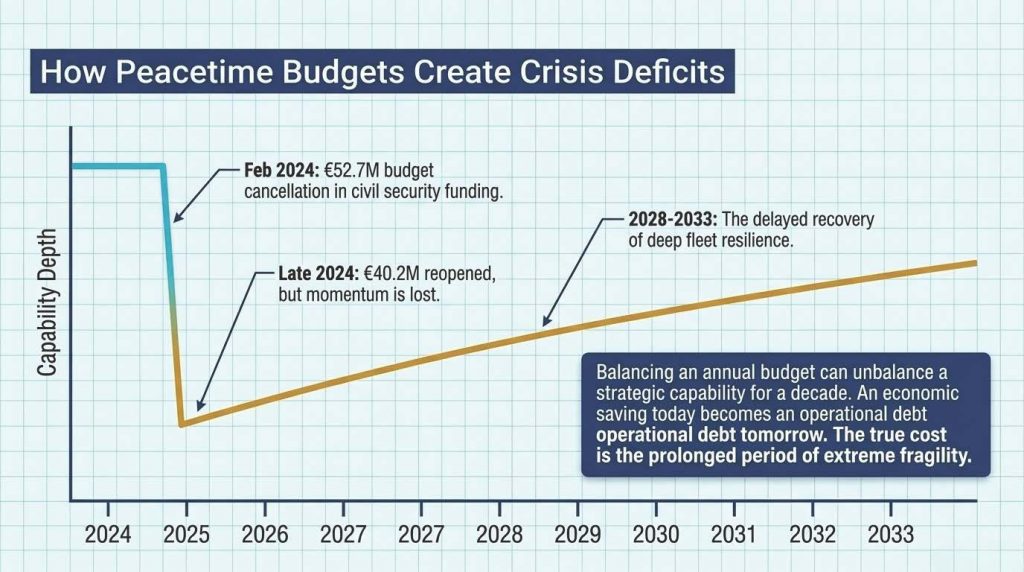
The credit cancellation decided in February 2024 by Gabriel Attal’s government now occupies a prominent place in the controversy. The decree of February 21 did indeed cancel €52.7 million in payment credits from the Civil Security program.[04] An end-of-year budget adjustment law later reopened €40.2 million, mainly to cover operational needs that arose in 2024.[05]
It would nonetheless be excessive to make this cancellation the direct cause of the Canadair shortage during the 2026 fires. The additional aircraft announced in 2022 could not, in any case, have been delivered on such a short timeline. Those whose order was finally signed in June 2026 are themselves not expected until 2032 or 2033.
That does not make the episode insignificant, however. It reveals, on the contrary, a deeper problem: the collision between annual budgeting and the long time frame of capability.
In a period of financial strain, a company can accelerate its collections, reduce its inventory, renegotiate its payment deadlines, or postpone certain investments. These actions can improve its working capital and give it temporary breathing room. They do not, however, correct a business model that structurally burns cash. They can even weaken it if they come with delayed maintenance, delayed equipment renewal, or delayed investments on which future activity depends.
One thus improves today’s cash position while accumulating operational debt.
The 2024 arbitration did not remove two aircraft from the sky in 2026. It contributed to postponing the moment when the fleet could regain more depth. An immediate budget saving can thus prolong a capability fragility for years.
The problem is not that a choice was made. Governing consists precisely in making choices, especially when public finances are constrained. But a genuine arbitration should have made explicit which capability was being temporarily forgone, for how long, at what cost, what risk was being accepted in the interim, and what policy was meant to offset it.
Should the operational maintenance of the existing fleet have been reinforced? Should multi-year leases have been contracted earlier? Should the preparation of complementary military capabilities have been accelerated? Should more have been invested in detection, infrastructure, prevention, or human resources? Should a date have been set at which the postponement of the order would necessarily be reassessed?
Without an explicit answer to these questions, a spending cut is not really a strategic decision. It remains a budgetary trim.
One can balance an annual budget while unbalancing a capability for ten years.
An Aircraft in Inventory Is Not Yet an Available Capability
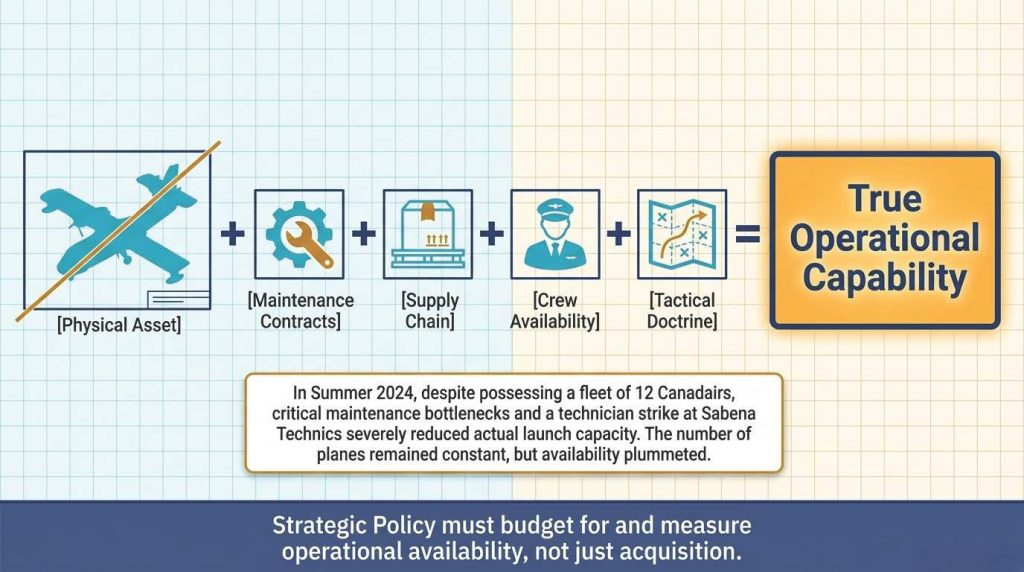
Public debate counts Canadairs. That makes sense: an aircraft can be photographed, an order can be dated, and a promise can easily be compared to the number of aircraft visible on a tarmac. But owning twelve Canadairs does not mean being able to deploy twelve.
Operational maintenance of Civil Security’s aircraft is outsourced. The contract awarded to Sabena Technics ran into execution difficulties, parts supply issues, and staffing problems. The situation became particularly tense during the summer of 2024, amid a labor dispute among maintenance technicians,[06] with the number of available aircraft falling to a level far too low for a season comparable to that of 2022.
A corrective plan was then launched: reinforced preventive maintenance, an increase in the contractor’s staffing, and work with the manufacturer to improve the supply of spare parts. The Government stated that these measures had allowed high availability to be restored by spring 2025.
But the improvement does not make the underlying problem disappear. Contractual availability does not always coincide with actual operational capability. An aircraft can be considered available without the fleet being able to carry out all planned missions. Some operations require several aircraft at once; the grounding of a single aircraft can therefore reduce real capability more than an aggregate rate would suggest.
In July 2025, an insufficient number of available aircraft indeed forced a choice between simultaneous engagement requests in the Aude and in the Bouches-du-Rhône.[07] The risk of a capability rupture was no longer merely theoretical.
The difference is fundamental. The number of aircraft is a patrimonial figure. The number of aircraft capable of taking off, chaining rotations, being repaired quickly, and starting again the next day is a performance figure.
Between the two lie maintenance, mechanics, spare parts, crews, retardant stocks, bases, air tanker bases, refueling infrastructure, the ground resources able to exploit the drops, and the doctrine determining where, when, and for how long the aircraft will be deployed.
France’s rapid-attack doctrine against nascent fires is particularly demanding on the machines. Rotations are numerous, scooping runs are brief and repeated, and the aircraft are engaged intensively from the first outbreaks of fire. Civil Security officials consider this doctrine sound, while acknowledging that it places heavy strain on an aging fleet dependent on a difficult supply of spare parts.
Operational maintenance is therefore not an auxiliary function of aerial capability. It is aerial capability.
The same reasoning applies to firefighters. The number of personnel counted says nothing about how many can be mobilized simultaneously, for how long, with what specialties, and with what relief rotations. A reinforcement sent to a stricken area is not created at the moment of its departure: it is drawn from another territory, whose coverage may be quietly degraded as a result.

It also applies to infrastructure. A road opened during a crisis does not durably constitute a capability simply because it appears in an intervention report. It must still be inventoried, legally secured, maintained, inspected, and funded during the years when it is not being used. A path reclaimed by vegetation, an unmaintained water point, or a turnaround area that has become inaccessible still exist on a map, but no longer in operational reality.
The first analytical framework should therefore distinguish between nominal capability, actually available capability, capability sustainable over time, and capability integrated into the rest of the system.
We spontaneously reason in terms of acquisition cost. A preparedness policy should reason in terms of availability cost.
The A400M: Crisis Turns a Possibility Into a Decision
The A400M is probably an even more revealing symptom than the debate over Canadair orders.

Airbus has been working for several years on a removable kit that turns this military transport aircraft into a retardant bomber. A test campaign conducted at Nîmes in late April 2025, with the Entente Valabre’s CEREN, confirmed the ability to drop up to twenty thousand liters without any permanent modification to the aircraft.[08] The system can be installed in the cargo hold, removed when the aircraft resumes its usual missions, and refilled on the ground in under ten minutes.
The solution does not replace a Canadair. The A400M cannot scoop water from a body of water and must return to base to be refilled. Its value lies more in creating long retardant lines and in protecting exposed areas upstream of a fire front.
Its use also raises real questions of trade-off. The aircraft belongs to the armed forces and carries out missions of strategic transport, operational support, training, and deployment on behalf of allies. Making it available to Civil Security means determining which military capability can be drawn down, for how long, and from what level of risk.
The kits must be funded, their maintenance organized, crews qualified, a doctrine of employment defined, and the aircraft integrated into the aerial command chain for firefighting.

But these questions had already been identified. The technology existed, and the French tests had proven conclusive as early as spring 2025.
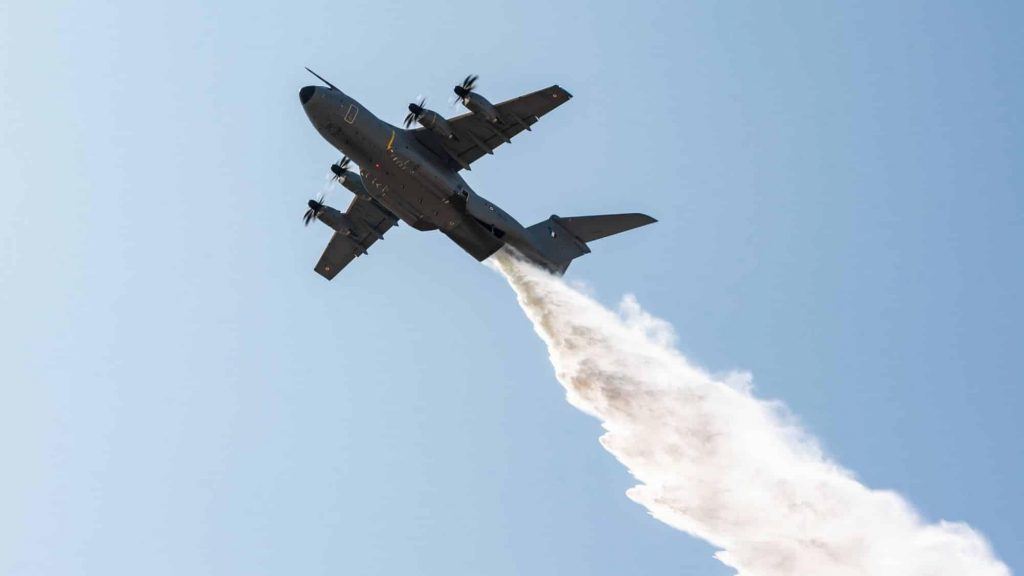
Yet the agreement allowing an A400M equipped with the kit to be made available, on an experimental basis, was not signed until July 17, 2026.[09] A few days later, the aircraft was deployed on the fires in Gironde. The Ministry of the Interior itself described the passage, in a very short time, from prototype to a first operational capability.
What normal times had kept locked in long-term capability deliberation, urgency turned into a decision.
Spain had announced, before the start of its 2026 campaign, the integration of its A400M kit into the national arsenal, alongside its amphibious aircraft and military helicopters. This does not mean the Spanish model is superior in every respect, nor that the A400M can replace the Canadair. It shows that the same technology can be treated as a prepared component of the transition, or as a solution activated under the pressure of events.
France’s delay was no longer primarily a technical one. It concerned financing, doctrine, responsibilities, and the trade-off between two public uses of the same asset.
We possessed several components of the solution. The crisis turned them into a capability.
Operational Coherence: Making Assets Act Together
The integration of an A400M, however, only solves part of the problem. Canadairs, Dashes, Air Tractors, helicopters, military assets, and European capabilities do not perform the same functions and are not subject to the same conditions of use. They depend on different maintenance, command, and support chains. Adding them together does not, therefore, spontaneously form a coherent system.

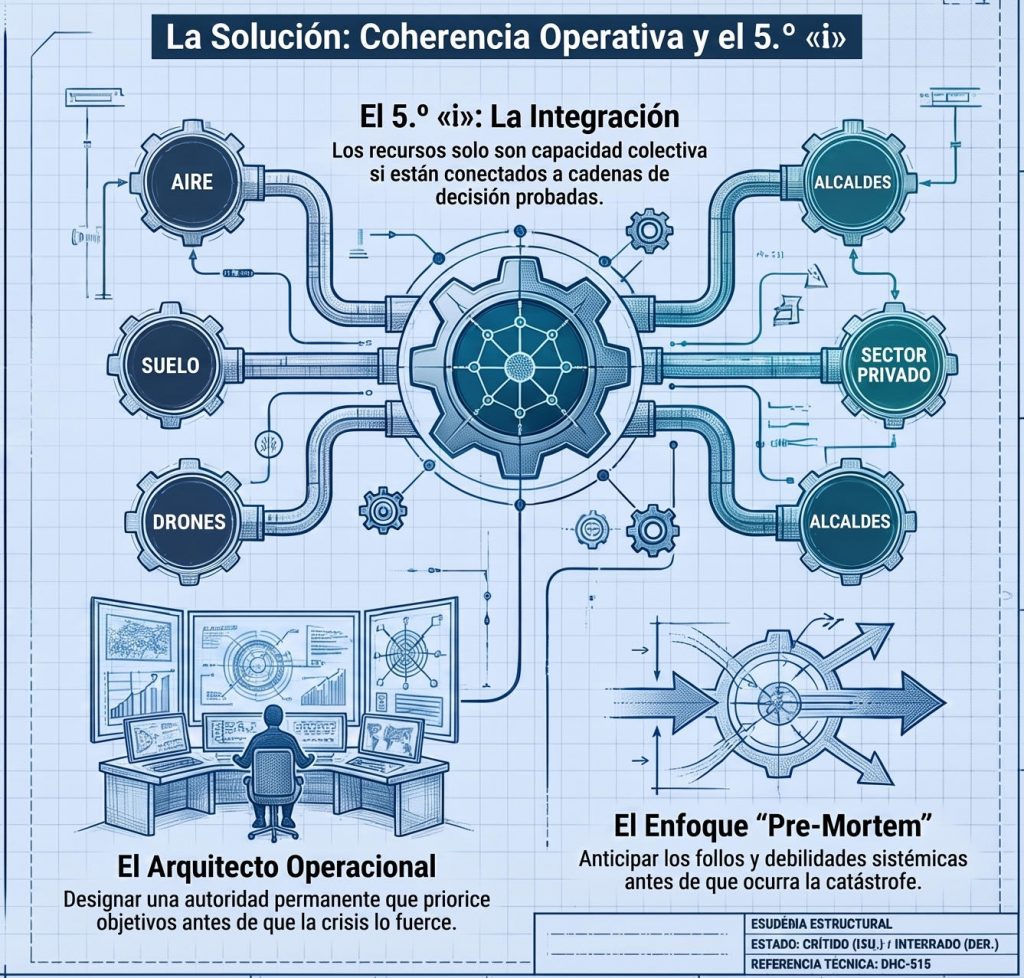
The Air and Space Force has officers responsible for operational coherence. Their job is to verify that different pieces of equipment, doctrines, information systems, personnel, and support functions actually contribute to the same military outcome. Aerial firefighting raises a comparable question: who is responsible for looking at the system as a whole and verifying that its various components actually produce the intended effect?

This is not about creating an “air force of fires,” nor about placing Civil Security under military command. It is about identifying a function of operational architecture: anticipating breakdowns, defining complementarities between aircraft, integrating civilian and military assets, organizing the flow of information, and connecting aerial capabilities to ground operations.
The use of drones illustrates this necessity. Small aircraft can locally reconnoiter an access route, monitor a fire edge, follow a front, or detect a flare-up. A long-endurance drone like the Reaper could provide persistent vision over several fire sites, update mapping, and help track the situation over twenty-four hours.
But an additional image does not in itself constitute an operational capability. It must still be analyzed, shared, and transmitted to an authority capable of reallocating resources accordingly. The drone’s real contribution therefore lies not only in what it observes, but in the decision it enables to be made earlier.
Technology produces information. Operational coherence turns that information into maneuver.
Outside a Crisis, Everyone Pursues Their Own Objective
Fire prevention and management cannot depend on a single ministry or a single operator. Forest is at once a natural habitat, a carbon sink, an economic resource, a recreational space, an agricultural territory, public or private heritage, protection against erosion, and a potential fuel mass.
The policies that apply to it fall under the Interior, Agriculture, Ecological Transition, prefectures, local governments, fire and rescue services, the National Forestry Office, the National Center for Private Forest Property, private owners, the timber industry, farmers, hunters, environmental associations, insurers, and numerous specialized bodies.
This plurality is not in itself a dysfunction. A subject this complex necessarily requires many areas of expertise and many contributors.
The problem arises when each actor pursues its own objective with its own mandate, its own indicators, its own funding, its own doctrine, and sometimes its own power to block, without anyone truly owning the overall outcome.
Several parliamentary studies have described in recent years a fragmented forestry governance spread across ministries, with funding divided among several budget programs that remain difficult to consolidate. An interministerial delegate for forests, timber, and their uses was established by decree on April 5, 2024,[10] to coordinate public policies; the delegate’s actual ability to arbitrate between administrations, however, remains to be documented.[11]

The compliance rate with legal brush-clearing obligations remains structurally low: a 2022 Senate report estimated it at around 30% nationally,[11] and inspections carried out locally in 2025 confirm comparable levels. There are, moreover, sometimes contradictory directives between fire prevention and biodiversity protection.
Take the case of a plot of land whose upkeep is limited because a protected species might come to nest there. Protecting that species is a legitimate objective. Reducing the fuel load is equally legitimate. If no authority is able to weigh the two risks against each other, the absence of a decision becomes a decision in itself. The plot remains as it is. If it burns, the potential habitat one had wanted to protect disappears along with it.
Not making a choice is not staying neutral. It is letting the status quo prevail, usually to the benefit of whichever rule is the most restrictive, or whichever actor holds the most effective legal lever.
Pastoralism illustrates the same difficulty. It can help maintain open landscapes, reduce combustible vegetation, create discontinuities, ensure a human presence, and support the early detection of anomalies. But its development requires simultaneously addressing access to land, water resources, fencing, agricultural subsidies, livestock protection, owner liability, and environmental objectives.
Each public policy can be coherent within its own scope. Their juxtaposition does not necessarily produce a coherent policy.
La Valbonne: Looking at Objectives Together
A counter-example does exist, however, notably on certain military training grounds.
The La Valbonne camp, in the Ain department, is both an operational training ground and a natural area home to protected habitats and species, including the little bustard. The European LIFE La Valbonne program aims to restore grasslands, wetlands, and certain wooded areas while preserving the site’s military functions. Pastoralism is used there to maintain open landscapes, while a training wetland has been rehabilitated to meet both ecological and operational objectives at once. The project’s specifications explicitly embrace the combination of military, environmental, and socio-economic effects.
The plurality of objectives has not disappeared. Military personnel, ecologists, farmers, companies, and local governments do not spontaneously pursue the same goal. But a manager is responsible for the site, and operational capability remains an explicitly assumed objective. Environmental constraints are therefore neither ignored nor simply tacked on alongside military needs: they are integrated into the site’s management.
Arbitration does not necessarily begin by sacrificing one objective. It begins by giving someone the responsibility of looking at them together.
An interministerial policy does not become integrated because several ministries take part in a meeting. It becomes integrated when an authority can rank objectives, make trade-offs binding, and then answer for the outcome.
Coordinating means letting actors talk to each other. Arbitrating means deciding which of their objectives will have to give way when they cannot all be met at once.
What the Crisis Accomplishes in a Few Hours
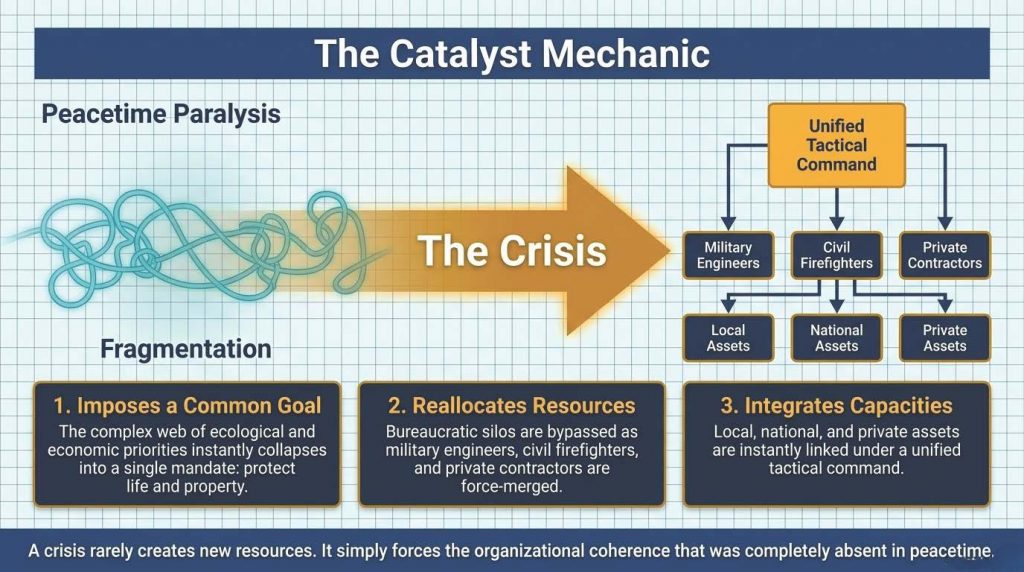
When a fire becomes uncontrollable, the system changes in nature. The objective becomes simpler: people must be protected, threatened areas evacuated, homes defended, and the spread slowed.
The hierarchy of priorities suddenly becomes clear. Resources are reallocated. Firefighters arrive from other departments. The armed forces contribute engineering units, surveillance, transport, or logistics. Local governments open shelters. Gendarmes carry out evacuations. Companies make equipment available. Farmers provide water tanks, tractors, and their knowledge of the terrain.
The crisis does not necessarily create new resources. It accomplishes three things that normal times find much harder to achieve: it imposes a common objective, allocates resources to that objective, and integrates capabilities belonging, until then, to different organizations.
It is this mechanism, far more than individual generosity alone, that allows the system to hold.
When a gendarme tasked with evacuating a home discovers two elderly people without a vehicle, he does not first try to determine which agency is administratively responsible for organizing their transport. He assesses the danger, finds a spot in a vehicle, calls a colleague, asks a neighbor, or changes his route.
He is not administering their situation. He is exercising operational judgment.
When a construction company mobilizes a bulldozer free of charge to create a firebreak, it is not simply lending a hand behind the firefighters. It is providing a heavy productive capability: a machine, a qualified operator, fuel, maintenance, knowledge of the terrain, an assumption of risk, and perhaps the forgoing of another job.
It becomes a component of the maneuver.
The useful questions then become less emotional. How was this company identified? Who asked it to intervene? Under whose authority? With what insurance coverage? Who would have borne the cost of destroyed equipment? Why did this capability have to be provided free of charge? Will it be recorded, formally arranged, and prepared for the next crisis?
A resource listed in a document is not necessarily an integrated capability. One must still know who can operate it, at what moment, under what conditions, and under what chain of decision.
The Fifth “i”
The armed forces can intervene on national territory when civilian resources are non-existent, insufficient, unsuited, or unavailable.
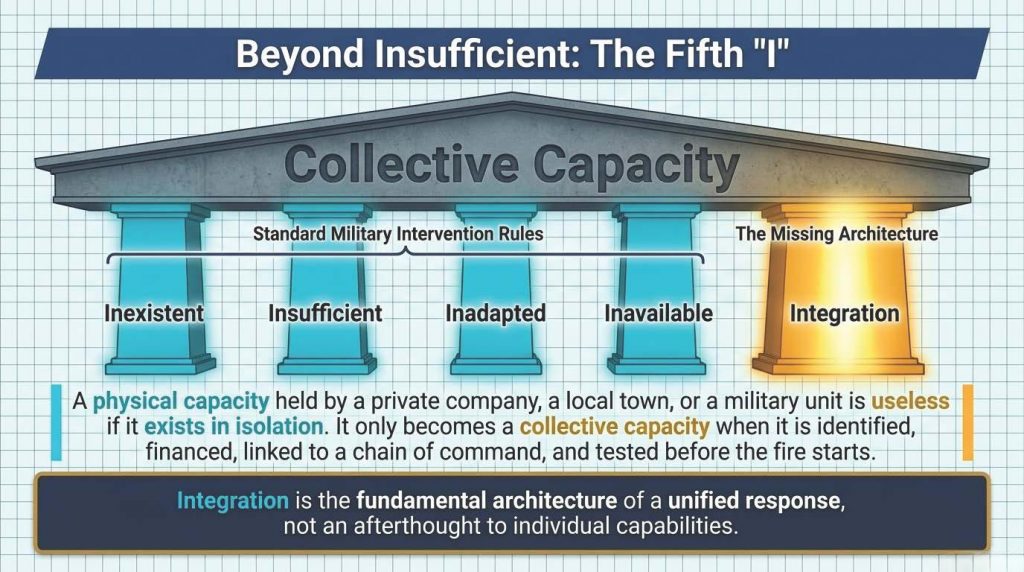
The rule of the four “i”s [inexistants, insuffisants, inadaptés, indisponibles] usefully reminds us that military resources supplement civilian ones without being meant to become a permanent substitute for them. But this framework could be applied well beyond the mere recourse to the armed forces.
If transport capacity is insufficient, how are residents without vehicles evacuated? If planned shelters are unavailable, what buildings can be mobilized? If public equipment is unsuited, what private capabilities exist locally? If a small municipality’s teams are insufficient, what engineering support can be sent in? If communication networks go down, what system replaces them? If insurance does not cover indirect economic losses, what mechanism prevents a chain of bankruptcies?
What may be missing is a fifth “i”: integration.
A capability can exist within a company, a municipality, an association, or a military unit without being genuinely available to the system. It only becomes a collective capability once it has been identified, prepared, funded, connected to a chain of decision, and tested.
This does not mean everything must be administered. The gendarme must retain his judgment. The mayor must be able to adapt the arrangement to his territory. The company must be able to spontaneously propose a solution.
The system’s role is not to write out in advance the response to every possible situation. It is to set objectives, prepare critical capabilities, secure those who take reasonable initiative, and allow the field to reallocate resources when the actual scenario no longer matches the one that was planned.
The Mayor, Responsible for the Last Mile
As during the health crisis, fires put mayors back at the center. They know the isolated individuals, the back roads, the available buildings, the vulnerable businesses, the associations, the farmers, and the equipment that can be mobilized. They provide the last mile of the public response, the point where a general doctrine meets the singular reality of a territory.
But this recognition also reveals a paradox. Operational and political responsibility is local, while much of the regulatory power, the funding, and the trade-offs continue to be made elsewhere.
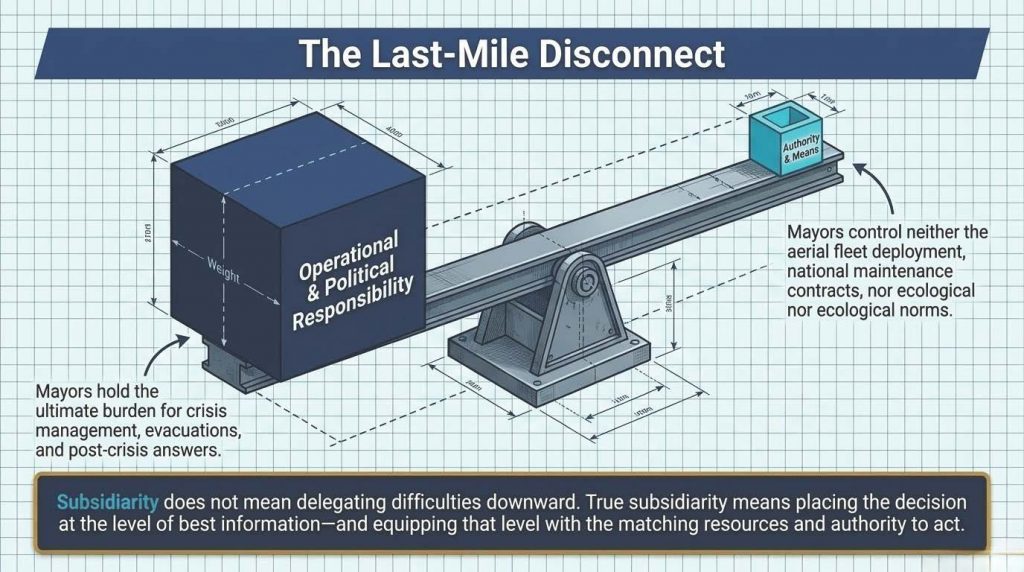
The mayor must prepare, inform, organize reception centers, monitor certain brush-clearing obligations, and answer to residents. Yet he controls neither the air fleet, nor the maintenance contract, nor the funding of the departmental fire and rescue service, nor the full set of environmental regulations, nor certain prefectural decisions determining evacuation or the reopening of his territory. The liability of mayors and municipalities can nonetheless be engaged with respect to monitoring brush-clearing compliance.
We ask them, therefore, to be agile with the consequences of decisions in which they did not necessarily take part.
In a company, declaring a manager responsible for a result without giving him authority over the teams, the tools, the investments, and the necessary dependencies does not create accountability. It creates a fuse.
Subsidiarity does not consist of delegating difficulties. It consists of placing the decision at the level that has the best information, along with the corresponding resources and responsibility.
“Solidarity,” a Convenient Story for a More Complex Reality
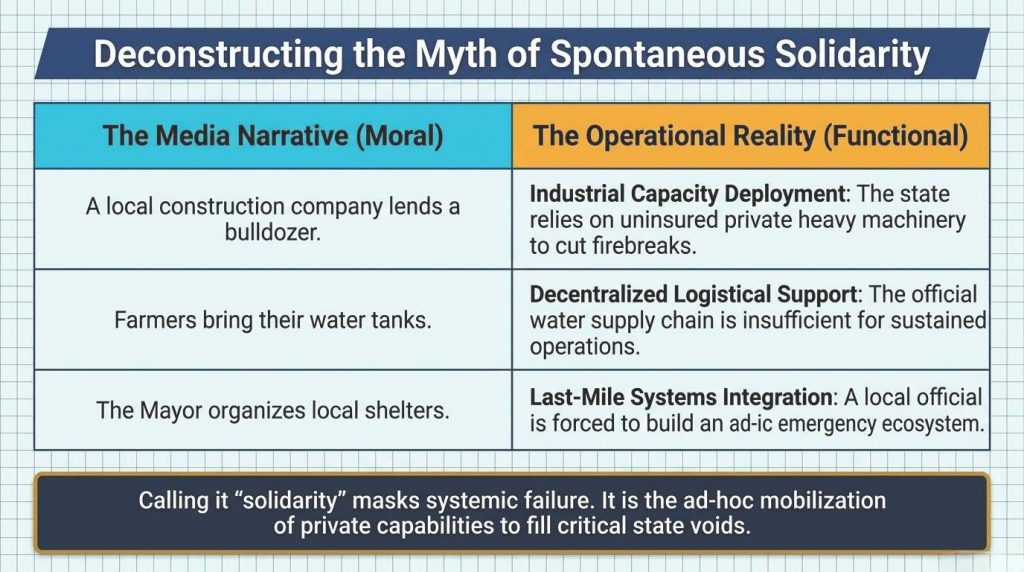
The media narrative speaks of an immense chain of solidarity. The term is legitimate when a resident opens his home to evacuees, when a volunteer serves meals, or when an association collects clothing.

It becomes far less precise when it is used to lump together, indiscriminately, a construction company’s bulldozer, a farmer’s water tank, the organization of a shelter, a mayor’s allocation of resources, a gendarme’s judgment, or the mobilization of trained volunteers belonging to an accredited Civil Security association.
Solidarity can describe the actors’ motivation. It does not describe the function they perform.
The bulldozer is an industrial capability. The water tank is a logistical capability. The mayor performs an integration function. The volunteer temporarily increases reception capacity. The gendarme locally adapts evacuation doctrine.
Using a single moral word to describe all these functions avoids looking at the organization that is actually being built.
The media treatment of the first and second lines is, moreover, telling. Firefighters, gendarmes, police officers, and soldiers carry out their mission. Their situation quickly leads to less consensual questions: how many are they, with what resources, for how long, with what relief rotations, and at the cost of what weakening of other territories?
Volunteers allow for a more emotional narrative. They become the everyday heroes. Their commitment supposedly proves that France still knows how to come together, that it is not as fractured as claimed, and that in the crucial moment it shows up.
This narrative is not false. It is off-center.
It gradually turns a disaster into a demonstration of national cohesion. The first line leads us to evaluate public capability. The second lets us celebrate society’s moral qualities. Yet it is not solidarity alone that explains why the system holds. It is its capacity for adaptation.
Actors reallocate resources, work around obstacles, take initiative, and integrate, under pressure, an organization that had not been fully prepared. This capacity deserves recognition, but it must not become a convenient way to avoid the central question: what was it forced to compensate for?
Every time a volunteer or a company fills a gap, it is not enough to simply thank them. One must identify the gap.
From Masks to Powder: Who Pays for a Strategic Capability Between Two Crises?
We have already seen the same mechanism during the health crisis. France discovered that its stockpiles of masks no longer constituted a sufficient capability and had to buy on an urgent basis on a saturated global market. Companies converted their production lines. Seamstresses made cloth masks, sometimes supplying town halls for free and sharing their methods on the internet.
The narrative remembers a formidable wave of solidarity. But these seamstresses primarily constituted a decentralized substitute production capability. They were responding to a need that industrial capacity and strategic stockpiles could no longer meet.
France then rapidly increased its domestic production. Then the urgency eased, imports resumed, and orders were not enough to sustain some of the newly created capabilities.
The problem extends beyond the health sector. It concerns all strategic capabilities that are rarely used but immediately indispensable when a crisis occurs.
Defense offers a particularly telling example in this respect. Eurenco had stopped producing propellant powder for large-caliber ammunition in France in 2007 and was sourcing it primarily from its Swedish subsidiary.[13] After the invasion of Ukraine and the saturation of European capacities, France decided to rebuild a domestic production line at Bergerac, aiming eventually for 1,200 tons a year.[13]
Yet the economic problem had been identified well before the war. As early as the late 2000s, parliamentary work was already discussing the need to guarantee Eurenco orders of adequate duration and volume, or to cover part of its fixed costs, in exchange for maintaining production capacities that could be mobilized on demand.

The conceptual solution was therefore already known: a strategic capability cannot always be financed by ordinary market orders alone. Sometimes its availability must be paid for, even when it looks oversized in normal times.
Who pays for a production line one hopes never to have to use? Who funds a rolling stockpile? Who maintains infrastructure that has not been used for several years? Who compensates a reserve capability?
A strategic capability that must be profitable at all times is not really strategic. It is an ordinary commercial activity.
The mask crisis, the powder crisis, and the fire crisis thus share the same structure. A rarely used capability is seen as costly; it is cut or allowed to deteriorate; a crisis then reveals its unavailability; it is bought urgently on a saturated market; field actors adapt; a capability is painfully rebuilt; and then it again becomes hard to justify once the urgency fades.
We certainly conduct after-action reviews. But they often remain confined to the object of the crisis at hand. The health after-action review deals with masks, the fire review deals with aircraft and firefighters, while the military review analyzes the deployment of the armed forces.
Who extracts the common patterns: the disappearance of dormant capabilities, single suppliers, saturable markets, stockpiles, maintenance, redundancy, citizen improvisation, and the business model between two crises?
We draw lessons from each crisis. We find it harder to recognize the same crisis when it changes its appearance.
The Pre-Mortem Forces Us to Decide Before the Emergency
The after-action review analyzes what happened. The pre-mortem starts from a different premise: the system has failed. It asks why before that failure occurs.
A pre-mortem conducted after the 2022 fires could have started from the following scenario: we are in the summer of 2026; the new Canadairs have not yet been delivered; part of the existing fleet is grounded; several major fires break out simultaneously; human resources are scattered; some infrastructure is no longer fully usable; some work has been delayed by conflicting regulations. Why does the system fail?
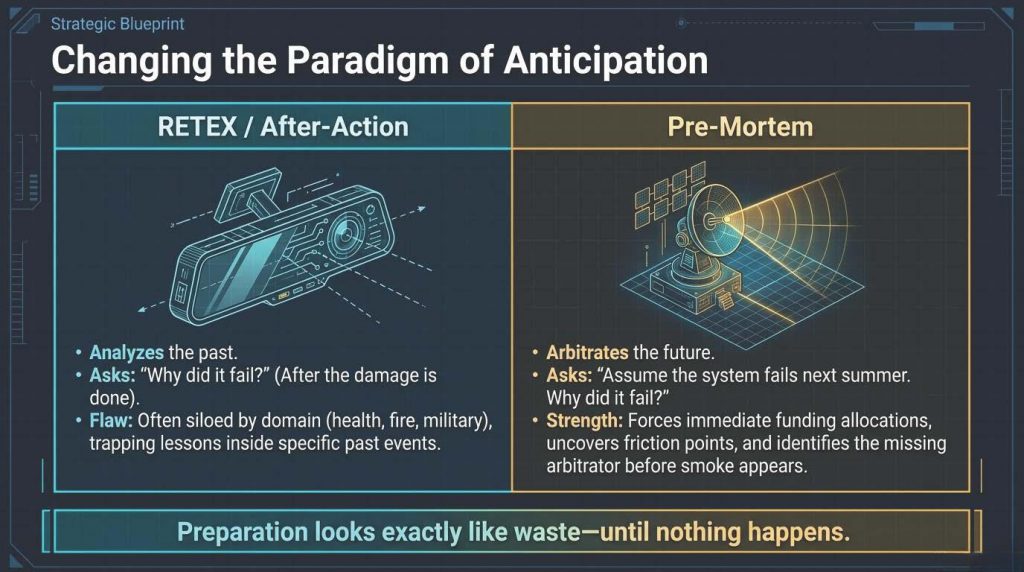
The answers would probably have brought to light maintenance, spare parts, relief rotations, infrastructure, private resources, unintegrated military capabilities, and the absence of a clearly account-able arbiter.
The pre-mortem does not precisely predict the next disaster. It forces us to look at the weaknesses everyone knows about but that no one wants to fund or address immediately.
Above all, it leads us to decide, before the emergency, on the level of redundancy we accept, the capabilities we maintain, the rules we adapt, the stockpiles we keep, and the authority that will hold the power to decide when not all objectives can be reconciled.
Preparedness often looks like waste as long as nothing happens. The after-action review documents the past. The pre-mortem forces us to decide on the future.
Institutional Time Is Not Operational Time
The Beauvau de la Sécurité Civile provides a good illustration of this gap. Launched in April 2024, it mobilized, over twelve months, more than nine hundred participants, thirty-one workshops, seventy hearings, and more than thirteen thousand responses to a survey, of which 13,111 were usable. Its summary report was presented on September 4, 2025,[12] and covers missions, crisis management, engagement, governance, funding, and the resources of Civil Security.


The survey notably found that a majority of respondents considered the objectives assigned to Civil Security to be insufficiently clear, and that a large share of them wanted stronger State involvement in steering this public policy.[14]
The diagnosis therefore already exists. When the next disaster strikes, we are told the work needs to be accelerated.
But not everything requires a law. Preparing a maintenance contract, testing a capability, inventorying infrastructure, entering into agreements with local businesses, clarifying a chain of arbitration, or organi-zing a pre-mortem can all move forward through administrative, contractual, and budgetary decisions.
Legislation may well be essential to change the funding of fire and rescue services, the status of volunteers, or the division of powers. It must not, however, become the point at which every operational decision waits.
On the ground, the question is who can act now. The institutional system often begins by asking which agency, which text, and which funding source has jurisdiction.
Both questions are legitimate. They do not operate on the same timeline.
The Fire Goes Out. The Liabilities Begin
The media crisis generally ends when residents return home, roads reopen, and the flames stop providing spectacular images. For the territory, the longest phase then begins.
Weakened trees must be secured, those to be felled identified, areas capable of natural regeneration determined, some plots replanted, burned wood processed, soils protected against erosion, and water points, tracks, networks, and buildings restored.
This work will itself cause new damage. Forestry equipment and trucks will use paths that were not designed to bear such traffic. A road directly burned is an identifiable form of damage. A road deteriorated six months later by the evacuation of burned wood is a consequence just as real, but much harder to trace back to a funding mechanism.

The fire produces a first set of liabilities. Reconstruction produces a second.
Small municipalities will have to inventory the damage, identify property owners, commission asses-sments, define project ownership, issue contracts, apply to insurers and for subsidies, advance expenses, and coordinate the work.
The problem will not simply be finding funding. It will be turning possible funding into an executable project.
The solidarity grant intended for local governments affected by climate or geological events covers only certain assets, requires an initial assessment within two months, and strictly regulates advances.[15] These generally cannot exceed 20% of the projected subsidy amount, and in certain cases 30%.
An announced envelope is not an awarded subsidy. An awarded subsidy is not yet cash in hand. Cash in hand is not yet a contract awarded, and a contract awarded is not yet infrastructure back in service. The real indicator is therefore not simply the budget voted. It is the time separating the announcement from the effective return of capability.
The Companies That Will Not Have Burned
The economic reckoning will also be delayed. Some businesses will have lost their buildings or their equipment. Others will have survived materially, only to disappear several months later: a private campground stripped of part of its season, a shop whose customers do not return, a restaurant left inaccessible, a craftsman whose clients are stricken, a forestry company deprived of access or resources, a farmer whose land can no longer be used.
Material damage is visible. The destruction of a business model is far less so. A company can be intact even as its activity no longer is.
At what date should the disaster’s toll be finalized? When the fire is contained? At the end of the tourist season? Twelve months later, once some businesses have exhausted their cash reserves? Three years later, once municipal tax revenues have declined?
A disaster is not measured only by destroyed assets. It is measured by the economic flows, human capacities, and investments it suppresses or displaces over time.
When the Horizontal Network Moves Faster Than the Institutional Chain
Faced with this gap, networks of local governments can spontaneously spring into action. Direct partnerships can emerge between a major city with substantial technical, legal, and financial services and a small stricken municipality.
This mutual aid can provide far more than a check: an engineer, a lawyer, a public procurement officer, a chief financial officer, a project manager, equipment, or the ability to prefinance an operation.
These horizontal networks reduce the time between need and action. They nonetheless create a risk of inequality. The most visible or best-connected municipality will more easily find a partner than one left out of the media narrative.
The State’s role should therefore not be to administer these initiatives to the point of slowing them down. It should be to secure them, organize equalization between territories, and guarantee that no territory is left behind.
When the vertical chain is too slow, the territory spontaneously rebuilds a horizontal operational chain. This, too, is a capacity for adaptation.
More Coordination
On July 21, 2026, the Government announced a national mobilization to restore burned massifs and adapt forests to climate change.
The plan notably provides for the creation of France Forêt 2100, a state startup tasked with connecting project developers and public or private funders, federating initiatives, and facilitating their coordination.[16] It also includes the creation of a budget program dedicated to forests starting in 2027, €100 million from the Green Fund earmarked for adapting forest massifs, and a “Réserve verte” label meant to identify and structure associative initiatives.
These tools may well prove useful. Forestry projects need funding, and project developers need to be able to identify the right windows and investors.
But the first response announced once again rests on the verbs connect, federate, coordinate, and mobilize.
Yet the crisis has just demonstrated that actors know how to connect with one another and coordinate when urgency imposes a common objective on them. Firefighters, soldiers, mayors, farmers, companies, associations, and residents did not wait for a new platform to work together.
The problem does not lie primarily in an inability to talk to one another. It appears when interests and time frames diverge once again.
Restoring the territory will nonetheless require very concrete choices. Some plots will need to be replanted, while others will need to evolve into open spaces. Choices will have to be made between biodiversity, timber production, pastoralism, and fire prevention; the restoration of tracks will have to be prioritized; engineering support will have to be directed toward the municipalities that need it most; and the difficulties of businesses that will not surface for several months will have to be followed. Above all, the authority that will answer for the territorial outcome over time will need to be designated. Without clearly assigned responsibility, coordination risks once again scattering decisions instead of making them effective.
France Forêt 2100 deals primarily with the forest. A disaster affects a territory. It also concerns roads, networks, municipal finances, agriculture, tourism, businesses, public services, and residents’ psycho-logical health.
Connecting funders and projects does not designate the owner of the outcome. Coordinating actors does not necessarily give anyone the power to arbitrate. Mobilizing resources does not guarantee they will be allocated to the most critical needs.
Its assessment should therefore focus less on the number of projects connected than on the real capacity to decide, allocate, integrate, prefinance, and answer for the outcome.
The Capacity for Adaptation Does Not Replace Operational Coherence
The fires do not reveal a general lack of resources. They show, on the contrary, a considerable quantity of public, military, territorial, private, and associative capabilities. Aircraft can intervene, drones can observe, companies have equipment, farmers know the terrain, and local governments know how to organize the reception of populations.
But these resources depend on different institutions, follow different doctrines, and are not always connected to the same chain of information and decision. Outside a crisis, they remain largely fragmented. When fire spreads, urgency suddenly imposes a common objective on them. Priorities are simplified, resources reallocated, and local initiatives integrated into the maneuver.
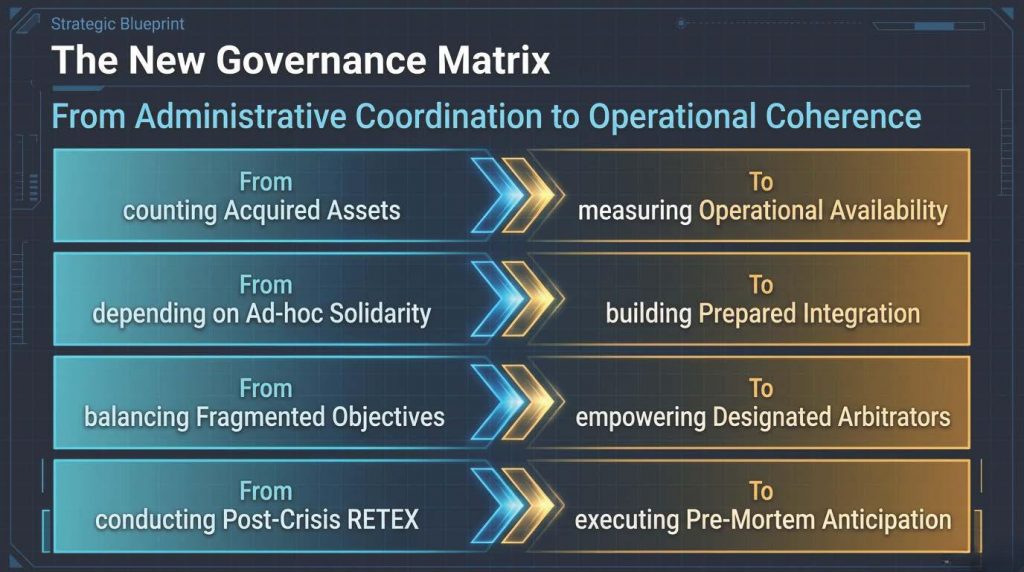
The crisis thus accomplishes, in a few hours, what normal times had not fully organized. It thereby temporarily imposes the operational coherence that normal times had not managed to organize.
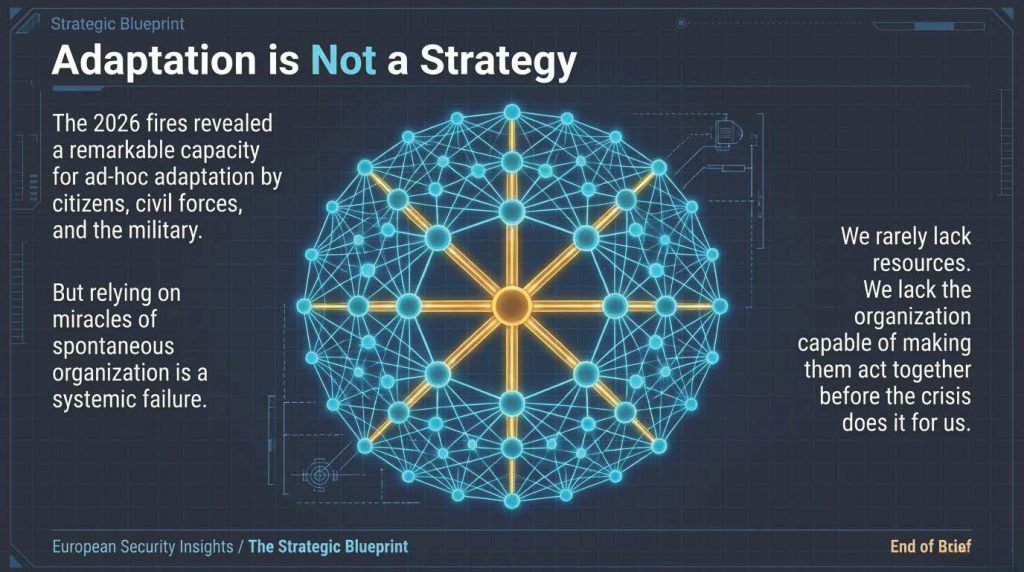
This capacity for adaptation constitutes a remarkable strength. It cannot, however, become an implicit doctrine of preparedness. An organization should not depend, over the long term, on the chance of an encounter, a mayor’s personal network, the fortuitous availability of an aircraft, or one agent’s exceptional judgment to carry out its critical functions.
The pre-mortem makes it possible to identify breakdowns before they occur. The fifth “i,” integration, turns scattered resources into collective capabilities. The capacity for adaptation allows them to be recombined when reality outstrips the planned scenario. But these three dimensions presuppose a permanent function of operational coherence, tasked with looking at the system as a whole and answering for the effect obtained.
This is not about adding a new structure above all the others, but about clearly designating whoever must verify that the means of observation, decision, dropping, ground intervention, maintenance, and support actually contribute to the same objective.
A crisis rarely reveals that we possessed no resources at all. It more often reveals that no one had been given responsibility for making those resources available, intelligible, and coherent before they became indispensable.
We do not always lack capabilities. We sometimes lack the organization capable of making them work together before the crisis takes charge of that in our place.
Our capacity for adaptation is remarkable. What should worry us is everything we still ask it to compensate for.
Jérôme Denariez
Notes
[01] De Havilland Aircraft of Canada Limited, “De Havilland Aircraft of Canada Limited Launches DHC-515 Firefighter,” press release, March 31, 2022; “De Havilland Canada Provides Production Update on De Havilland Canadair 515 Aircraft,” March 10, 2026. The DHC-515 program was officially launched in March 2022; in March 2026, De Havilland Canada reported producing twenty-two aircraft for six European customers: Croatia, Spain, Italy, Greece, Portugal, and France.
[02] “La France signe pour ses deux premiers DHC-515,” Aerobuzz, August 12, 2024. Ministry of the Interior, “Lancement de la campagne feux de forêts 2026,” speech, June 4, 2026. The contract signed with the Canadian Commercial Corporation under rescEU covers two aircraft, with deliveries announced for April and November 2028.
[03] Ministry of the Interior, “Feux de forêt : mieux prévenir, mieux combattre, mieux reconstruire,” June 5, 2026; De Havilland Canada, “Sécurité Civile Française Doubles Its DHC-515 Commitment with Order for Two Additional Aircraft,” June 4, 2026; “Sécurité civile : l’État renforce ses moyens aériens avec deux hydravions Canadair supplémentaires,” Mer et Marine, June 8, 2026. The order covers two additional aircraft, for an investment of nearly €200 million; delivery is expected in 2032 or 2033.
[04] Decree No. 2024-124 of February 21, 2024 canceling budget credits, published in the Official Journal on February 22, 2024. Program 161 “Civil Security” saw a cancellation of €52,766,476 in payment credits outside Title 2.
[05] Senate, written question No. 00419 from Françoise Dumont and the Ministry of the Interior’s response, published June 5, 2025. Law No. 2024-1167 of December 6, 2024 on end-of-year budget management reopened €40.2 million in additional payment credits under Program 161.
[06] “La Sécurité Civile impactée par la grève chez Sabena Technics à Nîmes,” Aerobuzz, May 30, 2024. The labor action launched on May 29, 2024 involved staff responsible for maintaining and operating Civil Security aircraft; initially, no Canadair, Dash, or Beech could respond to fire alerts.
[07] “Après le Canadair : la bataille des successeurs,” L’Essentiel de l’Éco, April 2, 2026. The article discusses, among other things, the trade-off made in July 2025 between two simultaneous deployment requests in the Aude and the Bouches-du-Rhône, for lack of a sufficient number of available aircraft.
[08] Airbus Defence and Space, “Airbus A400M firefighting kit completes a successful test campaign,” press release, June 26, 2025. The test campaign conducted in late April 2025 at Nîmes-Garons with the Entente Valabre’s CEREN confirmed the ability to drop up to 20,000 liters of water or retardant; the kit, installed in the cargo hold without any permanent modification to the aircraft, can be reloaded in under ten minutes.
[09] Ministry of the Interior, “Un avion A400M en renfort de l’action de lutte contre les feux de forêts,” press release, July 2026: agreement signed July 17, 2026 between the Ministry of the Interior, the Ministry of the Armed Forces, and Airbus. First operational deployment on the Gironde fires in late July 2026 (“Airbus A400M Debuts Firefighting Mission as Wildfires Blaze Through France and Spain,” The Aviationist, July 28, 2026).
[10] Decree No. 2024-312 of April 5, 2024 establishing an interministerial delegate for forests, timber, and their uses. Decree of April 10, 2024 appointing Jean-Michel Servant to this position, effective April 15, 2024.
[11] Senate, information report No. 856, “Feux de forêt et de végétation : prévenir l’embrasement,” Jean Bacci, Anne-Catherine Loisier, Pascal Martin, and Olivier Rietmann, August 3, 2022. The report states that compliance with legal brush-clearing obligations is, depending on the area, often below 30%.
[12] National Assembly, Information Report No. 1643 on state forest management, presented by Laurent Baumel and Sophie Mette, June 25, 2025, section I.A: “A fragmented forestry governance, which the appointment of an interministerial delegate is not enough to fully structure.”
[13] “À Bergerac, Eurenco relance la production stratégique de poudre sur le sol français,” L’Usine Nouvelle, March 21, 2025; “Le ministère des Armées accélère le tempo des relocalisations industrielles,” L’Usine Nouvelle, April 8, 2024. French production of propellant powder for large-caliber ammunition had been moved to Sweden in 2007; the new Bergerac plant is targeting an annual capacity of 1,200 tons, extendable to 1,800 tons. See also Senate, Report No. 513 (2008-2009) on the 2009-2014 military programming bill, tabled July 1, 2009: the report already discussed orders of adequate duration and volume, or covering part of the fixed costs, in exchange for maintaining production capacities mobilizable on demand.
[14] Civil Security and crisis management, “Présentation par le ministre du rapport de synthèse du Beauvau de la Sécurité civile,” September 4, 2025; “La grande enquête du Beauvau de la Sécurité civile : découvrez les résultats !,” October 14, 2025. The consultation brought together more than 900 participants around five thematic workstreams and thirty-one workshops, complemented by seventy field meetings. The online survey collected more than 20,000 contributions, of which 13,111 were complete and usable responses. Among respondents, 56% found the outlook and objectives assigned to Civil Security insufficiently clear, and 80% wanted greater State involvement in steering this public policy.
[15] General Code of Local Authorities (Code général des collectivités territoriales), articles R. 1613-7 and R. 1613-10. The subsidy request must be submitted to the State’s representative within two months of the event. An advance can represent up to 20% of the subsidy’s projected amount, and up to 30% for urgent work necessary for people’s mobility or safety.
[16] Ministry of Ecological Transition, “Forêts : le Gouvernement lance une mobilisation nationale pour accélérer la restauration des massifs touchés, renforcer leur résilience et mobiliser les citoyens,” press release, July 21, 2026. The plan notably includes the creation of the state startup France Forêt 2100, a new budget program dedicated to forests starting in 2027, and the allocation of €100 million from the Green Fund to the adaptation and resilience of forest massifs.
[17] European Commission – Joint Research Centre, “Current wildfire situation in Europe,” EFFIS data updated as of July 22, 2026: 254,388 hectares burned in the European Union since the start of the year; Spanish Government, statement by the President of the Government, July 27, 2026: more than 170,000 hectares burned in Spain, six times more than in the same period in 2025; European Commission, “L’UE prête à faire face aux incendies de forêt d’été,” June 2, 2026: a system comprising twenty-two aircraft, five helicopters, and 777 firefighters from fourteen countries; Reuters, August 2, 2026: two crew members killed in a collision between two firefighting helicopters in Greece.
Decoding: The Blind Spot in Readiness
More than 250,000 hectares have burned across Europe since the start of summer 2026 (August remains historically the most destructive month); Spain had already lost more than 153,000 hectares by July 28 — six times more than at the same date in 2025; Greece is fighting dozens of fires a day and lost two water-bomber pilots in a mid-air collision on August 2; southern Italy and Sicily have also been hit. To address this, the EU mobilized its rescEU fleet — 22 aircraft, 5 helicopters, 777 firefighters from 14 countries, prepositioned in Spain, France, Portugal, Italy, Greece, and Cyprus.[17]
The least one can say is that this European capability challenge does not stop at France’s borders: every year, Greece, Spain, Italy, and France must face comparable dramatic situations — the same problem changing country without ever really changing in nature.
This scene of an Italian Vigili del Fuoco Canadair CL-415 dropping its load resembles what happens in other European countries every year.

The European Union already has a response of this kind through the rescEU mechanism, which prepositions a shared fleet across six Mediterranean countries. But this pooling reproduces, at the continental scale, exactly the bias that Jérôme Denariez denounces at the national scale: it adds up resources without necessarily designating who, in Brussels or elsewhere, is responsible for arbitrating between the simultaneous requests of several member states in crisis at the same time — something that now happens almost every summer.
The fifth “i” applies to Europe too: without a permanent function of operational coherence capable of setting priorities between Greece, Spain, Italy, and France when fires strike simultaneously, rescEU will remain a stockpile, not a system.
What this article by Jérôme Denariez adds to the debate over the summer 2026 fires is not a list of material shortfalls — public debate is already handling that, aircraft by aircraft, million by million. It is a shift in the diagnosis: from a question of resources to a question of governing availability.
Three ideas structure this reading and deserve to be retained beyond the Canadair case.
First, the distinction between nominal capability and available capability applies to any French strategic asset whose maintenance is outsourced, underfunded, or subject to annual budgeting — it converges, by another path, with your own distinction between chosen dependency and imposed dependency: a national capability that is not maintained becomes a de facto dependency, even while it still appears in the inventory.
Next, the “fifth i” — integration — offers a framework transposable to other files on the site. A capability only truly becomes collective once it is connected to other resources, to a chain of information, and to an authority capable of deciding on its use. But the article now adds an essential extension: integration is not enough without a permanent function of operational coherence. That function must verify that equipment, doctrines, personnel, maintenance, intelligence, and support actually contribute to the same outcome. The industrial fragmentation of the SCAF program, the scattering of European naval programs, or the disconnect between national tools and European pooling mechanisms all fall under this same pathology: capabilities exist separately without any architect clearly responsible for their combined action.
Finally, the critique of the “solidarity” narrative connects to a recurring question across many defense, security, and sovereignty files: who is structurally responsible for making a capability available before it becomes indispensable? In the case of forest fires, the article shows less a total absence of responsibility than a fragmentation so extensive that no authority appears to genuinely own availability and the overall outcome. The same question arises for the operational maintenance of military equipment, ammunition stockpiles, or critical supply chains.
The throughline remains the one already tested with respect to naval and combat aviation: a crisis almost never reveals a total absence of resources. It reveals that those resources were neither sufficiently available, nor integrated, nor placed under an authority responsible for ensuring their operational coherence. When this function is not organized in advance, the crisis ends up imposing, on its own, the common objective, the priorities, and the trade-offs.
See also :
- « When the Crisis Arbitrates in Our Place » — (2026-0804)
- « Wenn die Krise an unserer Stelle entscheidet » — (2026-0804)
- « Quand la crise arbitre à notre place » — (2026-0804)
React to This Article
Comments have been closed on this site for several years, in order to avoid off-topic digressions and opinions that add nothing to a debate requiring genuine expertise on the subject. We remain, however, attentive to the remarks of our qualified readers: if you would like to react to an article, write to us at webmaster@european-security.com. Depending on their relevance, the most pertinent contributions may be published, with the author’s agreement, as an “Expert Perspective” integrated into the article concerned.
Expert Perspective
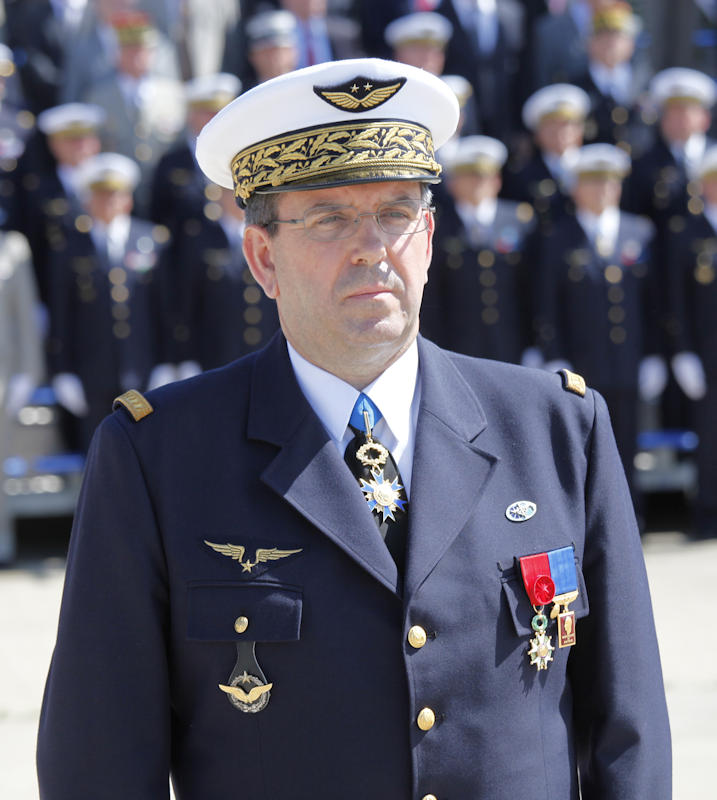
Major General Philippe Carpentier, French Air & Space Force (2S), first commander of the Multimodal Transport Center
Let me start by saying that Jérôme Denariez knows remarkably well the full range of actors involved in this fight against wildfires, and that he lays out, with great discernment, the interactions between them — not always simple ones — as well as the paths toward progress. His conclusion is very much on point: bring operational coherence to the system and integrate its various components under a single authority able to make the necessary trade-offs on a permanent basis.
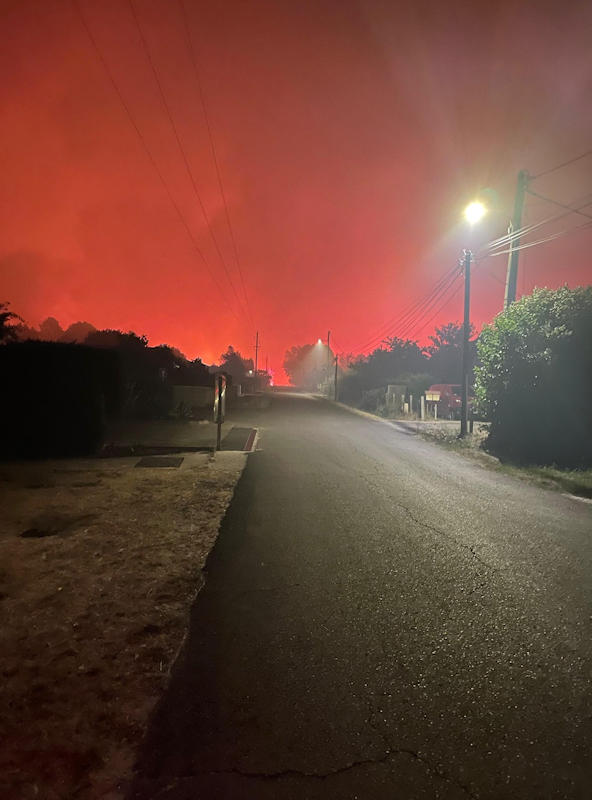
I live in Biscarrosse, which has just been cruelly struck by these devastating fires. Around 200 homes and businesses were destroyed. For many years, we felt great empathy for our unfortunate fellow citizens in the Southeast and in Corsica, struck every summer. In 2022, the danger came close to our doorstep without touching us. This year, we were hit head-on by these fires, as were many other places across our beautiful country. Moving from watching it on television to living the reality is a fairly violent shock.
The villages in the Landes and in western Gironde are “embedded” within maritime pine forests, and fires spread very quickly there toward the surrounding areas. The fire started on Thursday, July 23, around 4:00 p.m., north of Biscarrosse; it went around the town to the east, beginning its cycle of destruction, and in six and a half hours covered the 8 kilometers to my neighborhood, to the south. I followed its progress closely and prepared for evacuation.
When a wall of black smoke, behind which one could make out a glowing front of flames rising above the pines, arrived within 200 meters of us, the gendarmes didn’t need to convince us to leave. As I closed my front door, I realized, like many of my neighbors, that there was little chance I would see it intact again.
Hundreds of us residents of Biscarrosse evacuated toward Biscarrosse-Plage. We found a stretch of sidewalk along a street to park and sleep in the car. Every 30 minutes, I anxiously checked the surveillance cameras around my house. The images were frightening, extremely bright, proof that the fire was raging all around, with dozens of embers swirling everywhere and falling onto the house, the lawn, and the hedges.
By early morning, there were far fewer embers in the air. I began to believe the firefighters had saved our homes.
These soldiers of the flames show tremendous professionalism and a strong sense of duty. I can easily picture them, as some have described to me, standing with their hose at the foot of a wall of flames more than 25 meters high, giving off thick, toxic black smoke. It takes great courage to confront and attack a fire in order to protect people’s property. France has admirable firefighters and Canadair crews. The State owes them improvements — in organization, in resources (aerial, ground, personal protective equipment, departmental funding), in coherence, and in integrated command — to optimize their action and minimize the risks they face.
If there were a single commander over the whole of firefighting functions — the same person outside the fire season as during the fires — that person would be constantly arbitrating between contradictory instructions coming from several ministries. And if that commander makes trade-offs without fully measuring all their collateral effects, they will bear the consequences of them during a crisis.
I cannot imagine that a senior fire service official, at the level of general or colonel, who has lived through the painful experience of these fires, could endorse “saving biodiversity” by effectively banning (through a strong recommendation paired with a discouraging administrative process) spring brush-clearing in certain areas — an order that directly contradicts their own mission of saving people and property first.
Of course, they are not the only ones responsible. Forest owners, and private individuals with regard to their own homes, are not all conscientious either, and some maintain their wooded areas poorly.
Although it is difficult to quantify, this rule has led to the destruction of homes, by making the firefighters’ task harder — particularly their ability to move along forest tracks. Likewise, the administrative difficulties involved in properly creating, for prevention purposes, wide firebreaks at strategic locations that would slow the spread of fires are a real handicap for firefighters. In the end, these firebreaks get built in an emergency, using whatever military engineering equipment happens to be available for civilian use.
In the name of accountability, it would only be fair for these ministerial officials to hold a public meeting in Biscarrosse and in Le Porge, to explain to all these people — morally devastated by the loss of their homes — the reasoning behind their “environmental” choices, choices that put French citizens’ property at risk. And as the son of a farmer, I remain deeply committed to a reasoned, sensible environmentalism — one capable of leaving future generations a livable planet, while also feeding the French people.
It will be worth following the consultations now beginning between the firefighters and the Minister of the Interior.
Cuando la crisis decide en nuestro lugar : En resumen
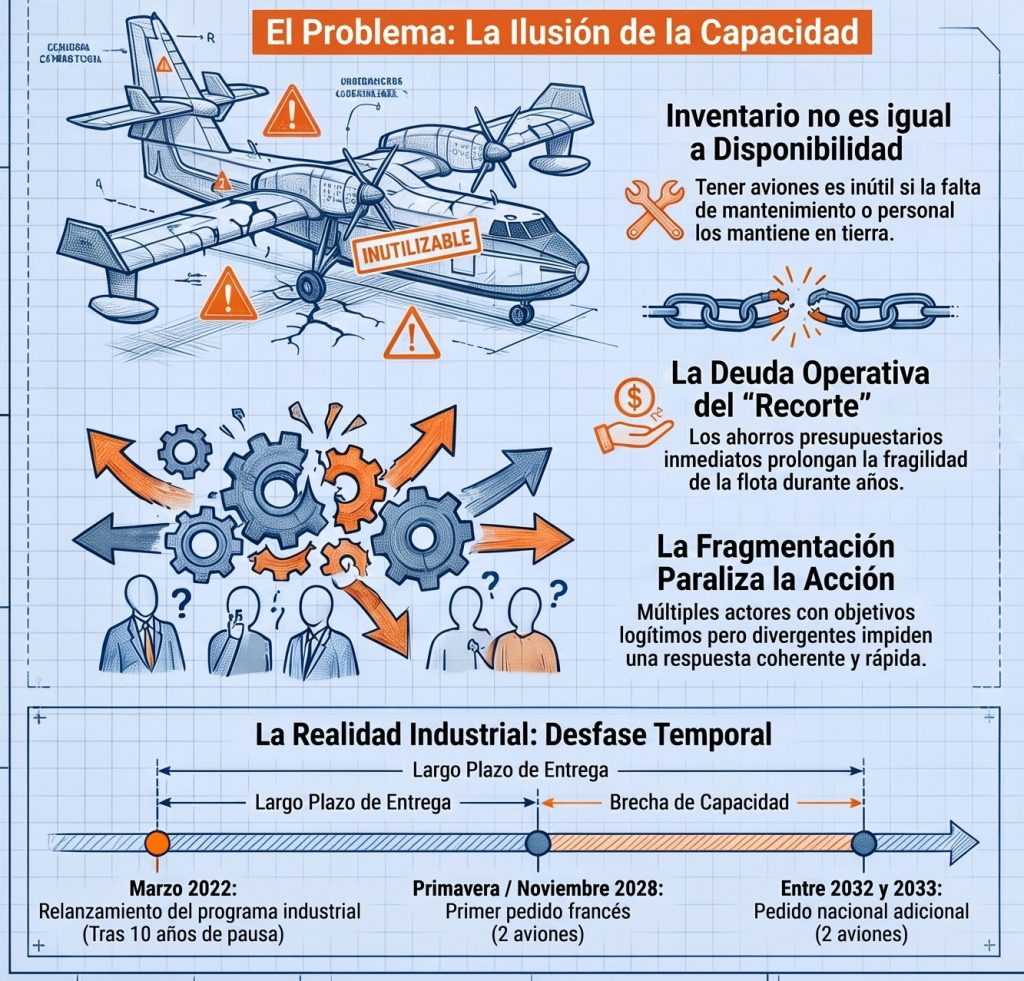
Los incendios del verano de 2026 no revelaron una verdadera escasez de medios en Francia, sino un vacío de gobernanza en la disponibilidad de las capacidades existentes. Los nuevos Canadair DHC-515 prometidos tras los incendios de 2022 no podían llegar antes de 2028-2033 en ningún caso: el verdadero problema no fue el retraso industrial, previsible, sino la ausencia de un dispositivo coherente para atravesarlo.
El artículo de Jérôme Denariez muestra cómo el recorte presupuestario de 2024, la crisis de mantenimiento de los Canadair en el verano de 2024, y el retraso en el despliegue del kit antiincendios del A400M —listo desde 2025 pero autorizado solo en julio de 2026— comparten la misma estructura: una capacidad poco utilizada se considera costosa, se degrada, y la siguiente crisis revela su indisponibilidad. El mismo patrón se repite con las mascarillas sanitarias de 2020 y con la producción de pólvora de Eurenco.
La propuesta central es la de una “quinta i”: tras inexistentes, insuficientes, inadecuados e indisponibles, falta la integración — una función permanente capaz de conectar medios aéreos, terrestres, mantenimiento y mando bajo una única autoridad de arbitraje.
Este desafío no se detiene en las fronteras francesas. Cada año, Grecia, España, Italia y Francia enfrentan situaciones dramáticas comparables. La Unión Europea ya dispone de una respuesta de este tipo con el mecanismo rescEU, que preposiciona una flota común en seis países mediterráneos — entre ellos España, que también ha reforzado su dispositivo con el kit A400M junto a sus aviones anfibios. Pero esta puesta en común reproduce, a escala continental, exactamente el mismo sesgo: se suman medios sin designar necesariamente quién, en Bruselas o en otro lugar, debe arbitrar entre las solicitudes simultáneas de varios Estados miembros en crisis al mismo tiempo — algo que ahora ocurre casi cada verano.
La “quinta i” también vale para Europa: sin una función permanente de coherencia operativa capaz de establecer prioridades entre Grecia, España, Italia y Francia cuando los incendios golpean simultáneamente, rescEU seguirá siendo una reserva, no un sistema.