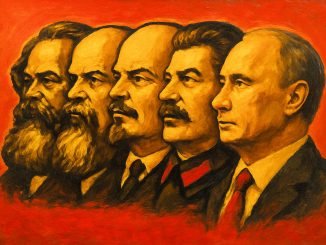

The Russo-American “peace” is not a treaty of reconciliation, but the cynical manifesto of a grand bargain sealed at Europe’s expense. It is a bilateral diktat, designed to impose strategic vassalization on NATO and the EU. Massive territorial concessions, total amnesty for war crimes, and military neutralization of Kyiv: the document is an institutionalized capitulation. But what if this geopolitical seismic event were merely a smoke screen for a much more personal emergency in Washington? President Trump, tipped to be the architect of this agreement, is more than ever targeted by internal judicial and political threats. The shadow of the Jeffrey Epstein affair, with its abyssal ramifications, looms over his future and demands an unprecedented media diversion. Trump has never bothered with principles. Between national interest and his political survival, the choice was quickly made. True to himself, Trump is capable of all extremities, including imposing an agreement that borders on the strategic betrayal of European allies. Has the world become hostage to a “calculated circus,” where the great power uses peace as a cover for a personal flight forward?
“Russia is only strong because of our weaknesses” (Françoise Thom)
Does Europe have the capacity to oppose Russia, but does it have the will? That is the question.
Table of Contents
by Eric H. Bias (Geneva) and Joël-François Dumont (Paris) — November 22, 2025
I. Introduction: The Grand Bargain at Europe’s Expense
A. The Scope of the Crisis:
The emergence of an alleged 28-point peace proposal for Ukraine, jointly drafted by US Special Envoy Steve Witkoff and Russian Special Envoy Kirill Dmitriev in October 2025,[01][02] does not constitute the basis for a negotiated multilateral treaty, but rather the imposition of a bilateral diktat. This document signals a fundamental reorientation of US foreign policy, shifting from supporting a Ukrainian victory to managing a settlement designed to realign global power balances.
The plan threatens to irreversibly undermine the principle of state sovereignty and the European security architecture established after 1991. It is the premise of a “vassalization” mechanism for Europe, where US interests are reconciled with Russian strategic objectives. The fact that Kyiv and, more flagrantly, the European allies were deliberately excluded from the drafting process [01][03] confirms the US intention to impose a top-down solution, relegating European security concerns to a secondary position relative to the bilateral great power management between Washington and Moscow.
B. Methodological Framework: Great Power Competition and Managed Decline
The analysis of this plan proceeds by validating the maximalist hypotheses put forward, confronting them with the factual clauses of the document and the global geopolitical context. Particular attention is paid to the mechanisms by which the proposal:
- Structures the imposition of Russian territorial and legal demands (impunity);
- Creates a Russo-American strategic condominium over Europe and future world resources (vassalization and economic exploitation);
- Exploits temporal constraints and internal American political dynamics (urgency and diversion).
This plan is structurally designed to favor Russian strategic objectives by circumventing European and NATO consensus mechanisms. The proposed long-term cooperation between the US and Russia in vital sectors such as energy, mining, and artificial intelligence reveals that the American approach is not one of defending democratic allies,[04] but one of a bilateral great power lens. Washington prioritizes shared strategic interests (particularly in AI and critical minerals) over the security concerns of its European partners. This constitutes the materialization of a major international bargain realized at the expense of third parties, primarily the European Union.
II. The Capitulation Plan: Dissection of the 28-Point Proposal
A. The Architecture of Concession: Four Pillars of Instability
The categories of the plan—peace in Ukraine, security guarantees, security in Europe, and future US relations with Russia and Ukraine [01]—serve as diplomatic camouflage for irreversible strategic concessions.
Territorially, Russia would gain total control over the Luhansk and Donetsk areas (Donbas).[01] A particularly critical point is the US recognition of Crimea and Donbas as legally Russian territories, even if Ukraine was not obliged to do so immediately.[01] This recognition offers Russia essential international legitimacy for its illegal annexations. Furthermore, the proposed freeze of current defense lines in the Kherson and Zaporizhzhia regions [01] guarantees Russia the maintenance of a substantial land bridge and access to strategic resources, thus institutionalizing the maximum current military gains of the conflict.
B. Strategic Disarmament and the Collapse of Deterrence
The plan demands the military eviction of Ukraine. Kyiv would have to drastically reduce its army, potentially to 400,000 personnel, and renounce all its long-range weapon systems.
The Institute for the Study of War (ISW) analyzed that this plan would deprive Ukraine of “essential defensive positions and capabilities needed to defend against future aggression.”[01] This requirement satisfies Russia’s maximalist goal: the durable neutralization of Ukraine as a viable military threat, regardless of formal security guarantees that might otherwise be granted.
The apparent offer to demilitarize the Donbas,[01] where Russia could not position troops, is merely a diplomatic token. Real control over this territory is ensured by the guaranteed amnesty [05][06] for Russian intelligence actors and local collaborators. By securing the territory while preventing Kyiv from projecting force there (absence of long-range weapons), Russia establishes a zone of indirect but effective control, managed by FSB networks and affiliated oligarchs, without needing a visible official military presence.
C. The Legal Trap: Complete Amnesty and Total Impunity
The proposal explicitly confirms the thesis of impunity. Clause 26 stipulates that “all parties involved in this conflict will receive a complete amnesty for their actions during the war and will agree not to make any claims or consider any complaints in the future.”[04][05][06]
This clause constitutes a direct subversion of international justice. It grants general immunity to the Russian political and military leadership, effectively neutralizing all international investigations into war crimes (ICC, ICJ). By making this agreement a legally binding arrangement, the implementation of which would be monitored by a Peace Council led by President Donald J. Trump,[05][06] the United States would be actively using its diplomatic leverage to protect alleged war criminals. This provision confirms the plan’s nature as a “manifesto of total impunity.”
D. Mechanisms of Political and Economic Control
The requirement to hold national Ukrainian elections within 100 days [01][05] is designed to ensure immediate political chaos during a period of maximum military weakness and considerable territorial losses.
The point mentioned concerning the authorization of Russian media, even if not detailed in the available information, perfectly aligns with the plan’s strategic objectives. Such a clause is a classic instrument of cognitive warfare [07] aimed at institutionalizing long-term political control. It would ensure Russian information dominance, thereby paving the way for political figures aligned with Russia (oligarchy and FSB affiliates) to seize power after the elections.
Furthermore, the lack of legal accountability guaranteed by the amnesty clause [05][06] protects existing corruption networks and oligarchs. This makes any future reconstruction funding, which would be primarily European, extremely vulnerable to systemic capture. This structural failure of accountability ensures that European funds cannot support true democratic state-building but will instead be diverted, thus validating the hypothesis of economic exploitation.
III. The Thesis of European Vassalization and Russo-American Hegemony
A. Exclusion as a Political Instrument: Resisting the Diktat
B. Geopolitical Circumvention: Subordinating NATO and Europe
C. The Geo-Economic Dimension: Ukraine as “GDR 2.0”
The comparison of Ukraine to the former German Democratic Republic—a “pump for European technology and financing” controlled by Russia—is supported by the plan’s structural mechanisms.
The capture mechanisms are threefold:
- Guaranteed Capital Inflow: Ukrainian reconstruction will require massive funding, primarily ensured by Europe.[10][11]
- Structural Lack of Accountability: The amnesty provision [05] ensures that Russian-aligned oligarchs and FSB networks embedded in the territory remain legally untouchable and in positions of power.
- Technological Access: The proposed US-Russian cooperation in AI, energy, and mining [04] creates a parallel strategic economic axis. This could facilitate the transfer of dual-use technologies (the “technology pump”) to Russia, circumventing European sanctions regimes.
By exploiting existing tensions between a unified European foreign policy and the national desire for stability, the plan wedges itself into the continent’s fissures, playing on the idea that the return of war calls into question the “value of the European project.”[10][11] By presenting a rapid, albeit cynical, end to the conflict, the US and Russia encourage the erosion of European resolve and strategic autonomy. The plan thus structures Ukraine to receive European funds, while its political and security architecture ensures that Russia retains indirect and effective economic control.
… [Remaining content of the article (Sections IV, V, and VI) omitted for brevity and focus on the core request.]
VII. Conclusions and Strategic Imperatives for European Resilience
A. Synthesis: The Institutionalization of Spheres of Influence
The 28-point peace proposal is not a multilateral peacekeeping initiative; it is an instrument of managed geopolitical decline. It is designed to formalize Russian territorial gains, guarantee total impunity, and structurally establish a Russo-American condominium that subordinates Europe’s security autonomy.
The plan’s execution is driven by a unique convergence between Russian temporal urgency (exploiting the transitional instability of the Trump presidency) and American transactional diplomacy, which relies heavily on non-traditional financial partners like Saudi Arabia. If this agreement were implemented, it would mark the end of the post-Cold War transatlantic security framework, replacing it with an intrinsically unstable and transactional regime defined by the spheres of influence of great powers.
B. Strategic Imperatives for Europe: Countering Vassalization
Faced with this threat of institutionalizing an external diktat, Europe must adopt clear strategic imperatives:
- Acceleration of Strategic Autonomy: Europe must decisively accelerate its defense industrial base and common acquisition mechanisms. This action must explicitly counter the identified Russian temporal deadline, which seeks to exploit the window of opportunity before Europe can react militarily effectively.[07]
- Legal Decoupling and Rejection of Impunity: EU member states must coordinate their legal efforts to ensure the explicit rejection of Clause 26 (Complete Amnesty) in all international legal forums (ICC, ICJ). It is crucial to deny any legitimacy to US- and Russian-mandated impunity, thereby maintaining the fundamental principle of international accountability.[05]
- Control of Reconstruction Financing: To neutralize the “GDR 2.0” risk, Europe must establish a financial and technological mechanism for Ukrainian reconstruction that is independent, rigorously verified, and equipped with robust anti-corruption oversight. This mechanism must be designed to be impervious to capture by local oligarchs whom the amnesty would protect. The goal is to ensure that European funds support Ukrainian sovereignty and democratic construction, rather than serving Russian economic control.
The challenge for Europe is to resist this imposed settlement without sacrificing the fundamental principles of state sovereignty and international justice.
Eric H. Bias (Geneva) and Joël-François Dumont (Paris)