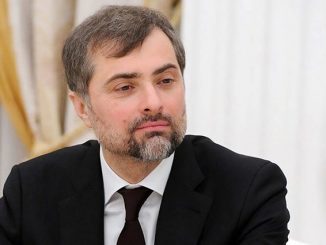

The ghosts of Sedan and 1940 are screaming a lesson that Europe refuses to hear: denial of reality always signs our death warrants. Facing Moscow, we are sleepwalking into the abyss.
Following General Thierry Burkart, General Fabien Mandon has dared to sound the alarm, shattering this suicidal silence and laying down the ultimatum for our survival: we must rearm morally, even if it means “accepting the loss of our children.”
Standing against this martial lucidity is a coalition of shame: political second-stringers hungry for buzz and the Kremlin’s useful idiots, united in an indecent concert. These gravediggers are disarming our minds and betraying the future. The alternative is brutal: look the threat in the face or perish, drowned in the blood of our own cowardice.
A Strategic Analysis of the Cycles of European Blindness (1806-2025)
Table of Contents
By Joël-François Dumont — Paris, November 24, 2025
Introduction: The Truth as a Weapon of Deterrence
The analysis of historical cycles, from the humiliation of Auerstedt to the debacle of 1940, demonstrates an iron law: the refusal to listen to the sentinels (Stoffel, Pellé, de Gaulle) leads inevitably to disaster.
Today, General Mandon’s warning about the need for moral rearmament is neither a provocation nor an isolated case, but aligns strictly with the analyses of his European counterparts, from Swedish General Micael Bydén to the Baltic and German intelligence chiefs. In most European countries, the highest defense officials have made very similar remarks, calling for mental preparation in the face of imminent peril. This strategic lucidity has ultimately shocked only the pro-Russian or complacent voices found at the extremes of the European political spectrum, who prefer the comfort of denial to the harshness of survival.
The survival of nations rests not merely on the thickness of their walls or the sophistication of their arsenals, but more fundamentally on their collective capacity to stare reality in the face. European military and political history, from the dawn of the 19th century to the fever-pitch geopolitical tensions of 2025, offers a tragic case study in the exorbitant cost of denial.
The question at hand—“Must we speak the truth, even if it offends, or must we keep saying what some only want to hear?”—is not an abstract philosophical query. It is the Gordian knot of state survival.
At regular intervals, Western democracies find themselves confronting revisionist or imperial powers that broadcast their intentions loud and clear. Every single time, a deadly dialectic takes hold. On one side, the sentinels—intelligence officers, military attachés, chiefs of staff—decode the weak and strong signals of the threat. On the other, a political apparatus and public opinion prefer the comfort of illusion to the harshness of lucidity.
Let’s examine this recurring pathology through four historical tipping points: the Prussian humiliation of 1806 that festered into the revenge of 1870; the doctrinal blindness preceding 1914; the “Strange Defeat” of 1940, paved by a decade of surrender; and finally, the critical situation of 2024-2025 in the face of the Russian threat.
From the ignored warnings of Colonel Stoffel and Colonel de Gaulle to the contemporary alarms sounded by General Fabien Mandon, we must determine if the “stupidity, cowardice, or treason” so rarely denounced are historical fatalities or avoidable moral bankruptcies. The legacy of General François Mermet and the Oath of Bon-Encontre will serve as a red thread, proving that even in the heart of the debacle, there is a path to resilience founded on the brutal acceptance of the real.
I. The Matrix of Hate: From the Catastrophe of Auerstedt to the Revenge of Sedan (1806-1870)
1.1 The Genesis of Resentment: 1806 and the Humiliation of Prussia
To grasp the dynamic that crushed Europe for a century and a half, we must return to the source of the German trauma. While Austerlitz (1805) consecrated Napoleonic genius, it was the campaign of 1806 that sealed the fate of Franco-German relations. Napoleon, in his hegemonic drive to redraw the continent’s map, did not just defeat Prussia militarily; he sought to annihilate it politically and morally.
The twin battles of Jena and Auerstedt on October 14, 1806, were a seismic event. While Jena remains in French memory, it was at Auerstedt that the Prussian humiliation was total. There, Marshal Davout, with a single army corps (the III Corps), routed the main Prussian army commanded by the Duke of Brunswick, despite being vastly outnumbered. A tactical miracle for the French; proof of degeneration for the Prussians.[01]
The aftermath was managed with a diplomatic brutality that would feed German nationalism for decades. Napoleon carved up German territories to create client states, reducing Prussia to a second-rate power.[01] The peace treaty was draconian, imposing humiliating military occupation and crushing war indemnities.
It was in this crucible of absolute defeat that the desire for revenge was born. Prussian reformers like Scharnhorst, Gneisenau, and Clausewitz analyzed the defeat not as an accident, but as a systemic failure against the French “nation in arms.” They swore to rebuild an army and a state capable of striking back, blow for blow. As historians note, German national sentiment crystallized around this hatred of the French occupiers and the burning memory of Auerstedt.[01]
1.2 The Mechanics of Revenge: The Bismarckian Strategy
Sixty years later, this resentment had lost none of its virulence; it had been institutionalized. Otto von Bismarck, the “Iron Chancellor,” channeled this historical energy to realize German unity. His sentence, uttered on the evening of the Battle of Sedan, rings out like a historical verdict: “Sedan happened because Auerstedt happened.”[02]
This cyclic vision of history would not stop there. In 1940, Adolf Hitler insisted on passing specifically through Sedan to repeat this very phrase, inscribing the Nazi invasion into the direct continuity of this historical vendetta.[02]
By 1870, the Prussian machine had nothing in common with the army of 1806. It was an industrial juggernaut, backed by a dense railway network and modern Krupp artillery. Facing this rising power, Imperial France locked itself in guilty lethargy, convinced of its natural superiority inherited from the Grande Armée.
1.3 The Ignored Cassandras of the Second Empire: The Case of Colonel Stoffel
The collapse of 1870 is all the more tragic because it was predicted with mathematical precision. Military archives are full of reports that could have changed the course of history.
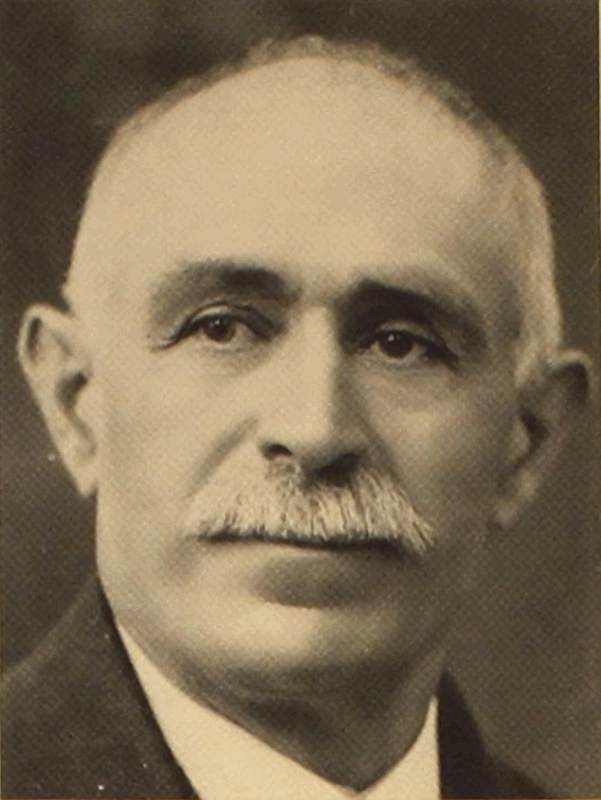
The central figure of this unfortunate clairvoyance is Baron Eugène Stoffel, military attaché in Berlin from 1866 to 1870.
Stoffel was not just an observer; he was a high-level analyst who understood that modern war relied on organization, logistics, and technology. His warnings were explicit:
His reports to the War Department and Emperor Napoleon III are a model of military intelligence.[03]
Eugène Stoffel (1821-1907) was an aide-de-camp to Napoleon III and attached to the embassy in Berlin before the Franco-Prussian War broke out. Upon his return to France, he stood by the emperor during the defeat at Sedan, then took charge of heavy artillery during the siege of Paris in 1870.
| Alert Domain | Content of the Stoffel Report (1866-1870) | French Reaction / Consequence |
| Mobilization Capacity | Prussia can mobilize quickly thanks to its territorial organization and railways. It can field 600,000 trained men. | Disbelief. Marshal Le Bœuf claims: “We are ready, not a gaiter button is missing.” |
| Artillery | Overwhelming superiority of Prussian cannons (steel, breech-loading) over French bronze pieces. | Disdain for Prussian technology (“steel breaks”). |
| State of Mind | Prussia is a nation united by the desire for war and hatred of France. It “simply proposes to invade our territory.” | Stoffel is treated as a “bird of ill omen” and a “Prussophile.” Peace is preferred. |
| Command | The Prussian General Staff is an intellectual elite trained for maneuver warfare. | Blind confidence in “French genius” and improvisation (the “system D”). |
Stoffel’s warnings were met with a wall of complacency and short-term political calculations. The legislature, concerned with budgetary savings and social appeasement, refused to consider the necessary reforms (such as expanded compulsory military service). General Palikao, Minister of War, noted his disagreement in the margins of Stoffel’s reports, preferring his own illusions to the reality on the ground.[03]
The result of this deafness was catastrophic. When war broke out, France was overwhelmed exactly as Stoffel had predicted. The capitulation at Sedan was no accident; it was the logical conclusion of years of denial.
II. The Great Illusion and the Strategic Surprise of 1914
2.1 Forgetting Lessons and the Dogma of the Offensive
After 1870, France rebuilt itself around the idea of “Revanche.” Yet, this obsession did not guarantee lucidity. Approaching 1914, the French General Staff developed a new blindness: the cult of the offensive à outrance. Convinced that “guts” (willpower) could overcome firepower, they neglected defense and logistics in modern warfare.
At the same time, a major strategic error was made regarding the German ’s Schlieffen Plan. This plan was designed to bypass the fortresses of the East with a massive invasion through neutral Belgium, relied on the use of reservists on the front line to widen the front. The French general staff considered this maneuver “impossible” due to a lack of sufficient manpower, refusing to believe that Germany would dare to dilute its active troops with reservists at the start of operations.
2.2 The Prophetic Report of Colonel Pellé (1913)
Once again, the truth was sitting on the decision-makers’ desks. Colonel Pellé, military attaché in Berlin, had succeeded Stoffel in the thankless role of Cassandra. His reports, corroborated by other sources of intelligence, provided an accurate picture of German intentions.[04]
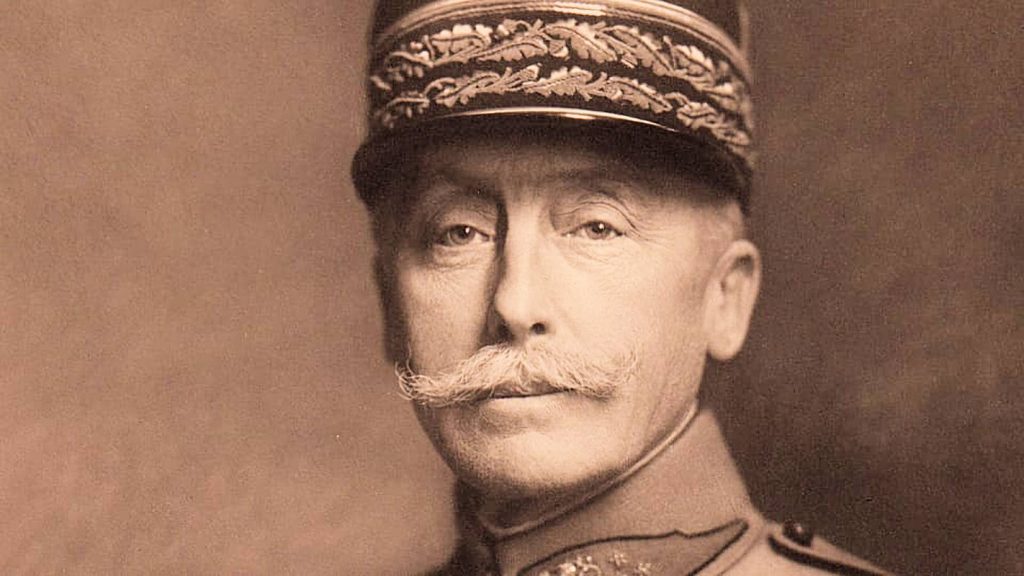
In a report dated 1913, Pellé detailed German preparations at the Belgian border. He flagged the construction of military camps (such as Elsenborn), oversized rail platforms, and tracks that could only be explained by a will to project massive troop formations westward, through Belgium.[04] More critically, he warned of the organic integration of German reserves: Germany would make no operational distinction between its active corps and its reserve corps, instantly doubling its initial strike force.[04]
Pellé also described the psychological state of Germany, a nation convinced of its encirclement and ready for a violent preventive war. He noted the German officers’ contempt for the French army, which they deemed undisciplined and eroded by politics.[04]
These reports were read by General Joffre and the Deuxième Bureau, but their conclusions were discarded because they clashed with Plan XVII, which called for a frontal attack in Lorraine. Admitting Pellé was right would have forced a total strategic rethink and stripped the planned offensive to protect the Belgian border. They chose to ignore the warning.
The consequence was the strategic surprise of August 1914. German armies surged through Belgium with unsuspected magnitude, narrowly missing Paris. It took the carnage of the Battle of the Frontiers and the miraculous recovery of the Marne to avoid total defeat. Once again, the price of denial was tallied in hundreds of thousands of lives.
III. The Strange Defeat, the Ignored Prophet, and the Honor of Resistance (1930-1940)
3.1 The Decade of Voluntary Blindness
The 1930s were the golden age of denial. While Hitler rearmed Germany at breakneck speed, France hid behind the Maginot Line and a pacifism born of exhaustion.
“The interwar period undoubtedly represents the pinnacle of strategic aberration. Never had an adversary’s intentions been laid out so clearly as in Mein Kampf, and never had democracies worked so hard not to see them.
As early as 1933, French intelligence services (the SR and the Deuxième Bureau), along with military attachés like General Renondeau in Berlin, provided a steady stream of intelligence on Nazi Germany’s clandestine, and later open, rearmament. They documented the creation of armored divisions (Panzers), the rebirth of the Luftwaffe, and the remilitarization of the Rhineland in 1936.
However, the political leadership, traumatized by the bloodletting of 1914-1918 and paralyzed by a pacifist public opinion, chose the path of appeasement. In 1939, Senator Marcel Pellenc drafted a damning report on the state of the French Air Force vis-à-vis the Luftwaffe, highlighting a critical industrial and technological deficit.[05] Instead of triggering a salutary wake-up call, this report was buried. The watchword was “not to drive Billancourt to despair” and to avoid panicking the population. They preferred to lie about aircraft production figures rather than admit the country’s vulnerability
3.2 The Solitude of Colonel de Gaulle
It was in this petrified intellectual landscape that Lieutenant-Colonel Charles de Gaulle attempted, alone against the brass, to shatter the wall of conformity. By publishing Vers l’Armée de Métier in 1934, he proposed not merely a technical reform, but a doctrinal revolution based on the trinity of Speed, Power, and Surprise. He announced that the Maginot Line would not suffice and that the internal combustion engine had upended the art of war just as gunpowder had in its time.[06]
The military institution’s reaction was not debate, but excommunication. General Louis Maurin, Minister of War and guardian of the defensive temple, publicly called out de Gaulle with a violence that testifies to the closed-mindedness of the era: “Goodbye, de Gaulle! Where I am, there is no place for you!”[07]
In the privacy of his office, Maurin went further, threatening the insolent officer who dared to alert politicians: ‘He found a pen-holder: Pironneau, and a phonograph: Paul Reynaud. I’ll ship him off to Corsica!’[07] For the General Staff, the danger was not Hitler, but the man challenging the dogma of the front’s inviolability
3.3 The Final Warning: The Memorandum of January 1940
“The blindness persisted right up to the gates of disaster. On January 26, 1940, during the “Phoney War,” de Gaulle, then a colonel commanding the tanks of the 5th Army, drafted a final warning: the memorandum titled The Advent of Mechanical Force. In this prophetic text sent to 80 prominent figures, he described the exact scenario of the coming defeat four months in advance.
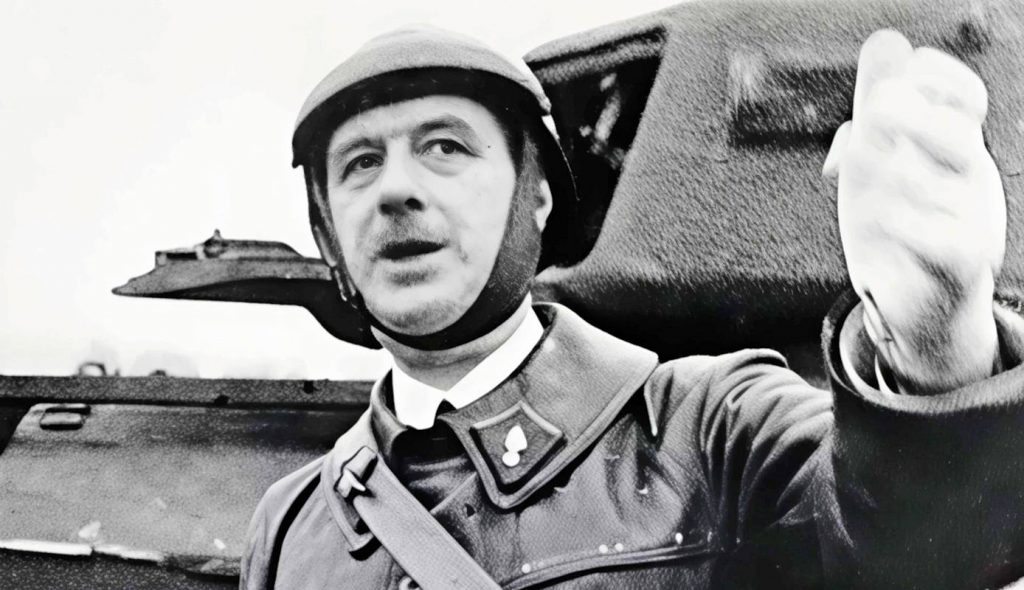
“The Maginot position, whatever reinforcements it may have received […], is liable to be breached. That is, in the long run, the fate reserved for all fortifications.”[08]
He warned that only a mechanical force could counter the German attack: “To break mechanical force, only mechanical force possesses certain effectiveness.”[08]
The High Command’s response was one of criminal nonchalance. General Georges, Gamelin’s deputy, annotated the document with a phrase that sums up the bankruptcy of an elite: “Interesting, but the reconstruction is not up to the level of the critique!”[09]
Four months later, the Panzers crossed the Meuse exactly as de Gaulle had predicted, and the French army collapsed, a victim of its refusal to listen to the truth.”
3.4 The Oath of Bon-Encontre: Light in the Debacle
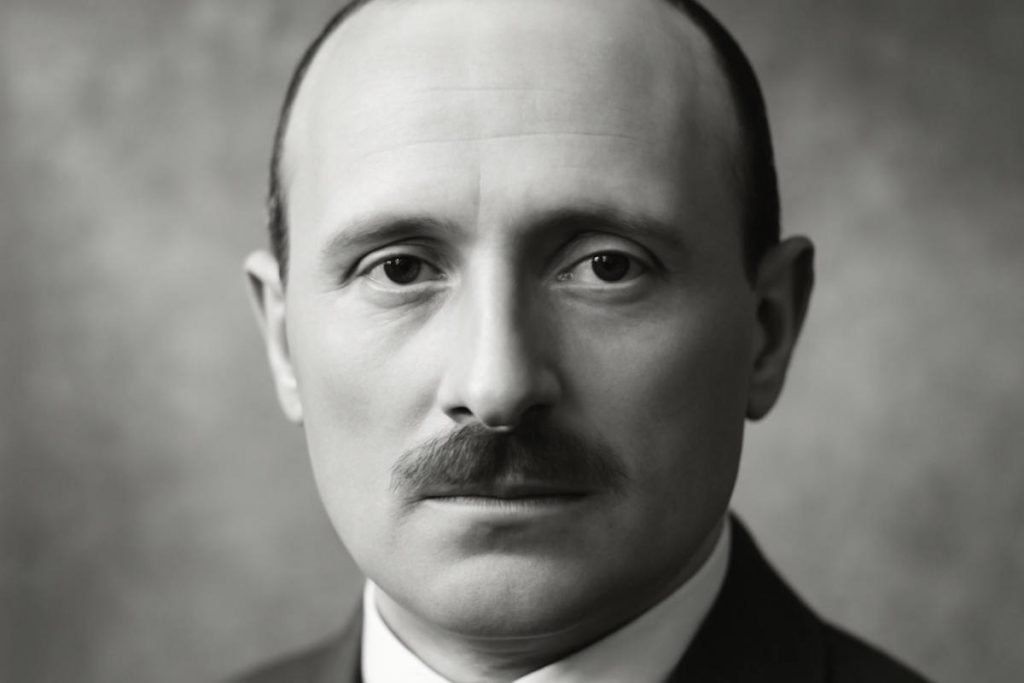
It is against this backdrop of moral and military disintegration that the episode of the Oath of Bon-Encontre takes on its full historical and symbolic weight. It embodies the refusal of denial at the very moment the State was collapsing.

On June 25, 1940, shortly after the armistice had been signed and France was officially defeated, the leaders of the French special services and a handful of intelligence officers refused to surrender (the SR Terre and the Counter-Espionage), headed by Colonel Louis Rivet and Captain Paul Paillole, retreated to Bon-Encontre, near Agen and swore to continue the fight in the shadows.[10] This oath gave birth to major clandestine networks.

In the courtyard of the requisitioned minor seminary, they committed an act of foundational disobedience.
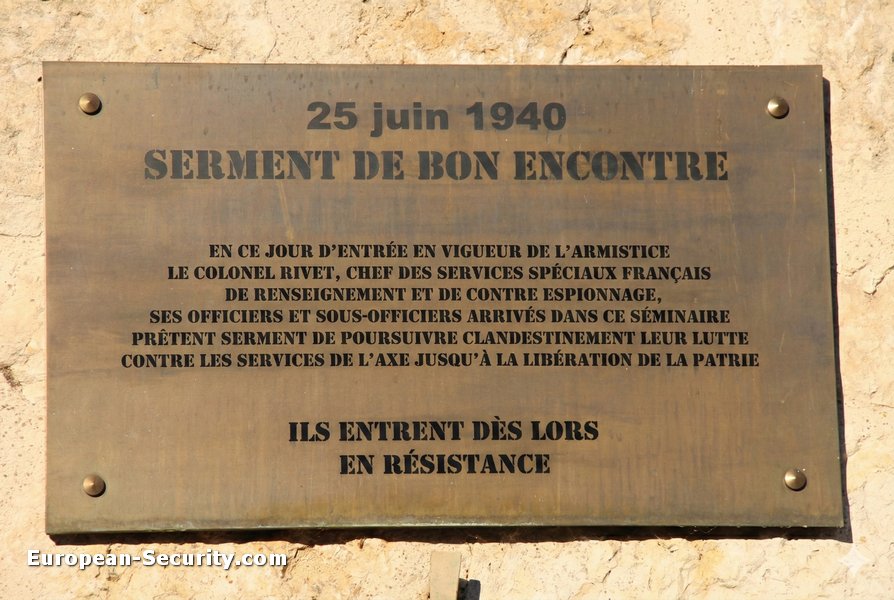
Unlike the Pétain government, which accepted defeat as history’s final verdict, these men knew—thanks to their intimate knowledge of the balance of power—that the war was not over. They knew that Britain would hold and that the resources of the colonial empires and the United States would eventually tip the scales.
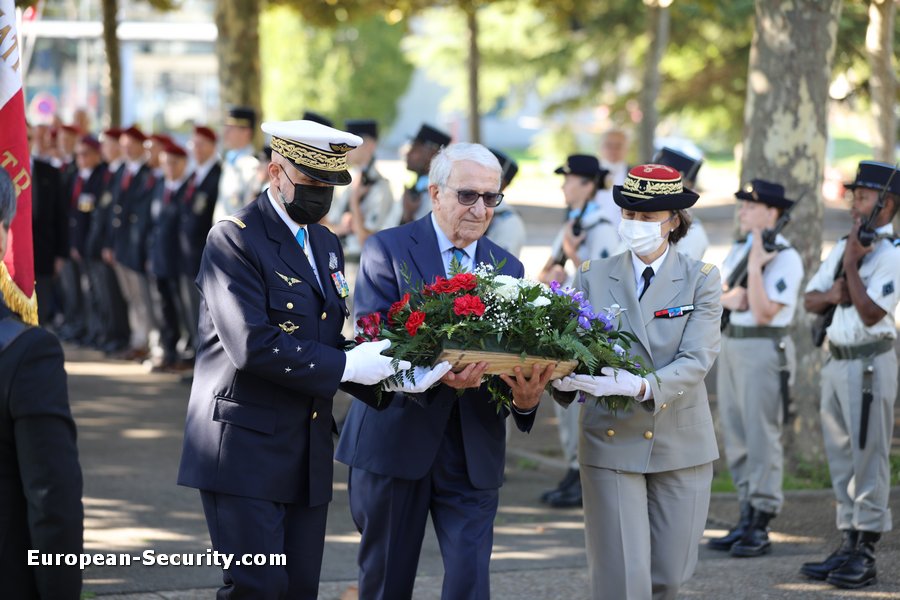
The Oath of Bon-Encontre was a solemn pledge to continue the fight from the shadows. Concretely, this meant:
- Never surrendering secret service archives to the enemy.
- Shielding personnel and agents from the clutches of the Gestapo.
- Continuing to provide intelligence to the Allies and preparing for retribution.
This oath did not remain a dead letter. It gave birth to major clandestine networks, such as the Travaux Ruraux (TR) network for counter-espionage. In this lineage stand the “Merlinettes”, young female transmission agents trained by the special services (nicknamed after Colonel Merlin).
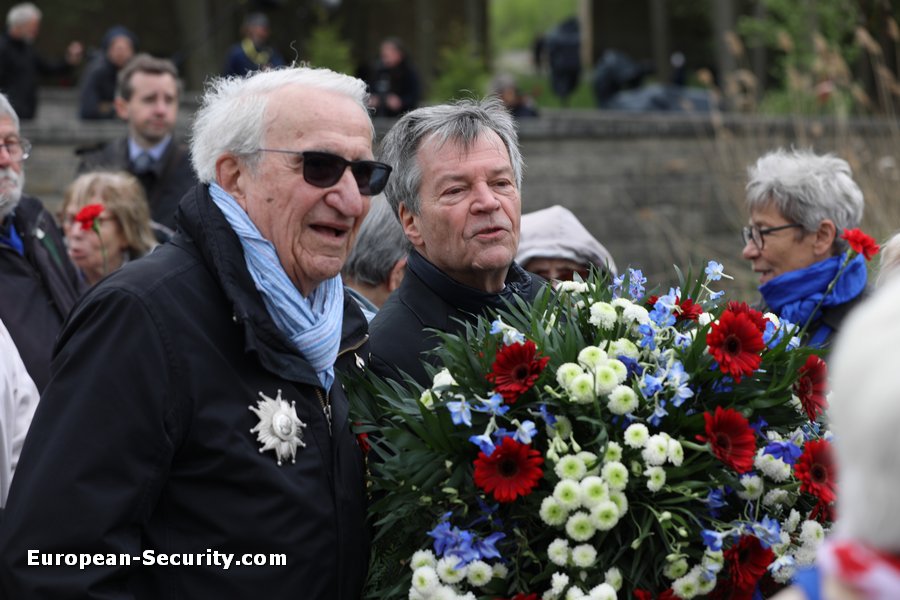
As recalled by Air Marshall François Mermet, president of the Association of Former Special Services (AASSDN), who fought for a belated but real tribute to the memory of these women, aged 20 to 25, parachuted into occupied territory to maintain vital radio links. Many were arrested, tortured, and deported to Ravensbrück. Their sacrifice, long forgotten, is today honored at the Eugénie-Malika Djendi Garden in Paris as well as at Ravensbrück.

Colonel Paillole liked to quote Bossuet to summarize this ethic:
“The greatest outrage one can do to Truth is to know it and at the same time abandon or weaken it.” Had France listened to its intelligence services and men like de Gaulle in the 1930s instead of rocking itself to sleep with illusions, it could have “prepared itself” and spared us the humiliation of 1940—yet another one.[10] The path of honor begins with the courage of truth.”
IV. History Stutters: The Russian Threat and European Denial (2024-2025)
4.1 Sweden, the New Cassandra of the North
Eighty years after WWII, Europe finds itself in a geopolitical configuration that eerily recalls the 1930s. A revisionist power, Russia, is challenging the continent’s security architecture. And once again, warning signs are accumulating, issued by nations that, due to their geography, are in the front line.
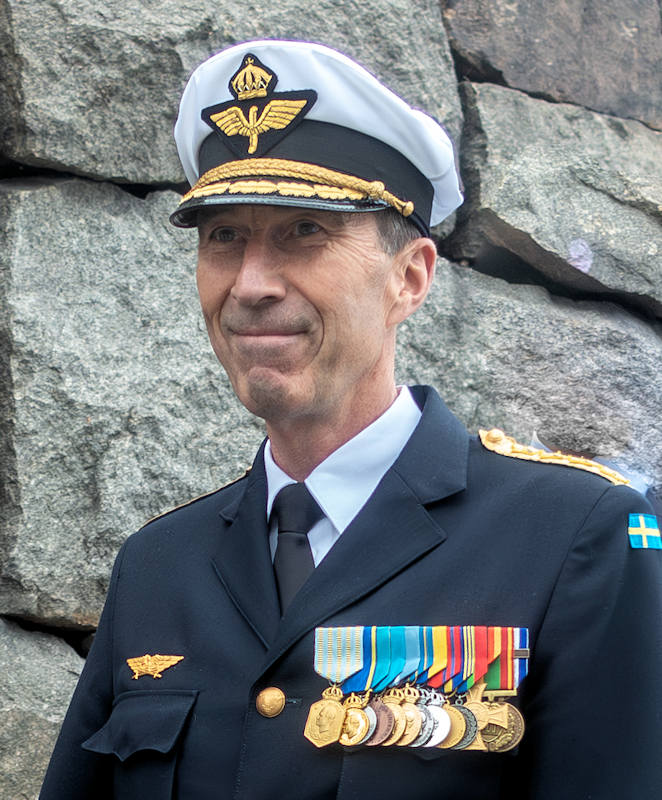
Sweden, breaking two centuries of neutrality, has taken the lead in this work of truth. The Swedish Commander in Chief, Air Chief Marshal Micael Bydén and the security services (Säpo) have issued repeated warnings throughout 2024 and 2025.and been unequivocal : Russia has “both eyes fixed on Gotland.”[11]
This strategic island is the keystone of Baltic defense; whoever controls it can block maritime access to the Baltic countries and threaten Finland.
Air marshall Micael Bydén, former Swedish Chief of Staff — Photo © Frankie Fouganthin
The Swedish warning goes beyond military geography. It documents a hybrid war already in motion:
- Religious Espionage: Swedish intelligence has revealed that the Russian Orthodox Church in Västerås was being used as an intelligence platform..[12] Its location is far from accidental: it sits in the immediate vicinity of a strategic airport, water treatment plants, and energy facilities. This is a glaring example of the use of civilian cover to prep for sabotage.
- The Shadow Fleet: The Swedish Navy is keeping a tight watch on a “shadow fleet” of Russian tankers in the Baltic Sea, suspected of doubling as floating listening stations and potential vectors for attacks against underwater infrastructure (cables, pipelines)..[13]
- The War Economy: Joint reports from Baltic and Nordic intelligence services underscore that Russia has shifted its economy onto a war footing. While an Estonian report initially estimated that this “war boom” would run out of steam by 2025, more recent analyses (Latvian and Swedish) suggest Moscow can sustain this effort until 2027 or beyond. This gives Russia a dangerous window of opportunity between 2026 and 2030 to test NATO.[14]
General Bydén shocked his fellow citizens by declaring: “Swedes must mentally prepare for war.”[11] This was not warmongering, but a call for civil resilience—indispensable in the face of total war.
Before him, the Inspector General of the Bundeswehr, General Carsten Breuer—along with his British, Dutch, and Belgian counterparts—had issued similar warnings. Most recently, the Polish Chief of the General Staff, General Wieslaw Kukula, declared on November 18, following the sabotage of a railway line, that his country had clearly entered a “pre-war” phase, as noted by Le Monde.[15]
4.2 General Mandon’s Warning: “Accept Losing Our Children”
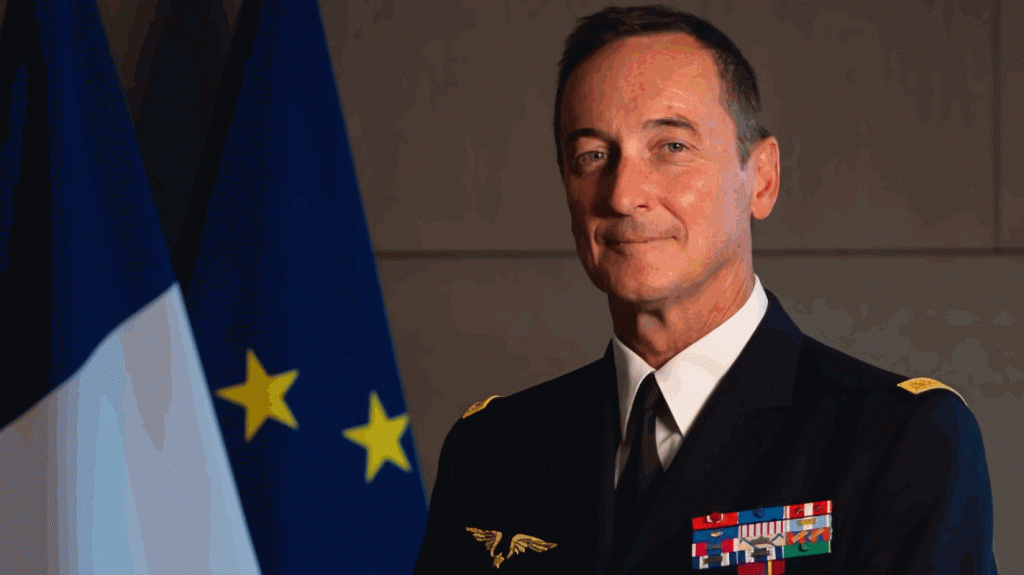
In France, the Chief of the Defense Staff (CEMA), Air Chief Marshal Fabien Mandon, relayed this anxiety with solemn gravity, just as his predecessor, General Thierry Burkhard, had done before him. Questioned before the defense committees of the National Assembly and the Senate on October 22 and November 5, he expressed his convictions—those of the military—which align with those of intelligence chiefs across Europe.
On November 18, before the Congress of Mayors, he tried to break the wall of indifference: “Russia cannot intimidate us if we are willing to defend ourselves..”[15]
The choice of the Congress of Mayors was not accidental. General Mandon knows that a nation’s resilience in the event of a major conflict relies on the local fabric, on the capacity of municipalities to cope with crises. His speech was intended as a shock to public opinion. He declared: “What we lack is the strength of soul to accept hurting ourselves to protect who we are… We must accept losing our children.”[16]
This terrible sentence must be understood in its strategic context. Nuclear and conventional deterrence only works if the adversary is persuaded that you are ready to go all the way. If a society signals that it will tolerate zero losses, that it prioritizes its immediate comfort over its future freedom, it becomes a tempting prey.
General Mandon warned that France has “three to four years” to prepare for a high-intensity shock.[16] He was not prophesying war; he was explaining the price of peace: the credibility of national determination. He was not prophesying war; he was explaining the price of peace: the credibility of national determination. He also noted: “Since this summer, the situation has gone from bad to worse.”[16]
V. The “Choir of Weepers” or the Treason of Modern Clerics
5.1 Anatomy of Political Cowardice
Faced with these warnings based on precise intelligence and profound historical analysis, the reaction of a part of the French political class tragically illustrates the permanence of the reflexes of 1870 and 1939. A “chorus of mourners,” in a mixture of feigned indignation and denial of reality.

General Mandon’s lucid warning triggered a shameful spectacle.
- Ideological Denial (Jean-Luc Mélenchon and LFI): The leader of La France Insoumise immediately reacted by denouncing a “warrior speech that no one decided on.”[17] He accused General Mandon of stepping out of his role, evoking “disorder in the State” and referencing de Gaulle’s Bayeux speech to criticize public expression by the military.[17] This posture stems from classic ideological blindness: refusing to see the external threat (Russian imperialism) to focus on an internal critique of institutions. It is a repetition of the French Communist Party’s error at the dawn of World War II, considering that the “capitalist” war did not concern the people—until enemy tanks were in Paris.
- Guilty Complacency (The National Rally): Sébastien Chenu and several RN executives questioned the CEMA’s “legitimacy” to “frighten the French people.”[17] This reaction is symptomatic of a persistent ambiguity regarding Putin’s Russia. By minimizing the threat and attacking the messenger, the RN adopts a posture reminiscent of the appeasers of the 1930s—those who thought they could get along with totalitarian regimes in the name of a misplaced nationalist realism.
- Moral Disconnection (Ségolène Royal and a certain Left): Ségolène Royal criticized the general’s remarks on social media, evoking a risk of “toxic masculinity” and undermining the nation’s morale.[17] Fabien Roussel (PCF) deemed the speech “unacceptable.”[17] These reactions testify to a profound misunderstanding of the tragic nature of history. They reflect a worldview where peace is a guaranteed natural state, and where the mention of sacrifice is an outdated male pathology. They forget, as Churchill reminded us, that the refusal to fight does not avoid war; it only makes it more disastrous.
- Denial is not the exclusive preserve of the Left. On the right side of the orchestra, the spectacle is just as pathetic, the cacophony just as distressing: Luc Ferry seems to have blown up his own “nonsense-o-meter”! A regular at soliloquies on TV channels like CNews or LCI, he has joined the clique of worldly “Putin-worshipping” ex-ministers, alongside Philippe de Villiers and Thierry Mariani. It feels like watching the casting call for a tragic remake of Francis Veber’s The Dinner Game (Le Dîner de cons), where blindness vies with smugness. By joining the choir of weepers, Ferry displays a culpable ignorance of History on the airwaves of both CNews and LCI..
5.2 “The Weight of Words, the Shock of Reality
Facing these salon-born princes, the figure of Jean-Marie Bockel stands as a living reproach. He is not playing at war: he lost a son in Mali for our freedoms. The contrast is all the more striking between the shameful frivolity of the former, who risk only their reputations on TV sets, and the tragic honor of a father who knows that the price of our security is not a metaphor, but a bloody reality.
5.3 Buzz vs. Survival
The contemporary tragedy lies in the primacy of media emotion over strategic reflection. The politicians howling at the scandal of General Mandon’s words are not protecting the population; they are morally disarming it. They cultivate a psychological vulnerability that Russian intelligence services know perfectly how to exploit.
This refusal to hear the truth is, in the very words of General Mermet, a form of treason. Treason against History, which has shown us where weakness leads. Treason against future generations, who risk paying the high price for our lack of foresight. Just as in 1939, we prefer not to ‘drive Billancourt to despair’ (or today, the consumer-voter), even if it means handing over a disarmed country to the coming shock
Conclusion: Truth as the Only Path of Honor
History is a ruthless judge that cares nothing for intentions, only results. The trajectory leading from Auerstedt to Sedan, from the Belle Époque to the trenches of 1914, and from the blindness of Munich to the debacle of 1940, proves an iron law: the denial of reality is always paid for in blood.
At every critical crossroads, men found the courage to speak the truth. Colonel Stoffel cried out in the wilderness against the rising Prussian power. Colonel Pellé described with precision the mechanics of the 1914 invasion. Colonel de Gaulle mapped out the German mechanical invasion, only to face the contempt of his superiors. And at Bon-Encontre, Colonel Rivet and Captain Paillole proved that honor lies in looking defeat in the eye in order to overcome it.
Today, Air Chief Marshals Bydén and Mandon, backed by European intelligence services, have taken up this thankless torch. They tell us that a geopolitical winter is coming, that Russia is preparing for a long confrontation, and that our societies must rearm morally. The “choir of weepers” attempting to drown out their voices with sterile polemics bears a heavy responsibility before History.
Annexes: Comparative Data of Strategic Alerts
| Era | Whistleblower | Content of the Alert (Inconvenient Truth) | Political / Media Reaction (Denial) | Historical Consequence |
| 1866-1870 | Colonel Stoffel | “Prussia will invade us with 600,000 men and superior cannons.” | “Bird of ill omen,” contempt for Prussian capabilities. | Defeat at Sedan, loss of Alsace-Lorraine, end of the Second Empire. |
| 1911-1913 | Colonel Pellé | “Germany will move through Belgium using its reserves on the front line.” | Refusal to change Plan XVII, disdain for German reserves. | Strategic surprise of August 1914, invasion, 4-year war. |
| 1934 | Colonel de Gaulle | “The engine is revolutionizing war. We need a professional mechanical army.” | General Maurin: “Goodbye, de Gaulle! Where I am, there is no place for you!” | Missed opportunity to modernize the military apparatus. |
| Jan. 1940 | Colonel de Gaulle | “The Maginot position will be breached. A mechanical counter-attack force is needed.” | General Georges: “Interesting, but the reconstruction is not up to the level of the critique.” | Debacle of May 1940, Occupation. |
| 1933-1939 | 2nd Bureau | “Hitler is preparing for total war. Our air force is obsolete (Pellenc Report).” | “Do not drive Billancourt to despair,” appeasement policy. | Defeat of 1940 (Resilience: Oath of Bon-Encontre). |
| 2024-2025 | Generals Burkart / Mandon / Bydén / Breuer | “Russia is targeting Gotland and Europe. We must accept losing our children.” | “Warrior speech” (LFI), “Toxic masculinity” (Royal), “Illegitimate” (RN). | Pending… Risk of major conflict 2027-2030. |
Annexes: Threat Indicators Table (2025)
| Indicator | Details of the Alert (Swedish and French Sources) |
| Hybrid Warfare | Use of the Västerås church (Sweden) for espionage near critical infrastructure. “Shadow fleet” in the Baltic. |
| War Economy | Russia maintains its war effort (military economic boom) at least until 2027, contradicting hopes of rapid collapse. |
| Geographic Target | The island of Gotland (Sweden) identified as the keystone of the Baltic. Threat to the Baltic States. |
| Civil Preparation | Necessity of local resilience (Congress of Mayors in France, preparation brochures in Sweden). |
If we want to avoid 2027 becoming our new 1940, it is imperative to listen to these warnings. We must accept the truth, even if it displeases. For as General Mermet said after Colonel Paillole, quoting Bossuet, the abandonment of truth is the prelude to all servitudes. Only lucidity, however painful, can spare us the verdict of iron and fire.
Epilogue: The Echo from the Grave
To conclude, it is chilling to re-read the letter Maxime Du Camp sent to Gustave Flaubert on September 19, 1870. As France collapsed before Prussia, he laid down a diagnosis of burning relevance about a nation drunk on its own illusions, quicker to make speeches than to fight. It was not just military strength that failed, but the moral framework.
With prophetic bitterness, he wrote: “We are dying of our moral looseness, of our ignorance, of our vanity, and of our horrible mania for the phrase.”
The parallel with our era is terrifying. Like those ancestors who refused to see the peril, we pay ourselves with rhetoric in the face of the Russian threat, forgetting that funeral lesson Du Camp screamed from the ruins of the Empire: “We believed that the word replaced the thing.”
May this echo from the grave wake us up before History stutters one time too many.
Joël-François Dumont
Sources:
[01] Theatrum Belli, 14 octobre 1806: Battle of Auerstedt.
[02] European Security, « From centuries-old hostility to a founding alliance » (2025-0926).
[03] Gallica BnF, Military reports written in Berlin 1866-1870 by Colonel Baron Stoffel.
[04] Cairn.info, An ignored warning: Colonel Pellé and the Schlieffen Plan.
[05] Sénat.fr, Debate transcripts – Reference to the Pellenc Report.
[06] Histoire en citations, Portrait of Charles de Gaulle in quotations.
[07] Interforum, Memoirs and documents on the period 1934-1940 (Quotation from General Maurin).
[08] Enseigner de Gaulle, Memorandum addressed by Colonel de Gaulle on January 26, 1940.
[09] Cairn.info, Presidents and the War (Annotation Georges).
[10] European-Security : « Bon-Encontre: the path of honor and the Resistance » (2021-1011) & AASSDN.
[11] Telegrafi, The commander of the Swedish army: Putin aims to control the Baltic Sea.
[12] The Moscow Times, Sweden Cuts Support for Russian Church After Intelligence Warnings.
[13] European Parliament, Russia’s shadow fleet: Size, impact and associated risks.
[14] PISM, Baltic and Nordic States Assess the Russian Military Threat.
[15] Élise Vincent Élise Vincent in Le Monde dated November 23 & 24, p.5: “General Mandon’s comments, a position shared in Europe: By declaring that we must ‘accept losing our children’ in the event of a conflict with Russia, the military man is in line with his counterparts.”
[16] Watson.ch, The “warlike” speech by the French Chief of Staff does not go down well.
[17] Le Journal du Dimanche, “Mélenchon protests against the comments made by the Chief of Staff of the Armed Forces.”
See Also:
- « The Tyranny of Denial and the Courage of Truth » — (2025-1124)
- « Die Tyrannei der Verleugnung und der Mut zur Wahrheit » — (2025-1124)
- « La tyrannie du déni et le courage de la vérité » — (2025-1124
Decryption
History is a judge of blood: from Sedan to 1940, it sentences without appeal those nations that despise their sentinels. The dead of 1940 are watching us: to ignore the threat is to choose disaster. Yet, facing Russia, Europe is still sleeping. The Chief of Defense is doing his duty when he speaks the raw truth: deterrence requires being ready to “lose our children.”
Opposite him? A caste of mediocre politicians prefers to scream scandal. Objective allies of Russian propaganda, these merchants of illusions sell us comfort when we should be forging swords. A choir of weepers, a sordid alliance of political second-stringers hungry for buzz and pro-Russian proxies who, out of cowardice, morally disarm the nation. This façade of pacifism is criminal. Refusing to see the coming war is signing our own death warrant. The choice is simple: lucidity or blood. By preparing, we might just avoid it.
This moral treason has a price, and it is already fixed. There is no room left for lies: either we face reality, or we will pay for our blindness with our lives.