Germany is going through a major political crisis following the AfD’s crushing victory in Saxony-Anhalt in September 2026. This electoral earthquake has triggered the historic collapse of the CDU, plunging its leader Friedrich Merz into a state of extreme fragility amid internal challenges and rival ambitions. While the far right deploys a deliberate strategy to dismantle the traditional parties, a “shadow republic” made up of former officials fears a possible systemic breakdown. Internationally, this shift has drawn enthusiasm from populist leaders such as Donald Trump and Viktor Orbán, while alarming Germany’s European partners. The press, finally, points to the risk of a constitutional deadlock and a deep identity rift at the heart of Europe’s leading economic power.
The shockwave from Saxony-Anhalt precipitated the collapse of Merz’s party, ten days before the September 20 verdict
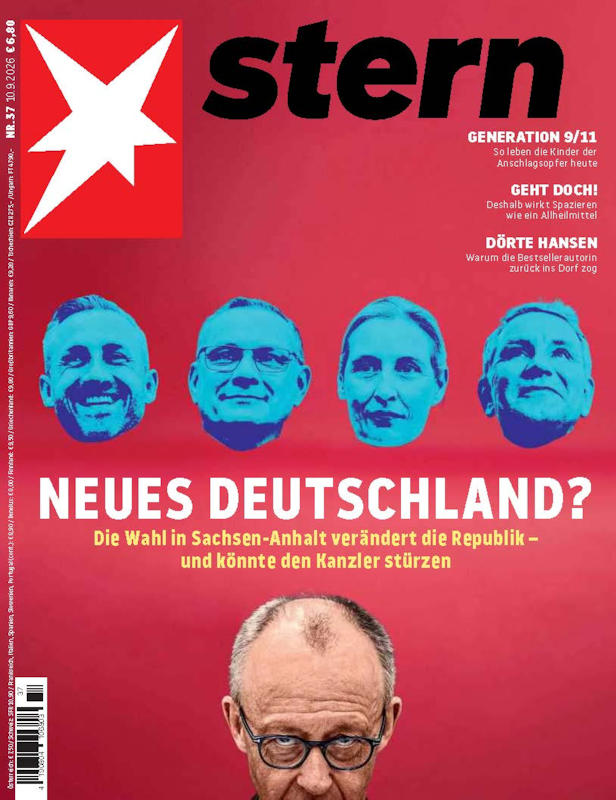
On September 6, 2026, the AfD won the regional elections in Saxony-Anhalt with 43.8% of the vote — a score that put it within three seats of an absolute majority. What the German press discovers in the days that follow is not just a number: it is a CDU fracturing in public, a chancellor weaker than any before him, and a far-right opposition that no longer hides its national ambitions. In this vertigo, no one is waiting for the September 20 verdict to act.
The Essentials
- The AfD wins 43.8% in Saxony-Anhalt; the CDU collapses to 17.2% (down from 37.1% in 2021) — its worst electoral defeat in decades.[01]
- Turnout, at 77.8%, reaches its highest level since reunification — a sign that mobilization, in both directions, was total.[02]
- The FAZ reveals an internal AfD strategy document organized around three pillars designed to destroy the CDU rather than simply compete with it.[03]
- An informal, cross-party network of former officials — the “shadow republic” — is already preparing, according to Die Zeit, for a scenario in which the party system breaks apart.[04]
- CDU grassroots figures in Brandenburg and Mecklenburg-Vorpommern are openly demanding Merz’s resignation and the end of the firewall against the AfD, ten days before the September 20 vote even takes place.[05]
- The French press (Mandeville/Moreau, Dickinson) and international congratulations (Trump, Musk, Orbán, Vox, Lega) broaden the story into a geopolitical reading that the German press, absorbed in coalition arithmetic, largely overlooks.
Contents
by Joël-François Dumont — Berlin, 11 September 2026.
1. The Shock of September 6
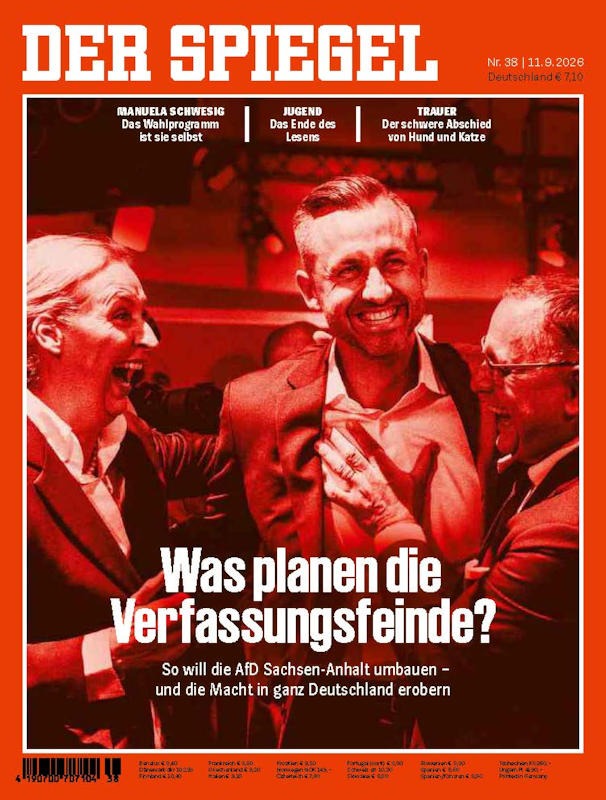
43.8% of the vote, seven parties out of fifteen winning at least one seat, turnout up more than 17 points from the previous election [06]: Saxony-Anhalt voted like never before since reunification, and it voted AfD. The CDU, for its part, fell from 37.1% to 17.2% — a collapse Der Spiegel summed up in one word: “Die Zerstörung” — The Destruction.[07] The party now holds just fifteen seats in its new parliamentary group, down from forty.
The irony is bitter for Friedrich Merz. As a candidate for the CDU presidency in 2018, he made the promise to cut the AfD’s support in half the banner of his campaign. On September 6, 2026, the opposite happened: the CDU was cut in half, and the AfD doubled its own score.[08] In the Bundestag three days later, Alice Weidel barely needed to press the point — the shame was already plain to see. Observers noted an unusual tone from her: for the first time, none of her usual snarling aggression, but the almost calm posture of an opposition leader who no longer sees power as very far away.[09]
2. The AfD Strategy: Destroy, Don’t Compete
This is not electoral improvisation. The AfD’s parliamentary group has formalized, in an internal strategy document revealed by the Frankfurter Allgemeine Zeitung, a three-pillar tactic: “Kulturkampf,” which polarizes the debate against the left to push the SPD and the Greens further toward their own extreme; “Ampel 2,” which deliberately cultivates the image of a CDU/SPD coalition as dysfunctional as the former three-way “traffic light” coalition, discrediting it by simple association; and mounting pressure on the Union itself, contesting its core claim to economic competence.[10] This is not a new doctrine — Alexander Gauland had already summed it up in one sentence back in 2017, the day after the AfD entered the Bundestag: “Wir werden sie jagen” — we will hunt them.[11] The CDU, not the Greens or the left, has always been the primary target.
On the ground, the mechanics are transparent. One AfD official, quoted anonymously by Der Spiegel, put it bluntly: “Schön, wenn wir regieren. Aber wenn wir regieren, indem wir drei, vier CDU-Leute zu Überläufern machen, haben wir gewonnen. Das wäre das Ende von Friedrich Merz, das Ende der CDU” — it doesn’t matter whether we govern; if we can turn three or four aging CDU deputies into defectors, we’ve won. That would be the end of Merz, the end of the CDU.[12] Offers of ministerial posts are already circulating behind closed doors. Focus documents the most troubling case: Peter Kurth, a former CDU finance senator in Berlin, reportedly considered for a state secretary post for the economy in an AfD government, and revealed by a Spiegel investigation to have financed networks tied to the Identitäre Bewegung, as well as a real-estate loan to three “Saxon separatists” now on trial for allegedly plotting, weapons in hand, to found a “National Socialist state”.[13]
3. The Shadow Republic
Perhaps the most politically striking piece to come out of this whole sequence is “Etwas wird passieren” (“Something is going to happen”), published by Die Zeit. It reveals the existence of an informal, cross-party network of former officials — ex-ministers, former party leaders, across the political spectrum — who have been quietly comparing notes since the CDU first passed a Bundestag motion with AfD votes.[14] Their implicit code phrase: “Sehen Sie das auch?” — Do you see it too? They all sense that “something is going to happen,” but are waiting for the September 20 elections to conclude before speaking out, for fear of being accused of sabotaging the campaign.
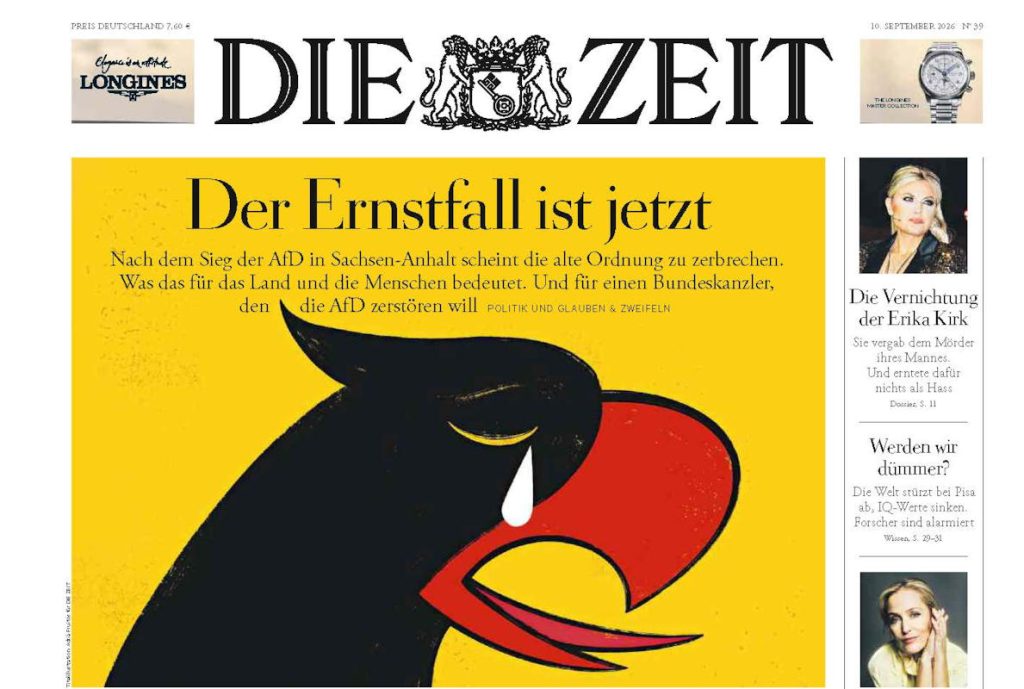
No concrete plan exists yet, but the idea of a realignment of centrist parties — or even a “left-wing populist” movement in the spirit of Sahra Wagenknecht’s 2018 venture — is already circulating in these circles.
This end-of-reign atmosphere shows up even in the political staging. Der Spiegel describes a Friedrich Merz delivering mea culpas on repeat — “beim sechsten Mal an diesem Tag fällt es ihm bereits deutlich leichter” (by the sixth time that day, it already comes more easily) — before a barely convinced audience of the SPD’s Seeheimer Kreis, under a red-lit tent in the gardens of the Parliamentary Society, a stone’s throw from the Reichstag.[15] One “excellently connected” CDU insider put it without mincing words: “Merz ist der König eines Scherbenhaufens, und ich zweifle inzwischen, dass man die Scherben wieder zusammensetzen kann” — Merz is king of a pile of shards, and I now doubt anyone can put them back together.[16]
4. The Contenders Bide Their Time
Hendrik Wüst, minister-president of North Rhine-Westphalia, is openly touted as “chancellor-in-waiting.” Die Welt pictures him eating a currywurst in front of the Brandenburg Gate, claiming “expertise qua Geburt” — expertise by birth — as a butcher’s son: barely concealed electoral staging.[17] But Wüst is calculating: he has a regional mandate to defend in North Rhine-Westphalia in April 2027, and knows that a hasty coup against Merz would leave him carrying a poisoned inheritance without any guaranteed payoff. “Er hat ja Zeit, er ist erst 51” — he has time, he’s only 51, notes Der Spiegel.[18] Markus Söder, the CSU leader, is playing the same waiting game, with an added incentive: the longer Wüst waits in Düsseldorf, the longer Söder remains the sole credible rival-in-reserve in Munich.
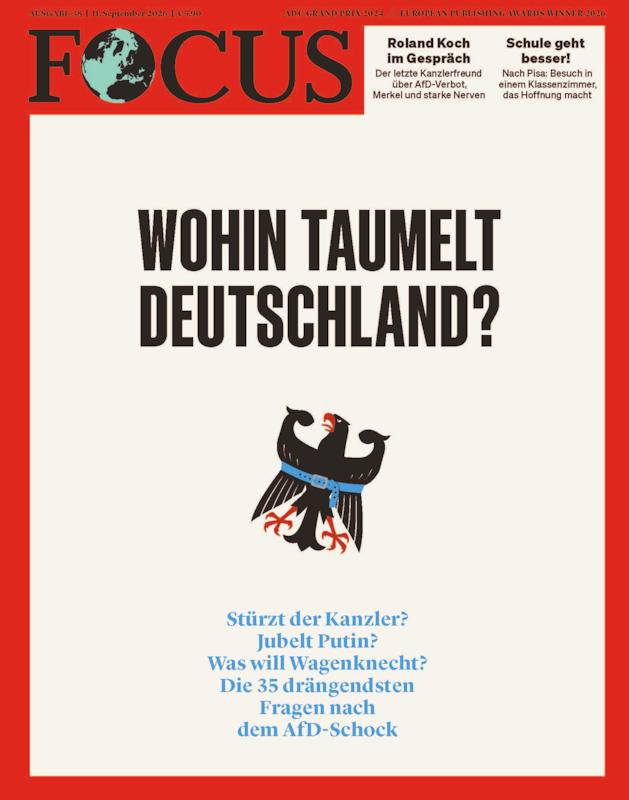
Focus lays out the two technical paths to a change of chancellor — a confidence motion triggered by Merz himself, or a constructive no-confidence motion in the Bundestag — and concludes that neither is simple: the CDU/SPD coalition holds a majority of only twelve votes, and an internal coup would remain, in CDU political culture, a heavy taboo.[19] The only theoretical escape route, rarely discussed but real: the “Merkel option,” in which Merz would resign as party chairman while remaining chancellor — exactly what Angela Merkel did after the 2018 Hesse election defeat, to save her chancellorship through to the end of the legislative term.[20]
Focus cover, September 11, 2026: “Where is Germany staggering to? Will the chan-cellor fall? Is Putin celebrating? What does Wagenknecht want? The 35 most pressing questions after the AfD shock.”
5. The Domestic Intelligence Service and the Ban Question
The prospect of an AfD government, even at the regional level, raises an unprecedented institutional question. Gerhard Conrad, a former BND (foreign intelligence) officer, warns in the pages of Focus: “Wenn die Partei, die bisher beobachtet wird, auf einmal die Macht über den Apparat bekommt, ist das eine Art Verfassungskrise” — if the party that has until now been under surveillance suddenly gains control of the apparatus itself, that amounts to a kind of constitutional crisis. He adds that, in such a case, one could essentially “only burn the files and evacuate beforehand“.[21] The heads of all sixteen regional domestic-intelligence offices and the federal office have already met to discuss how to keep the AfD away from sensitive data exchanges.
On the question of an outright ban, a shift is underway: Hendrik Wüst has become the first senior CDU figure to openly call for a federal-state working group to examine the matter.[22] But the obstacles remain considerable — the Cologne administrative court recently suspended the classification of the federal AfD as a “confirmed right-wing extremist” organization, and the legal thresholds for an outright ban are set considerably higher still.[23]
6. The International Scoreboard of Congratulations
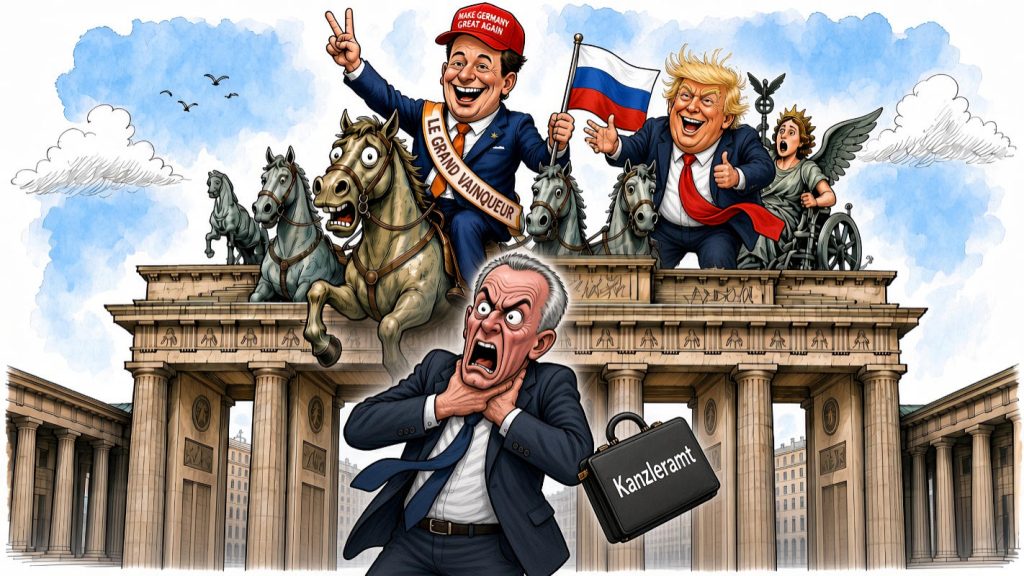
The very evening of the vote, Donald Trump shared on Truth Social a projection putting the AfD at 44.4%, without comment — an unmistakable nod, Focus notes, to a party his MAGA movement “courts with particular affection“.[24] Elon Musk offered a terse “Gut gemacht!” Viktor Orbán, even as his own party had just lost power in Hungary, called it “a giant election night for Germany and for Europe.” Santiago Abascal (Vox, Spain) and Matteo Salvini (Lega, Italy) congratulated Alice Weidel by name, one of them even calling her a “friend”.[25]
In counterpoint, French Economy Minister Roland Lescure called the outcome a “very, very worrying” signal.[26] And Focus points to a paradox few German outlets have noted: the AfD remains something of a pariah even within Europe’s far right — Marine Le Pen and Giorgia Meloni broke ties with it years ago, judging it too radical. A German result nearing an absolute majority could, in a reversal of roles, reinforce their own positioning as the “reasonable” face of right-wing populism, on the eve of elections in France, Spain, and Italy.[27]
7. French Perspectives: Mandeville, Moreau, and Dickinson
That same day, in Le Figaro, Laure Mandeville laid out the most structurally ambitious thesis of the entire press cycle: the AfD’s success is not a purely German accident, but the symptom of a broader Western denial — that of elites who dodged the questions of migration and identity for years. She cites a figure that captures the generational shift: 44% of Saxony-Anhalt voters under 30 voted AfD.[28]
Interviewed by Mandeville, political scientist Patrick Moreau — a leading Germanist and specialist in political extremism — draws a distinction essential to understanding the party’s nature: unlike France’s National Rally, which chose a strategy of “de-demonization,” the AfD chose the opposite path, modeled on Austria’s FPÖ — owning its radicalism rather than disguising it. He portrays Ulrich Siegmund as an emblem of an “unapologetic” national conservatism toward Germany’s past, and concludes with a line that connects directly to the geopolitics of the “Europe at Germany’s Hour” dossier: the priority is no longer the past, but ending support for Ukraine — “the Kremlin’s Trojan horse“.[29]
On euradio that same day, our colleague Quentin Dickinson brings a different texture — the spoken voice of a diplomat-commentator intimately familiar with Brussels and Berlin. He describes a potential AfD-BSW coalition as “a perfect war machine against the European Union,” bringing together openly pro-Russian factions and others deeply admiring of Donald Trump. And he names, almost in passing, the gravest risk of all: the de facto resurrection of two Germanys, one dominated by pro-Russian parties, the other run by centrist ones, with Berlin reduced to “the condition of a powerless arbiter of an insoluble social conflict”. [30]
Joël-François Dumont
See also:
- « CDU : La révolte avant l’heure » — (2026-0911)
- « CDU: The Revolt Ahead of Schedule » — (2026-0911)
- « CDU: Die Revolte vor der Zeit » — (2026-0911)
Notes
[01] Official results, Landeswahlleiterin Sachsen-Anhalt, September 6, 2026.
[02] “Hoffen, dass sich etwas ändert,” Frankfurter Allgemeine Zeitung, no. 211, September 11, 2026, by Luca Neuschaefer-Rube.
[03] “Weidel gegen Merz,” Frankfurter Allgemeine Zeitung, no. 210, September 10, 2026, by Friederike Haupt, Mona Jaeger, Eckart Lohse, and Matthias Wyssuwa.
[04] “Etwas wird passieren,” Die Zeit, no. 39, September 10, 2026, by Tina Hildebrandt and Robert Pausch.
[05] “CDU-Basis droht Merz mit Austritt,” Tichys Einblick, September 11, 2026; “CDU-Krise spitzt sich zu,” Nordkurier, September 11, 2026.
[06] “Hoffen, dass sich etwas ändert,” Frankfurter Allgemeine Zeitung, no. 211, September 11, 2026.
[07] “Die Zerstörung der CDU,” Die Zeit, no. 39, September 10, 2026, by Martin Machowecz, August Modersohn, Martin Nejezchleba, Cornelius Pollmer, and Tilman Steffen.
[08] “Weidel gegen Merz,” Frankfurter Allgemeine Zeitung, no. 210, September 10, 2026.
[09] Ibid.
[10] Ibid.
[11] Alexander Gauland, public statement, 2017, the day after the AfD’s entry into the Bundestag.
[12] “Die Zerstörung der CDU,” Die Zeit, no. 39, September 10, 2026.
[13] “Griff nach Macht,” Der Spiegel, no. 38, September 11, 2026, by Astrid Geisler, Fabian Hillebrand, Ann-Katrin Müller, and Philipp Wittrock.
[14] “Etwas wird passieren,” Die Zeit, no. 39, September 10, 2026.
[15] Ibid.
[16] Ibid.
[17] “König des Scherbenhaufens,” Der Spiegel, no. 38, September 11, 2026, by Jan Friedmann, Konstantin von Hammerstein, Paul-Anton Krüger, Andreas Niesmann, and Christian Teevs.
[18] Ibid.
[19] “Wie weiter, Deutschland?,” Focus, no. 38, September 11, 2026.
[20] Ibid.
[21] Ibid.
[22] Ibid.
[23] Ibid.
[24] Ibid.
[25] Ibid.
[26] Ibid.
[27] Ibid.
[28] Laure Mandeville, “L’AfD, rejeton des dénis de l’Occident,” Le Figaro, September 11, 2026.
[29] Patrick Moreau, interview with Laure Mandeville, “La victoire de l’extrême droite allemande raconte la maladie de nos démocraties,” Le Figaro, September 11, 2026.
[30] Quentin Dickinson, editorial, euradio, September 10, 2026.
Decryption — Germany Seen From Outside: “Sehen Sie das auch?”
There is something vertiginous about reading, side by side, the German and French press on this same September 11. The headlines out of Hamburg, Frankfurt, and Munich count votes, seats, coalition scenarios, the Wüst-Söder rivalry — a meticulous, almost clinical arithmetic of a political system coming apart at the seams. The French press, with less raw material but more distance, asks straight away the question Germany, caught up in the vertigo of its own crisis, has not yet had the leisure to ask calmly: what does this shift say about the rest of the West?
The answer, perhaps, is contained in a single image: a network of former officials quietly exchanging a password — “Sehen Sie das auch?” — while the whole world, from Washington to Moscow, by way of Budapest and Madrid, already watches Germany as the next domino to fall. The restrained silence of this shadow republic, waiting for September 20 before speaking out loud, may be the surest sign that no one in Germany yet knows how to answer the question Focus put on its cover, in five capital letters: Wie weiter, Deutschland?