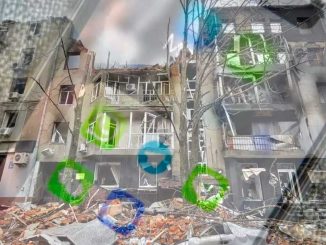
“As Moscow bombs Ukrainian cities and infrastructure on a massive scale, Donald Trump has asked the victim to stop defending itself with all its means. He is also attacking the political legitimacy of President Volodymyr Zelensky by demanding new elections. By contrast, the tycoon offers the Russian aggressor an unexpected prospect: it would be possible to conclude bilateral economic agreements without resolving the conflict, or even ending hostilities.” — Piotr Smolar, Le Monde correspondent in Washington, 13 October 2026.[01]

The Essentials
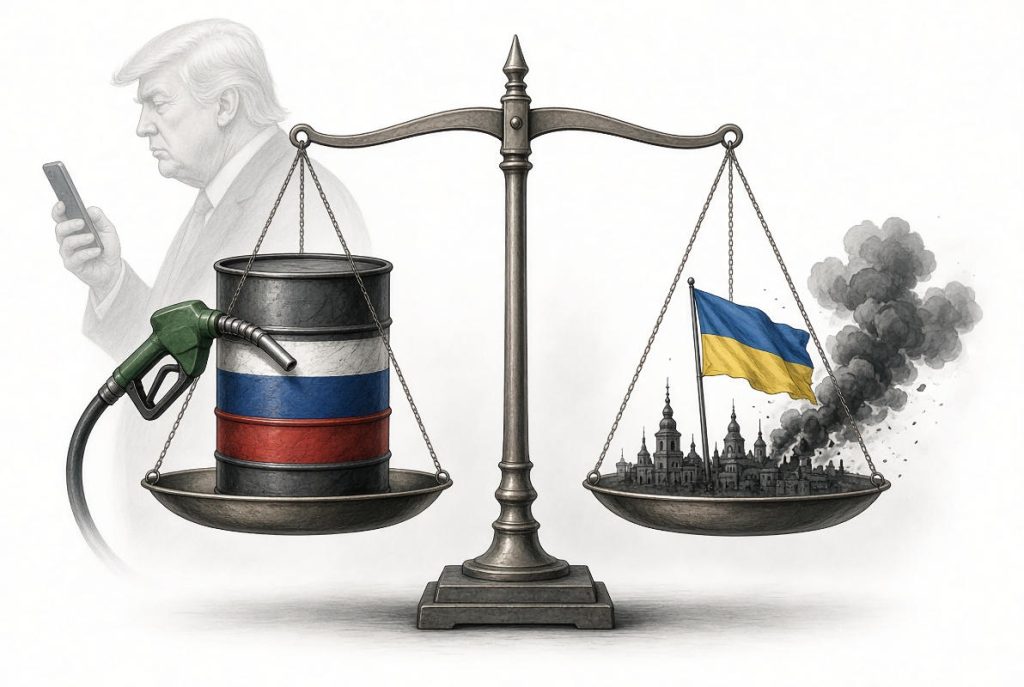
- The deal. On 9 October, after a call with Putin, Trump lifts US sanctions on Russian diesel until April. He announces 300,000 tonnes right away, then 500,000 in November, then one million. At that scale, 300,000 tonnes is barely fourteen hours of US consumption: the effect on prices is negligible.
- Kyiv. Ukraine was not consulted. The “energy ceasefire” proclaimed on 11 October was confirmed neither by Moscow nor by Kyiv.
- The pressure. Washington reportedly threatened to cut off intelligence sharing (Axios, Financial Times, CNN), which a US official denies. SpaceX throttled the speed of Ukraine’s military Starlink terminals on 14 October. No evidence shows an order from Trump: the suspicion is legitimate, the proof is missing.
- The interests. A consortium tied to the US negotiators is eyeing Lukoil’s foreign assets. The New York Times writes that nothing indicates a personal profit for Kushner or Witkoff. Trump reports more than $1.2 billion in crypto income for 2025, but no link to his Russia policy has been established.
- The rejection. Twelve senators, six of them Republicans, call for the deal to be cancelled. Even before this agreement, 23% of respondents in 36 countries said they trusted Trump (Pew).
- The deadlines. 18 October (Graham Act), 29 October (Lukoil), 3 November (midterms).
Contents
by Joël-François Dumont | Berlin, 14 October 2026 —
In three sentences
Everything is said. What remains is to prove it, and the past week supplies the pieces: Russian diesel handed to Moscow, an ultimatum to Kyiv, intelligence that fell silent at the worst moment, a satellite service throttled without warning for Ukrainian forces.
The avowed motive fits in a single figure: more than $6 a gallon for diesel in the United States for the past month, three weeks before the midterm elections of 3 November.[02] The rest, we will separate from the facts.
This text is an editorial: it makes the case for the prosecution. Every fact cited is sourced; whatever is suspicion is presented as such, because that is how an accusation stays solid.
Forty days, ten facts
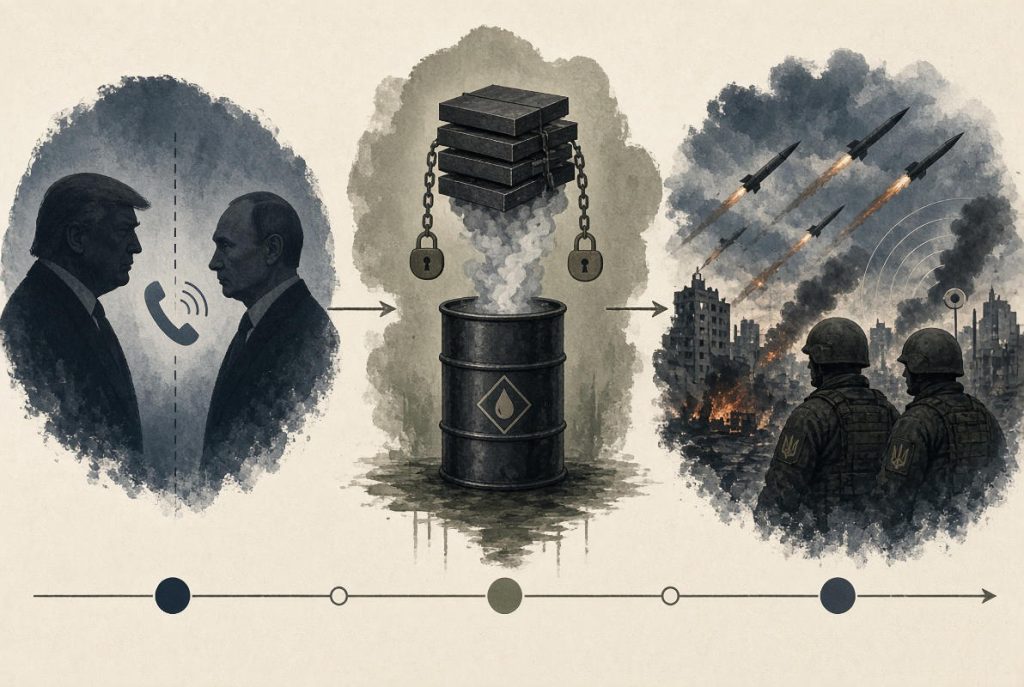
Six of the ten facts below fall within six days, from 9 to 14 October.
| Date | Fact |
|---|---|
| 5 September | Putin raises the sale of Lukoil’s foreign assets with Witkoff and Kushner, in the Kremlin.[03] |
| 18 September | Trump signs the Graham Act, which tightens sanctions on Russia; the thirty-day aeview expires on 18 October.[01] |
| 3 October | The New York Times reveals a plan for a consortium tied to the US negotiators to buy Lukoil assets.[04] |
| 5 October | Riyadh announces its support for the “Yemen Dawn” operation; the Mecca pact is activated.[05] |
| 9 October | Trump–Putin call; sanctions on Russian diesel lifted until April; in Miami, Witkoff and Kushner reportedly threatened to cut off intelligence.[06][02][07] |
| 10 October | Trump demands “a new president” in Kyiv; a Houthi missile hits Riyadh airport (12 dead, 309 wounded).[08][05][06] |
| 11 October | Trump proclaims an “energy ceasefire” that neither Moscow nor Kyiv confirms.[08][02] |
| 12 October | Five ballistic missiles hit Kyiv, with no warning from partners according to Zelensky.[09] |
| 13 October | Twelve senators, six of them Republicans, call for the deal to be cancelled; Trump denies having cut off intelligence.[10][11] |
| 14 October | SpaceX limits the speed of the Ukrainian military’s Starlink terminals, without warning, according to an adviser to Zelensky.[12] |
Three deadlines follow: on 18 October, the White House must say whether it applies the Graham Act or waives it.[01] On 29 October, the extension of US restrictions on Lukoil’s assets expires.[13] On 3 November, Americans vote.
Diesel: a deal that does not lower prices
On 9 October, after a call with Putin, Trump lifts US sanctions on Russian diesel until April.[06][02] He announces 300,000 tonnes right away, 500,000 in November, then one million.[01][02][06] The totals vary from one outlet to another: 2.5 million,[14] 3 million in Trump’s message as quoted by NPR,[15] up to 4 million on a page of Le Monde.[08] We keep the immediate volumes.
At that scale, the effect is negligible. According to the Süddeutsche Zeitung, 300,000 tonnes is less than a tenth of one day of global consumption, and barely fourteen hours of US consumption according to the US energy agency.[06] The United States consumes 15 to 17 million tonnes a month.[02] The G7 had agreed, in early October, to release 100 million barrels from its strategic reserves.[06]
Can Russia even deliver? Up to 40% of its refining capacity is reportedly hit by Ukrainian strikes, and Putin had suspended diesel exports to supply his domestic market.[02][06]
Kyiv was not consulted: it learned of it on Truth Social, on the very day its delegation was negotiating in Miami with Witkoff and Kushner, while Moscow was already partly lifting its ban on diesel exports.[02] The Sunday “energy ceasefire” took Zelensky by surprise, and Moscow did not confirm it.[08] An identical announcement in September had come to nothing.[02]
And who sells diesel? America. Trump had considered banning US exports, the energy companies opposed it, and he brandished the threat to force the Europeans to open their strategic reserves.[02] Les Echos points out that America’s problem lies in refining capacity, not in crude oil.[16]
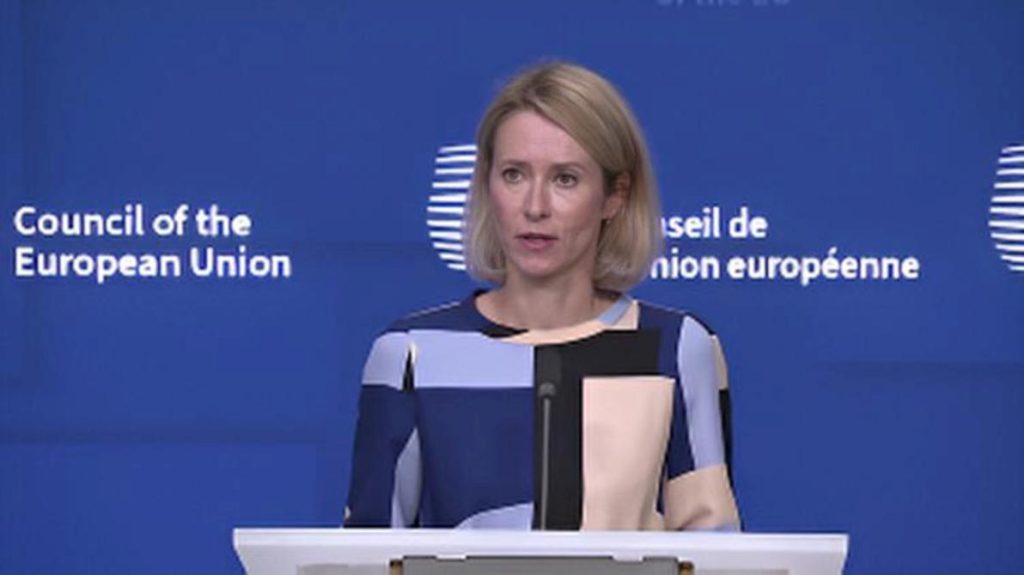
The six Republican senators who signed the 13 October letter write that the deal will bring Americans no notable relief and that it finances the Russian war effort.[10] Kaja Kallas sums it up for Europe: it gives Moscow “more revenue to wage war”.[17]
Pressure on Kyiv: intelligence, Starlink

For weeks, Washington has demanded that Ukraine stop striking Russian refineries. A US official speaks of six ignored requests.[18] On 10 October, Trump demands “a new president” in Kyiv; Zelensky answers that it is for Ukrainians to choose their leader, and offers sixty days of total ceasefire before elections.[08]
The threat over intelligence. In Miami, on 9 October, Witkoff and Kushner reportedly threatened to cut off Kyiv’s access to US intelligence, according to Axios,[07] the Financial Times and CNN,[19] which cites two European officials. A US official denies it. On 13 October, Trump denied that the sharing had stopped; his spokeswoman replied that she would have to get back to that.[11]
The missile without warning. On the evening of 12 October, five ballistic missiles hit Kyiv. Zelensky writes that Ukraine received no early warning from its partners.[09] Foreign Minister Andriy Sybiha says cooperation with the Americans continues and cites a “special type of weapon”.[20] A senior official speaks of a “failure”.[09] Another tells the Kyiv Independent: they say they cut nothing, but did not warn them either.[21]
Starlink. On 14 October, Serhiy Beskrestnov, adviser to the Ukrainian president on defence technology, announces that SpaceX introduced a speed limit overnight on the military plan for terminals in motion, without warning Ukrainian forces. As a result, they had to cancel all offensive missions, according to the Ukrainian 7th Corps. While the Ukrainians are self-sufficient in guiding long-range launches, for short- and medium-range strikes, they are entirely dependent on the Starshield system. By capping the drones’ speed, the Ukrainians are thus prevented from defending themselves and targeting strategic objectives in Russia. It is worth noting in passing that Elon Musk had applauded, on X, Trump’s call for a change in the Ukrainian president,[08] who, according to the NZZ, has since resumed an official role as an advisor to the Pentagon.[22]
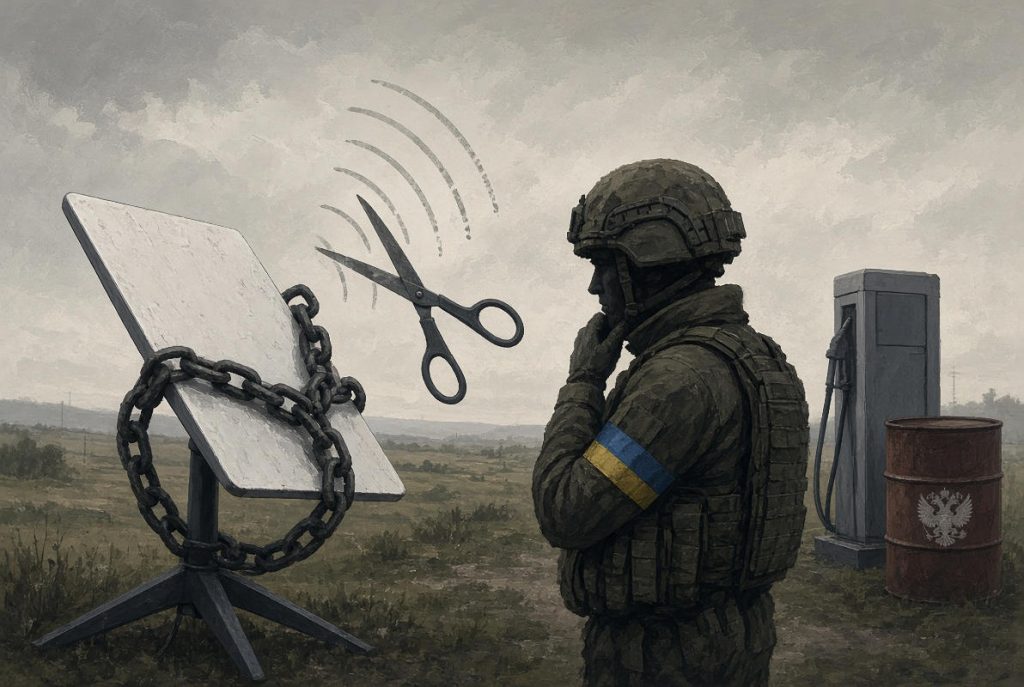
All things considered, the suspension of alerts by U.S. intelligence agencies—which are the only ones in the world to have geostationary satellites—combined with the restrictions imposed on Starshield and Starlink, constitute a significant means of exerting pressure on Kyiv by giving Vladimir Putin the green light to continue bombing civilian areas as he has been doing for years, but now with the encouragement of President Donald J. Trump.
This latest betrayal by Donald Trump leaves Ukrainians unable to defend themselves and prevents them from launching attacks. With an ally like that, who needs an enemy?
The interests: Lukoil and crypto
On 3 October, the New York Times reveals that the negotiations on Ukraine include a multibillion-dollar agreement on Lukoil’s foreign assets: oil fields in Cameroon, refineries in Europe, petrol stations in New Jersey.[04] Lukoil valued them at around $20 billion. Putin himself raised the sale with Witkoff and Kushner, on 5 September.[03]
The leading consortium includes the investor Todd Boehly, a $2 million donor to Trump’s causes, two Gulf groups that have done business with Kushner or the Witkoff family, and a US government entity.[23] According to the Financial Times, these are Sheikh Tahnoon of Abu Dhabi and the Qatari Al-Khayyat family, a partner of Kushner and Ivanka Trump in a hotel project in Albania.[03] An investor in the consortium is also a co-owner of World Liberty Financial, the crypto company tied to the Trumps and the Witkoffs.[23]
The New York Times writes that nothing indicates that Kushner or Witkoff would draw a personal profit from it. A Witkoff spokesman denies any conflict of interest; Kushner has denied a link between his businesses and his diplomacy. A senior administration official says the two men negotiated “a substantial upfront payment” and a share of the profits for the United States.[24] Lawmakers are asking questions about conflicts of interest.
The timeline deserves to be laid out: Putin proposes Lukoil on 5 September, the press reveals it on 3 October, the diesel deal is concluded on the 9th. We do not say that one explains the other; we say that the public is entitled to ask the question.
There remains the president’s fortune. In his 2026 financial disclosure to the Office of Government Ethics, Trump reports more than $1.2 billion in crypto income in 2025, including about $550 million from World Liberty Financial and $635 million in royalties on the $TRUMP cryptocurrency.[25] Forbes estimates his fortune at $6.5 billion in March 2026, against $2.3 billion in 2024, which remains an estimate and not a balance sheet.[25] Trump replies that his funds are managed independently.[26]
None of this proves that a decision on Russia was made for private gain. All of it is enough to demand transparency.
The rejection: Washington, Europe, the world
On 13 October, twelve senators, six of them Republicans (McConnell, Tillis, Collins, Murkowski, Cornyn, Armstrong), ask Trump to cancel the agreement. They call it “a gift to our adversary” and “a betrayal of our allies”, which finances Putin’s “deadly and illegal” war.[10][15]
Tillis judges the operation possibly illegal, in light of a 2022 text and the Graham Act.[27] Wicker, chairman of the Armed Services Committee, doubts that the agreement applies.[28]
The reversal is clear: until now, Republican support for Trump’s foreign policy was almost unanimous.[29] Representative Fitzpatrick is preparing, for after the midterms, a law banning any purchase of Russian oil.[01] Chuck Schumer speaks of a “pact with the devil”, and former Vice President Mike Pence of a betrayal.[06]
The rejection is not only American. The Pew Research Center surveyed 36 countries from 8 February to 13 May 2026, before this deal: 23% of respondents trust Trump on world affairs, 76% do not. Confidence is falling in 16 of the 24 comparable countries and rising in none.[30] Europe is the harshest, and in South Korea, a majority (55%) has an unfavourable opinion of the United States for the first time in more than twenty years.[31]
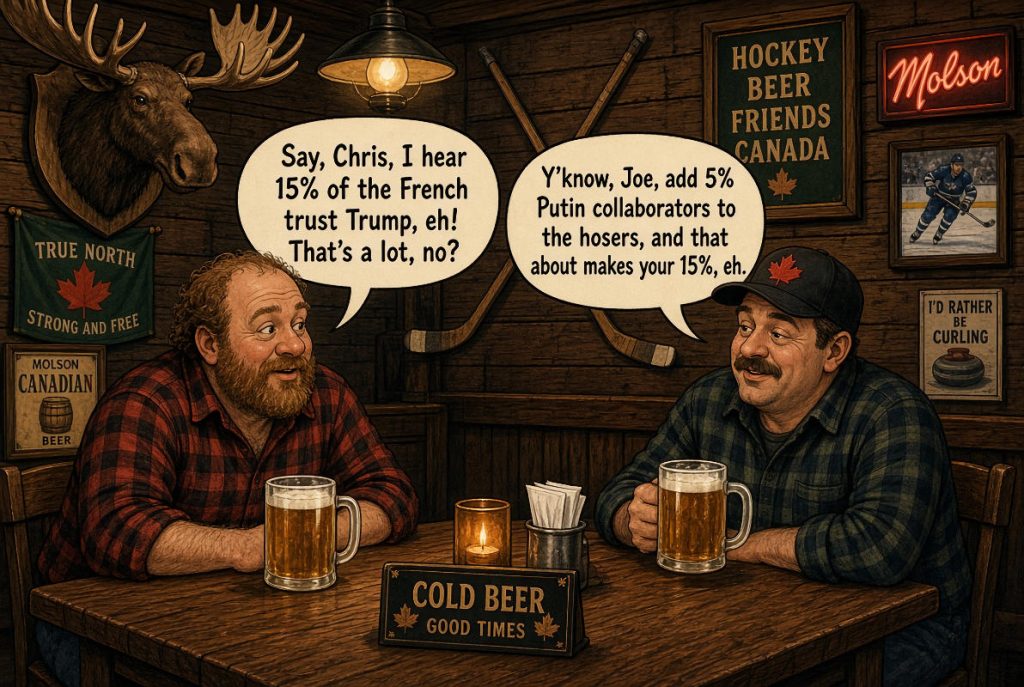
In France, 15% trust Trump, against 23% across all 36 countries — Pew Research Center, survey of 8 February to 13 May 2026.[32]
| Country | Trust in Trump (%) |
|---|---|
| Sweden | 11 |
| France | 15 |
| Netherlands | 15 |
| Germany | 16 |
| Italy | 17 |
| Spain | 21 |
| Greece | 22 |
| South Korea | 22 |
| Japan | 25 |
| All 36 countries | 23 |
Only Sweden does worse than France; Japan is the only country in this panel above the level of the 36 countries.
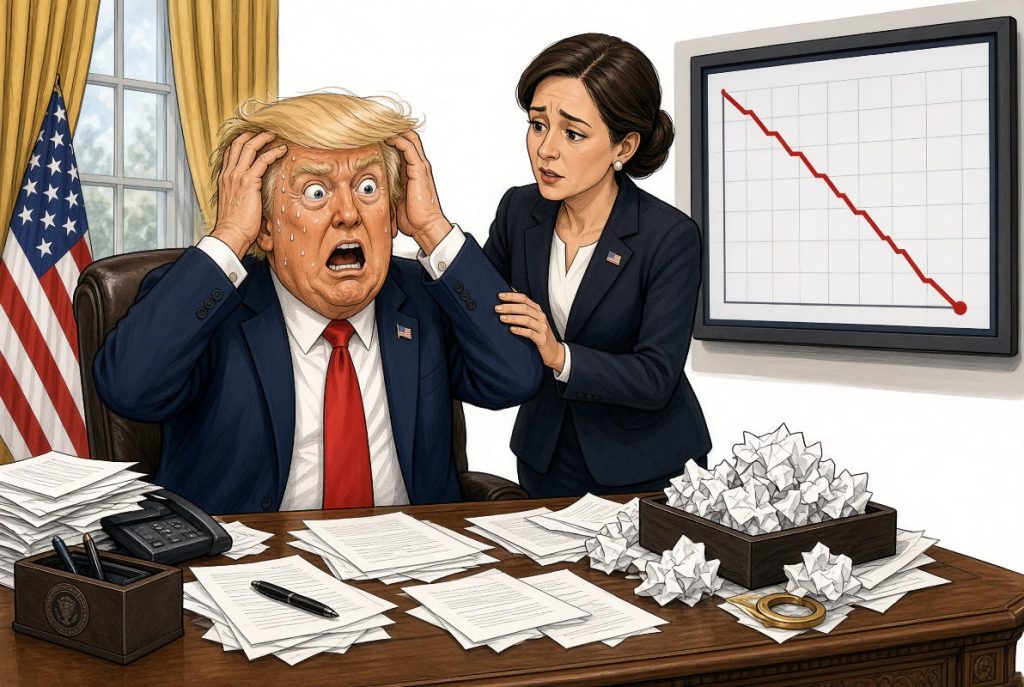
Pew also notes that America and its president are now judged as one: in Poland, the share of those who do not trust Trump but keep a positive image of the United States falls from 70% to 31%.[33] The diesel deal adds to a rejection already won.
Europe and the Gulf: the betrayal piles up
Monday’s and Tuesday’s headlines say the same thing: “Ukraine and Europe defied” (Le Monde),[34] “America’s U-turn” (Le Figaro),[35] “Kyiv feels betrayed” (Süddeutsche Zeitung).[36] Germany’s federal education minister Karin Prien speaks of moral bankruptcy “for a few litres of diesel”.[36] Kaja Kallas announces a record list of 1,600 new sanctions and refuses to ease the pressure on Moscow.[17]
Who reacted first? Kallas, Sweden’s Kristersson and Britain’s Andy Burnham spoke before Sunday,[37][17] then Berlin and the Commission on Sunday.[08] Emmanuel Macron spoke the same day, on X.[08] And according to Politico, relayed by secondary outlets, the United States is organising in Poland a meeting on the future of NATO to which France, the United Kingdom and the Baltic states are not invited. Colby says the aim is not to create a bloc; the Pentagon has not commented. We have not been able to confirm the date.[38]
In Warsaw, on 13 October, British Foreign Secretary Ed Miliband backed Zelensky’s call for an energy ceasefire and warned against Russian hybrid attacks across the whole continent.[39] London also highlights its new National Centre for Information Defence, announced by Andy Burnham at the UN on 22 September.[40]
The Gulf. On 10 October, a Houthi missile hits Riyadh airport: 12 dead, 309 wounded, the deadliest attack in ten years. Mohammed bin Salman had repeatedly asked Trump to take action against the Houthis; Washington limits itself to intelligence, and Trump replies: “We will look into it”.[05] Riyadh is seeking support elsewhere, in France, in the United Kingdom, from Pakistan and Turkey. No official Saudi reaction publicly denounces Washington: silence is the rule, as in March.
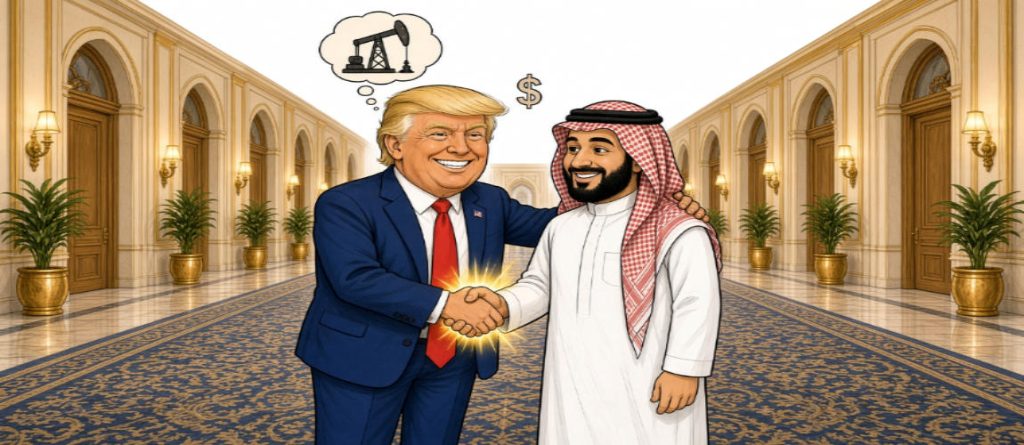
This silence is that of a partner who absorbs the blow. We described it as early as 16 September in “Abqaiq, Miami, Bab-el-Mandeb: the American guarantee put to the test of the facts”: 2019, a protector who does not retaliate; March 2026, a crown prince mocked in public; September, a refusal of support. October adds the fourth episode.[41]
Asia. In South Korea, 22% of respondents trust Trump,[42] and 55% have an unfavourable opinion of the United States.[31] More than eight South Koreans in ten still name America as their most important ally: they reject Trump rather than the alliance. Trump has since called for reducing joint military exercises.[42]
What is to be done?
In the sources we have read, nobody advocates silence. Here is what they put on the table, and what is still missing.
- Hold the sanctions. The Union adds 1,600 names, a record, and Kaja Kallas is working with the states that provide flags to the shadow fleet.[17] That is already done, and the effect remains uncertain: a European diplomat explains that the list serves above all to convince Asian partners.[17]
- Get the Graham Act applied. On 18 October, the White House must say whether it applies the law it signed on 18 September or waives it.[01] Congress has already spoken on both sides, through the letter of the twelve senators.[10]
- Reduce dependence on US intelligence. François Heisbourg calls for speeding up IRIS² and Ceres so that Kyiv no longer depends on Washington.[08] It remains to be seen what capabilities these programmes will offer Kyiv, and by what date.
- Arm Ukraine before winter. Finland promises ammunition for Ukraine’s F-16s “in the coming days”. The new-generation SAMP/T will not arrive before 2027, and Patriots are in short supply.[08]
- Play the Ukrainian card. Daniel Fried recalls that the United States wants access to Ukrainian drone and autonomous-vehicle technologies. He adds that Ukrainian tactics regularly win NATO war games.[01] Kyiv therefore holds cards that Europe can make the most of, including against Russian hybrid warfare: according to Zelensky, more than 200 Ukrainian counter-drone specialists are already deployed in five Gulf countries.[41] In Warsaw, he also claimed that the strikes on Yandex’s data centres had made the air “a little more breathable” on social media; the specialists consulted see, at this stage, no demonstrated drop in Russian influence operations.[43][44]
The hardest part remains: preparing for a hybrid war that is spreading. Poland is preparing a “pre-war state”, France new measures on its territory, NATO an adaptation of its plans.[45] What Europeans do between now and 18 October, then 3 November, will say whether they intend to weigh in or to endure.
The counterpoint
Washington’s defence deserves to be heard. A US official explains that Ukrainian strikes on refineries “hurt Russia”, but also the United States, and that Washington remains a reliable partner, supplying ammunition and intelligence.[07]
Daniel Fried, a former diplomat at the Atlantic Council, distinguishes substance from form: “We are playing a good hand badly,” he tells Le Monde.[01] He does not believe in a break in intelligence, because the administration needs Kyiv. Nigel Gould-Davies of the IISS, for his part, judges that the promised diesel volumes are too small to change much in practice.[46]
These two voices play down the material effect. They do not answer the essential point: if the gain is slim, it is the signal that counts, and for Andrew Mitcha of the University of Florida, Washington made Moscow a major concession and got nothing in return.[46]
A more open reading comes from Eric Ciaramella of the Carnegie Endowment, a former member of the National Security Council and the CIA. In Foreign Affairs, he argues that the announcement is not necessarily a major setback for Kyiv: it fits into a shift by the administration toward an energy ceasefire, and Trump himself told Zelensky that, as long as Ukraine stopped hitting the refineries, it could “do whatever you want to Russia”. This opening is worth something, he says, only if the West gives Kyiv the means to threaten Russian military targets: Starlink access over the area from which most ballistic missiles are launched, which Trump and Musk pass back and forth, and the 300 Patriot interceptors Europeans have not gathered. He also describes Washington as “at best a capricious interlocutor”, citing the reports of the threat to cut off intelligence.[47] This reading therefore assumes precisely what the administration has not yet done.
The barter

Diesel handed to Moscow, the ultimatum to Kyiv, intelligence silent for one evening, the satellite throttled on another: each of these facts can be debated, none goes away. A president who calls the war “ridiculous”[01] gives the aggressor the means to prolong it, according to Kaja Kallas,[17] and asks the victim to stop defending itself with all its means.
Anne Applebaum sees in it a desperate attempt to force Ukraine to capitulate and to save the Russian economy.[01] It is a reading, not a fact, but it gives meaning to a week in which the proclaimed peace convinced no one. Trump, whom the Nobel Peace Prize again passed over on 9 October, keeps saying he ended many wars.[06] Like Sister Anne in the tale of Bluebeard, we see nothing coming!
On 18 October, the 29th, then 3 November, we will know whether Washington corrects course or perseveres. Until then, America’s allies no longer have to ask whether it has betrayed them: they are counting what it costs them.*
Joël-François Dumont
Notes and sources
Titles of foreign-language articles are given in the original language; quotations originally in another language are translated by us.
[01] Piotr Smolar, “Aux États-Unis, le recours de Donald Trump au gazole russe, au détriment de l’Ukraine, provoque une vaste controverse”, Le Monde, 13 October 2026.
[02] André Müller, “Trumps Gegner reagieren scharf auf Dieselabkommen mit Putin”, Neue Zürcher Zeitung, 12 October 2026, p. 3.
[03] Meduza, based on the New York Times, “Lukoil’s foreign asset sale becomes part of U.S.–Russia talks on ending Ukraine war, NYT reports”, 5 October 2026. Source
[04] Pravda (European Pravda), based on the New York Times, “US and Russia are negotiating multibillion-dollar deal on Lukoil assets, says NYT”, 3 October 2026. Source
[05] Fanny Arlandis, “L’Arabie saoudite au défi de la riposte après l’attaque des houthistes”, Le Monde, 13 October 2026, p. 6.
[06] Süddeutsche Zeitung, 12 October 2026: Charlotte Walser, “Trump fordert neuen Staatschef für die Ukraine”, p. 6; Sebastian Gierke, “Trumps Diesel-Deal alarmiert die Ukraine”, p. 1.
[07] Axios, relayed by Pravda, “US threatened to cut intelligence sharing with Ukraine over strikes on Russian oil refineries”, 10 October 2026. Source
[08] Claire Gatinois and Thomas d’Istria, “Après le ‘deal’ sur le gazole russe, Europe et Ukraine tentent de faire front commun”, Le Monde, 13 October 2026, p. 5.
[09] Associated Press, “Ukraine had no intelligence from partners about missiles headed to Kyiv, Zelenskyy says”, 13 October 2026. Source
[10] CBS News, “Bipartisan senators urge Trump to rescind Russian diesel deal, calling it a ‘betrayal’ of Ukraine”, 13 October 2026. Source
[11] Kyiv Post, “Trump Denies US Has Stopped Sharing Intelligence With Ukraine”, 13 October 2026. Source
[12] Interfax-Ukraine, “SpaceX limits Starlink terminal speed in Ukraine overnight without warning – presidential adviser”, 14 October 2026. Source
[13] Ukranews, “Negotiations between U.S. and Russia on Ukraine now include major oil deal – media reports”, October 2026. Source
[14] The Hill, relayed by Fox 59, “GOP senators condemn Trump’s Russia diesel deal as ‘betrayal of our allies’”, October 2026. Source
[15] NPR, “Bipartisan group of senators call on Trump to rescind Russian diesel deal”, 13 October 2026. Source
[16] Bastien Bouchaud, “Les baisses de taxes sur le carburant offrent un répit limité aux Américains avant les élections de novembre”, Les Echos, 12 October 2026, p. 7.
[17] Philippe Jacqué, “Bruxelles ajoute plus de 1 600 noms à sa liste de sanctions”, Le Monde, 13 October 2026, p. 4.
[18] Axios, relayed by RBC-Ukraine, “US threatens to cut off intelligence sharing with Ukraine over strikes on Russian oil refineries”, 10 October 2026. Source
[19] CNN, “US threatens to suspend intel sharing, weapons purchases if Ukraine continues Russia energy strikes, sources say”, 11 October 2026. Source
[20] Euronews, “Could the US cut Ukraine off from vital military intelligence again?”, 13 October 2026. Source
[21] Kyiv Independent, “As Russian missiles slip through Kyiv’s air defenses without warning, officials say US intelligence sharing remains intact. For now”, 13 October 2026. Source
[22] Volker Pabst, “Erinnerungen an den Eklat im Oval Office”, Neue Zürcher Zeitung, 12 October 2026, p. 3.
[23] Kyiv Post, article on the plan to buy Lukoil’s assets, based on the New York Times, October 2026. Source
[24] IBTimes, “Russian Envoy Backs Jared Kushner as Ukraine Peace Talks Expand Into Multibillion-Dollar Oil Deal”, October 2026. Source
[25] Nordot, “Trump made over €1 billion from crypto in first year back in office, new filing shows”, 2026. Source
[26] Free Press Journal, “Donald Trump Defends $1.2 Billion Crypto Earnings, Says ‘Everybody’s Profiting’ As Wealth Surges To $6.5 Billion”, 1 July 2026. Source
[27] Al Jazeera, “Republican senator says Trump diesel agreement with Russia may be illegal”, 11 October 2026. Source
[28] Yahoo, “‘A betrayal’: More Republicans condemn Trump’s diesel deal with Putin”, October 2026. Source
[29] TVP World, “‘Gift to our adversary’: More Republicans balk at Trump’s Russia diesel deal”, October 2026. Source
[30] Ground News, based on the Pew Research Center, “Trump, US receive overwhelmingly negative reviews in new Pew global survey”, 23 June 2026. Source
[31] TASS, based on the Pew Research Center, “Majority of South Koreans not on board with US policy, first time in two decades — poll”, 26 August 2026. Source
[32] Pew Research Center, Spring 2026 Global Attitudes survey (8 February–13 May), “European views of Trump and the U.S. are especially negative”, 23 June 2026. Source
[33] Fingerlakes1, “Foreign views of U.S. increasingly tied to opinions of Trump, Pew finds”, 28 August 2026. Source
[34] “Accord Trump-Poutine : l’Ukraine et l’Europe défiées”, front page of Le Monde, 13 October 2026.
[35] Philippe Gélie, “La volte-face de l’Amérique”, editorial, Le Figaro, 12 October 2026, p. 1.
[36] Sebastian Gierke, “Trumps Diesel-Deal alarmiert die Ukraine”, Süddeutsche Zeitung, 12 October 2026, p. 1.
[37] ANSA, “Burnham, ‘piena solidarietà a Zelensky dopo le parole di Trump’”, 10 October 2026. Source
[38] Politico, based on kurs.com.ua, “The US did not invite key allies to a meeting on NATO’s future”. Source
[39] Foreign, Commonwealth & Development Office, press release of 13 October 2026 (courtesy translation supplied by the British Embassy in Paris).
[40] LBC, on Andy Burnham’s UN speech, 22 September 2026. Source
[41] Joël-François Dumont, “Abqaiq, Miami, Bab-el-Mandeb : la garantie américaine à l’épreuve des faits”, European-Security.com, 16 September 2026. Source
[42] Financial News, on the Pew poll in South Korea, 26 August 2026. Source
[43] Kyiv Independent, “No, Ukraine’s strikes on Yandex data centers didn’t cripple Russian influence ops”, 13 October 2026. Source
[44] SBS, “Russian facilities were attacked. Then came a viral theory”, 14 October 2026. Source
[45] “Les alliés de Kiev face aux agressions hybrides de Moscou”, Le Monde, 13 October 2026, p. 4.
[46] Mayeul Aldebert, “À l’approche des ‘midterms’, le coup de massue de Donald Trump à l’Ukraine”, Le Figaro, 12 October 2026, p. 5.
[47] Eric Ciaramella, “Ukraine Can Turn Imminent Peril to Its Advantage”, Foreign Affairs, 14 October 2026. Source
Decoding: after diesel, the information war
Russian diesel is allowed again, Kyiv was not consulted and the American consumer will gain almost nothing: that much is established. The rest, the threat over intelligence, the throttling of Starlink, the dealings around Lukoil, still belongs to suspicion. It is legitimate; it is not proven.
Three facts withstand any challenge: Russian diesel is allowed again, Kyiv was not consulted, and the gain for the American consumer is negligible. The rest comes down to pressure, suspicion or private interest, and we have classed it as such. That is the strength of an accusation: keeping only what holds up.
The coming days will tell what follows. On 18 October, the White House will say whether it applies the Graham Act or waives it.[01] On the 29th, the extension of restrictions on Lukoil’s assets expires.[13] Between those dates, the question raised by Eric Ciaramella remains open: an energy ceasefire makes sense only if Kyiv can threaten Russian military targets in return, which Washington has not yet authorised.[47] On 3 November, American voters will say what they think of this barter.
One front remains that this text has only touched on: information. London has announced a National Centre for Information Defence,[40] and Ed Miliband warned in Warsaw against Russian hybrid attacks across the whole continent.[39] Kyiv, for its part, claims credit for its strikes on Yandex’s data centres, though the specialists consulted see, at this stage, no demonstrated drop in Russian influence operations.[43][44] What do we know about Russian interference, what can be proved, and what does Ukraine have to offer Europe in that war? We will devote our next piece to it.