
There are conferences that confirm the world order, and others that announce it. Munich 2026 unquestionably belongs to the second category. Not because formal decisions were made there—security conferences are not decision-making summits—but because the language changed, and in diplomacy, language always precedes facts.
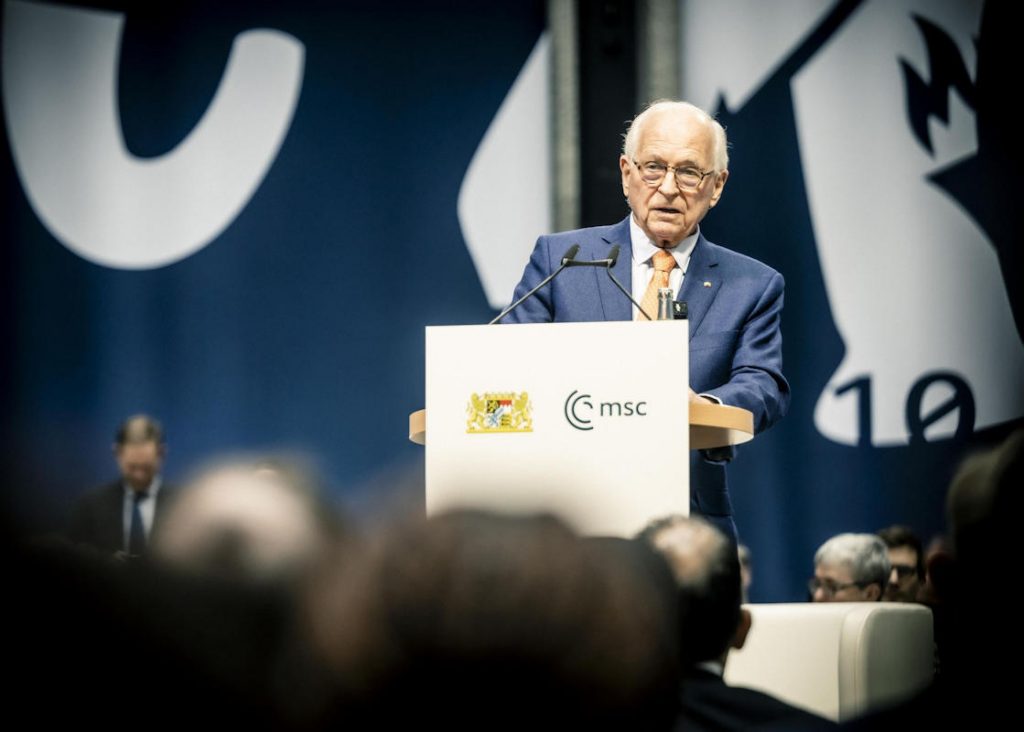
Munich 2026: when will Europe stop waiting for permission? It’s like a dream!
Table of Contents
Introduction — The Moment of Truth
par François de Vries — Berlin, le 16 février 2026 [*]
Last year, in this very Bayerischer Hof Hotel, J.D. Vance had strangely chosen Munich—the martyred city of the 1938 compromise—to deliver a condescending lecture to his European allies about their supposed passivity in the face of freedom of expression.[01] The discomfort was total. Trump’s running mate had demonstrated, with clinical brutality, that the transatlantic relationship could be used as a tool of ideological pressure. Europe absorbed the blow, stunned.
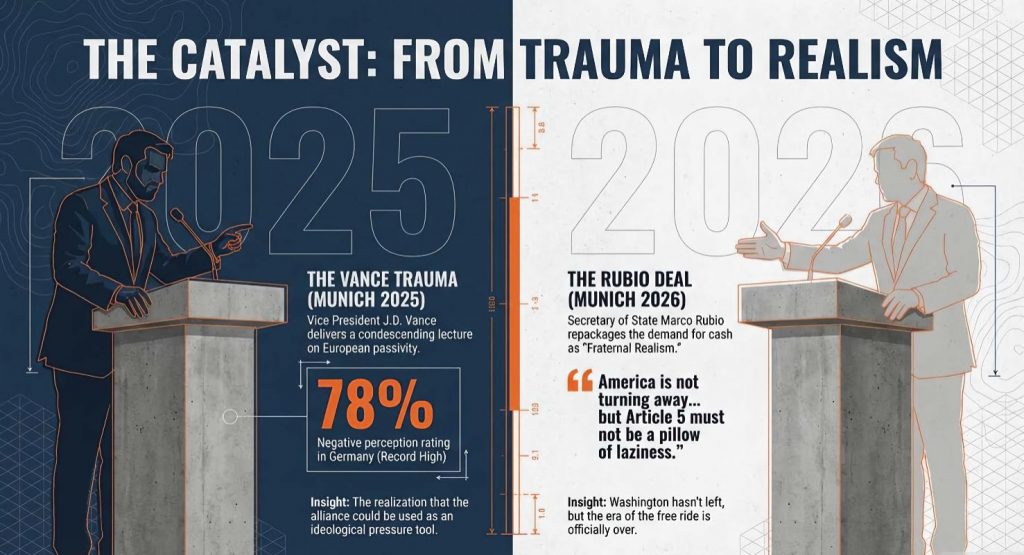
Twelve months later, the contrast is striking. But it would be naive to take comfort in Marco Rubio’s more conventional tone and conclude that tensions are behind us. The American demand remains intact—only its packaging has changed.[02] What is new, however, is the European response. For the first time in decades, it is no longer defensive or apologetic. It is offensive, assertive, and it now has a name: power.
I. Rubio’s “Fraternal Realism,” or the Art of Demanding with a Smile
The Vance Syndrome: What Munich 2025 Shattered
To understand the impact of Marco Rubio’s intervention, one must measure the depth of the wound left by his predecessor. J.D. Vance had not simply ruffled a few diplomatic feathers. In a few minutes at the podium, he had challenged the very legitimacy of the Atlantic partnership as it had been built since 1949.[03]
The German reaction was revealing. In a country where the memory of the Cold War remains vivid, where the alliance with Washington is perceived as a pillar of postwar political identity, Vance’s speech had the effect of an earthquake. The polls confirmed it: Vance retains one of the most negative images ever recorded in Germany for an American official.[04] That is the scale of the trauma Rubio had to repair.
Rubio or “Fraternal Truth”
The Secretary of State pulled off the feat of delivering an identical message in substance—Europeans must invest far more in their defense—while being applauded where Vance had been booed. The difference lies in a few well-calibrated phrases, but above all in a fundamentally different posture: where Vance lectured, Rubio engaged; where one designated defendants, the other invited partners to step up.
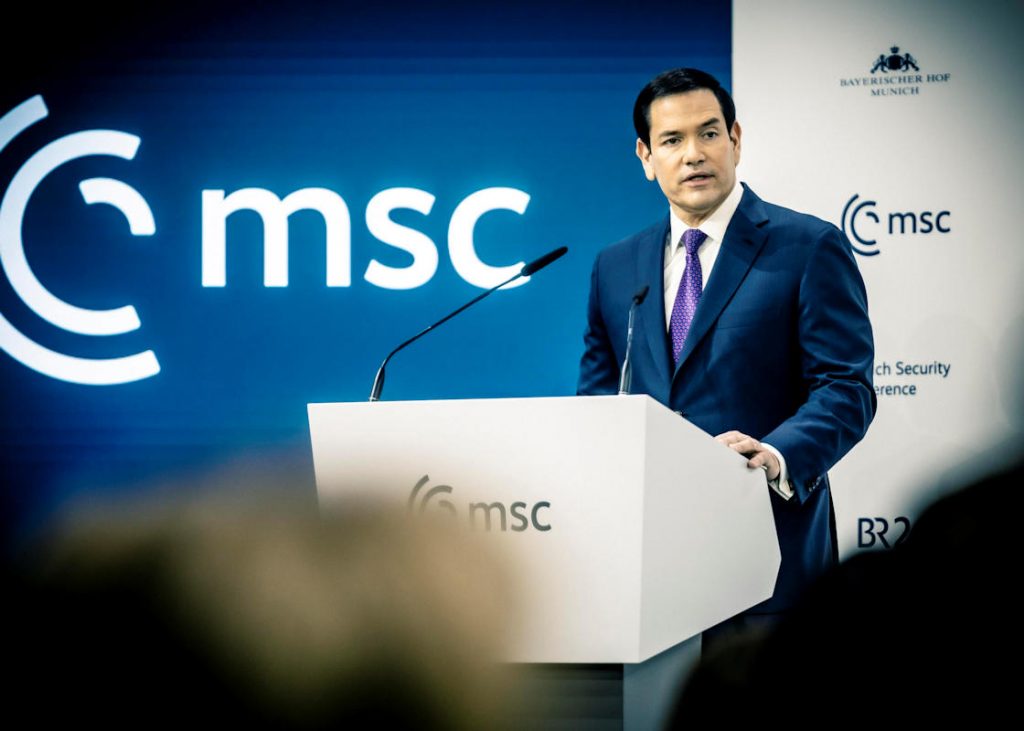
“America is not turning its back on its allies; it is asking them to grow up. Our commitment to Article 5 is sacred, but it must not be a pillow of complacency. We will stand by your side, but we will no longer be alone on the front lines.” — Marco Rubio, U.S. Secretary of State
This “strategic realism” is not a break with the Trump era—financial demands remain the same, hostility to European free-riding remains a hallmark of the administration.[05] But it signals something important: Washington has not abandoned the Alliance; it intends to rebuild it on new contractual terms. This nuance, subtle as it may be, opens a political space that Europeans would be wise to seize.
II. The European Pivot: Three Countries, Three Ruptures
1. Germany Sheds Its Restraint—Finally
The most structurally significant event of MSC 2026 probably did not come from Washington, but from Berlin. Friedrich Merz’s speech marked a genuine break with the “Kultur der Zurükhaltung”—that culture of military restraint that had made Germany, since 1945, an economic giant but a strategic dwarf.[06]
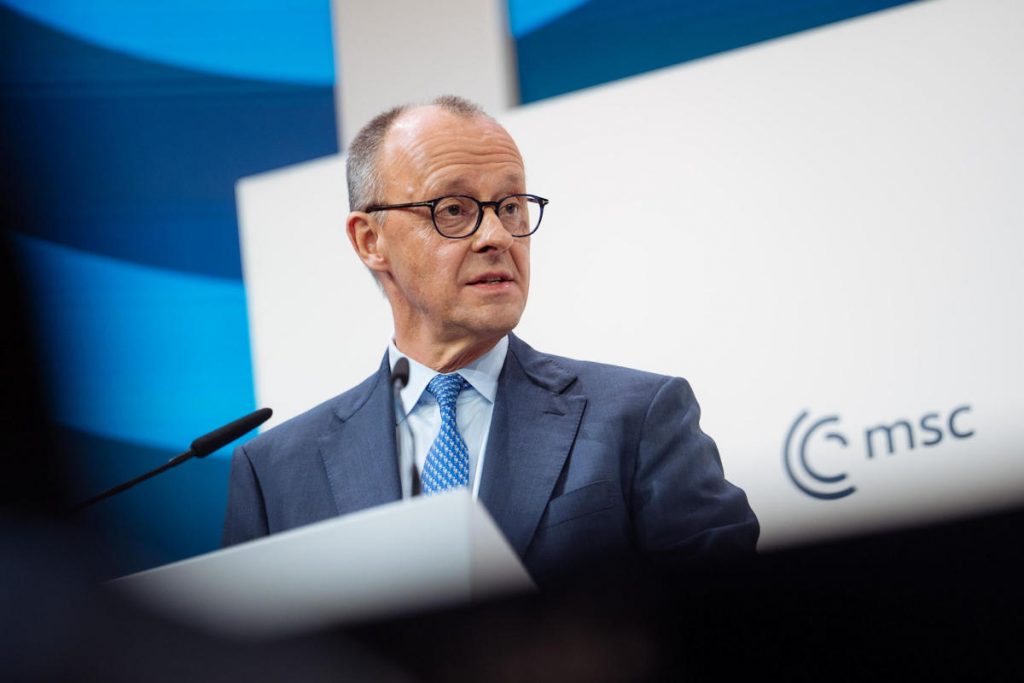
“Peace is not a natural state; it is a state we protect. Germany now assumes its responsibility as Europe’s leading conventional power. Our defense budgets are no longer adjustment variables, but the price of our freedom.” — Friedrich Merz, German Chancellor
These words matter more than they appear to. For too long, Angela Merkel’s successors conjugated strategic ambition in the conditional future tense. The “Zeitenwende” announced by Scholz after the invasion of Ukraine in 2022 long remained at the slogan stage.[07] Merz speaks of “responsibility as Europe’s leading conventional power”—a formula that finally embraces Germany’s geographic and capabilities reality. Berlin no longer asks permission to exist geopolitically.
This reversal has a concrete industrial and budgetary dimension: Germany’s new defense financing commitments, some of which now exceed the 2% of GDP required by NATO,[08] signal that this time, words are backed by action. Europe gains its most necessary driving force.
2. France, or Autonomy as Doctrine
If Berlin brings mass, Paris brings doctrine. Emmanuel Macron seized the opportunity of Germany’s renewed dynamism to accelerate his European strategic autonomy agenda, without which any rearmament would risk benefiting only American manufacturers.[09]
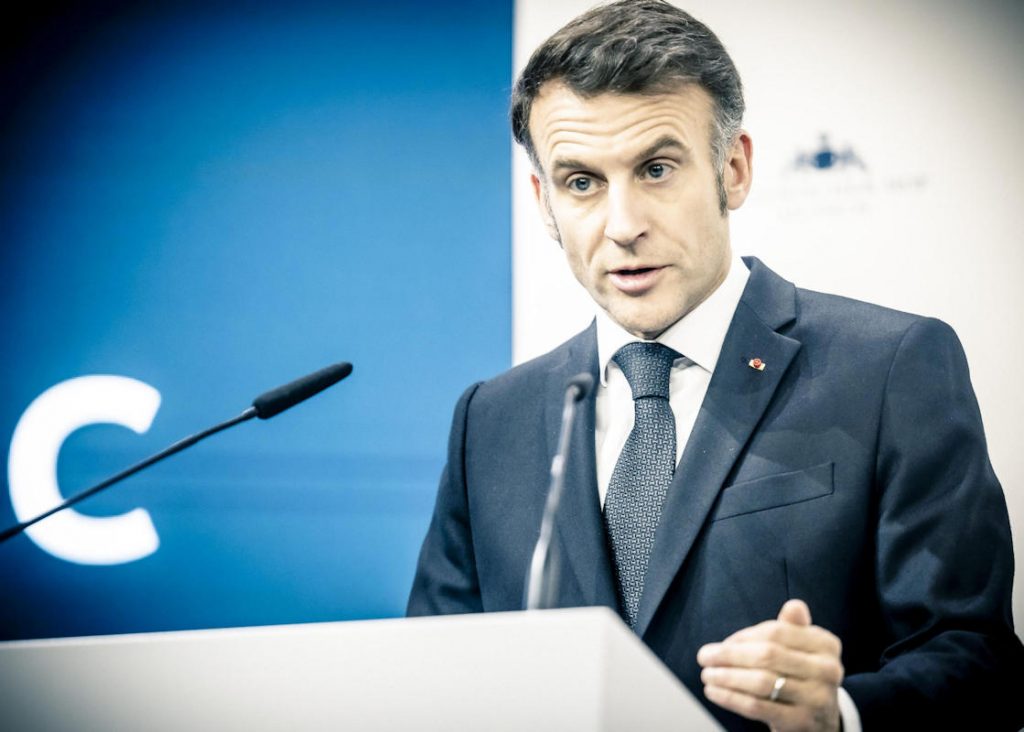
The formula “Buy European to protect European citizens” is more than a commercial slogan: it is a redefinition of what solidarity means in defense matters.
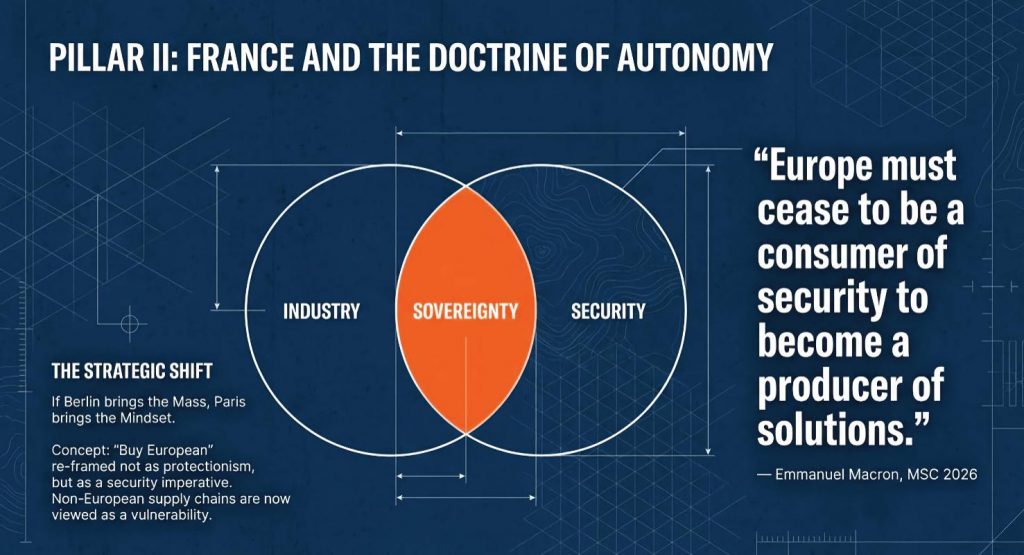
It means that European rearmament cannot be content with being a cost-sharing exercise—it must also be an industrial, technological, and political project.
3. The British and Canadian Surprise: The Architecture Expands
The most spectacular piece of news from the conference came from beyond the EU’s borders. Canada became the first non-European country officially associated with European defense structures through PESCO/CSDP projects [10]—an event that would have seemed unthinkable just five years ago.
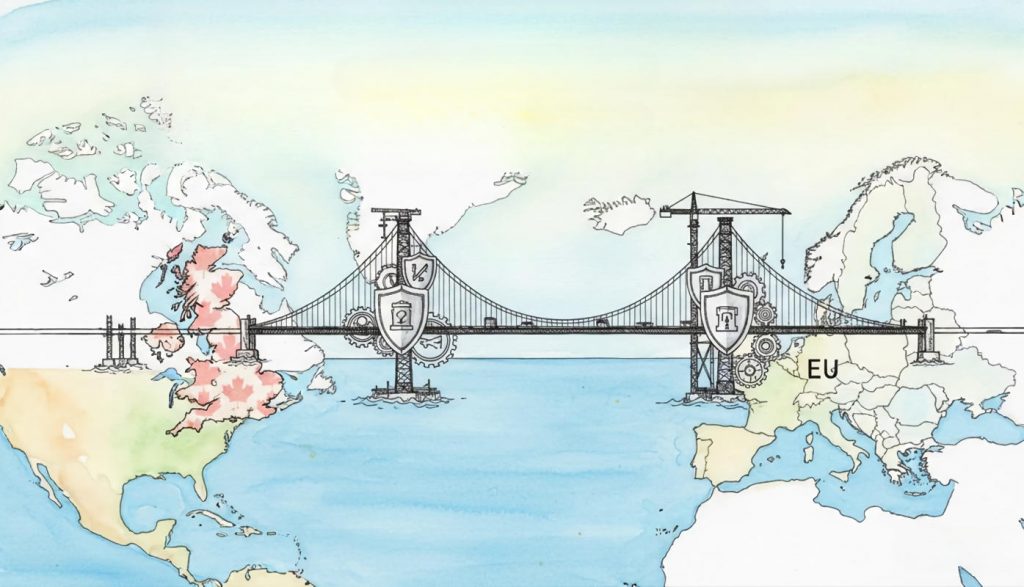
This Canadian “transatlantic bridge” is not trivial. By linking its industrial destiny to Paris and Berlin, Ottawa is sending a signal to Washington: Euro-Atlantic security can be structured without passing solely through American tutelage.[11]
For his part, Keir Starmer chose Munich to propose a “comprehensive defense pact” with the EU. His formula—“Brexit was a political separation, not a security divorce”—is both an outstretched hand and an admission: the United Kingdom needs Europe as much as Europe needs it.[12]
III. Zelensky, the War, and the Danger of “Theatrical Peace”
Against this backdrop of architectural reconfiguration, Volodymyr Zelensky played the role—uncomfortable but indispensable—of reality check. While certain European capitals, and Washington behind the scenes, were beginning to murmur the words “diplomatic off-ramp” and “exit process,”[13] the Ukrainian president reset the clock with calculated brutality.
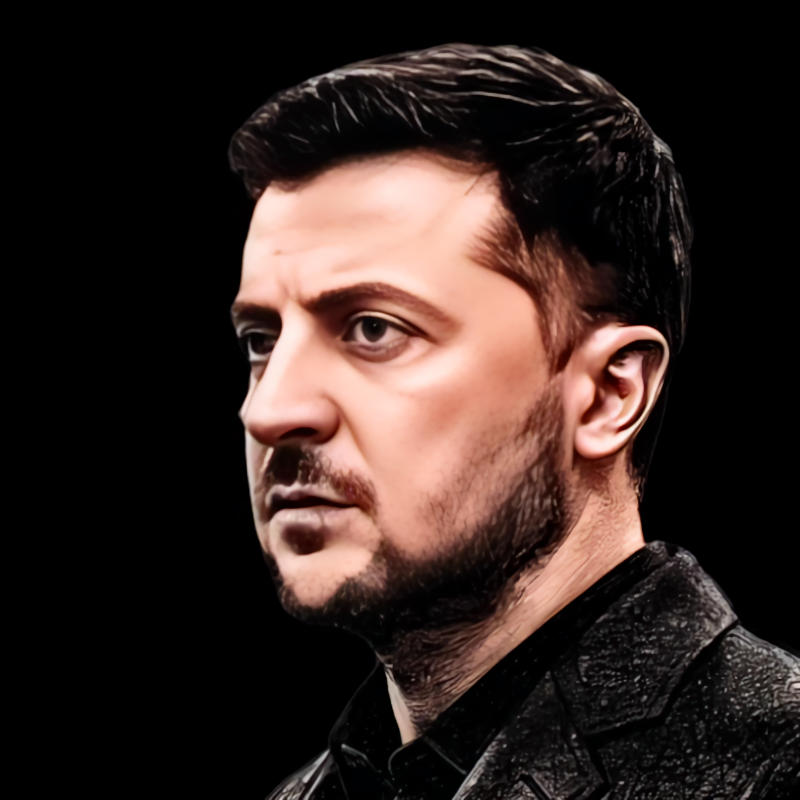
“Some propose ceasefires that are nothing but theater.
A ceasefire without security guarantees is just a pause to allow the aggressor to reload. Don’t ask us when the war will end; ask yourselves why you haven’t yet sent everything needed to finish it.”
President Volodymyr Zelensky — Portrait © European-Security
This warning comes at the right time. The history of 20th-century conflicts is littered with hastily negotiated ceasefires that only postponed and amplified future confrontations. The analogy with the Minsk Accords, which gave Moscow time to prepare militarily for 2022, is on everyone’s minds.[14]
Zelensky’s position poses a fundamental question to the emerging security architecture: can we build a powerful Europe on the rubble of a botched peace at its doorstep? The answer, strategically, is no. A Ukraine weakened by an agreement without guarantees would become the soft underbelly of an architecture whose foundations would be compromised from the laying of the first stone.
IV. What Munich 2026 Does Not Resolve
It would be tempting to conclude on a euphoric note: Europe is awakening, allies are rallying, the new architecture is being built. Reality is more nuanced, and analytical honesty demands naming its fragilities.
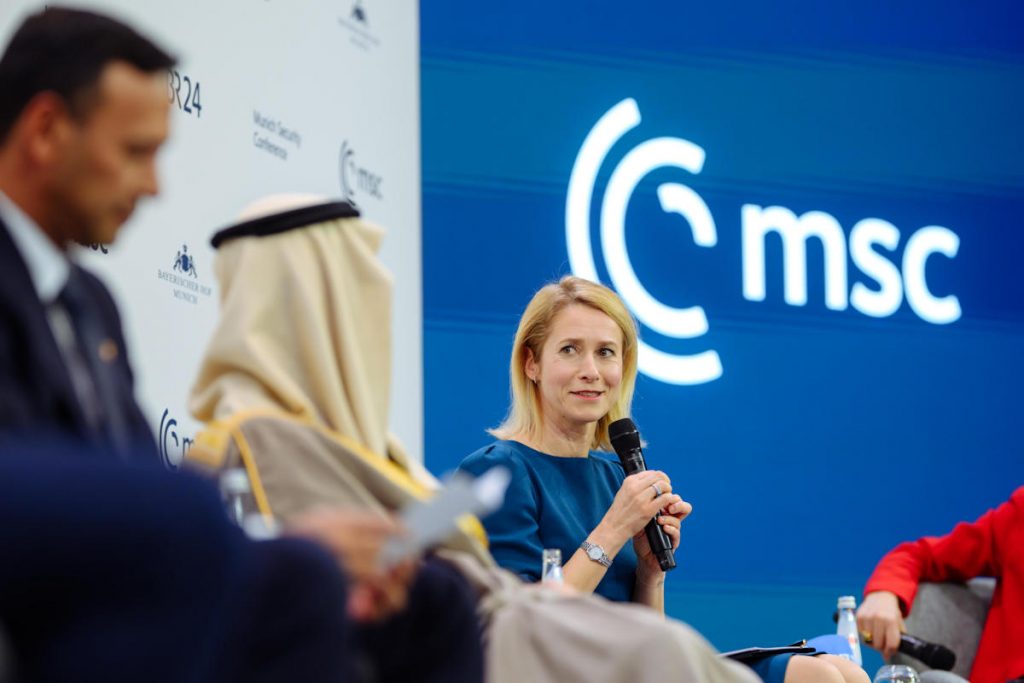
First, not all Europeans are on board with this movement. While the continent’s major powers have displayed a will to break with the past, several EU member states maintain ambiguous, even frankly obstructionist positions on issues of common financing or industrial integration.[15]
Second, Rubio’s “strategic realism” remains conditional. The American administration has demonstrated, in recent years, a capacity to change course quickly. The Article 5 guarantee remains “sacred” according to the Secretary of State [16]—Europe cannot build a durable security architecture on dependence on Washington’s goodwill.
Finally, the question of command remains unresolved. Who leads this European defense? France claims doctrinal leadership, Germany claims capabilities leadership, Poland claims Eastern urgency leadership.[17] These convergent ambitions can create energy—but also institutional paralysis if not channeled by clear governance.
Conclusion — History Accelerates
Munich 2026 will be remembered as the conference where Europe stopped asking for permission. That is no small thing. For thirty years, the continent’s security architecture rested on an unspoken assumption: the Americans will deliver no matter what. That assumption is dead. And its death, destabilizing as it may be, is perhaps the necessary condition for the birth of a truly adult Europe.
Canada associated with European defense structures, the United Kingdom extending its hand to the EU, Germany assuming its power, France carrying its doctrine of autonomy, Zelensky reminding everyone of the price of reality: these lines converge toward something that did not exist eighteen months ago.
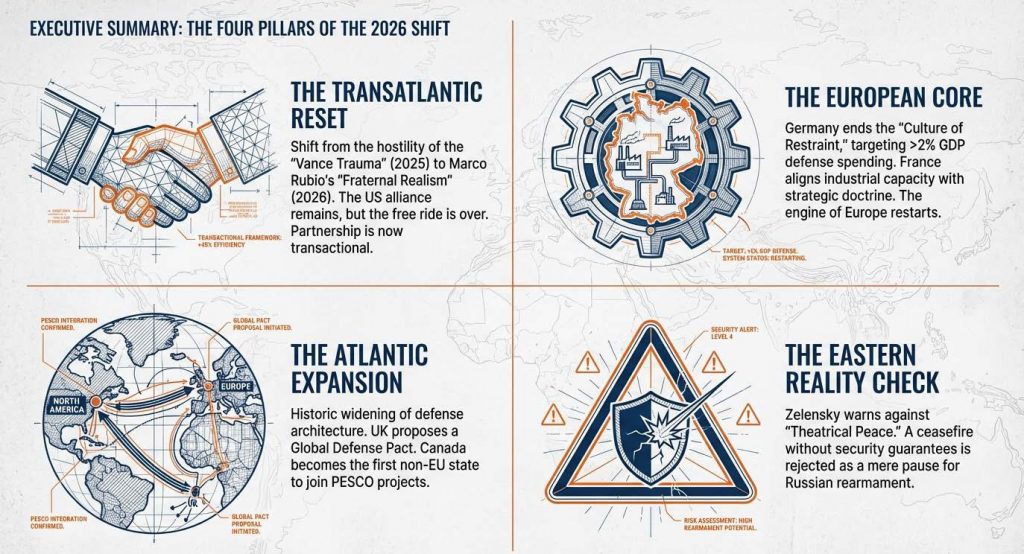
But an architecture is not decreed in the hushed calm of a Munich conference. It is built over time, in budgetary coherence, in the capacity to overcome divergent national interests, and in the political will to hold the course when the winds change. MSC 2026 laid the discursive foundations. The real test will unfold in capitals, in parliaments, and on the front lines that, in Ukraine, continue to shape tomorrow’s world.
François de Vries
[*] Analysis based on public interventions at the Munich Security Conference, February 14–16, 2onference, February 14–16, 2026. European-Security
Notes
[01] Munich Security Conference, February 2025. Speech by J.D. Vance, Vice President-elect of the United States. Full transcript available at securityconference.de.
[02] On the continuity of American burden-sharing demands, see: Hal Brands, “The Burden-Sharing Debate Isn’t Going Away,” Foreign Policy, January 2026.
[03] For an analysis of the Atlantic partnership as a community of values, see: Thomas Risse, “Transatlantic Relations After Trump,” Journal of European Public Policy, Vol. 32, 2025.
[04] YouGov / Handelsblatt poll, February 2026: J.D. Vance scores a 78% negative perception rating in Germany, a record for an American official since the Bush era.
[05] Cf. the “America First” platform and Donald Trump’s repeated statements on insufficient European contributions to NATO between 2017 and 2026.
[06] On the “Kultur der Zurükhaltung” and its historical origins: Sebastian Harnisch, “Role Theory and German Foreign Policy,” in Harnisch & Maull (eds.), Germany as a Civilian Power?, Manchester UP, 2001.
[07] Olaf Scholz’s speech to the Bundestag, February 27, 2022 (“Zeitenwende”). On the gap between announcement and actual implementation: annual report of the German Institute for International and Security Affairs (SWP), 2025.
[08] German federal budget plan 2026-2030: the Ministry of Finance projects defense spending at 2.3% of GDP from 2027, source: Bundesministerium der Finanzen, press release of January 18, 2026.
[09] On European strategic autonomy as a French project: Emmanuel Macron’s speech at the Sorbonne, April 2024, updated at Munich 2026.
[10] Permanent Structured Cooperation (PESCO / CSDP): EU defense cooperation framework created by the Lisbon Treaty (Art. 46 TEU), operationally launched in 2017. Canada’s association constitutes an unprecedented legal precedent.
[11] Canada-EU joint declaration, Munich, February 15, 2026. The PESCO projects concerned focus on cyber defense and military logistics.
[12] Keir Starmer’s intervention at MSC 2026. For post-Brexit security context: House of Commons Defence Committee, UK-EU Defence Cooperation After Brexit, report, December 2025.
[13] Leaks reported by Politico Europe and Le Monde, February 10-12, 2026, on informal discussions in Brussels around a “diplomatic element” before MSC.
[14] Minsk I (September 2014) and Minsk II (February 2015) Accords: for a critical analysis of their strategic failure, see: Andrew Wilson, “Why Minsk Failed,” European Council on Foreign Relations, March 2022.
[15] Hungary and Slovakia maintain explicit reservations on common European defense financing. See: European Council, informal summary of the January 2026 summit.
[16] Marco Rubio’s intervention at MSC 2026. Full transcript available at state.gov.
[17] On leadership competition within European defense: Piotr Buras & Gustav Gressel, “Who Leads European Defence?” ECFR Policy Brief, February 2026.
See also:
- « Vers une nouvelle architecture de sécurité » — (2026-0216)
- « Toward a New Security Architecture » — (2026-0216)
- « Auf dem Weg zu einer neuen Sicherheitsarchitektur » — (2026-0216)
Decryption
While the substance of the American message remains demanding, particularly with regard to financial burden sharing, Rubio’s approach has helped to restore a dialogue that seemed to have broken down. This American “strategic realism” now encounters a Europe in the midst of change, driven by the new dynamism of Chancellor Friedrich Merz and the desire for rearmament among its neighbors. Between the Ukrainian emergency highlighted by Volodymyr Zelensky and Emmanuel Macron’s ambitions for autonomy, MSC 2026 is shaping the contours of a Europe that is no longer content to observe, but is finally seeking its own voice as a power.