
Why should a site dedicated to European defense and security take an interest in a priest in Madagascar?
Because global security is not determined by weapons alone, but by stability. This film on Akamasoa is the visual proof that one man alone has succeeded in building peace where chaos reigned supreme. An example to reflect upon and, above all, to replicate. European-Security.com is therefore stepping out of its usual reserve today to take a stand. We do not do this out of simple emotion, but out of geopolitical realism.
Father Pedro’s masterful work at Akamasoa demonstrates that building a robust civil society is the best bulwark against endemic violence.
Christian Paris and Esteban Mathieu’s documentary provides irrefutable proof of this ‘miracle in the heart of hell’: an entire city risen from a landfill. By supporting Christian Paris’s fight to secure this Nobel Peace Prize for Father Pedro Opeka, we affirm that in the 21st century, true security comes through restored dignity and education. It is a strategic victory over poverty that the Nobel Committee must sanction.
Like Father Pedro, alongside Christian Paris and Esteban Mathieu, we too are convinced that “Poverty is not a fatality.”
Shot in late 2025 in Madagascar, this film is a landmark documentary. It is much more than a mere testimony: this film constitutes the visual and factual proof that one man alone has succeeded in reversing the course of history, transforming a landfill into a vibrant living community.
Table of Contents
by Joël-François Dumont — Paris, December 31, 2025
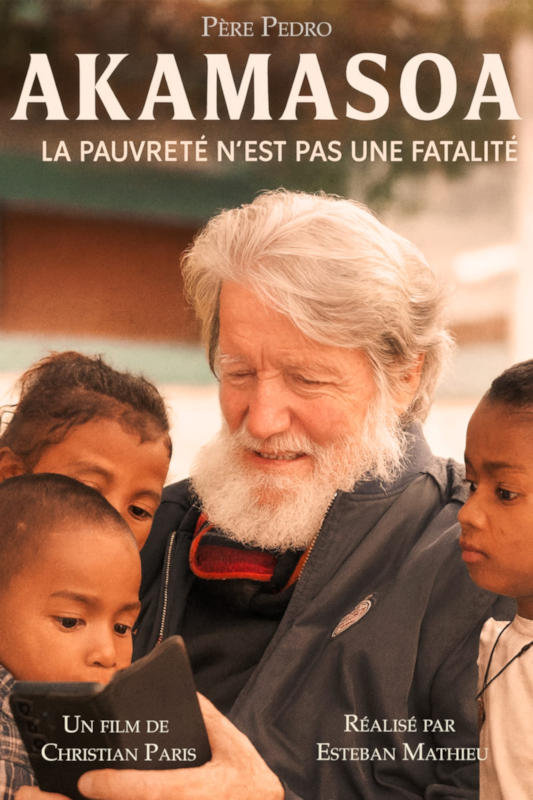
It is the indispensable piece of evidence required to under-stand both the urgency and the legitimacy of his nomination for the Nobel Peace Prize.
There are films that merely tell a story, and there are films that bear witness to History in the making. The documentary directed by Christian Paris and Esteban Mathieu belongs undeniably to the second category.
In a world saturated with images often devoid of meaning, this film acts as a brutal and magnificent revealer of a reality that Western chancelleries some-times struggle to conceptualize:
Miracles are possible, even in the heart of hell.
A film by Christian Paris, directed by Esteban Mathieu, coming soon to the big screen.
“Poverty is not a fatality”
This phrase, hammered home by Father Pedro Opeka during our radio exchanges, is not a slogan. It is the backbone of this feature film. Where other humanitarian documentaries sometimes sink into voyeurism or “misery porn,” Christian Paris’s camera chooses another path: that of dignity and respectful distance.
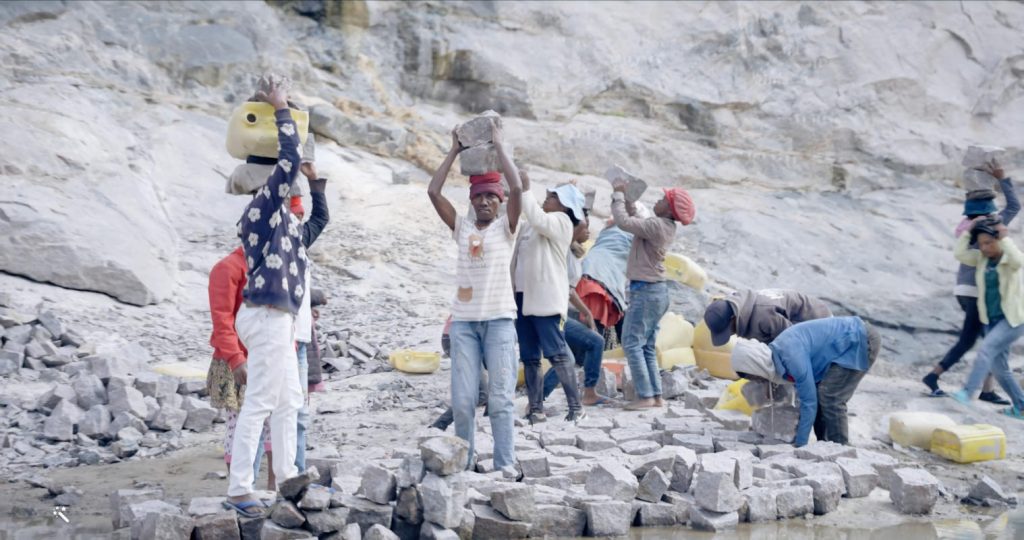
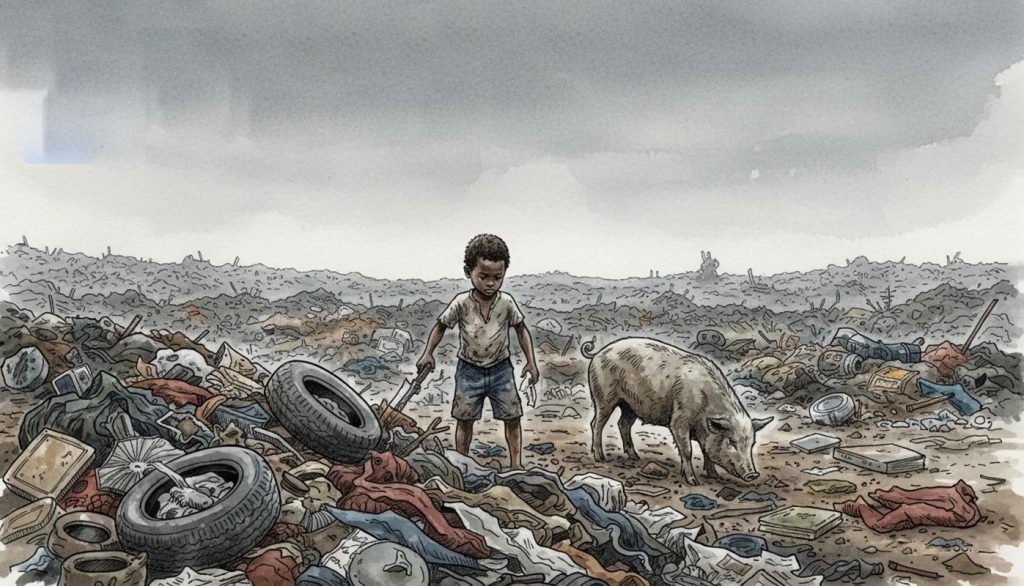
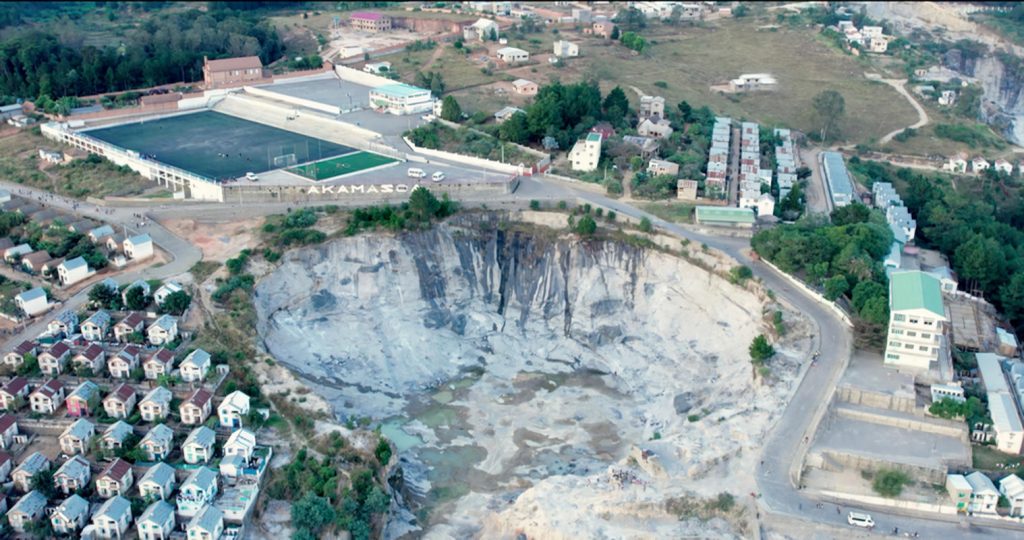
The film opens with the visual shock of the Andralanitra landfill. The director plunges us into what was the starting point: children fighting with pigs for meager scraps of food. But very quickly, the image shifts. What the viewer discovers is not charity, but work. We see a nation of builders, cutting granite to erect their own walls. The film documents with surgical precision the transformation of a mountain of garbage into a structured city of 22 villages.
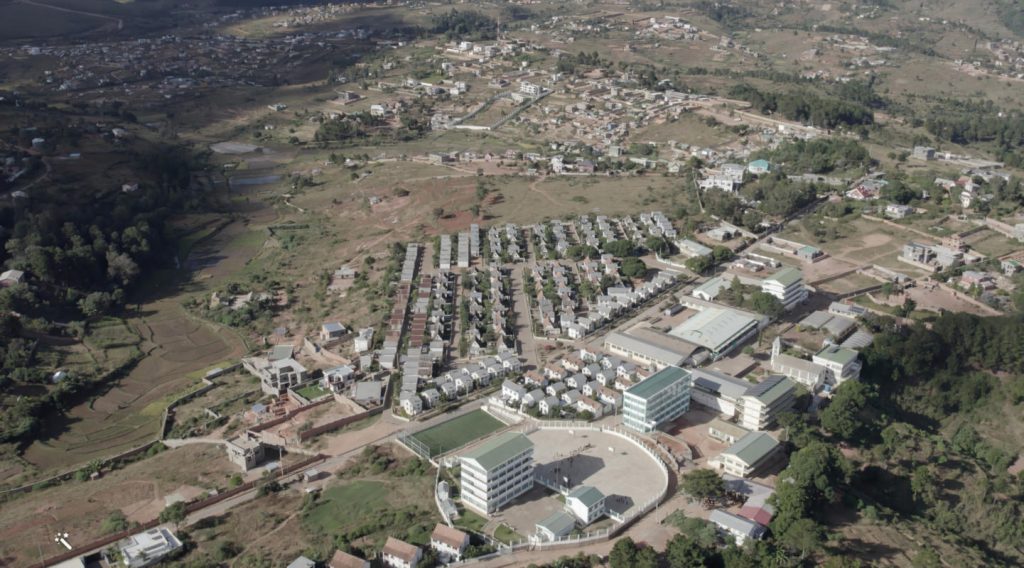
The strength of this documentary lies in its ability to show the sheer scale of the project. Wide shots of the 5,000 houses, stadiums, and paved roads provide tangible proof that we are not dealing with a classic NGO, but with a quasi-state structure.
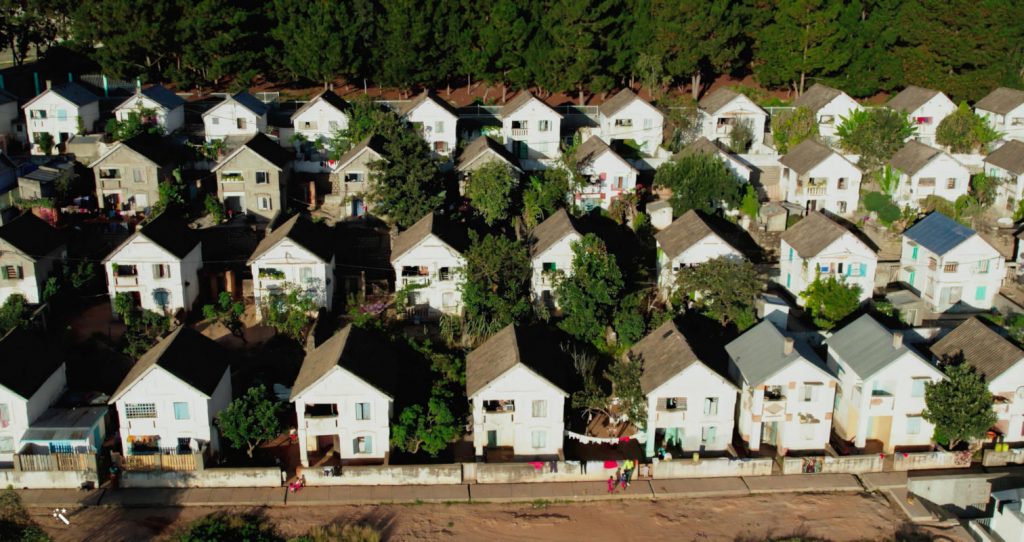
As the film’s objectives outline, one must “see to believe.” The aerial images of the “crater” transformed into a living space serve as irrefutable evidence.
Hope is a struggle
For the global security analyst, this film goes beyond reporting. It exposes a unique model of social stabilization.
Father Pedro: A model of rebellion against poverty and fatalism
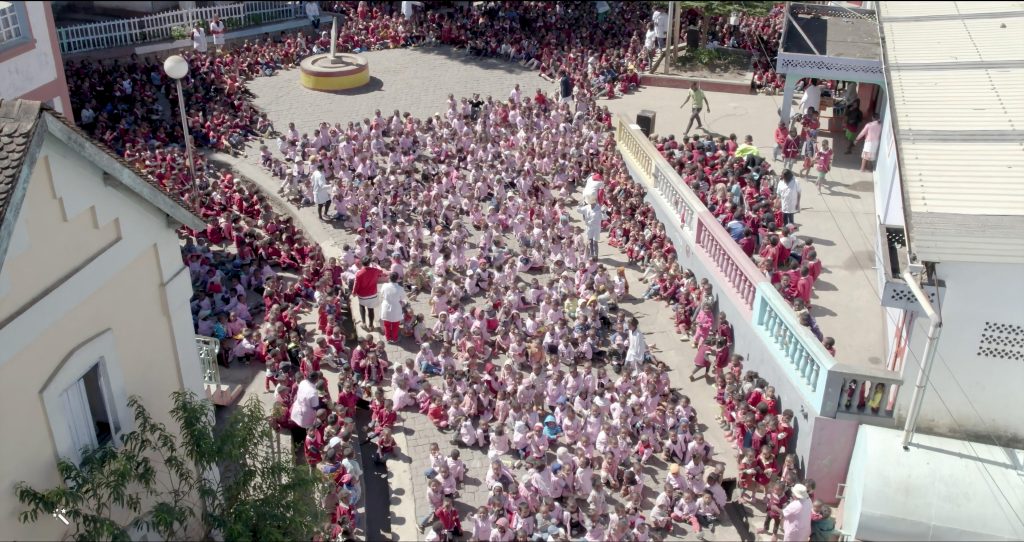
With 21,000 children currently enrolled in school and supervised by 800 teachers, Akamasoa is presented on screen as a “weapon of mass peace.” The documentary highlights these children’s faces, not as victims, but as the future doctors, professors, and engineers of Madagascar.
The realization succeeds in the tour de force of showing the man—this “tireless Sisyphus” of 77 years—without falling into hagiography.
We see a man of action, a builder whose handshake with Pope Francis—his friend and fellow Argentine—rings as a universal recognition of his model.
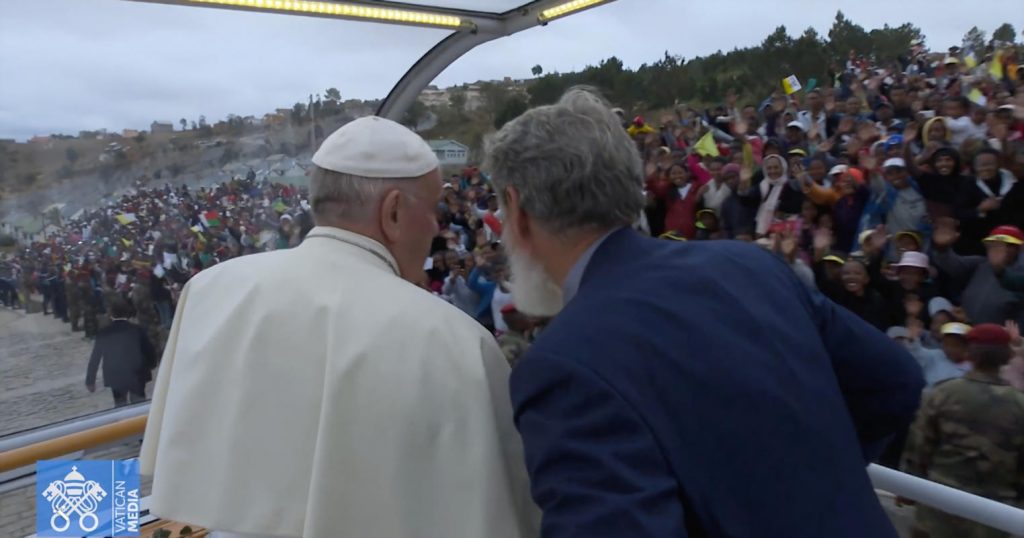
But the emotion truly peaks when Father Pedro reveals this intimate exchange, which took place amidst the bustle of the Papamobile. The Holy Father, gazing at the crowd and the houses, turned to him and whispered: ‘In this place, there is light, there is a light.’[01]
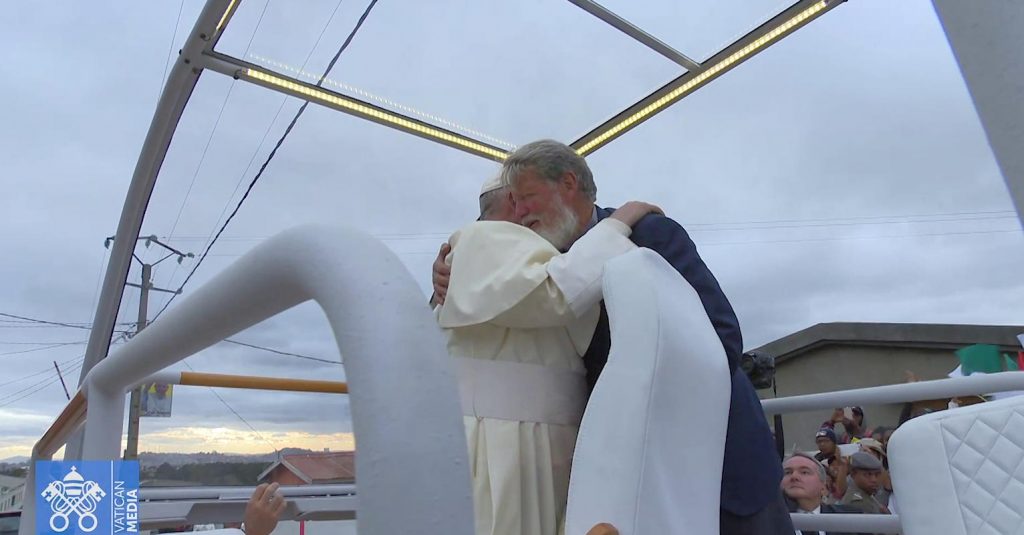
A phrase that resonates as the ultimate blessing, confirming that Akamasoa is not merely a place of survival, but a beacon of radiance.
Ultimately, this film fulfills a crucial mission: to safeguard the work. As the directors’ note suggests, the Nobel Peace Prize would not be an award for ego, but a shield to ensure the sustainability of what has been built.
Christian Paris and Esteban Mathieu deliver much more than a film here. They hand us a compelling case against cynicism and resignation. While global GDP could theoretically eradicate poverty, Father Pedro has done it concretely, on the scale of a city. This film is the proof the world needs to understand that Akamasoa is a replicable model for Africa and beyond. A must-see, to understand that hope is a battle.
Joël-François Dumont
[01] See: “The Pope prays for the light of Akamasoa to spread throughout the world”: In a particularly festive atmosphere, Francis discovered the “City of Friendship” on Sunday, founded thirty years ago by an Argentine priest to help the poor of Antananarivo living in a landfill in the Malagasy capital to regain a dignified life: work, shelter, and education. A “great work” celebrated by Francis, by Marie Duhamel in Vatican News, Vatican City (2019-0908).
See also:
- « La pauvreté n’est pas une fatalité : La preuve par l’image » — (2025-1231)
- « Poverty Is Not Fate: The Proof in Images » — (2025-1231)
- « Armut ist kein Schicksal: Der Beweis im Bild Untertitel » — (2025-1231)
Decryption: Beyond Emotion, the Strategy of a Miracle
In this exclusive podcast, the editorial team at European-Security analyzes what is undoubtedly one of the greatest structural successes of the last half-century. Far from conventional rhetoric, the facts presented here are raw and indisputable. The “Akamasoa System” is not merely humanitarian aid; it is the victory of organization over chaos.
Key figures from our analysis:
- 36 years of uninterrupted combat against fatality.
- 22 villages built with permanent structures, equipped with full state-like infrastructure.
- 21,000 children enrolled in school simultaneously, from primary school to university.
- 1 million human beings rescued and reintegrated with dignity through work.
This unique global model proves that a concrete alternative to the failure of traditional development exists. By inextricably linking security, education, and the obligation to work, Father Pedro has created a stabilization protocol that is exportable to other fracture zones, particularly in the face of the African demographic challenge.
This is no longer just a work of charity; it is a geopolitical solution to the challenges of the 21st century. As we demonstrate, awarding the Nobel Peace Prize to this work means choosing to sanctuary the future of these thousands of children and politically validating a method that has defeated poverty where it seemed invincible.
It echoes the words of Pope Francis himself when visiting Akamasoa: ‘In this place, there is light… there is a light.‘