The collapse of the Future Combat Air System (FCAS) project, as analyzed by Roger Barake, is too often reduced in European circles to a mere clash of corporate egos or an excess of nationalism on the part of Dassault Aviation. This superficial reading ignores a far more complex historical and strategic reality. In geopolitics, soothing simplifications always eventually buckle under the weight of hard facts.
Without needing to revisit centuries-old traumas like Austerlitz, Jena, or Auerstedt, it is plain to see that when it comes to industrial defense cooperation, deep-seated mistrust remains the rule between Paris and Berlin. Behind the conventional rhetoric of the “Franco-German couple”—a term that is entirely unilateral and virtually unused across the Rhine—two irreconcilable visions of sovereignty are clashing.
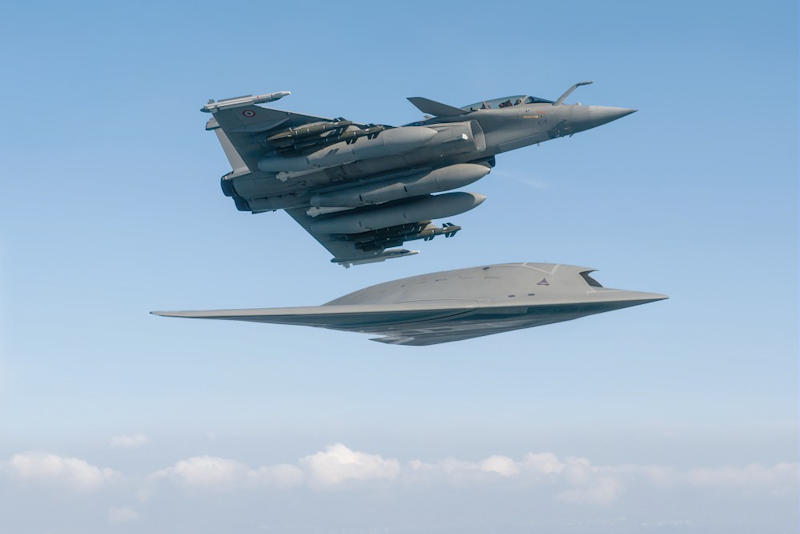
For Dassault Aviation, refusing a diluted technology-sharing agreement is not a posture of pride, but the legitimate preservation of its “crown jewels.” A fifth-generation fighter jet cannot be designed through permanent compromise or political subcontracting; it demands absolute conceptual coherence and industrial leadership. Authority must be the natural corollary of responsibility.
The Mirage of Cooperation and the Reality Check
This French industrial wariness is further rooted in a recent and glaring political reality. Lately, we have seen German officials confidently suggest “sharing” or Europeanizing France’s nuclear deterrent. The fact that Berlin is now proposing to mutualize a sovereign asset that France spent 70 years building at colossal financial expense—an asset that the German political establishment has nonetheless consistently condemned and moralized against for decades—perfectly illustrates the asymmetric nature of this partnership.
Between a Germany that favors industrial integration as a means to expand its influence and protect its interests—even if it means ultimately buying off-the-shelf American F-35s—and a France that ties its industrial base to its ultimate independence, the misunderstanding was structural. The abandonment of FCAS is no accident: it is the brutal return of national realities over the illusions of a disembodied European defense.
By RADM (Ret.) Jean-Patrick Dayras — Levant Time — Toulon, June 22, 2026 – 07:33 PM
Roger Barake’s article “Storm Warning in the European Sky” [01] presents the stated reasons for the abandonment of the FCAS project (Future Combat Air System).
This article offers a particular perspective by depicting Franco-German relations as they are perceived by many French people. It sheds specific light on this regrettable abandonment.
Here are some illuminating excerpts from the introduction of the aforementioned article:
“The program’s failure immediately reignited criticism targeting Dassault Aviation and its CEO, Éric Trappier. In certain German and European political circles, the head of the French aircraft manufacturer is portrayed as one of the main figures responsible for the deadlock. His detractors accuse him of having championed an overly nationalistic vision of the program, incompatible with the logic of European cooperation.
For several years, Éric Trappier has maintained that the problem is not European but industrial. In his view, a combat aircraft cannot be designed through constant compromises between multiple companies and multiple states. His reasoning is straightforward: responsibility must be inseparable from authority. If a manufacturer is tasked with developing the primary aircraft, it must also hold the corresponding decision-making power.
Two competing visions of European defense have clashed since the program’s inception.
The first, often associated with Berlin and European institutions, favors the sharing of expertise, industrial integration, and the pooling of technologies.
France requires an aircraft capable of operating from aircraft carriers and of contributing to the airborne component of its nuclear deterrent. Germany shares none of these requirements. As for Spain, its primary concern is securing its place in the European aeronautics industry.”
These excerpts perfectly illustrate two opposing visions: Dassault, which only seeks leadership and design control over its own portion of the program, is genuinely concerned with upholding a conceptual and industrial coherence that guarantees the production of a high-performance aircraft — one whose development and manufacture for the benefit of the Air Force, and also the Navy in France’s case, would be faster and certainly less costly than a model designed under multiple constraints and modifications, some of which would be rejected by one partner or another on the grounds that they are not relevant to them (such as features related to carrying a nuclear weapon or carrier landing, which concern only France — something none of the parties was unaware of from the outset).
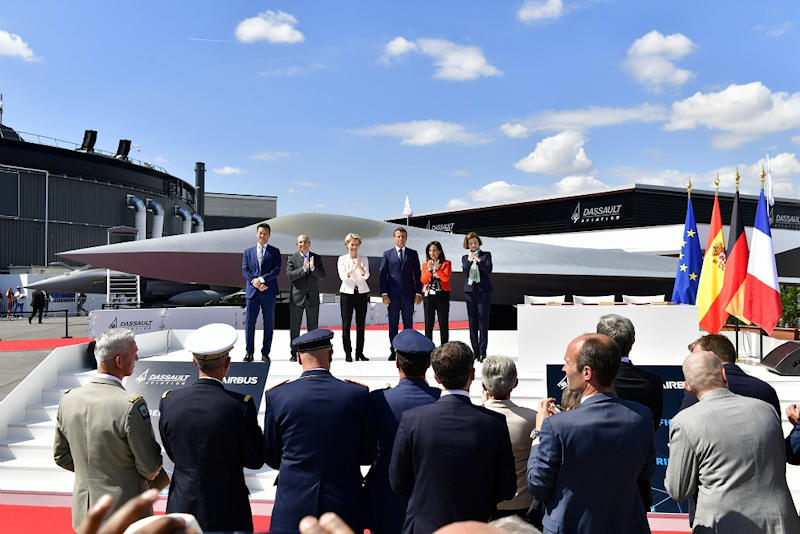
Reading these excerpts alone highlights the crux of the mutual misunderstanding between the two viewpoints. Berlin, with Europe behind it, favors the sharing of expertise, industrial integration, and the pooling of technologies. Dassault prioritizes efficiency and its own experience-based competence as it relates to the aircraft itself — and only the aircraft — thereby preserving its know-how.
It is therefore necessary to revisit a few key points in order to explain what lies beneath the divergence between the French and German perspectives — a genuine disagreement, in fact.
In his remarkable biography of Talleyrand, Jean Orieux precisely identifies what still burdens, to this day, a healthy relationship and genuine understanding between the two countries.
At the Congress of Vienna in 1815, following the fall of Emperor Napoleon,“Prussia was constantly demanding Saxony, the Rhineland, Luxembourg, and Belgium; England backed its claims on one point: the Rhineland.”
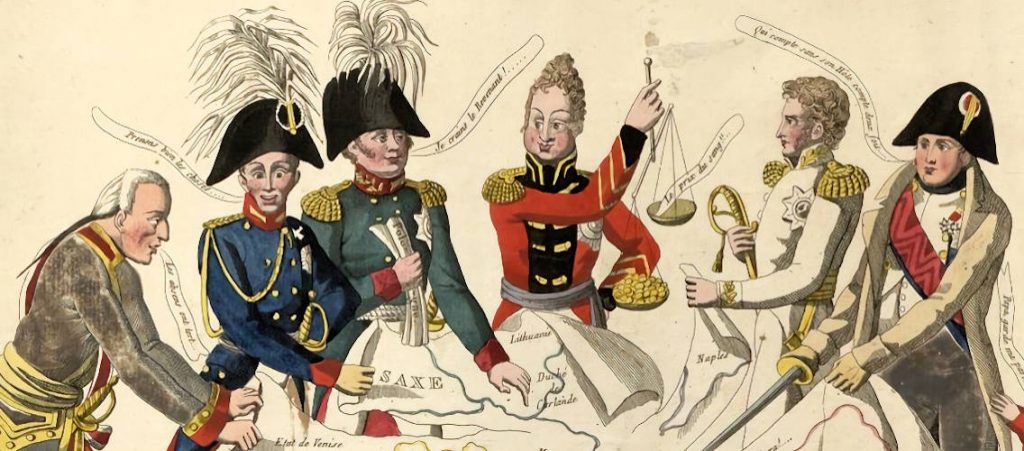
She did it above all to position a war machine on the French border (…) Napoleon had been brought down in the name of European security. The Rhineland was given to Prussia, and European security was ruined for a century and a half (…) France thus found itself under the menacing watch of an army permanently stationed 220 km from Paris along an open border. A nation drunk on hatred since Jena was being installed at our doorstep. England (…) was freely setting up a fearsome watchdog on the Rhine. The rest is history: Bismarck, Sadowa, Sedan, the annexation of Alsace-Lorraine, the War of 1914, Hitler. Europe, murdered.
The consequences are still felt today, including in the Middle East: after Hitler, one must add that in order to erase the guilt of the Holocaust, a Jewish state was created on already-occupied land. Lebanon stands as both witness and victim.
Jean Orieux does not mince his words — his choice of language makes that clear — when he speaks of a nation drunk on hatred since Jena.
More temperately, one might ask whether a certain animosity among Germans toward the French today is not the distant, post-Jena legacy of having been represented at the signing of the unconditional surrender of German armed forces — thereby ending World War II in Europe — on May 7, 1945.
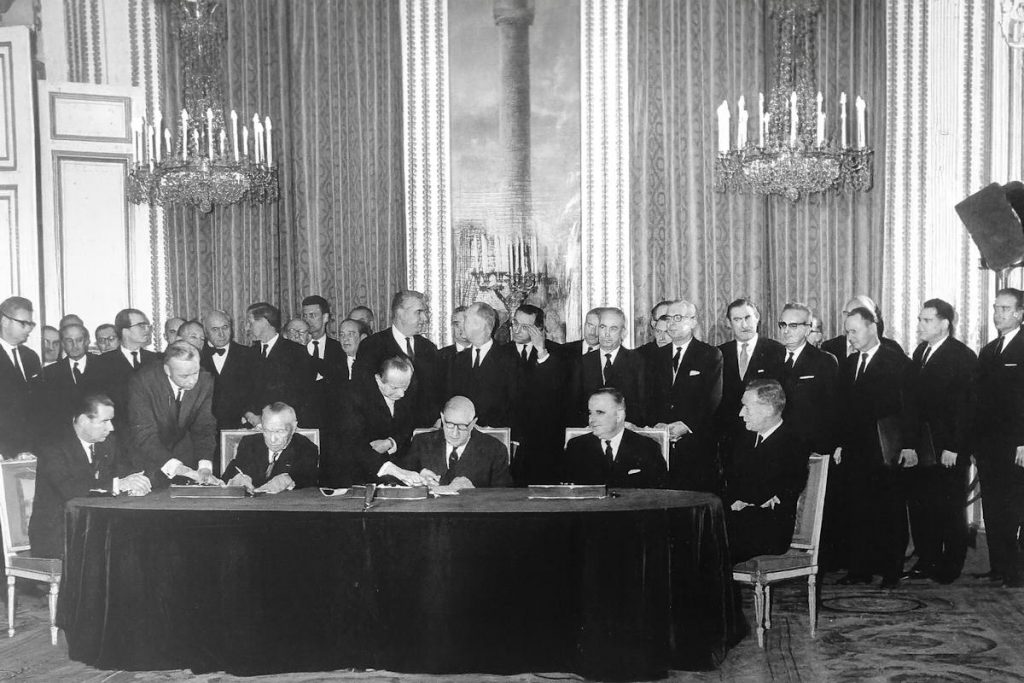
In 1962, De Gaulle invited Adenauer to attend a Mass at Reims Cathedral — a city symbolic of Franco-German conflict — to demonstrate the will to turn the page on past wars, cement lasting reconciliation, and make Franco-German cooperation a driving force in European integration.
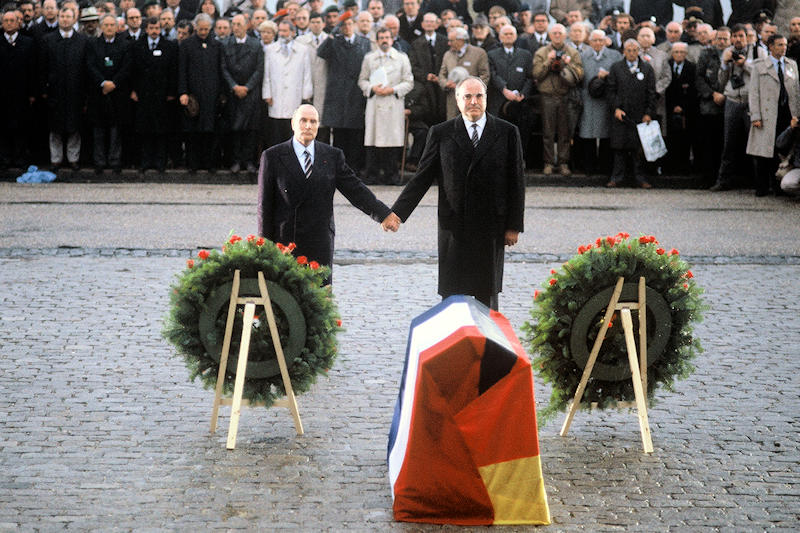
On September 22, 1984, during commemorations of the Battle of Verdun, Mitterrand and Kohl joined hands before the Douaumont ossuary — a symbol chosen to seal European reconciliation, deepen European integration, and consolidate peace in Europe.
On both occasions, the two French presidents were driving forces behind a sincere and definitive reconciliation. De Gaulle and Adenauer built that reconciliation; Mitterrand and Kohl deepened it, making the Franco-German partnership the engine of Europe.
Why, then, is there a perceptible cooling of relations? Today, while France still speaks of a Franco-German couple, the term has fallen out of use in Germany.
The creation of a Euro so unfavorable to France in terms of trade, the deindustrialization of France orchestrated in part by Germany, Merkel’s unilateral decision to abandon nuclear energy — which put France in the dock before the court of German and French environmentalists — and the rules governing electricity pricing in Europe [02] as applied in France all point to an animosity toward the French on the part of those we call ‘our friends.’
But nations have no friends — only partners, and sometimes allies, for as long as the alliance holds.
French politicians are forcing France into European integration at a breakneck pace; yet are the Germans not often pushing for a European Union that serves German interests?
It is without doubt too early to declare Dassault — and by extension France — guilty. Time will tell which aircraft Germany chooses to buy. The F-35? [03]
RADM Jean-Patrick Dayras
[01] « Storm Warning in the European Sky » — Levant Time — (2025-0613)
[02] Pegging electricity prices to the price of gas is disadvantageous to nuclear-powered France. This measure is ostensibly designed to facilitate the energy transition by incorporating more renewable energy. Germans argue that nuclear power does not fall under the category of renewables — yet they have partially offset the elimination of nuclear energy with coal-fired power plants!
[03] To supplement its fleet of 35 aircraft ordered in haste in 2022, with entry into service expected in 2028.
See also:
- « The Abandonment of FCAS: Autopsy of an Industrial Dinosaur in the Age of Algorithmic Warfare » — (2026-0703)
- « Das Scheitern von FCAS: Autopsie eines industriellen Dinosauriers im Zeitalter der algorithmischen Kriegsführung » — (2026-0703)¨
- « L’abandon du SCAF : Autopsie d’un dinosaure industriel face à la guerre algorithmique » — (2026-0703)¨
- « Retour sur le projet d’avion de combat franco-allemand » — (2026-0622)
- « Revisiting the Franco-German Fighter Jet Project » — (2026-0622)
- „Rückblick auf das deutsch-französische Kampfflugzeugprojekt“ — (2026-0622)
- « Avis de tempête dans le ciel européen » — (2026-0613)
- « Storm Warning in the European Sky » — (2026-0613)
- « Sturmwarnung am europäischen Himmel » — (2026-0613)