Dragged by Israel into an escalating war with Iran, without having analyzed all its strategic implications, the United States is learning a hard lesson. This lesson boils down to a simple, fundamental principle: one cannot pursue multiple strategic goals simultaneously in a war. Furthermore, one must know how to choose the right one, at the right time.
by Vice Admiral Christian Girard — Toulon, July 14, 2026.
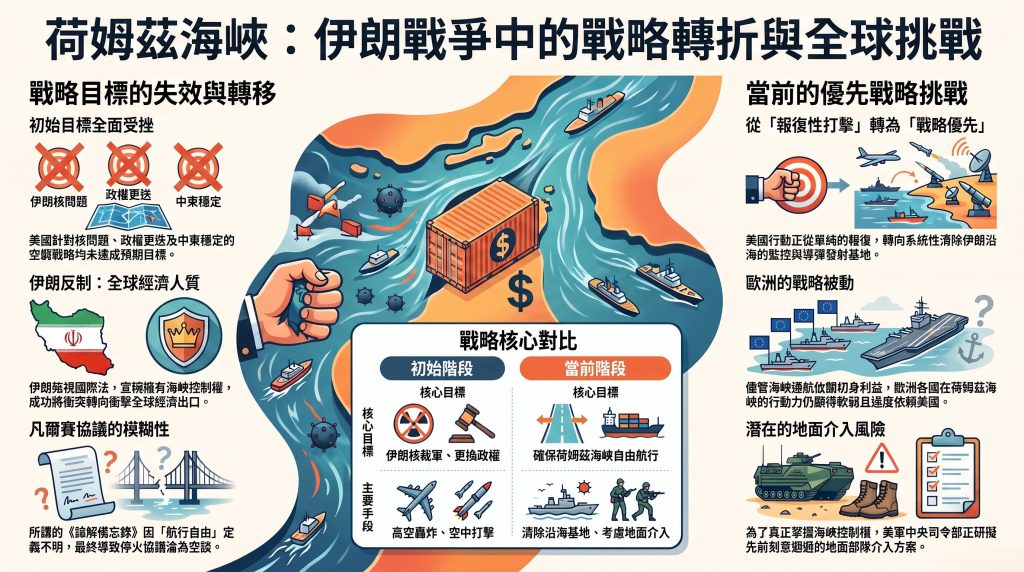
The initial objectives were to resolve the Iranian nuclear issue, achieve regime change, and, in doing so, ensure the stability and security of a Middle East where Israel would be both legitimized and dominant. A campaign of airstrikes was supposed to make this possible. None of these goals have been achieved, regional stability has deteriorated, and a majority of commentators have consequently concluded that the strategy has failed.
However, like the genie of Aladdin’s lamp, Iran has retaliated by conjuring up the issue of freedom of navigation in the Strait of Hormuz, over which it now claims control in defiance of international law. Upending the strategic chessboard, Tehran has raised the stakes by targeting the global economy. The analysis of the geographical situation and the critique of US military operational strategy it allows were detailed in our previous analyses.
Recently, a short-lived protocol (Memorandum of Understanding) was signed as a basis for further negotiations aimed at a subsequent settlement of all strategic issues. It included a ceasefire that was quickly compromised. Its signing, however, allowed the US President to celebrate his birthday in grand style at Versailles. Although diplomatic contacts between the parties reportedly continue today, the ceasefire is now nothing more than a memory.
The protocol, like so many diplomatic papers, was drafted in such a way that each party could interpret it in its own best interest; the priority was not the effectiveness of its implementation, but the mere fact that it was signed at a given moment. In this case, the foundational ambiguity of the agreement lay in what “freedom of navigation in the Strait” actually meant and how it would be implemented.
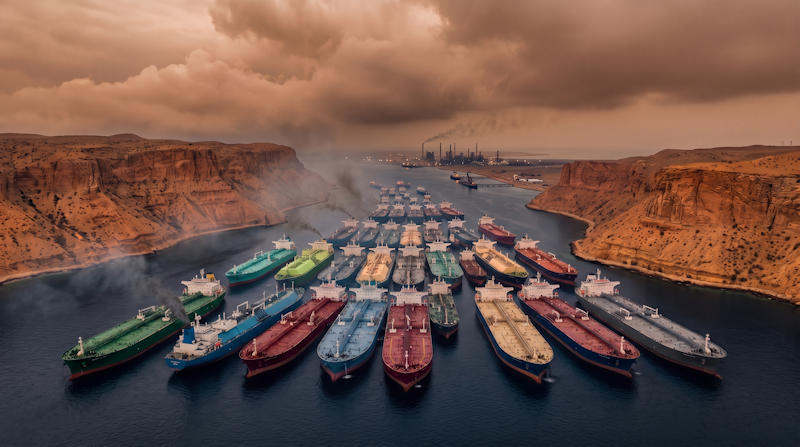
As previously noted, freedom of navigation in the Strait did not initially appear to be a strategic priority for the United States. It seems to have become one now, at least partially, though Washington has yet to draw all the necessary military operational conclusions.
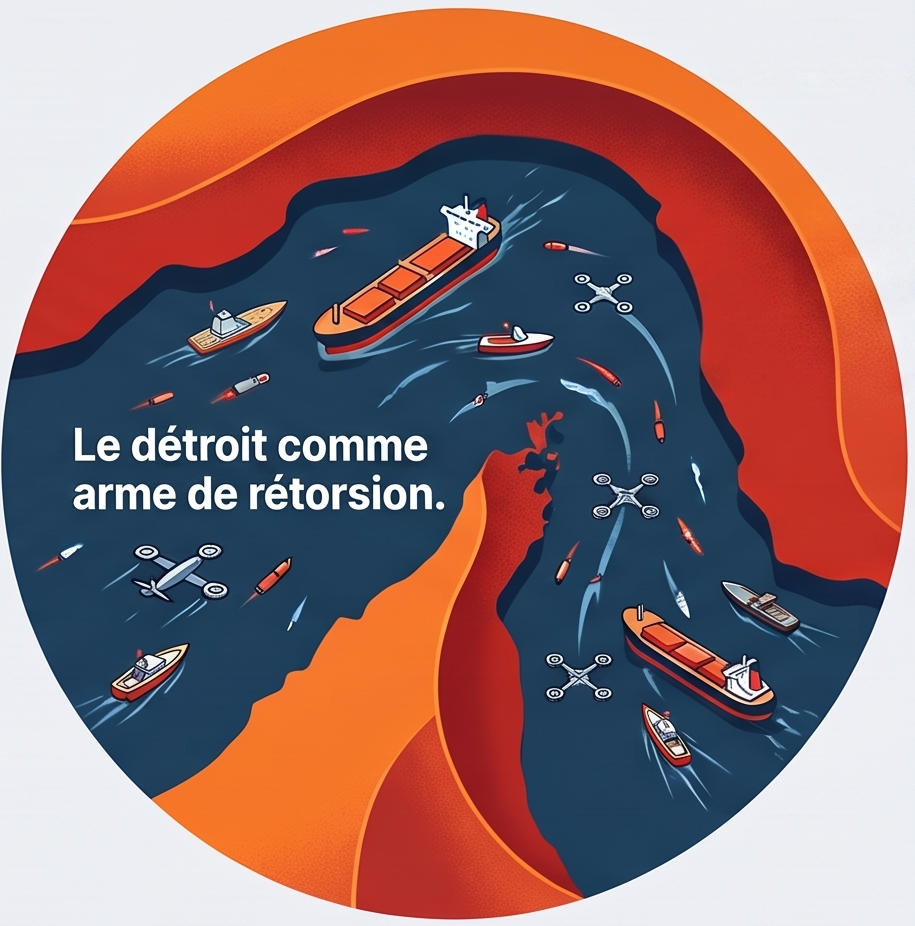
While the hope of ending the direct confrontation through diplomacy seems to persist on the American side, retaliatory measures against Iranian attacks are now targeting coastal sites around the Strait. These sites serve as surveillance outposts, launch bases for drones and missiles, or shelters for remaining fast attack craft. The objective is indeed to deprive Iran of the physical capability to obstruct maritime traffic.
The strait as a weapon of retaliation — Infographic © European-Security —
Yet, this still seems to be done as a retaliation rather than as a primary and major strategic objective. Meanwhile, the stakes are critical for many countries worldwide, particularly in Europe. We have previously deplored their pusillanimity on this issue—a lack of resolve they did not exhibit in the Bab el-Mandeb Strait.
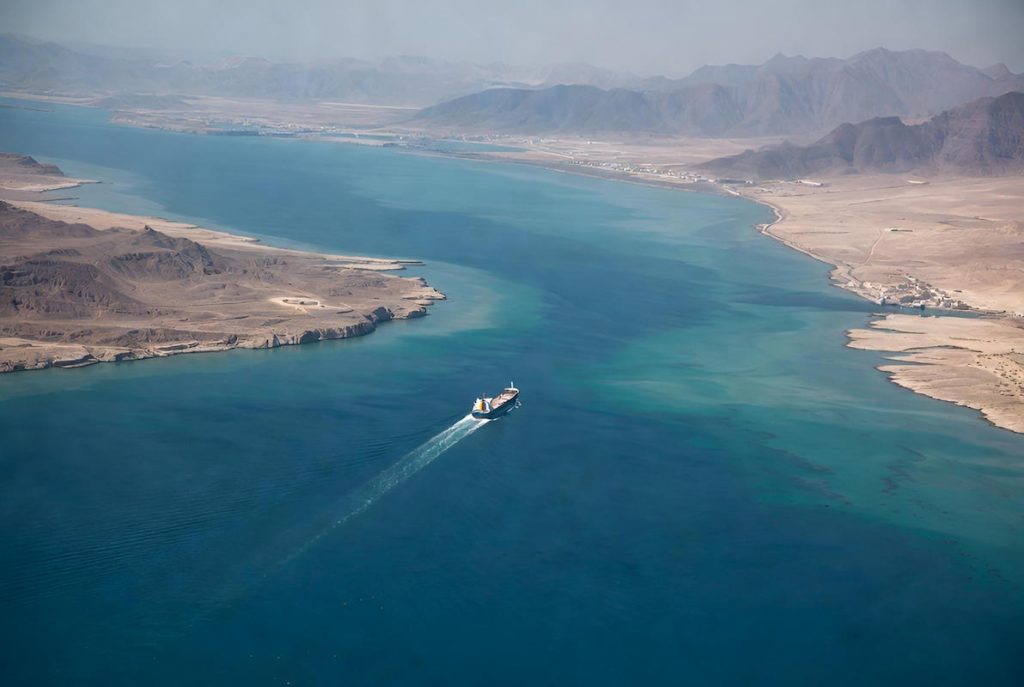
Will the American president finally understand that this is his true strategic priority, as it constitutes the key to the resilience of the Islamic Revolutionary Guard Corps (IRGC) regime? The stubbornness of Iranian negotiators should lead him to this conclusion. If so, US military operations to assert effective control over the Strait should intensify. The operational details are certainly under review at CENTCOM, with the main question inevitably being the feasibility and modalities of a ground intervention—an option avoided until now.
Christian Girard
(Cover photo: A U.S. Air Force F-35A Lightning II flies over the U.S. Central Command area of responsibility on June 19, 2026 — US Air Force Photo by Airman 1st Class Adriana Jordan-Alcaniz)
See Also :
- « Le blocus du détroit d’Ormuz (1) » — (2026-0429)
- « The Blockade of the Strait of Hormuz (1) » — (2026-0429)
- « Die Blockade der Straße von Hormus (1) » — (2026-0429)
- « Faut-il sauver le soldat Trump ? (2) — Le détroit d’Ormuz et l’autonomie stratégique européenne » — (2026-0514)
- « Should We Save Soldier Trump? (2) — The Strait of Hormuz and European Strategic Autonomy » — (2026-0514)
- « Muss der Soldat Trump gerettet werden? (2) — Die Straße von Hormus und die strategische Autonomie Europas » — (2026-0514)
- « Le détroit d’Ormuz (3) : L’enjeu stratégique immédiat et prioritaire de la guerre d’Iran » — (2026-0714)
- « The Strait of Hormuz (3): The Immediate and Priority Strategic Stake of the Iranian War » — (2026-0714)
- « Die Straße von Hormus (3): Die unmittelbare und vorrangige strategische Herausforderung im Iran-Krieg — (2026-0714)
Decryption: The Hormuz Trilogy and the Failure of American Naval Hubris
With this third installment, Admiral Christian Girard completes a relentless strategic trilogy on the Strait of Hormuz crisis, confirming point by point the diagnoses established in his previous analyses. Last April, in his first text dedicated to the ghost of a blockade, he demonstrated with a sailor’s rigor that the challenge was not so much physical as psychological and declaratory—Iran successfully taking the world economy hostage through the mere “announcement effect.” In May, in his memorandum “Should We Save Soldier Trump? (2)”, the Admiral pushed his operational critique further, denouncing the dead end of a techno-centric approach and American hubris: the illusion that a purely naval and air power could control the land without putting “boots on the ground,” even as Iran skillfully shifted the conflict to the shoreline and the infrastructure of its neighbors.
This third chapter records a definitive shift on the chessboard. The glaring failure of the US airstrike strategy—originally aimed at the regime and its nuclear program—has allowed Tehran to wield control of Hormuz as a weapon of mass retaliation.
In light of the fleeting nature of the diplomatic protocol celebrated at Versailles, this third installment envisions a refocusing of US strategy toward the long-neglected goal of establishing effective military control over the Strait of Hormuz—a task that is far from complete. For Europe, this outcome validates the Gaullist warning issued in the second part of the saga: in the face of a failing historical protector, freedom of navigation and the law of the sea cannot be bought off the shelf in Washington. The European Union must urgently summon its own fighting spirit and assume an autonomous military posture—not to rescue American calculations, but to defend its vital interests where the future of global trade is being decided.