In his striking first essay, Clausewitz at Hormuz: The Impossible Memorandum, Jérôme Denariez immersed us in the intricacies of an absurd diplomacy, demonstrating the impossibility of drafting a rational compromise when the logic of pure war seizes a global chokepoint. With this second volume, Hormuz: The Return of Reality, the author breaks free from diplomatic fictions to confront us with the only truth that now matters: the truth on the ground.
From the Impossible Compromise to the Brutality of Facts
Beyond a perfect synergy with Admiral Girard’s analyses, we observe the exact same lucidity in both authors: one that marks the end of technological illusions and the great return to the brutality of reality. In the face of the blockade, armchair rhetoric fades before geography, economics, and brute force. An implacable breakdown that sounds a wake-up call for the West.
Table of Contents
by Jérôme Denariez — Paris, July 9, 2026.
After the memorandum: Hormuz, uranium, and the return of reality
When the text becomes the dashboard of disagreements
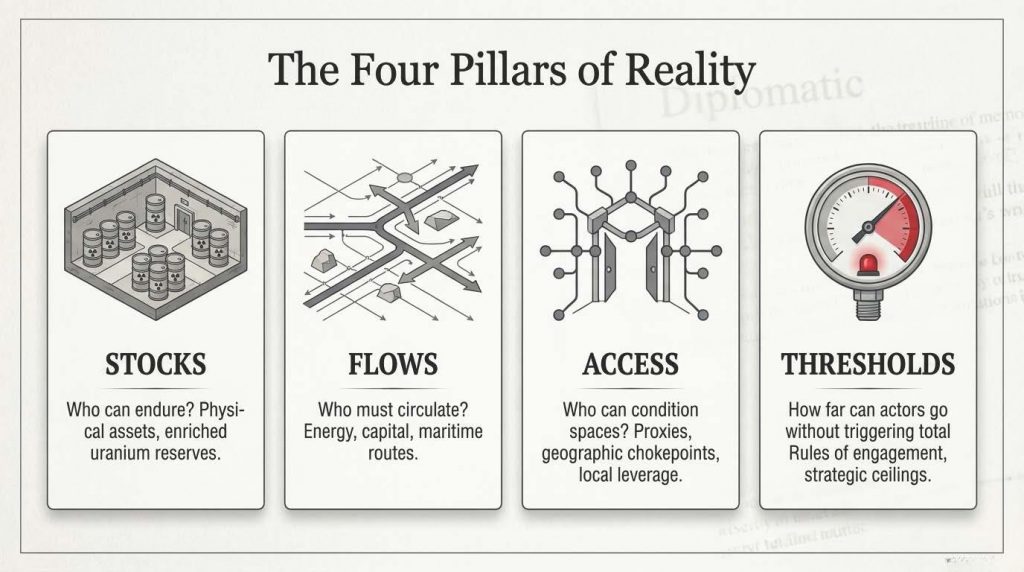
Last week, I proposed a framework for interpretation based on stocks, flows, access, and thresholds. The idea was simple: a war cannot be understood solely through strikes, press releases, or military maps. It must also be read through what circulates, what blocks, what gets refinanced, what gets insured, what gets renegotiated, and what becomes conditional.
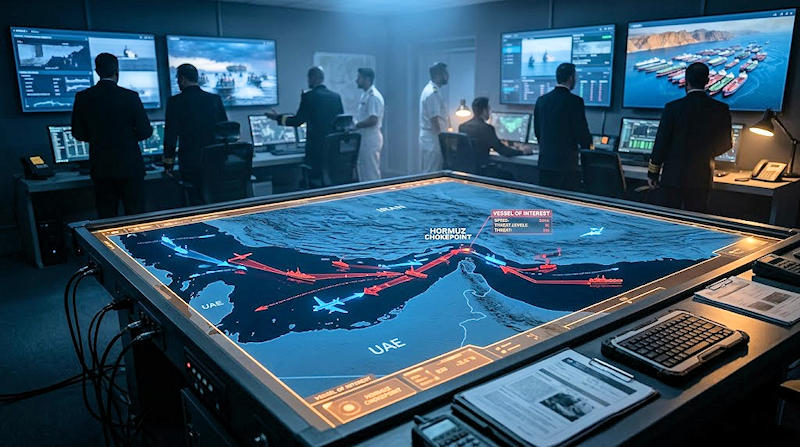
Events are now giving this framework an almost brutal materiality. The climax came with the July 8 press conference at the NATO summit in Ankara, during which Donald Trump declared the ceasefire over and announced that the United States would strike Iran “hard” again that very evening.
Since then, the situation has moved from rhetoric to action. The United States has resumed strikes against Iranian targets linked, in particular, to drone, missile, coastal defense, and surveillance capabilities in the Strait of Hormuz. Iran claims that these strikes left at least fourteen people dead and seventy-eight wounded. Tehran then retaliated against U.S. and allied facilities in the Gulf, notably in Bahrain, Kuwait, and Qatar.
The memorandum was supposed to close a sequence. It no longer really holds as a ceasefire. Yet, it continues to function as a dashboard: uranium, Hormuz, inspections, sanctions, proxies, guarantees, alliances, and strike thresholds, allied discipline, internal consistency of regimes.
The text no longer stabilizes the crisis. Instead, it reveals its breaking points.
We are no longer fighting just to know who won the war. We are fighting to know what the ceasefire actually authorized, who validates the reopening of Hormuz, who controls the stockpiles of enriched uranium, who speaks on behalf of Lebanon, who reassures the Gulf, who restrains Hezbollah, who provides Iran with a financial exit ramp, that is holding Israel back and who turns this crisis into a precedent.
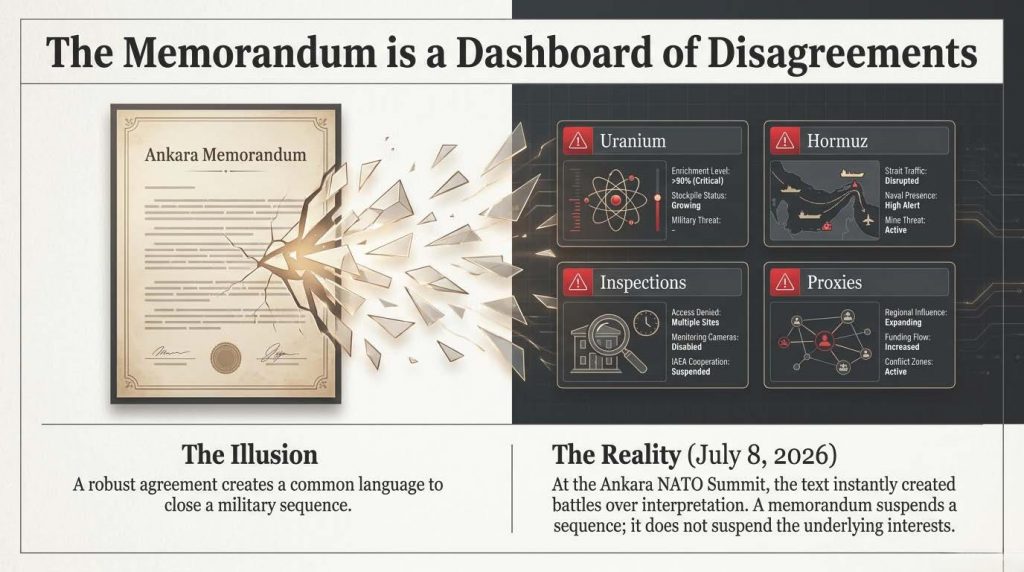
A memorandum can suspend a military sequence. It does not suspend the interests that made it necessary in the first place. Negotiations that start off on the wrong foot.
A negotiation that begins by contradicting itself
Diplomacy often reveals the solidity of an agreement in the hours immediately following its announcement. A robust agreement creates a common language. A fragile agreement immediately triggers a battle over words: who is negotiating, where, with what mandate, on what scope, with what trade-offs, and under what constraints.
This is exactly what this sequence demonstrates.
Discussions are announced, then qualified. Locations, mediators, formats, and possible or indirect meetings are mentioned. Each side then specifies what is not yet negotiated, what may never be, or what can only be discussed under certain conditions.
If the memorandum were a robust peace, it would not need to be immediately secured by so many clarifications, parallel channels, mediators, and partial denials. The text produced a minimal framework—sufficient to suspend part of the escalation, but insufficient to align objectives.
Everyone may want de-escalation. But no one wants the exact same peace.
Washington wants to convert a military sequence into a diplomatic result. Tehran wants to transform its military survival into negotiating leverage. Israel wants to prevent an American de-escalation from leaving a strategic threat intact. The Gulf states want flows to resume without becoming permanent hostages to an unstable compromise. China wants to avoid energy disorder without bearing the political cost of stabilization alone.
The resumption of strikes adds another layer: it also disrupts decision-making processes. In Tehran, tensions appear to be rising between those who believe that negotiations remain necessary to preserve the regime and those who see the U.S. strikes as proof that the regime must return to a strategy of power politics. On the U.S. side, the challenge is no longer just to strike Iran, but also to contain the political and military repercussions of these strikes, including among its allies.
Therefore, the memorandum does not settle the crisis. It merely organized, for a time, its provisional grammar. It now reveals its fractures.
Uranium: The stock that strikes did not resolve
The hardest point is perhaps right here: uranium.
Strikes can damage sites, slow down capabilities, destroy infrastructure, and project an image of power. They do not automatically resolve the question of the stockpile. Yet, in the Iranian case, the stockpile has become the heart of the matter: how much enriched uranium survived, at what level, in what form, in which locations, under whose control, and with what possible access for inspectors?
This perfectly matches the framework outlined in the first part.
The Iranian nuclear issue is not just a matter of sites. It is a matter of stocks, thresholds, and access. The stock is the actual quantity of enriched uranium available. The threshold is the level of enrichment and the technical distance separating this stock from military use. Access is the ability to locate, verify, inspect, down-blend, seal, move, or place under control.
This is why the vocabulary of the discussion is shifting.
We are no longer speaking only of destroying. We are talking about recovering, verifying, down-blending, monitoring, or neutralizing. In other words, we are moving from strikes to the treatment of the stock. And this treatment requires physical access, a minimum of cooperation, or a capacity for constraint far heavier than a few airstrikes.
Furthermore, this access is not an abstraction. Images of the struck sites show obstructed entrances, access routes that need to be cleared, and zones that must be secured before anyone can even inspect, measure, or move anything. The strike can thus produce an immediate military effect while creating a new operational difficulty: how do you verify a stock when the path leading to it has itself become a construction site?
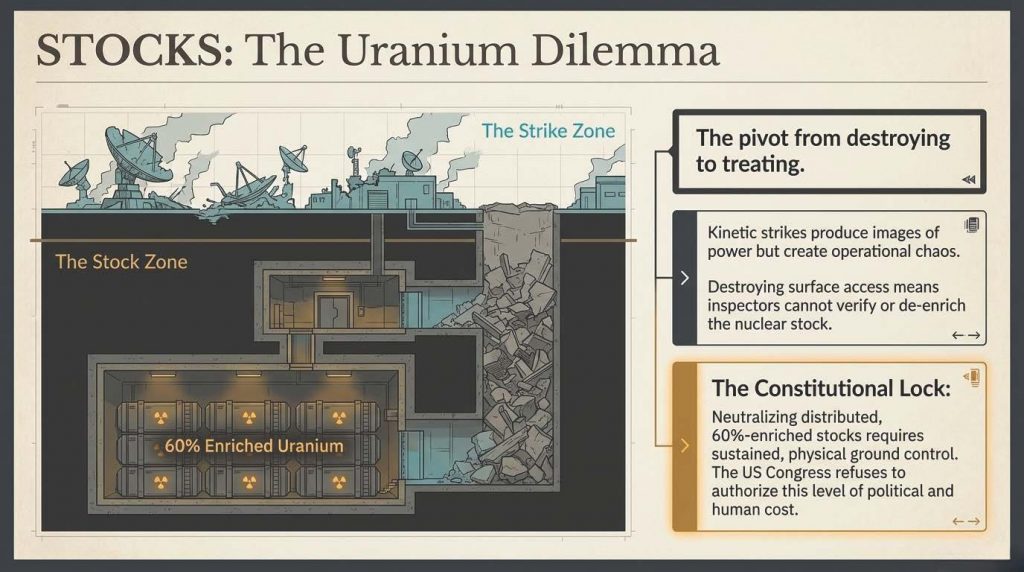
The orders of magnitude illustrate the scale of the issue. Iran reportedly possesses several tons of enriched uranium at various levels, including a portion enriched to 60%, which is very close to the military threshold. This is not a technical detail. In nuclear logic, the first stages of enrichment consume most of the industrial effort; once these steps are cleared, the transition to a military grade can be significantly faster.
This is where the American constraint becomes decisive.
To actually recover the enriched uranium, enforce its containment, or trigger a regime change, a much deeper action would undoubtedly be required: a ground, prolonged, and politically assumed operation, and therefore an infinitely more costly one. Yet, Congress is precisely stepping in to remind everyone that continuing hostilities against Iran cannot turn into an open war without explicit political authorization.
The deadlock is therefore no longer just military. It is becoming constitutional.
Donald Trump can still strike. He can still threaten. He can still claim victory. But if the real objective becomes retrieving the stock, completely neutralizing the nuclear capability, or achieving regime change, then the nature of the operation changes entirely. We are no longer talking merely about bombings. We are talking about control, duration, human intelligence, access to the terrain, potential casualties, coalitions, and a political mandate.
Iran can lose sites, absorb strikes, accept a negotiation, and continue to repress its society. But as long as the stock is not located, verified, and treated, it retains leverage. And as long as Trump cannot easily transform aerial superiority into a sustainable ground operation, Tehran can test something other than American power: the political depth of American resolve.
The memorandum promised to address a nuclear threat, but it depended on an access to the stock that the war did not guarantee.
Israel: Tactical victory, strategic constraint: When tactical success meets institutional limitations
Israel is perhaps the actor for whom the memorandum is the most difficult to read. On a tactical level, the strikes can deliver results: hit sites, degraded capabilities, and a clear message of force sent to Tehran. Yet, on a strategic level, the core question remains entirely unanswered: what has truly been neutralized, what has merely been slowed down, and what retains the capacity to reconstitute itself?
This explains why the Israeli threshold is not the American threshold.
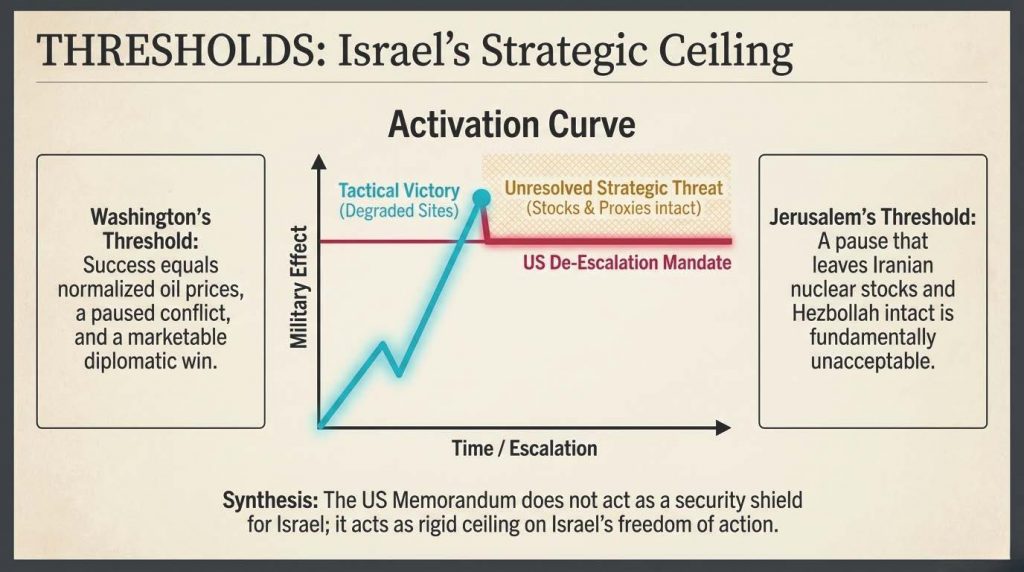
For Washington, a sequence can be framed as a success if oil prices drop, if Hormuz remains navigable, if markets breathe, if Iran returns to the negotiating table, and if Donald Trump can claim a victory. For Israel, the questions are far harsher: Has the uranium stockpile been dealt with? Is the capacity for reconstitution destroyed? Are Iran’s regional proxies neutralized? Is Hezbollah truly contained? Does Lebanon return to being a state capable of exercising its own sovereignty?
Domestic pressure on Benjamin Netanyahu adds a further constraint. He must demonstrate that the sequence did not simply yield an American pause, but rather a lasting reduction of the threat. His political timeline, public pressure, security expectations, and the memory of past interventions in Lebanon make it difficult to accept a memorandum that leaves too much room for ambiguity.
Israel could therefore find itself in a paradoxical position: having achieved a tactical victory, only to see that victory capped by an American de-escalation. A strike can reassure in the short term. It can even project a capability. However, if it treats neither the nuclear stockpile, nor the reconstitution capacity, nor the regional proxies, nor Hezbollah, it leaves a strategic anxiety fully intact.
For Israel, the memorandum may ultimately look less like a way out of the crisis than a ceiling placed on its freedom of action.
The resumption of U.S. strikes reinforces this ambiguity. Washington can strike Iran, but also asks Israel not to strike or not to retaliate at certain times in order to preserve a diplomatic window. This episode, seemingly almost absurd, is in fact central: the indispensable ally also becomes a factor in escalation that must be reined in.
U.S. power therefore remains central, but it must manage its own unintended consequences: what it triggers in its adversary, what it restrains in its allies, what it promises to the Gulf states, what it explains to the markets, and what it secures from Congress.
Hormuz: Reopening at full cost
The Strait of Hormuz is not merely a geographic passage. It is critical access, an implicit price, an insurance policy, a delay, a route, a guarantee, and a threat.
One can proclaim its reopening. Yet, shipowners, insurers, crews, littoral states, and the powers securing the area must first consider the passage truly navigable.
Oman may seek a reopening mechanism. The United States may want to guarantee freedom of navigation. Europeans may support a legal framework. But Iran is there to remind everyone that without its inclusion, no route can stabilize for long. Tehran does not need to completely close the strait to maintain leverage. It only needs to make passage conditional, uncertain, or politically expensive.
The International Maritime Organization also points out that a reopening cannot simply be decreed. Hundreds of ships and roughly 6,000 seafarers have remained stranded in the Persian Gulf since the start of the conflict. The issue is therefore not just about oil barrels or maritime transit. It becomes human, financial, social, and logistical.
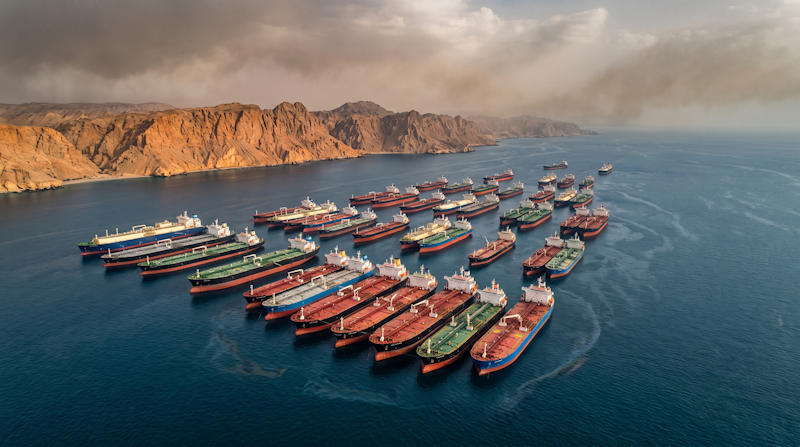
A ship can theoretically pass; but a crew must first accept the mission, an insurer must cover it, a shipowner must assume the risk, a state must guarantee it, and a route must be deemed viable.
It takes only a few hit vessels, targeted oil or gas carriers, a handful of tankers turning around, a heightened threat level, or a shipowner suspending rotations for the reopening to cease being a diplomatic announcement and return to a calculation of full cost.
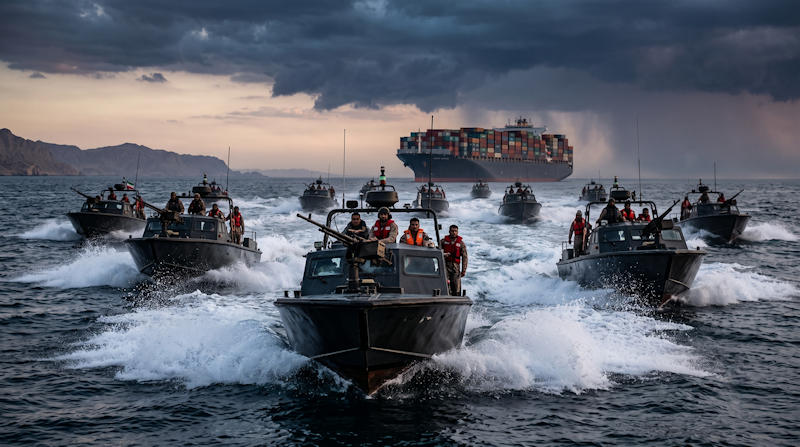
Hormuz no longer functions as an open-or-closed switch. It becomes a space of permanent repricing.

The risk shifts into insurance premiums, naval escorts, delays, alternative routes, technical fees, cargo declarations, implicit validations, and interpretations of maritime law. A strait can be open in law and remain partially closed in practice. It can also be open in practice, but only because everyone accepts a new cost to keep the flows moving.
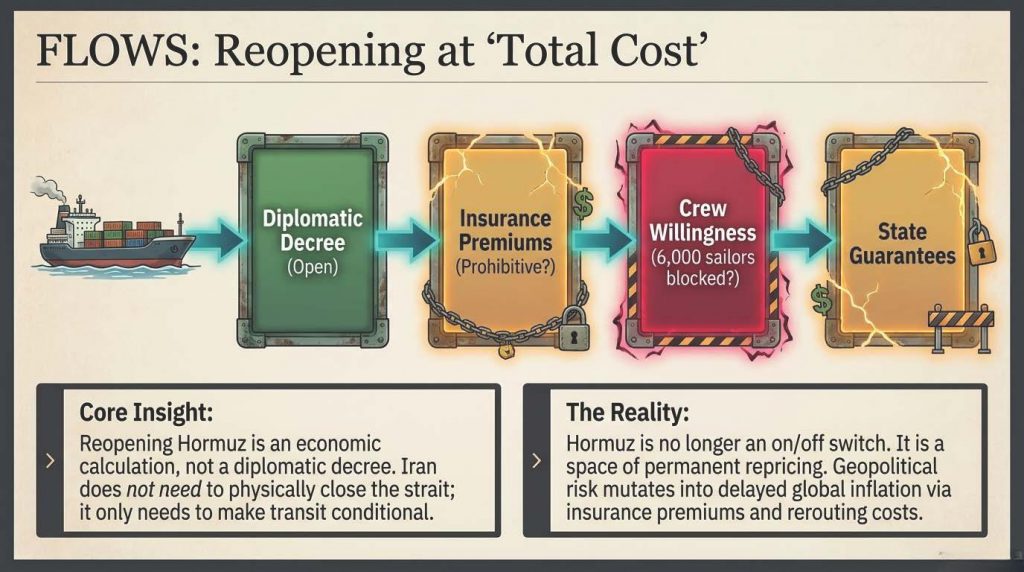
This is precisely where deferred inflation is born. It does not appear immediately in a ceasefire press release or in the spot price of a barrel. It lodges itself in insurance premiums, delivery times, buffer stocks, longer routes, renegotiated contracts, currency hedges, bank fees, and precautionary margins. It then circulates through supply chains, sometimes months after the crisis has been officially “stabilized.”
For a CFO, this is familiar logic: a contract can be signed, but real execution depends on covenants, guarantees, payment terms, default clauses, insurance, and hidden costs. Hormuz becomes exactly that: no longer just a dot on the map, but an operational appendix to the memorandum.
Peace is therefore not judged by the announcement of a reopening. It is judged by the full cost of the passage.
Qatar: Providing the Plane, Securing the Runway
This episode might seem almost anecdotal. It is not.
Donald Trump was supposed to return from the NATO summit aboard the new Boeing 747-8 gifted by Qatar and touted as a future Air Force One. He ultimately left Turkey aboard the former presidential aircraft, with U.S. sources citing security concerns, secure communications, and command capabilities amid renewed tensions with Iran. The White House has disputed the interpretation that the Qatari aircraft was insufficiently secure, but the episode has reignited the debate over countermeasures, communications, and the requirements for a presidential aircraft in a crisis situation.
The anecdote is almost perfect.

Qatar can provide the symbolism: a prestigious, spectacular, and diplomatically flattering aircraft. But the crisis serves as a reminder of its function: a presidential aircraft is not merely a luxury item. It is a sovereign infrastructure for command, communication, protection, evacuation, and the continuity of the state.
At the same time, Qatar itself finds itself exposed to Iranian retaliation targeting U.S. or allied facilities in the Gulf. Even if the extent of the damage must be assessed with caution, the image is powerful: the country offering the aircraft also sees its bases, runways, radar systems, defenses, and air access points drawn into the geography of risk.
Qatar is offering the aircraft. Iran is reminding the world that power is also played out through the infrastructure that enables takeoff.
This is the very logic of this crisis: symbolism never overshadows the conditions of use. The diplomatic objective once again becomes a matter of access, security, certification, communications, runways, and threat thresholds.
Iran: Brutal at home, transactional abroad: Ideology absorbed by a survival apparatus
Iran is often presented as an ideological regime. It still is. Yet, in this sequence, it also appears as a much more pragmatic survival apparatus: brutal at home, transactional abroad, formidable in negotiation, and highly attentive to cash, stocks, access, and time. This evolution does not make it any less dangerous. On the contrary, it can make it harder to read.
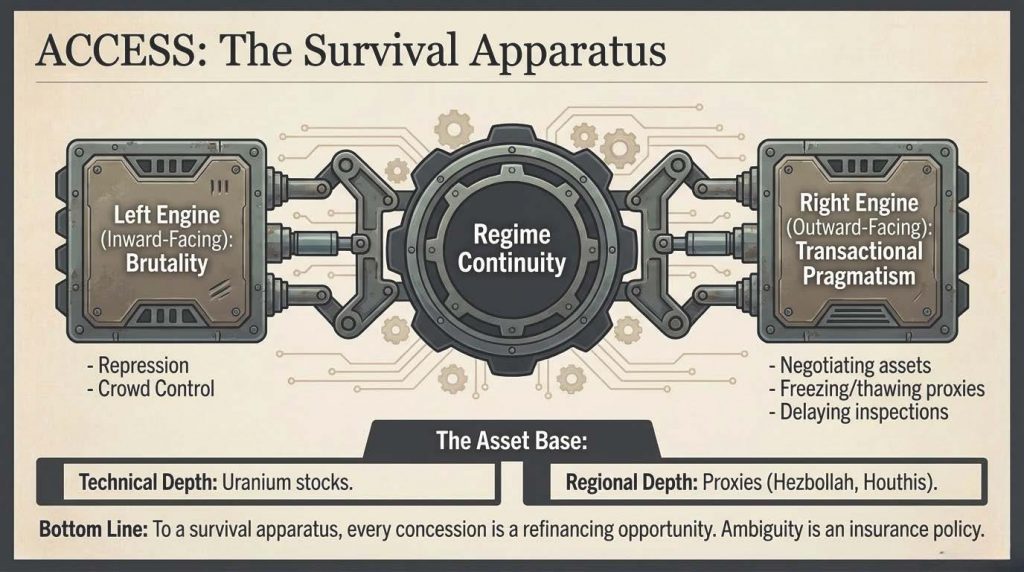
Repression continues inside the country while discussions proceed outside. The regime controls, intimidates, condemns, hangs, and lashes, all while negotiating inspections, frozen assets, maritime routes, sanctions, down-blending, and passage conditions. This simultaneity is not a contradiction. It is a method.
Khamenei’s funeral provided a spectacular manifestation of this logic. Several days of ceremonies, a mobilization announced at several million people, a staging of continuity, and a regime that intends to show it still administers grief, crowds, and revenge. The figures may be debated. The constraint exists. Attendance can be organized, encouraged, sometimes forced. But even a coerced mobilization says something: one must still possess an apparatus capable of summoning, transporting, managing, feeding, directing, and staging crowds.
But this apparent unity does not eliminate internal tensions. On the contrary, the U.S. strikes make them more visible: Should they negotiate to salvage what can be salvaged, or should they take a tougher stance to avoid appearing to be a humiliated regime?
This is where the American reading can go wrong. A regime does not collapse simply because it is unpopular. It can be a minority and remain powerful if that minority represents several million people, if it holds the administrations, the security forces, the resources, the religious networks, the jobs, the aid, and the sanctions. Iran is not merely ruled by a power; it is locked down by a system.
In this sequence, proxies are not a peripheral subject. They are the other form of the Iranian stock. Uranium provides strategic depth through technical capacity; Hezbollah, Iraqi channels, or the Houthis provide depth through regional nuisance. The former is verified by inspection. The latter are read in escalation thresholds.
A pragmatic dictatorship remains a dictatorship.
It simply becomes more flexible in its means, colder in its calculations, and more unpredictable in its thresholds. A pure ideology can sometimes be read in its dogmas. A survival apparatus is read in its trade-offs. It can retreat, stall, concede, move a stock, open a channel, close an access point, harden repression, or relaunch a proxy depending on what serves its continuity. This is perhaps not the disappearance of ideology. It is its absorption by a logic of power preservation.
And in a negotiation, that changes everything. Facing a regime that seeks first and foremost to survive, every concession becomes a potential refinancing, every delay an option, every ambiguity an insurance policy, and every denied access a strategic reserve.
Lebanon: The impossible clause
Lebanon appears as a regional clause of the memorandum. This is logical on paper. One cannot stabilize Iran, Israel, and the Gulf without dealing with regional proxies, and Hezbollah remains one of Tehran’s primary instruments of strategic depth. But this is precisely where the text collides with reality.
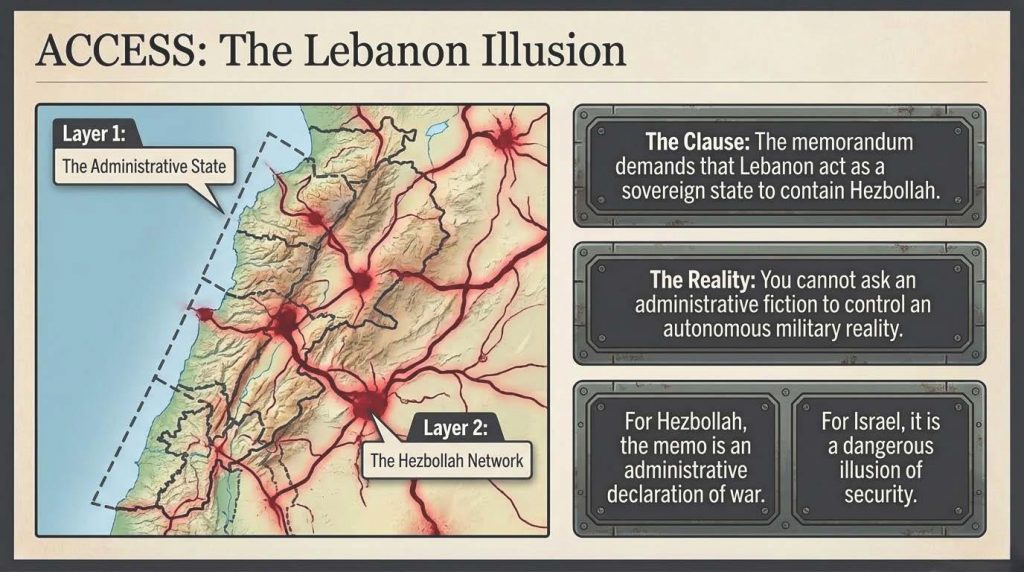
Washington can speak of Lebanese sovereignty. Israel can demand a lasting reduction of the threat to its north. Lebanon can sign a framework. Mediators can present a path to stabilization. But Hezbollah does not read this type of agreement as a simple de-escalation measure. It reads it as an attempt to transform an autonomous military power into an administrative execution problem.
A weakened state is asked to once again operate a sovereignty it does not fully control. Israel is asked to view a framework as a guarantee, even though its execution depends on actors hostile to it. Hezbollah is asked to accept a reduction of its role precisely at the moment when Iran seeks to preserve its regional leverage. And the United States is asked to guarantee an architecture that assumes, in practice, that the Lebanese balance of power can be transformed by a piece of text.
Lebanon thus receives a promise of sovereignty. Hezbollah sees a declaration of administrative war.
For Israel, this looks like an old anxiety: seeing the international community treat Lebanon as a state fully in control of its territory, while the threat can reconstitute itself under the very cover of that sovereignty. For Washington, the Lebanese framework is a condition for stabilization. For Israel, it can become a ceiling placed on its freedom of action.
Syria, in the background, also serves as a reminder that regional stabilization is not always synonymous with political opening. It can sometimes consist of making an authoritarian apparatus useful in controlling another form of disorder. Here again, the memorandum does not resolve the conflict. It shifts it into execution.
Washington under constraint
Donald Trump can claim the victory photo. However, the rest of the sequence is entrusted to a much more complex mechanism: reassuring markets, containing Iran, preserving Israel, avoiding oil price hikes, maintaining the opening of Hormuz, speaking to the Gulf, managing Congress, dealing with Lebanon, and preventing de-escalation from being interpreted as an excessive concession.
This is where the Vance and Rubio lines become interesting.
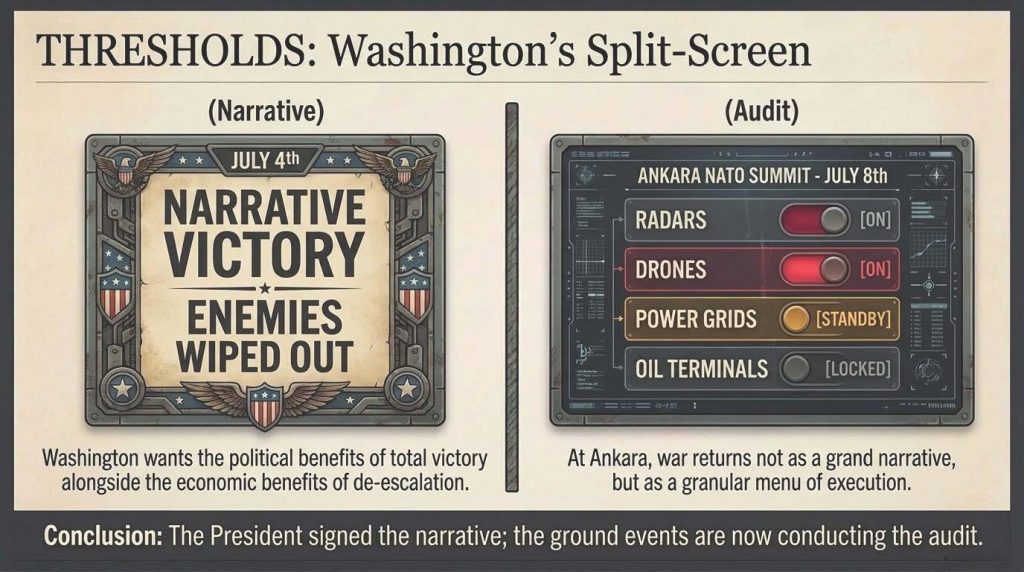
The former primarily seeks stabilization: avoiding an entanglement, preserving the American economy, prolonging the ceasefire, maintaining flows, and making the memorandum sellable. The latter insists more on pressure: limiting Iranian influence, containing Hezbollah, reassuring Israel, and preventing an economic agreement from leaving a strategic threat intact. These two lines are not necessarily contradictory. They can even be complementary in a negotiation. But they reveal a central tension: the United States wants to simultaneously exit the war and retain the political benefits of a posture of strength.
This is difficult. The resumption of strikes does not eliminate the political pressure; it accelerates it. Trump has lit a fuse. He retains the ability to strike, but he no longer fully controls the political fallout. For the more Washington frames the memorandum as a victory, the more costly every single incident becomes. A contested route, a residual strike, an Iranian statement, a Hezbollah threat, an Israeli anxiety, or a new question about uranium are no longer just regional events. They are closing variances.
The contrast with the American commemorative sequence is telling. During the celebrations of the 250th anniversary of independence, Donald Trump primarily reinstalled a domestic narrative: American grandeur, the communist threat, domestic polarization, and the assertion of an already victorious power. Iran appeared there more as a claimed victory than as an still-open crisis.
A few days later in Ankara, the same file returns to the center, not as a closed conflict, but as a test of strength, allied loyalty, and military execution. What the national discourse had kept at a distance returns through missiles, Hormuz, bases, Patriots, and guarantees.
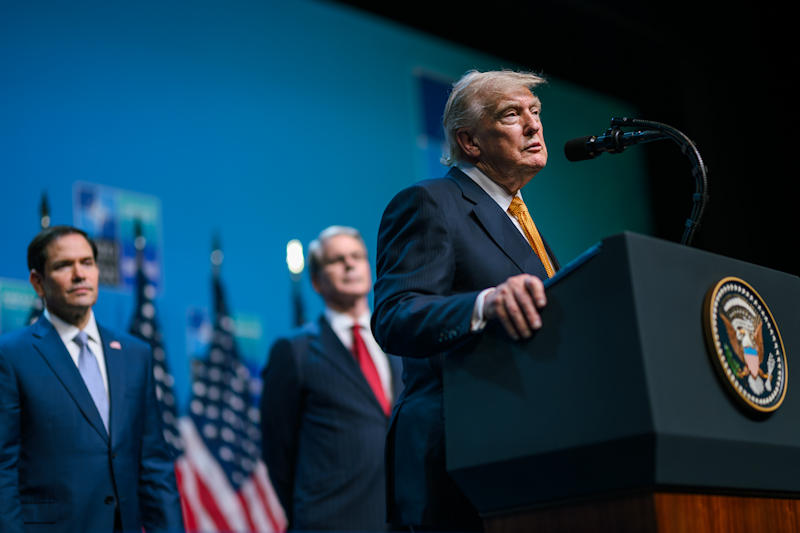
The NATO summit sequence in Ankara confirms this tension. Donald Trump declared the ceasefire with Iran over, announced new “strong” strikes, and simultaneously asserted that the objective is not war but the “denuclearization of Iran.” He rejects the vocabulary of regime change, while suggesting that striking Iranian leaders could already constitute an ultimate form of it. He claims that Iran is “wiped out,” that its navy, air force, and capabilities have vanished; yet the actual execution tells a different story: firing, retaliation, an uncertain strait, stranded crews, and guarantees to be recalculated, with the nuclear stock still at the center of discussions.
In Ankara, the American press conference almost provided the operational grammar of this phase. Donald Trump is already distinguishing thresholds: radars, drones, missiles, fast boats, coastal sites, mines, and then, if necessary, bridges, power plants, desalination plants, oil terminals, or a targeted blockade. War does not return only in the clash of missiles. It returns in the selection of assets that are struck, spared, threatened, or kept as leverage.
Sanctions also return as an execution clause. The revocation of the temporary waiver allowing certain sales of Iranian oil lacks the spectacular image of a strike, but it acts on the exact same flows: cargoes, buyers, banks, insurance, revenues, currencies, and bargaining margins.
At the same summit, the Alliance is also reinterpreted. Allies, including the United States, reaffirm their commitment to the mutual assistance clause, and Trump indicates that the United States wants to stay in NATO. But he simultaneously reproaches the Europeans for not having supported him sufficiently against Iran, reopens the Greenland file, attacks Spain, and transforms allied solidarity into a test of political reciprocity.
Trump does not necessarily leave NATO. He transforms its cost, its language, and its thresholds.
This is the entire American ambiguity of the moment. Trump narrates crises as conflicts closed by a gesture. Yet, Iran forces the opposite reading: what matters is not just the gesture, but what it fails to close. Uranium is not a symbol, Hormuz is not a backdrop, proxies do not disappear in a press release, and a locked-down regime does not collapse because a president announces it has been contained. Trump signed the narrative. Events are now conducting its audit.
The Gulf seeks guarantees, not a narrative
The Gulf countries do not read the sequence the way Washington, Tehran, or Jerusalem do. They are not primarily looking for a narrative victory. They seek the continuity of infrastructure, exports, insurance, terminals, financial flows, and American protection. Their question is not just “who won?” It is “who guarantees that the crisis does not start again tomorrow morning?”
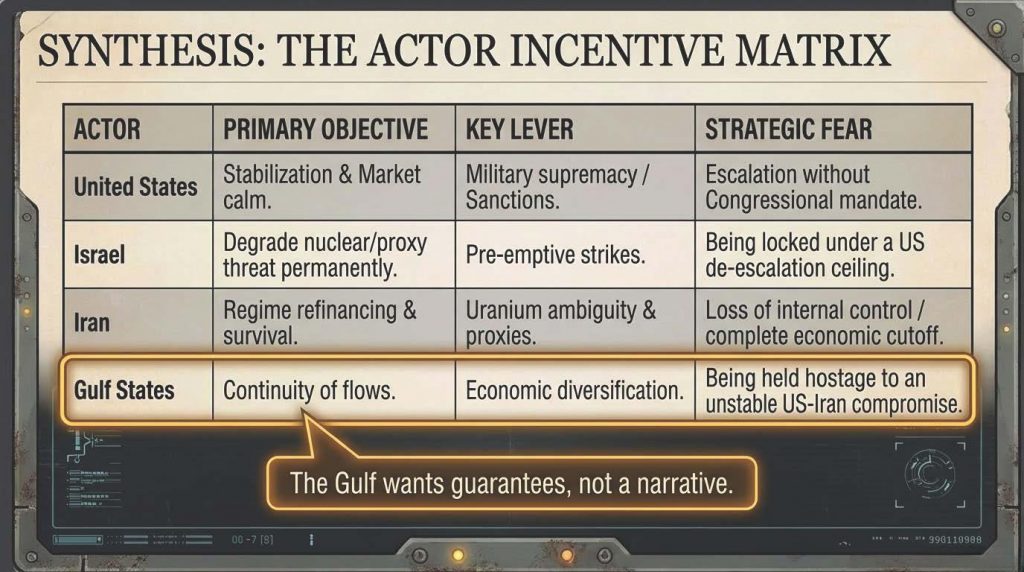
This is why the memorandum reassures them only halfway. A ceasefire can bring oil down. It can calm markets. It can give diplomats a work sequence. But it does not remove the Gulf’s structural dependence on a strait that a hostile actor can render dangerous without even closing it completely.
The Gulf countries are discovering, once again, the difference between protection and dependence.
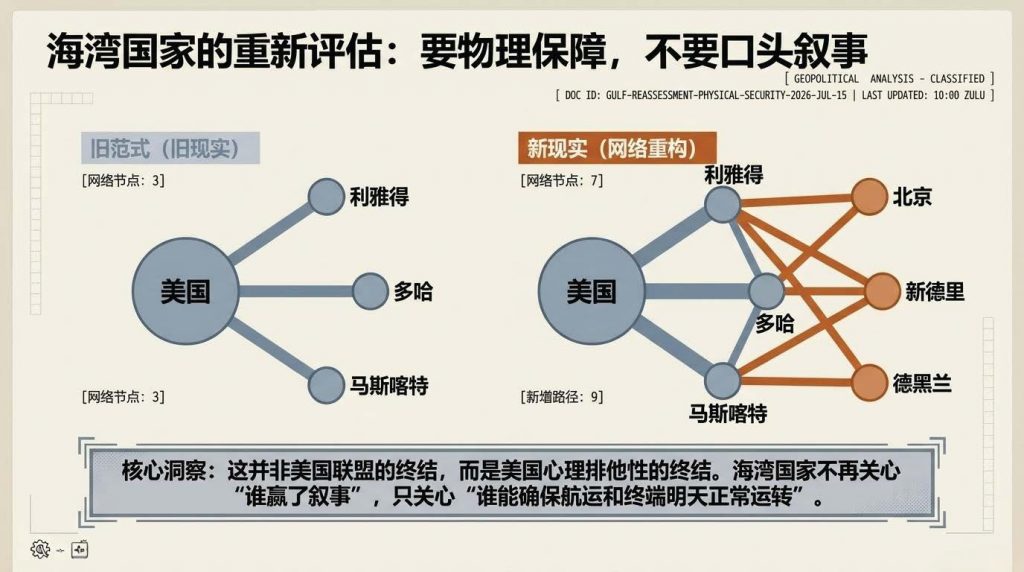
American protection remains indispensable. But if this protection becomes more transactional, more political, more subject to electoral calendars, and more uncertain in its intervention threshold, then everyone looks for complements. There is more talk with Washington, but also with Tehran, Beijing, Doha, Muscat, Riyadh, Abu Dhabi, Islamabad, or New Delhi. Not through a spectacular shift, but through prudent diversification.
This is not the end of the American alliance. It is the end of its psychological exclusivity.
This diversification does not unfold in a symbolic vacuum. Palestine remains an unwritten political clause of any regional stabilization: it weighs heavily on public opinion, limits the regimes’ room for maneuver, and sets a threshold of legitimacy beyond which strategic normalization can become politically untenable.
Religion adds another layer of ambiguity. It does not produce a straightforward strategic unity among littoral states, given the deep-seated divisions between Sunnis, Shias, the Gulf monarchies, Turkey, Iran, Islamist movements, and state apparatuses. Consequently, brutally weakening the primary regional Shia power would not mechanically translate into strengthening the West. It could also open up a vacuum for competing Sunni powers, more radical networks, or authoritarian stabilization mechanisms for which the societies involved—starting with the Iranian people—would pay the price.
BRICS+ as backup infrastructure
The sequence does not brutally announce a new world order. It shows something more subtle: a gradual shift in the operational center of gravity.
The United States retains the strike power, the capacity for sanctions, financial depth, the Israeli alliance, military centrality, and a major part of the narrative. But they no longer control the closing conditions of a crisis alone. The crisis closes elsewhere too: in Chinese routes, Asian energy purchases, strategic reserves, payment circuits, Qatari and Omani mediations, Saudi trade-offs, Indian positions, Pakistani connections, European constraints, Israeli calculations, and Iranian capabilities for nuisance.
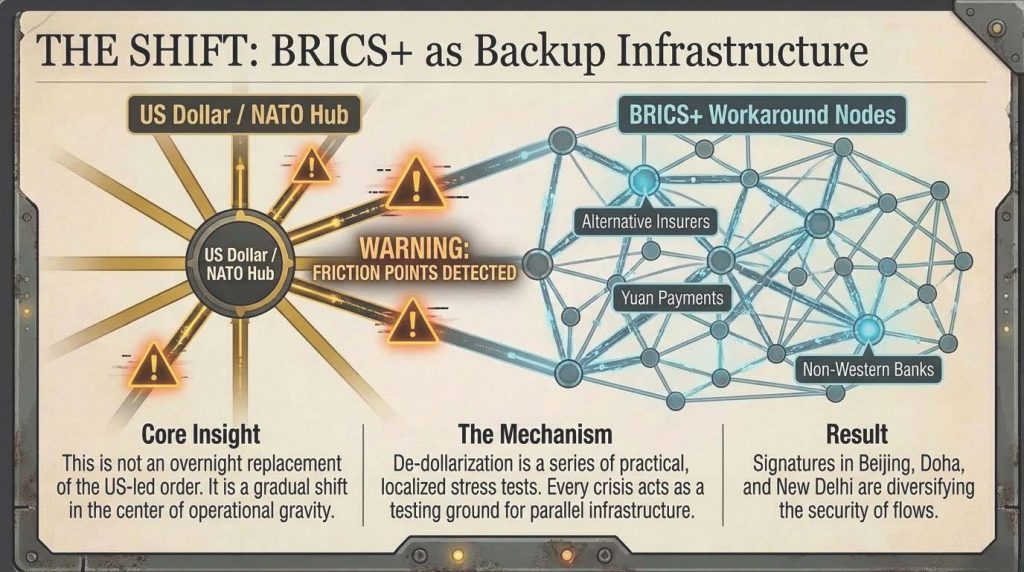
This is where the BRICS+ appear less as a homogeneous alliance than as a symptom. They do not form a perfectly aligned bloc. China, India, Iran, Russia, Saudi Arabia, the UAE, or Brazil have neither the same interests, nor the same priorities, nor the same vulnerabilities. Some can even find themselves, depending on the file, in opposing positions. But they reflect the same evolution: more and more actors seek to no longer depend on a single center of decision, a single payment system, a single security guarantee, a single Western reading of law, or a single architecture of sanctions.
Dedollarization is often read too spectacularly, as if the dollar were to be replaced overnight. That is not how things happen. The dollar remains central. American markets remain deep. American financial power remains massive. But crises create alternative uses. Local currency settlements are tested. Certain infrastructures are bypassed. Routes are secured. More is stockpiled. Insurers, banks, intermediaries, and guarantees that do not always pass through the same circuits are sought.
Weak signals are sometimes lodged in very concrete mechanisms: alternative insurance, guarantees backed by non-Western circuits, payments envisioned in yuan or cryptocurrencies, intermediary banks, and shipowners ready to accept a risk that others refuse. Not everything is yet stabilized. Not everything is necessarily viable. But the important point lies elsewhere: every crisis creates a testing ground for backup infrastructure.
Dedollarization is not primarily a slogan. It is a sum of backup practices that eventually become habits. Hormuz can accelerate this movement, not because the strait would become Chinese, Iranian, or BRICS+ by decree, but because a major energy crisis forces every actor to ask how to continue buying, selling, transporting, insuring, and financing if the usual architecture becomes too political, too vulnerable, or too expensive. This is how weak signals become infrastructure.
Europe in the backdrop of the center
Europe, in this sequence, remains in an uncomfortable position. It still speaks from the backdrop of the center: G7, declarations, international law, regional stabilization, maritime security, diplomacy, and support for allies. But the decisive levers are often located elsewhere. Security remains largely American. Energy passes through routes that Europe does not control. Critical materials depend on Asian industrial chains. Technology, AI, payments, and sanctions remain caught in architectures where Europe has many regulations, but less execution power.
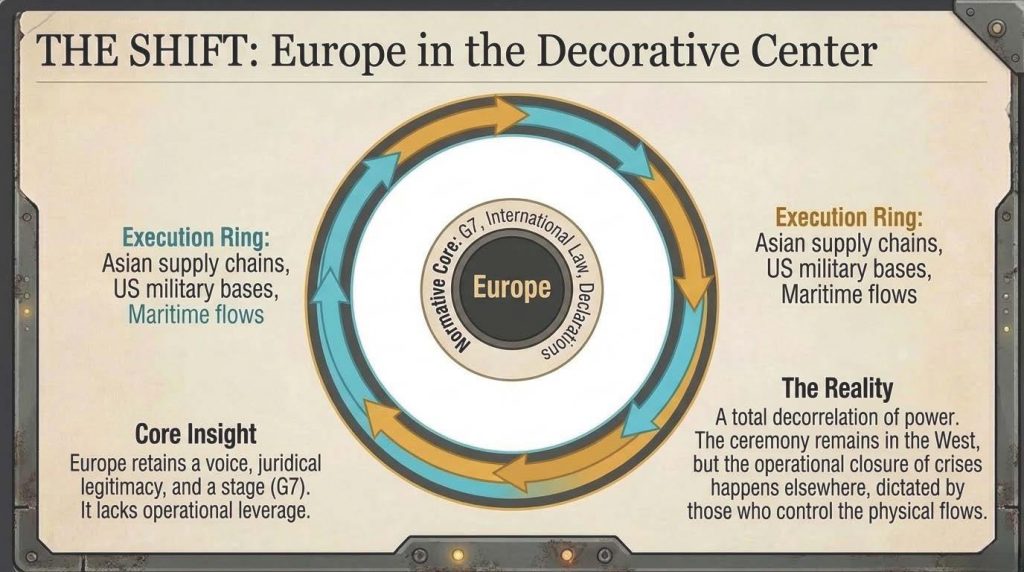
This is not a disappearance. It is a decorrelation. Europe retains a voice, sometimes an expertise, often legal legitimacy, and still a capacity for coordination. But it does not close the crisis. It accompanies it, comments on it, partially frames it, and then discovers that execution depends on actors more directly exposed to the flows or more directly capable of securing them.
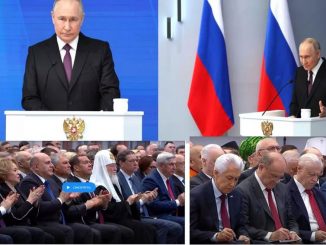
The G7 retains the ceremonial of power. But the operational closure of crises is increasingly negotiated in an expanded world. The Ankara summit gives a brutal illustration of this. The backdrop says the Alliance. The speech says the contract. On the images from Ankara, everything looks institutional: flags, the NATO logo, aligned delegations. But the American speech transforms this scene into a permanent renegotiation table: bases, arms purchases, Article 5, trade, Greenland, Iran, Ukraine. Everything becomes a clause, a threshold, or a trade-off.
War has returned in the appendices
In the short term, the sequence seems to turn backward. The memorandum was supposed to open a stabilization trajectory. It is already brought back to its initial ambiguities: Hormuz remains conditional, discussions remain uncertain, Lebanon remains highly inflammable, Israel remains distrustful, Iran retains its levers, the Gulf seeks guarantees, Washington announces new strikes while speaking of denuclearization, NATO reaffirms its unity while revealing its fault lines, and China stands ready to convert its energy vulnerability into an anchoring power.
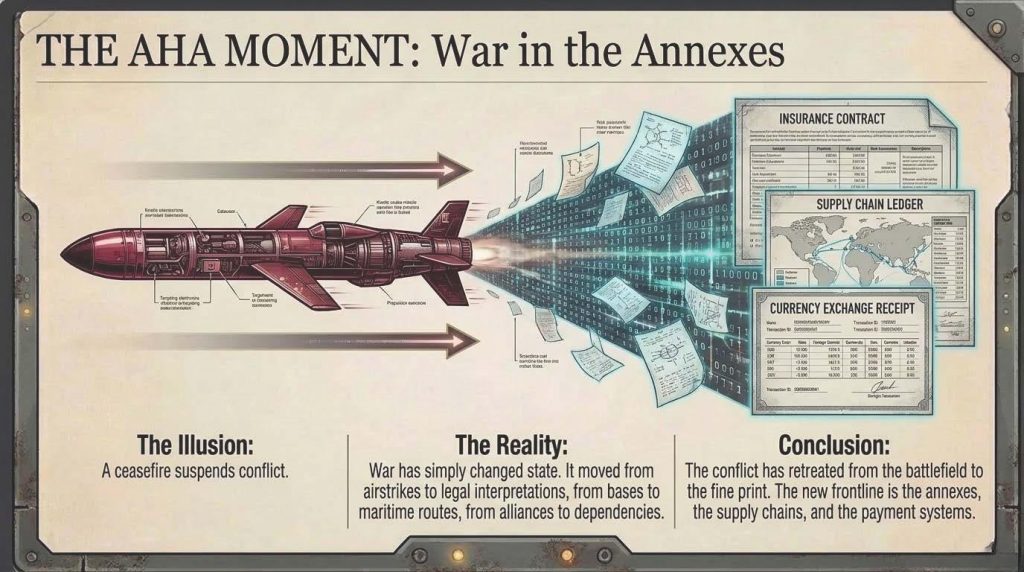
But this backward turn does not mean a simple failure. It shows instead that the war is not ended by the text that claimed to suspend it. It changes its regime. It moves from strikes to interpretations, from missiles to insurance, from military bases to maritime routes, from press releases to execution conditions, and from formal alliances to practical dependencies.
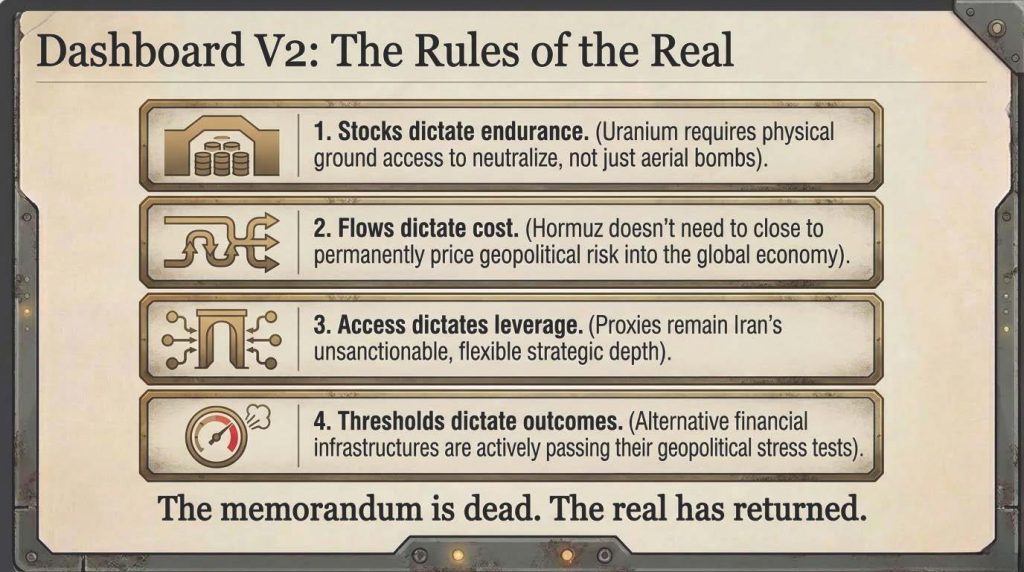
This is where the first analytical framework regains its full utility. Stocks tell who can endure. Flows tell who must keep circulating. Access tells who can open, close, or condition. Thresholds tell how far everyone accepts to go without tipping over.
The memorandum may no longer hold as a ceasefire. But it still holds as an instrument of reading. One sees the gaps, the missing clauses, the unprovisioned risks, the insufficient guarantees, and the dependencies that change owners.
We also see something else here: the shift from a progress report to a preliminary assessment. The strikes are causing casualties. Retaliatory strikes shift the risk to the Gulf. Allies must be kept in check. Iranian factions are clashing over the course of action to take. Prestigious aircraft are once again becoming infrastructure that must be secured. Runways, bases, straits, ports, radar systems, insurance, and payment systems are once again becoming the true objects of power.
War has not necessarily resumed in the classical sense. It has simply returned to where it is now most often played out: in stocks, flows, appendices, thresholds, infrastructures and payment systems.
Jérôme Denariez
Hormuz: The Return of Reality — Summary
General context
The memorandum meant to freeze the Iran-Israel-U.S. conflict didn’t hold. On July 8, at the NATO summit in Ankara, Trump declared the ceasefire over and announced new U.S. strikes on Iran. Since then, strikes have resumed (targeting drones, missiles, coastal defense, and Hormuz surveillance capabilities), Iran claims at least 14 dead and 78 wounded, and has retaliated against U.S./allied installations in Bahrain, Kuwait, and Qatar. The author’s text no longer functions as a ceasefire but as a reading grid for the crisis’s fracture points: uranium, Hormuz, guarantees, proxies, allied cohesion.
Uranium: the unresolved core
Strikes damage sites but don’t resolve the enriched uranium stockpile (several tons, some at 60%, close to the weapons-grade threshold). Recovering or neutralizing this stockpile would require a prolonged, politically costly ground operation — and Congress has reminded the administration that open war requires explicit authorization. The lock is now constitutional as much as military: Iran retains leverage as long as the stockpile isn’t located and controlled.
Israel: tactical victory, strategic ceiling
Israeli strikes produce a tactical effect, but the strategic question remains: Is the stockpile addressed? Is reconstitution capacity destroyed? Is Hezbollah contained? Netanyahu faces domestic pressure to show a durable reduction of the threat, not just an American pause. Washington sometimes asks Israel to hold back strikes to preserve a diplomatic window — the ally becomes an escalation risk to be managed.
Hormuz: reopening at full cost
The strait isn’t a simple on/off switch. Its usability depends on insurers, shipowners, crews, and littoral states. About 6,000 sailors and hundreds of vessels remain stranded. Iran doesn’t need to fully close Hormuz — making passage costly and uncertain (insurance premiums, alternate routes, delays) is enough to create deferred inflation that ripples through global supply chains long after a ceasefire is announced.
The Qatar episode
Trump forgoes using the Boeing 747 gifted by Qatar to fly home from Ankara, citing security concerns — while Qatar itself comes under Iranian retaliation. The anecdote shows that diplomatic symbolism never replaces material conditions (security, infrastructure).
Iran: brutal at home, transactional abroad
The regime represses harshly domestically (Khamenei’s funeral, mass mobilization) while negotiating externally. This isn’t a contradiction but a survival method. Proxies (Hezbollah, Iraqi militias, Houthis) form another kind of strategic “stockpile,” complementing the nuclear one.
Lebanon: the impossible clause
Lebanon is asked to exercise sovereignty it doesn’t control, Israel to accept guarantees resting on hostile actors, and Hezbollah to give up its role — right as Iran seeks to preserve its regional leverage. The memorandum shifts the conflict into execution rather than resolving it.
Washington under pressure
Tension between the Vance line (economic stabilization) and the Rubio line (strategic pressure). In Ankara, Trump reaffirms NATO membership while criticizing Europeans for insufficient support against Iran, reopening the Greenland issue, and attacking Spain — turning allied solidarity into a test of reciprocity.
The Gulf, BRICS+, and Europe
Gulf states seek continuity guarantees rather than a victory narrative; they’re cautiously diversifying ties (China, Pakistan, India) without breaking from Washington. BRICS+ appear as “backup infrastructure” — alternative payments, non-Western insurance — more than a unified bloc. Europe remains in the “backdrop of the center”: strong on rhetoric and legal norms, but with limited execution power over energy, security, or payments.
Conclusion: the war in the annexes
The conflict doesn’t end with the text meant to suspend it; it shifts register — from strikes to interpretations, from missiles to insurance, from communiqués to execution conditions. The “stocks, flows, access, thresholds” framework remains the relevant lens for tracking a crisis now playing out as much in insurance premiums and payment systems as on the battlefield.
See Also:
- « Clausewitz à Ormuz : le mémorandum impossible » — (2026-0702)
- « Clausewitz at Hormuz: The Impossible Memorandum » — (2026-0702)
- « Clausewitz an der Straße von Hormus: Das unmögliche Memorandum » — (2026-0702)
- « Hormuz : Le retour du réel » — (2026-0709)
- « Hormuz: The return of reality » — (2026-0709)
- « Hormus: Die Rückkehr der realität — (2026-0709)
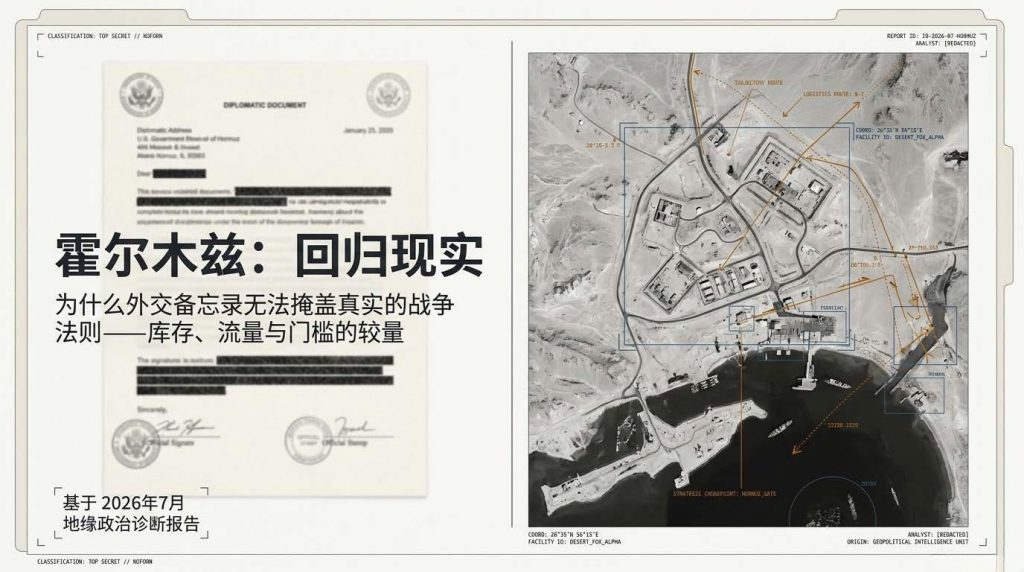
霍尔木兹:现实的回归 —— 摘要
总体背景
原本旨在冻结伊朗、以色列与美国之间冲突的备忘录未能维持。7月8日,在安卡拉举行的北约峰会上,特朗普宣布停火结束,并宣布美国将对伊朗发动新一轮打击。此后,美方恢复了针对无人机、导弹、沿岸防御设施及霍尔木兹海峡监视能力等目标的打击行动。伊朗方面称已造成至少14人死亡、78人受伤,并对美国及其盟友在巴林、科威特和卡塔尔的设施进行了报复。作者的这篇文章已不再是对停火协议的描述,而成为解读危机断裂点的分析框架:铀、霍尔木兹海峡、安全保障、代理人势力、盟友团结。
铀:未解决的核心问题
空袭可以摧毁设施,却无法解决浓缩铀库存问题(数吨浓缩铀,其中部分丰度达60%,已非常接近武器级门槛)。若要真正回收或消除这批库存,恐怕需要一场旷日持久、政治代价高昂的地面行动——而美国国会已明确表示,对伊朗采取全面战争行动须获得明确的政治授权。制约因素如今已不仅是军事上的,更是宪法层面的:只要库存未被定位和控制,伊朗就仍握有筹码。
以色列:战术性胜利,战略性受限
以色列的打击产生了战术效果,但战略问题依然悬而未决:库存是否得到处理?重建能力是否被摧毁?真主党是否被有效遏制?内塔尼亚胡面临国内压力,需要展示对威胁的持久削弱,而不仅仅是美国促成的暂时停火。华盛顿有时要求以色列克制打击,以维持外交谈判空间——这个盟友本身也成了需要被约束的升级因素。
霍尔木兹海峡:重新开放的全面成本
海峡并非简单的开关。其通行能力取决于保险公司、船东、船员以及沿岸国家的态度。约6000名船员和数百艘船只仍滞留在波斯湾。伊朗无需彻底封锁海峡——只需让通行变得昂贵且不确定(保险费上涨、绕行路线、延误),便足以制造一种滞后型通胀,在停火宣布后数月仍持续冲击全球供应链。
卡塔尔插曲
特朗普放弃使用卡塔尔赠送的波音747客机从安卡拉返美,理由是安全考虑——与此同时,卡塔尔自身也成为伊朗报复行动的目标。这一插曲说明,外交上的象征意义永远无法取代安全、基础设施等实际条件。
伊朗:对内强硬,对外务实
政权在国内持续实施严厉镇压(哈梅内伊葬礼、大规模动员),同时在外部继续谈判。这并非矛盾,而是一种生存策略。真主党、伊拉克民兵武装、胡塞武装等代理人势力,构成了另一种形式的战略”库存”,与核能力相辅相成。
黎巴嫩:不可能达成的条款
黎巴嫩被要求行使其并不真正掌控的主权;以色列被要求接受依赖敌对势力履行的安全保障;真主党被要求放弃其角色——而这恰恰发生在伊朗试图保留其地区筹码之际。备忘录并未解决冲突,而是将其转移到执行层面。
华盛顿承压
万斯路线(经济稳定)与鲁比奥路线(战略施压)之间存在张力。在安卡拉,特朗普一方面重申美国留在北约的立场,另一方面又指责欧洲盟友在对伊朗问题上支持不足,重提格陵兰岛议题,并抨击西班牙——将盟友团结变成了一场互惠性测试。
海湾国家、金砖+与欧洲
海湾国家寻求的是持续性保障,而非胜利叙事;它们正谨慎地拓展与中国、巴基斯坦、印度等国的关系,但并未与华盛顿决裂。金砖+更像是一种”备用基础设施”——替代性支付体系、非西方保险机制——而非一个统一的阵营。欧洲则仍停留在”中心的布景”位置:在言辞和法律规范上表现强势,但在能源、安全、支付体系等实际执行力方面相对有限。
结论:战争转入附录
这场冲突并未随着旨在暂停它的文本而终结,而是转换了表现形式——从空袭转向解读,从导弹转向保险,从公报转向执行条件。”库存、流动、准入、门槛”这一分析框架,依然是追踪这场危机的有效工具——如今这场危机在保险费率和支付系统中的博弈,不亚于在战场上的较量。