Since April, three European Security bylines have each, in their own way, dissected the crisis in the Strait of Hormuz: Admiral Christian Girard across a three-part naval analysis, Jérôme Denariez in a two-part geoeconomic decryption, Françoise Thom in a historian’s warning about Europe’s temptation to turn back to Russia. Three methods that were never coordinated. One shared conclusion: Europe can no longer afford to watch this crisis from the sidelines.
The Essentials
- Three European Security authors, without coordinating with one another, each analyzed the Hormuz crisis between April and July 2026.
- Each independently arrives at the same conclusion: European strategic indecision.
- The synthesis traces how three different methods — military, economic, historical — converge on a single diagnosis.
by François de Vries — Paris, le 18 juillet 2026.[*]
Table of Contents
A Crisis, Three Readings
On April 26, 2026, Admiral Christian Girard opened, in these pages, a trilogy devoted to the blockade of the Strait of Hormuz. Two months later, Jérôme Denariez proposed a radically different reading grid to decode the ceasefire memorandum signed between Washington, Tehran, and Israel. Between the two, in late May, Françoise Thom warned of an altogether different risk: that the oil crisis born of this same conflict might push Europe to resume, out of weakness, its dialogue with Vladimir Putin.
Three texts, three authors, three methods — and yet, taken together, a single diagnosis emerges. This is no editorial coincidence: it is proof that a crisis viewed from several angles at once produces a sturdier truth than any single reading taken in isolation.
Admiral Girard: The Naval Lesson — The Sea Does Not Subdue the Land
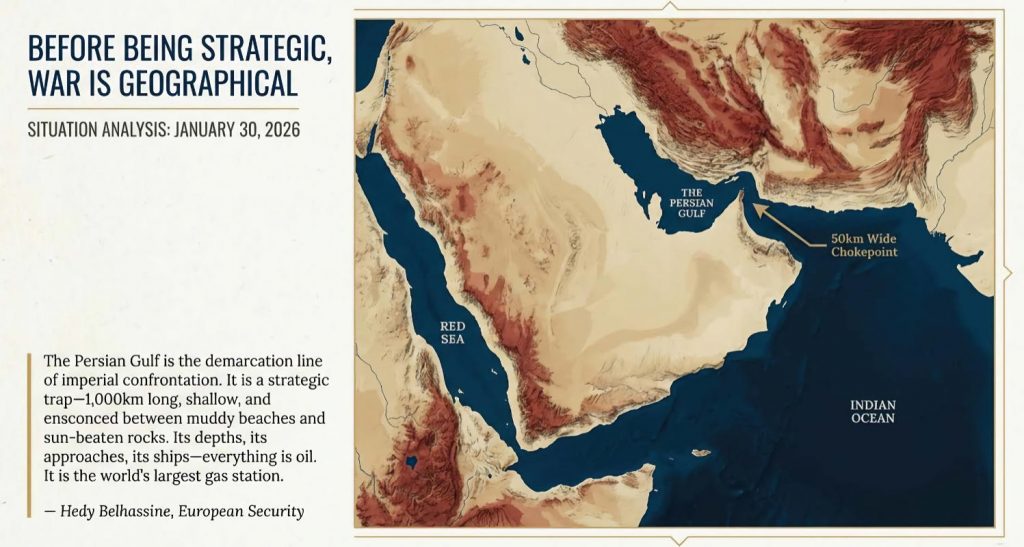
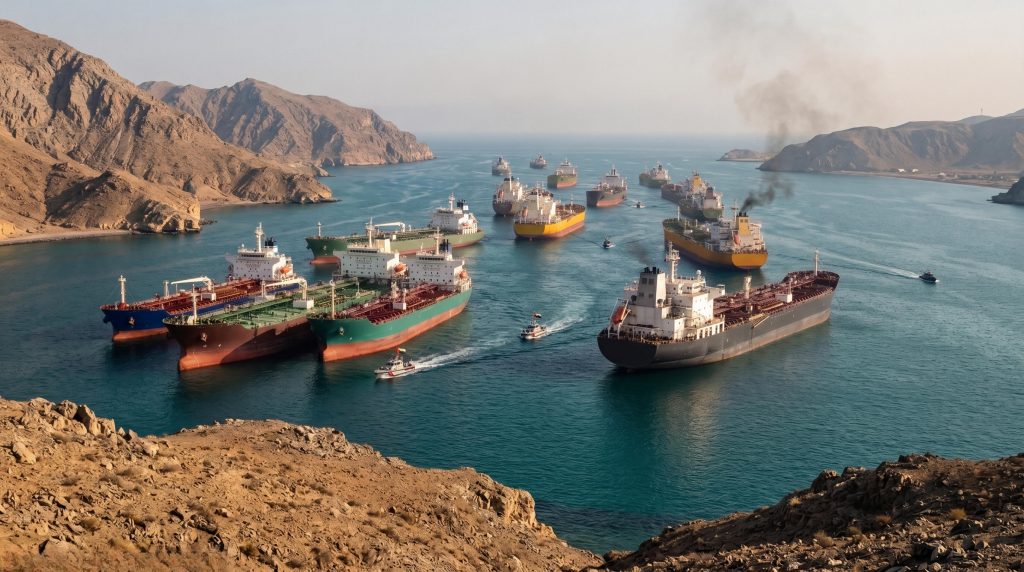
Admiral Girard starts from the ground, in the most literal sense. In his first piece, he shows that the ‘blockade’ of Hormuz remains largely virtual: the strait is not physically closed, but its blockage produces very real effects — rising insurance premiums, freight costs, oil prices — through the sheer force of psychological and legal warfare. In his second installment, he widens the lens to a lesson in military history: from Waterloo to Afghanistan, no power has ever durably subdued a territory through control of the seas and skies alone. America’s failure to control the Iranian coastline, despite overwhelming technological superiority, fits squarely within that continuity.

His third piece, published on July 14, closes the loop: having failed to convert its air superiority into territorial control, Washington now watches Iran turn the strait into a weapon of retaliation, targeting coastal sites — surveillance posts, drone and missile launch bases, fast-boat shelters — rather than the passage itself.
Vice-admiral Christian Girard © All Rights Reserved
His conclusion is constant from one text to the next, almost a refrain: states have no feelings, only interests.
Europe has a vital, economic and strategic interest in reopening the strait — it cannot simply wait for the outcome of American-Iranian negotiations.
Jérôme Denariez: The Invisible Grid — Stocks, Flows, Access, Thresholds
Where Girard reasons like an officer, Jérôme Denariez reasons like a geopolitical economist. His reading grid — stocks, flows, access, thresholds — starts from a simple observation: contemporary war no longer ends with a capitulation or a treaty; it shifts into more ambiguous objects — a memorandum, a corridor, an inspection clause.
Applied to Hormuz, this grid reveals what official statements conceal. The stock that matters is not only military: it is also Iran’s enriched uranium, whose fate remains unresolved despite the strikes. The flow that matters is not only oil: it is the confidence of insurers and shipowners, without which a strait ‘reopened in law’ remains closed in practice.
Jérôme Denariez © All Rights Reserved

And the actor that matters most, according to Denariez, may not be the one everyone assumes: China, seemingly on the sidelines of the crisis, becomes its ‘anchoring power’ — the one without which no durable normalization of flows is possible.
His conclusion, in his second piece published on July 9, is unambiguous about Europe’s place: it remains ‘in the backdrop of the center stage’ — institutionally present, at the G7, in the communiqués — but disconnected from the levers that actually decide the crisis’s outcome.
Françoise Thom: The Historical Lesson — Moscow Is Biding Its Time
The third text barely mentions Hormuz directly — and that is precisely what makes it the indispensable complementary piece. Françoise Thom traces, from Russia’s December 2021 ultimatum to today, the constancy of the Kremlin’s strategy: exploiting every Western crisis, including ones that have nothing to do with Ukraine, to weaken European cohesion.

Her demonstration is stark: the gas and oil shortage caused by the war in the Middle East deprives Europe of its alternative Gulf suppliers, leaving it more exposed to Russian energy blackmail at the very moment when some member states are considering resuming dialogue with Moscow. Putin, she writes, is watching for this moment of apparent weakness to hand down his terms for a capitulation disguised as negotiation.
Françoise Thom — Portrait © European-Security
The link to Hormuz, which Thom does not draw herself but which the juxtaposition of the three texts makes plain, is direct: it is because the strait remains unstable that Europe finds itself squeezed on energy, and therefore tempted by the Russian diplomatic mirage.
The Point of Convergence: Europe Midstream
None of the three authors cites the other two. None built their text with the others in mind. Yet their progression could be summed up in a single sentence: Girard describes the visible battle, Denariez reveals the invisible system, Thom restores the depth of time. Three lenses which, layered together, trace the same triangle:
• Girard shows that Europe has both the means and the interest to act militarily to secure Hormuz, yet refuses to do so out of timidity.
• Denariez shows that Europe, by remaining in the backdrop of the center stage without acting on the real levers, lets other powers — China foremost — become indispensable to resolving crises that concern it directly.
• Thom shows that this same passivity, extended to the Ukrainian theater, opens the door to Russian energy blackmail with potentially irreversible consequences.
The thread linking these three diagnoses is therefore not Hormuz as such. It is European strategic indecision itself — its capacity to turn, under the simultaneous pressure of several uncoordinated crises, into cumulative vulnerability rather than a moment of awakening.
What Our Readers Should Take Away
Three pens, three methods, a single trajectory: from the visible battle to the invisible system, all the way to the depth of time. Europe lacks neither the means nor the reasons to act. What it still lacks is the collective capacity to convert its interests into decisions and its means into action.
François de Vries
[*] This text synthesizes six analyses published between April 26 and July 14, 2026:
[01] Admiral Christian Girard, “The Blockade of the Strait of Hormuz (1)” — (2026-0429).
[02] Admiral Christian Girard, “Should We Save Soldier Trump? (2) — The Strait of Hormuz and European Strategic Autonomy” — (2026-0514).
[03] Françoise Thom, “Europe Put to the Test” — (2026-0531) (reprinted from Desk Russia).
[04] Jérôme Denariez, “Clausewitz at Hormuz: The Impossible Memorandum” — (2026-0702).
[05] Jérôme Denariez, “Hormuz: The Return of Reality” — (2026-0709).
[06] Admiral Christian Girard, “The Strait of Hormuz (3): The Immediate and Priority Strategic Stake of the Iranian War” — (2026-0714).
See also:
- « Ormuz : trois voix, un diagnostic sur l’autonomie européenne » — (2026-0718)
- « Hormuz: Three Voices, One Diagnosis on European Autonomy » — (2026-0718)
- « Hormus: Drei Stimmen, eine Diagnose zur europäischen Autonomie » — (2026-0718)