Is the Strait of Hormuz truly closed, or are we witnessing a massive psychological warfare operation? In this hard-hitting analysis, Vice Admiral Christian Girard subjects the realities of the blockade to rigorous military scrutiny. Stripping away the virtual fantasy that currently surrounds the threat of Iranian naval mining, and highlighting the surprising inability of the American hyperpower to control the coastline despite its technological supremacy, the Admiral unmasks the true intentions of the belligerents.
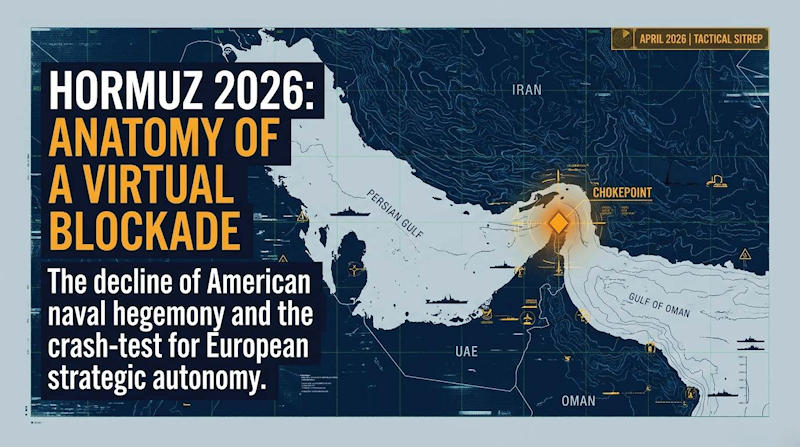
Why does Washington refuse to make freedom of navigation an absolute priority? How is Iran leveraging law and economics to hold the world by the throat? Discover an uncompromising technical and diplomatic breakdown that calls on European powers—led by France and the United Kingdom—to shake off their hesitation and enforce an independent diplomatic and military third way.
Table of Contents
By Vice Admiral Christian Girard (Ret.) — Toulon, April 29, 2026.
We are told, with little precision, that the strait is blocked—first by Iran, which decreed it, and subsequently by the Americans, who enacted a counter-blockade in reaction to force the Iranians to negotiate. It is well-established, however, that ships have crossed and continue to cross. Some do so with Iranian consent along a mandatory route close to their coast after paying a transit fee; others pass without apparent incident, such as at least two American destroyers that undoubtedly transited through the southern waters of the waterway to enter the Persian Gulf. The American blockade appears to apply only to Iranian vessels or those bound for Iranian ports; nevertheless, twenty-six Iranian ships have successfully bypassed it since mid-April, according to Lloyd’s List, a firm specializing in maritime intelligence.
A Political-Strategic Decision with a Declaratory Effect
The strait is not physically closed. It is the target of a political-strategic decision whose primary effect is declaratory.
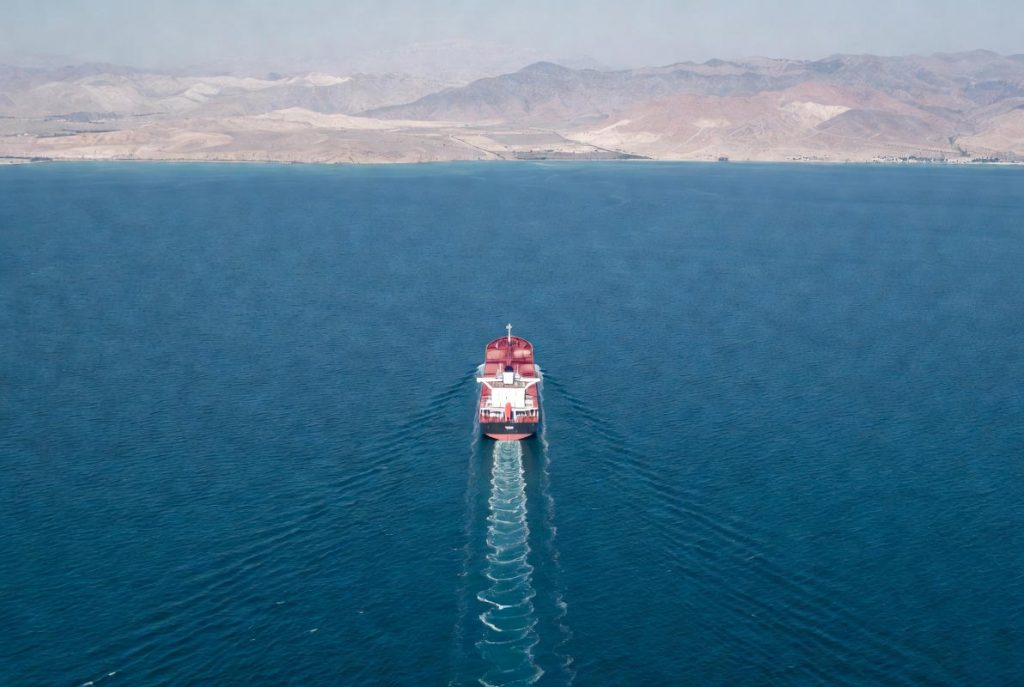
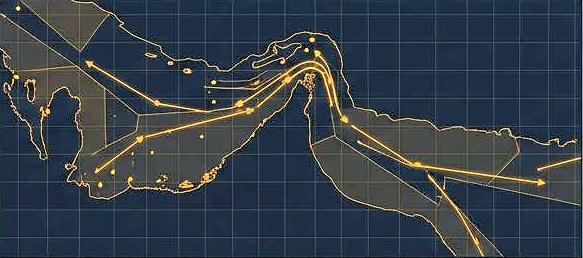
Let us examine the technical aspect of a potential “physical” blockade. The width of the strait varies between roughly 30 and 60 miles (50 to 100 km). Only naval mining could pose a genuine obstacle to navigation. Even then, it would have to be effective—meaning deployed across all navigable channels usable by the large vessels handling transport through the strait—and its presence verified, leaving no option to cross without exposing ships to prohibitive risks. This is currently not the case. (Tactical Assessment: The Permeability of the Strait — Infographic © European-Security)
A full-scale operation to block the strait with mines, had it occurred, could not have escaped the surveillance of Gulf coastal states and American forces due to the sheer volume of surface activity it would require. No such activity has been reported. Only sporadic, random mining operations could have been conducted discreetly by Iranian vessels, likely under the cover of night. This remains a possibility that has not been confirmed to date. It must also be noted that if Iran were to employ mining, it would risk disrupting its own traffic, particularly after the cessation of hostilities.
A Virtual Blockade with Very Real Psychological Effects
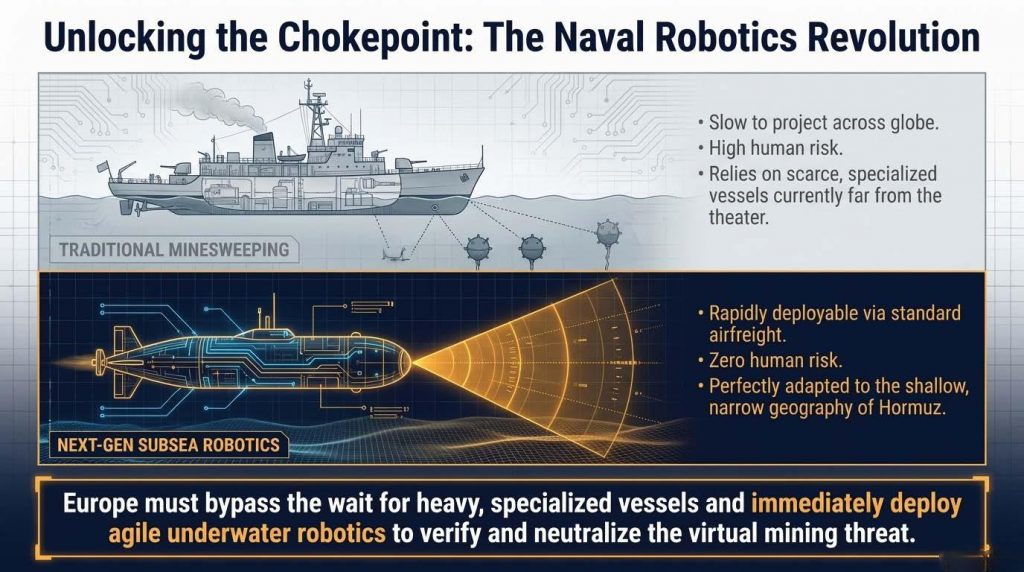
The reality of naval mining therefore remains largely virtual today. It must be swiftly confirmed or refuted to allow a sound assessment of a severe political-strategic situation, the outcome of which represents a vital stake for the global economy. This assessment requires the rapid deployment of specialized assets. Astoundingly, despite the urgency, there seems to be no talk of this—driven by a lack of available assets, and undoubtedly a lack of political will on the Western side. Perhaps the hypothesis of mining has been ruled out, but doing so would be a major gamble. Lest we forget, during the 1970s and 1980s, France pre-positioned a minehunter/sweeper division in Djibouti, which intervened on various occasions in the Gulf region, notably during the Iran-Iraq war to counter drifting mines laid by Iraq.
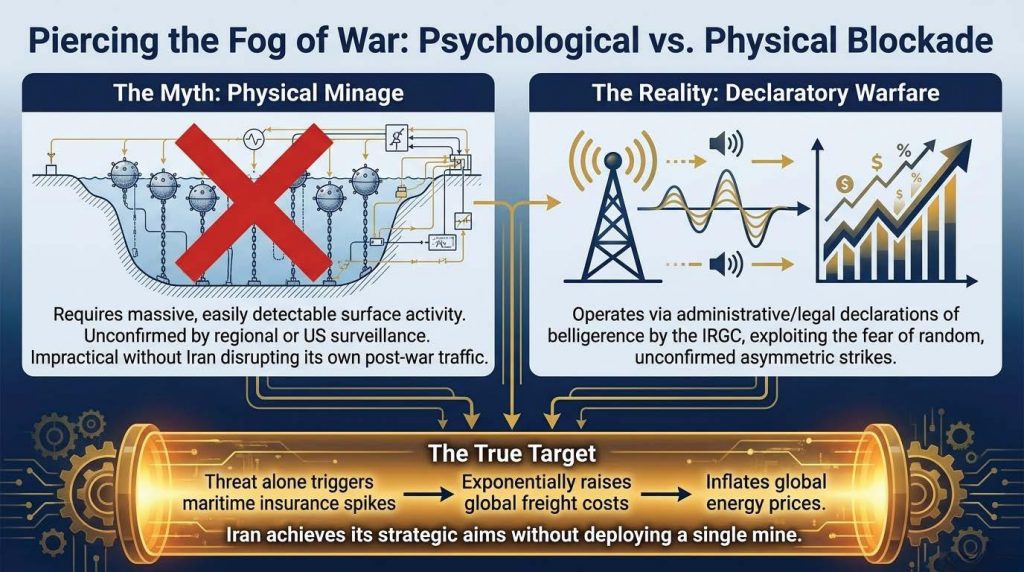
The blockade here is therefore primarily a wartime “legal” or “administrative” decision. Its foremost objective is to trigger psychological effects that lead to concrete economic consequences, such as spikes in maritime insurance and freight costs, as well as in the prices of oil, gas, and numerous other commodities essential to the smooth functioning of the global economy.
This is a major element of the Iranian strategy openly displayed by the Islamic Revolutionary Guard Corps. It stands, naturally, in total contradiction to international maritime law under the Montego Bay Convention regarding free transit through international straits, but also to the naval law of blockade, which can only be enforced between belligerents and never against neutral parties.
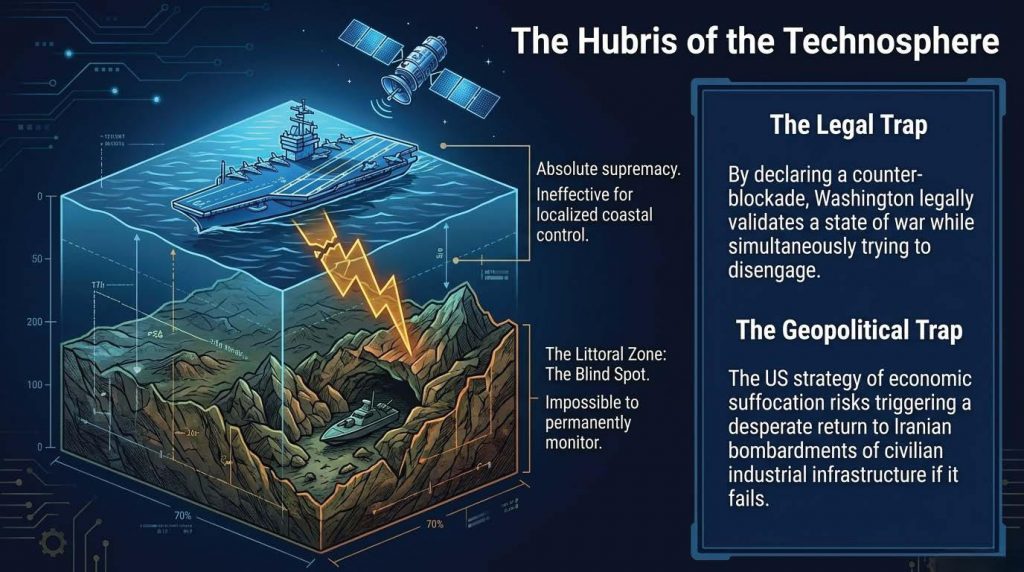
There is no doubt that the American countermeasure serves as leverage to force an agreement ending the current state of belligerency. Its use confirms, de facto and legally, the state of war initiated by the United States against Iran at a time when the former is seemingly trying to extricate itself from it. It is hardly surprising that Iran conditions the opening of negotiations on the cessation of the American blockade. Does the “art of the deal” not appear here to run counter to basic diplomatic common sense?
Yet, beyond its psychological dimension, the effectiveness of the blockade is inherently conditioned by the presence of military means of coercion. This alone lends credibility to the political-strategic decision. Consequently, the question arises regarding the control of the region by the military assets of both sides.
It is, to say the least, surprising that the Americans, given their aerial and informational military superiority, are unable to maintain permanent surveillance and tight control over every maritime activity in the strait all the way to the Iranian coast. This would allow them to instantly counter any Iranian attack on shipping, provided they possessed the appropriate retaliatory assets.
The Paradoxes of the American Hyperpower
Freedom of navigation through the strait is clearly not a strategic priority for them. The proof lies in their willingness to outsource the issue. Their economy does not directly depend on the hydrocarbon imports transiting the strait. At the same time, such behavior provides a mechanism to draw Europeans into a war about which they were never consulted and into which they do not want to be dragged against their will.
However, the deployment of U.S. Army Apache helicopters—originally designed for anti-tank warfare—is likely explained by a desire to establish a capability to counter the threat of the Pasdaran’s fast attack crafts or drones. Yet, it would be far preferable to destroy the launch sites or coastal shelters, or to deprive the Iranians of the intelligence necessary to track and attack their potential targets. Despite the power of the deployed American carrier strike groups, it appears that the United States either lacks the will or is unable to ensure permanent control of the strait’s coastline. They lack the necessary assets in the field of mine countermeasures, and those capable of dealing with drones and fast boats have yet to prove themselves. Their current strategy is primarily focused on strangling the Iranian economy. While this does not rule out a return to bombing civilian industrial infrastructure in the event of failure, it conserves military assets and limits the negative fallout of the war on public opinion.
Information Warfare: Depriving Tehran of Its Eyes
On the Iranian side, independent of the aforementioned assets and given the annihilation of their navy, one must question the source of the intelligence used for detecting, identifying, and tracking elements of maritime traffic.
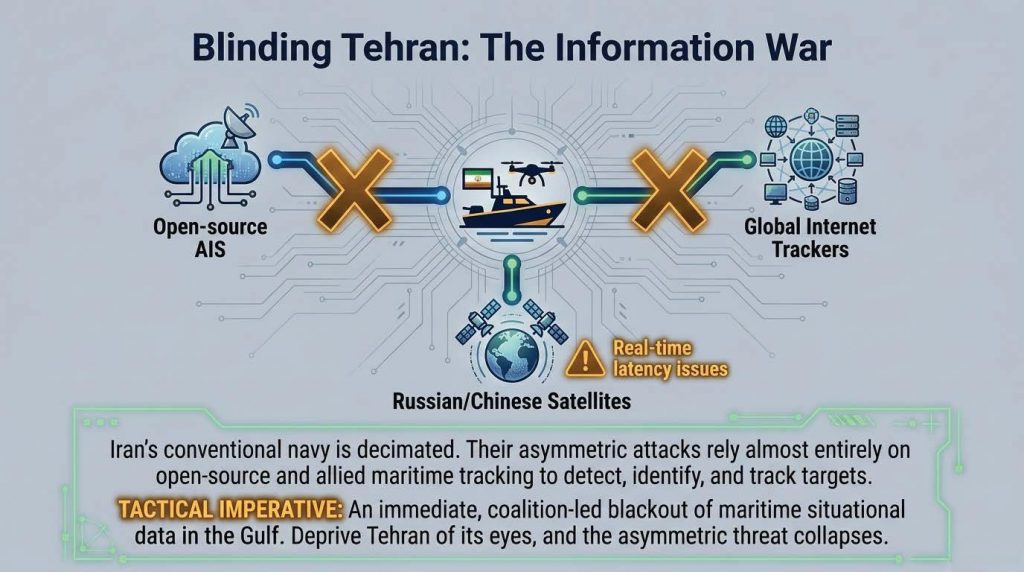
To put an end to Iranian blackmail, it is obviously imperative to deprive them of all sources of intelligence regarding the tactical situation, not only in the strait but throughout the entire Gulf. The global broadcasting of maritime positioning data on websites should be actively banned, even though Russian and Chinese intelligence will certainly provide—and continue to provide—satellite-derived information to Iran. It is doubtful, however, that this can be done in real time. Furthermore, it is unlikely that any radar installations remain intact on the Iranian coast.
The Necessary Awakening of European Naval Diplomacy
In this context, the stance of European countries—and specifically that of Europe’s two naval powers, France and the United Kingdom, traditionally committed to the principle of freedom of navigation—is particularly chilly. It is limited, much like in Ukraine regarding the reassurance force, to recalling the general principles of international law and studying active operational participation in protecting shipping only after the cessation of hostilities.
While it is entirely understandable and justified to avoid entering the conflict with Iran by aligning with the American side, it nevertheless appears necessary to play an active role in reopening the strait without waiting for the outcome of potential negotiations between the belligerents. This is vital both given the high stakes for the global economy and to avoid appearing de facto incapable of playing a strategic role independent of the United States.
To this end, direct negotiation with Iran is required. Backchannels are undoubtedly active, but they are not currently the subject of any official statement, despite the President of the Republic’s very recent remark made during an informal conversation. Is it not time for European powers to lift their heads in the Middle Eastern theater, where they once played a historic role?
However, a concrete agenda regarding the objective of these direct negotiations must be established and agreed upon. Sanctions relief could serve as a powerful bargaining chip to obtain compliance with free navigation in the strait in accordance with international law, which must be their ultimate goal. This objective could align with Iranian strategy, which seeks to decouple the issue of the strait from the broader stakes of the war imposed on them by the American-Israeli tandem—chiefly the nuclear issue.
In difficulty within a situation of his own making and eager to extricate himself from it, Donald Trump—irritated by his inability to rally Europeans to his views, particularly through a supplementary deployment of military assets—might find advantage in the external intervention of a third-party actor in diplomatic negotiations aimed at reopening the strait.
Beyond that, the pre-positioning of European military assets, capable of rapidly participating in securing maritime traffic in the Persian Gulf and the strait, appears to be a prerequisite for liberating European strategy from the insufferable arrogance and danger of the U.S. administration’s policy.
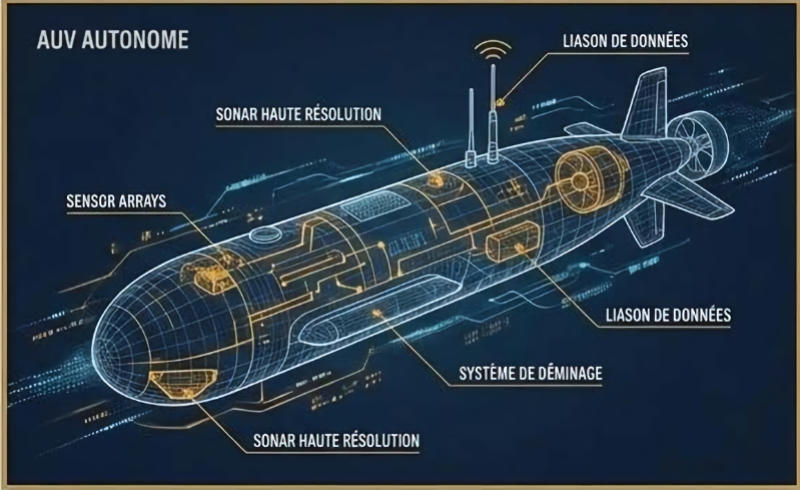
Mine countermeasure assets, despite the uncertainties analyzed earlier, are a priority. Even if those currently under development in the field of underwater robotics do not yet appear fully operational, they would certainly be more easily and rapidly deployable than the scarce specialized vessels that currently exist far from the theater of operations. They could well prove their worth here.
Christian Girard
(See also the second part of this strategic note: “Should We Save Soldier Trump? Or an Opportunity for Europeans to Assert Their Strategic Autonomy — The Strait of Hormuz”)
See Also:
- « Le blocus du détroit d’Ormuz (1) » — (2026-0429)
- « The Blockade of the Strait of Hormuz (1) » — (2026-0429)
- « Die Blockade der Straße von Hormus (1) » — (2026-0429)
- « Faut-il sauver le soldat Trump ? (2) — Le détroit d’Ormuz et l’autonomie stratégique européenne » — (2026-0514)
- « Should We Save Soldier Trump? (2) — The Strait of Hormuz and European Strategic Autonomy » — (2026-0514)
- « Muss der Soldat Trump gerettet werden? (2) — Die Straße von Hormus und die strategische Autonomie Europas » — (2026-0514)
- « Le détroit d’Ormuz (3) : L’enjeu stratégique immédiat et prioritaire de la guerre d’Iran » — (2026-0714)
- « The Strait of Hormuz (3): The Immediate and Priority Strategic Stake of the Iranian War » — (2026-0714)
- « Die Straße von Hormus (3): Die unmittelbare und vorrangige strategische Herausforderung im Iran-Krieg — (2026-0714)


Hormuz 2026: The Mirror of American Decline and the Crash-Test of European Sovereignty
Breakdown of the Two Notes by Admiral Girard
Through these two strategic notes, Admiral Christian Girard does not merely analyze a local crisis; he describes the reconfiguration of global power balances underway in 2026.
The Impasse of the All-Technological and Hubris
The Admiral’s primary lesson is a cruel historical reminder: dominance over the seas and skies is insufficient to impose one’s will on land. By locking itself into a purely military analysis and neglecting geography and economics, the Trump administration condemned itself to impotence. Iran, acting as an agile regional power, successfully shifted the conflict to the terrain of energy infrastructure, holding hostage an West that remains viscerally dependent on fossil fuels. The assessment is bitter: the American blockade has failed, and Washington is now looking to outsource a maritime security mission upon which its economy, paradoxically, does not directly depend.
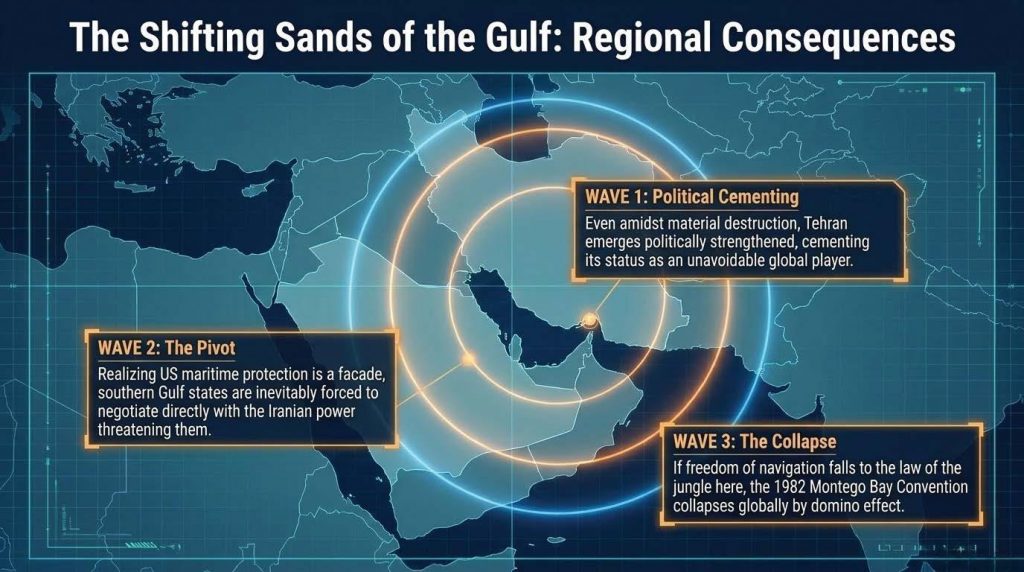
Regional Perspectives: An Unavoidable Iran, a Weakened US
Should the conflict halt today, the outlook for the Middle East outlines a deeply altered geopolitical landscape:
- A Strengthened Iran: Regardless of material destruction, the Tehran regime emerges politically elevated. By establishing the Strait of Hormuz as its ultimate insurance policy against Israeli designs, Iran solidifies its status as a global “key player”.
- The Shifting of the Gulf States: Observing the American failure to protect them, the Arab monarchies of the southern shore will inevitably be tempted to distance themselves from Washington to deal directly with the Iranian power threatening them.
- A Dangerous Precedent for International Law: If the principle of free circulation derived from the Montego Bay Convention is permanently flouted in Hormuz, the entirety of global maritime law risks collapsing in a domino effect.
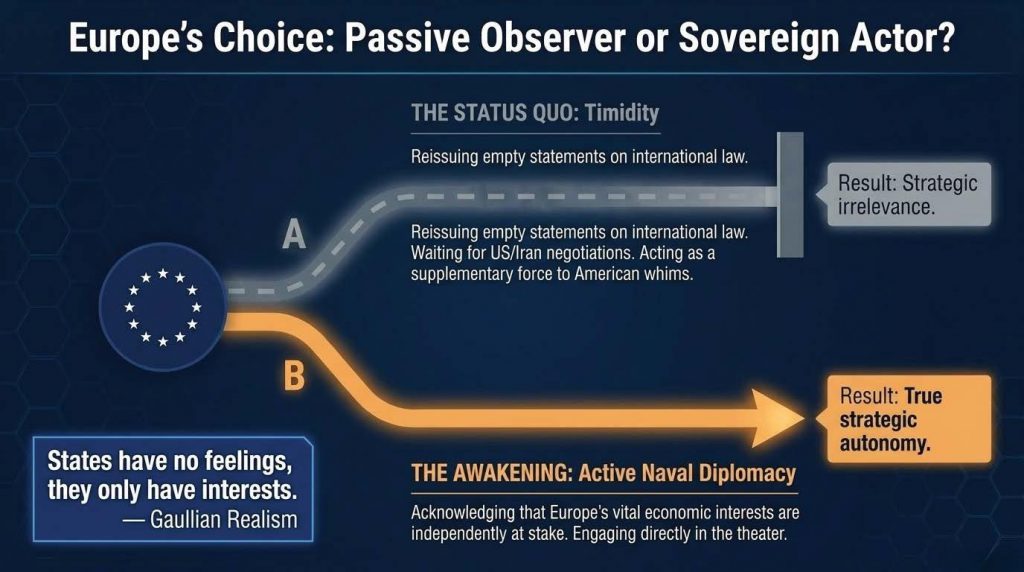
Europe’s Choice: Exist or Disappear
For Europe, this crisis is a dramatic wake-up call. Remaining passive on the grounds that it did not cause the crisis would be a major political error. Admiral Girard recalls a Gaullist truth: States do not have feelings; they only have interests. Europe has a vital need for the reopening of this economic choke point.
Operational perspectives do exist: the deployment of mine countermeasures (especially underwater robotics), blinding Iranian tactical information systems, and anti-drone protection. Yet the true key is psychological. To continue to exist in the 21st century in the face of predatory empires, the European Union must extend the geopolitical awakening born from Russian aggression in Ukraine beyond continental borders. It must dare to engage in autonomous military confrontation—not to “save Soldier Trump”, but to uphold international law and finally defend its own interests.