France-Germany: The Paroxysm, 1914–1945 (3)

From the “Diktat” of Versailles to Capitulation

From the assassination in Sarajevo to the ruins of 1945, Franco-German antagonism reaches its paroxysm: two world wars, a peace that humiliated instead of pacifying, and the rise of a criminal ideology that carried the logic of revenge all the way to annihilation. The third installment of this series traces how the “Diktat” of Versailles unwittingly prepared the revenge of 1940 — and how Europe touched bottom before it could, at last, begin to climb back up.
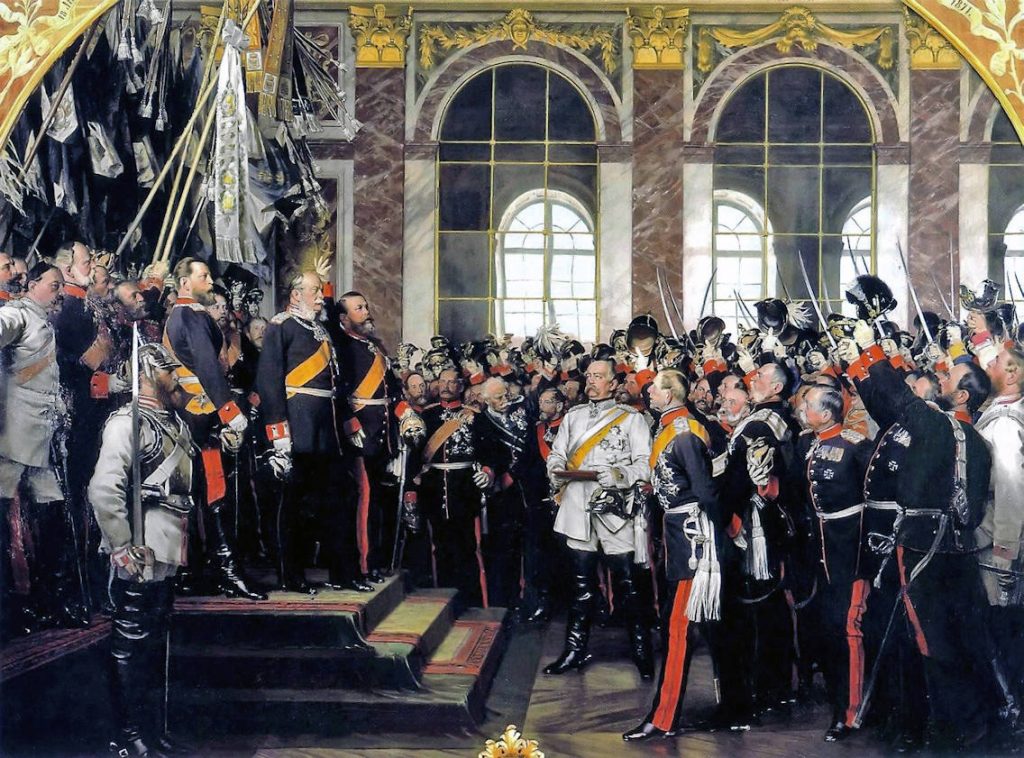
Proclamation à Versailles dans la galerie des glaces de l'empire d'Allemagne (18 janvier 1871)
Proclamation at Versailles in the Hall of Mirrors of the German Empire (18 January 1871)
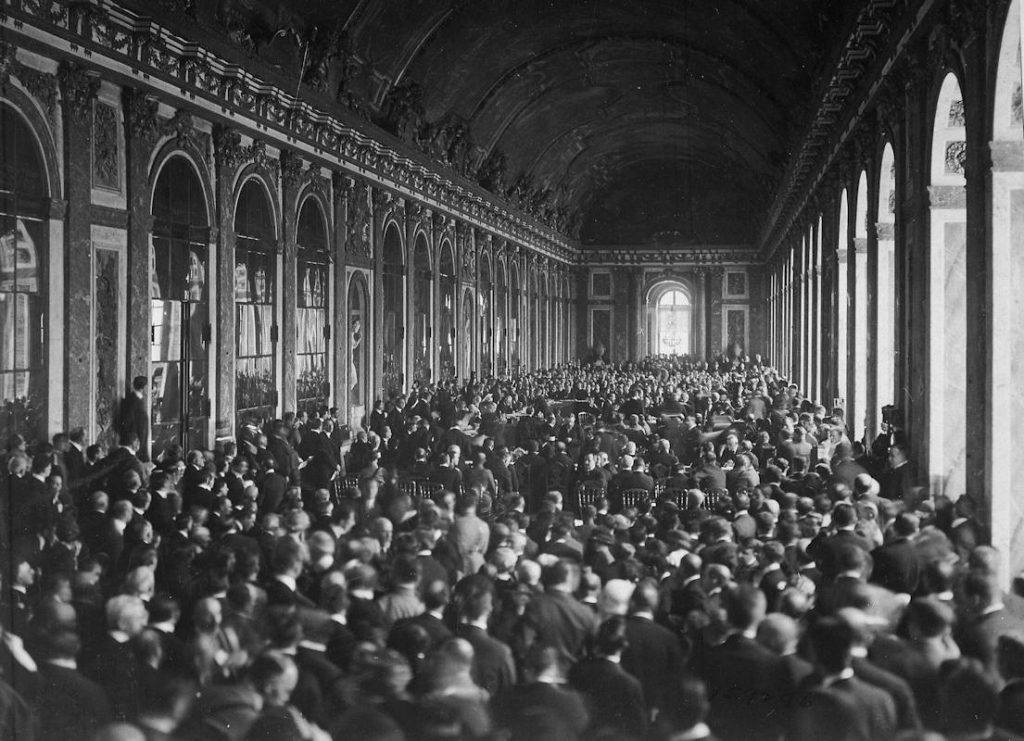
Traité de Versailles signé dans la galerie des glaces — US National Archives
The signing of the Treaty of Versailles in the Hall of Mirrors, 28 June 1919 — the same room where the German Empire had been proclaimed in 1871 — Photo US National Archives

by Joël-François Dumont — Paris, August 19, 2026

Introduction

The spark of Sarajevo, on 28 June 1914, embraced a continent already locked in place by its rival alliances and its arms race. What the First World War would inflict on a defeated Germany — a treaty perceived as a “Diktat” rather than a peace — would in turn prepare, with almost mechanical precision, the revenge of 1940. The cycle set in motion at Jena and Auerstedt in 1806, and continued at Sedan in 1870, here reached its paroxysm: two world wars in thirty years, and, with the Holocaust, humanity confronted with the abyss to which a logic of revenge, carried to its absolute conclusion, could lead.

1. The First World War and the Treaty of Versailles: A Cycle of Humiliations Perpetuated

The Great War as a Continuation

The First World War, unleashed in August 1914, can be read as a continuation and an escalation of the Franco-German conflict of 1870. The question of Alsace-Lorraine remained an open wound for France, feeding a revanchist nationalism. In Germany, Pan-Germanism and imperial ambitions contributed to a climate of confrontation. Successive international crises and the rigidity of the alliance systems — described in the previous installment of this series — made the conflagration nearly inevitable.
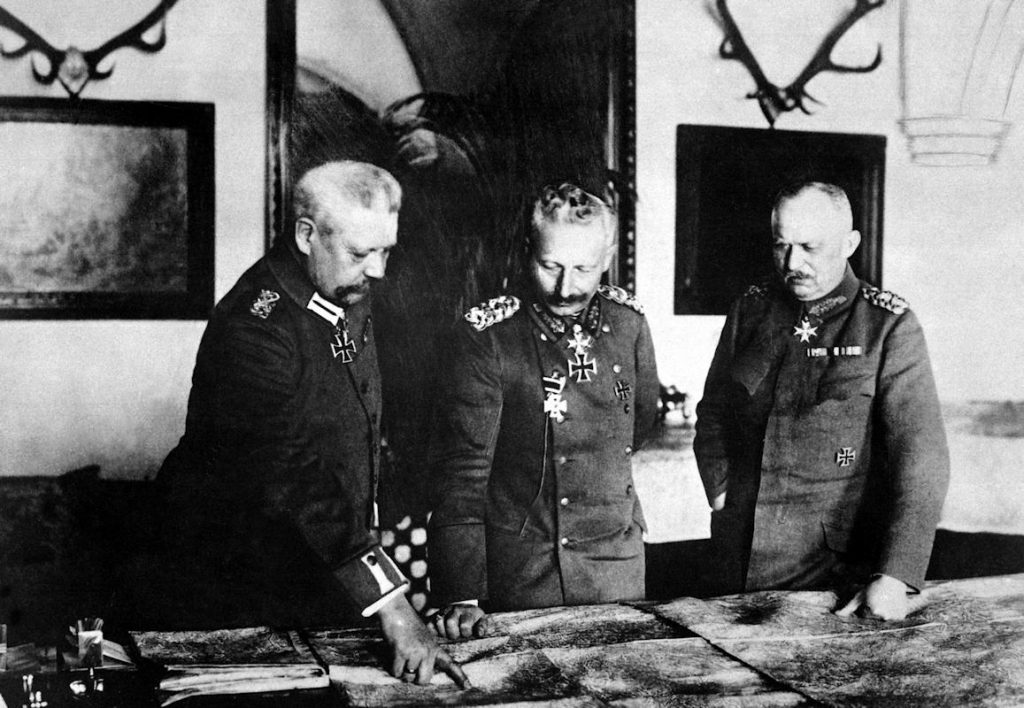
Le haut commandement allemand : Hindenburg (à gauche), Guillaume II (au centre) et Ludendorff (à droite), penchés sur une carte d’état-major. C’est pourtant Hindenburg lui-même qui, en novembre 1918, convainc le Kaiser que l’armée ne le suivra plus — précipitant l’abdication qu’aucun des trois hommes ici réunis n’aurait imaginée quelques mois plus tôt — Photo Robert Senneke / Wikimedia
The German High Command: Hindenburg (left), Wilhelm II (center) and Ludendorff (right), bent over a staff map. Yet it was Hindenburg himself who, in November 1918, convinced the Kaiser that the army would no longer follow him — precipitating the abdication that none of the three men gathered here would have imagined a few months earlier — Photo Robert Senneke / Wikimedia

The Armistice of 11 November 1918 and the Prelude to the “Diktat”
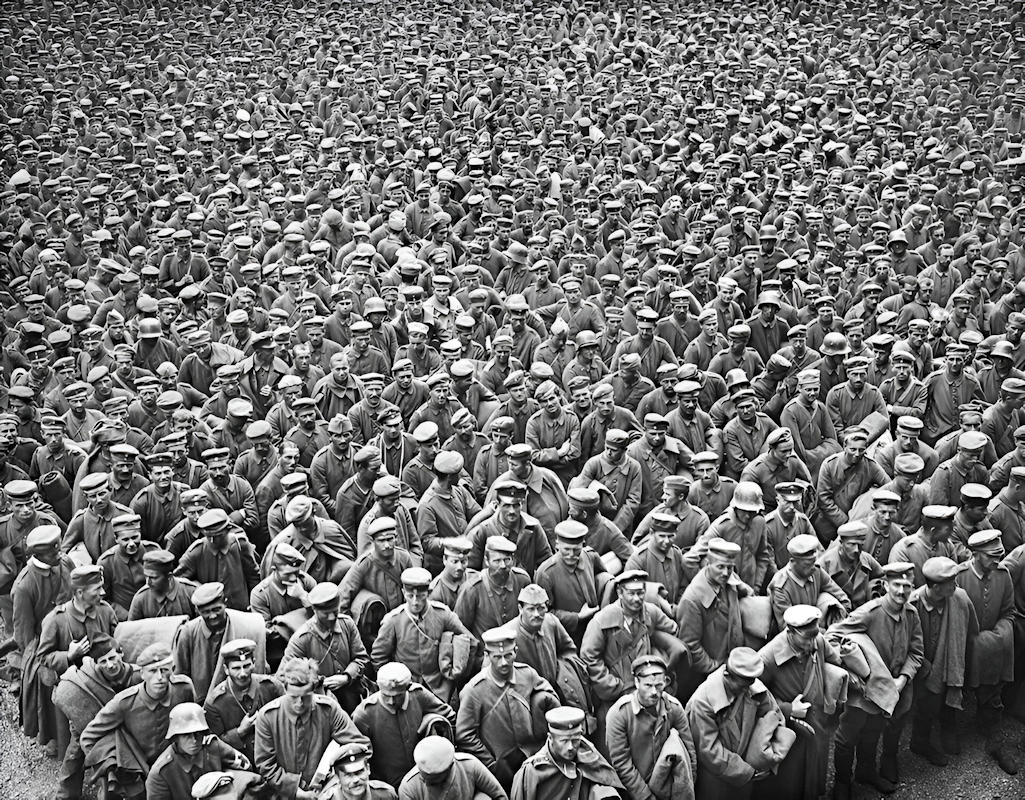
Des dizaines de milliers de prisonniers de guerre allemands capturés à Amiens, août 1918 par la 4e Armée britannique. La bataille d’Amiens, ouverte le 8 août, sera qualifiée par Ludendorff lui-même de « jour de deuil de l’armée allemande » — le moment où le haut commandement comprend que la guerre est militairement perdue, trois mois avant l’armistice — Photo David McLellan prise le 26.8.1918 — Collection Imperial Museum
Tens of thousands of German prisoners of war captured at Amiens, August 1918, by the British Fourth Army. The Battle of Amiens, which opened on 8 August, would be called by Ludendorff himself “the black day of the German army” — the moment the High Command understood the war was militarily lost, three months before the armistice — Photo David McLellan, taken 26.8.1918 — Imperial War Museum Collection

At Berlin, the collapse of the front was accompanied by an equally brutal political collapse. On 9 November 1918, Chancellor Max von Baden announced — without even having received formal confirmation — the abdication of Wilhelm II, before resigning himself shortly afterward and handing over the chancellery to Friedrich Ebert, leader of the Social Democratic majority.
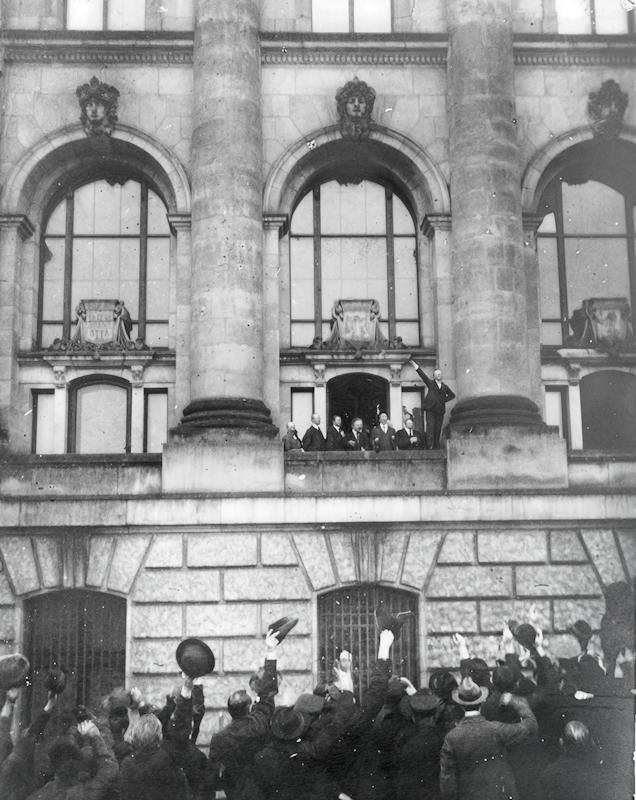
Philipp Scheidemann, bras levé, proclame la République allemande depuis un balcon du Reichstag, le 9 novembre 1918 — Guillaume II vient de renoncer au trône le jour même, mettant fin à près de cinquante ans de monarchie. À quelques centaines de mètres de là, Karl Liebknecht proclame, ce même jour, une République socialiste rivale : une nouvelle époque commence, mais deux Allemagnes s’en disputent aussitôt le sens — Photo Erich Greiser / Wikipedia
Philipp Scheidemann, arm raised, proclaims the German Republic from a balcony of the Reichstag, 9 November 1918 — Wilhelm II had renounced the throne that very day, ending nearly fifty years of monarchy. A few hundred meters away, Karl Liebknecht proclaimed, that same day, a rival Socialist Republic: a new era begins, but two Germanys immediately dispute its meaning — Photo Erich Greiser / Wikipedia

That same day, Philipp Scheidemann proclaimed the German Republic from a balcony of the Reichstag, while Karl Liebknecht, a few hundred meters away, proclaimed a free Socialist Republic: two rival Germanys were born in a single day, on the ruins of the same Empire.
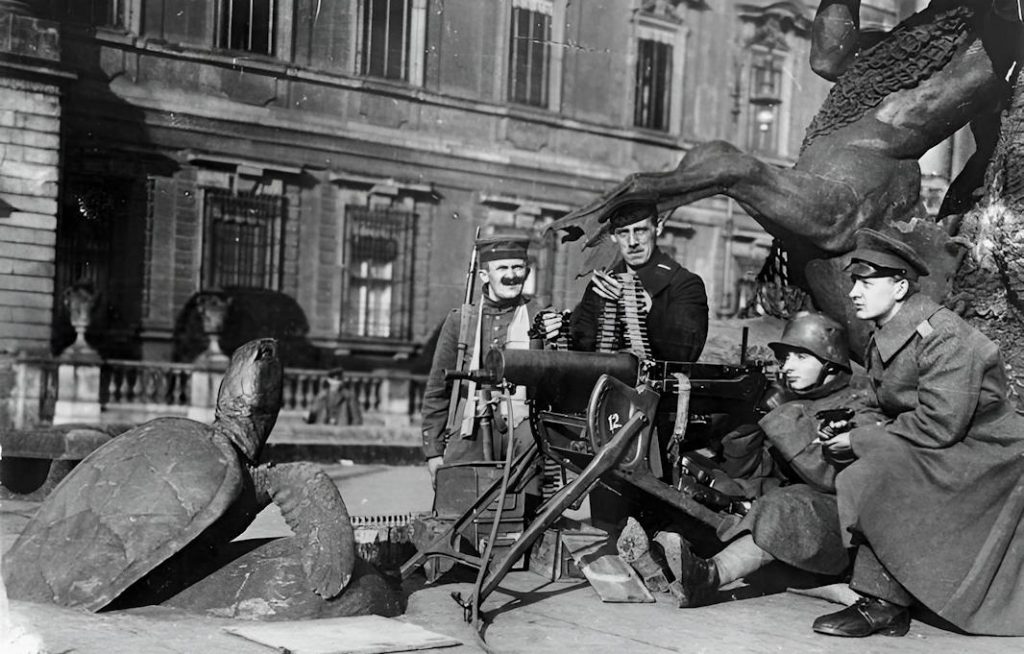
Poste de mitrailleuse au pied de la fontaine du château (Schloss-Brunnen), Berlin, novembre 1918 : la révolution qui emporte l'Empire ne se joue pas que dans les discours de balcon — elle se joue aussi, très concrètement, dans les rues de la capitale — Photo Bundesarchiv
A machine-gun post at the foot of the palace fountain (Schloss-Brunnen), Berlin, November 1918: the revolution sweeping away the Empire was not confined to balcony speeches — it was also playing out, very concretely, in the streets of the capital — Photo Bundesarchiv

Wilhelm II, disavowed even within his own camp, crossed the Dutch border the very next day and found there an exile that would last until his death in 1941 — never formally abdicating until 28 November.

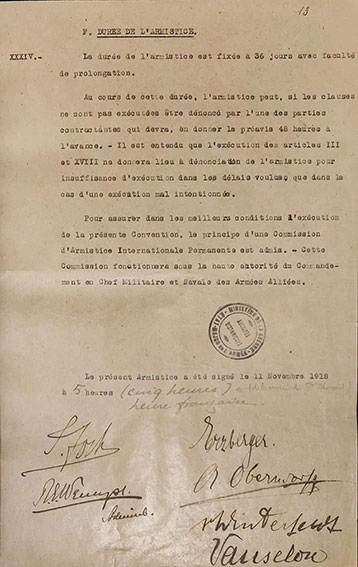
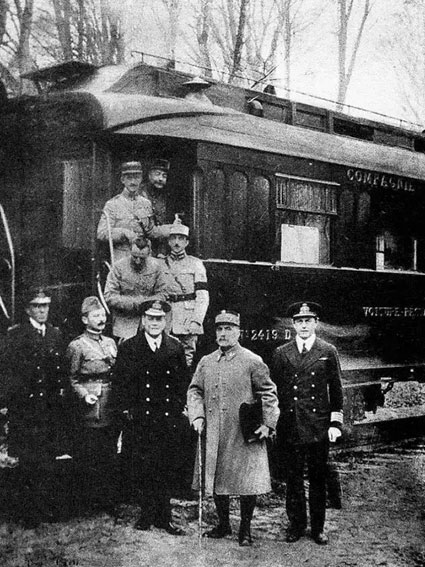
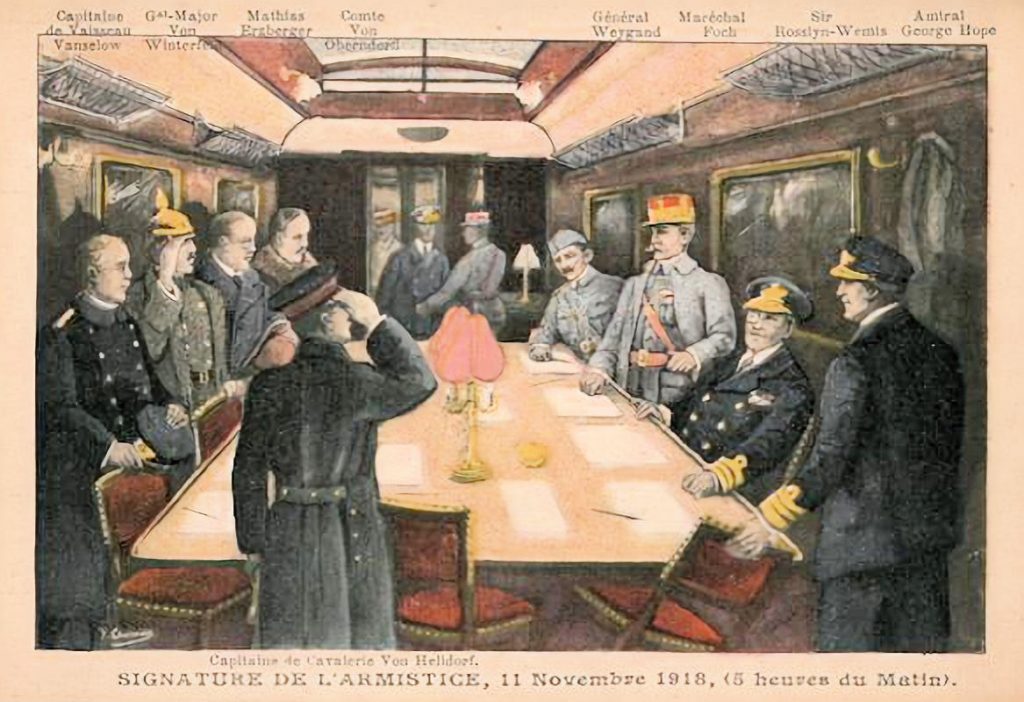
It was amid this chaos that the German delegation, led by Secretary of State Matthias Erzberger — a civilian, for lack of any general willing to publicly own the defeat — signed the armistice at 5:15 a.m. on 11 November, in Marshal Foch’s railway carriage stationed in the forest of Compiègne. Fighting ceased at 11 a.m. But the armistice was not peace: the British naval blockade, which had deprived Germany of food and raw materials since 1914, remained in place for several months after the guns fell silent, worsening an already deadly famine and feeding, among Germans, a sense of endless capitulation rather than an honorable armistice. This sentiment would lie at the heart of the “stab-in-the-back” legend (Dolchstoßlegende), already present in latent form even before the signing of the treaty that would, seven months later, crystallize it.
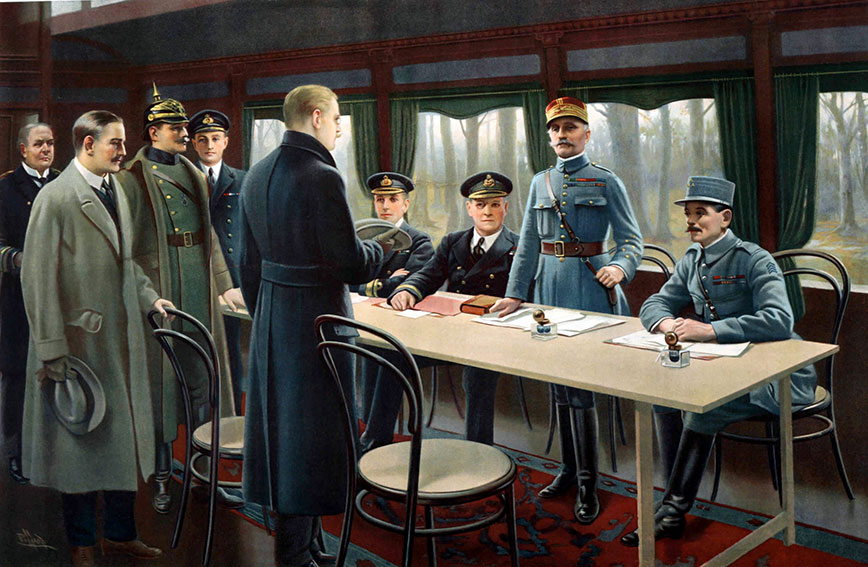
Cérémonie de clôture après la signature de l’armistice du 11 novembre 1918 dans le wagon-salon, forêt de Compiègne. De gauche à droite : Ernst Vanselow (capitaine de vaisseau), le comte Alfred von Oberndorff (ministère allemand des Affaires étrangères), Detlof von Winterfeldt (général allemand), Jack Marriott (capitaine de la Royal Navy britannique), Matthias Erzberger (chef de la délégation allemande, secrétaire d’État — il sera assassiné en 1921 pour son rôle dans l’armistice), George Hope (contre-amiral britannique), Rosslyn Wemyss (amiral de la flotte britannique, Premier Lord de la Mer), Ferdinand Foch (maréchal de France) et Maxime Weygand (général français) — Photo National Trust
Closing ceremony after the signing of the armistice of 11 November 1918 in the railway carriage, forest of Compiègne. From left to right: Ernst Vanselow (Kapitän zur See), Count Alfred von Oberndorff (German Foreign Ministry), Detlof von Winterfeldt (German general), Jack Marriott (Royal Navy captain), Matthias Erzberger (head of the German delegation, Secretary of State — he would be assassinated in 1921 for his role in the armistice), George Hope (British Rear Admiral), Rosslyn Wemyss (British Admiral of the Fleet, First Sea Lord), Ferdinand Foch (Marshal of France), and Maxime Weygand (French general) — Photo National Trust
Adieu à la délégation allemande après la signature de l’armistice, tableau de Maurice Pillard Verneuil. Face à Foch et Weygand debout, ainsi qu’aux amiraux britanniques Wemyss et Hope, Erzberger s’apprête à quitter la clairière de Rethondes, escorté par von Winterfeldt, von Oberndorff et Vanselow
Farewell to the German delegation after the signing of the armistice, painting by Maurice Pillard Verneuil. Facing Foch and Weygand standing, along with British admirals Wemyss and Hope, Erzberger prepares to leave the Rethondes clearing, escorted by von Winterfeldt, von Oberndorff, and Vanselow

The day after the signing, the French press echoed the moment with a solemnity mixed with relief. Unlike the American press, which learned of the event at a distance and folded it into the broader story of the Berlin chaos, the Paris newspapers had only one piece of news to announce — the end of four and a half years of war.
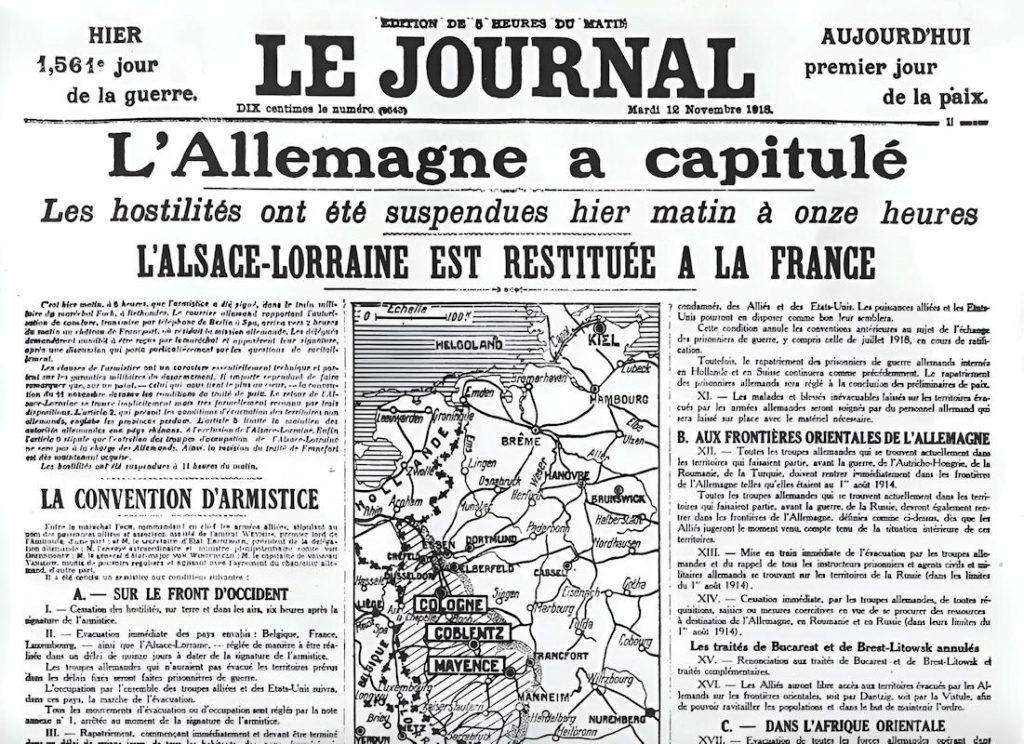
Une du Journal, mardi 12 novembre 1918, édition de cinq heures du matin : « Hier, 1 561e jour de la guerre. Aujourd'hui, premier jour de la paix. » Sous le titre « L'Allemagne a capitulé », le quotidien publie le texte intégral de la convention d'armistice, article par article — dont l'article 2, cité en tête, qui prévoit le retour immédiat de l'Alsace-Lorraine à la France, quarante-sept ans après l'annexion de 1871 — Source : Gallica-BnF
Front page of Le Journal, Tuesday 12 November 1918, five o’clock morning edition: “Yesterday, the 1,561st day of the war. Today, the first day of peace.” Under the headline “Germany Has Capitulated,” the paper published the full text of the armistice convention, article by article — including Article 2, cited first, providing for the immediate return of Alsace-Lorraine to France, forty-seven years after the 1871 annexation — Source: Gallica-BnF
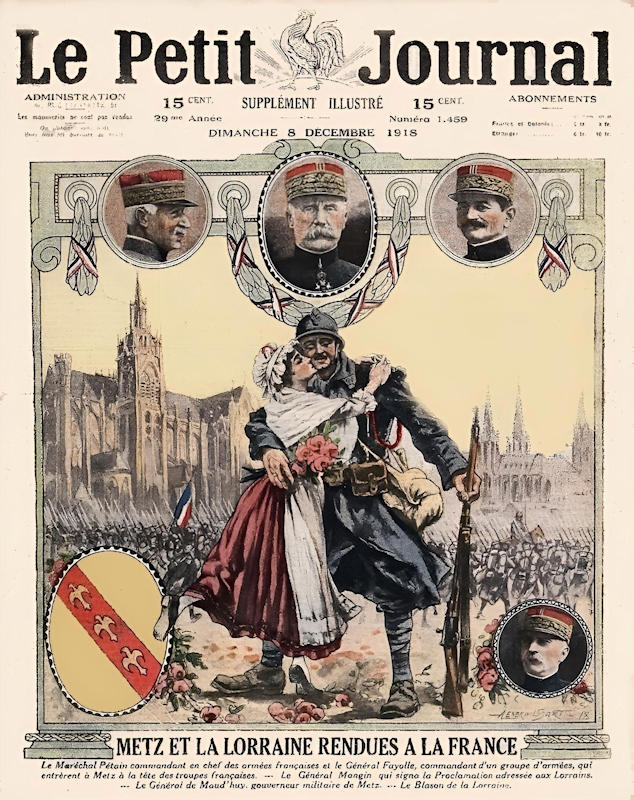
Metz et la Lorraine rendues à la France » — Une du Petit Journal, supplément illustré, 8 décembre 1918. Quarante-sept ans après l'annexion de 1871, l'Alsace-Lorraine revient à la France : la première clause de l'armistice, retrouvée ici sous les traits d'une allégorie populaire, plutôt que dans le langage sec d'un traité — Source : Le Petit Journal
“Metz and Lorraine Restored to France” — Le Petit Journal, illustrated supplement, 8 December 1918. Forty-seven years after the 1871 annexation, Alsace-Lorraine returns to France: the first clause of the armistice, here given the face of a popular allegory rather than the dry language of a treaty — Source: Le Petit Journal
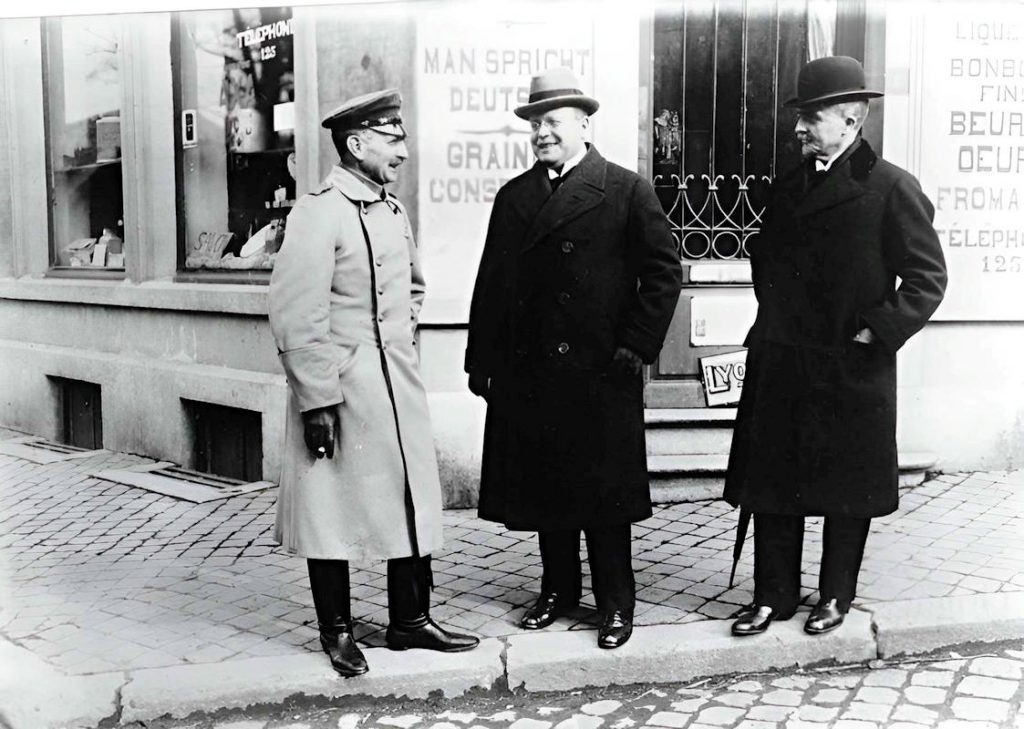
Matthias Erzberger (au centre), membre de la commission allemande d'armistice, à Spa (Belgique) en 1919, aux côtés du général von Hammerstein (à gauche) et du sous-secrétaire d'État Freiherr von Langwerth-Simmern (à droite). Après avoir signé l'armistice du 11 novembre, Erzberger poursuivra pendant des mois cette tâche ingrate de négociateur — celle-là même qui le désignera, aux yeux de l'extrême droite nationaliste, comme cible à abattre — Photo Bundesarchiv, Bild 183-R10390
Matthias Erzberger (center), member of the German Armistice Commission, at Spa (Belgium) in 1919, alongside General von Hammerstein (left) and Under-Secretary of State Freiherr von Langwerth-Simmern (right). After signing the armistice of 11 November, Erzberger would spend months continuing this thankless task of negotiator — the very task that would mark him, in the eyes of the nationalist far right, as a target — Photo Bundesarchiv
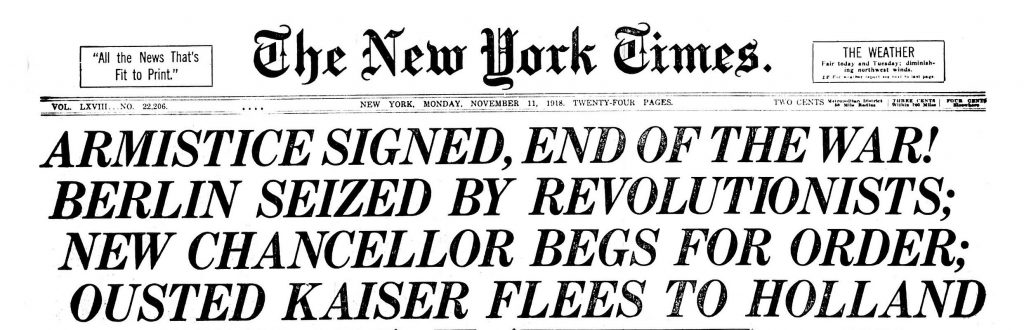
Une du NYT du 11.11.191 8 (Source Wikipedia)
Front page of The New York Times, 11 November 1918: four tiers of headlines for a single day of history — the armistice, the revolution in Berlin, the Kaiser’s flight to Holland. The armistice clauses detailed in the right-hand column cite first the German withdrawal from Alsace-Lorraine — forty-eight years almost to the day after the 1871 annexation — Source: New York Times Archives, via Wikipedia
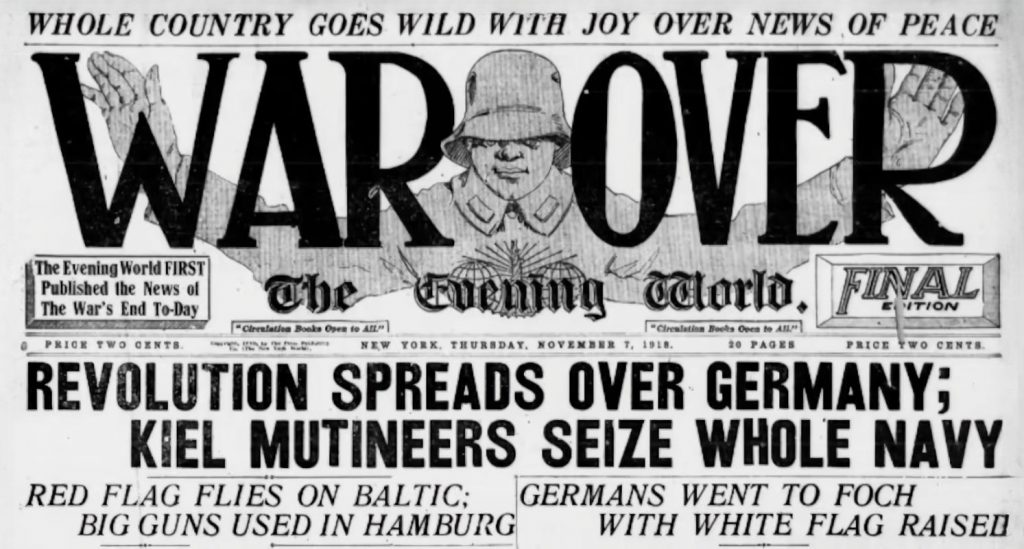
Le New York Evening World annonce prématurément la fin de la guerre dans son édition du 7 novembre 1918 — quatre jours avant l'armistice réel, sur la foi de rumeurs non confirmées. Un avant-goût de la confusion informationnelle qui entourera, jusqu'au bout, les derniers jours du conflit — Photo Library of Congress, via HistoryNet/MHQ
The New York Evening World prematurely announces the end of the war in its 7 November 1918 edition — four days before the real armistice, on the strength of unconfirmed rumors. A foretaste of the informational confusion that would surround the final days of the conflict right to the end — Photo Library of Congress, via HistoryNet/MHQ

The Treaty of Versailles (28 June 1919): The German “Diktat”

After four years of appallingly murderous war, Germany and its allies were defeated. The Treaty of Versailles, signed on 28 June 1919 — the anniversary of the Sarajevo assassination — was drawn up by the victorious powers, chiefly France, the United Kingdom, and the United States, with no real German participation in the negotiations. For Germany, the treaty was immediately perceived as a “Diktat,” an imposed and punitive peace.
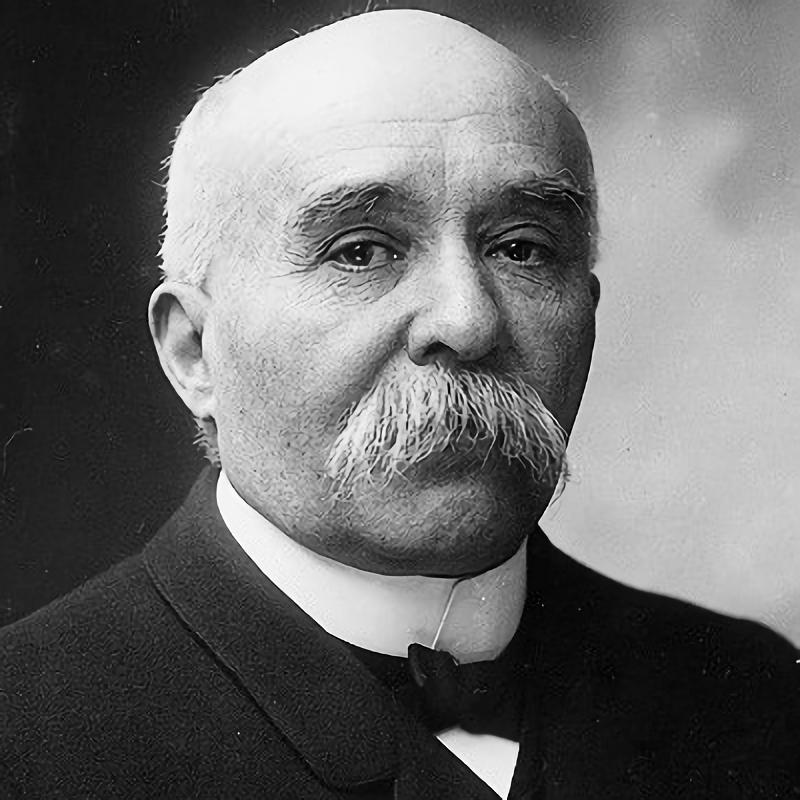
Geprges Clemenceau par Nadar

Georges Clemenceau, the French Prime minister, whose country had suffered most from the German invasion, demanded an “unconditional signature” and sought to durably weaken Germany in order to guarantee France’s security.

Georges Clemenceau, Prime Minister — Portrait by Nadar

The treaty’s terms were particularly severe. Territorially, Germany had to return Alsace-Lorraine to France, lost significant territory to Poland, Belgium, and Denmark, saw the Saar basin placed under international administration, and had all its colonies confiscated: in total, around 15% of its European territory and 10% of its population. Militarily, its army was cut to 100,000 men, with no air force, no tanks, no submarines, and the Rhineland was demilitarized.
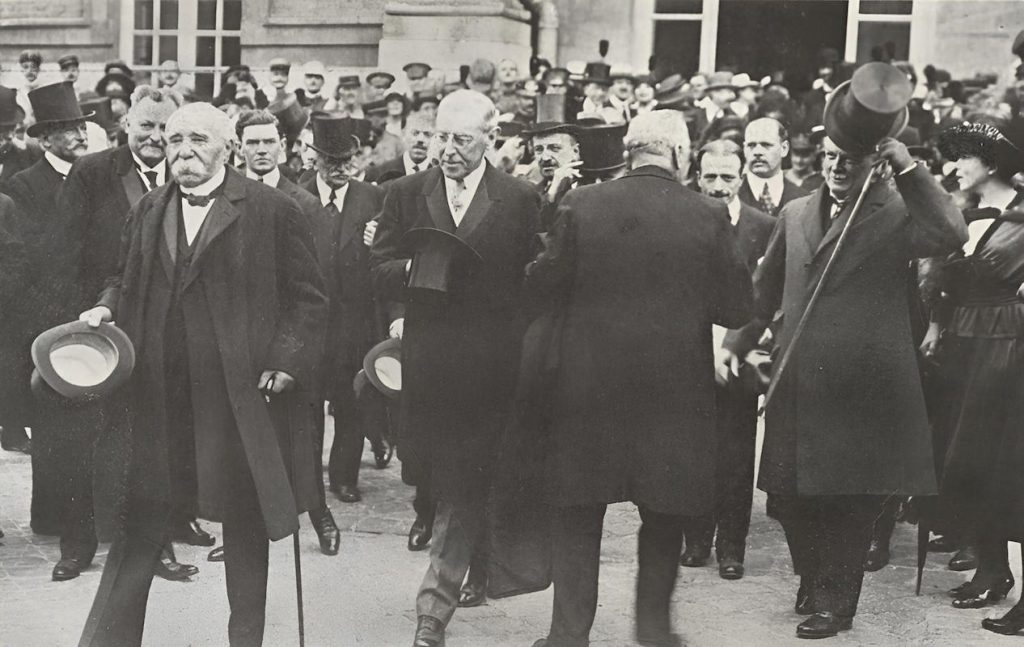
Georges Clemenceau (au premier plan) et Woodrow Wilson quittent le palais de Versailles, le 28 juin 1919, jour de la signature du traité. Deux des trois artisans du « Big Three » — avec David Lloyd George — qui ont imposé à l'Allemagne vaincue les termes d'une paix que Clemenceau lui-même jugeait déjà trop indulgente, et que les Allemands, eux, jugeront impitoyable — Photo Keystone (Domaine public)
Georges Clemenceau (foreground) and Woodrow Wilson leave the Palace of Versailles, 28 June 1919, the day the treaty was signed. Two of the three architects of the “Big Three” — along with David Lloyd George — who imposed on defeated Germany the terms of a peace that Clemenceau himself already considered too lenient, and that the Germans, for their part, would find merciless — Photo Keystone  (Public domain)

Economically and financially, Article 231 — the famous “war guilt clause” — designated Germany and its allies as solely responsible for the outbreak of the war, the legal basis for colossal reparations, assessed in 1921 at 132 billion gold marks.
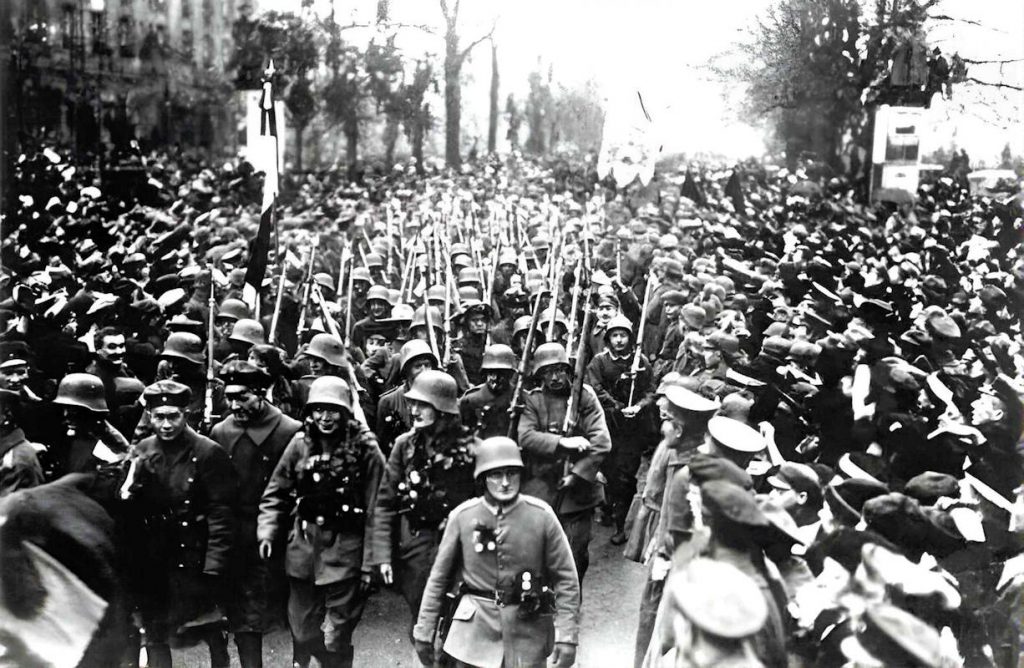
Retour des troupes à Berlin, en décembre 1918 : les soldats, fleuris et couronnés de feuillage en signe d'accueil triomphal, défilent sous les acclamations d'une foule immense. C'est ce jour-là qu'Ebert lance aux régiments : « Aucun ennemi ne vous a vaincus » — une phrase de réconfort patriotique qui deviendra, malgré lui, l'un des piliers du mythe du coup de poignard dans le dos — Photo Bundesarchiv/ Wikipedia
Return of troops to Berlin, December 1918: soldiers, decked with flowers and wreaths of foliage as a sign of triumphant welcome, march to the acclaim of a huge crowd. It was on this day that Ebert told the regiments: “No enemy has vanquished you” — a phrase of patriotic comfort that would, against his intention, become one of the pillars of the stab-in-the-back myth — Photo Bundesarchiv/Wikipedia

The German perception of the treaty was unanimously negative. Friedrich Ebert, the president of the Weimar Republic, greeted German soldiers returning from the front by declaring that “no enemy has vanquished you,” feeding the myth of the “stab in the back” (Dolchstoßlegende), according to which the German army had not been militarily defeated but betrayed by civilians and revolutionaries at home. This perception of an unjust and humiliating peace, imposed by force, undermined the legitimacy of the young Weimar Republic from the outset.

Socio-Economic Consequences: The Breeding Ground for Crisis
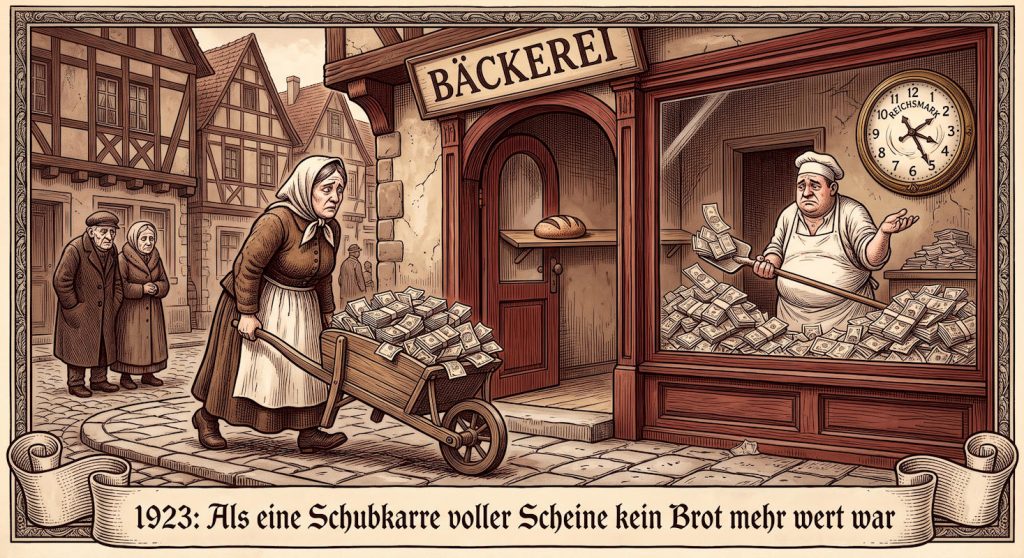
L'hyperinflation de 1923 : une brouette de billets ne suffit plus à acheter un pain. Le mark, dont la valeur s'effondre d'heure en heure, devient le symbole même de l'humiliation économique qui vient nourrir le ressentiment exploité, dix ans plus tard, par le national-socialisme — Illustration IA © European-Security
The hyperinflation of 1923: a wheelbarrow full of banknotes is no longer enough to buy a loaf of bread. The mark, its value collapsing by the hour, became the very symbol of the economic humiliation that would feed the resentment exploited, ten years later, by National Socialism — AI Illustration © European-Security
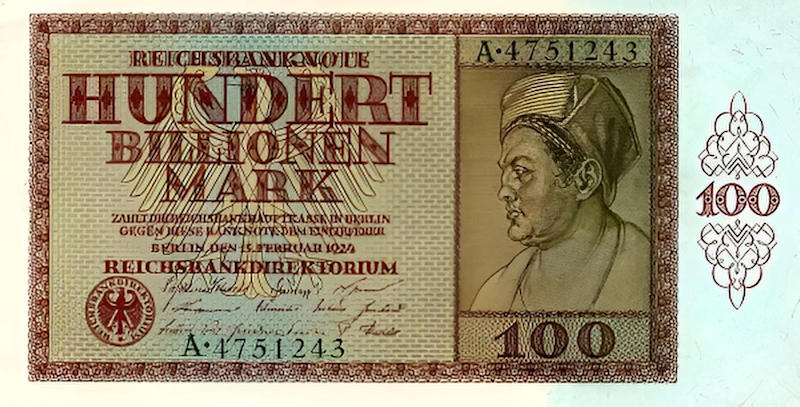
Billet de 100 milliards de marks (100 000 000 000 000 Mark), Reichsbank, 15 février 1924. À son émission, en novembre 1923, une coupure de ce montant valait environ 1 300 marks-or ; dix-huit jours plus tard, elle n'en valait plus que 100 — la plus grosse coupure jamais émise en Allemagne, symbole même de l'effondrement monétaire de 1923 — Münzkabinett, Staatliche Museen zu Berlin
Banknote for 100 trillion marks (100,000,000,000,000 Mark), Reichsbank, 15 February 1924. When first issued, in November 1923, a note of this denomination was worth about 1,300 gold marks; eighteen days later, it was worth only 100 — the largest denomination ever issued in Germany, the very symbol of the 1923 monetary collapse — Münzkabinett, Staatliche Museen zu Berlin

The burden of reparations, combined with territorial and industrial losses, strangled the German economy and contributed to devastating hyperinflation in the early 1920s.
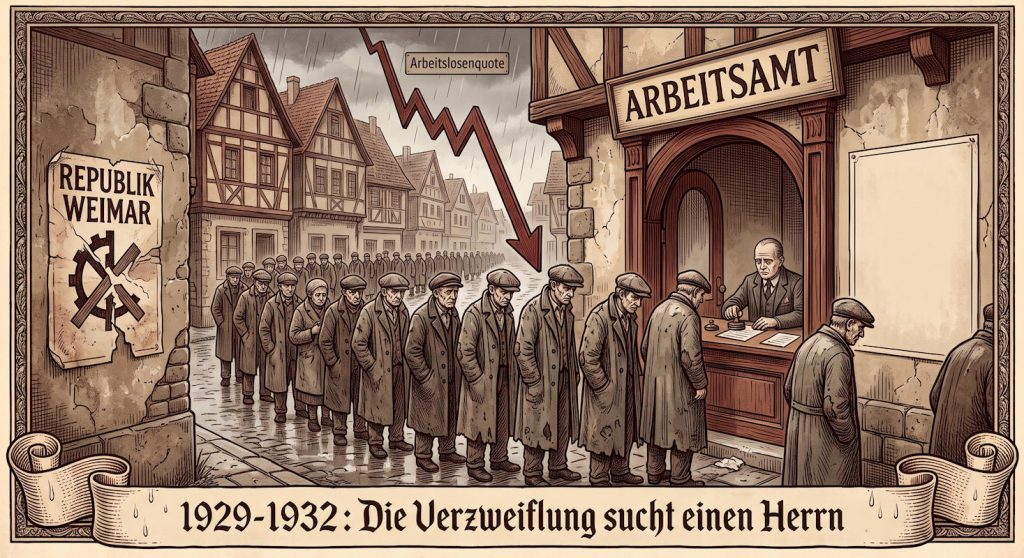
Devant l'Arbeitsamt, 1929-1932 : la file s'allonge à mesure que le chômage explose, passant de moins d'un million à plus de six millions de sans-emploi en l'espace de trois ans. Ce terreau de misère et de désespoir, la République de Weimar — déjà discréditée par l'hyperinflation de 1923 — ne parvient plus à l'endiguer. C'est ce vide que le national-socialisme s'apprête à combler — Illustration IA © European-Security
Outside the Arbeitsamt, 1929–1932: the line grows longer as unemployment explodes, rising from under one million to more than six million jobless in the space of three years. This breeding ground of misery and despair, the Weimar Republic — already discredited by the 1923 hyperinflation — could no longer stem. This was the void National Socialism was about to fill — AI Illustration © European-Security
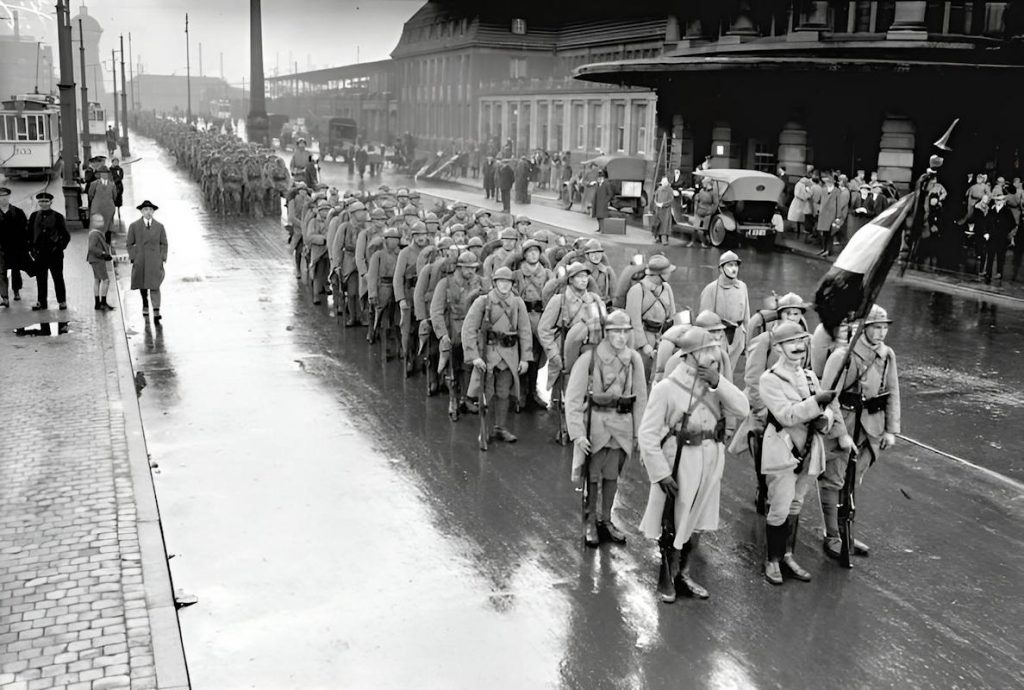
Les derniers soldats français quittent Dortmund, octobre 1924 — l'occupation de la Ruhr, déclenchée en janvier 1923 par le refus allemand de livrer charbon et bois selon les termes du traité de Versailles, s'achève après près de deux ans. Ironie du sort : c'est cette occupation elle-même, par la « résistance passive » qu'elle déclenche outre-Rhin, qui précipite la planche à billets et l'hyperinflation qui ravage l'Allemagne cette même année — Photo Bundesarchiv
The last French soldiers leave Dortmund, October 1924 — the occupation of the Ruhr, triggered in January 1923 by Germany’s refusal to deliver coal and timber under the terms of the Treaty of Versailles, comes to an end after nearly two years. An irony of fate: it was this very occupation, through the “passive resistance” it triggered in Germany, that set the printing presses running and unleashed the hyperinflation that ravaged the country that same year — Photo Bundesarchiv

The global economic crisis of 1929 then hit Germany head-on, worsening unemployment and social hardship. This breeding ground of economic difficulty, political instability, and national humiliation proved extremely fertile for nationalist and extremist movements.

The signing of the treaty in the Hall of Mirrors at Versailles — the very place where the German Empire had been proclaimed in 1871 — was perceived as a deliberate symbolic humiliation, reversing that of 1871 but inflicting a fresh wound on German national pride. In seeking to punish Germany through excessively harsh and humiliating measures, the Treaty of Versailles thus missed its goal of establishing a lasting peace. On the contrary, it created the conditions of its own failure by nourishing a profound desire for revenge, unwittingly paving the way to a new catastrophe.

2. The Interwar Years and the Second World War: The Paroxysm of Conflict
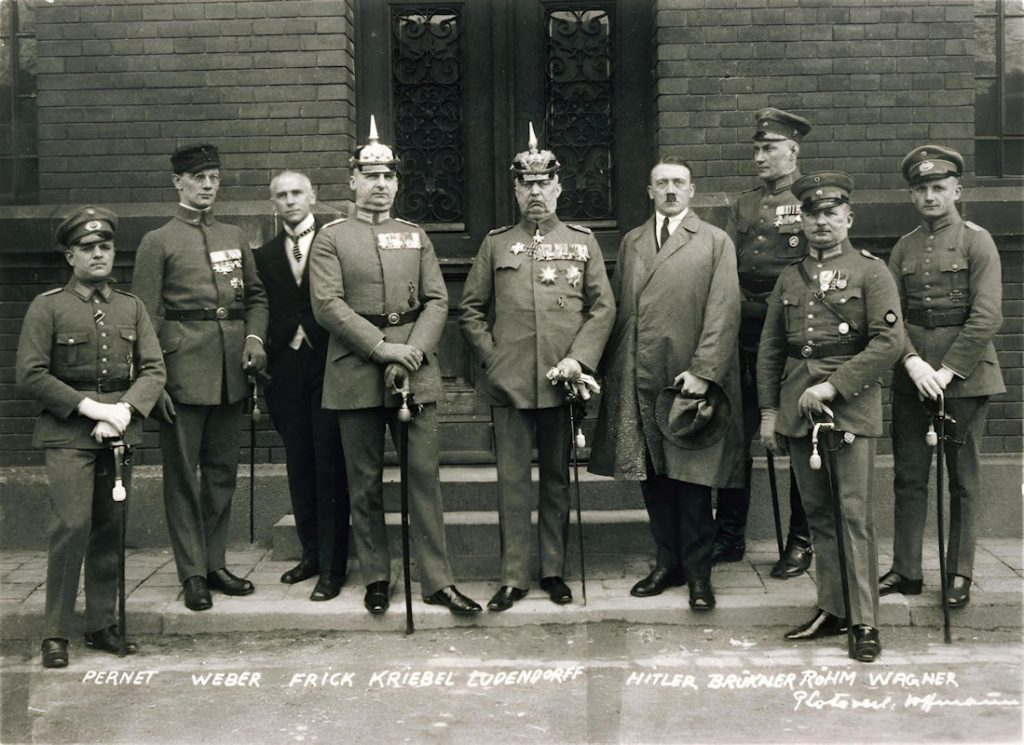
Hitler et ses co-accusés dans la cour du tribunal de Munich, le 1er avril 1924, avant l'annonce du verdict du procès pour le putsch manqué de la Brasserie (novembre 1923). La clémence du jugement — cinq ans de forteresse dont Hitler n'en purgera que neuf mois — scandalisa les observateurs de l'époque et lui permit de transformer le procès en tribune politique — Photo Heinrich Hoffmann / Bundesarchiv
Hitler and his co-defendants in the courtyard of the Munich courthouse, 1 April 1924, before the verdict was announced in the trial over the failed Beer Hall Putsch (November 1923). The leniency of the sentence — five years’ fortress confinement, of which Hitler would serve only nine months — scandalized observers at the time and allowed him to turn the trial into a political platform — Photo Heinrich Hoffmann / Bundesarchiv

The Crisis of 1929 and Hitler’s Rise

The Weimar Republic, already weakened by attempted putsches and hyperinflation, was hit hard by the Great Depression. Adolf Hitler and his National Socialist Party exploited this despair with formidable efficiency, promising to tear up the “Diktat of Versailles,” restore Germany’s greatness, and give it back its pride.

Défilé du parti nazi à Nuremberg, 1933 — Le premier grand rassemblement du régime depuis l'arrivée au pouvoir d'Hitler en janvier. Brassards à croix gammée, saluts hitlériens, drapeaux pendant aux fenêtres : en quelques mois, le NSDAP a transformé l'espace public allemand, prélude à la démolition méthodique des clauses de Versailles qui s'engage cette même année — Photo Robert Sennecke, Narodowe Archiwum Cyfrowe, domaine public
Nazi Party parade in Nuremberg, 1933 — the regime’s first great rally since Hitler’s rise to power in January. Swastika armbands, Nazi salutes, flags hanging from windows: within a few months, the NSDAP had transformed German public space, a prelude to the methodical demolition of the Versailles clauses that began that same year — Photo Robert Sennecke, Narodowe Archiwum Cyfrowe, public domain

The NSDAP, which had won only 2% of the vote in 1928, saw its score climb to 18% in 1930, then 38% in 1932. On 30 January 1933, Adolf Hitler was appointed chancellor. Resentment over Versailles was a determining factor in his rise, but not the only one: the economic crisis and the support of certain conservative and industrial elites, who believed they could control him, also played a decisive role.

Revanchist Rhetoric and Remilitarization

Once in power, Hitler set about methodically dismantling the clauses of the Treaty of Versailles. He restored compulsory military service, launched a massive rearmament program, and, in 1936, remilitarized the Rhineland in flagrant violation of the treaty.
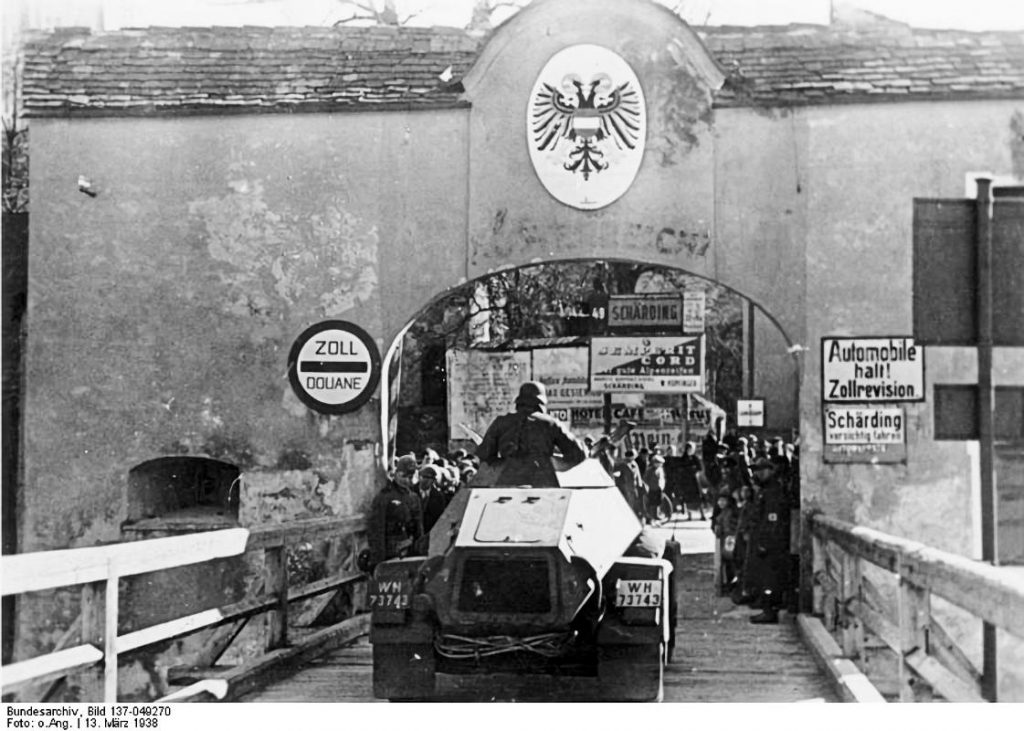
Un blindé allemand franchit la frontière autrichienne à Schärding, le 13 mars 1938 — jour de la proclamation officielle de l'Anschluss. L'écusson autrichien surplombe encore l'arche, les panneaux de douane sont toujours en place ; dans quelques instants, ils n'auront plus aucun sens. Un an plus tard, à quelques kilomètres de là, ce jour sera immortalisé en pierre à Oberschützen — Photo Bundesarchiv
A German armored car crosses the Austrian border at Schärding, 13 March 1938 — the day of the official proclamation of the Anschluss. The Austrian coat of arms still overlooks the archway, the customs signs are still in place; in a few moments, they will mean nothing at all. A year later, a few kilometers away, this day would be immortalized in stone at Oberschützen — Photo Bundesarchiv
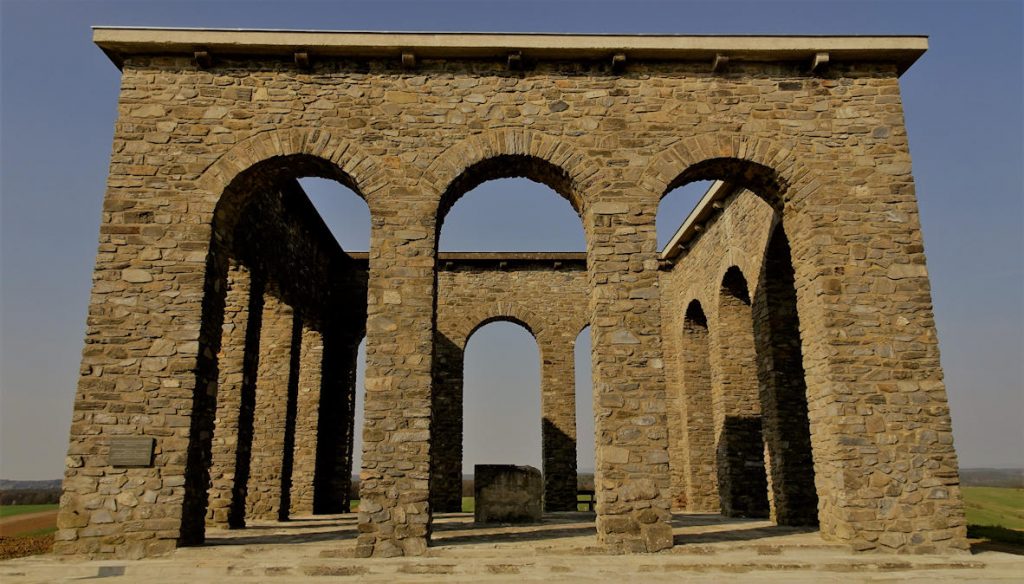
Le « Anschlussdenkmal » d'Oberschützen (Burgenland), tel qu'il apparaît aujourd'hui — a été le plus grand monument national-socialiste jamais construit sur le sol autrichien, inauguré le 21 mai 1939 pour célébrer l'Anschluss de mars 1938. Sa construction avait mobilisé toute la population locale, enfants compris, dans plus de 33 000 heures de travail bénévole. Depuis 1997, une plaque y appelle à en faire un lieu de mémoire « contre la dictature, contre la violence, contre le racisme » — Photo Wikipedia
The “Anschlussdenkmal” of Oberschützen (Burgenland), as it stands today — the largest National Socialist monument ever built on Austrian soil, inaugurated on 21 May 1939 to celebrate the Anschluss of March 1938. Its construction had mobilized the entire local population, including children, in more than 33,000 hours of volunteer labor. Since 1997, a plaque there has called for it to become a place of remembrance “against dictatorship, against violence, against racism” — Photo Wikipedia

The annexation of Austria in March 1938, then of the Sudetenland in September 1938, followed the same logic, always in the name of restoring national honor — a nationalism that, under Nazi ideology, was perverted into a doctrine of racial supremacy and brutal expansionism.
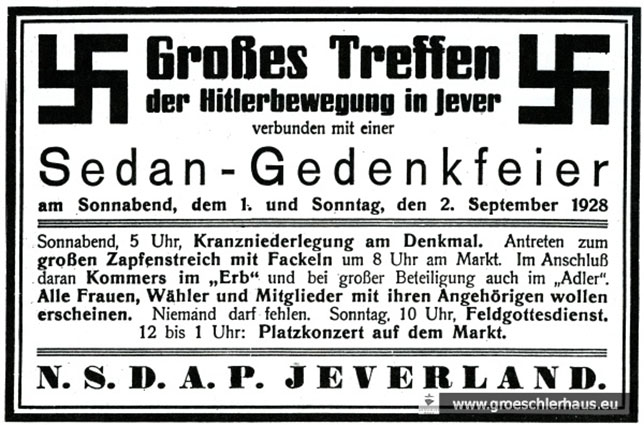
Appel pour un dépôt d’une gerbe en l’honneur de Sedan — Archives allemandes (1928)
Call for a wreath-laying in honor of Sedan — German archives (1928)

The Second World War and the Symbolism of Sedan, then Rethondes

The invasion of Poland on 1 September 1939 triggered the Second World War. In the spring of 1940, the German army launched its offensive in the West, rapidly overwhelming the Netherlands, Belgium, Luxembourg, and then France. The German breakthrough through the Ardennes and the crossing of the Meuse at Sedan in May 1940 carried immense strategic and symbolic weight: this victory, in which French forces were overwhelmed and routed, amounted to a reversed and aggravated replay of the French defeat of 1870 — the very place where, in 1870, Bismarck had seen the revenge for Auerstedt come to pass.
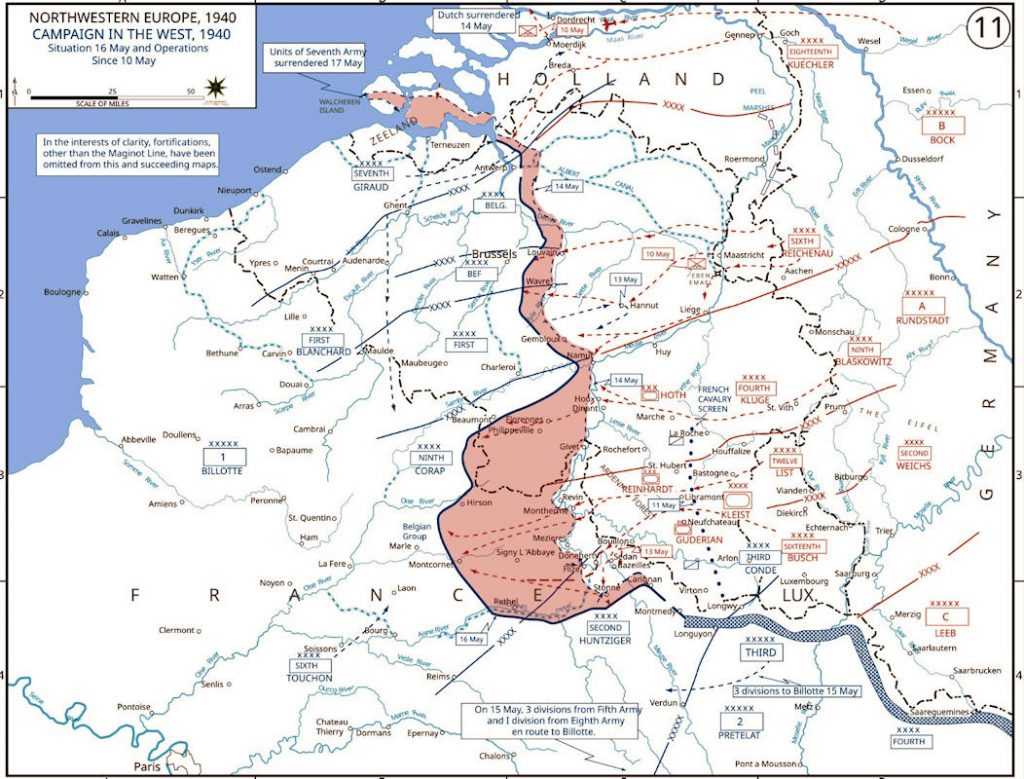
Carte d'état-major : la percée allemande à travers les Ardennes, mai 1940. Contournant la ligne Maginot par le nord (en hachures, à droite), les divisions blindées de Guderian et Kleist franchissent la Meuse à Sedan le 13 mai, ouvrant la brèche (en rose) qui isolera les armées alliées engagées en Belgique — Source : Cartes d'état-major, West Point Atlas of American Wars
Staff map: the German breakthrough through the Ardennes, May 1940. Bypassing the Maginot Line to the north (hatched, right), Guderian’s and Kleist’s armored divisions crossed the Meuse at Sedan on 13 May, opening the breach (in pink) that would isolate the Allied armies engaged in Belgium — Source: Staff maps, West Point Atlas of American Wars

But it was a month later, and at a different site of memory, that Hitler would deliver the strongest symbolic gesture of all: on 22 June 1940, he insisted that the Franco-German armistice be signed in the very same railway carriage, at Rethondes near Compiègne, in which Germany had been forced to sign its own capitulation in 1918.
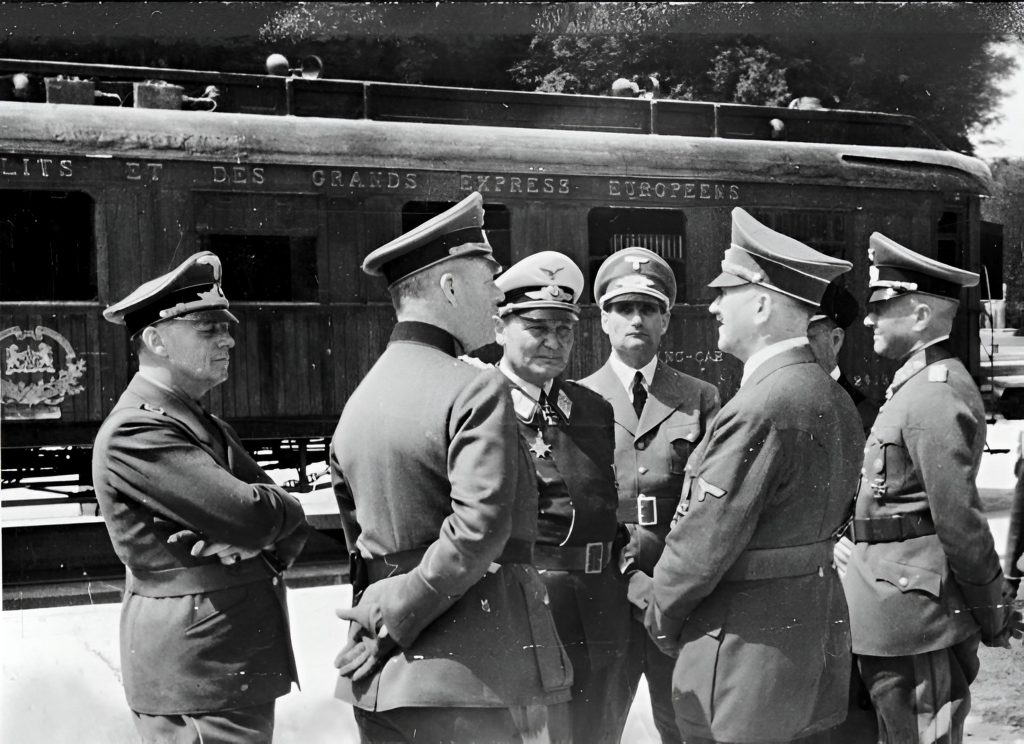
Le 21 juin, Ribbentrop, Keitel (de profil), Göring, Hess, Hitler, Raeder (caché par Hitler) et Brauchitsch, devant le wagon de l'Armistice.
On 21 June, Ribbentrop, Keitel (in profile), Göring, Hess, Hitler, Raeder (hidden behind Hitler), and Brauchitsch, in front of the Armistice carriage — Photo Bundesarchiv

This deliberate staging — forcing a defeated France, twenty-two years later and in the identical setting, to relive the humiliation Germany had suffered — amounted to a conscious manipulation of collective memory for purposes of psychological warfare, intended to crown the victory of 1940 as the culmination of a long cycle of revenge, from Sedan to Versailles and then to Rethondes.
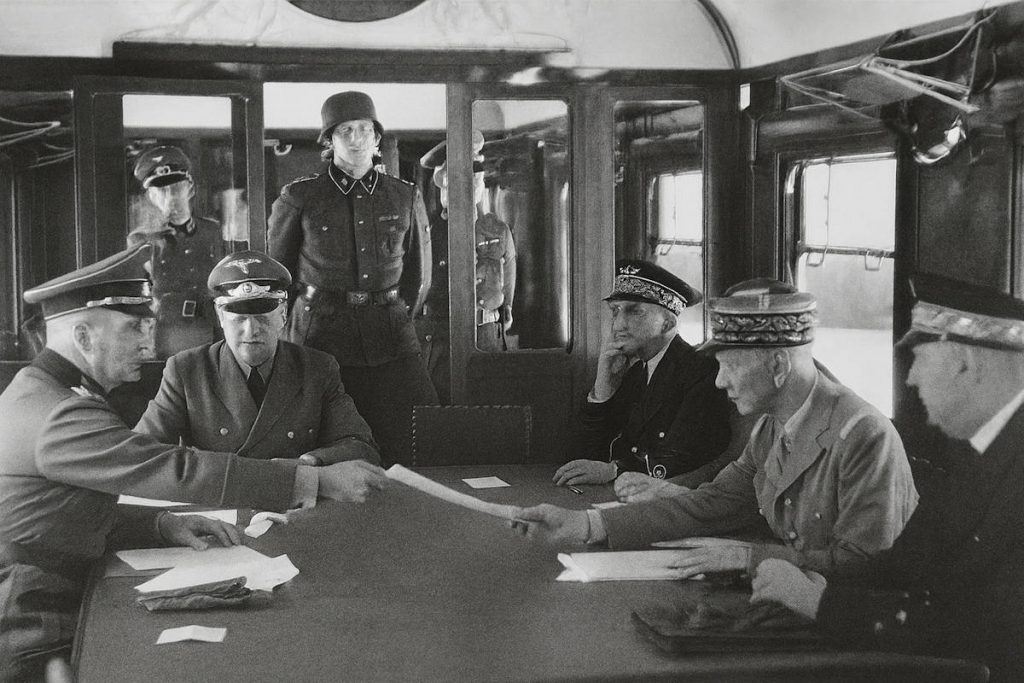
Bundesarchiv_— Le 22 juin 1940, l’armistice est signé en forêt de Compiègne — Photo Bindesarchiv
The signing of the armistice on 22 June 1940 at Rethondes, in the forest of Compiègne: on the left, General Keitel; on the right, the French delegation with General Huntziger flanked by Air Force General Bergeret and Vice-Admiral Le Luc (in profile, right) — Photo Bundesarchiv
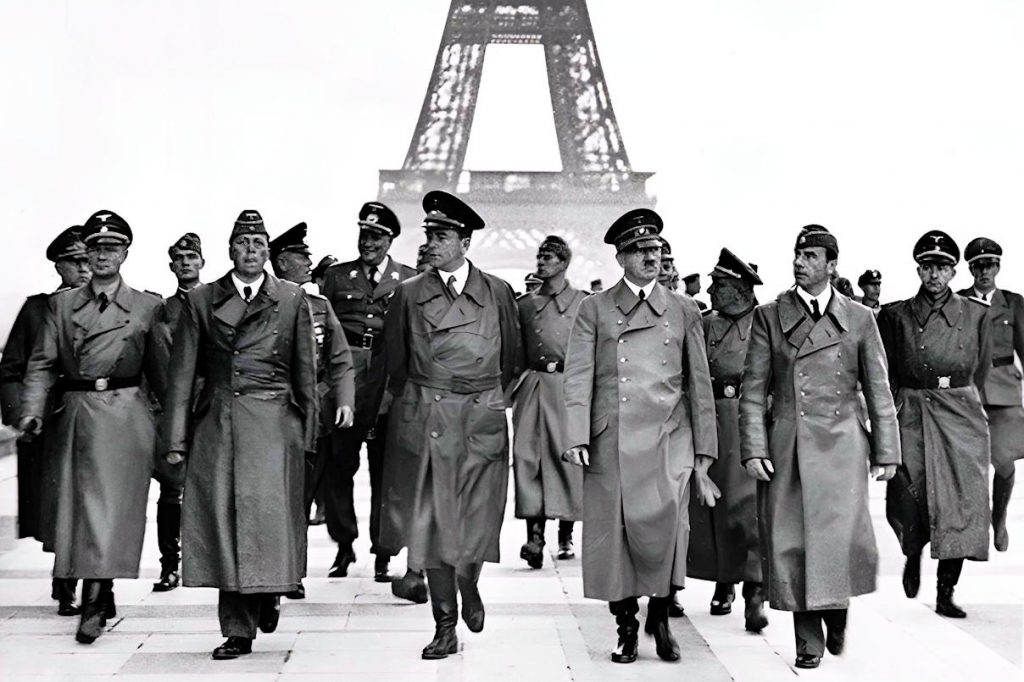
Hitler visite Paris au petit matin, sa seule visite dans la capitale française — dont il repartira dans les heures suivantes pour n'y jamais revenir. La date exacte de cette « Blitz Besuch » reste débattue par les historiens (23 ou 28 juin 1940) ; certains y voient un choix délibéré, tombant vingt et un ans jour pour jour après la signature du traité de Versailles, mais cette coïncidence calculée n'est pas établie avec certitude. Sedan, Rethondes, puis Paris : la mise en scène de la revanche de 1940 s'achève ici, sous la tour Eiffel — Photo Bundesarchiv
Hitler visits Paris in the early morning — his only visit to the French capital, from which he would depart within hours, never to return. The exact date of this “Blitz Besuch” remains debated among historians (23 or 28 June 1940); some see it as a deliberate choice, falling twenty-one years to the day after the signing of the Treaty of Versailles, though this calculated coincidence is not established with certainty. Sedan, Rethondes, then Paris: the staging of the 1940 revenge concludes here, beneath the Eiffel Tower — Photo Bundesarchiv

Occupation and Collaboration

France’s rapid defeat in June 1940 was a national trauma. The country was divided, with a zone occupied by Germany in the north and along the Atlantic coast, and a “free zone” in the south, governed by Marshal Pétain’s Vichy regime, which embarked on a policy of collaboration with the Nazi occupier. This period of occupation, deprivation, repression, and collaboration marked the lowest point of French sovereignty and a particularly dark chapter in Franco-German relations.
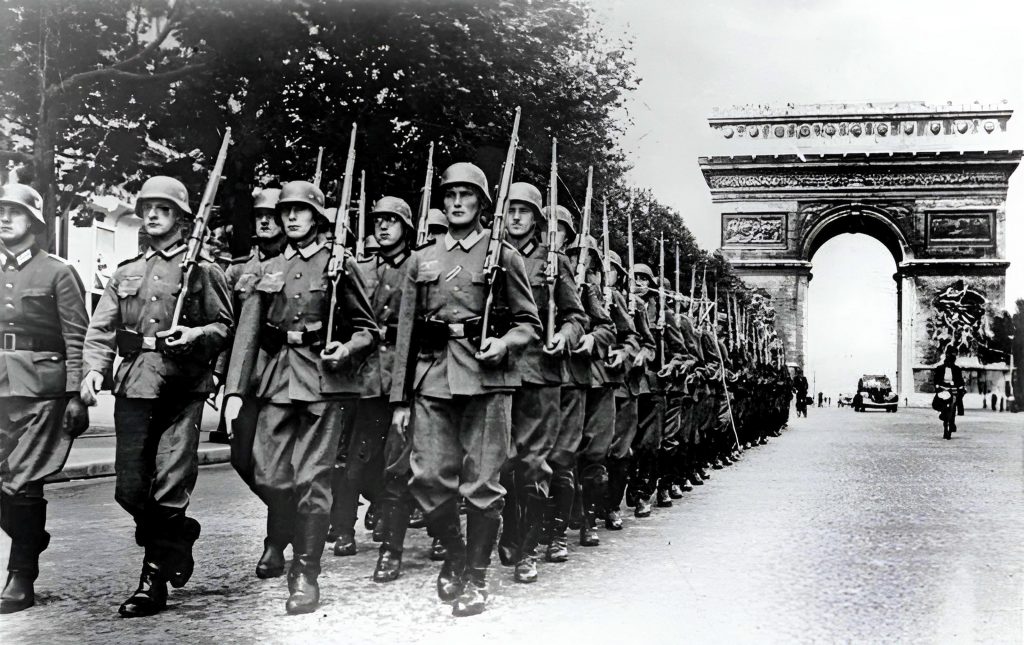
Défilé de la Wehrmacht sur les Champs-Élysées le 14 juin 1940 — Photo Bundesarchivv
Wehrmacht parade on the Champs-Élysées, 14 June 1940 — Photo Bundesarchi

For France, the defeat of 1940 and the occupation were a profound humiliation. For Germany, the war ended in total defeat, massive destruction, the revelation of the horror of the Holocaust, and the division of the country.
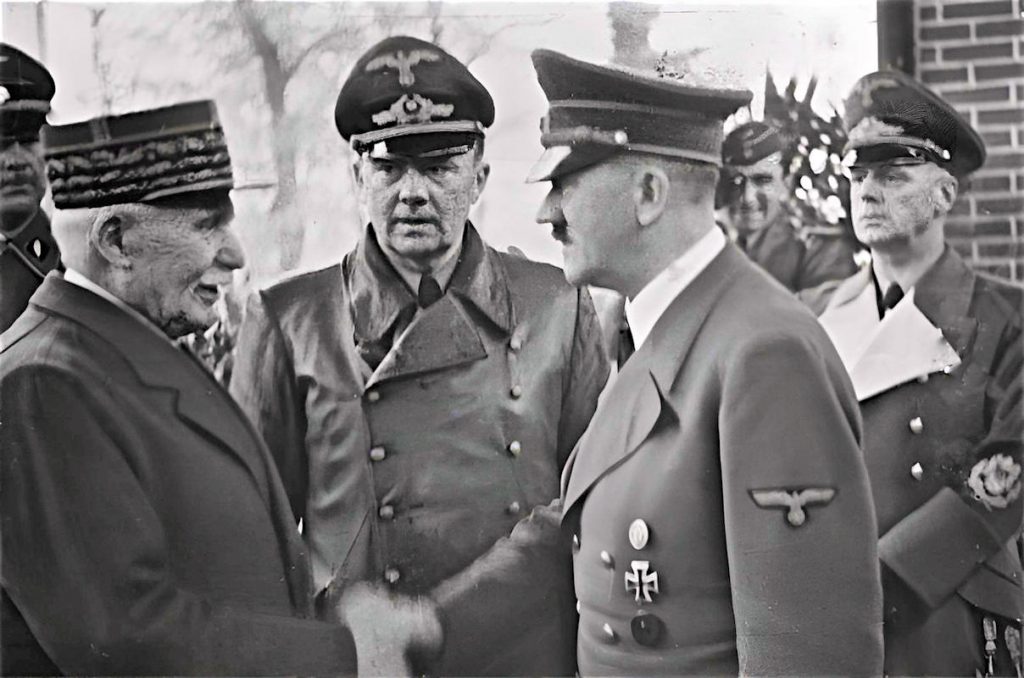
Entrevue de Montoire entre Philippe Pétain et adolf Hitler
The Montoire meeting, 24 October 1940: the handshake between Marshal Pétain and Adolf Hitler that, six days later, would be used to publicly legitimize France’s entry into “the path of collaboration.” Twenty-two years after having been the symbolic victor of Rethondes as commander-in-chief of the victorious French armies, Pétain now finds himself on the other side of history — head of a defeated state negotiating its survival with the very architect of the 1940 revenge — Photo Bundesarchiv

Two exhausted nations, a continent in ruins, and a cycle of reprisals that, this time, seemed to have reached its absolute limit — the point beyond which nothing was left to avenge, so total had the devastation been on both sides.
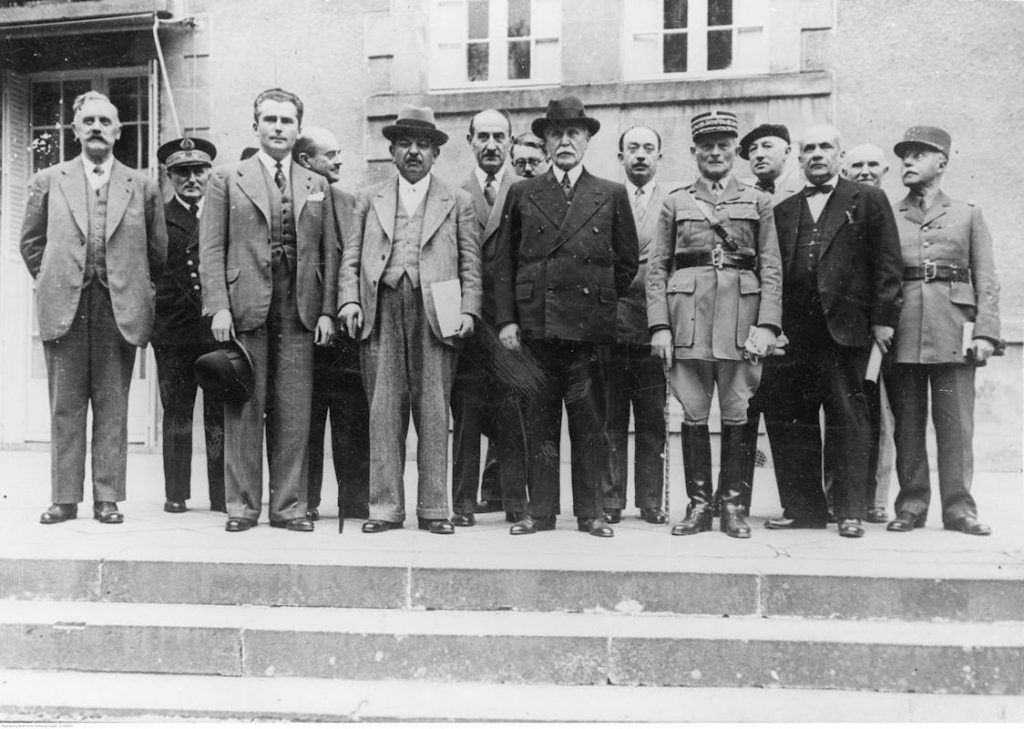
Le « chef de l’État français » et le premier gouvernement du régime de Vichy, photo prise sur la terrasse du pavillon Sévigné à Vichy en juillet 1940. De g. à d. : Pierre Caziot, François Darlan, Paul Baudouin, Raphaël Alibert, Pierre Laval, Adrien Marquet, Yves Bouthillier, Philippe Pétain, Émile Mireaux, Maxime Weygand, Jean Ybarnégaray, Henry Lémery, François Piétri, Louis Colson. Source Wikipedia
The “Head of the French State” and the first Vichy government, photographed on the terrace of the Pavillon Sévigné in Vichy, July 1940. From left to right: Pierre Caziot, François Darlan, Paul Baudouin, Raphaël Alibert, Pierre Laval, Adrien Marquet, Yves Bouthillier, Philippe Pétain, Émile Mireaux, Maxime Weygand, Jean Ybarnégaray, Henry Lémery, François Piétri, Louis Colson — Source Wikipedia

It was on these ruins, in this landscape of moral desolation, that a process of reconciliation would, against all odds, begin.

The fourth installment of this series will follow this improbable reversal: how two statesmen, Charles de Gaulle and Konrad Adenauer, managed to transform seventy years of cyclical hostility into a founding partnership for Europe — and what that reversal can still teach us today.

Joël-François Dumont

See also:

Analysis: Why 1945 Was Not 1918

This paroxysm deserves a moment’s pause before turning the page toward reconciliation. The mechanism described in the first two installments of this series — humiliation, cultivated resentment, deferred revenge — operated one last time with devastating force in 1940: the deliberate choice of Rethondes, the echo of Bismarck’s words at Sedan, all of it suggests that Germany’s leaders at the time believed, quite consciously, that they were acting in direct continuity with 1870 and 1918. The cycle reproduced itself exactly as it had been designed to — all the way to its logical, appalling conclusion.

But 1945 differs from 1871 or 1918 in one essential respect: this time, there is no victor left in a position to humiliate the other without destroying itself in the process. France in 1945 lacked the means for a punitive peace comparable to Versailles — it emerged from the Occupation itself utterly exhausted. And Germany, confronted with the sheer scale of its own crimes, no longer had the same psychological ground on which to cultivate a new, legitimate sense of national grievance. It may be this double impossibility, more than any sudden surge of virtue, that opened the door — provided statesmen were able to seize it.