Seven previous installments have traced, from Jena to Stockholm, two and a half centuries of a Franco-German relationship built on vengeance then reconciliation, grand designs then cautious management. This eighth installment takes a step back: what remains, today, of the horizon this “couple” represented for an entire generation — and where must we now look for the resolve that has long been missing elsewhere?
It traces the source of a failure that has repeated itself for sixty years — a German renunciation dated with precision, in May 1963 — and holds it up against three mirrors that reveal its true nature: a United Kingdom that made, five months earlier, exactly the same choice; an Italy that, without ever aiming for fusion, still managed to deliver and export; a Sweden that, by contrast, built over two centuries the autonomy Bonn refused to pursue, and is reaping the rewards today, as far as the waters off Brest and Toulon.
Finally, it asks the question that neither this eighth installment nor the seven before it had yet posed so directly: must France keep searching, in its face-to-face with Berlin alone, for the horizon that sixty years have not been enough to reach?
The Essentials
- A renunciation dated with precision: in May 1963, four months after the signing of the Élysée Treaty, the Bundestag attached a preamble that stripped the text of its strategic force — the origin, never revoked since, of sixty years of Franco-German failures on every question of sovereignty.
- A British mirror, almost to the day: on December 21, 1962, at the Nassau Agreement, London made exactly the same choice Bonn would make five months later — American dependence rather than autonomy, even though it too had the means to choose otherwise.
- An imperfect but solid Italian counter-example: the FREMM cooperation never produced the promised industrial fusion, but over twenty years it delivered two equipped fleets and an export success France alone might not have achieved.
- An inverse model, Swedish: two centuries of a doctrine of self-sufficiency, now translated into concrete contracts — four frigates sold to Sweden on August 31, 2026, a Global Eye system bought by France in return, and even Swedish patrol boats protecting French nuclear submarines at Brest and Toulon.
- A historical myopia that persists: Poland in 1938, exploiting the dismemberment of Czechoslovakia to seize the Zaolzie before paying the price a year later, casts a harsh light on its arms choices today.
- A question, not a rupture: the Franco-German relationship must continue — but it can no longer remain, on its own, the horizon of a French foreign policy that now needs to look elsewhere as well.
Contents
by Joël-François Dumont — Paris, August 29, 2026.
What Remains of a Horizon, Two Hundred and Twenty Years On
Introduction
The Franco-German relationship was a horizon for my generation. Colombey, the Élysée, Ludwigsburg, Verdun, the Franco-German Brigade, Airbus — I watched them being built; some I covered myself, others were told to me by those who had lived them from the inside, from Colonel Dr. Heinrich Bucksch to Ambassador Maillard. I was fortunate enough to meet or interview nearly every major figure of that period — including General de Gaulle himself, who came to hold a Council of Ministers meeting at the prefecture of the Nord, where my father was prefect: I spoke with him alone on two occasions, on April 24 and 25, 1966. The first of these conversations touched, by a coincidence that still moves me today, on the fact that I had been, at thirteen, the first young Frenchman exchanged with Germany — a decision made just two days after Adenauer’s departure from Colombey, when the General asked my father to develop youth exchanges between the two countries, between Dijon and Mainz.
At the time, it was just one thread among many — but it is threads like this one, patiently woven, that made up the horizon I am speaking of.
It was a horizon in the literal sense: a line one moved toward without ever quite reaching it, but which gave direction to sixty years of French foreign policy.
It no longer is one.
This does not mean Paris and Berlin should stop cooperating — the seven previous installments have shown everything solid this relationship has produced. But a horizon, by definition, lies ahead, not to the side. And the sustained resolve that had long seemed lacking elsewhere in Europe has, in recent years, settled — more quietly than one might have expected — in Stockholm.
I. What Held
Two quite distinct categories emerge from two hundred and twenty years of shared history.
The great founding gestures, first — occasional but structuring: the ECSC in 1951, the first voluntary renunciation of sovereignty in European history; the settlement of the Saar by referendum and treaty rather than by force, a total contrast with 1871 and 1940; General de Gaulle’s first official visit to West Germany, in September 1962, six days of a triumphant tour crowned by his speech to German youth in Ludwigsburg; Mitterrand’s address to the Bundestag in 1983; the handshake at Verdun in 1984.
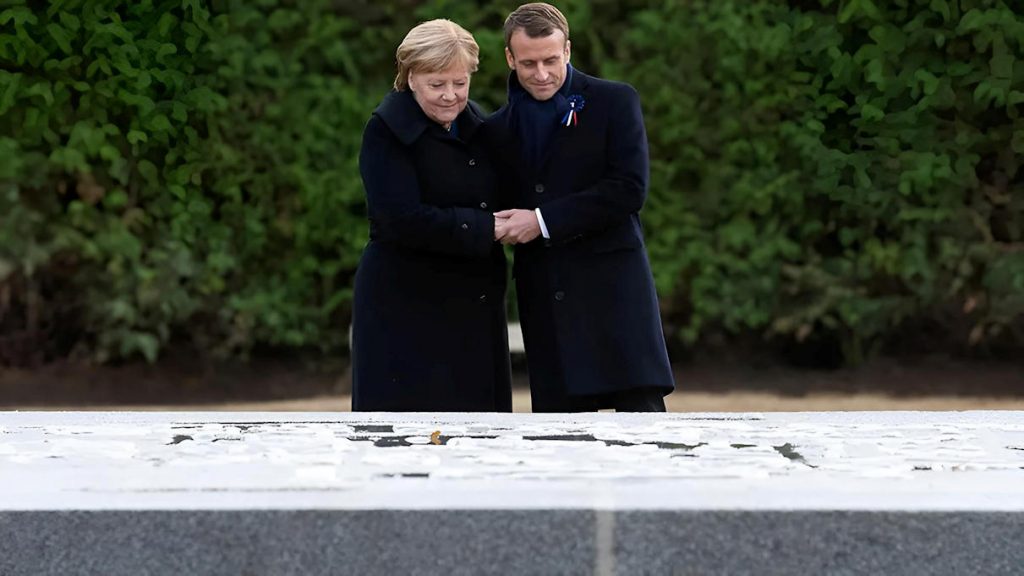
Rethondes, in 2018, is its most recent echo:[22] Macron and Merkel meet there for the centenary of the Armistice, unveil a plaque, sign the guestbook in a replica of the railway carriage — a sincere gesture, but one that, thirty-four years on, replays the very same choreography as Verdun without adding anything new.
The truly unprecedented gesture, mean-while, never came from those actually in power.
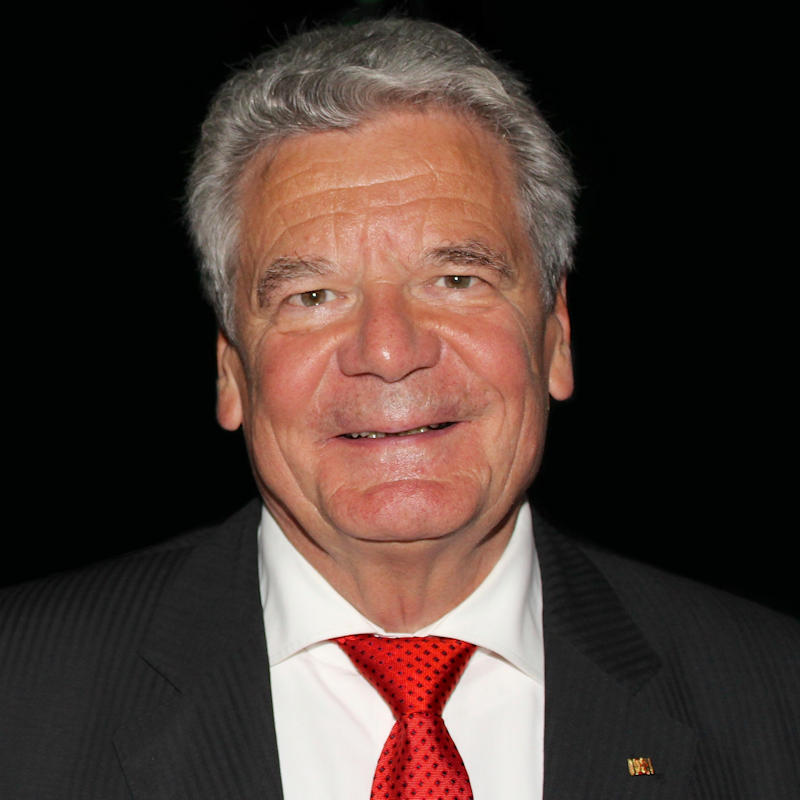
It was Pastor Joachim Gauck, federal president without executive power, who became, in September 2013, alongside François Hollande, the first German head of state to visit Oradour-sur-Glane, sixty-nine years after the massacre. Frank-Walter Steinmeier would return there with Emmanuel Macron in June 2024, speaking of “a sense of shame.”[23] No chancellor — neither Merkel in sixteen years, nor Scholz, nor Merz — has ever done so.
Pastor Joachim Gauck, President of the Federal Republic of Germany — Photo © 2026 Bundespräsidialamt
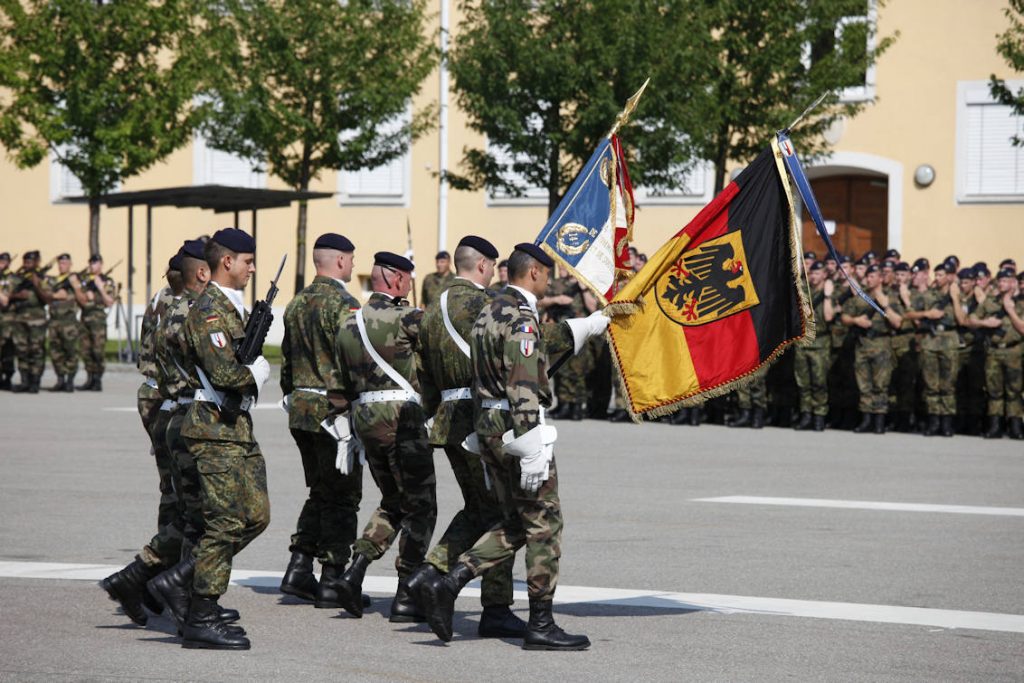
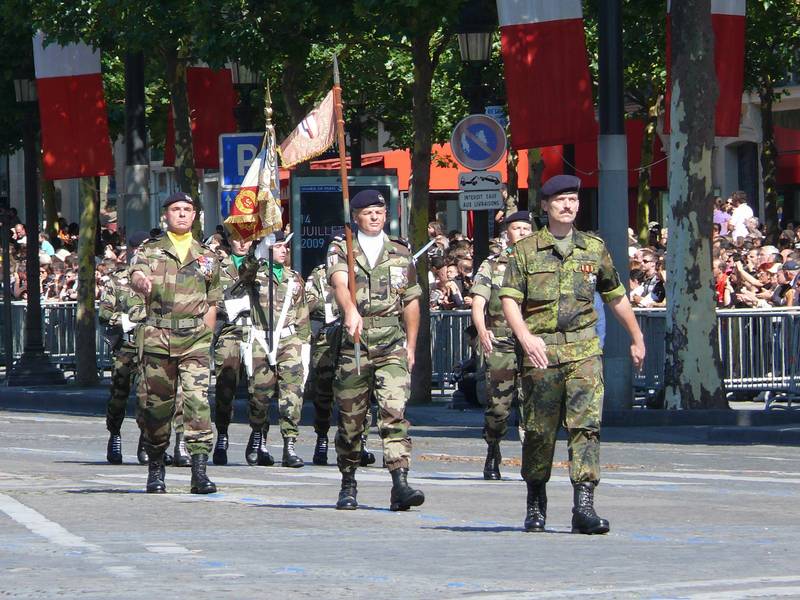
The institutions that became part of everyday life, next — less spectacular, but more resilient over time, precisely because they touched daily life rather than only state summits: the Franco-German Brigade, operational from 1989, decided at the Karlsruhe summit; the Eurocorps, born in 1992 at the La Rochelle summit, now based in Strasbourg and expanded to six framework nations;[01] Arte and the OFAJ (Franco-German Youth Office) — culture and youth, the only two areas, as seen in the sixth installment, that the 1963 preamble left untouched in the Élysée Treaty.
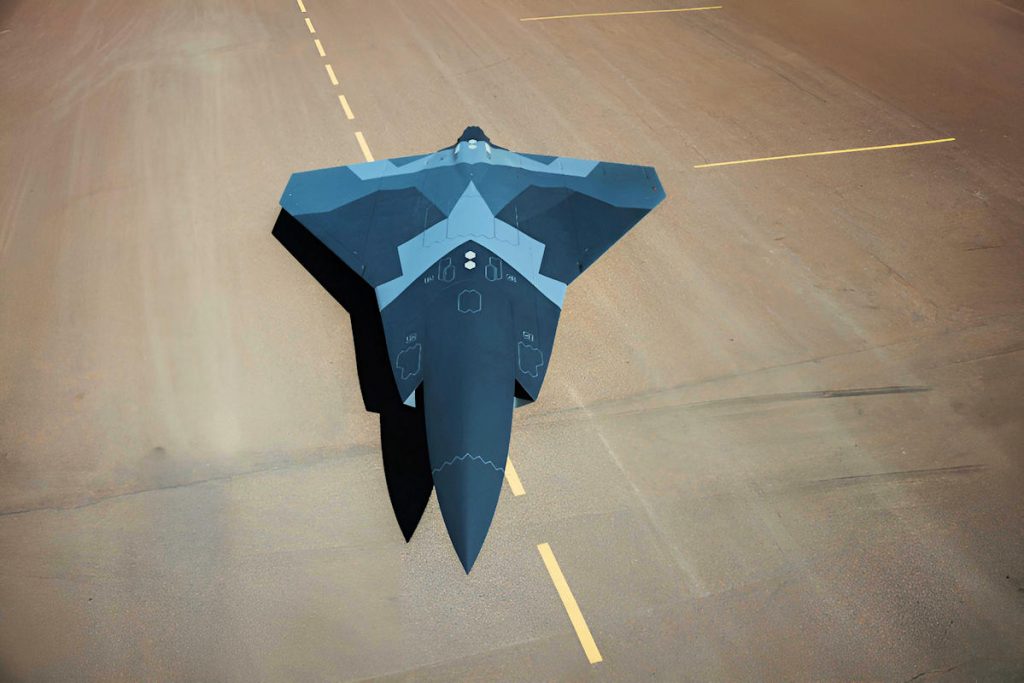
The nEUROn demonstrator, launched by France in 2003, deserves a place apart. Among the six European partners gathered around Dassault Aviation, it was Sweden’s Saab that carried the heaviest load — design of the main fuselage, avionics.[02] Twenty years later, Saab is building directly on that legacy with its own next-generation demonstrator. It is, quietly, the longest-running successful industrial cooperation in this entire body of work.
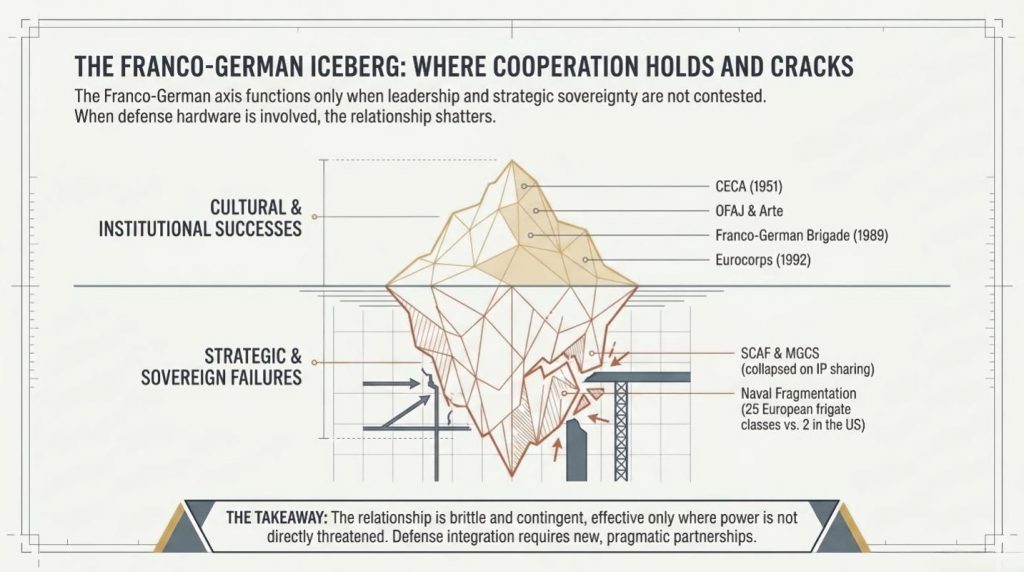
The common thread running through these successes is clear: they held every time neither partner had to contest the other’s leadership on a matter of strategic sovereignty.
II. What Gave Way — and Two Mirrors to Understand It
The moment such a matter arises, the Franco-German duel fails systematically. The FCAS (SCAF) and MGCS collapsed over questions of intellectual property and industrial sharing. European naval shipbuilding fragments into twenty-five different classes of frigates and destroyers, against two in the United States.
The cause of this recurring pattern has a precise date: May 1963.[03] One month after the signing of the Élysée Treaty, the Bundestag attached to it a preamble reaffirming the primacy of the Atlantic Alliance — a gesture experienced, according to the testimony of Georg Bucksch, as a betrayal by its signatories. This was no mere procedural adjustment. It was the moment West Germany renounced — without ever stating it as such — ever having to build alone what France was then building with its own strike force.
This renunciation has never been revoked. It explains, in a direct line, why Germany bought F-35s rather than back a European alternative, even though it had the power to choose otherwise.[04] But choosing the European alternative would have required a political courage Berlin never gave itself the means to exercise — and the moment of that choice is no longer, today, a theoretical hypothesis. Rheinmetall, whose targeted 2030 revenue reaches fifty billion euros, has chosen Lockheed Martin as its preferred industrial partner rather than a European counterpart.[05] And since May 2026, Washington has already withdrawn roughly 5,000 troops from German soil — nearly 15% of its force — while shifting its strategic center of gravity on the eastern flank toward Poland, a move still unfinished but already underway.[06] The disengagement this body of work has documented since the seventh installment is therefore no longer, for Germany, a scenario to anticipate. It is happening.
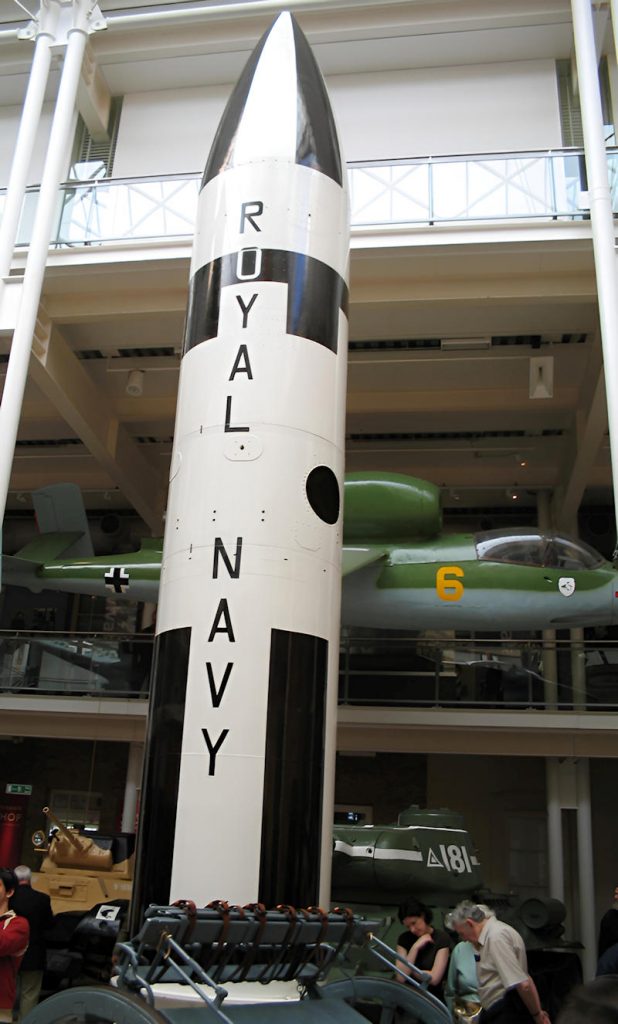
On December 21, 1962, at Nassau, Kennedy and Macmillan concluded an agreement under which the United States would supply the United Kingdom with Polaris missiles. In exchange, London renounced any fully auto-nomous deterrent force, aligning its use with the American agreement except in cases of “supreme national interest.” Part of the RAF Bomber Command’s bomber fleet was even placed at the disposal of the Supreme Allied Commander Europe — a post only ever held by an American general since NATO’s founding.[07]
Royal Navy Polaris missile, on display at the Imperial War Museum, London — the very object of the choice made at Nassau on December 21, 1962: American depen-dence rather than autonomy, 5 months before Bonn made the same choice — Photo Emőke Dénes © Imperial War Museum
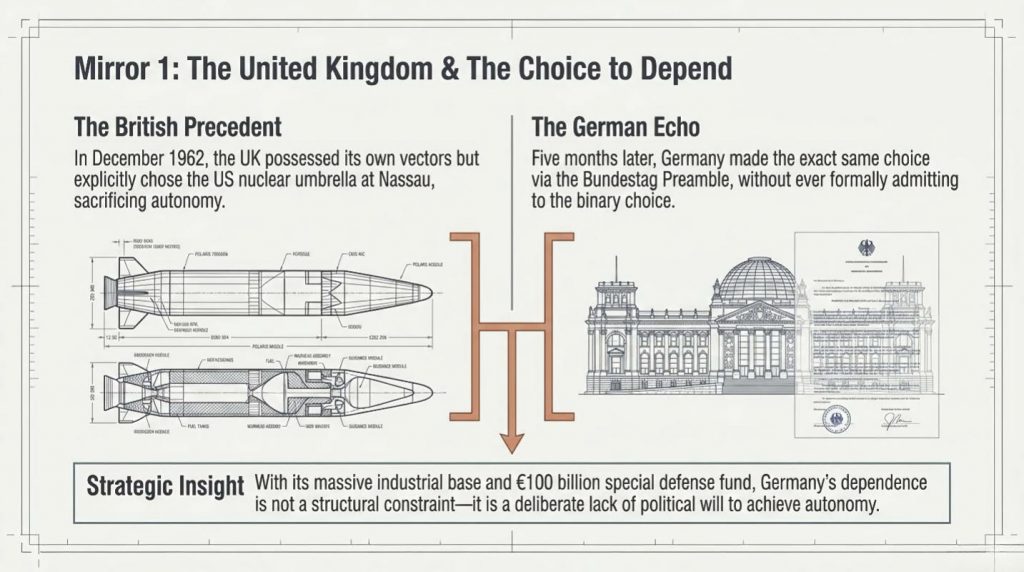
The United Kingdom offers the most exact mirror of this renunciation — almost to the day. De Gaulle was furious: he saw it as proof that the United Kingdom remained oriented toward Washington rather than Europe. Four weeks later, he cast his first veto against British accession to the EEC.[08] One month separates Nassau from the signing of the Élysée Treaty, and four months separate that signing from the German preamble that emptied it of substance. This is not a coincidence of timing: it is the same question, put to three countries at once — to build, or to depend — with three different answers. France chose to build. The United Kingdom chose to depend, fully aware of what it was doing, even though it already possessed its own delivery systems and could have continued alone. Germany, five months later, chose the same dependence — but without ever having had to decide explicitly between the two options, as the United Kingdom had: the 1963 preamble spared it even the need to choose.
Italy, by contrast, shows that an imperfect cooperation is worth more than an ambition that collapses. The FREMM program, launched in 2005 between Naval Group on the French side and Fincantieri on the Italian side, never produced the industrial integration its name suggested. Naval Group’s former CEO, Patrick Boissier, admitted as much outright before the National Assembly: the cooperation saved only about 30 million euros, or 1 to 1.5% of the program’s total cost — “we are not dealing with a genuine cooperative program,” he concluded.[09] And yet: both navies were equipped, both shipyards produced their vessels, and the Italian FREMM achieved a commercial success the French version did not equally match — chosen by Egypt, by Indonesia, and selected as the design basis by the US Navy itself for its future Constellation-class frigates.[10] A cooperation without real fusion, but one that never blew up the way FCAS or MGCS did.
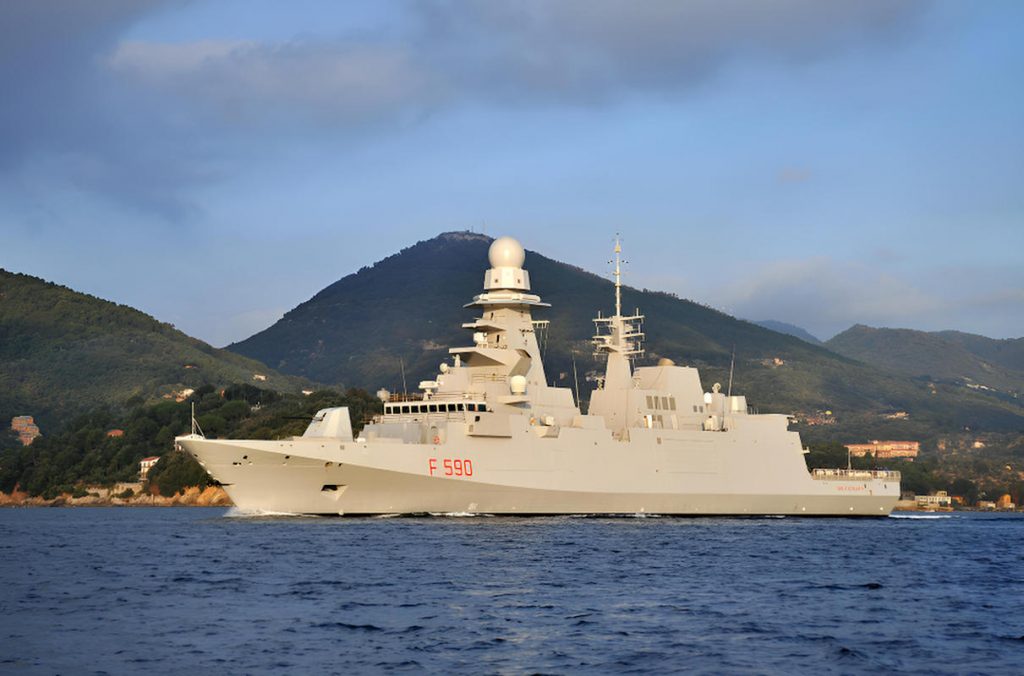
The lesson is sober, almost disappointing: for a cooperation to hold, it is enough that no one genuinely contests the other’s leadership — even if this means, at bottom, that each side builds its own ship alongside the other’s rather than with it.
The automobile industry offers a third mirror, a civilian one this time, and it says exactly the same thing. In 1993, Renault and Volvo grandly announced a full merger, planned for January 1, 1994. On December 2, 1993, Swedish shareholders rejected the plan, seeing it as “a disguised takeover”; Volvo’s CEO, the architect of the deal, resigned.[24] Seven years later, in 2000-2001, a far more modest arrangement succeeded where the merger had failed: Renault simply sold its truck division to Volvo, which took full control, with Renault becoming a shareholder of the group in return. This time, no one contested leadership: Volvo led, Renault Trucks integrated. The arrangement has held for twenty-five years. Renault, having learned from that failure, would build its alliance with Nissan starting in 1999 on a governance structure clarified from the outset — an alliance now cited as a model.
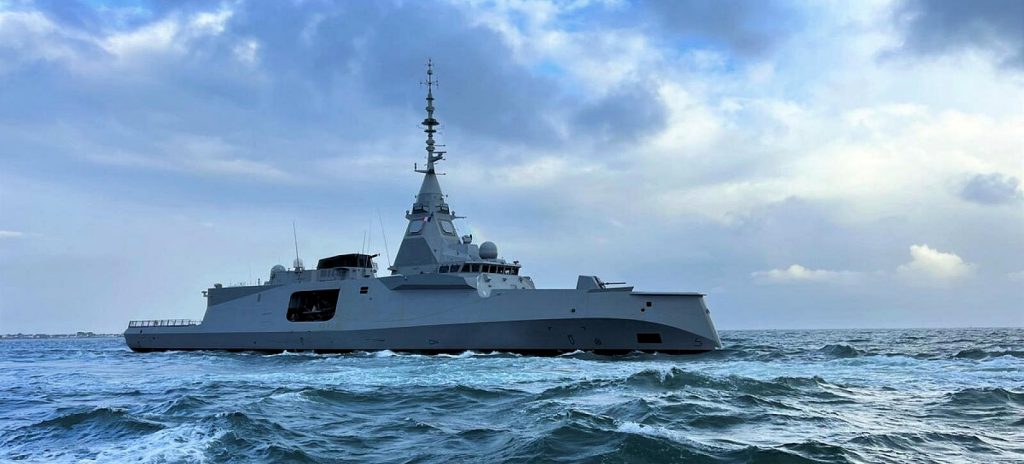
Set side by side, these two mirrors say the same thing as the question posed earlier: can Germany free itself from the American straitjacket? The United Kingdom had a choice in 1962 and chose dependence. Italy, without ever aiming for full autonomy, still managed to deliver and export. Neither path was dictated by the country’s size or geography — unlike a small state that structurally lacks the means for autonomy. Germany, with its economy, its industry, and now its special fund of 100 billion euros, has never been in that position of constraint. The straitjacket was never external.
III. Two Ways of Never Giving Up
One must be careful not to see this as a specifically German failing. Sweden did, over two centuries, exactly the opposite. Its doctrine of “total defense,” which merges civilian and military approaches, rests on a principle documented by the Revue Défense Nationale itself: a credible policy of non-alignment requires an arms industry sufficiently autonomous not to depend on any outside protector.[11] Saab was granted, from the Cold War onward, a state monopoly on equipping the Swedish air force — a deliberate choice, never reversed since.[12]
The fact that Sweden joined NATO in 2024, ending two centuries of neutrality, does not contradict this lesson: it entered the Alliance in full possession of its own capabilities, not in search of an umbrella it could never have provided for itself.[13]
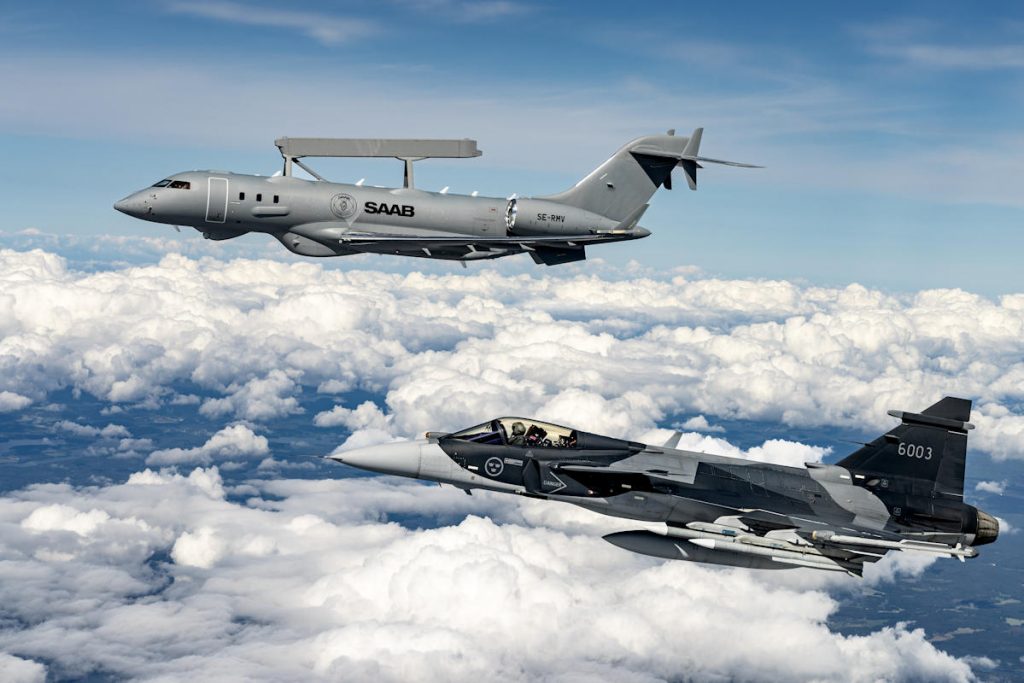
The result can be read in this very week’s news. On August 31, 2026, President Macron travels to Stockholm to sign the sale of four Defense and Intervention Frigates to Sweden — 4.3 billion euros, Sweden’s largest military investment since the 1980s.[14] France, for its part, chose the Swedish Global Eye system to renew its airborne surveillance fleet. Naval Group generated zero euros in European revenue in 2019; it now generates a billion, thanks in particular to Sweden, the Netherlands, Belgium, and Greece.[15]
The comparison with its own previous program is telling. The French FREMM, ten units built, found only one true export customer — Morocco; the second unit often counted as “exported,” rushed to Egypt in 2015, was in reality a French frigate already under construction for the Navy, never having entered service under the national flag.[25] With the FDI, Naval Group appears to have found the reverse formula: thirteen units already sold, eight of them abroad alone, against five built for France. Where the previous generation had to improvise an emergency export sale just to exist abroad, this one convinces, by design, more abroad than it equips the French Navy itself.
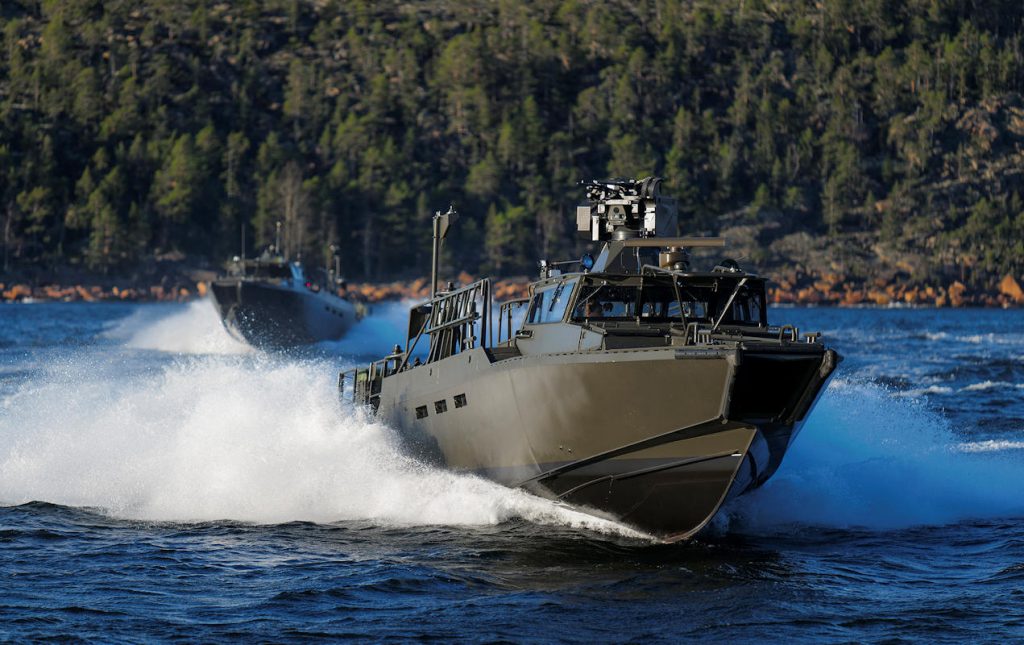
Reciprocity extends down to operational details. In 2025, while the French program for marine commando patrol boats bogged down — two units delivered out of twelve planned, the Breton shipyard awarded the contract having stumbled over soaring costs — it was the Swedish navy that filled the gap: three CB90 assault craft, built by Saab, loaned for eighteen months to the French Navy, with French crews trained by their Swedish counterparts.[16] They now protect French nuclear submarines at Brest and Toulon. This is no longer merely an industrial partnership. It is, quite concretely, Sweden stepping in to cover a French shortfall — the exact reverse of the dependence this body of work criticizes in Germany.
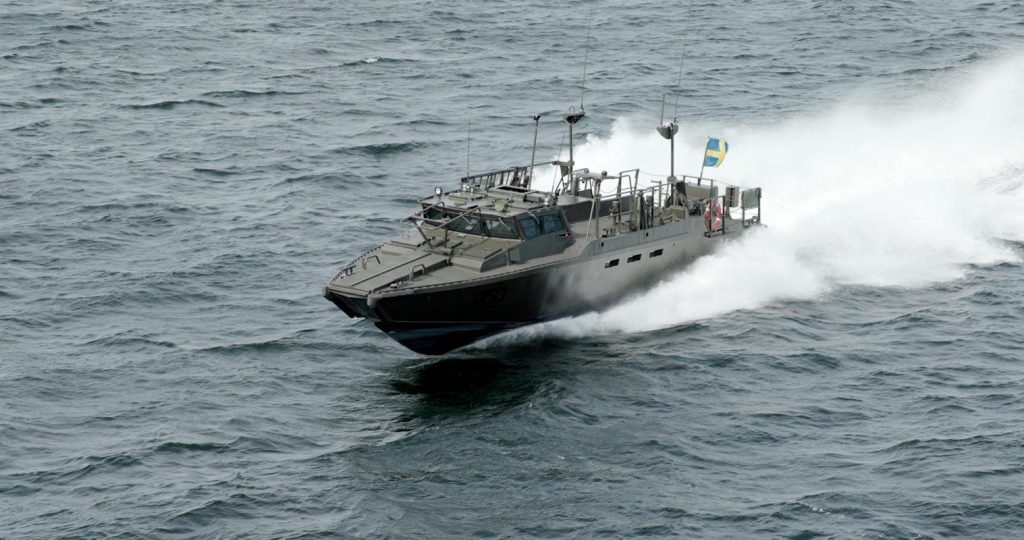
Sweden is the very example of these “small countries” able to identify niches and innovative technologies early — the ones that will make the difference on the ground.
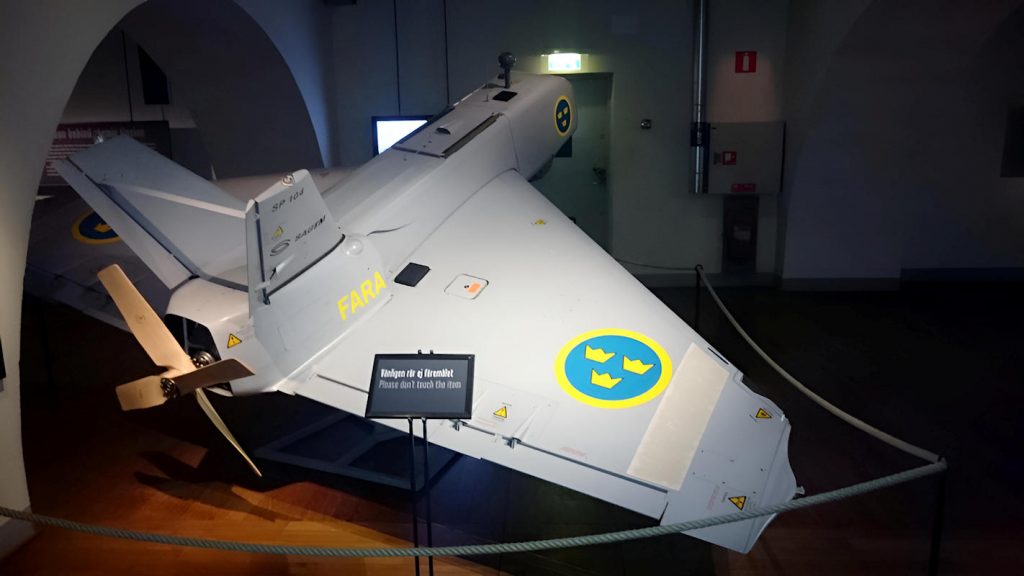
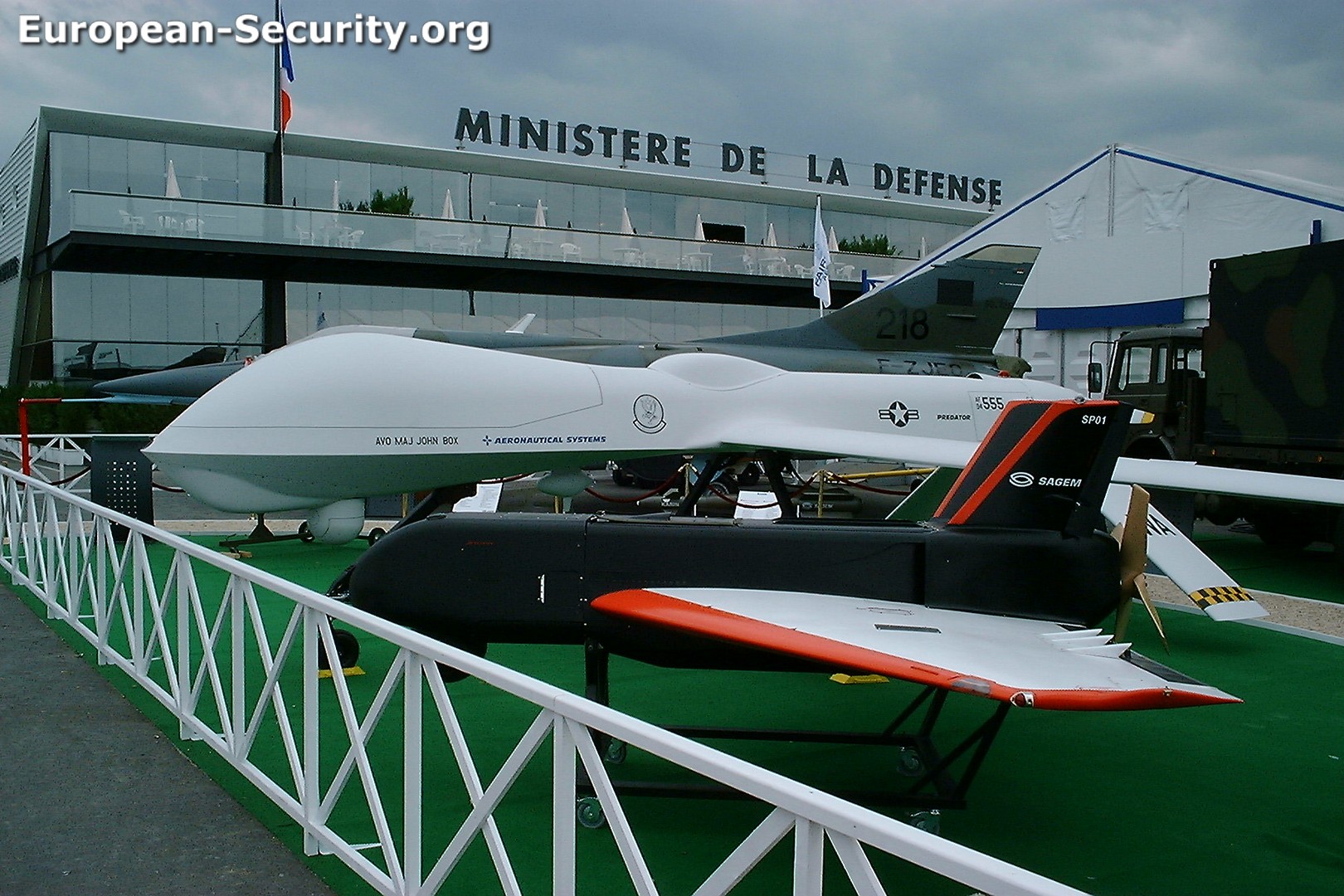
The example of the Ugglan (the owl) is telling. Equipment maker Sagem (now Safran) had developed, on its own funds, a revolutionary tactical drone in the late 1990s, following the Crécerelle: the Sperwer (the sparrowhawk), more powerful and significantly more capable, fitted with inertial navigation — like the Crécerelle — but also with GPS and, above all, a unique optical system with a camera relaying high-quality real-time imagery.
Which two countries acquired it first? The Netherlands and Sweden, five years before France, followed by Greece and, after France, Canada and Denmark. Swedish artillery entrusted it to the “K3” Hussars of Karlsborg, and it was the Dutch Air Force that achieved a world first: certifying a drone to fly within controlled airspace.
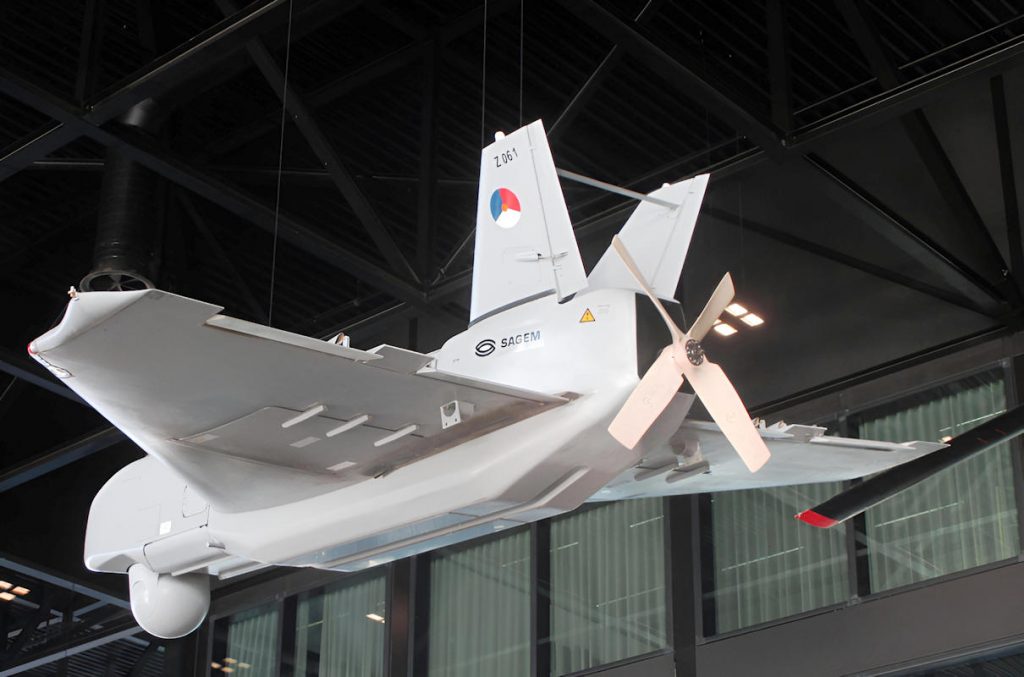
— Photo © HendrikHeuvelrug
Patrick Durieux, commercial director of Sagem’s drone business, told Eric Biass at Satory that “France” had only been their “fourth customer.” The French Army, for its part, would not equip its 61st Artillery Regiment at Chaumont — the famous “Black Devils” regiment that had hosted us in 2006 — until 2005, under the designation SDTI (Interim Tactical Drone System).
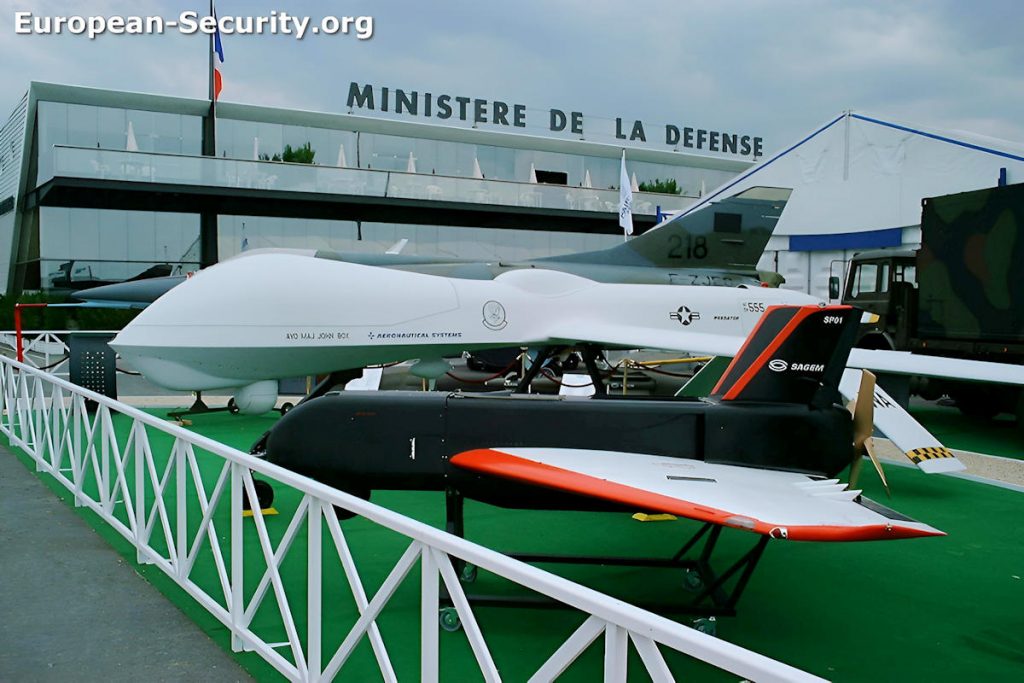
Credit, then, where credit is due. The first to take the matter seriously was the head of the USAF during the Vietnam War: their use over North Vietnam and China is estimated to have saved the lives of 70 to 100 US Air Force reconnaissance pilots. The second was Amédée de Montchal, the French Army Chief of Staff, an artillery officer who commanded the admiration of his subordinates. And let us also recall that the world’s first two drone regiments were Belgian and French. This takes nothing away from the Israelis, who quickly grasped their potential, developing many variants and using them around the clock. Then, one day, the Ukrainians took it up, as everyone knows. The Russians had no choice but to follow suit. But seeing the Turks — not to mention the Iranians — invest more in this field than France, which had once held a lead, is to admit that in France, certain “officials” failed.
But who believed in drones in France in 1999? No one, aside from our artillery officers in the Army and the Air Force; the drone was anything but a priority until General Paloméros was appointed Air Force Chief of Staff. At that point, France began playing in the top league again — but it had lost fifteen years to false debates, including over whether or not to arm our MALE drones once finally purchased.
The pattern is worth noting: of the Sperwer’s first six identified customers in the 1990s-2000s, three — Sweden, Greece, the Netherlands — find themselves today, a generation later, among France’s most active naval clients or partners. Denmark and Canada, by contrast, have dropped off the map. This is surely no coincidence: these are the same countries — not large enough to want to contest France’s industrial leadership, nor small enough to settle for buying without demanding excellence — that keep coming back to find in France what they cannot find elsewhere.
Football perhaps captures this difference best: there are clubs that develop their own talent from the ground up — France with its nuclear training academy, Sweden with its own, as much industrial as civic — and there are richly funded clubs which, never having had to train themselves, struggle to turn budget into titles.
IV. The Myopia That Comes at a Cost
The Polish case illustrates a third path — neither acknowledged renunciation nor patient self-sufficiency, but a myopia on a strikingly short cycle, and already an old one. On September 30, 1938, the very day Prague capitulated at Munich, Warsaw in turn issued an ultimatum to Czechoslovakia and seized the Zaolzie, a disputed region around Teschen. Rather than seeing in the dismemberment of Czechoslovakia the forward edge of a threat aimed at itself as well, Poland saw it as a territorial opportunity to seize.
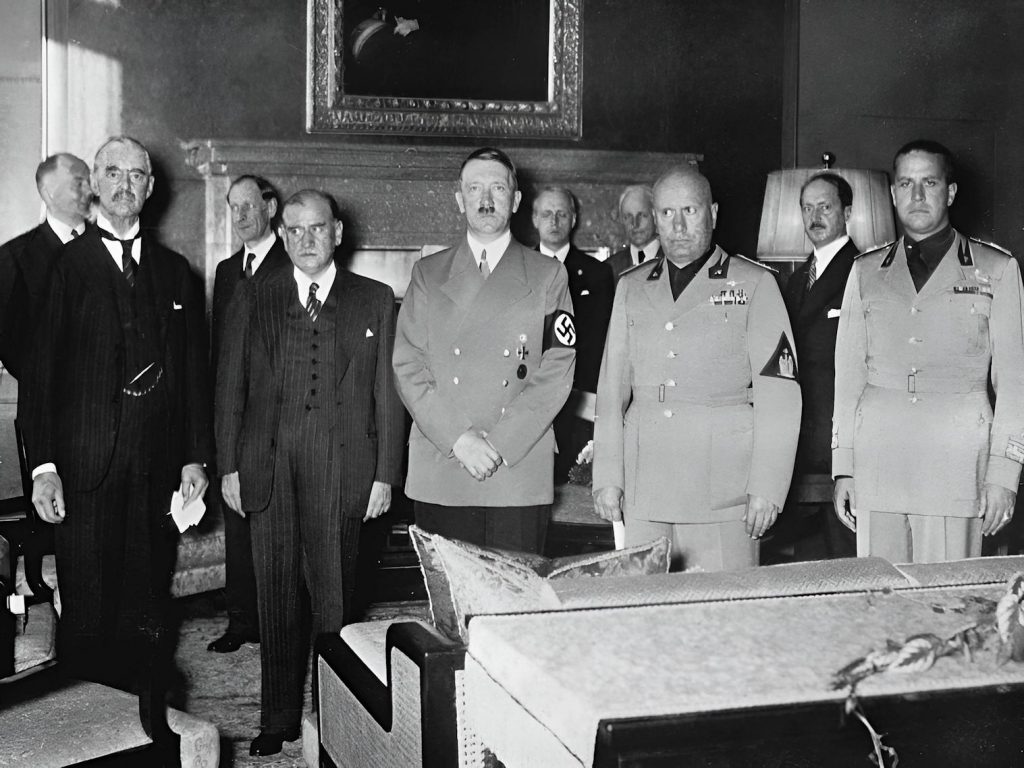
The calculation proved catastrophic: on September 1, 1939 — exactly one year to the day later, and the very day Germany invaded Poland — the Zaolzie fell back under German control.[17][18] The country that had profited from a neighbor’s isolation found itself, almost to the day, alone facing the same fate.
“The Zaolzie Is Ours!” (“Zaolzie nasze!”)
Under the headline Zaolzie nasze! (*The Zaolzie is ours!*), the Kraków daily announced: “Czechosłowacja zwraca dwa powiaty za Olzą. Dziś wkraczamy do Cieszyna!” (Czechoslovakia returns two districts beyond the Olza and declares: Today we enter Cieszyn!)
The article, citing the Polish news agency PAT from Warsaw, reported that the note of September 30 — the very ultimatum addressed to Prague — had just been accepted in full by the Czechoslovak government. “The Cieszyn region must be handed over to Polish military authorities before 2 p.m. on October 2; complete evacuation of the territory will follow within ten days.”
Front page of the Kuryer Codzienny, Kraków, October 3, 1938 (Public domain)
A second article, headlined “Zwyciężyliśmy!” (“We have won!”), celebrated in lyrical terms the return of “ancestral Piast lands” lost after the First World War, the disappearance of an “artificial border” dividing two Slavic nations, and Poland’s “firm and inflexible” resolve. The front page carried portraits of President Ignacy Mościcki, Marshal Edward Śmigły-Rydz, Prime Minister Felicjan Sławoj-Składkowski, and Deputy Prime Minister Eugeniusz Kwiatkowski. At the bottom of the page, a final short item noted the arrival of a Czechoslovak general at Polish headquarters in Cieszyn, come to settle…
The Polish mirror: the cycle of strategic myopia — from the annexation of the Zaolzie in September 1938 to the German invasion exactly one year later, down to Poland’s reflex today, favoring bilateralism with Washington and Seoul over European systems — AI Illustration © European-Security
As Françoise Thom recently observed, “nationalism is always myopic,” whether it strikes from within or is instrumentalized from without. Nationalism is not merely a passion: it is a strategic myopia that afflicts equally the one who lives it from within.[19]
What this episode reveals is not a Polish inability to identify its own interests — Poland today, devoting 4.7% of its GDP to defense, lacks neither strategic clarity nor means.[20] It is a deeper reflex running through its history: preferring the apparent solidity of a bilateral relationship with whoever is strongest at the moment — Germany in 1938, the United States and South Korea today — to the slower, less certain, but more durable solidarity of a coalition among equals. France, having offered in vain the Mamba system and the Leclerc XLR tank, experienced this firsthand.[21]
V. Searching for Other Horizons
The question posed by this eighth installment is thus no longer that of the sixth — that the Franco-German couple never existed as a fusion is by now an established fact. It lies elsewhere: must France keep searching, in this face-to-face alone, for the horizon that sixty years have not been enough to reach?
Three principles for a new French doctrine: let go of total fusion, favor capability-based pragmatism, and rely on the resolve of smaller but steady partners — AI Illustration © European-Security
There is no single required answer. The Weimar Triangle, revived by the Genshagen Foundation, offers a three-way framework — France, Germany, Poland — for navigating where, in the words of Admiral Girard, European abstraction alone cannot carry a strategic decision. But it is Sweden that, this very week, offers the most concrete proof that resolve sustained over time eventually produces results — and which deserves, on that basis, to be cultivated without haste rather than neglected as Europe’s “small” partners were, for far too long.
Better a tight, courageous partnership than a great harness that no longer moves forward.
Joël-François Dumont