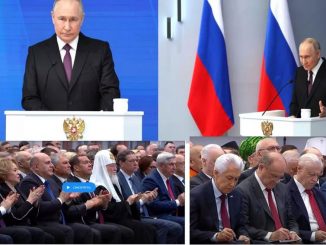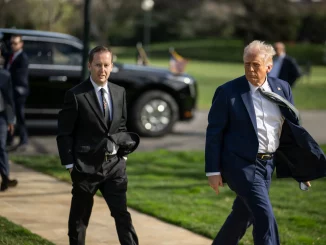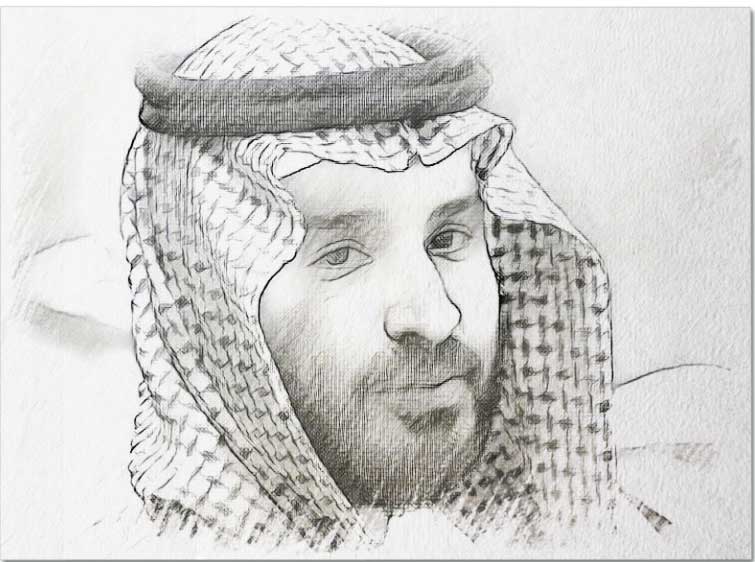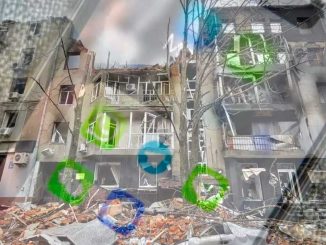
Three episodes, seven years apart, one recurring pattern: when Riyadh needs Washington most, Washington looks the other way — or worse, makes light of it in public. For the Gulf monarchies, the question is no longer hypothetical.
The Essentials
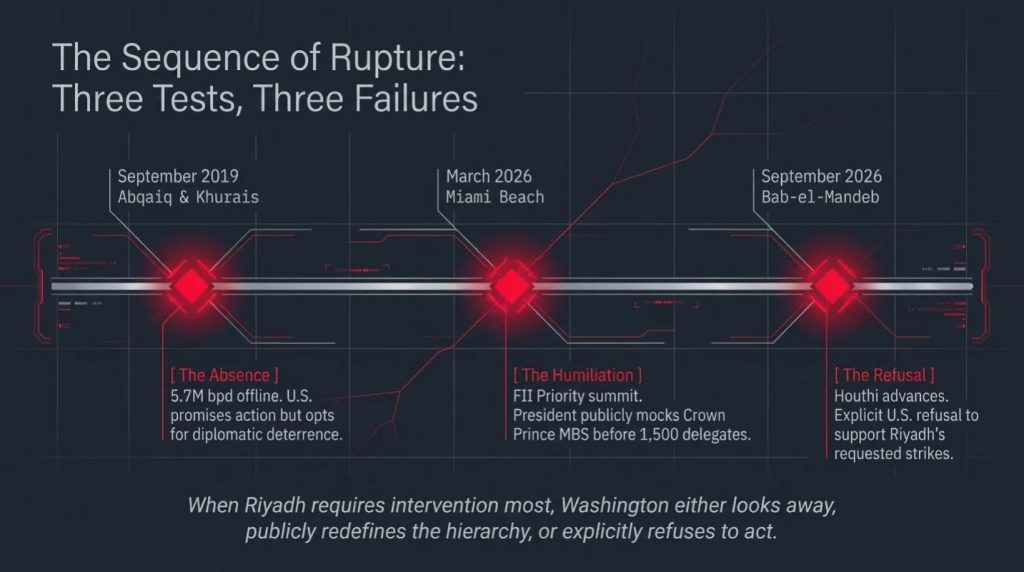
- September 14, 2019: Attack on Abqaiq and Khurais, 5.7 Mb/d cut — half of Saudi production. Trump promises to be “locked and loaded,” then chooses deterrence over retaliation.
- March 27, 2026: FII Priority summit, Miami Beach — funded by the Saudi sovereign wealth fund PIF. Before 1,500 delegates, Trump declares that MBS is “kissing my ass.”
- May 18, 2026: MBS, the UAE president, and the Emir of Qatar jointly persuade Trump to abandon a major strike against Iran — the Gulf takes matters into its own hands, collectively.
- September 2026: Despite two personal calls from MBS, Washington refuses to back Riyadh against the Houthi advance in the Red Sea, choosing instead to stay focused on Iran and Hormuz.
Contents
by Joël-François Dumont | Berlin, September 16, 2026 —
2019: The First Warning
On September 14, 2019, two of the world’s most critical Saudi oil facilities — Abqaiq and Khurais — were struck by a barrage of drones and cruise missiles. Half of the kingdom’s national production, 5.7 million barrels per day, was knocked offline within minutes. Riyadh had nonetheless invested billions of dollars in American Patriot systems and F-15s; nothing intercepted the attack.[01]
Defense Secretary Mark Esper called it an “unprecedented” attack. Donald Trump publicly promised to be “locked and loaded.” But two weeks later, the urgency had faded: Washington opted for diplomatic deterrence and sanctions rather than a direct military response against Iran.[02] For Riyadh, the message was clear, even if never stated outright: the American guarantee has limits, and those limits appear precisely when the Kingdom needs it most.
March 2026: Public Humiliation
Seven years later, it was no longer an absence of action that wounded Riyadh — it was a remark. On March 27, 2026, at the FII Priority summit in Miami Beach, funded by the Saudi Public Investment Fund itself, Donald Trump recounted a private conversation with Mohammed bin Salman before 1,500 international delegates. He concluded, in his characteristic style, that the crown prince “didn’t think he’d end up kissing my ass” and now “has to be nice to me.”[03]
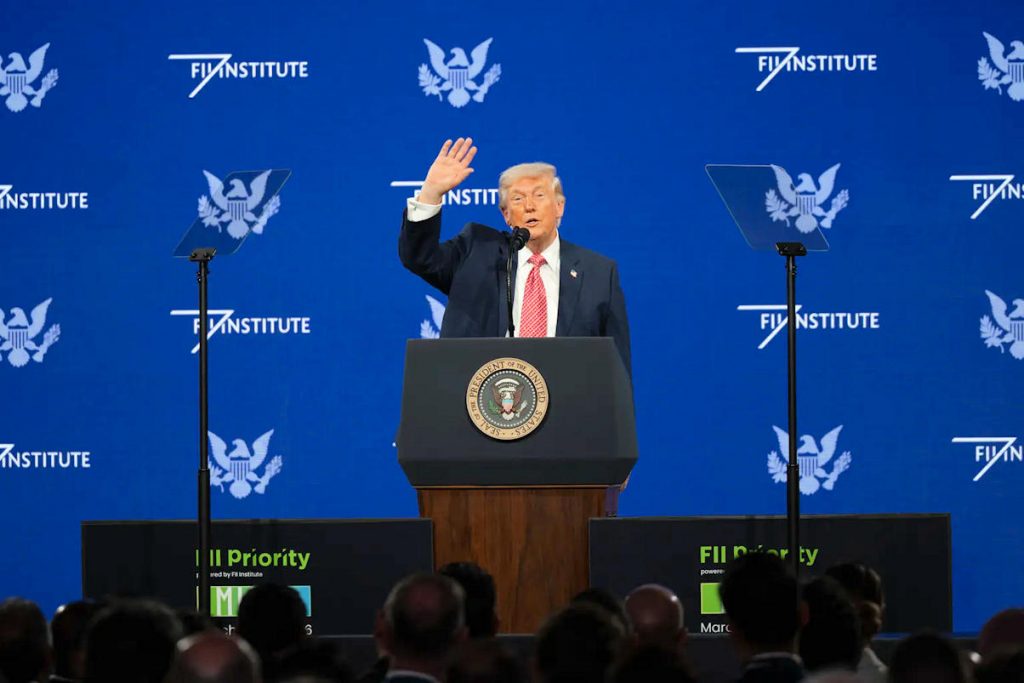
“He didn’t think he would be kissing my ass, he really didn’t. He thought I was going to be just another failing American president, leading a declining country. But now he has to be nice to me. Tell him to be nice to me.”
This lapse in language made headlines around the world; we noted it at the time in our report “$1,000 Billion for Nothing: The Gulf and Asia Facing the American Betrayal “ (April 10, 2026).
The insult was delivered on a stage funded by Saudi money, before an audience partly Saudi. Riyadh chose silence: neither the Royal Court nor the Foreign Ministry reacted publicly. That silence was itself a signal — that of a partner absorbing the blow rather than responding, for lack of a credible short-term alternative.
May 2026: When the Gulf Takes Back Control
The sequence, however, was not entirely one-sided. On May 18, 2026, Mohammed bin Salman, Emirati President Mohamed bin Zayed, and Qatar’s Emir Tamim bin Hamad jointly persuaded Trump to abandon a strike described as “major” against Iran.[04] The episode is worth noting: the Gulf is not merely in a position of supplicant before Washington. On certain issues, coordinated action by the three capitals is enough to sway an American decision — provided they act together, and on a matter vital enough to mobilize all three states at once.
September 2026: The Refusal
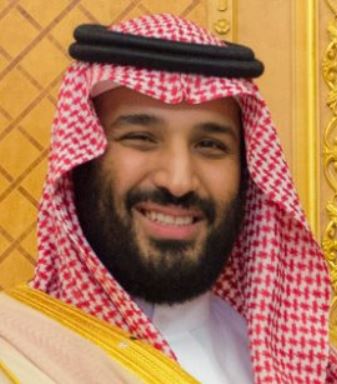
What could have closed the sequence on a more balanced note tipped once again in September. As Admiral Christian Girard recalled in his September 13 analysis on Bab-el-Mandeb, President Donald Trump reportedly issued an explicit refusal to a Saudi request for strikes against the Houthis, who had just seized Mokha and then Perim Island — despite two personal calls from MBS. American officials reportedly indicated they wanted to stay focused on Iran and Hormuz rather than open a new front.
Riyadh thus found itself, for the third time in seven years, forced to rely on its own resources — after an absence of retaliation in 2019, a public humiliation in March, and a refusal of support in September.
A War Fueled from Outside
The Gulf’s sense of abandonment is compounded by a fact Western capitals took months to publicly document: Moscow and Beijing were not mere bystanders to this war. As early as March 2026, UK Defense Secretary John Healey pointed to Vladimir Putin’s “hidden hand” in the tactics used by Tehran; Nick Perry, Chief of the UK’s Joint Operations, called the signs of a link between Moscow and Iran’s drone tactics “definitive.”[05]
China went further than simply supplying equipment. On May 8, 2026, Secretary of State Marco Rubio announced sanctions against three Chinese satellite companies accused of providing Tehran with imagery and data on American military activity.[06]
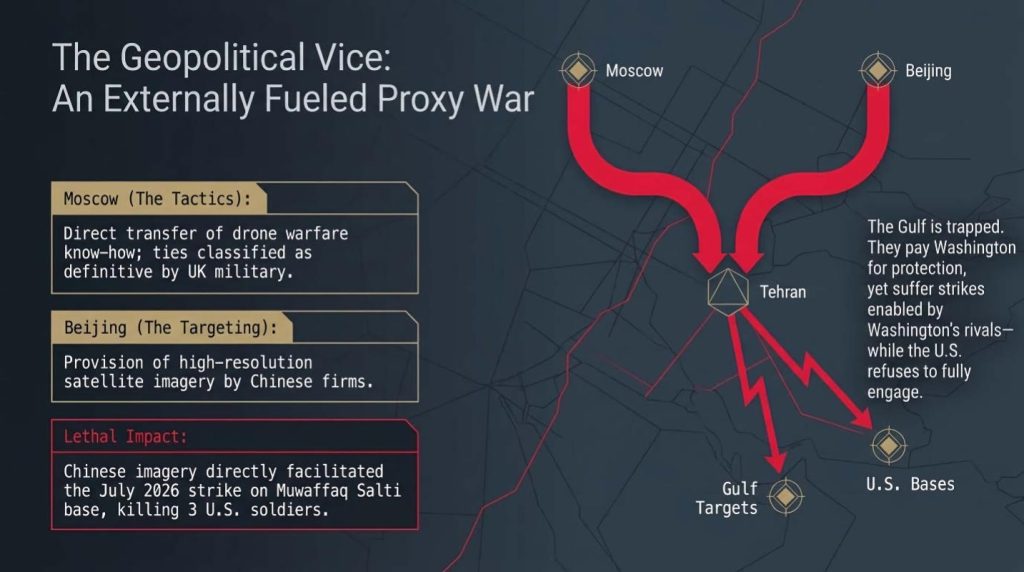
On July 17, 2026, an Iranian strike on Jordan’s Muwaffaq Salti Air Base killed three American soldiers. According to a Wall Street Journal investigation published in mid-September, Chinese companies had supplied Iran with high-resolution satellite imagery of that base, both before and after the strike — the clearest evidence yet, according to American officials, that Chinese support directly contributed to the deaths of American soldiers. That imagery, officials noted, was in addition to Iran’s own satellites, human sources, and Russian intelligence.[07]
Riyadh, Doha, and Abu Dhabi are therefore not merely paying the price for an inattentive America. They are enduring a war in which two rival powers to Washington are actively providing their aggressor with better means to target them — while their supposed protector refuses to intervene.
This picture takes on particular weight when set against what other allies did during the same period. London opened Diego Garcia [08] on March 1 and deployed Sky Sabre, Typhoons, and counter-drone systems from Kuwait to Bahrain. Paris sent its aircraft carrier, eight frigates, and Rafale jets [09] to protect Emirati airspace — its base in Abu Dhabi was even struck by a drone. More striking still: Kyiv, in the midst of a war for its own survival and recently deprived of direct American military support, dispatched more than 200 counter-drone specialists to five Gulf countries to share its experience fighting Russian Shaheds.[10]
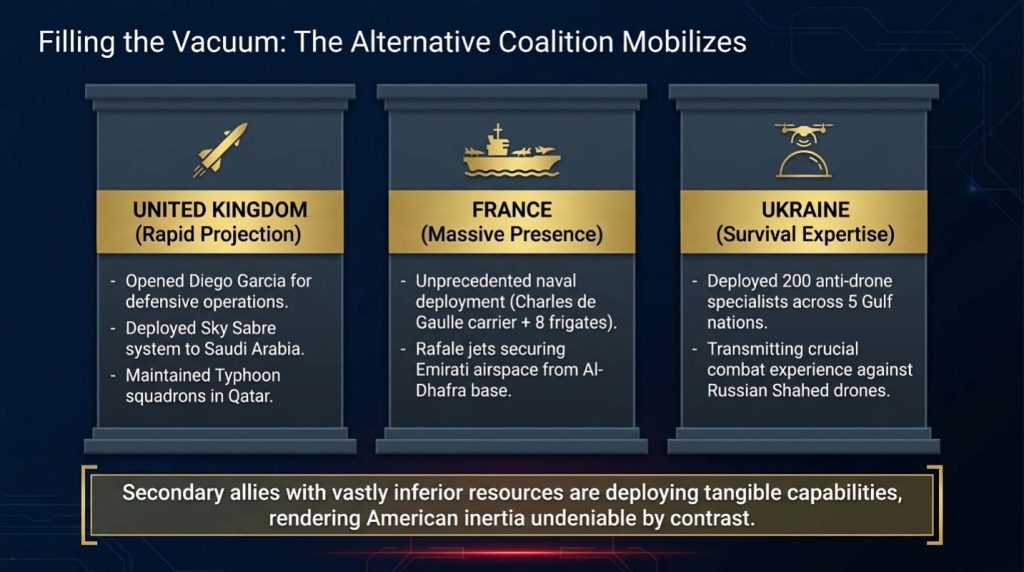
Washington, the region’s historic security guarantor, was thus, on three occasions in seven years, the one major ally that failed to show up when it mattered most.
What This Says About the Gulf — Not Just Washington
These three episodes do not tell the same story. The first was an operational and political failure. The second was a deliberate, public display of hierarchy. The third was an assumed strategic choice — concentrating resources on Hormuz rather than spreading them thin over the Red Sea. But taken together, they trace a trajectory: that of a partnership in which Saudi financial investment — $600 billion announced in May 2025, raised to $1 trillion by MBS himself — has yet to translate into a proportionate security guarantee.
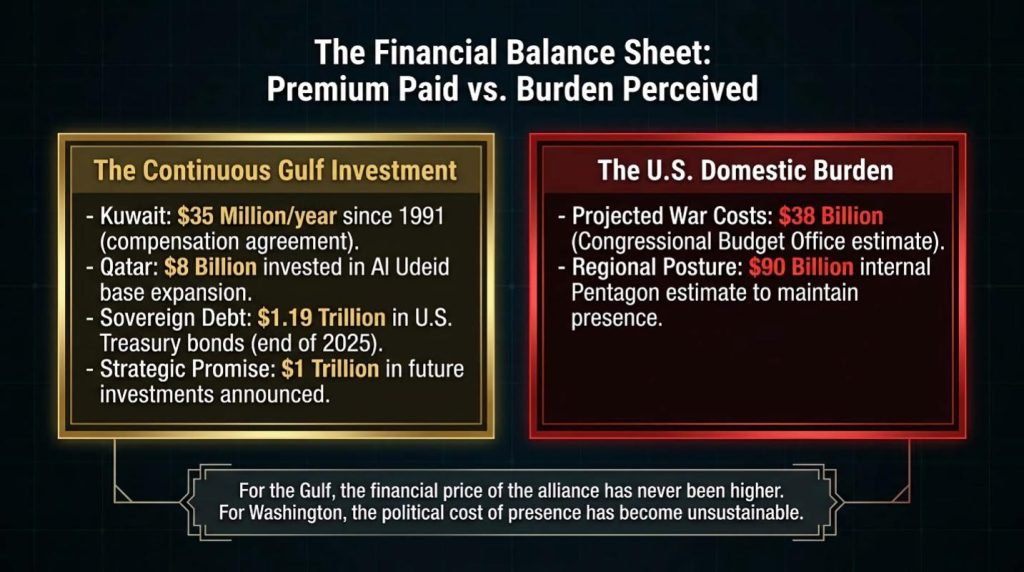
This Saudi investment is not an isolated case. Since the Gulf War, every monarchy has paid, in one form or another, for American protection: Kuwait has paid roughly $35 million annually since 1991 under a bilateral compensation agreement; Qatar has invested more than $8 billion in expanding Al Udeid Air Base, CENTCOM’s forward headquarters; Bahrain hosts the US Fifth Fleet; and by the end of 2025, Kuwait, Saudi Arabia, and the UAE alone held roughly $1.19 trillion in US Treasury bonds.[11]
The May 18 episode is a reminder, however, that this dependency is not inevitable: it can be negotiated — and negotiated better collectively than alone.
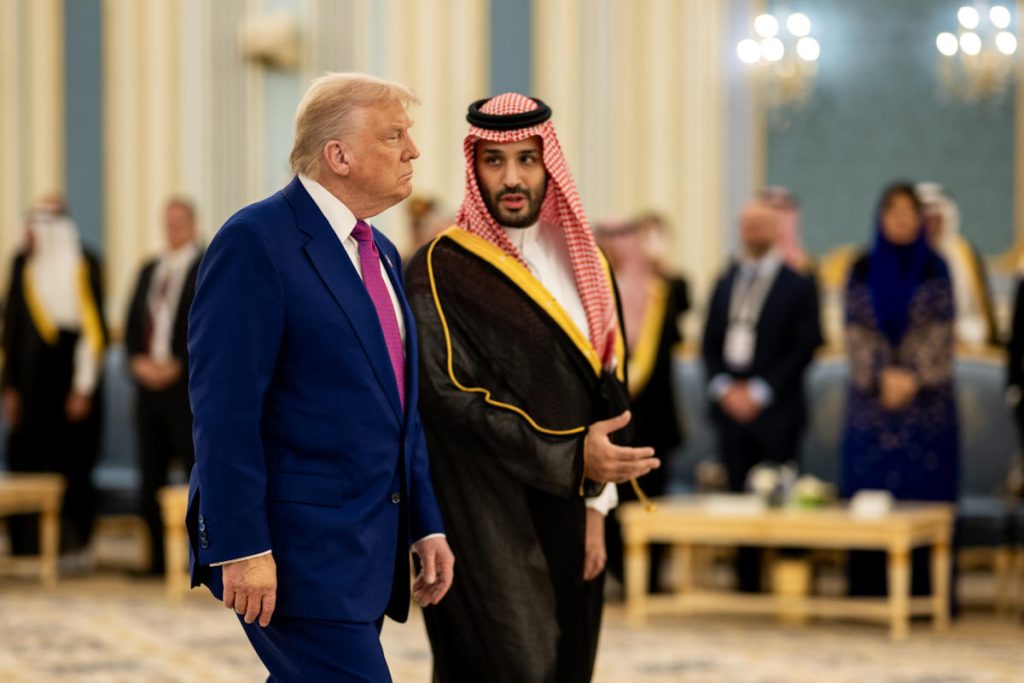
The question raised by the repetition of these three episodes is therefore not simply “Will Washington abandon Riyadh again?” — but rather: how much longer will the Gulf monarchies keep financing a security guarantee that, at every real crisis, proves more conditional than advertised?
On September 15, 2026, the Congressional Budget Office put the cost of the Iranian war to Washington at $38 billion, including $21.7 billion in munitions alone — on top of nearly $90 billion requested by the Pentagon to rebuild its stockpiles. The Gulf’s budgetary history, recounted above, invites a question no less pointed than the previous ones: how long before Washington presents its Gulf partners with the bill for a war fought partly for their security — as it has already done, in another form, since 1991?
Joël-François Dumont
Notes and Sources
[01] Baker Institute, October 2019: the September 14, 2019 attack on Abqaiq and Khurais cut 5.7 Mb/d of Saudi crude production and 0.7 Mb/d of natural gas liquids — the largest disruption in the modern history of oil, by volume.
[02] Baker Institute, October 2019: after an initial threat of retaliation, the Trump administration opted for a deterrence strategy rather than a direct strike against Iran; “just over two weeks later, the sense of urgency was gone.”
[03] L’Orient-Le Jour, March 29, 2026: at the FII Priority summit in Miami Beach on March 27, before international investors, Donald Trump mocked Mohammed bin Salman, saying he didn’t think he’d “kiss his ass” and that he now had to “be nice” to him. See also “$1,000 Billion for Nothing: The Gulf and Asia Facing the American Betrayal ” (April 10, 2026).
[04] On May 18, 2026, Mohammed bin Salman, Emirati President Mohamed bin Zayed, and Qatar’s Emir reportedly jointly persuaded Donald Trump to abandon a strike described as “very major” against Iran. This information comes from a single source and would need to be corroborated before definitive publication — see note below.
[05] Gulf News, March 2026: UK Defense Secretary John Healey and Chief of Joint Operations Nick Perry pointed to a “definitive” link between Russia and Iranian drone tactics.
[06] US State Department, May 8, 2026: sanctions against three Chinese satellite companies for supplying intelligence to Iran during Operation Epic Fury.
[07] Wall Street Journal, September 2026 (reported also by SOFX and Vision Times): Chinese satellite imagery supplied to Iran before and after the July 17, 2026 strike on Muwaffaq Salti, Jordan — three American soldiers killed.
[08] Combined sources — CSIS/Cordesman (1991 Kuwaiti agreement); Medium/Mohamed Dosou, March 2026, and Open Canada, May 2026 (Al Udeid, Treasury bond holdings).
[09] UK Ministry of Defence / Gulf News, March 1-31, 2026: authorization to use Diego Garcia and RAF Fairford for US defensive operations (March 1); deployment of the Sky Sabre system to Saudi Arabia, Rapid Sentry and ORCUS systems to Kuwait, a light missile launcher to Bahrain, extended Typhoon deployment to Qatar (March 31); Defense Secretary John Healey confirms British forces intercepted Iranian drones.
[10] Defense News / The Arab Weekly / Yahoo News, March 2-12, 2026: France deploys the aircraft carrier Charles de Gaulle, eight frigates, and two helicopter carriers to the Mediterranean, described as an “unprecedented” naval mobilization; Rafale jets protect Emirati airspace from Al-Dhafra base; France’s naval base in Abu Dhabi is struck by a drone, with limited damage according to Defense Minister Catherine Vautrin. Foreign Minister Jean-Noël Barrot expresses France’s support for Saudi Arabia, the UAE, Qatar, Iraq, Bahrain, Kuwait, Oman, and Jordan, and states France is ready to contribute to their defense if requested.
[11] Al Jazeera / The Hill / Daily Sabah / Militarnyi, March-May 2026: President Volodymyr Zelensky announces the deployment of more than 200 Ukrainian counter-drone experts to five Gulf countries (UAE, Saudi Arabia, Qatar, Kuwait, Jordan), tasked with sharing Ukraine’s experience fighting Russian Shahed drones; the assistance came as Washington had just suspended direct military support to Ukraine. Zelensky claims successful interceptions in several Gulf countries.
See also:
- « Abqaiq, Miami, Bab-el-Mandeb : La garantie américaine à l’épreuve des faits » — (2026-0916)
- « Abqaiq, Miami, Bab-el-Mandeb: Die amerikanische Garantie auf dem Prüfstand » — (2026-0916)
- « Abqaiq, Miami, Bab-el-Mandeb: The American Guarantee Put to the Test » — (2026-0916)
Decryption: Third Time’s Not the Charm
These three episodes resonate differently in the Gulf than they would elsewhere, and that difference lies in a conception of alliance that is not Washington’s own.
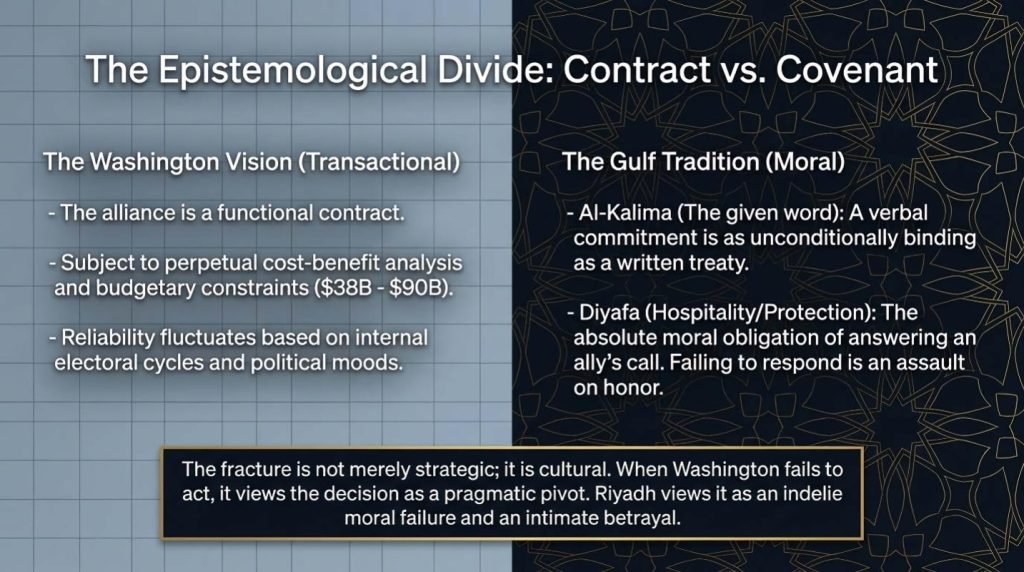
In Arab political tradition, and particularly in that of the Gulf monarchies, the spoken word — al-kalima — binds as much as a written treaty; loyalty to an ally who has requested assistance is not one diplomatic option among others, but a moral obligation whose breach is remembered for a long time. That same culture makes hospitality (diyafa) a cardinal value: welcoming, protecting, and responding to one who seeks help are acts that define honor as much as interest.
Measured against that standard, the Abqaiq-Miami-Bab-el-Mandeb sequence does not read merely as three strategic failures. It reads as three breaches of a word Riyadh believed it had received — in 2019, with a promised response that never came; in 2026, twice in a row, with a refusal of assistance requested by an ally who had, for its part, honored its own commitments for decades. For a culture in which loyalty is proven at the exact moment it is asked for, not in the comfort of rhetoric, that silence weighs heavier than a mere tactical disagreement.
[Arabic decryption follows in the original, unchanged: “فك الشيفرة: الكلمة والولاء” — see French/Arabic version for the full text.]