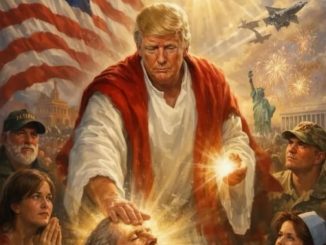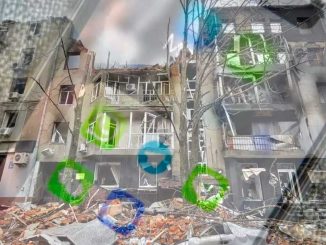
Eighteen months of disorder: a president who humiliates his allies, depletes his own munitions stockpiles, normalizes Russian assistance to an adversary killing American soldiers — and who, without meaning to, may have done more for Europe’s strategic autonomy than ten years of speeches. The question is how much longer the world will wait, arms folded, for someone to tell him so to his face.
The Essentials
- September 17, 2026: Mark Carney receives a double standing ovation at the European Parliament in Strasbourg — von der Leyen proposes making Canada the EU’s first “associate member” — five days after Trump was booed by tens of thousands of protesters in Dublin.
- September 15, 2026: The Pentagon’s Inspector General confirms the Iranian war cost $33.4 billion between late February and late June, including $22.3 billion in munitions alone; THAAD stockpiles are nearly 80% depleted, Patriot stockpiles more than 60%.[01]
- May 2026: Acting Under Secretary of the Navy Hung Cao admits to the Senate that arms deliveries to Taiwan have been paused for lack of available munitions.[02]
- September 14, 2026: Finland becomes the 10th European country to join France’s advanced nuclear deterrence initiative — a country that only joined NATO in 2023 after decades of neutrality.[03]
- Week of September 15: Two oil depots blockaded in France (Fos-sur-Mer, Frontignan); one gas station in ten out of fuel; the Washington Post warns the worst is yet to come, including in the United States.[04][05]
- This week: Saudi Arabia conducts more than 300 airstrikes in five days against the Houthis — alone, without waiting for Washington.[06]
- Asked about possible Russian assistance to Iran, Donald Trump replies: “It’s like they do it and we do it, in all fairness.”[07]
Contents
by François de Vries | Brussels, September 17, 2026 —
Chaos as a Method
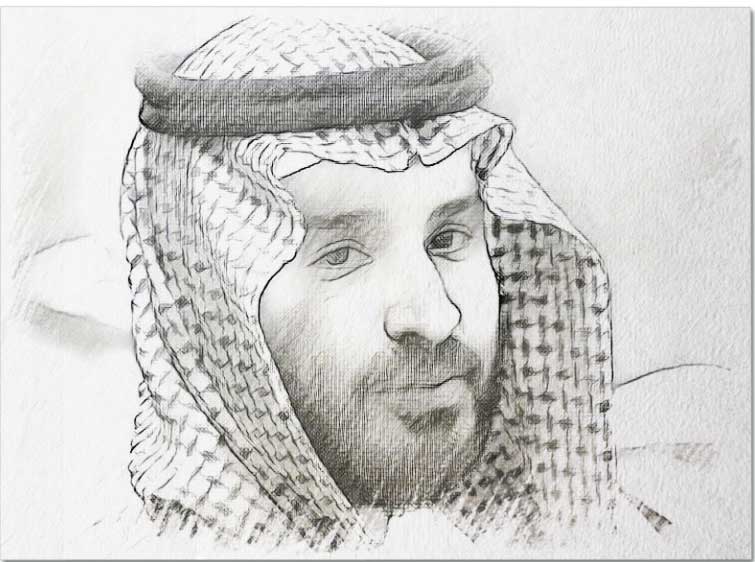
The evidence is hard to escape: in eighteen months, Donald Trump has achieved what neither Russia nor China had managed in twenty years — convincing a substantial part of the Western world that the American guarantee is no longer a given, but a variable. The list is long and grows every week: Abqaiq left without a response, MBS publicly humiliated in Miami, the refusal to back Riyadh against the Houthis in September, arms deliveries to Taiwan suspended “for lack of munitions,”[02] renewed threats to annex Canada, and now the admission, without hesitation, that Russia may be helping Iran target American soldiers — “in all fairness,” as though it were an accepted rule of the game between great powers rather than a betrayal.[07]
What the Chaos Precipitated, Despite Itself
Here the irony becomes almost unbearable: every failure produced, in mirror image, a response.
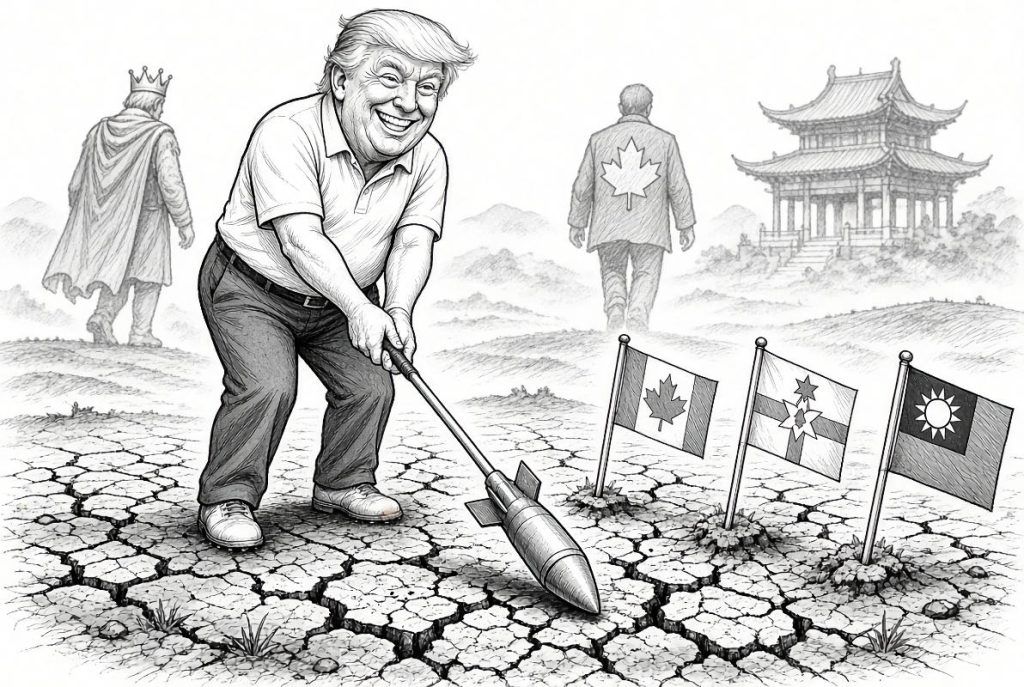
Finland, one of Europe’s most cautious countries, had its Parliament lift the historic ban on nuclear weapons on its soil in order to join the French nuclear umbrella — not the American one.[03]
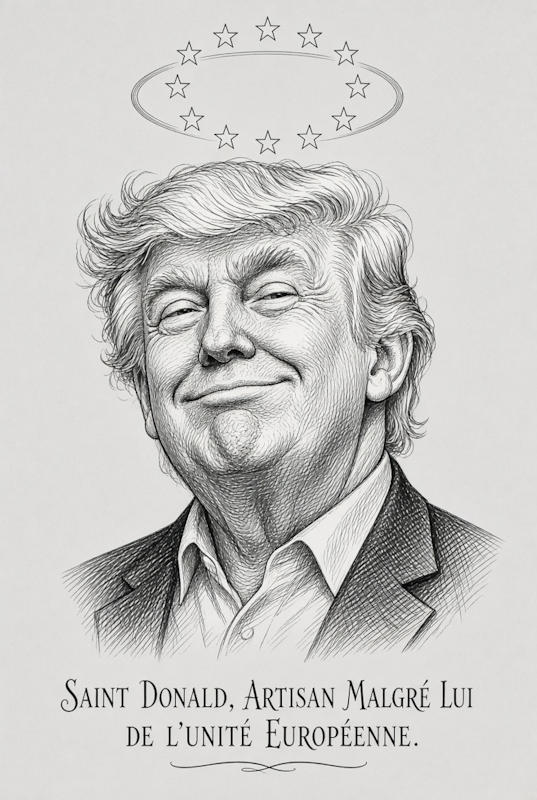
This contempt is no isolated misunder-standing. At Davos, Trump reportedly told European leaders: “You’re pathetic, your societies and economies are falling apart — now give us Greenland,” before claiming, factually wrong, that “without us, you’d all be speaking German.” His Vice President J.D. Vance admitted on Signal to hating “bailing out Europe again,” while Defense Secretary Pete Hegseth called the continent “pathetic” in the same exchange. Trump himself repor-tedly believes the European Union was founded for the sole purpose of “screwing” the United States — an admission that inadvertently explains everything else: a united, integrated Europe cannot be as easily subjugated as a collection of divided countries.
Without meaning to, Donald Trump has done more for Europe’s strategic autono-my than ten years of rhetoric. It remains to be seen how much longer the world will wait, with its arms folded, for some-one to tell it a few home truths to its face
Illustration © European-Security
“Canada is not for sale—and never will be” (Mark Carney at the White House on May 6, 2025)
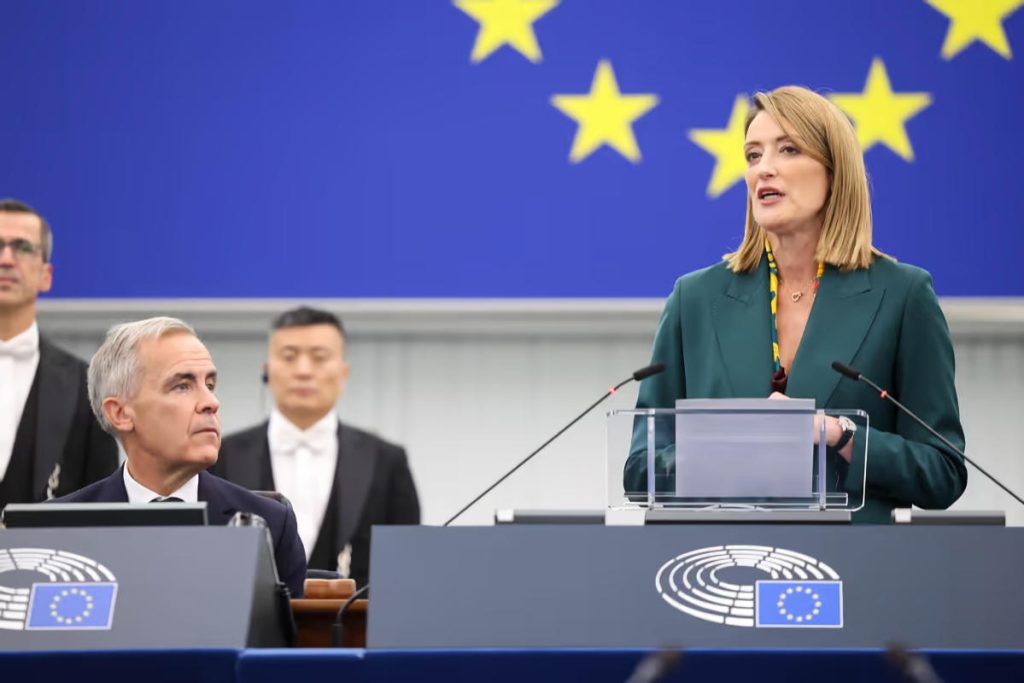
Welcoming the Canadian Prime Minister, European Parliament President Roberta Metsola said: “Europe and Canada share a simple understanding: that we are always stronger when we work together. Canadians stood with Europe in our darkest moments, and we will never forget their sacrifice. Today, we are looking to the future together, with huge potential to deepen our cooperation from defence and trade to energy, education and research.”
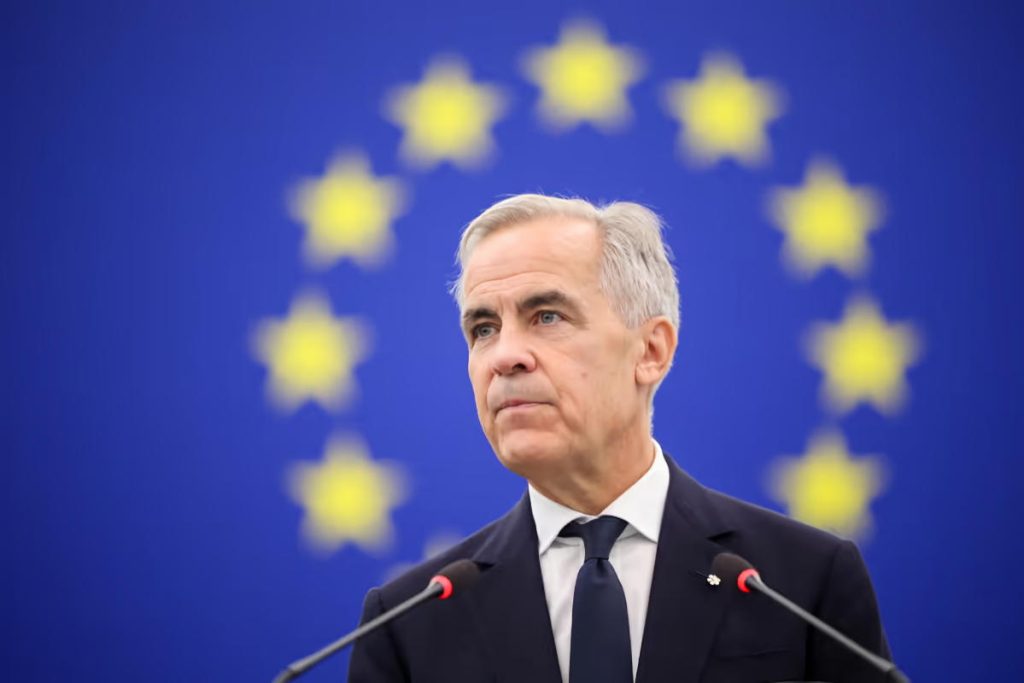
Paying homage to the long historical ties between Europe and Canada, Mr. Carney highlighted “our commitment to the rule of law, and our unyielding defence of human dignity, individual freedom, and democracy that share the same deep roots, the same unwavering dedication.”…“We believe that a strong economy is not an end in itself but the means to a just society… We believe that our prosperity grows when it is shared,” he said.
Mark Carney’s Canada signed a security and defense pact with the European Union, after noting that 75 cents of every dollar of defense investment went to the United States — “that’s not smart,” he concluded.[08]
Five days earlier, in Dublin, Trump faced tens of thousands of protesters chanting his name between boos, under giant balloon caricatures of him alongside Netanyahu. The contrast with the welcome given to Carney barely five days later could not have been starker: on September 17, the Canadian Prime Minister received a double standing ovation at the European Parliament in Strasbourg — MEPs jostling to shake his hand and take selfies before he even spoke — while Ursula von der Leyen had proposed, the day before, making Canada the EU’s very first “associate member,” a status still to be invented.
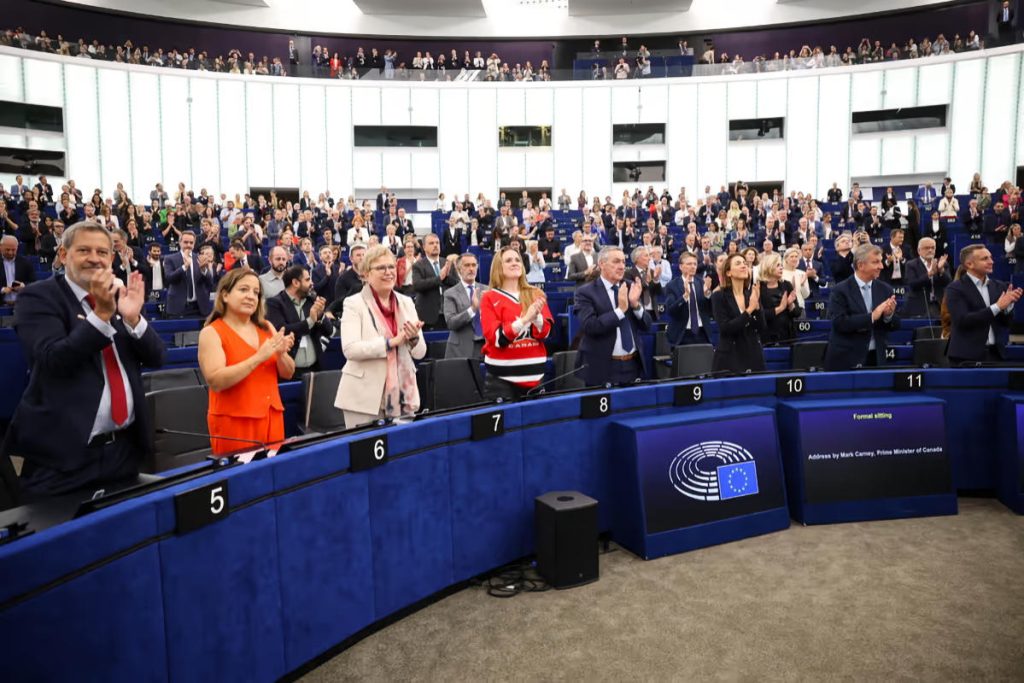
The contrast, just days later, could not have been starker. On September 17, Carney received a double standing ovation at the European Parliament in Strasbourg — a welcome so enthusiastic that MEPs jostled to shake his hand and take selfies before he even spoke — while Ursula von der Leyen proposed making Canada the EU’s very first “associate member,” a status still to be invented. Five days earlier, in Dublin, Trump had faced tens of thousands of protesters chanting his name between boos, under giant balloon caricatures of him alongside Netanyahu.
Quentin Dickinson, on euradio, went so far as to ask the question no one would have seriously raised two years ago: “What if Canada became the 28th member state of the European Union — rather than the 51st state of the United States, as Donald Trump would like?“[09] Ottawa is certainly not there yet — European treaties do not even allow for it — but that the question can now be seriously asked out loud says a great deal about how far things have moved in eighteen months.
None of this stems from some improvised infatuation. There has never been a falling-out to mend between Europe and Canada — only a closeness that had come to be taken for granted. In 1914 as in 1939, Canadian volunteers were among the very first to cross the Atlantic to defend Britain and France, long before the United States resolved to do so. What 2026 is reawakening, then, is not a new alliance: it is an old loyalty, dormant for the span of an American century now visibly drawing to a close.
Canada is not alone in this reflex. Ukraine, in the midst of a war for its own survival, sent 200 counter-drone specialists to five Gulf countries to share expertise America no longer provided.Ukraine, in the midst of a war for its own survival, sent 200 counter-drone specialists to five Gulf countries to share expertise America no longer provided.[10] And Saudi Arabia, this week again, demonstrated it knew how to act alone when necessary: more than 300 strikes in five days against the Houthis, without a green light from Washington.[06]
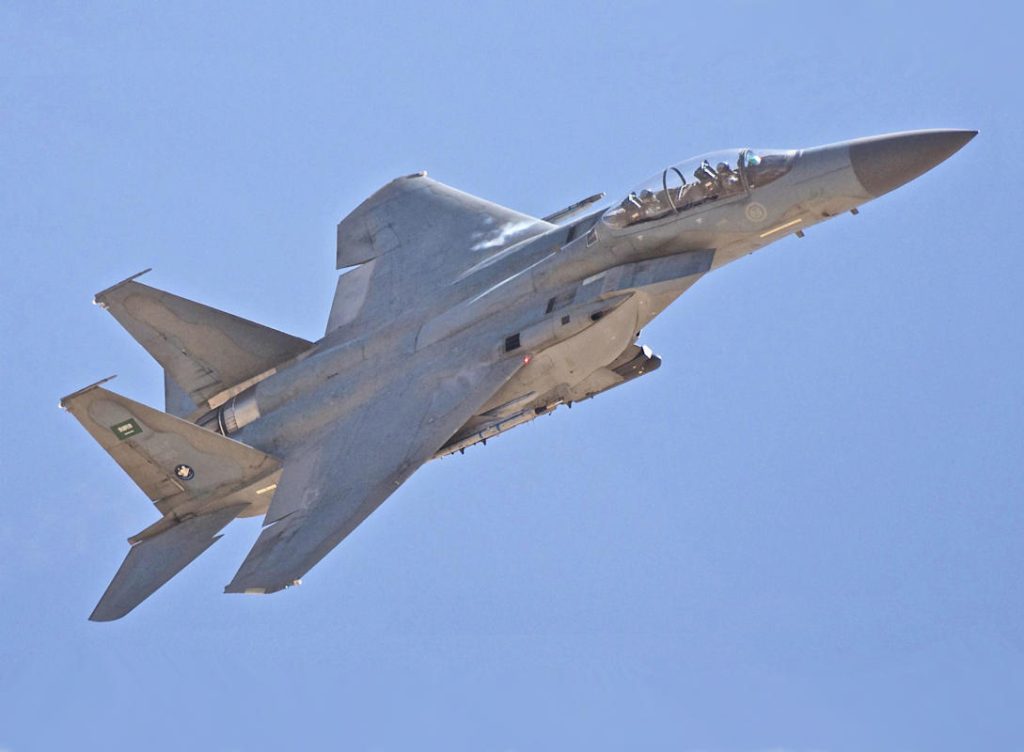
The paradox is complete: it is by abandoning his allies, one by one, that Trump pushed them to do without him.
The Price Paid at Home
But this awakening has a cost, and it is public opinion that pays it — on both sides of the Atlantic. In France, two oil depots were blockaded back-to-back this week by fishermen at the end of their rope; one station in ten is out of fuel; seven French people in ten expect their purchasing power to decline, according to Elabe. A cross-union mobilization is planned for September 29, a strike at TotalEnergies on October 8, calls are circulating for October 17 — seven months before the presidential election.[04] Portugal, Syria, and, according to AFP, “the Americas, Europe, Asia, Africa and the Middle East” are experiencing similar unrest.
And it isn’t over. The Washington Post wrote two days ago: analysts predict a new surge in gasoline and diesel prices, “potentially more damaging” than anything that has come before — including in the United States, where gas reached $4.59 a gallon in Cincinnati this week. Saudi Arabia’s East-West pipeline, the overland alternative to Hormuz, has just been damaged. Despite the Trump administration’s assurances, the worst, according to the same analysts, still lies ahead.[05]
The Silence Is Not Total — But It Does Not Carry
It would be unfair to say no American voice has spoken up. Jake Sullivan, the former National Security Advisor, was scathing: Russia “is supplying intelligence so that Iran can pinpoint locations where U.S. service members are present,” and “one of the big winners in all of this is Vladimir Putin.”[12] War on the Rocks, a leading security publication, ran a headline without euphemism: “Punish Russia for Helping Iran Target the U.S. Military.”[11] Robert Kagan, writing in The Atlantic, documented the emergence of a “post-American world.”
Democratic Senator Chris Murphy (Connecticut), for his part, doesn’t bother with diplomatic nuances. On September 15, 2026, in the Senate, speaking about the Trump clan’s ties to Moscow, he was very clear: “This is as close to treason as you can get.” And later, without mincing words: “Trump has become one of Putin’s most important allies.”
The entourage close to power has not been spared either. This week, ProPublica revealed that a Russian businessman close to Putin, decorated by him with the Order of Friendship, financed several hundred thousand dollars of Donald Trump Jr.’s wedding in the Bahamas — a man with a troubled past, according to the investigative journalist behind the scoop.[13] The same day, FBI Director Kash Patel, questioned before the Senate, said he knew nothing of it — while having to explain his own $25,000 payment received in 2024 from a production company tied to the Kremlin.[14]
But these voices run into a wall: that of a president who, asked directly about Russian assistance to Iran, does not deny it — he normalizes it. “I think he might be helping them a bit, yeah, and he probably thinks we’re helping Ukraine, right? […] It’s like they do it and we do it, in all fairness.” A moral equivalence between helping an invaded ally and helping an adversary that kills American soldiers — stated without apparent embarrassment.[07] As long as that sentence sums up the position at the top of the state, the criticism, however justified, has no purchase.
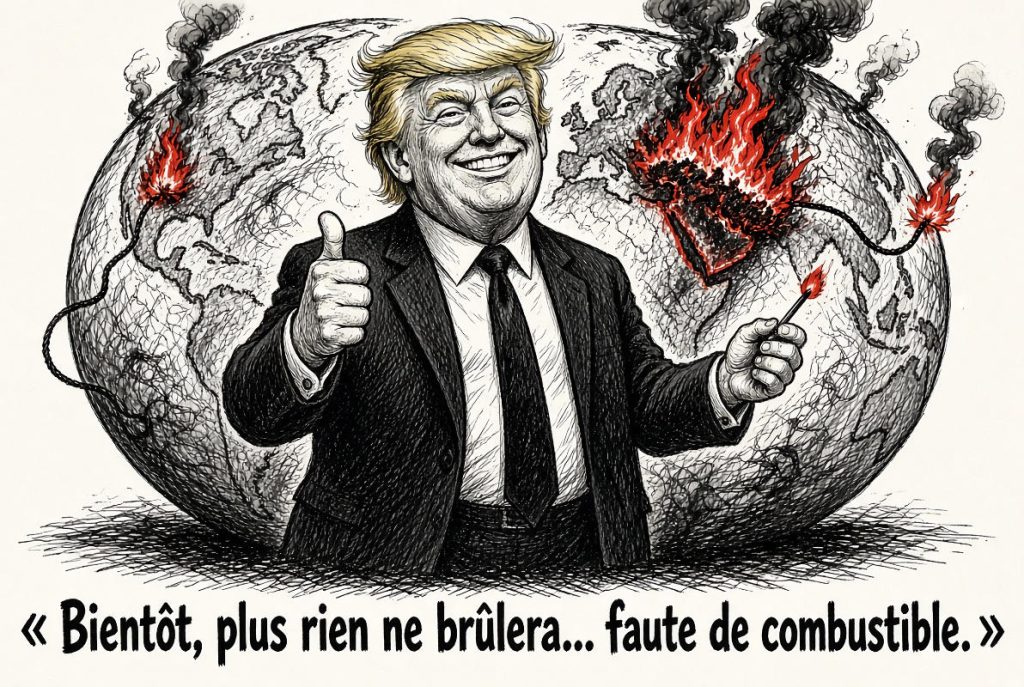
Who Benefits From the Chaos
The answer, documented by Time as much as by the Council on Foreign Relations, leaves little doubt: Russia, first and foremost — higher oil revenues, slower American aid to Ukraine, global distraction at the very moment its Ukraine offensive needed breathing room.[15] Kirill Dmitriev, Putin’s special envoy, makes no secret of it: the lifting of sanctions on Russian oil amounts, he wrote, to “acknowledging the obvious: without Russian oil, the global energy market cannot remain stable.”[16] China, for its part, has banked a quieter but very real diplomatic win: at the May summit in Beijing, Xi Jinping succeeded in placing American arms sales to Taiwan at the center of the discussions — an angle Washington, ill-prepared, failed to avoid.[17]
François de Vries
Notes and Sources
[01] U.S. Department of Defense Inspector General, September 15, 2026: the Iranian war’s cost to Washington estimated at $38 billion (per an earlier report) / $33.4 billion for the February 28–June 30 period, including $22.3 billion in munitions; THAAD stockpiles nearly 80% depleted, Patriot stockpiles more than 60%.
[02] Testimony of Acting Under Secretary of the Navy Hung Cao before the Senate, May 2026: arms deliveries to Taiwan paused “to make sure we have the munitions we need for Epic Fury.”
[03] Al Jazeera / Stars and Stripes, September 14, 2026: Finland becomes the 10th European country to join France’s advanced nuclear deterrence initiative, after its Parliament lifted (June 17, 125 votes to 61) the historic ban on nuclear weapons on its soil.
[04] The Local fr / Yahoo News, September 15–17, 2026: blockades of the Fos-sur-Mer and Frontignan oil depots; one gas station in ten out of stock; Elabe poll (7 in 10 French people expecting declining purchasing power); mobilizations planned for September 29, October 8 and 17.
[05] Washington Post, September 16, 2026 (Evan Halper, Rachel Chason, Joyce Lee): a new surge in gasoline and diesel prices expected; gas at $4.59/gallon in Cincinnati; damage to the Saudi East-West pipeline.
[06] Al Jazeera / Washington Times, September 15–16, 2026: more than 300 Saudi airstrikes in five days against Houthi positions, conducted without prior American approval.
[07] Yahoo News, July 25, 2026: Donald Trump, asked by Fox Radio about possible Russian assistance to Iran: “I think he might be helping them a bit, yeah […] it’s like they do it and we do it, in all fairness.”
[08] Axios / CBC, February–March 2026: Canadian Prime Minister Mark Carney announces the country’s first-ever defense industrial strategy, joins the EU’s SAFE program; Nanos poll (9% of Canadians consider the U.S. a trustworthy ally); quote: “75 cents of every dollar […] that’s not smart.”
[09] Quentin Dickinson, weekly editorial, Euradio, September 2026.
[10] Al Jazeera / Daily Sabah / Militarnyi, March–May 2026: more than 200 Ukrainian counter-drone specialists deployed to five Gulf countries.
[11] War on the Rocks, March 29, 2026: calls to “punish Russia for helping Iran target the U.S. military.”
[12] Russia Matters / statements by Jake Sullivan, March 2026: Russia supplying targeting intelligence to Iran; “one of the big winners in all of this is Vladimir Putin.”
[13] ProPublica / Democracy Now, September 15–16, 2026: Umar Kremlev, a Russian businessman close to Putin, decorated with the Order of Friendship, finances Donald Trump Jr.’s wedding in the Bahamas; Trump Jr.’s net worth estimated at $300 million by Forbes.
[14] ABC News / Newsweek, September 15, 2026 (Senate hearing) and February 2025 (initial disclosure): FBI Director Kash Patel says he was unaware of the Kremlev affair; confirmation of his own $25,000 payment in 2024 from a Kremlin-linked company.
[15] Time / Council on Foreign Relations, March 2026: Russia benefits in the short term from the Iranian war — higher oil revenues, slower American aid to Ukraine.
[16] Statement by Kirill Dmitriev, Putin’s special envoy, cited by Yahoo News, March 2026: the lifting of sanctions on Russian oil amounts to “acknowledging the obvious: without Russian oil, the global energy market cannot remain stable.”
[17] East Asia Forum, May 31, 2026: at the Beijing summit (May 13–15), Xi Jinping places American arms sales to Taiwan at the center of the bilateral dialogue — described as a significant Chinese diplomatic win.
See also:
- « Danke, Donald: Das Chaos, das die Karten der Welt neu gemischt hat » — (2026-0917)
- « Merci Donald : Le chaos qui a rebattu les cartes du Monde » — (2026-0917)
- « Thank You, Donald: The Chaos That Reshuffled the World’s Cards » — (2026-0917)
Decryption: The Burghers of Calais, 21st Century Edition
There is an image, born in the fourteenth century and sculpted by Rodin five hundred years later, of six notables walking toward their fate with rope around their necks, resigned, to spare their city. Europe in 2026 has not reached that point — but the reflex it displays, collectively, sometimes resembles that dignified submission more than an assumed revolt. Each of the facts documented above — Finland, Canada, Ukraine, Saudi Arabia — shows that it is possible to act without waiting for Washington’s authorization. And yet, no European head of state has yet publicly spoken the sentence that so many facts now demand: enough is enough.
The question is no longer whether Donald Trump bears responsibility for part of the current chaos — the facts gathered here speak for themselves. It is how much longer the nations concerned will choose diplomatic caution over candor.
History teaches that the vacuum left by the silence of moderates is never vacant for long: it fills, sooner or later, with those who feel no such scruple — and in Europe as elsewhere, the parties waiting for precisely that moment are those who have never been afraid to say out loud what others only think.