Iran will likely emerge from the conflict weakened. That does not mean the United States will emerge victorious. For several weeks now, this war has been acting less on territories or military capabilities than on flows, delays, costs, and expectations. For European companies building their 2027 budgets, Hormuz is no longer a distant geopolitical question.
The Essentials
- Hormuz traffic: 4 outbound and 10 inbound crossings over the weekend of September 14, versus roughly 125 daily large commercial vessel transits before the war (Kpler/Reuters).
- Brent around $108 on September 14 — inflation still partly invisible, sitting in pre-hike inventories and unrenegotiated contracts.
- Saudi East-West pipeline (4-5 Mb/d, bypassing Hormuz) shut down after a drone attack originating from Iraq.
- Islamic Resistance in Iraq militias: roughly 50,000 fighters, capable of resisting Baghdad’s disarmament attempts.
- The Fed: markets priced in roughly a 90% probability of a 25bp rate hike on September 14; 10-year Treasury yield crossed 5%, its highest since 2023.
- Trump’s $5,000 check: 63% disapproval, 35% presidential approval (Reuters/Ipsos).
- China: a Sino-Iranian oil clearing mechanism ($2-2.5bn over one year) and Xi’s diplomatic push in Cairo in early September.
- Global oil stocks down more than 500 million barrels since the war began; regional refined product exports down nearly 60%.
Contents
by Jérôme Denariez | Paris, September 15, 2026 —
Iran has suffered significant damage, its economy is under pressure, and its oil exports are heavily constrained. American military superiority is hardly in question. Its political translation is more doubtful. The Iranian regime remains in place, traffic through the Strait of Hormuz remains well below its pre-war level, and the crisis has spread to the Red Sea. On September 14, Kpler data showed only four outbound and ten inbound crossings of commodity-carrying vessels over the weekend, against roughly 125 daily transits of large commercial ships before the conflict.[01]
The war has above all changed in nature. It is no longer only about military capabilities; it is now about flows.
Brent crude passed $100 and hovered around $108 on September 14. Insurance premiums, freight rates, and the risk of vessel immobilization are rising alongside it. Yet the price of the barrel is only the immediately visible part of the shock. Oil remains an industrial raw material, present directly or indirectly in petrochemicals, plastics, resins, solvents, synthetic fibers, tires, and packaging. Hormuz is also an essential route for gas, fertilizers, metals, grain, and numerous bulk cargoes.[01][02]
Part of the inflation generated by the conflict has therefore not yet appeared in price indices. It sits in inventories purchased before the price rise, in contracts not yet renegotiated, in goods in transit, and in additional delays. Energy inflation is the first wave. The risk now is its transmission to other prices and then to wages — serious enough that ECB officials are already discussing the need for further tightening if the energy increase becomes entrenched.[03]
For companies, the question is also a financial one. When a shipment takes fifteen additional days, those fifteen days must be financed. Add to that the safety stocks built up to reduce the risk of shortage. Freight becomes inventory, inventory becomes working capital need, and working capital need becomes a financing need. Lost time becomes an expense.
This is how a war fought thousands of kilometers away ends up entering a European cash-flow budget.
Rerouting Does Not Remove the Vulnerability
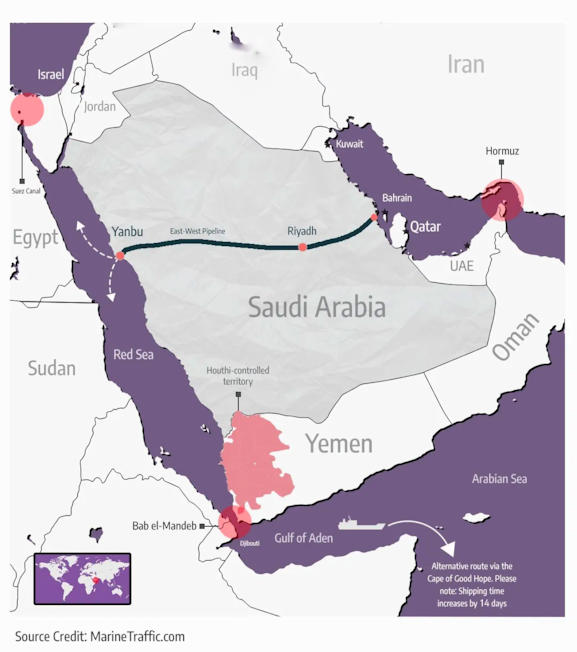
Saudi Arabia was meant to be one of the main shock absorbers of the crisis. The kingdom operates the 1,200-kilometer East-West Pipeline, which carries crude to Yanbu on the Red Sea without crossing Hormuz. Since the war began, it had been transporting roughly 4 to 5 million barrels per day, or 4 to 5% of global supply.[04]
It was temporarily shut down after a drone attack that, according to Riyadh and Baghdad, originated from Iraqi territory.[04] Days earlier, the Houthis had carried out a rapid offensive on Yemen’s Red Sea coast, seizing Mokha and then Perim/Mayun, in the middle of Bab-el-Mandeb, increasing their ability to pressure maritime traffic. Reuters reports that this offensive benefited from Iranian funding, weapons, and operational advice; Tehran denies militarily directing the movement.[05]
The term “proxy” becomes insufficient here if it suggests a simple chain of command running from Tehran. The Houthis have their own territorial foothold, a proven military chain, and local decision-making capacity. Their effectiveness does not require them to be a top-tier conventional army: it is enough that they are more cohesive and more resilient than the forces facing them.
Iraq poses a similar problem. Several Iran-aligned Shia militias remain strong enough to resist Baghdad’s disarmament attempts; Reuters estimates the components of the Islamic Resistance in Iraq at roughly 50,000 fighters. The Iraqi origin of the attack on the Saudi pipeline does not yet allow formal attribution to any particular group, but it shows that Iraqi territory can become an operational depth for the conflict.[04][06]
Iran therefore benefits not only from territorial depth. It benefits from a network of distributed capabilities. Degrading the center is not necessarily enough when the pressure can reappear in Yemen, in Iraq, or in the Red Sea.
Washington Is Not Without Options
The United States still has several ways out. None is free. Increasing pressure on Iran keeps the risk to energy flows alive. Negotiating means accepting the survival of a regime Washington sought to constrain far more forcefully. A negotiated settlement with the states bordering Hormuz would necessarily grant Tehran a role in the strait’s security architecture. Finally, a mediation in which Beijing took a significant role would carry an obvious strategic cost for the United States.
This external constraint is now producing domestic effects. Oil above $100 is arriving in an economy where underlying inflation remains too high. On September 14, markets priced in roughly a 90% probability of a 25-basis-point Fed rate hike. The 10-year Treasury yield crossed 5%, its highest level since 2023.[07]
The institutional contradiction is fairly simple. The executive branch wants to cushion the cost of the war and preserve economic activity; the Fed must prevent the energy shock from becoming entrenched in inflation. The more energy prices rise, the less the White House controls its own domestic economic calendar.
The presidential proposal to pay $5,000 to every American adult if Republicans keep Congress illustrates this difficulty. It would require congressional approval, and its funding mechanism has not been defined.[08] Its principle alone is enough to expose the problem: massively supporting demand at the very moment the central bank is trying to contain inflationary pressure amounts to asking monetary policy to brake while fiscal policy floors the accelerator.
The political calculation itself is uncertain. In the latest Reuters/Ipsos poll, 63% of respondents disapproved of the proposal. Donald Trump’s approval stood at 35%, while Democrats held a seven-point lead in the generic congressional ballot and held a narrow edge on economic management as well.[09]
The external conflict is thus beginning to reduce domestic room for maneuver. This is no longer just a question of gas prices: the channel runs through inflation, interest rates, mortgage and auto credit, corporate investment, and ultimately, the vote.
Beijing Does Not Need to Rush
China follows a different logic. It has an interest in avoiding a lasting disruption of the energy supplies its economy depends on. It has, on the other hand, no reason to freely release Washington from a conflict that ties down American military and political resources far from the Indo-Pacific.
Beijing is already repositioning. In early September, Xi Jinping proposed a new regional security architecture in Cairo and called on Middle Eastern states to reduce outside intervention.[10] At the same time, Sino-Iranian trade continues to rely on mechanisms that bypass part of the traditional financial system: Reuters has documented an oil-linked clearing mechanism that has funneled several billion dollars’ worth of Iranian orders into China.[11]
The Chinese position is therefore less contradictory than it appears: stabilize the Middle East enough to preserve flows, without prematurely restoring American strategic freedom.
This is where the Iranian war meets the Indo-Pacific. Washington has explained for years that this region is its priority theater and that China is its principal strategic competitor. Yet Asian partners are watching the United States scale back certain exercises in South Korea while simultaneously devoting a growing share of attention to the Middle East. The Philippine defense minister recently acknowledged that Beijing might seek to exploit the “spaces” created by these adjustments, while stressing that American commitments to Manila remained unchanged.[12]
The problem, then, is not a disappearance of American power in Asia. It is a question of marginal credibility: how many crises can the United States handle simultaneously before its partners begin multiplying their own hedges?
A War Entering the Budgets
Europe, for its part, finds itself in an unenviable position. It has few levers over the military conduct of the conflict, but it is beginning to absorb the consequences: costlier energy and freight, pricier inputs, additional inventories, greater working-capital needs, and potentially higher interest rates.
This picture, however, deserves nuance: Europe is not absent from the region. Operation ASPIDES,[14] deployed since February 2024 and backed by bases in Djibouti, is already protecting part of Red Sea commercial traffic. The missing lever, then, is not so much military as political — a lack of decision-making, more than a lack of means.
European companies are precisely now preparing their 2027 budgets. They must determine which energy price assumption to adopt, which supply chains depend directly or indirectly on Hormuz or the Red Sea, what level of safety stock to finance, and what margin to preserve if rates remain elevated for longer.
The oil market has so far held up by burning through its buffers. Since the war began, global stocks have reportedly fallen by more than 500 million barrels; regional exports of refined products remain nearly 60% below pre-war levels.[13] A crisis lasting a few weeks can be absorbed. A crisis lasting several quarters ends up reshaping behavior, contracts, and investment.
Iran will likely emerge from this war weakened. The United States, nonetheless, may emerge strategically diminished. These two propositions are not contradictory.
The question is no longer simply which of the two adversaries can inflict the most damage on the other. It is how much cost Iran and its regional environment can impose on the economic system before American military superiority ceases to be politically profitable.
While this answer is being worked out, Beijing advances, Gulf states diversify their guarantees, and European companies begin doing their math.
Hormuz is no longer just a strait. It is becoming a budget assumption.
Jérôme Denariez
Notes and Sources
[01] Reuters, September 14, 2026, Kpler data on Hormuz traffic: four outbound and ten inbound crossings over the weekend; roughly 125 daily transits of large commercial vessels before the conflict. Hormuz accounted for roughly 20% of daily global crude and LNG flows.
[02] Reuters-cited traffic data shows that vessels still observed are carrying, beyond oil and LPG, fertilizers, grain, metals, and other bulk goods, confirming that the disruption goes beyond hydrocarbons alone.
[03] Reuters, September 14, 2026: Martins Kazaks, ECB Governing Council member, states that further tightening could become necessary if higher energy costs spread more broadly to wages and prices.
[04] Reuters, September 12, 2026: the Saudi East-West Pipeline had been carrying 4-5 Mb/d since the start of the Hormuz crisis. Riyadh and Baghdad stated that the attack leading to its temporary closure came from Iraqi territory; no group had claimed the operation at the time.
[05] Reuters, September 10, 2026: the Houthi advance toward Mokha and then Perim reportedly benefited from weapons, funding, and advice from Revolutionary Guard officials; Iran denies exercising direct military command over the Houthis.
[06] Reuters, September 9, 2026: roughly 50,000 fighters are affiliated with groups grouped under the name Islamic Resistance in Iraq; the Iraqi government faces significant difficulty disarming them.
[07] Reuters, September 14, 2026: markets priced in roughly a 90% probability of a 25bp Fed hike; the 10-year Treasury yield crossed 5%.
[08] Reuters, September 13, 2026: Donald Trump proposed a $5,000 payment to every adult if Republicans keep Congress. The measure would require congressional action, and no detailed funding plan was presented.
[09] Reuters/Ipsos, September 14, 2026: 35% approval for Donald Trump; 63% disapproval of the $5,000 proposal; Democrats leading 44-37 in the generic congressional ballot; 38-37 in their favor on economic management.
[10] Reuters, September 2, 2026: during his visit to Egypt, Xi Jinping called on regional states to consider a new security architecture and to reduce outside intervention.
[11] Reuters, September 10, 2026: Sino-Iranian clearing mechanism allowing Iran to purchase Chinese goods while bypassing part of the international banking system; sources estimate between $2 and $2.5 billion transited through the vehicle in question over one year.
[12] Reuters, September 7, 2026: Philippine Defense Minister Gilberto Teodoro stated that China could seek to exploit the reduction of certain US-South Korean exercises, while stressing that US-Manila cooperation had not diminished.
[13] Reuters, September 14, 2026, citing the IEA: global oil stocks have fallen by 507 million barrels since the war began; Gulf refined product exports remain nearly 60% below pre-war levels.
[14] Operation Aspides, also known as EUNAVFOR Aspides, is a military operation conducted since 2024 by the European Union in response to Houthi attacks on international maritime shipping in the Red Sea. It runs alongside Operation Prosperity Guardian, a mission with similar objectives led primarily by the United States and a coalition of more than twenty countries.
[15] Operation Atalante, known internationally as Atalanta, is a military and diplomatic mission initiated by France and implemented by the European Union under the European Naval Force (Eunavfor) and the Common Security and Defence Policy (CSDP), aimed at combating insecurity in the Gulf of Aden and the Indian Ocean, a maritime zone threatened by pirates operating from the Somali coast.
[16] Operation Prosperity Guardian, launched in 2023 under Anglo-American leadership, remains the only one authorized to strike land targets — a distinction that underscores the strictly defensive nature of the European deployment.
See also:
- « Ormuz, Red Sea: The Gulf War Enters European Budgets » — (2026-0915)
- « Ormuz, mer Rouge : La guerre du Golfe entre dans les budgets européens » — (2026-0915)
- « Ormuz, Rotes Meer: Der Golfkrieg erreicht die europäischen Budgets » — (2026-0915)
- “Houthi Advance and the Capture of Ali al-Taher: A Major Regional Impact” by Tabine Bacharraoui, Levant Time — (2026-09-14)
- “The Bab-el-Mandeb Strait — Toward European Action?” by Vice Admiral Christian Girard (ret.) — (2026-09-13)
- “Houthis Seize Bab-el-Mandeb, Saudi Arabia Caught in a Pincer” by Roger Barake, Levant Time (2026-09-11)
Decryption: Two Straits, One Bill
Jérôme Denariez’s analysis and Admiral Christian Girard’s, published two days earlier on Bab-el-Mandeb, complement each other more than they overlap. Both describe the same war spilling beyond its initial military boundaries — into budgets on one side, into a second strait on the other — but they point to an asymmetry the hurried reader might miss: Hormuz offers no maritime escape route, while Bab-el-Mandeb can still be bypassed via the Cape of Good Hope, a route already carrying a large share of traffic since 2024.
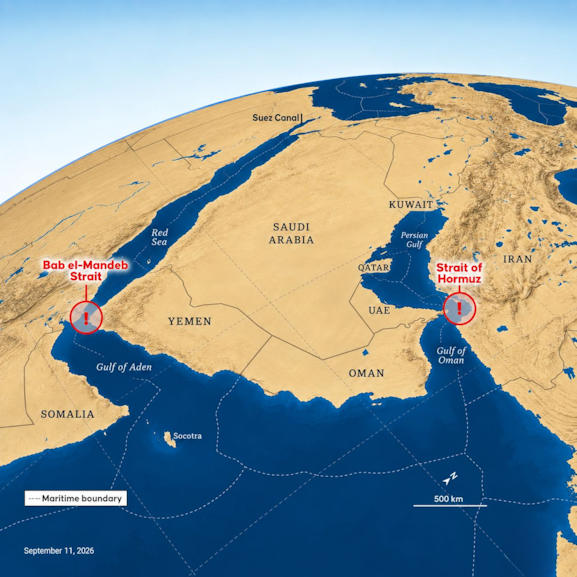
The risk, then, is not of the same nature: at Hormuz, it is a risk of price and availability that directly hits the barrel and, in turn, European companies’ 2027 budgets; at Bab-el-Mandeb, it is above all a risk of delay and logistical surcharge — more absorbable, but one that adds to the first rather than replacing it.
It is precisely this addition that sets the European position apart from the American position described by Jérôme Denariez. Washington is managing a domestic political dilemma — inflation, rates, the electoral calendar. Europe, “for its part,” has no lever over the military conduct of the conflict, but it already has, contrary to what one might assume, assets on the ground: Operation ASPIDES [14] since February 2024, backed by ATALANTE [15] and by the bases in Djibouti.[16] This paradox — militarily present at Bab-el-Mandeb, diplomatically absent, and absorbing without any say the budgetary shock coming from Hormuz — is perhaps the real question raised by the two texts together: how long can a Europe that has the means but not the political will content itself with doing its cash-flow math while others, in Washington as in Beijing, redraw the balance of the Gulf?