Why does Putin persist so relentlessly in trying to destroy Ukraine, at a cost in blood and treasure that even his own services must surely judge unsustainable? In this piece, historian Françoise Thom sets aside the usual explanations — revenge for the 2004 Orange Revolution, a desire to humiliate the West, fear of a democratic beacon on Russia’s doorstep — as insufficient on their own. Instead, she starts from the Russian president’s own words, increasingly unguarded with age and the habit of absolute power: in 2024, he admits that peace bores him and that action, even in the form of whistling bullets, reassures him; in 2026, he worries about what Russians will do once the war ends; and, speaking to teachers, he bluntly compares the world to a food chain in which orcas tear apart polar bears — a lesson, he says, that should be taught to children to justify the war.
From these admissions, Françoise Thom draws a chilling conclusion: it is the state of war itself, more than the prospect of victory, that fascinates Putin. To understand why, she reaches back to the fifteenth century and the fall of Constantinople: Byzantine chroniclers already explained the Ottoman Empire’s meteoric expansion through the janissary system — young Christian captives converted and trained into fanatical loyalty to the sultan, who ended up hating their own former countrymen more than anyone else. Thom traces this same cascading mechanism of enslavement through Catherine the Great, through Stalin’s Comintern schools, and now through Putin himself: the Chechen Kadyrovs, the occupied Ukrainian populations thrown into “meat-grinder assaults,” the imported North Korean soldiers. The ultimate project, she argues, does not stop at Ukraine: it aims to turn the defeated against Europe itself, through pro-Russian parties cultivated in every country — a process that, in her view, has only just begun.(Ed. note)

by Françoise Thom — Paris, 10 September 2026 — Source Desk Russia [01]
“My homicidal maniac is of a peculiar kind. I shall have to invent a new classification for him, and call him a zoophagous (life-eating) maniac. What he desires is to absorb as many lives as he can, and he has laid himself out to achieve it in a cumulative way.”
“For all that die from the preying of the Undead become themselves Undead, and prey on their kind. And so the circle goes on ever widening, like as the ripples from a stone thrown in the water.. ”Bram Stoker, Dracula
There is something mysterious about the relentlessness with which Putin is bent on destroying Ukraine. None of the hypotheses that can be put forward to explain his behavior seems truly satisfactory. Certainly, Putin resents Ukraine for the victory of the Orange Revolution in 2004. It is also clear that he aims to accelerate the breakdown of the international order by dealing it devastating blows. Undeniably, he wishes to humiliate the West by inflicting defeat on a state that has become its ally. Without a doubt, he has not forgiven Ukraine for seeking to defect and join Europe. Indeed he fears the existence of a bastion of freedom and prosperity on Russia’s doorstep. All these factors have played a role, but when one considers the extent of destruction Putin is willing to accept for Russia in order to prevent Ukraine from existing, one cannot help but conclude that there must be other causes.
In recent months, the Russian president himself has given us a clue. Age and a lifetime of tyranny have led to a loss of inhibition in him, offering a glimpse into his own terrifying mental world. In December 2024, he explained why war is a good thing: “When everything is calm, measured, stable, we are bored. This is when everyone wants action. As soon as action starts, everything whistles at our temples, and seconds, and bullets, unfortunately. .. we are scared.” All of this spouted with a gleeful expression. In July 2026, he argued for prolonging the war: “After the special military operation, what will we do? We can see that people are passionate about it; they’re fully invested in it, and they feel they’re participating in something great, something vital for Russia.” And on December 26, 2026, speaking to a group of teachers, Putin revealed his deeper philosophy and the ultimate cause of the war against Ukraine.
When a teacher mentioned that he had spent time in the far north, Putin asked him if he had seen any polar bears. When the teacher replied in the affirmative, the president launched into this tirade: “Right nearby, orcas hunt these bears, devouring them as if they were nothing. They descend in packs — and then, boom, tear them (bears) apart, That’s the food chain. Children should be taught about this, so that they understand what kind of world we live in and why we are conducting the special military operation,” As he spoke these words, the Russian president wore his customary sneer—the one he displays when he lets himself be carried away by sadistic joy. All these remarks leave no doubt: it is the state of war itself that delights Putin, even more than the prospect of victory. We must now understand why.
In the wake of communism, a joke was circulating in Poland: it’s possible to turn an aquarium into fish soup, but it’s hard to make an aquarium out of fish soup. Yet this difficult transition took place in Central Europe and Russia beginning with Gorbachev’s reforms. There was a time when Russians felt that politics depended on them, that real issues were decided at the polls. Imperceptibly, they were transforming from subjects into citizens. It was this Russia that Putin inherited. As soon as he came to power, he set out to turn the aquarium back into fish soup, to return Russians to servitude. The first method he used was money. He invited Russians to sell themselves out. He persuaded them that they would grow rich if they abandoned any desire to get involved in politics. At that time, he himself—dazzled by his own success—thought only of increasing his fortune; he imagined that money would bring him omnipotence. He set out to buy off foreign leaders, adopting a classic imperial policy of corrupting and co-opting the elites of neighboring countries. This policy was a resounding success: as Montesquieu had already observed, in any despotic government, it is all too easy for people to sell themselves out. This was true of both Russians and foreigners. During these early years of Putin’s reign, the co-opted foreigners contributed significantly to Russia’s development, just as they had in the days of the tsars.
But Putin came gradually to doubt the omnipotence of money. In 2004, he spent colossal sums in Ukraine yet was unable to get his candidate, Viktor Yanukovych, elected or to prevent the Orange Revolution. By the spring of 2008, it was clear that the economic blockade of Georgia had failed. Worse still, in the winter of 2011–2012, the protests in Moscow made him realize that a prosperous Russian middle class was not willing to give up its political rights. And most alarmingly, Russians who were investing their assets abroad were on the verge of gaining a degree of independence from the government that Putin viewed as dangerous.
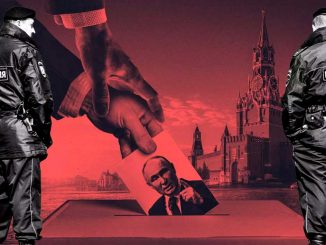
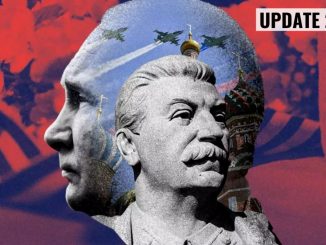
Starting in 2012, Putin set out to turn Russians into real slaves. He chose war. Initially, he succeeded in reviving the image of the besieged Russian state that had characterized Stalin’s era: a fortress surrounded by enemies that can only be kept together by the iron fist of a despot. Thus, the Russians find themselves in a closed-off world surrounded by barbed wire and run by prison guards over which they have no influence. They are no more citizens in this confined universe than the zeks were in the Gulag. The return of scarcity and rationing contributes to eradicate even the memory of freedom. Now, Russian men are selling their lives—for a fortune, to be sure—but Putin could not care less: the army is a machine for producing corpses and slaves. Feeling their sphere of autonomy shrink, seeing the world closing in on them, Russians are taking refuge in passivity and indifference. The accounts reaching us from Crimea are telling: under a hail of drones, surrounded by fires, Russians stand still, glued to their smartphones. The countless videos they record of Ukrainian drone attacks reveal the same detachment: they do not feel concerned and watch the blaze as if it were a more or less successful fireworks display. This does not prevent them from inwardly acquiescing to the regime’s expansionist goals. Every prisoner dreams of enlarging his cage.
The noose is also tightening around the “elites,” as they are commonly called: the war economy justifies plunder and confiscation at any moment; wealth is no longer a source of security but a risk factor. Putin, for his part, realizes that war engenders a sense of omnipotence far more intoxicating than the possession of billions. This ecstasy is laid bare in the remarks we cited above. Westerners imagine that the prospect of economic decline must lead him to end the war and reach a compromise peace with Ukraine. This is the rationale behind CIA Director John Ratcliffe’s visit to Moscow to explain to Putin just how badly things are going for him. But Putin is impervious to 21st Century rationality. His worldview belongs to the 14th and 15th centuries. We have seen him leaning over Prince Dmitry Donskoy’s coffin like Count Dracula in old vampire movies.
Following Putin’s lead, we must immerse ourselves in those distant centuries to try to understand what gives the Russian president the confidence that he can achieve his goals of power even with a moribund economy. Byzantine historians, reeling from the Turkish conquest of Constantinople (May 29, 1453), pondered the causes of the Ottoman Empire’s irresistible advance into Christian lands and arrived at an interesting conclusion that gives us food for thought today. According to the chronicler Doukas, the source of the Ottoman Empire’s dynamic expansion was slavery. The Turks selected from among their Christian captives young men of humble origins who were robust and in good health; the sultans turned them into Janissaries. This extraordinary social rise from “shepherds and peasants” made them fanatically devoted to the sultan: “they are capable of enduring inhuman suffering during battle” and thus secure victory. This is how Turkish power grew: “Slaves acquire other slaves, the slaves of slaves acquire new ones, and all are called slaves of the sovereign.” All are Christians who have renounced their faith: “And now that they have abjured their faith and wallow in wordly pleasures like pigs in their pasture, they harbor a deadly and implacable hatred, like that of rabid dogs, toward their compatriots,” observes Doukas1. Another Byzantine historian, Chalcondyle, who wrote a meticulous chronicle of the rise of the Ottoman Empire, sees slavery—like Doukas—as a competitive advantage that explains the Turks’ success, whereas “the majority of Christians, at least those who fear God and show mercy and compassion toward their neighbors […] abhor such ways of acting2… ” These historians were primarily interested in the phenomenon of the Janissaries, which they saw as the key to Turkish victories over the Christians, and had not fully grasped the extent of the system whose military aspect they had described. In fact, the Turkish Empire also recruited young Christian slaves who had been converted to Islam to serve as the highest-ranking state officials. They were trained at the Palace School founded by Sultan Mehmed II, the conqueror of Constantinople. This institution instilled in them a sense of camaraderie and fanatical devotion to the sovereign. “Native” Ottomans were excluded from their own government3.
This mechanism of enslavement through successive waves, described by Byzantine historians, can be observed in Tsarist Russia. After sending the Serbian general Tekeli to dismantle the autonomy of the Zaporozhian Cossacks in 1775, Catherine II relocated the Cossacks to the Kuban, where they were used to subdue the Circassians, a Caucasian people inhabiting the northwestern coast of the Black Sea. This mechanism was even more evident during the Soviet period. In the midst of the Great Terror, facing the executioner’s axe, Soviet agents scattered throughout the world displayed unparalleled zeal in subverting free nations. During World War II, the Comintern schools organized by Stalin indoctrinated prisoners of war from European countries, then selected the converts to become the future leaders of “liberated” Europe.
Putin put this method to the test from the very beginning of his reign. After crushing the Chechen rebellion, he turned to two Chechen renegades—Kadyrov father and son—and converted the Chechens into Janissaries personally devoted to him. These Chechens were deployed to the occupied territories in Ukraine to spread terror there. The same approach led Putin to decimate the male population of the occupied territories in Ukraine by sending them to fight in “bloodbath assaults” against their former compatriots, with the relentless determination of traitors who had defected to the enemy camp. Let us not forget, either, the North Koreans, who were enslaved during Stalin’s time and are now being brought into Russia to crush Ukraine. Likewise, enslavement of the GDR citizens under Stalin was so deep that the descendants of those Sovietized Germans are today one of Russia’s vectors of influence in Europe. Putin’s plan is to install a puppet ruler in Kyiv and to enlist the surviving, re-educated Ukrainians in future wars against Europe. Ukrainian prisoners of war report that the Russians are offering them the chance to switch sides and join Russian forces so they can then “occupy Europe together”.
The same strategy—relying on traitors following displays of military might or terror-inducing sabotage operations, and creating in every European country pro-Russian parties that are fanatically devoted to Moscow—is now the main pillar of Putin’s policy and what allows him to hope for a swift revival of Russian power following his presumed victory in Ukraine. European defectors, converted to the cult of the “Russian world,” will be co-opted both to restore the Russian economy and modernize the military-industrial complex, and to install regimes in Europe that are subservient to the Kremlin. In the Russian president’s view, the process of gradually subjugating Europe—at which he has been patiently working for years—is still in its early stages. He may have his reasons to be brimming with optimism. Who knows if wishful thinking isn’t actually on the Western side.
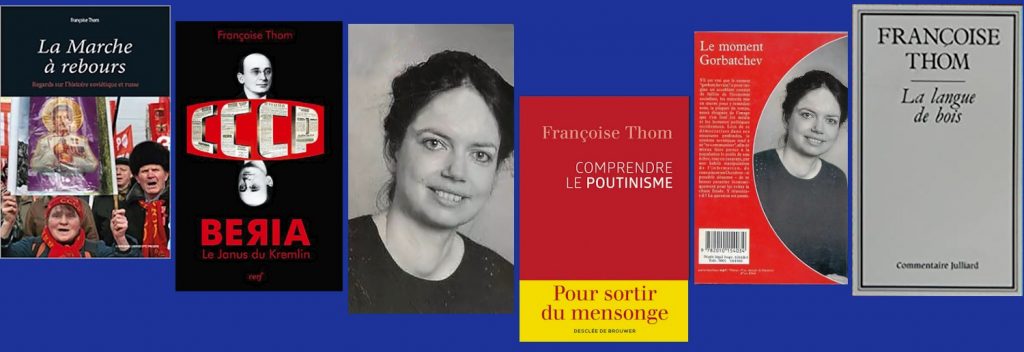
Françoise Thom
[01] This paper was originally published on Desk Russia, and is reproduced here with the permission of the author and Desk Russia.
[02] Doukas, Turco-Byzantine History, XXIII, 9.
[03] The History of the Decline of the Greek Empire, by Chalkondyle, Paris 1577, p. 40.
[04] Chalkondyle, Paris 1577, p. 40. Myron P. Gilmore, The World of Humanism, Payot 1955, pp. 25–26.
- « Count Dracula’s Food Chain » in Desk Russia — (2026-0910)
- « La chaîne alimentaire du comte Dracula » in Desk Russie — (2026-0906)
- « Andreï Melnitchenko, un « Discours de la servitude volontaire » contemporain » in Desk Russie — (2026-0726)
- « How Eschatology Wreaks Havoc in the United States and Russia » in Desk Russia — (2026-0324)
- « США и Россия: разрушительная сила эсхатологии » — (2026-0322)
- « USA und Russland: Die verheerenden Auswirkungen der Eschatologie » — (2026-0322)
- « États-Unis et Russie : les ravages de l’eschatologie » in Desk Russie — (2026-0322)
- « The Epstein Case, a Godsend for Russian Propaganda » in Desk Russia — (2026-0303)
- « Der Fall Epstein: Ein Glücksfall für die russische Propaganda » — (2026-0301)
- « Дело Эпштейна: находка для российской пропаганды » — (2026-0301)
- « L’affaire Epstein, une aubaine pour la propagande russe » in Desk Russie — (2026-0301)
- « La lutte finale du président Poutine » in Desk Russie — (2026-0131)
- « President Putin’s Final Battle » in Desk Russia — (2026-0202)
- « Der letzte Kampf von Präsident Putin » — (2026-0131)
- « Последняя битва президента Путина » — (2026-0131)