Admiral Christian Girard offers here a technical and historical corrective that stands in sharp contrast to the media excitement of the moment. While television panels sound the alarm over the simultaneous closure of the Arabian Peninsula’s two great maritime chokepoints, he recalls a structural difference too often overlooked: Hormuz has no maritime alternative whatsoever, whereas Bab-el-Mandeb can always be bypassed via the Cape of Good Hope — a route already carrying a large share of traffic since 2024.
One detail worth noting: the island of Perim, where a French destroyer was struck by Yemeni tank fire in the 1970s, is precisely the same island the Houthis have just seized — under its current Arabic name, Mayyun. Fifty years therefore separate the two episodes, at the very same spot.
The Essentials
- Unlike Hormuz, which has no maritime alternative, Bab-el-Mandeb can always be bypassed via the Cape of Good Hope — a route already carrying a large share of traffic since 2024, with Red Sea containerized traffic already down 60% according to the IMF.
- The Houthis, presented as Iran’s proxy, are also pursuing their own regional agenda — tribal irredentism against southern Yemen and against Saudi influence to the north.
- The island of Perim, where a French destroyer was struck by Yemeni tank fire in the 1970s, is precisely the island the Houthis have just seized, under its current Arabic name, Mayyun.
- The already-effective Western military presence on site (Prosperity Guardian, ASPIDES, ATALANTA, the Djibouti bases) explains the absence of any European diplomatic reaction, unlike at Hormuz.
- A Conflict Armament Research Center investigation documents a Houthi arsenal quietly rebuilt over the past eighteen months — more than 800 components seized, at least ten missile types.
- American Patriot PAC-3 interceptor stockpiles reportedly fell by two-thirds in six months according to CSIS, with France itself named by Axios among the countries drawing on this same supply.
- According to the Times of Israel, Trump reportedly refused a Saudi request for strikes against the Houthis, preferring to stay focused on Iran and Hormuz.
by Vice-Admiral (Ret.) Christian Girard — Toulon, September 13, 2026
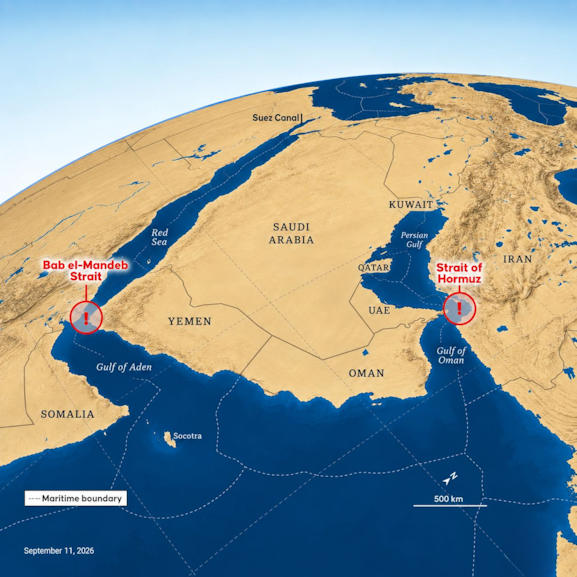
It is natural, when discussing recent developments in the Bab-el-Mandeb Strait, to link them to the situation prevailing in the Strait of Hormuz. Both flank the Arabian Peninsula and control a significant share of the region’s maritime exports of fossil fuels, essential to the global economy. Bab-el-Mandeb is, moreover, the normal shipping route between Asia and Europe. It is therefore entirely legitimate to be concerned by the fresh deterioration of the international situation caused by the announcement that the Houthis have taken control of the Red Sea coastline, including the town of Mocha — chiefly with regard to its potential economic consequences. While there is a certain symmetry between the situation in the two straits in the context of the Iran war, the case of “the Gate of Grief” deserves closer examination.
Zoom in, pan, or switch to satellite view to explore the area — Interactive map © Google Maps »
Both straits are today, in effect, under Iranian threat: directly at Hormuz, or through the proxy of the military force known as the Houthi militia. The latter is the armed wing of the traditional irredentism of North Yemen’s tribes — directed, on one hand, against any authority not emanating from their own ranks, in particular that of the country’s southern coastal strip, opening onto the sea via the port of Aden, once a British colony and long considered progressive, but also, on the other hand, against the influence and pressure of the powerful Saudi Kingdom to the north.[01] Presented as Iran’s proxy, this force — certainly supported and armed by Tehran — is undoubtedly also playing its own game amid the current international context.[02]
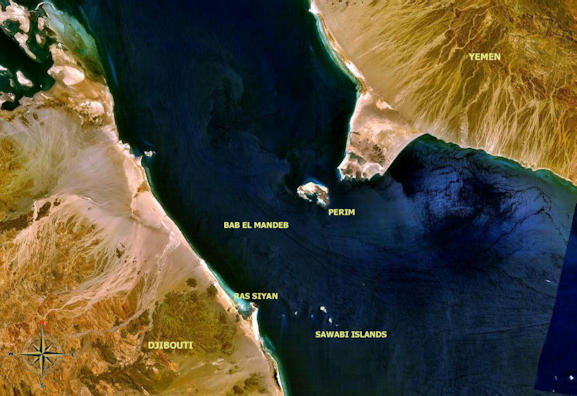
The threats it directs against maritime traffic have, to date, targeted only Saudi shipping. The Anglo-American land-strike operations conducted under “Operation Prosperity Guardian” (still active) are certainly not unrelated to this relative restraint. That operation was launched in 2023 following Houthi attacks on maritime traffic in response to the situation created in Palestine by Israel, and led to vigorous American strikes against land targets, notably in the capital, Sanaa.
Despite the complete loss of credibility of his statements, Donald Trump is probably not lying when he says he has spoken with the Houthis and reached an agreement with them. That said, he has not supported the Saudi Kingdom — which is genuinely under threat — despite Riyadh’s insistent requests, a fact that will surely deepen the Kingdom’s resentment toward him, resentment already fueled by the conduct of the American war in the Persian Gulf.

As has been observed regarding Hormuz, the consequences for maritime transport manifest themselves as soon as the threat is uttered: rising insurance costs, rerouting or suspension of traffic, all before any military action. A notable strategic effect is thereby achieved. But it must also be noted that maritime traffic had already suffered a sharp reduction through rerouting around the Cape of Good Hope, owing to risks in Red Sea navigation that predated the current crisis. Containerized traffic in the Red Sea had already fallen by 60% in 2024, according to the IMF.
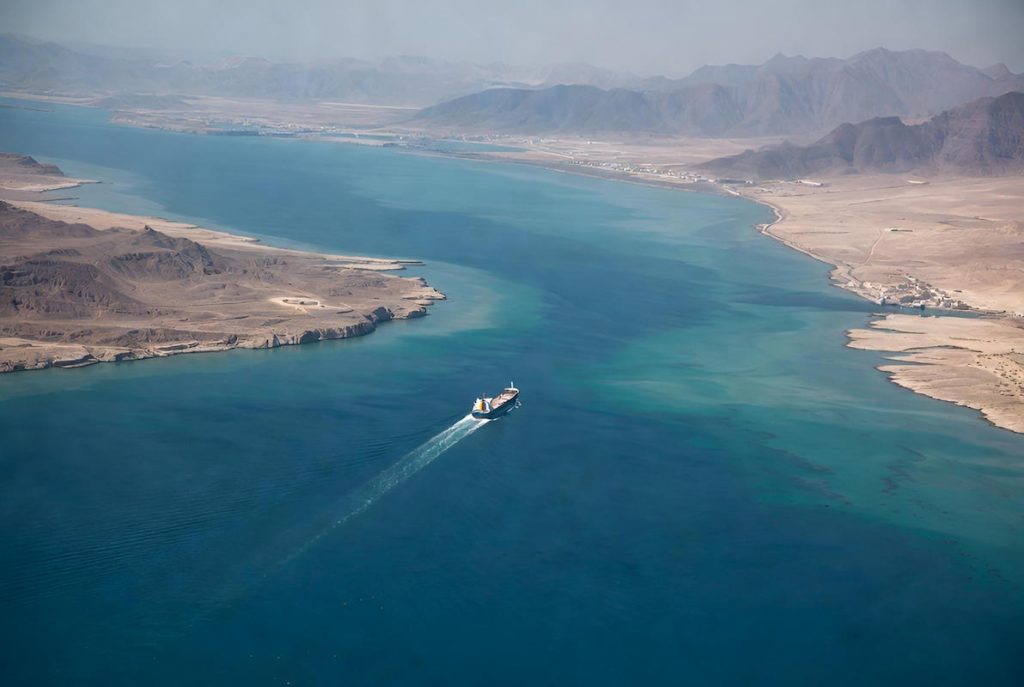
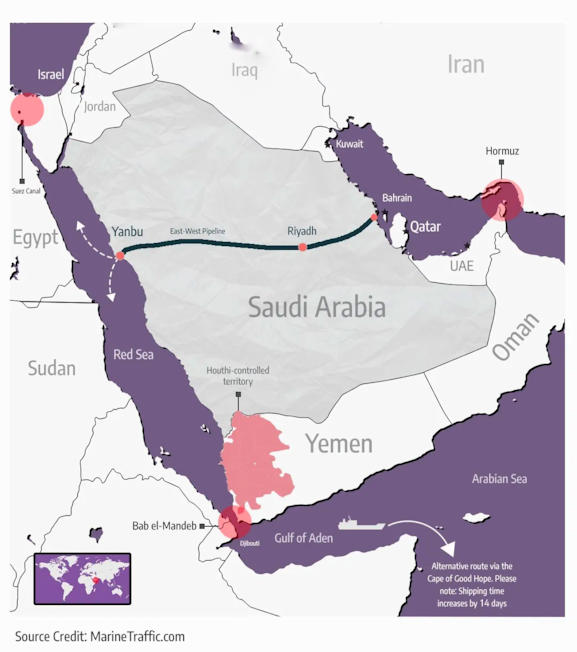
It should also be noted that the Strait of Hormuz has no maritime alternative, whereas it remains possible to bypass Africa via the south, avoiding Bab-el-Mandeb entirely — as was the case until the reopening of the Suez Canal in 1975 following the Six-Day War. An actual closure of Bab-el-Mandeb would directly and severely affect only Egypt, which has surely already seen its Suez Canal revenues decline, and Saudi Arabia, which would no longer be able to export its oil via Yanbu, the outlet of the east-west pipeline that bypasses the Strait of Hormuz. This would certainly have significant economic consequences for the international oil market.
A second factor deserves emphasis: the political instability that has always prevailed in the region. Navigation in the area has always been potentially dangerous, exposed to fire from land-based weapons, a danger heightened by the narrowness of the passage. A French T47-class escort destroyer was struck by Yemeni tank fire in the 1970s for having approached too close to the island of Perim. The seizure of the Yemeni Red Sea coastline — and even of the Hanish Islands, of Perim, or of Zuqar — hardly changes the nature or reality of the threat posed by land against sea compared to what already existed: its worsening is determined far more by political considerations than by geography or by the Houthis’ offensive military potential.[03] This threat has been the subject of Western naval missions for several years, supported by the various military bases established in Djibouti, including France’s. Independent of the already-mentioned “Prosperity Guardian” mission, the European Union has conducted a maritime operation to protect commercial shipping in the area since February 2024 — Operation ASPIDES — in addition to the even older Operation ATALANTA against insecurity and piracy.


The military situation in the Bab-el-Mandeb Strait is thus nothing like that prevailing at Hormuz, particularly because Europeans are present here with assets whose effectiveness has been acknowledged by the Houthis themselves, as has that of the Americans. This no doubt explains the absence of any diplomatic reaction from European countries to a situation that nonetheless stirs television panels.
It remains necessary, nonetheless, to stay extremely vigilant regarding any hardening of Houthi statements and actions. The most likely military responses could come from Saudi Arabia and Egypt. The approach of the American midterm elections, together with the strain on American resources, make any reinforcement of American action unlikely, except perhaps on a punctual basis. Europeans may yet have to act more assertively, despite their habitual timidity, should the situation deteriorate further. For now, this is not necessary. Are the economic consequences already perceptible?
Christian Girard
[01] The old partition between North and South Yemen appears to have faded from memory, even though it was only formally abolished in 1990.
[02] See “The Houthis seize Bab el-Mandeb, Saudi Arabia caught in a pincer” — by Roger Barake — Source: Levant Time (2026-09-11).
[03] See « Houthi Advance and the Capture of Ali al-Taher: A Major Regional Impact » by Tabine Bacharraoui in Levant Time — (2026-0914).
See also:
- « The Bab-el-Mandeb Strait — Toward European Action? » — (2024-0913)
- « Le détroit de Bab-el-Mandeb — Vers une action européenne ? — (2024-0913)
Decryption: What the Numbers Say, Behind “the Gate of Grief” (Bab-el-Mandeb)
Three recent developments lend further, quantified, support to Admiral Girard’s analysis.
On the Houthis’ “offensive military potential”: Admiral Girard does not judge it negligible — he himself notes that it has been notably strengthened — but considers that it does not, as things stand, constitute the decisive strategic factor in the current situation, which remains dictated above all by political considerations. An investigation by the Conflict Armament Research Center documents precisely this build-up: the movement has quietly refined its arsenal over the past eighteen months, even as Iran and Saudi Arabia exhausted themselves in open warfare — more than 800 missile components seized, at least ten different types identified, with Iranian engineers sent to teach Houthi technicians to assemble the systems themselves rather than import complete missiles. Only 5% of these components came directly from Iran; the rest transited through sixteen other countries.
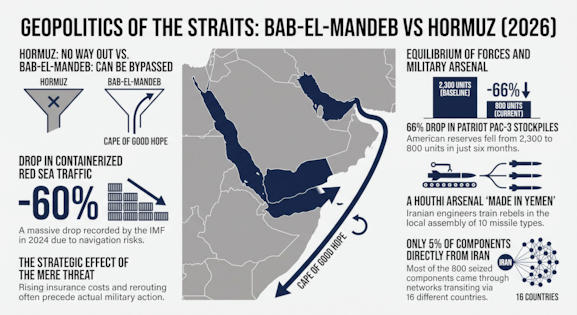
On the “strain on American resources” raised in connection with the midterm elections: American stockpiles of Patriot PAC-3 interceptor missiles are reported to have fallen from more than 2,300 units before the Iran war to roughly 800 today, according to CSIS — a drop of nearly two-thirds in six months. Axios notably names France among the countries drawing, alongside Israel and Ukraine, on this same already-strained American supply — which sheds a more concrete light on Europeans’ quiet reluctance to commit further.
Finally, on the Saudi resentment the admiral anticipates: the Times of Israel reported in recent days that Donald Trump explicitly refused a Saudi request for strikes against the Houthis, with American officials indicating a wish to “stay focused on Iran and Hormuz rather than open a new front” — despite two personal calls from Mohammed bin Salman. Riyadh thus finds itself, once again, having to rely on its own resources alone.