
At sea, war no longer needs warships. It borrows cargo ships and tankers, and slips through the gaps in the law: a flag of convenience, a shell company, a switched-off transponder. Jérôme Denariez and Vice-Admiral Christian Girard explore this ground in three texts that we are publishing one after the other.
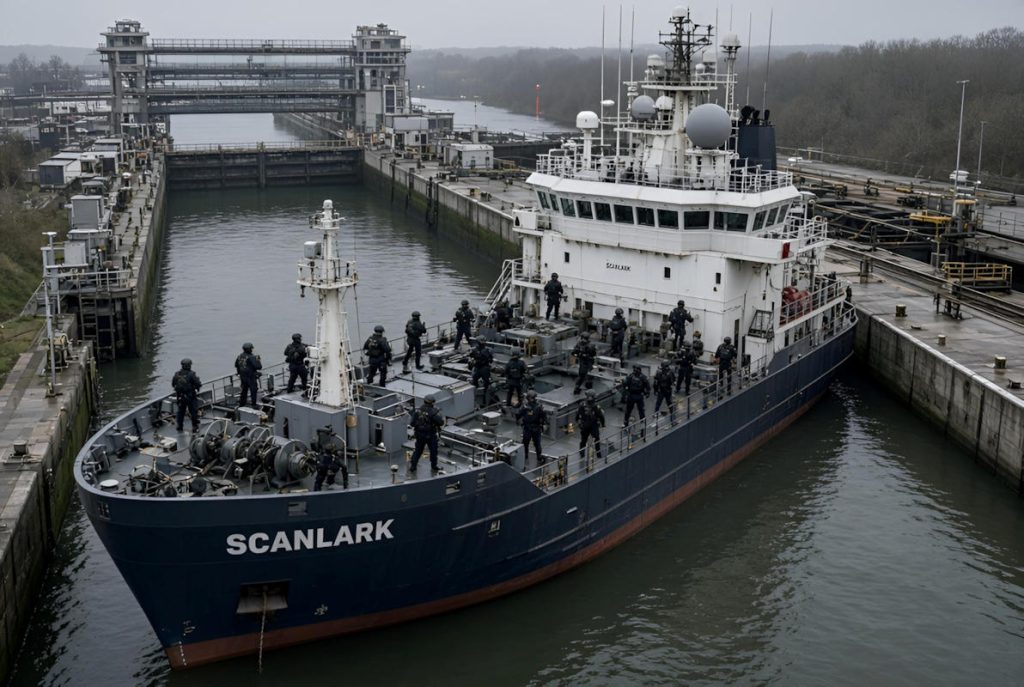
The first, “The Cargo as a Weapon”, starts from an affair that remains unresolved: in September 2025, German police boarded the Scanlark in the Kiel Canal because a drone had reportedly taken off from its deck. What becomes of a merchant ship when a military function can land on it for a few hours, then leave? From China to Western navies, everyone is working on it, and counting naval power in warships is no longer enough.
The second, “The Flag as Camouflage”, shifts the gaze from the hull to the contract. What is now being concealed is no longer the ship, but the person who owns it, insures it and finances it. From the Iranian fleet to the Russian shadow fleet, opacity has become an infrastructure of maritime trade.
The third, signed by Admiral Christian Girard, deals with the law of the sea: “to endure or to prevent?” How can it be made effective when an architecture patiently built over decades is cracking within a few years? Are Europeans giving themselves the means to defend it? Here is the first of these three papers.
The Essentials
- The suspicion. On 7 September 2025, German police boarded the Scanlark in the Kiel Canal: a drone had reportedly taken off from its deck on 26 August. Five Russian crew members are targeted by the investigation, but the launch has still not been established.[01]
- The shift. From simple transport, like that of the five Russian cargo ships sanctioned by London in 2024 for delivering Iranian military equipment,[02] to a drone platform: out of 144 incidents recorded in thirteen European countries, the IISS considers it probable that Russia-linked ships were used to launch or recover aircraft.[03]
- The weapon migrates to the hull. An SM-6 missile fired from a former oil-industry supply vessel (the Ranger, in 2021),[04] Dutch support ships built on a commercial design,[05] an Iranian drone carrier made from a merchant ship, with a 180-metre deck.[08]
- China, but not only China. Reuters tracked more than a hundred civilian ships associated with Chinese exercises; in mid-August 2025, twelve of them, six Ro-Ro ferries and six deck-cargo ships, converged on a beach in Guangdong.[10] The United States classifies 168 of its 190 large merchant ships as “militarily useful”.[15]
- The law, overtaken. For the San Remo Manual, what counts is function, not silhouette. But a ship can change its employment twice within a few hours, faster than an investigation.[17]
- The question. No longer how many warships a state owns, but how many ships it would be able to bring into the war.
Contents
by Jérôme Denariez — Paris, 18 October 2026.
On 7 September 2025, German police special units boarded the Scanlark as the cargo ship passed through the locks of the Kiel Canal. The vessel had attracted attention a few days earlier: on 26 August, a drone had reportedly taken off from its position before flying over a German Navy ship, apparently to photograph it. The search uncovered equipment and antennas considered unusual on a cargo ship. Five Russian nationals in the crew have since been under investigation on suspicion of acting as agents for sabotage and of taking images liable to compromise security. The publicly available findings still do not allow us to say that the drone was actually launched from the Scanlark.[01]
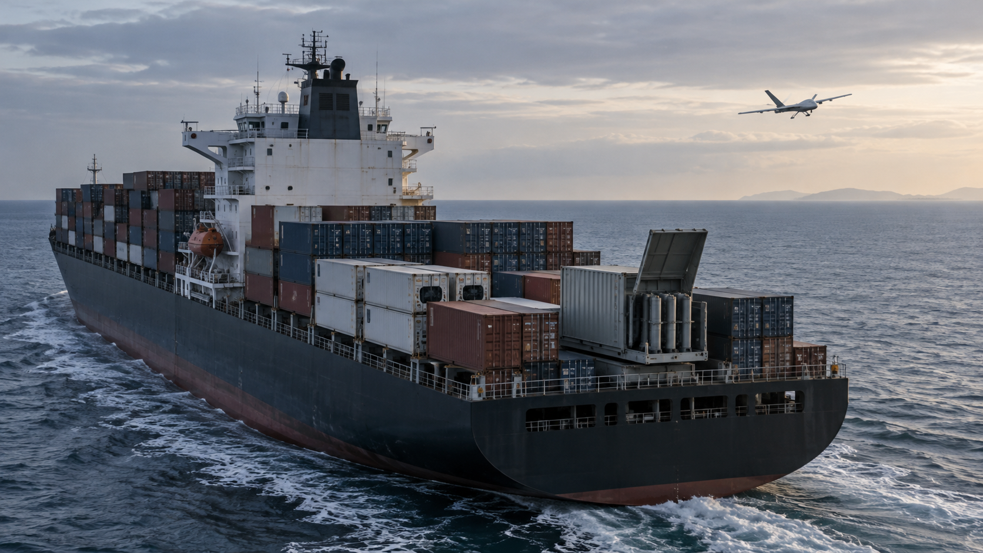
It is precisely this uncertainty that makes the case interesting. Merchant ships have carried war ever since wars have been fought beyond the coasts: men, weapons, fuel, vehicles or ammunition. All the great powers have used civilian tonnage to support their operations, and some still maintain arrangements for mobilising it in a crisis. The question changes when the vessel no longer simply carries the means needed for military action, but begins itself to observe, gather intelligence, relay, launch or recover. Part of the military function then migrates to the commercial platform.
From transport to action
The first degree remains classic. In September 2024, the United Kingdom sanctioned five Russian cargo ships — Skif-V, Omskiy, Musa Jalil, Begey and Baltiyskiy — for their role in transporting Iranian military supplies to Russia. The same announcement targeted Russian entities involved in operating the drones and missiles supplied by Tehran. The cargo ships are here the maritime link in a military chain; they are not themselves the weapon system.[02]
The boundary becomes less clear when the ship provides something other than transport. The suspicion surrounding the Scanlark bears precisely on this change of function: a commercial hull could have served temporarily as a support point for an aerial intelligence capability, without requiring the far more identifiable presence of a military vessel. The operational gain does not necessarily depend on the sophistication of the method.
A drone spotted above a military installation can be detected in seconds; determining where it took off from, identifying the vessel that supposedly operated it, reconstructing its navigation and then tying the operation to a sponsor can take weeks. The commercial hull then brings less power than banality.
The phenomenon is taken seriously enough that the International Institute for Strategic Studies devoted a study to it in July 2026, covering 144 drone-related incidents observed between August 2024 and February 2026 in thirteen European states. The IISS considers the existence of a coordinated Russian campaign highly likely and the use of Russia-linked vessels, notably some belonging to the parallel fleet, as launch or recovery platforms probable. This assessment does not mean that each incident can be attributed to a specific ship: individual attribution remains precisely one of the main difficulties.[03]
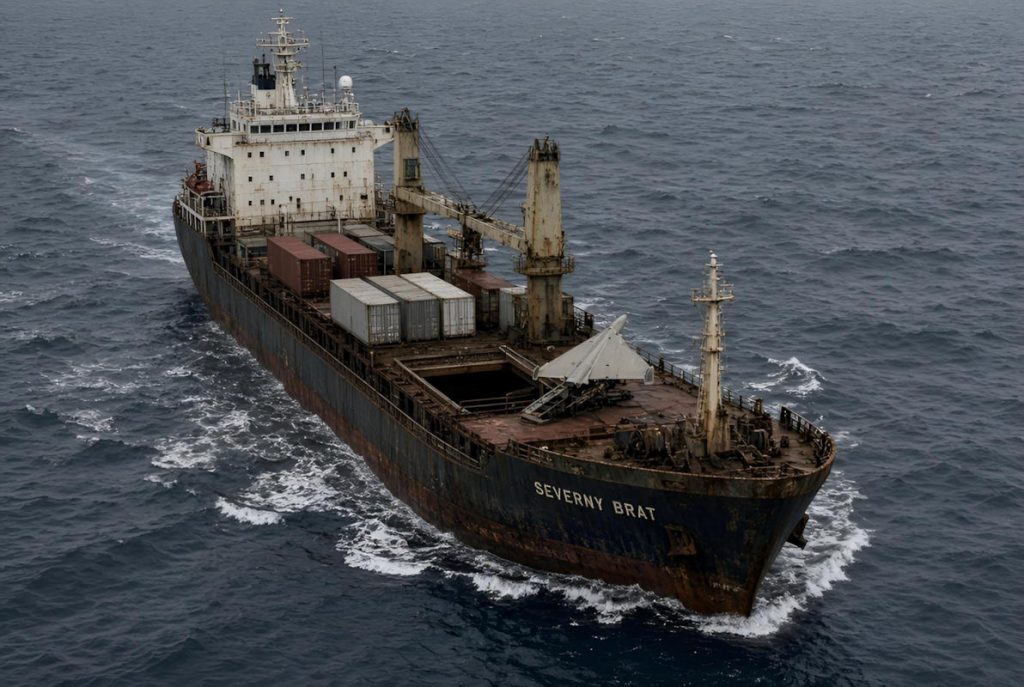
Russian forces have carried out drone launches in the Baltic, but not only there: in the North Atlantic, the Channel, the Mediterranean and the Black Sea. These launches are the work of commandos attached to unit 29155 of Russian military intelligence (GRU),[22] known to be associated with sabotage and hybrid attacks in Europe — including attempted drone attacks and parcel bombs. Many other operations have also been launched on land (the Leipzig attack, notably).[21] French intelligence services also believe that the Russian secret services could use barges on the Rhine to camouflage hybrid-warfare operations, as the Soviet GRU did in the early 1980s, when the situation in Poland was explosive and a “special operation” was taking shape. It did take place, but not as expected.
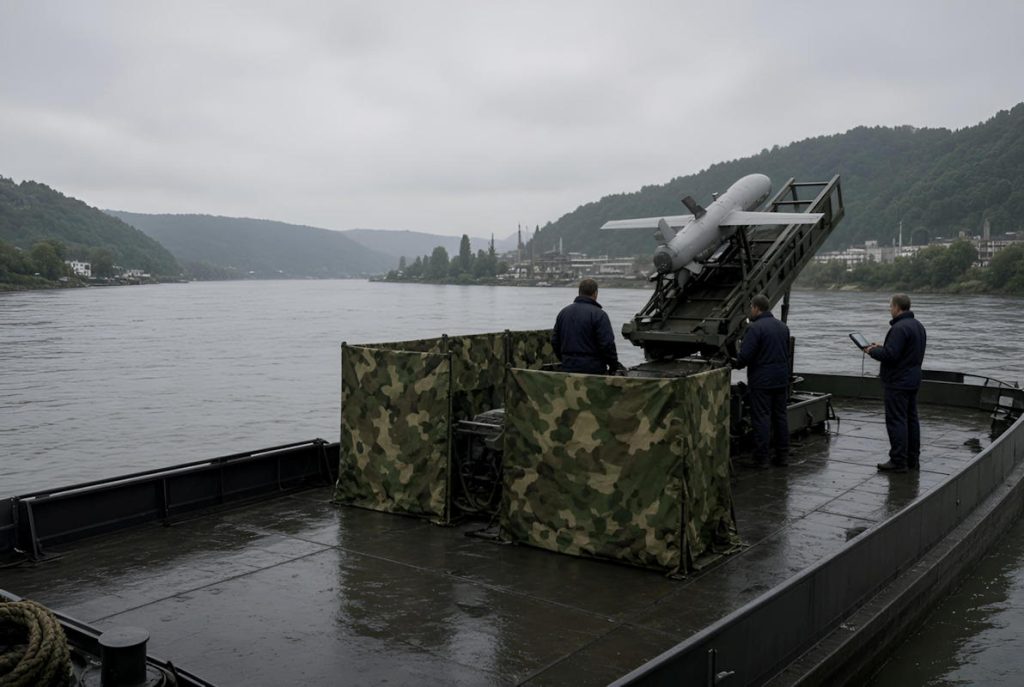
We thus move gradually from transport to support, then from support to intelligence and eventually to action. This evolution would have remained relatively limited had military systems continued to impose heavy transformations on the ships that carry them. Yet it is precisely this relationship that is beginning to change.
When the weapon adapts to the hull
For a long time, seriously militarising a merchant ship meant adapting the ship. Weapons had to be installed, magazines fitted out, superstructures modified, fire-control systems created and personnel capable of operating them embarked. The hull had to be transformed to receive the weapon. Part of today’s developments consists in reversing this movement.
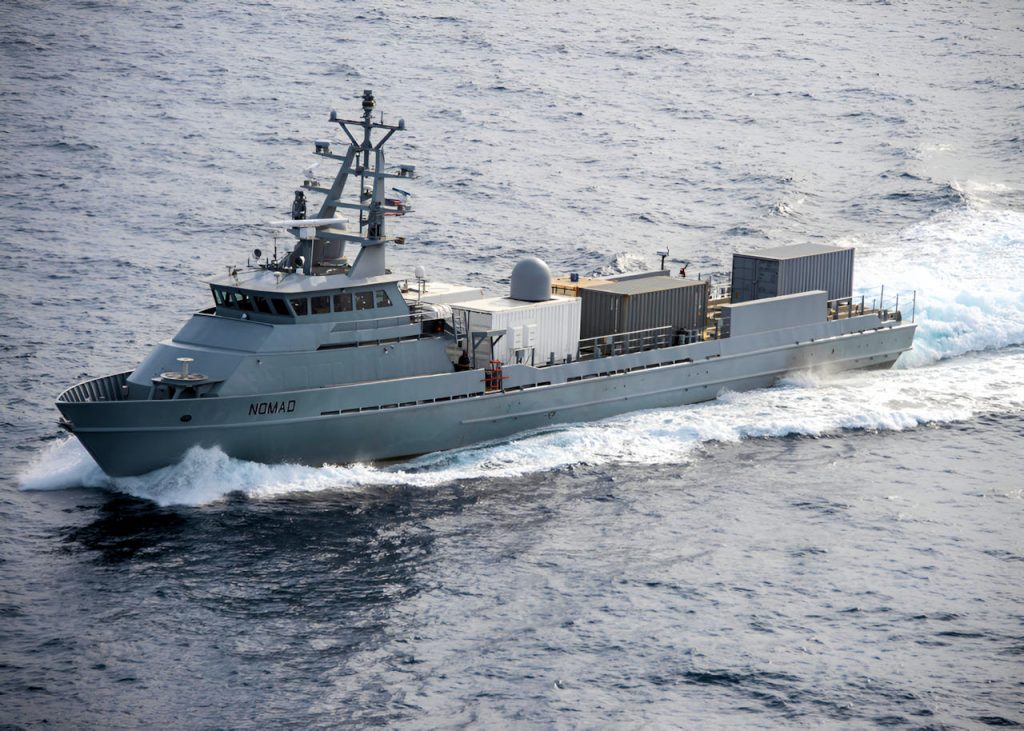
In 2021, the American Ghost Fleet Overlord programme reached a milestone with the firing of an SM-6 missile from the Ranger, a former fast supply vessel of a type used in the offshore oil and gas industry, converted into an experimental autonomous or optionally manned vessel.
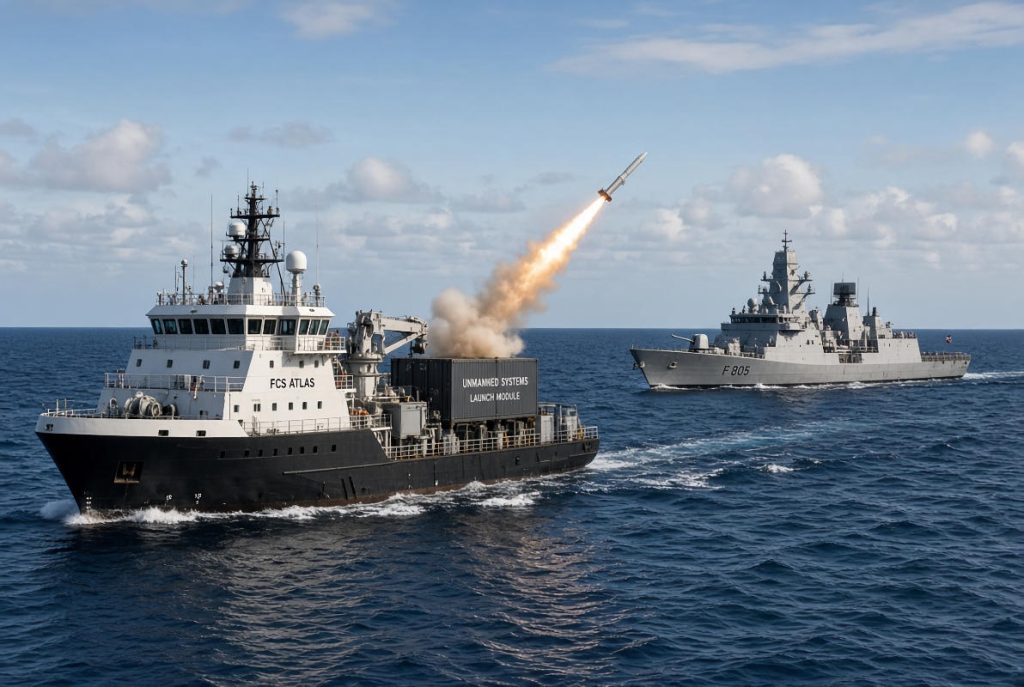
The missile is launched from a modular launcher whose footprint is close to that of a shipping container. The experiment obviously does not turn a support ship into a destroyer; it shows that a sophisticated effector can be dissociated, to a certain extent, from the platform around which this type of weapon would traditionally have been integrated.[04]
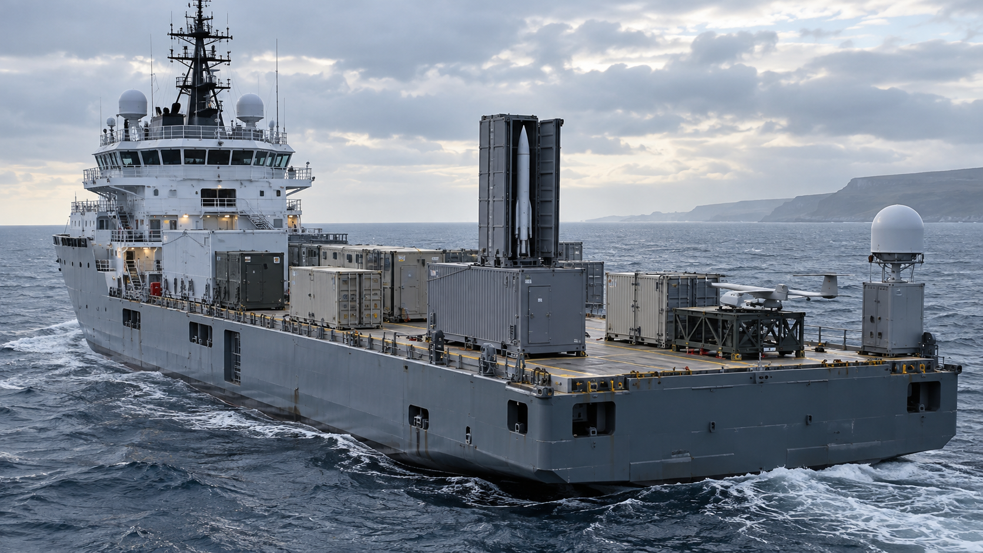
The Netherlands has chosen a comparable path for its future Multirole Support Ships. The navy starts from an existing commercial design, Damen’s Fast Crew Supplier 5009, widely used offshore, then militarises it while limiting hull modifications.
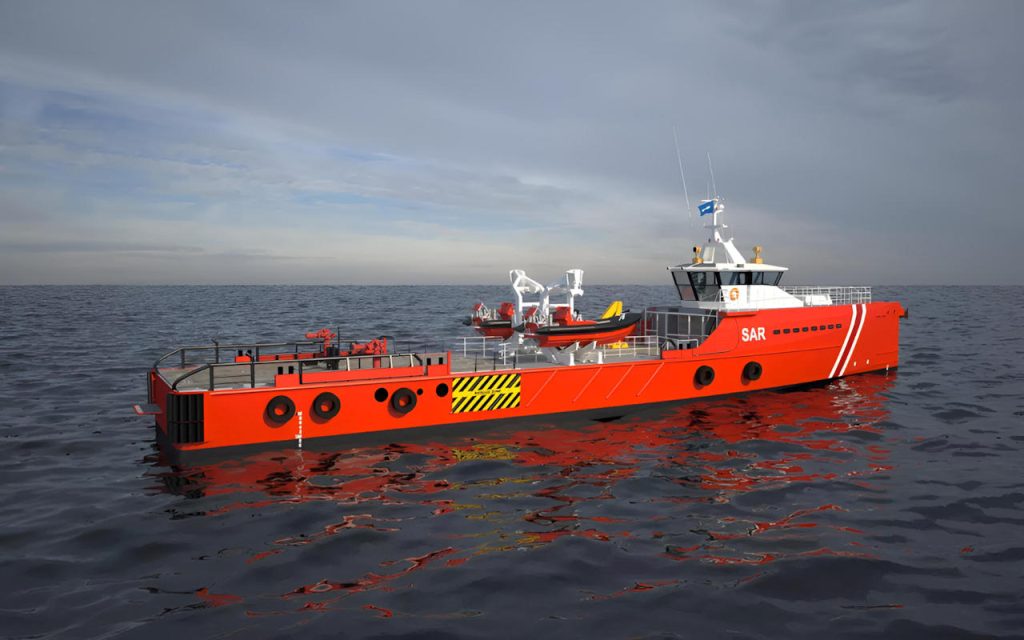
Air-defence launchers, electronic warfare, loitering munitions, underwater drones and collection equipment can be embarked as modules. The project even accepts a separation between the platform and part of its combat chain: the support ship’s missiles are to be launched and guided from a neighbouring air-defence frigate. In 2025, The Hague also announced the acquisition of containerised systems that can be installed on several types of vessels.[05][06]
The United Kingdom applied the same reasoning to a different function. Before becoming RFA Proteus, tasked notably with monitoring the seabed and undersea infrastructure, the Topaz Tangaroa worked as a support vessel for offshore oil installations. Its large working deck, handling capacity and endurance already provided much of the qualities sought; London bought the hull and converted it, rather than developing a specialised vessel from a blank sheet.[07]
Iran offers an even more radical demonstration. The Shahid Bahman Bagheri, admitted into the Revolutionary Guards’ fleet in 2025, comes from a commercial vessel converted into a platform able to operate drones and helicopters from a deck of about 180 metres. At this stage, no civilian ambiguity remains: the ship has become a military vessel. Its analytical interest lies precisely in this openly assumed conversion of a large commercial hull into an air-naval capability, without going through the construction of an aircraft carrier designed as such from the outset.[08]
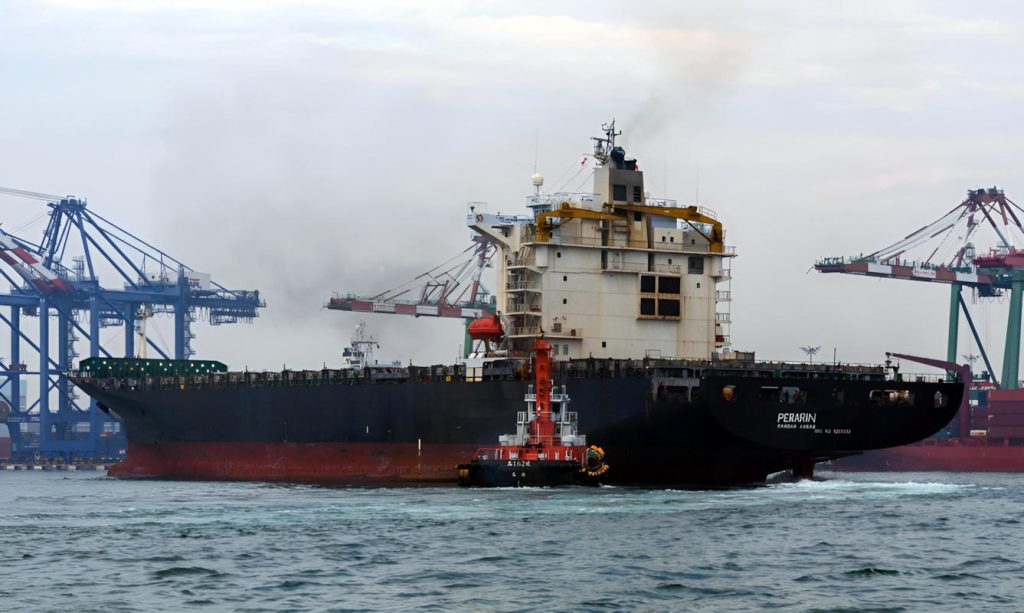
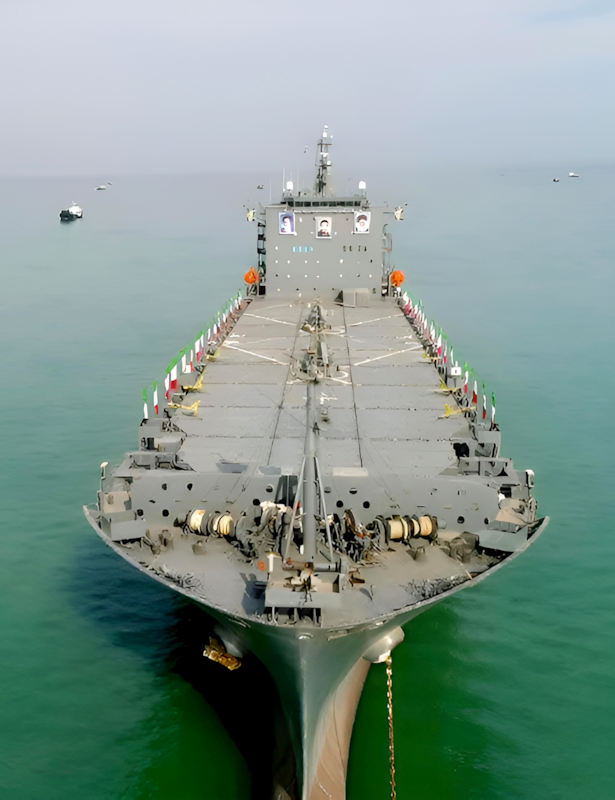
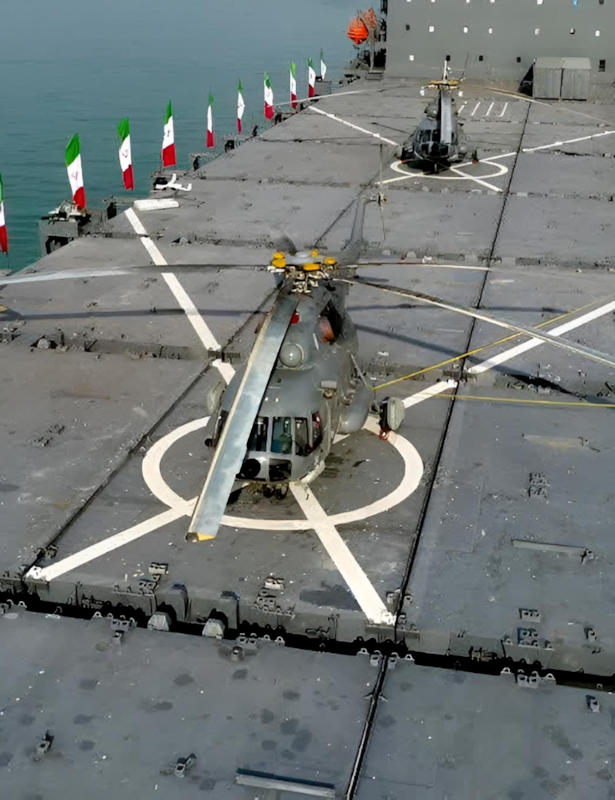
The Shahid Bahman Bagheri was converted by Iran into a drone carrier to launch attacks from the sea and entered service on 6 February 2025.
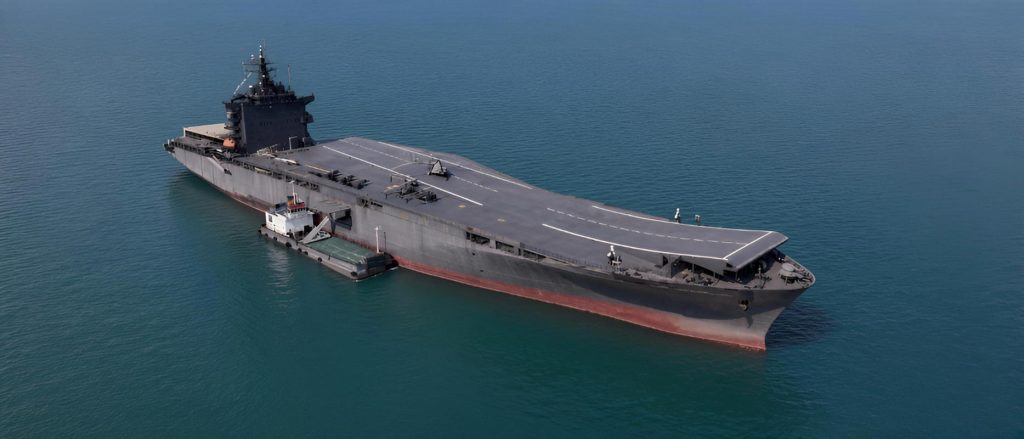
It is no longer only the hull that is adapted to the weapon. The weapon is becoming modular enough to migrate to the hull.
This migration has, however, an obvious limit: placing an effector on a deck does not create a military capability. One must still designate the target, transmit the information, integrate the platform into a chain of command, ensure its communications, maintenance and resupply. Modularity has operational value only if part of the system surrounding the weapon also becomes transferable. The question is therefore not only whether a cargo ship can carry a missile or a drone, but whether it can be integrated quickly enough into the system that will make it possible to use them.
This extension of military functions to civilian platforms also depends on the environment in which they must operate. In a grey-zone situation or in a sufficiently controlled maritime space, the vulnerability of a commercial hull may be acceptable given the cost and mass it brings. In a highly contested environment, it becomes a major constraint: poorly compartmented, weakly protected and generally without defences of its own, the civilian vessel then depends on the combat fleet, which must open and maintain for it the space it needs to operate. The merchant navy therefore does not replace the navy; it takes on its full value when the latter allows it to act.
The fleet we do not count
China is a particularly instructive case here. For several years, the People’s Liberation Army has been training Ro-Ro ferries and other civilian vessels to carry forces and equipment.
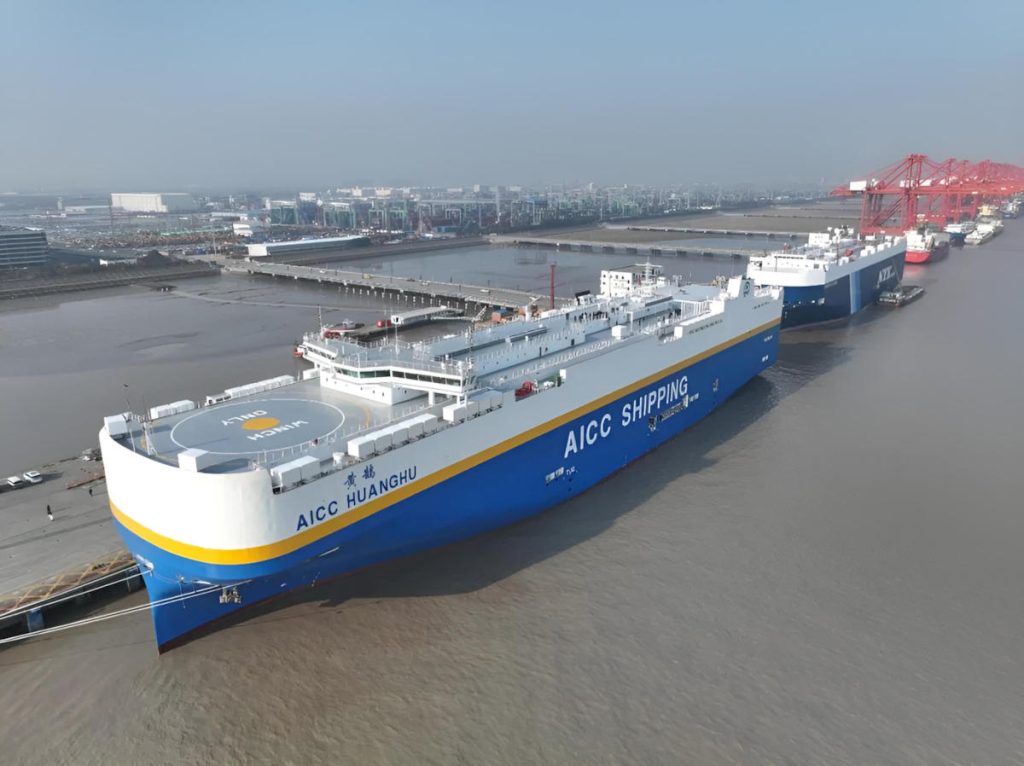
The work of the China Maritime Studies Institute has gradually documented the extension of the system: large ferries, deck-cargo ships, coordination of civil-military movements, floating infrastructure and the search for solutions to land equipment without relying on intact port facilities. The study devoted to 2023 activities still estimated that the civilian fleet was probably incapable, at that date, of providing on its own the capabilities needed for a major operation against Taiwan; it nevertheless noted significant progress and the appearance of new types of vessels in exercises.[09]
The 2025 training gave this preparation a far more visible dimension. A Reuters visual investigation tracked more than a hundred civilian vessels associated with manoeuvres and, during an exercise held in August in Guangdong, identified six Ro-Ro ferries and six deck-cargo ships converging on a landing area. Satellite images show in particular cargo ships unloading vehicles on a beach, as well as the use of temporary infrastructure to facilitate landing equipment. Once the exercise is over, these ships can resume their commercial activity.[10]
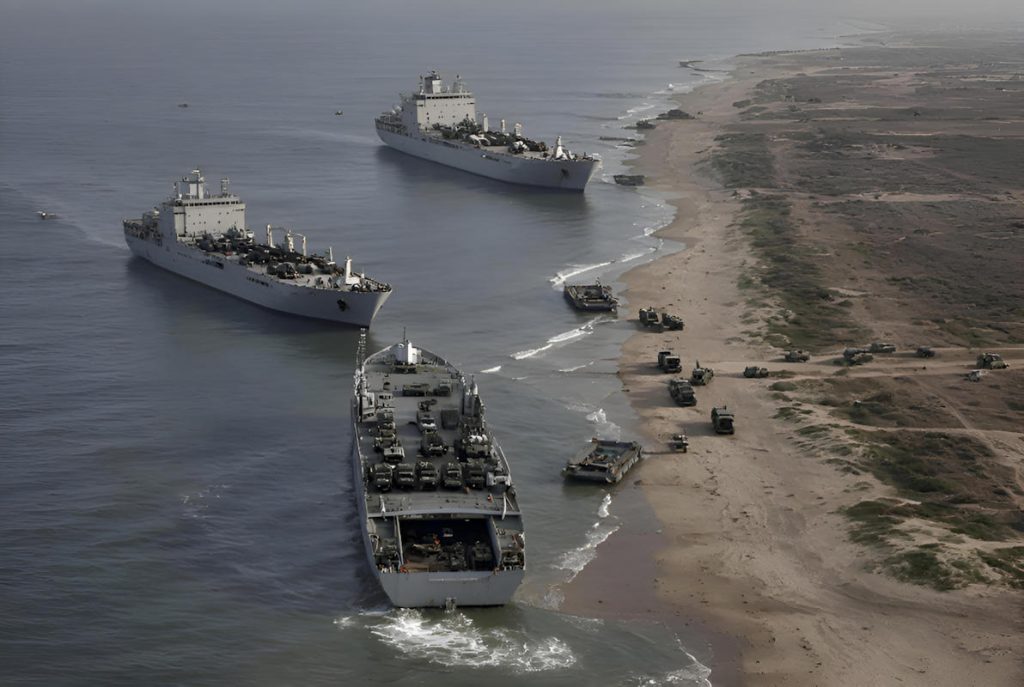
It is this reversibility that matters. The ship does not need to become permanently military to enter a state’s military potential. The question is particularly sensitive around Taiwan. On European-Security.com, Vice-Admiral Christian Girard stressed as early as 2023 the fundamental difference between a land war like that in Ukraine and a possible Chinese operation: crossing the strait would first require lasting control of the air-maritime space, then the ability to transport and sustain the necessary forces on the island.[11]
The first echelon must above all be distinguished from the effort that follows it. Civilian ferries or Ro-Ros are probably not the vessels one would wish to expose first against a coast that is still defended. Specialised amphibious assets would keep the opening function: crossing, fighting, creating access and obtaining enough local freedom of action. The value of the commercial fleet appears afterwards, when a beachhead must be turned into a lasting operation and the vehicles, fuel, ammunition, reinforcements and logistical volumes that military amphibious ships alone could hardly carry over time must cross the strait. In this perspective, the Chinese civilian fleet is less a second assault fleet than a reserve of mass behind the assault force.
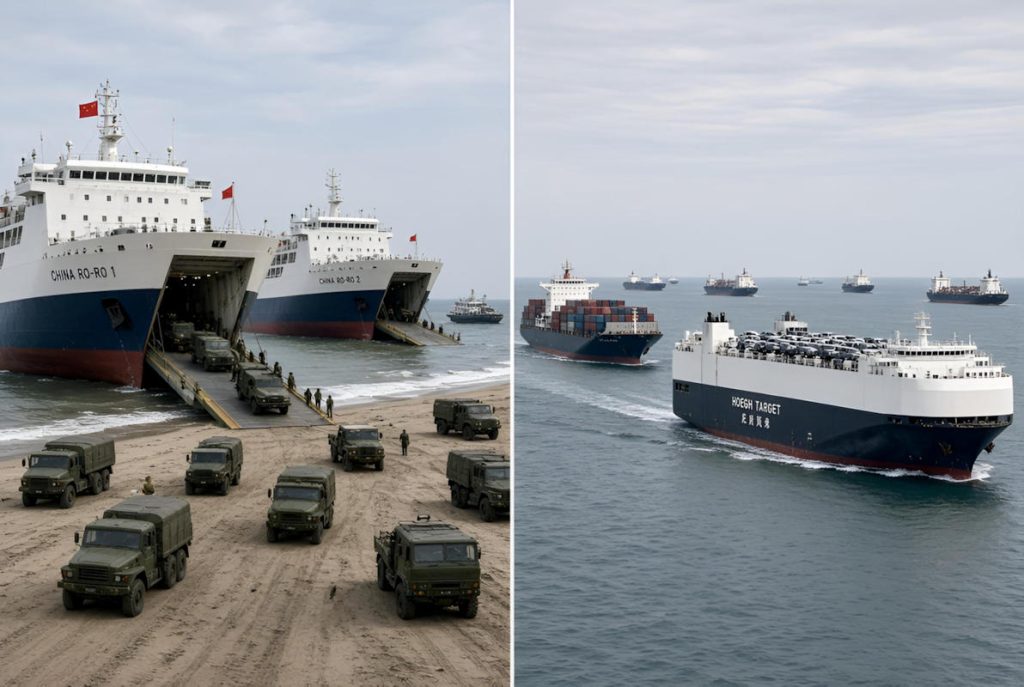
Moreover, Chinese potential does not stop at transport. A study by the China Maritime Studies Institute published in 2025 describes, within the maritime militia, reconnaissance units, “information boats” and specialised personnel tasked with collecting and passing intelligence to the PLA. The authors also consider it logical for Beijing to exploit the latent ISR capability of its distant-water fishing fleet and of merchant vessels operating abroad, and likely that specialised personnel are already embarked on some of them.[12]
This continuum between navy, coast guard, militia, fishing fleet and civilian assets does not come from nowhere. A talk by Rear Admiral Mike Brookes published by European-Security.com in 2023 already insisted on the coordinated operation of Chinese naval forces, coast guard and maritime militia, as well as on the use of auxiliaries for survey and intelligence purposes. In August 2026, a vessel identified as belonging to the maritime militia was also observed, for the first time according to the report cited by Reuters, off Taiwan’s eastern coast, accompanied by a coast guard ship and a research vessel. This coast opens onto the Pacific and is precisely the space through which some outside support to the island could transit in a crisis.[13][14]
It would, however, be misleading to see this as a Chinese singularity. The US Maritime Security Program maintains 60 commercially active merchant ships in exchange for their availability for defence needs; in August 2026, the US Maritime Administration classified 168 of the 190 large US-flagged merchant ships as “militarily useful”. Denmark and Germany use a similar principle with the ARK programme: up to eight DFDS Ro-Ro ferries can be made available to the armed forces at short notice while remaining commercially operated when the forces do not need them.[15][16]
The mobilisation of civilian capabilities is therefore not a Chinese singularity. The difference lies rather in scale, in the functions envisaged, in the degree of integration into military planning and in the conditions under which this mobilisation is organised, acknowledged or, on the contrary, concealed. China, however, combines a considerable merchant marine, a dominant shipbuilding industry, mobilisation mechanisms, an institutionalised maritime militia and exercises that progressively involve several categories of civilian assets in operational scenarios. The civilian ship is no longer only a resource that could be requisitioned in wartime; some are already integrated into its preparation.
When does the civilian ship enter the war?
This evolution necessarily meets a legal limit. The law of armed conflict does not decide a ship’s military character from its silhouette. The San Remo Manual provides that a merchant vessel may become a military objective when, notably through its employment, it makes an effective contribution to military action and its neutralisation offers, in the circumstances ruling at the time, a definite military advantage. The text cites in particular troop transport, replenishment of warships, reconnaissance, early warning, surveillance, command, control or communication functions, as well as the transport of military materiel.[17]
The law therefore has the necessary principle: function matters more than appearance. The contemporary difficulty lies rather in the speed with which this function can change. A ferry that carries cars every day remains a civilian asset; the same vessel, requisitioned to carry armoured vehicles in an amphibious operation, no longer performs the same function. RFA Proteus or the Shahid Bahman Bagheri pose hardly any problem of reading: their conversion and their integration into military structures are acknowledged.
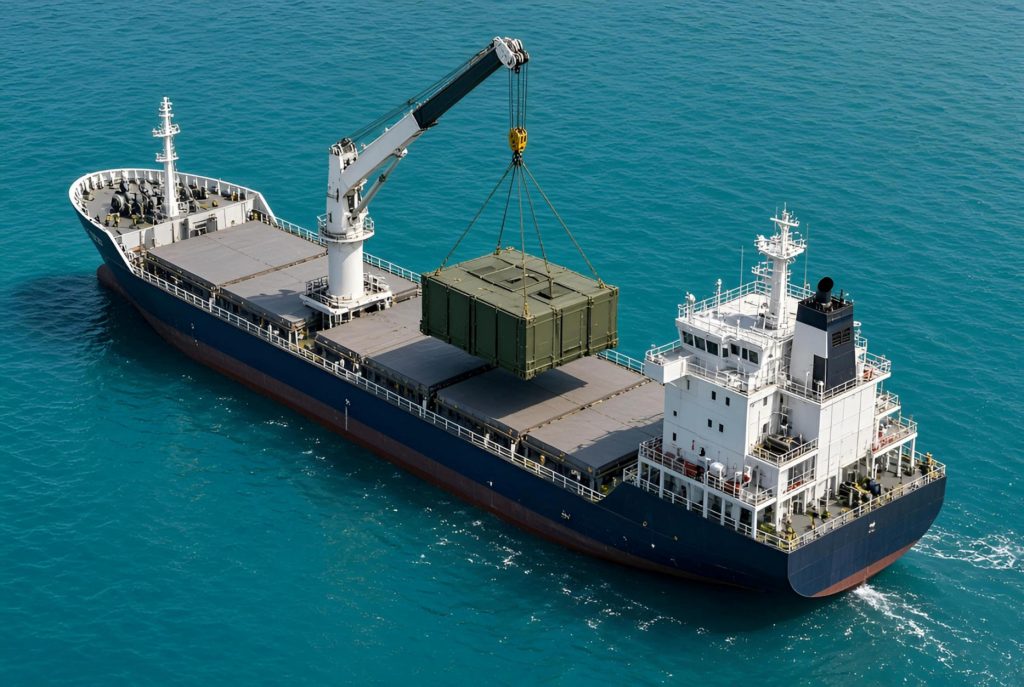
The situation becomes less comfortable when the transformation is temporary: a module arrives on board, a drone is launched, a sensor transmits for a few hours, then the equipment is unloaded and the ship resumes ordinary commercial activity. Its hull has not changed; its employment, for its part, has changed twice.
The difficulty then lies less in legally qualifying the vessel than in qualifying it fast enough. The Scanlark provides a useful illustration. More than a year after the events, despite the search of the ship and the opening of an investigation, the public information still forces us to speak of a suspicion. The law defines the criteria for qualifying a military contribution; operations must sometimes establish this contribution in a time that is not that of the judicial investigation. A prosecutor may have months. The commander of a naval force confronted with a platform suspected of providing targeting intelligence may have minutes.
Reversibility thus becomes a possible operational advantage. It multiplies the platforms capable of occasionally performing a military function and forces the adversary to devote intelligence to vessels that, a few hours or days earlier, might genuinely have carried nothing but goods. It also requires keeping distinctions: a ferry contractually placed at an army’s disposal, a former commercial hull officially converted into a military vessel and a civilian cargo ship used clandestinely for an intelligence mission raise neither the same questions of law nor the same difficulties of attribution. Yet they bear witness to the same material evolution: certain functions of naval power are no longer as closely tied as before to platforms designed from the outset for war.
Counting naval power differently
Counting differently does not, however, mean indiscriminately adding military vessels and civilian ships. A large merchant fleet is not automatically an equivalent military reserve. The truly relevant figure is force-generation capacity: how many ships can be mobilised, within what time, with which crews, which technical interfaces, which modules, which communications and which protection; how many can then be kept available for several weeks or several months.
The real naval reserve is not the number of civilian hulls. It is the ability to turn them quickly into sustainable military effects.
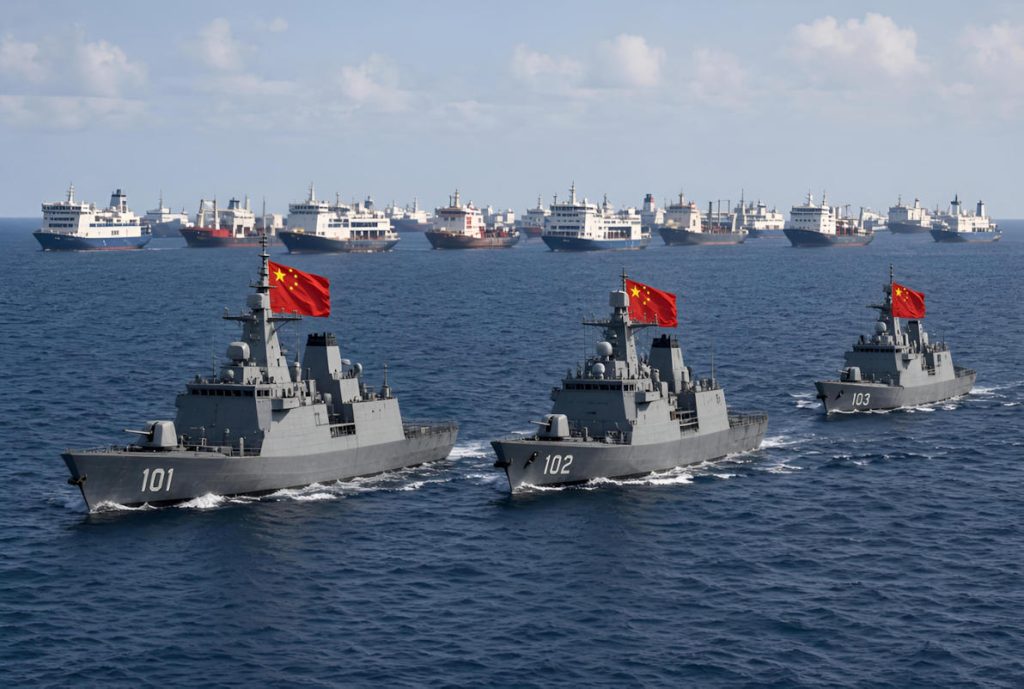
This obviously makes neither destroyers, nor frigates, nor specialised amphibious ships any less indispensable. A commercial hull is generally more vulnerable, less compartmented, less protected and far less able to survive in a highly contested environment. Its integration into a force also requires secure communications, trained crews, a doctrine, protection, industrial capacity and suitable command procedures. But the exclusive comparison of military fleets is becoming progressively incomplete.
One must also look at what a state can mobilise around them: ferries, Ro-Ros, deck-cargo ships, offshore vessels, tankers, port capacity, merchant crews, shipyards and modular systems able to change platform quickly. The ability to produce commercial hulls, adapt them and arm them with personnel is also becoming a potential datum of military power, even though these vessels appear in no defence inventory.
Methods diverge. Russia seems to be testing the value of ambiguity and deniability; Iran has demonstrated the possibility of radical conversions; Western navies are experimenting with modularity and have long contracted out part of their logistical depth; China is pushing the integration of civilian assets into mobilisation planning particularly far. The common trend is in the end rather unspectacular. It does not necessarily produce new grey ships to photograph in a shipyard; it consists in discovering that part of the capability being sought already exists, in another form and for another use.
The merchant navy does not replace the war fleet. It can now become its depth.
The question is then no longer only how many warships a state owns, but how many ships it would be able to bring into the war.
Jérôme Denariez

See also:
- « The Cargo Ship as a Weapon » — (2026-1018)
- « Das Frachtschiff als Waffe » — (2026-1018)
- « Le cargo comme arme » — (2026-1018)
Notes and sources
[01] NDR, “Spionageverdacht gegen Frachter in Kiel: Ermittlungen laufen”, 11 September 2025, and “Frachtschiff Scanlark: Haben russische Crewmitglieder spioniert?”, 2 October 2025. Both articles detail the search, the suspicion of a drone launch on 26 August and the investigation targeting five Russian nationals. Source
[02] Foreign, Commonwealth & Development Office, “UK and partners respond to Iran’s transfer of ballistic missiles to Russia”, 10 September 2024. The announcement sanctions five Russian cargo ships for transporting Iranian military supplies. Source
[03] International Institute for Strategic Studies, “Russia’s UAV Campaign Over Europe”, 2 July 2026. The study analyses 144 incidents and assesses as probable the use of Russia-linked vessels as launch or recovery platforms. Source
[04] U.S. Naval Institute, Brian O’Rourke, “Ghost Fleet Fires Real Missile”, Proceedings, October 2021. The Ranger and the Nomad are described as modified commercial fast supply vessels; the Ranger fires an SM-6 from a modular launcher. Source
[05] Dutch Ministry of Defence, “Nieuw ondersteuningsvaartuig met luchtdoelraketten en EOV-capaciteit”, 19 November 2024. The Multirole Support Ship is a militarised version of Damen’s Fast Crew Supplier 5009, with launchers, EOV, drones and other modules. Source
[06] Dutch Ministry of Defence, “Tegenstander de baas met nieuwe scheepsbewapening”, 17 June 2025. The Hague announces modular, containerised weapons and equipment that can be installed on several types of vessels. Source
[07] Royal Navy, “RFA looks to Greek god Proteus to protect UK’s underwater assets”, 2 May 2023. Proteus began her career as the oil-platform support vessel Topaz Tangaroa before her military conversion. Source
[08] Associated Press, “Iran inaugurates its first drone-carrier warship”, February 2025. The Shahid Bahman Bagheri, derived from a commercial ship, receives a deck of about 180 metres for drones and helicopters. Source
[09] China Maritime Studies Institute, J. Michael Dahm, China Maritime Report No. 35, “Beyond Chinese Ferry Tales: The Rise of Deck Cargo Ships in China’s Military Activities, 2023”, February 2024. The report analyses Chinese ferries, deck-cargo ships, causeways and civil-military logistics. Source
[10] Reuters, “China’s civilian shadow navy practices for invasion of Taiwan”, 20 November 2025. The visual investigation tracks more than a hundred civilian vessels linked to the exercises and documents the Guangdong amphibious manoeuvres. Source
[11] European-Security.com, Vice-Admiral Christian Girard, “Relation et antisymétrie entre les situations de l’Ukraine et de Taïwan”, 24 April 2023. The text stresses the fundamental constraint of crossing the strait and of sustaining an island operation. Source
[12] China Maritime Studies Institute, Ryan D. Martinson, China Maritime Report No. 46, “China’s Fishermen Spies: Intelligence Specialists in the Maritime Militia”, April 2025. The report describes the “information boats” and the latent ISR capability of Chinese fishing and merchant fleets. Source
[13] European-Security.com, Rear Admiral Mike Brookes, “Highlighting Dangers Facing Our Country”, 5 April 2023. The talk describes the coordination of Chinese naval forces, coast guard and maritime militia, and the role of auxiliaries. Source
[14] Reuters, “China militia boat spotted for first time off Taiwan’s east coast, patrol finds”, 8 October 2026. A maritime militia vessel is observed off Taiwan’s eastern coast with a coast guard ship and a research vessel. Source
[15] U.S. Maritime Administration, U.S.-Flagged Fleet Dashboard, August 2026. Of 190 large US-flagged merchant ships, 168 are classified as “militarily useful”; 60 take part in the Maritime Security Program. Source
[16] Danish Defence / DFDS, ARK agreement renewed from 2026: up to eight Ro-Ro ferries can be made available at short notice while being commercially operated when not needed by the military. Source
[17] San Remo Manual on International Law Applicable to Armed Conflicts at Sea, §60. The text lists the activities that may make an enemy merchant ship a military objective, including troop transport, support, intelligence, surveillance, C2 and transport of military materiel. Source
[18] Wikipedia, “German auxiliary cruiser Atlantis”. The Goldenfels, a cargo ship built in 1937 by Bremer Vulkan for DDG Hansa, became in December 1939 the auxiliary cruiser Atlantis (HSK 2): six 15 cm guns, torpedo tubes, mines, two seaplanes. She spent 602 days at sea under several false identities, sank or captured 22 ships, including the Automedon (11 November 1940, about 250 nautical miles north-west of Sumatra, in the Indian Ocean), and was destroyed on 22 November 1941 by the cruiser HMS Devonshire while refuelling a submarine. Captain Bernhard Rogge received a katana from Japan for delivering the seized documents. Source
[19] Wikipedia, “Hōkoku Maru-class ocean liner” and “MV Ondina”. The Hōkoku Maru and the Aikoku Maru, liner-cargo ships requisitioned by the Imperial Japanese Navy, were armed with eight guns and two seaplanes. The Hōkoku Maru was sunk in the Indian Ocean on 11 November 1942, south-west of the Cocos Islands, by the Dutch tanker Ondina and the Indian patrol vessel HMIS Bengal. Source · Source
[20] Convention (VII) relative to the Conversion of Merchant Ships into War-ships, The Hague, 18 October 1907, articles 1 to 6: direct authority and responsibility of the flag state, external marks of a warship, a commissioned commander on the officer list, a crew subject to military discipline, respect for the laws and customs of war, announcement of the conversion in the list of warships as soon as possible. Source
[21] The Moscow Times, “Russia’s GRU behind airport parcel bombing plot, European intelligence believes”, 5 August 2026; Cargo Forwarder Global, “Moscow orchestrated integrator attacks”, 4 May 2025. On 20 July 2024 a parcel caught fire at Leipzig-Halle airport; fires followed in Warsaw (21 July) and Birmingham (22 July). European intelligence services attribute the operation to the GRU, which reportedly recruited disposable agents through messaging apps. Russia denies it; the attribution rests on conclusions reported by the press. Source · Source
[22] Wikipedia (French), “Unité 29155”: GRU unit associated with sabotage, assassination and hybrid-attack operations in Europe. This note points to the unit’s profile; it does not establish its role in drone launches or in the Leipzig affair. Source
Decoding: the 1940 raider had a uniform, the modular cargo ship has none
Jérôme Denariez describes cargo ships that serve war without changing their appearance. Naval history knows the opposite case: the cargo ship disguised as a cargo ship, but armed as a cruiser. What separates the two?
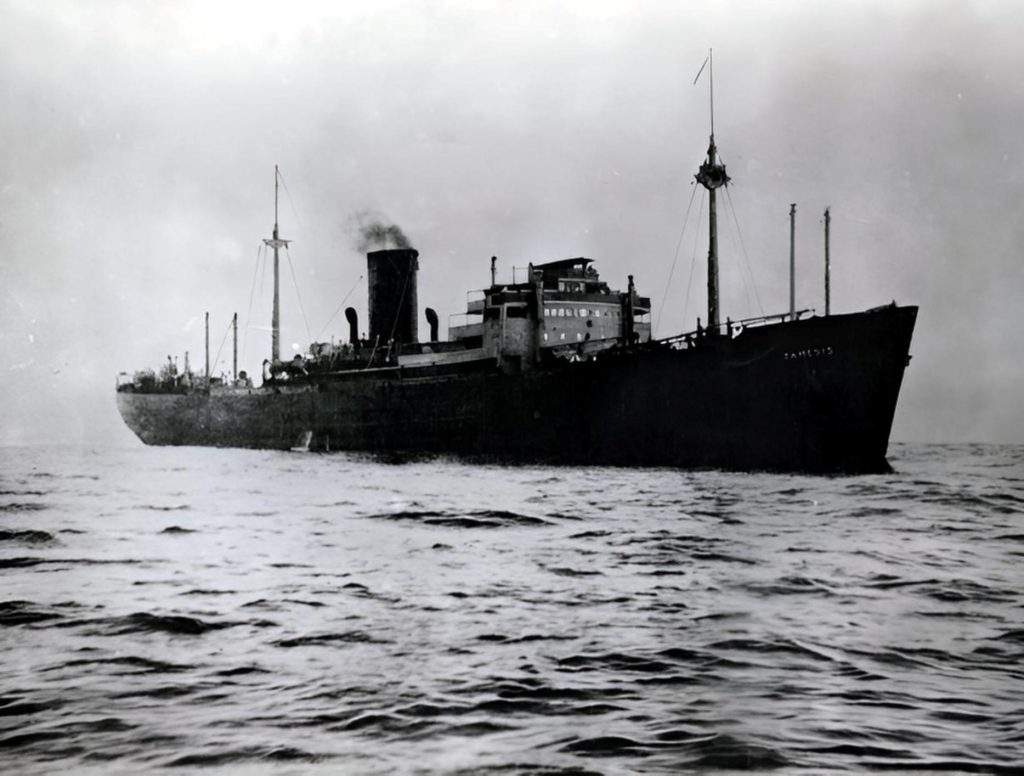
Between 1939 and 1945, the Kriegsmarine put nine auxiliary cruisers into service, the Hilfskreuzer, numbered HSK 1 to HSK 9. The most famous is the Atlantis: built in 1937 as a cargo ship, requisitioned at the end of 1939, she received six 15 cm guns, torpedo tubes, mines and two seaplanes. She spent about twenty months at sea, sometimes a Soviet cargo ship, sometimes a Japanese or Dutch one, and sank or captured 22 ships before being surprised by the British cruiser Devonshire in November 1941.[18] The story of the Kormoran, eighth of the series, will be told by Jérôme Denariez in his next paper.
Japan did the same in the Indian Ocean with two liner-cargo ships rebuilt by the Imperial Navy, the Hōkoku Maru and the Aikoku Maru, armed with eight guns and two seaplanes. In one year, they sank or captured five ships. On 11 November 1942, the Hōkoku Maru was destroyed in action by the Dutch tanker Ondina and the Indian patrol vessel Bengal; the tanker, hit several times, reached Fremantle.[19]
These raiders had something that Jérôme Denariez’s cargo ships do not have: a status. The 1907 Hague Convention requires a converted merchant ship to be placed under the direct authority of the state, to bear the external marks of a warship, to be commanded by a commissioned officer, to have a crew subject to military discipline and to respect the laws of war. The conversion must be announced in the list of warships.[20] The raiders cheated on appearance until the moment they opened fire, but they were genuine warships.
The one-day module goes through none of these formalities. A cargo ship that embarks a drone or a missile container for a few hours changes neither flag, nor crew, nor registration. In our reading, the 1907 convention describes a declared conversion, not a passing employment. What remains is the San Remo Manual’s criterion, the ship’s actual function.[17]
The 1940 raider cheated on its silhouette, and paid the price: once unmasked, it was a recognised military target. The modular cargo ship cheats on its employment, and that is far harder to prove.