
After the collapse of FCAS and the tremors surrounding MGCS, European military shipbuilding might seem spared from the Franco-German curse. It is not: it suffers a more insidious version, where the very absence of a major joint programme conceals an equally costly fragmentation. This paper examines why the fear of a ‘naval FCAS’ pushes Europe toward dozens of rival assembly lines rather than cooperation — and why this defensive reflex, however understandable after the aerial failure, produces exactly the outcome it claims to avoid: dependence on American standards.
Key Takeaways
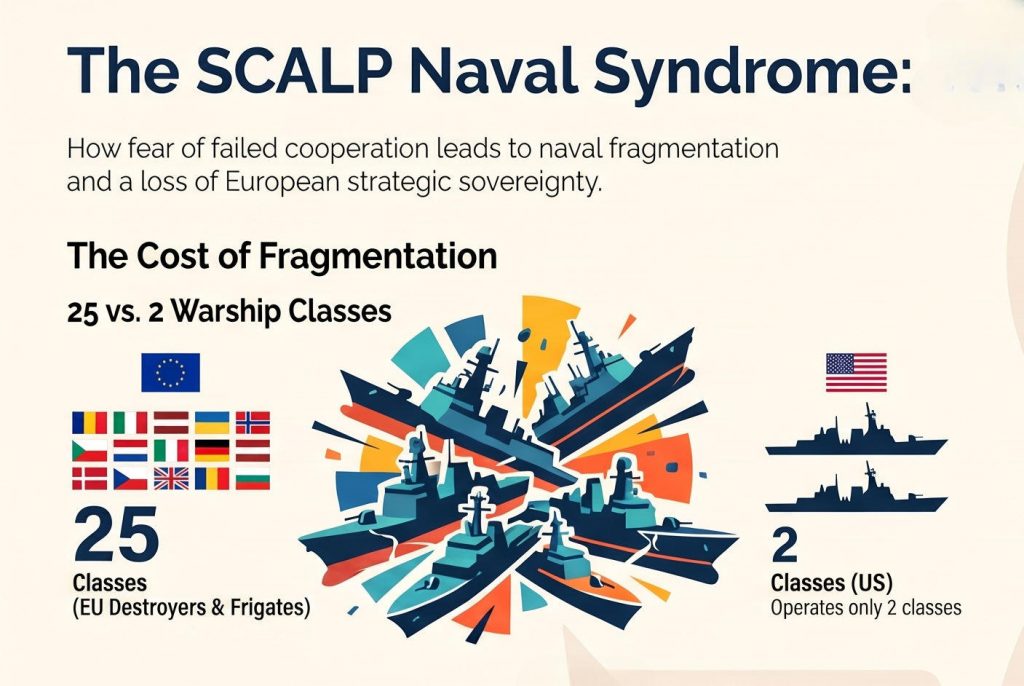
- • The ‘SCALP Naval syndrome’ describes Europe’s refusal to integrate its military shipbuilding, out of fear of repeating FCAS’s governance failure — a reflex that produces exactly the dependence on American standards it claims to avoid.
- • The numbers: the European Union operates 25 different classes of destroyers and frigates, versus 2 in the United States — despite a European defence budget less than half the size of the Pentagon’s.
- • Germany, now budgetarily dominant thanks to its €100 billion Sondervermögen, has favoured off-the-shelf American purchases (F-35, Patriot) over European industrial cooperation.
- • The sovereign SCALP Naval missile illustrates the standards trap: SYLVER silos and 533 mm tubes versus American MK-41 silos and Tomahawk — a choice that locks in the entire ship’s architecture, not just the munition.
- • Ukraine offers a third path: an economy of mass built on low-cost maritime drones, which has crippled an entire fleet without a single cruise missile ever coming into play.
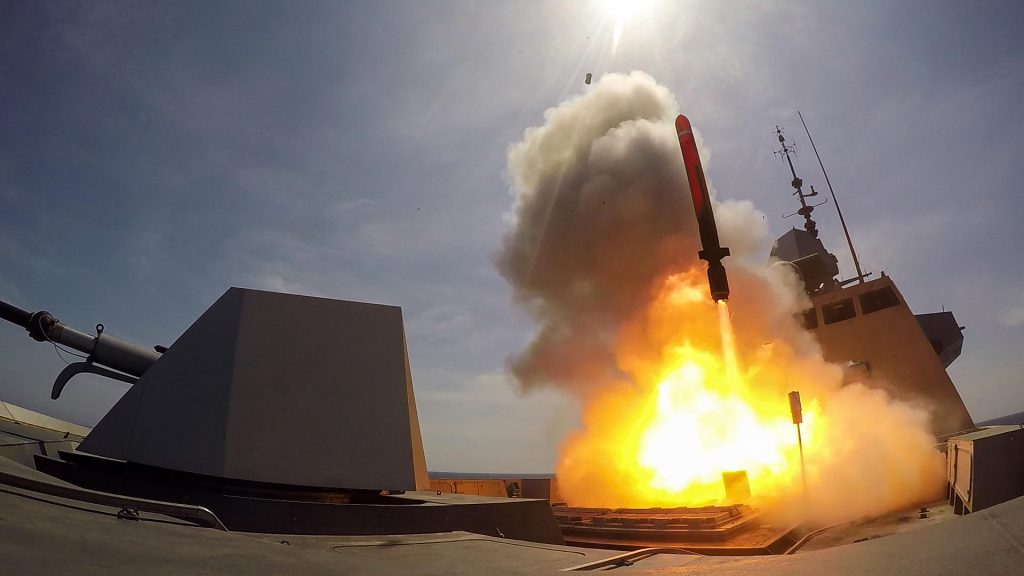
Table of Contents
by Joël-François Dumont — Paris, July 28, 2026.
A Rich but Powerless Europe
Dscussing European defence today requires lifting the veil on an uncomfortable reality: Europe does not suffer from a scandalous lack of financial resources, but from a structural inability to convert its investments into coherent military power.
The combined defence budget of NATO’s European members stood at roughly $276 billion in 2018 — less than half the American budget, then around $650 billion.[01] And yet, with this fraction of the Pentagon’s budget, Washington produces a far more coherent force: while the European Union operates no fewer than 25 different classes of destroyers and frigates, the United States makes do with 2.[02]
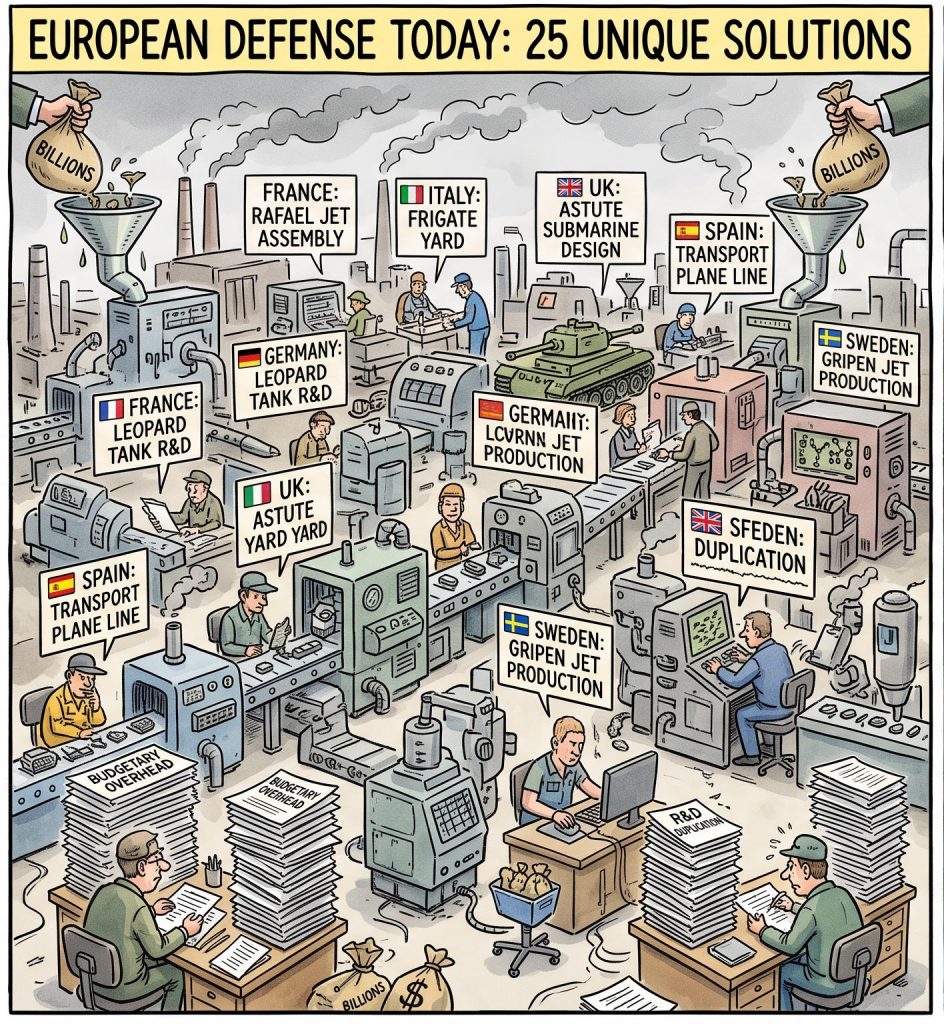
The same gap appears, almost identically, in main battle tanks (12 different types in Europe versus 1 in the United States) and fighter jets (14 versus 5).[02] As early as 2014, Airbus CEO Tom Enders was already warning that Europe maintained ‘17 production lines for tanks, armoured vehicles and artillery, compared to 2 in the United States’.[03]
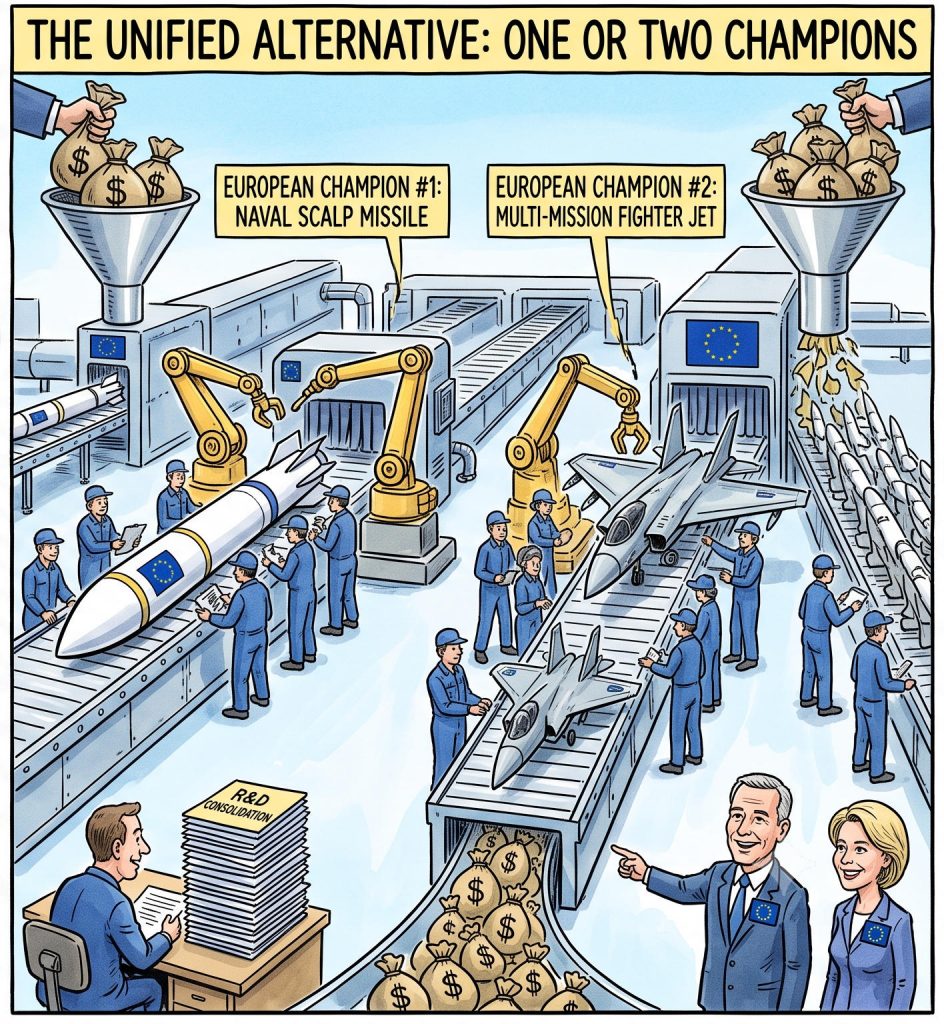
Each nation jealously guards its own assembly line, its own design bureaus, its own micro-series. It is on this fragmented playing field that the ‘SCALP Naval syndrome’ emerges: the glaring symbol of a Europe unable to impose its own sovereign champions, paralysed by the fear of an industrial abyss and the spectre of strategic decline.
1. Germany and the Illusion of 100 Billion: The Cost of Blind Choices
One cannot understand Europe’s naval paralysis without examining the trajectory of its leading economic power. Germany is today paying dearly for a succession of opportunistic strategic pivots:
The technological lag: a missed digital transition across its key infrastructure and administrations, hampering the integration of the critical data technologies needed for next-generation warfare.
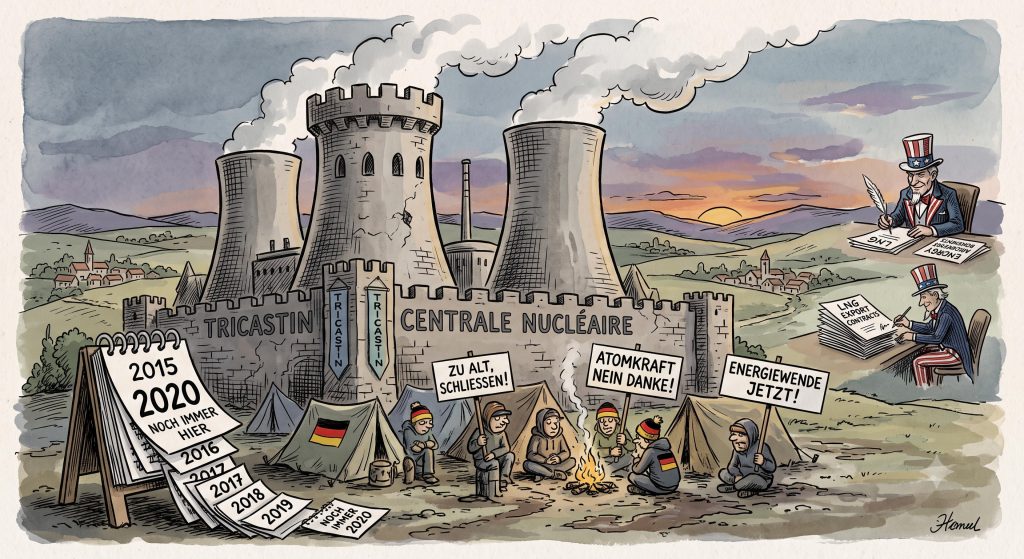
The energy suicide: driven by domestic political calculations under Angela Merkel — politically sidelining the SPD by sealing a circumstantial alliance with the Greens — Berlin abruptly turned its back on civilian nuclear power after Fukushima, an episode that still feeds French industrial distrust today.[04] The result borders on the grotesque: a colossal geopolitical vulnerability plugged in a hurry by a massive, polluting return to coal.
This energy suicide did not stop at Germany’s borders. For years, Berlin—through its Environment Minister Barbara Hendricks (SPD)—repeatedly and publicly demanded the closure of Fessenheim, France’s oldest nuclear power plant, deeming it “too old” to remain in service. [05] Paris eventually gave in: the two reactors were shut down in 2020. The irony is bitter: on January 14, 2026, Chancellor Friedrich Merz himself described Germany’s nuclear phase-out as a “serious strategic error,” acknowledging that his country “is carrying out the most costly energy transition in the world.” [06] Berlin thus shut down a French power plant deemed too dangerous by its own standards, only to admit twenty years later that those very standards were a mistake. The bill, however, remains to be paid by the Germans—not by the French, who lost Fessenheim.
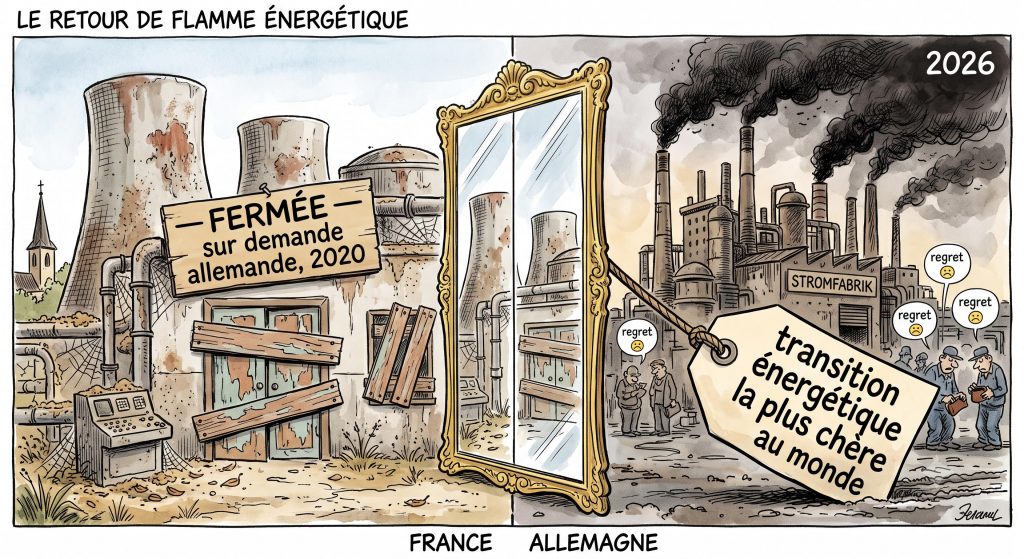
This low-key battle over EDF, which lasted more than a decade, marks the true starting point. What the Fessenheim affair set in motion was not merely a temporary tension but a slow—and increasingly overt—drift between the two countries: a divorce that goes unspoken, yet one that is reflected, with identical logic, in every industrial issue examined since then: the SCAF, the combat cloud, and now shipbuilding.
How can we fail to mention certain precedents here ?
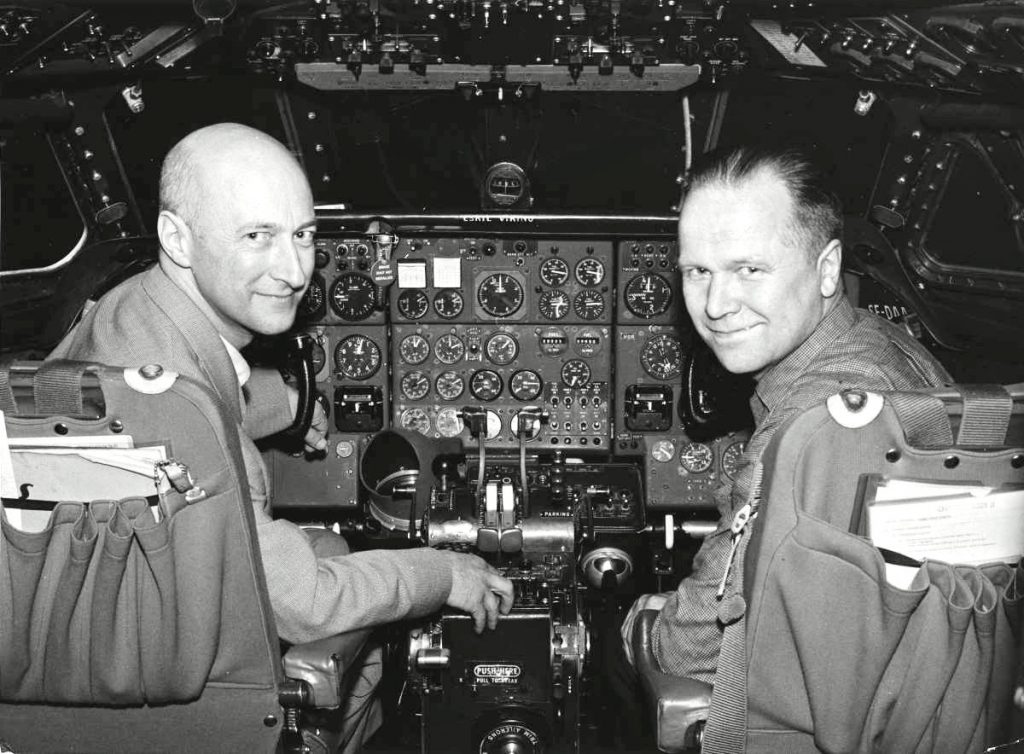
Lufthansa did indeed never operate a single Caravelle. All the major European airlines of the time flew the Caravelle: 282 aircraft were sold to more than 30 airlines, Air France, SAS, Alitalia, Sabena, Iberia, Swissair, TAP, Finnair and Istanbul Airlines, amongst others — but Lufthansa moved directly from its Vickers Viscount turboprops to the Boeing 707 as early as 1960, the very year that jet aircraft were just beginning to gain a foothold in Europe. Better still: Lufthansa went on to become the very first European customer for the Boeing 727 (1964) and one of the very first customers worldwide for the 737.
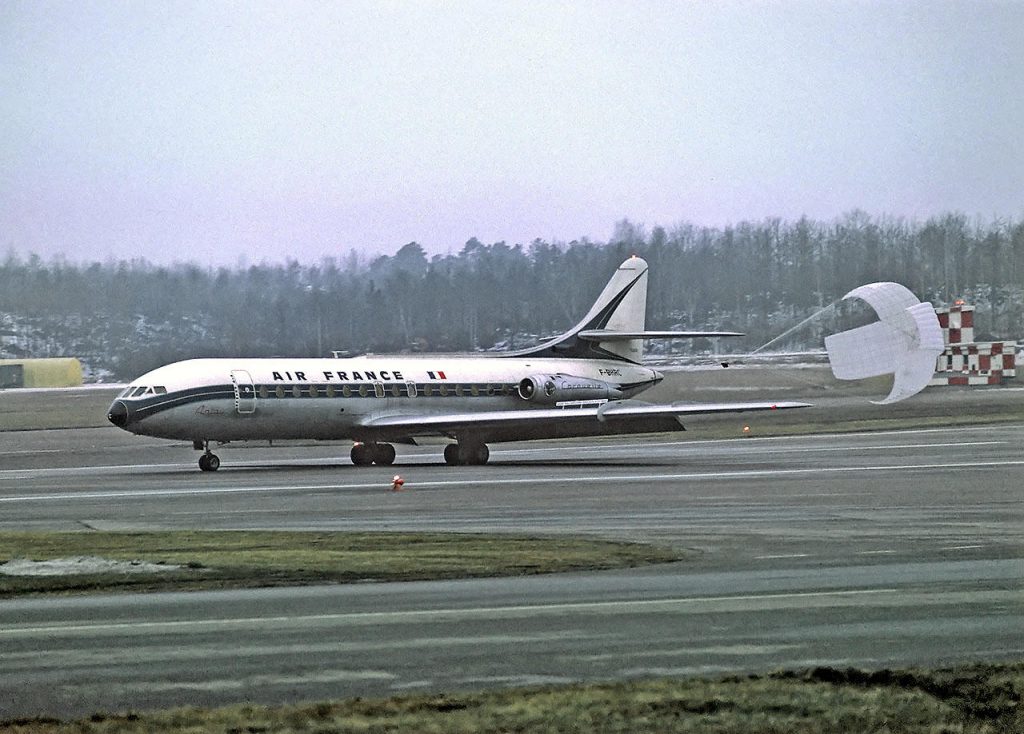
So it’s not just that “Lufthansa didn’t buy French” — it was Lufthansa that actively chose to be a showcase and launch partner for American aviation right from the dawn of the jet age, whilst its European counterparts, including countries such as Finland, opted for the French aircraft.
Space tells the same story, twenty years ahead of the naval sector. In 1995, at the Baden-Baden summit, Kohl and Chirac sealed a joint space reconnaissance programme — France was to lead the Helios II optical satellite, Germany the Horus radar satellite, with each country funding a share of the other’s programme. But Berlin abandoned Horus in 2001 and instead entrusted the construction of an entirely national system to OHB-System, a small Bremen-based company with 120 employees and no experience as a space programme prime contractor. This would become SAR-Lupe — born, ironically, out of the lessons learnt by the German military from its own failure to obtain US satellite intelligence during the Kosovo War.
Germany had therefore fully understood, as early as 1999, the value of space sovereignty: it simply chose to build it alone rather than with France, even though a cross-funding agreement was already in place. The pattern that is repeating itself at sea today — preferring national isolation to chosen dependence on a European partner — is therefore not a 21st-century phenomenon: it dates back at least three decades and has been documented in three different sectors: aviation (Lufthansa/Caravelle, 1960), space (Horus/SAR-Lupe, 2001), and nuclear power (Fessenheim, 2015–2020).
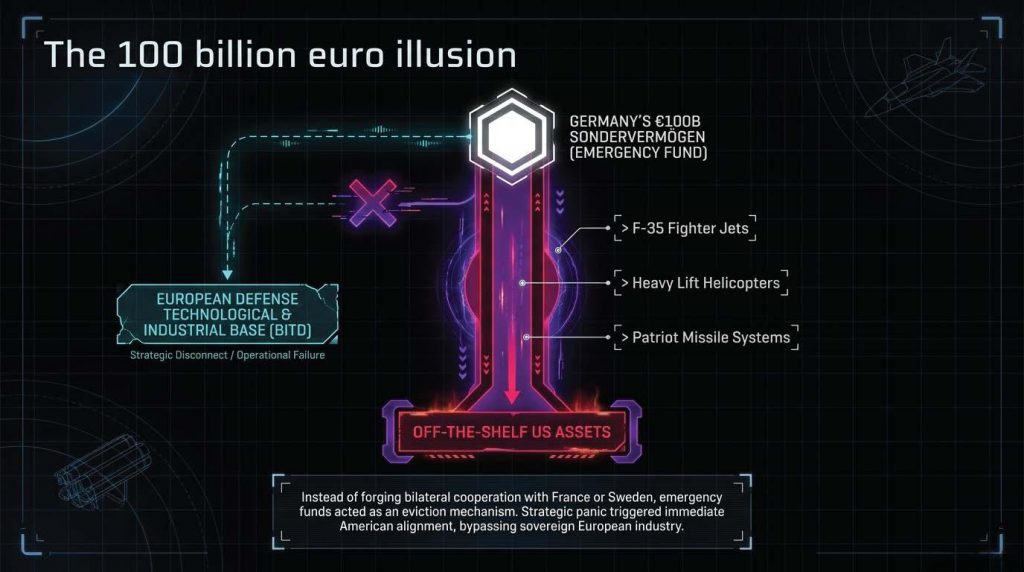
Germany, now Europe’s leading budgetary power thanks to its €100 billion Sondervermögen, did not use this lever to build European industrial leadership — its own or a partner’s. It used it to buy American: F-35 jets, Heavy Lift helicopters, Patriot systems. The message, unspoken but implicit in every contract signed with Washington rather than with Paris or Stockholm, is simple: Germany will more readily accept depending on the United States than it will accept depending on — or making Europe depend on — a champion that is not German.
By choosing immediate American alignment over Europe’s Defence Technological and Industrial Base (DTIB), Berlin effectively ruled out any balanced bilateral cooperation with France or Sweden.
This logic was confirmed one last time on 28 July 2026: Safran announced the end of the Franco-German joint venture EUMET, created with MTU to power the future combat aircraft, for lack of resources to develop two separate engines — France refocusing its effort on its own national roadmap alone.[07]
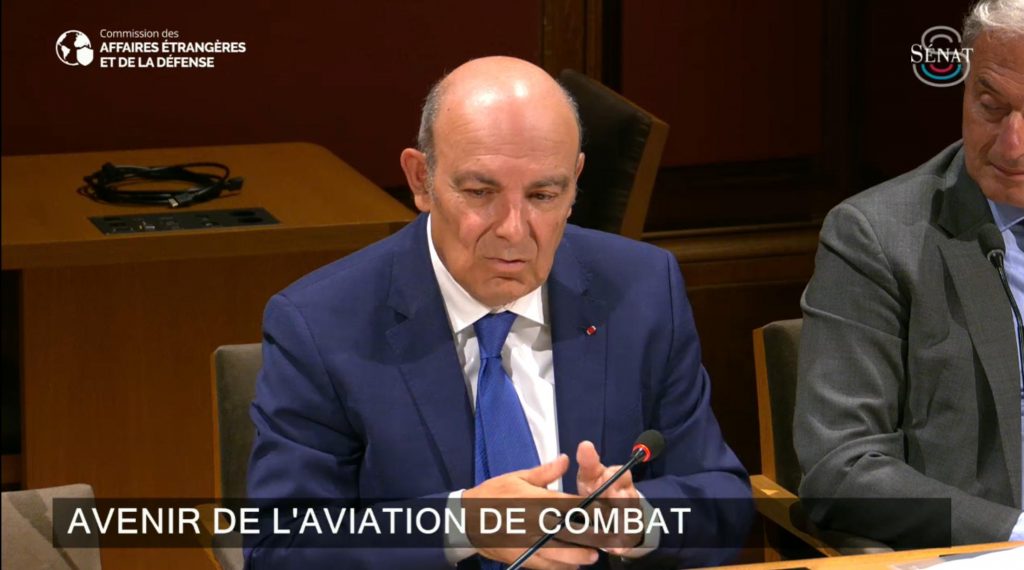
Dassault Aviation’s CEO, Éric Trappier, summed up the stakes in a single sentence that applies to every case examined in this piece: “The engine is fundamental: it’s what gives us our independence and our sovereignty.”
2. The ‘Naval FCAS’ Syndrome: The Trap of Facade Integration
Faced with the mess of multiple frigate-building nations, some observers call for a great unifying mass: a ‘naval FCAS.’ But among industrialists and sailors alike, this prospect triggers an absolute dread — fed by a still-raw aerial precedent.
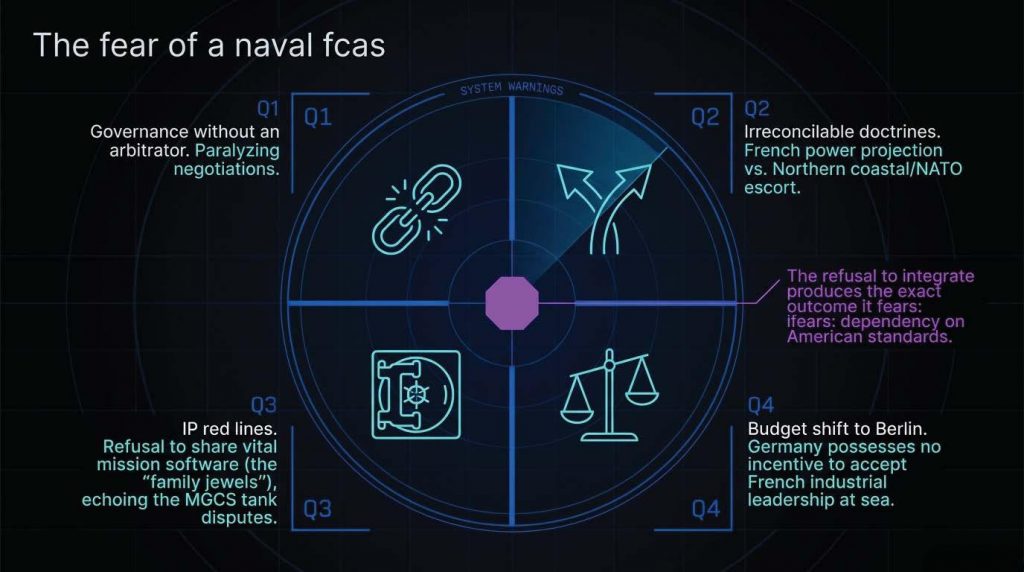
The four causes that brought down FCAS in fact reappear, in inverted form, in the very refusal of a naval FCAS.
- The governance without an arbiter that paralysed seven years of negotiations between Dassault and Airbus [05] teaches, on the naval side, not ‘let’s organise governance better’ but ‘let’s simply avoid cooperation altogether.’
- The irreconcilable military doctrines — French power-projection versus coastal interdiction and NATO escort duties for the Nordic navies — would reproduce, within a single naval specification, the original sin that swallowed the Franco-German fighter jet.
- Intellectual property as the true red line, illustrated by Tom Enders publicly asking whether France was being ‘treated like China’[06][09] over the MGCS tank programme, follows the same logic as Dassault’s historic refusal to hand over full access to its flight control laws and electric flight-control surfaces — its true crown jewels.[04] On the naval side, it is the fire-control codes and mission software of Naval SCALP missile that play this role: no state wants to open these crown jewels to a multinational consortium, even though the missile itself — the family tool — could, in theory, be shared more broadly industrially. And
- The shift in budgetary power in Berlin’s favour removes any reason for Germany to accept, at sea, a French industrial leadership it once tolerated when France carried more weight.

While “crown jewels” belongs to a vocabulary already established in the industrial world — the trade secrets no company ever gives up — the expression “family tool” is coined here rather than borrowed, and deserves clarification. By it, we mean the national weapon systems themselves: the means each country has spent generations, sometimes several centuries, building in order to design, produce and evolve its own armaments — a tank, a combat aircraft, a missile, a submarine, as much as the entire industrial chain that makes them possible. It is the inheritance, the accumulated expertise, the right to manufacture at home what one needs to defend oneself.
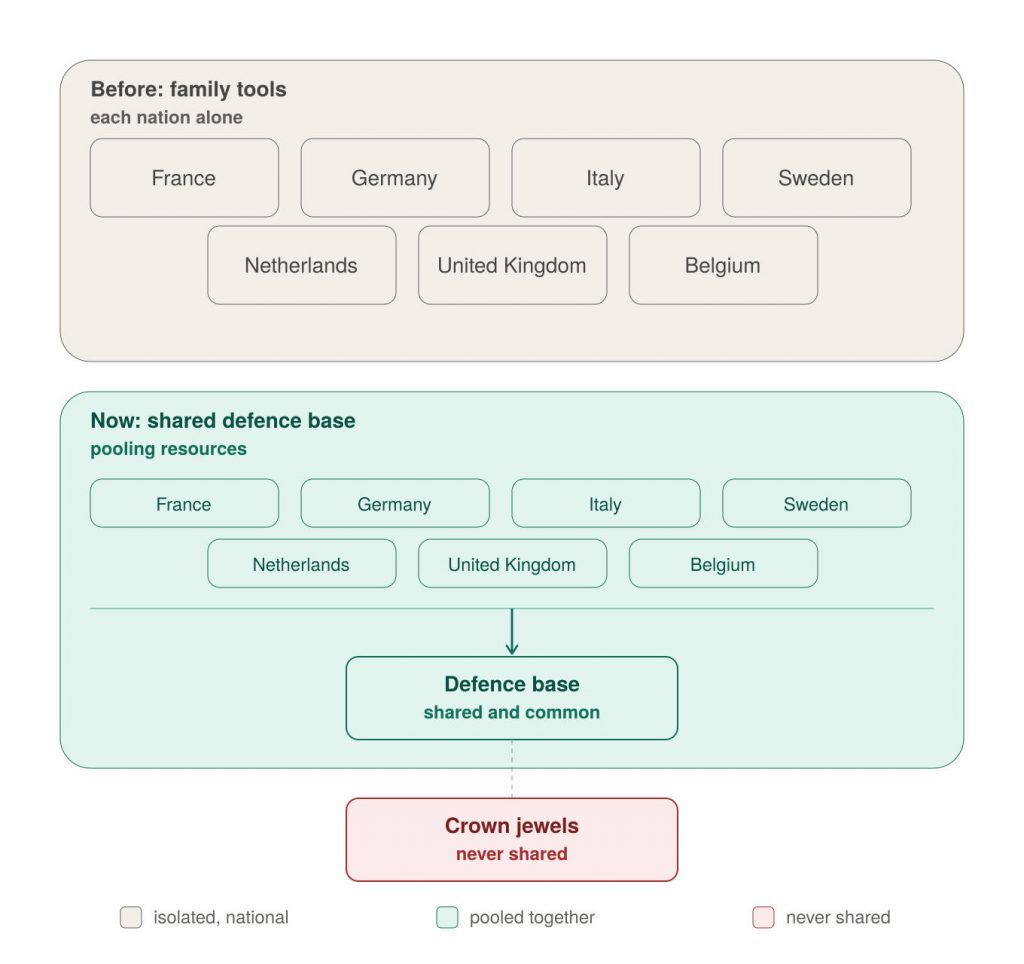
After the dramatic autopsy of the great integrated programmes, naval shipbuilding therefore refuses to apply the same recipe. Trying to design a single combat ship or submarine to reconcile operational requirements never harmonised upstream is a fatal illusion — but refusing outright produces a symmetrical cost: fragmentation. In both cases, the greatest common denominator almost always ends up being the adoption of American standards.
3. The Battle for the ‘Family Tool’: Why SCALP Naval Paralyses
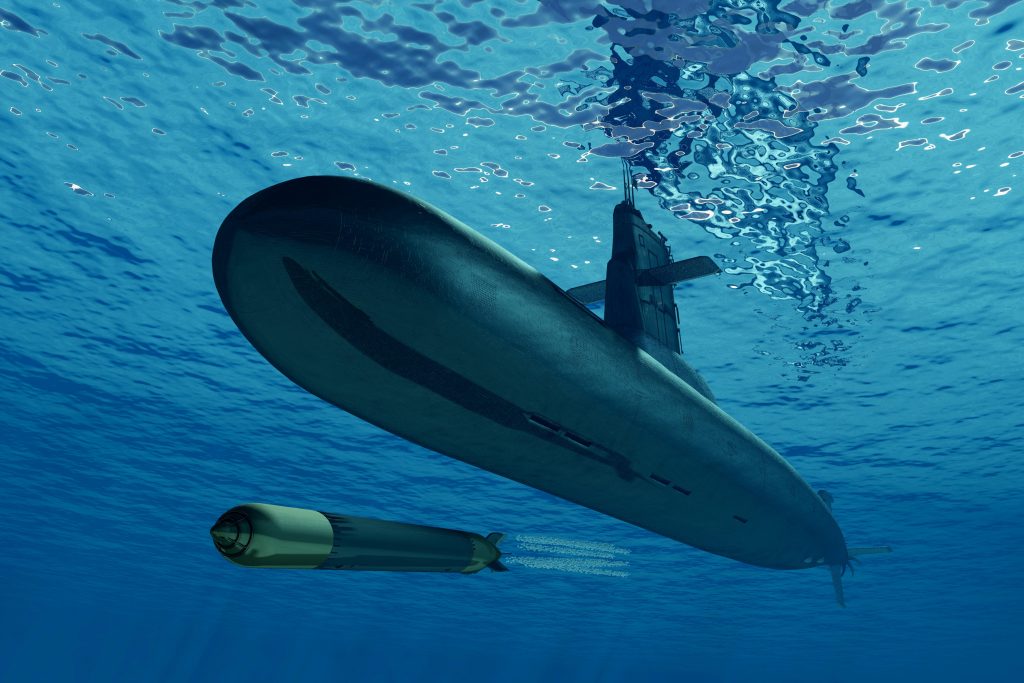
This is where the heart of the syndrome lies. Developed by MBDA and fielded by Naval Group, SCALP Naval (MdCN) is a technological feat: a sovereign cruise missile capable of deep strategic strikes beyond 1,000 km, fired from a surface ship’s vertical SYLVER A70 silos or ejected via the hydrodynamic capsule of a standard 533 mm torpedo tube aboard a submarine.
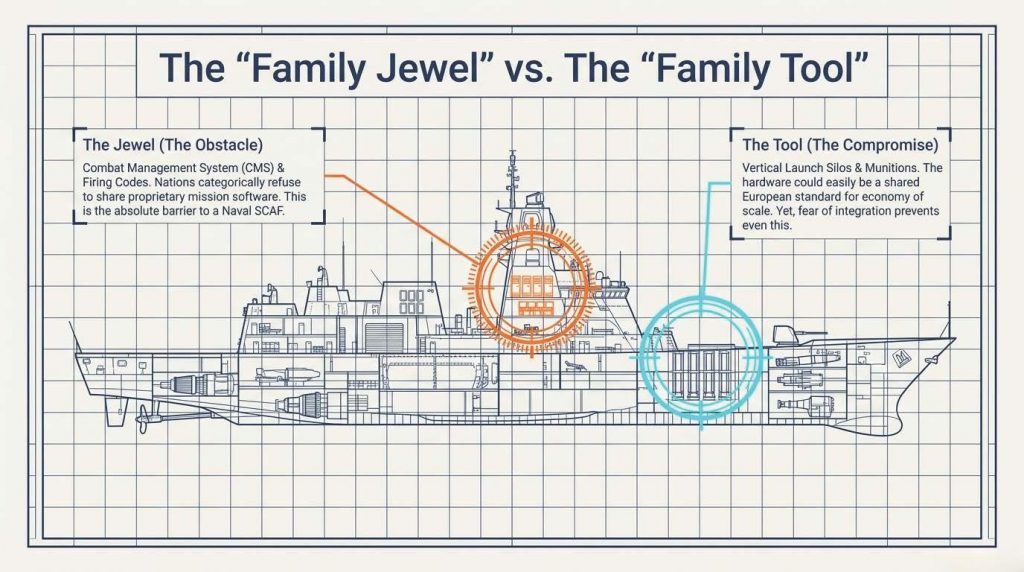
For industrialists, giving up this missile means abandoning the ‘family tool.’
| THE STRATEGIC STANDARDS TRAP | |
| Sovereign option (MBDA / Naval Group) | Alignment option (USA) |
| SYLVER silos / 533 mm tubes | MK-41 silos / US standards |
| SCALP Naval missile | Tomahawk missile |
| ► Control of mission software ► Targeting independence ► Total industrial sovereignty | ► Dependence on US firing keys and data libraries ► Technological lock-in |
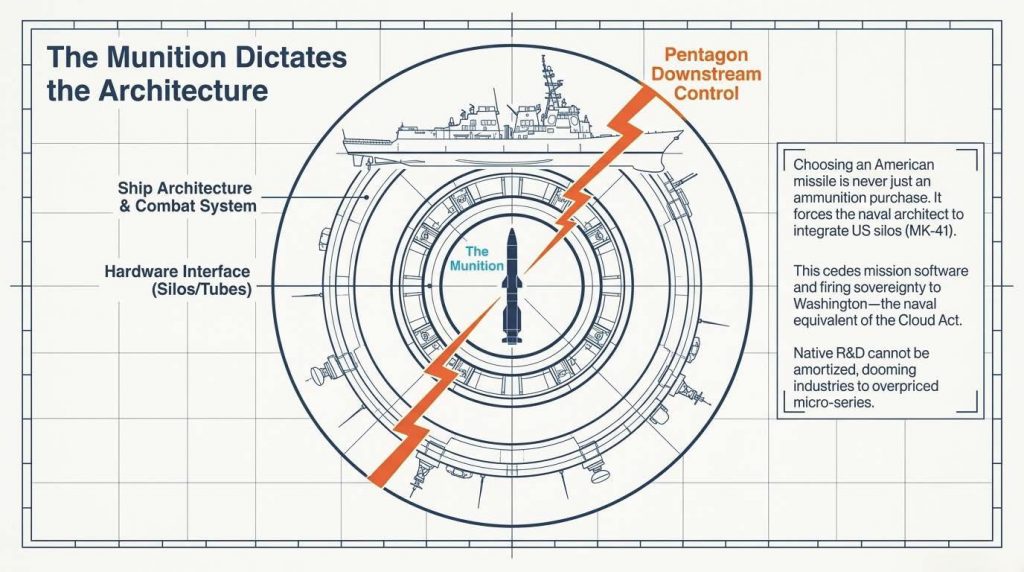
When a European navy chooses to buy an American Tomahawk, it does not merely buy a munition: it forces the naval architect to adopt Washington’s MK-41 silos or launch interfaces. It hands over mission software, targeting, and firing sovereignty downstream to the Pentagon.
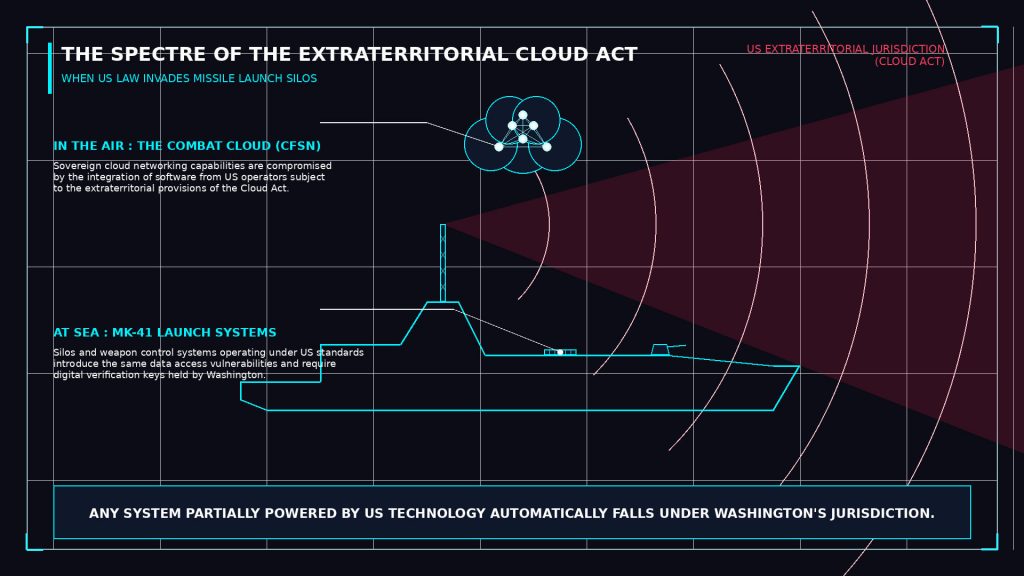
This is structurally the same mechanism as the Cloud Act paradox documented around Germany’s aerial combat cloud (CFSN): a system, even partly operated by a company under US jurisdiction, falls under extraterritorial data-access laws.[07] MK-41 silos at sea, the Cloud Act in the air: the same lock-in, two domains.
Paralysed at the thought of asserting an autonomous military posture without American blessing, several European navies sacrifice SCALP Naval on the altar of operational convenience. They condemn the European industry to overpriced micro-series, preventing the amortisation of R&D costs that gives American giants their strength.
4. The Shadow of the Nuclear, Global Rearmament — and the Ukrainian Lesson
While European navies lock themselves into parochial quarrels and the fear of asserting their autonomy, the rest of the world has fully grasped the value of deep strike from the sea.
The strategic rupture of AUKUS (the deal transferring American and British nuclear-powered attack-submarine technology to Australia) has broken a major lock. Everywhere, the line between very-long-range conventional capabilities and strategic deterrence is blurring: Japan and South Korea are developing deep-diving submarines fitted with vertical silos to fire ballistic and cruise missiles, positioning themselves at the strategic threshold.
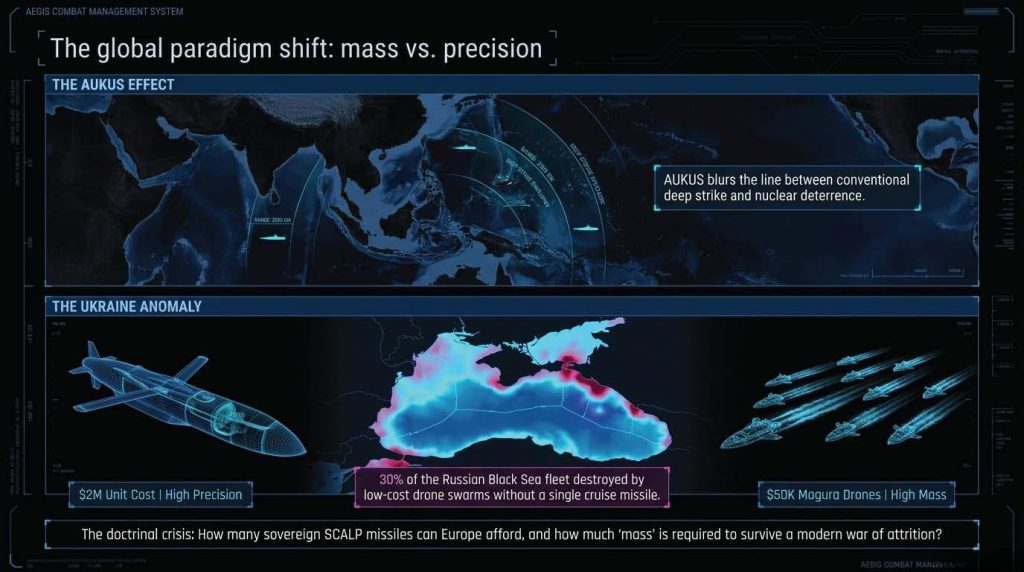
In this rapidly recomposing global landscape, the naval cruise missile has become a genuine currency of power — but it is not the only one. Ukraine offers the most radical counter-example: a sovereign missile with a 1,000 km range remains, by its very nature, a very small-series object. Against this, Ukraine’s economy of mass — already illustrated by Magura maritime drones — has crippled an entire fleet without a single cruise missile ever coming into play: roughly 30% of Russia’s Black Sea fleet has been destroyed or damaged by swarms of low-cost drones since the start of the conflict.[08]
SCALP naval missile and the Magura drone are not competitors — one strikes in depth, the other neutralises on the surface — but their coexistence raises a genuine doctrinal question for Europe: how many SCALP Navals can it truly afford, and how much ‘mass’ will it need alongside them?
Conclusion: Coming Out of Denial
SCALP Naval is not merely a piece of military equipment: it is the revealer of Europe’s inferiority complex. As long as European navies refuse to consolidate their DTIB around their own ‘family tools,’ as long as they prefer the American technological crutch to avoid taking on strategic responsibility, they will remain a budgetary giant but a political dwarf.
It is no longer a matter of fantasising about an unrealistic grand joint programme, but of having the political courage to order the sovereign weapons that already exist. Before it is definitively too late.
This model, inherited from an era when every great power could still claim military self-sufficiency, no longer holds. No European nation, taken alone, today has the financial means or the critical technological mass to keep pace, on its own, with next-generation weapon systems — and this is as true at sea as it is in the air.
The time has come for the European family to admit what it has long refused to see: dependence, in one form or another, is no longer an option but a necessity. But not all dependence carries the same price. There is chosen dependence, negotiated between partners who agree to share their family tools — this is the still-unfinished wager of Naviris, or of a common European standard. And there is imposed dependence, that of American MK-41 firing keys and targeting libraries, which does not make Europe an ally but an auxiliary.
The real question, then, is no longer whether Europe should depend on someone, but which dependence it intends to choose.
Joël-François Dumont
Sources
[01] Wikipedia, ‘Defence budgets around the world’ — NATO-Europe ( $276bn) and US ( $649bn) defence spending in 2018.
[02] Olsson (2021), cited in ‘Tackling the Issue of Fragmentation in the European Defence Industry’ and by the European Defence Agency, Defence Data 2024-2025 — 25 destroyer/frigate classes in the EU versus 2 in the United States; 12 tank types versus 1; 14 fighter jets versus 5.
[03] Tom Enders (Airbus Group CEO), speech to the Atlantic Council, cited by EDA News, May 2014.
[04] ‘FCAS: The Foretold Death of a Franco-German Myth,’ European-Security, 14 July 2026 — on Dassault’s refusal to grant full access to its architecture data (flight control laws, electric flight-control surfaces).
[05] Ibid. — Governance without an arbiter, the Dassault-Airbus rivalry.
[06] Epoch Times, cited in ‘FCAS: The Foretold Death of a Franco-German Myth’ — Tom Enders, chairman of KNDS, on the German veto.
[07] ‘Combat Cloud: Are the Dice Already Loaded Ahead of the July 17 Summit?,’ European-Security, 16 July 2026 — the Cloud Act paradox around Germany’s CFSN.
[08] ‘The Recomposition of Global Military Shipbuilding,’ European-Security, 24 July 2026 — roughly 30% of Russia’s Black Sea fleet destroyed or damaged by Ukrainian maritime drones.
See also:
- « Le syndrome du SCALP Naval : Autopsie d’un naufrage capacitaire européen » — (2026-0728)
- « The SCALP Naval Syndrome: Autopsy of a European Capability Shipwreck » — (2026-0728)
- « Das SCALP-Naval-Syndrom: Autopsie eines europäischen Fähigkeitsschiff-bruchs » — (2026-0728)
- « La recomposition de la construction navale militaire » — (2026-0724)
- « The Recomposition of Global Military Shipbuilding » — (2026-0724)
- « Die Neuordnung des weltweiten Marineschiffbaus » — (2026-0724)
- « Le prix que la France paie trois fois » — (2026-0719)
- « The Price France Pays Three Times » — (2026-0719)
- « Der Preis, den Frankreich dreifach zahlt » — (2026-0719)
- « Cloud de combat : les dés sont-ils déjà pipés ? » — (2026-0716)
- « Combat Cloud: Are the Dice Already Loaded Ahead of the July 17 Summit? » — (2026-0716)
- « Combat Cloud: Sind die Würfel schon vor dem Gipfel am 17. Juli gefallen? » — (2026-0716)
- « SCAF : la mort annoncée d’un mythe franco-allemand » — (2026-0714)
- « FCAS: The Foretold death of a Franco-German Myth » — (2026-0714)
- « FCAS: Der angekündigte Tod eines deutsch-französischen Mythos » — (2026-0714)
- « The Abandonment of FCAS: Autopsy of an Industrial Dinosaur in the Age of Algorithmic Warfare » — (2026-0703)
- « Das Scheitern von FCAS: Autopsie eines industriellen Dinosauriers im Zeitalter der algorithmischen Kriegsführung » — (2026-0703)¨
- « L’abandon du SCAF : Autopsie d’un dinosaure industriel face à la guerre algorithmique » — (2026-0703)
Decoding: FCAS’s Inverted Mirror
At bottom, the SCALP Naval syndrome is FCAS’s inverted mirror: where combat aviation collapsed under the weight of poorly governed integration, the navy collapses under the weight of non-integration born of the fear of being poorly governed. The two pathologies, seemingly opposite, produce the same result — strategic dependence on American standards, whether the F-35 in the sky or the Tomahawk and MK-41 silos at sea.
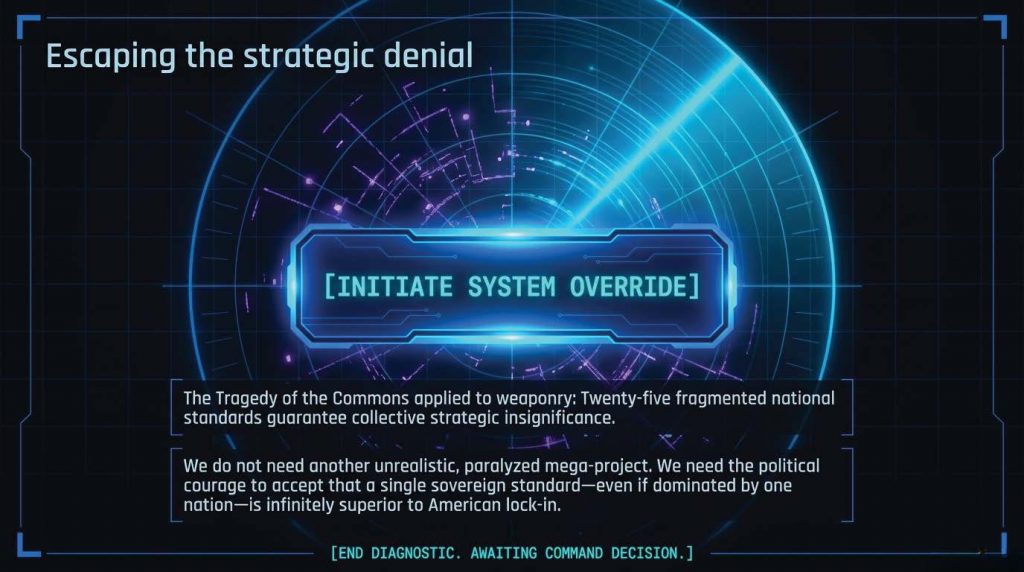
The real lesson of this FCAS-MGCS-Combat Cloud-SCALP Naval body of work is that European navies do not need a joint programme to sabotage themselves: the mere accumulation of rational national decisions is enough to produce a collectively irrational result. Twenty-five classes of frigates and destroyers, each sovereign shipyard guarding its own ‘family tool’: this is the tragedy of the commons applied to weapons procurement. It is no longer a matter of fantasising about an unrealistic industrial fusion on the FCAS model, but of doing the opposite of what killed FCAS: accepting that a single sovereign standard — French though it may be — is worth more than a multitude of national standards all condemned to strategic irrelevance.
La sindrome dello SCALP navale: autopsia di un naufragio delle capacità europee
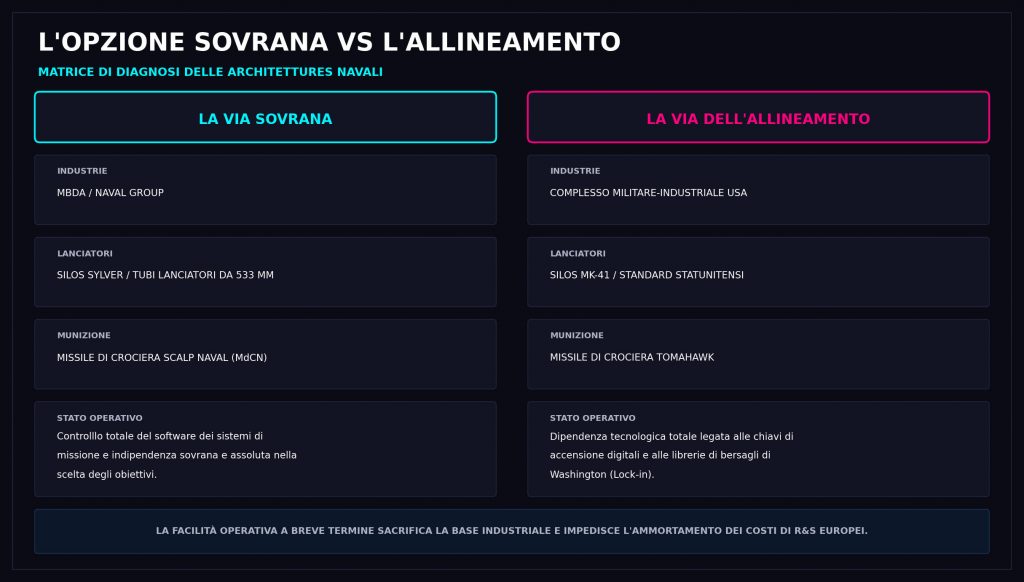
In fondo, la sindrome dello SCALP Navale è il riflesso speculare dello SCAF: mentre l’aviazione da combattimento è crollata sotto il peso di un’integrazione mal gestita, la marina sta crollando sotto il peso di una mancata integrazione per paura di essere mal gestita. Le due patologie, apparentemente opposte, producono lo stesso risultato: la dipendenza strategica dagli standard americani, che si tratti dell’F-35 nei cieli o del Tomahawk e dei silos MK-41 in mare.
La vera lezione da trarre da questo corpus SCAF-MGCS-Cloud da combattimento-SCALP Naval è che l’Europa navale non ha bisogno di un programma comune per affondarsi da sola: il semplice accumulo di decisioni nazionali razionali è sufficiente a produrre un risultato collettivamente irrazionale. Venticinque classi di fregate e cacciatorpediniere, con ogni cantiere navale sovrano che protegge il proprio «strumento di famiglia»: è la tragedia dei beni comuni applicata agli armamenti. Non si tratta più di fantasticare su una fusione industriale irrealistica sul modello dello SCAF, ma di fare l’opposto di ciò che l’ha affossato: accettare che un unico standard sovrano — anche se francese — valga meglio di una moltitudine di standard nazionali, tutti condannati all’insignificanza strategica.