The Essentials
- More than four years after the war began, the balance of power remains an apparent stalemate, but the geostrategic conditions have profoundly changed: the weight of military support has shifted from the United States to the Europeans, who are struggling to make up the shortfall in Patriot missiles.
- Drone warfare has transformed both theatres: on land, an almost frozen trench war; at sea, the Russian navy had to withdraw from Sevastopol to Novorossiysk after heavy losses.
- The admiral recalls the analytical framework he has held consistently since 2022: two interdependent strategies — a Ukrainian Clausewitzian strategy of survival, facing a Western indirect strategy that is measured and never fully unified.
- The initial red lines (strike distance onto Russian soil) have been progressively crossed without any Russian reaction beyond continuing the war — Ukraine has built its own missile industry and now strikes deep, hitting enemy refineries and logistics.
- NATO’s informational support remains decisive and unchallenged by the Trump administration, but the call for a defensive air shield over Ukraine, however justified, remains unanswered.
- Since Trump took office, Russia has directly targeted Europeans through hybrid warfare — interference, funding of extremist parties such as the AfD, attacks already recorded (Leipzig) — drawing them, whether they like it or not, closer to the conflict.
- No clear, unified European strategy is emerging to end the war; the “coalition of the willing” remains an operational virtuality with no effect. The admiral calls for raising alert levels, particularly in France, on territorial operational defence.
- Uncertainty over the American stance remains complete: neither a full withdrawal nor a separate Russian-American deal appears imminent in the short term, as Washington’s priority is now the war in Iran.
President Putin obstinately maintains the same rhetoric and displays the same objectives: to “denazify” Ukraine, meaning replace its leaders, neutralise its army, prevent it from joining NATO, secure the annexation of all the regions he has proclaimed part of the Russian Federation, and implicitly subjugate — if not eventually annex — the entire country. Ukraine is still fighting for its survival.
Contents
A balance of power that has changed hands
For more than four years, the geostrategic conditions that led to this apparent stalemate have been profoundly altered. Initially supported by the United States and European countries, but primarily on the military front by the Biden administration, Ukraine saw this burden almost entirely transferred to European countries once Donald Trump took power — with the current consequence that the shortage of US-supplied Patriot missiles is dangerously weakening the country’s air defence. The Europeans are unable to sufficiently make up the shortfall.
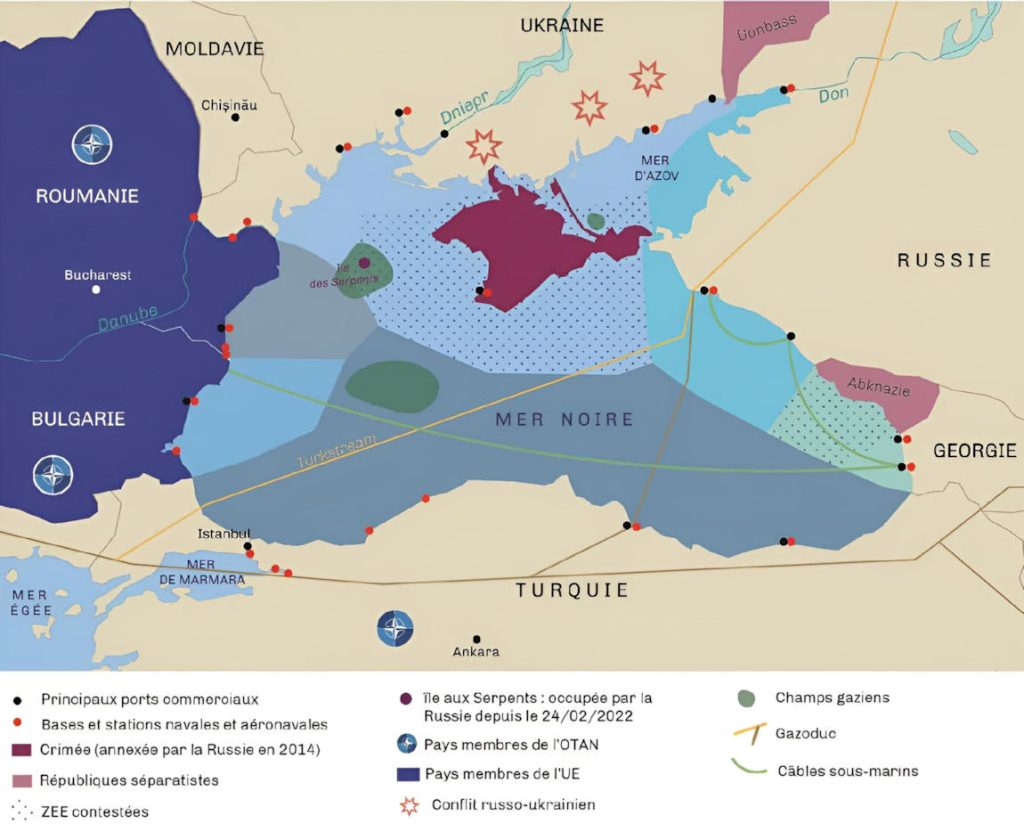
At the same time, the means of waging war have been profoundly transformed by the use of drones and the considerable improvement in their missions, characteristics, and performance. The war on the ground front is an extremely deadly trench war, almost frozen in a 21st-century version of the First World War in which drones are the principal weapon. At sea, after initial Russian superiority, the use of missiles and aerial and surface drones restored the balance in the north-west of the Black Sea, forcing the Russian fleet to withdraw from the port of Sevastopol towards Novorossiysk after heavy losses. The flow of Ukrainian grain production, blocked for a time, has resumed but again appears threatened by the Russian counter-reaction, which is in turn using drones against commercial maritime traffic.
A strategic emancipation that keeps confirming itself
On the military strategy front, it was analysed from the very start of the war that there existed, on the Ukrainian and Western sides, two strategies[1], one dependent on the other. Ukraine, fighting for its survival, was engaged in a Clausewitzian strategy, driving it towards escalation to the extremes. The Westerners, aware of Russia’s status as a nuclear power, for their part practised an indirect strategy of measured, gradual support to Ukraine — a strategy far from unified, nor even explicitly formulated, but in practice limiting Ukraine’s capacity for action, particularly because of the deterrence-through-intimidation[2] exercised by Russia, which brandished and continues to regularly brandish the nuclear threat, but just as much, and independently of that threat, because of their fear of being drawn directly into the conflict.
It had been noted that Ukrainian strategy could only seek to emancipate itself from the tutelage imposed on it. Indeed, the red lines initially set for it — in particular the strike range of offensive weapons onto Russian territory — have been progressively exceeded without provoking any reaction from the Russian side other than the unperturbed continuation of the war. But far more significantly, Ukraine has undertaken a remarkable effort to develop its own defence industry, beyond even that of drones, into that of missiles. It now strikes deep inside enemy territory against refineries and logistics depots, in retaliation for the attacks it suffers against its own. This strategic self-liberation can only continue and intensify, in an attempt to balance the Russian “Douhetian” strategy of systematically destroying Ukrainian infrastructure through bombardments of every kind.
The indirect strategy changes engine
NATO’s informational support to Ukraine is not the subject of open debate, certainly rightly so, although it is essential on the military level since it conditions the deployment of weapons, both defensive and offensive. It is the subject of a dedicated chapter in the book already cited[3]. It is fundamental and does not appear to be called into question by the Trump administration. It should be noted, however, that the call to establish a “defensive air shield” over Ukrainian territory, as was done over Israeli territory during the Iranian air attacks, has still gone unheeded despite its operational necessity and its obvious moral and legal justification. The constraints exercised on Ukrainian strategy by the Westerners have thus progressively loosened without disappearing entirely. Today they owe more to a shortage of immediately available resources — European resources above all, today — than to a fear of becoming more deeply engaged in their support.
The American unknown
It is particularly difficult to predict what the American attitude may be. Beyond the wish not to actively involve itself in supporting Ukraine, the desire to disengage from the European theatre will probably not, in the short term, lead to a complete withdrawal and the abandonment of the American security guarantee, particularly regarding nuclear deterrence. This will certainly limit Russia’s aggressive impulses towards NATO countries — the recent visit of the CIA director to Moscow being one indication of this. The prospect of a direct agreement between the Russian and American presidents, over the heads of the Europeans and Ukrainians, which had appeared as a risk at the time of the Alaska meeting, seems to be receding. America’s priority today is clearly the war against Iran.
The void in the face of hybrid war
Since Donald Trump’s arrival, Russia has come to regard the Europeans as the main obstacle to its victory and is developing an indirect strategy towards them by means of a war described as hybrid — attempting to sow fear and confusion in public opinion and to bring to power extremist parties openly favourable to its positions, such as the AfD in Germany. This situation is itself increasingly dangerous. The rising number of alerts, such as the aggressions attributable to Russia already recorded in various European countries, notably in Leipzig, Germany, is clear proof of it.
Whether they like it or not, European countries are being drawn ever closer to the war in Ukraine.
Faced with this situation, leaders are attempting to raise the alarm, with no evident success, among public opinions that consider only the rising cost of energy — and its economic consequences, in reality due to the war against Iran — which they are tempted to attribute also to the war in Ukraine.
Continuing political and financial support alone to Ukraine, though indispensable, seems clearly insufficient in the short term, at a moment when it is about to face another winter under terrible conditions. The “coalition of the willing,” a laudable initiative in itself, remains an operational virtuality with no effect on current operations or their eventual cessation — which should indeed be the immediate and priority objective. There is therefore, today no more than yesterday with the Americans, no clear, unified strategy among European countries to end the war. It nonetheless seems essential to raise alert levels, particularly in France, regarding what used to be called territorial operational defence — a Cold War concept that seemed to have been forgotten.
As in the First World War, Ukraine must hold on by means of the indirect military strategy it is already implementing, limiting its losses on the front line while acting in depth within Russian territory to weaken the economy and logistics of the enemy’s war machine. It must continue its industrial development, with European support, in order to free itself from foreign dependencies in their deployment and logistics.
It would be entirely unrealistic today to expect any change whatsoever in Russian strategy, or to hope for a change of regime or leader, as appears in some recent commentary. The major, immediate risk is indeed that of an escalation of Russian hybrid warfare actions. This raises the question of the responses necessary and possible to these aggressions, beyond passive security measures. Will they fall within NATO’s remit? How can they be coordinated at the European level, given the current state of the Union’s institutions? Where might they lead?
Uncertainty is complete. The issue seems only rarely considered./.
Christian Girard
[1] Strategic point on the war in Ukraine, late 2022 – european-security.com
[2] On the War in Ukraine, 2025 – Chapter 6 – The Shadow of the Nuclear, Éd. L’Harmattan
[3] On the War in Ukraine, 2025 – Chapter 8 – NATO’s Informational Support, Éd. L’Harmattan
[4] See « Guerre en Ukraine : la dimension navale du conflit » — Source : Centre d’Études stratégiques de la Marine (CESM), mai 2022.
Decoding: On the War in Ukraine
This piece follows directly from the analysis Admiral Girard has been developing since the very start of the conflict, and which he was already describing in 2023 as the “emancipation of Ukrainian strategy”: the idea that, over time, Kyiv could only seek to loosen the constraints imposed on it by its Western backers. This paper confirms that this movement has indeed continued — the crossing of the initial red lines, the development of a domestic missile industry, deep strikes into Russian territory — without triggering the nuclear escalation that was originally feared.
What is changing, however, is the second term of the equation he had already set out in late 2022: the West’s “indirect strategy.” It has not disappeared, but its engine has shifted — from a deficit of political will to a deficit of means, European ones above all, as Washington withdraws from the file. The admiral thus points to a shift rather than a reversal: the Europeans are no longer merely indirect supporters by choice, but increasingly by necessity, for lack of a defence industry equal to the American shortfall in Patriot missiles.
The most serious point he raises — and one he frames, with his usual caution, as questions rather than statements — concerns Russia’s hybrid war aimed directly at European countries: electoral interference, funding of parties such as the AfD, attacks already recorded. He does not settle the question of the response required (NATO’s role, European coordination), but poses it as the most urgent and least addressed issue of the moment — a strategic void that echoes, by another path, the institutional voids the international press identifies elsewhere, on other theatres.