From Prussian Humiliation to German Unification
How could a single Napoleonic battle sow, in Prussia, the seeds of an antagonism that would poison Europe for more than a century? The first instalment in a series devoted to the Franco-German relationship, this article traces the birth of German national sentiment in humiliation, and its first great revenge: the unification of Germany by “blood and iron,” at France’s expense.
The Essentials
- A two-speed treatment: after Austerlitz, Napoleon showed himself magnanimous toward defeated Austria and Russia — but merciless toward Prussia, humiliated down to its dynastic memory.
- An unprecedented disaster: at Jena and Auerstedt (14 October 1806), the Prussian army, reputed to be the foremost in Europe, was annihilated in a single day — 10,000 dead and wounded, 3,000 prisoners, 115 guns lost.
- Humiliation reaching to the heart of power: Napoleon moved into the royal palace in Berlin, seven Prussian ministers pledged him allegiance, and the personal effects of Frederick the Great were sent to Paris as trophies.
- A territorial dismemberment: the Treaty of Tilsit (July 1807) stripped Prussia of half its territory and population, and reduced its army to 42,000 men.
- The birth of modern German nationalism: it was in this humiliation that Fichte forged, with his Addresses to the German Nation, the cultural foundations of an identity that would seek its revenge.
- The cycle reverses in 1871: Bismarck unified Germany by “blood and iron,” proclaimed the Empire at Versailles itself, and in turn inflicted on France the humiliation of the annexation of Alsace-Lorraine.
Contents
by Joël-François Dumont — Berlin, 14 August 2026.
Introduction
The Franco-Prussian antagonism that would durably mark relations between the two nations has deep roots in the Napoleonic era. France had already had its disputes with Austria, but the confrontation with Prussia from 1806 onward would take on a particularly bitter turn, leaving scars that ran deep and lasted long — scars that would shape, for more than a century, how two great European nations would come to see one another.
Table: Chronology of Franco-German Conflict and Reconciliation
| Date(s) | Major event | Key actors | Outcome for Franco-German relations |
|---|---|---|---|
| 1805 | Battle of Austerlitz | Napoleon I, Francis II (Austria), Alexander I (Russia) | French victory; indirect impact on Prussia thereafter |
| 1806 | Battles of Jena and Auerstedt | Napoleon I, Frederick William III (Prussia) | Crushing defeat of Prussia, French occupation, Prussian humiliation |
| 1807 | Treaty of Tilsit | Napoleon I, Frederick William III (Prussia) | Partial dismemberment and harsh terms imposed on Prussia |
| 1870-1871 | Franco-Prussian War | Napoleon III, Otto von Bismarck | French defeat, German unification, annexation of Alsace-Lorraine |
1. The Napoleonic Era: Prussian Humiliation and the Emergence of German National Sentiment
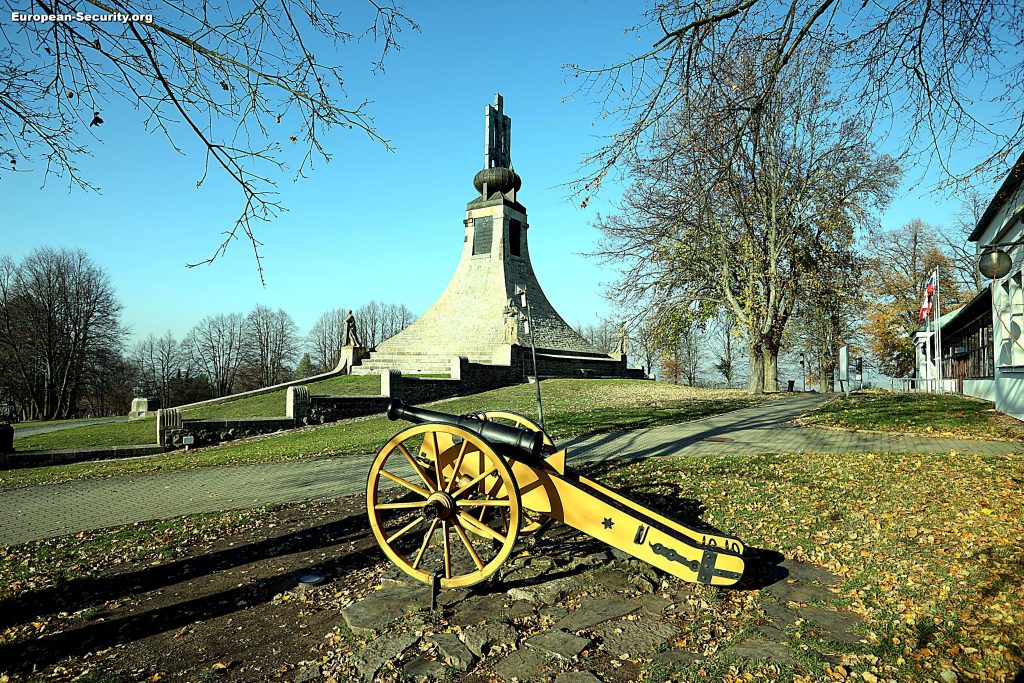
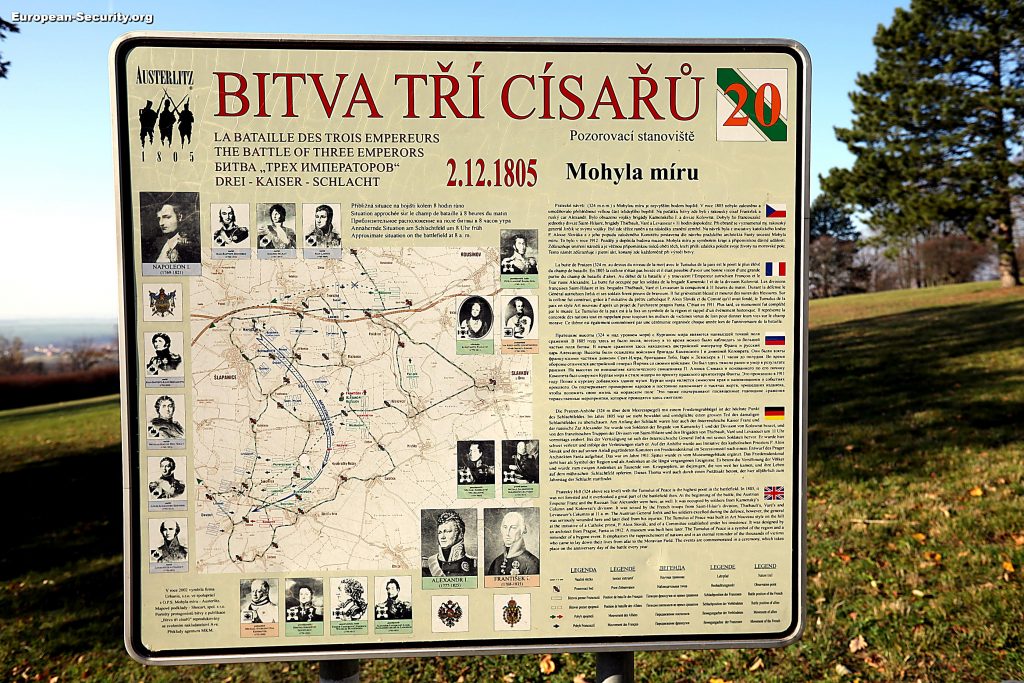
The Battle of Austerlitz (2 December 1805) and its immediate aftermath
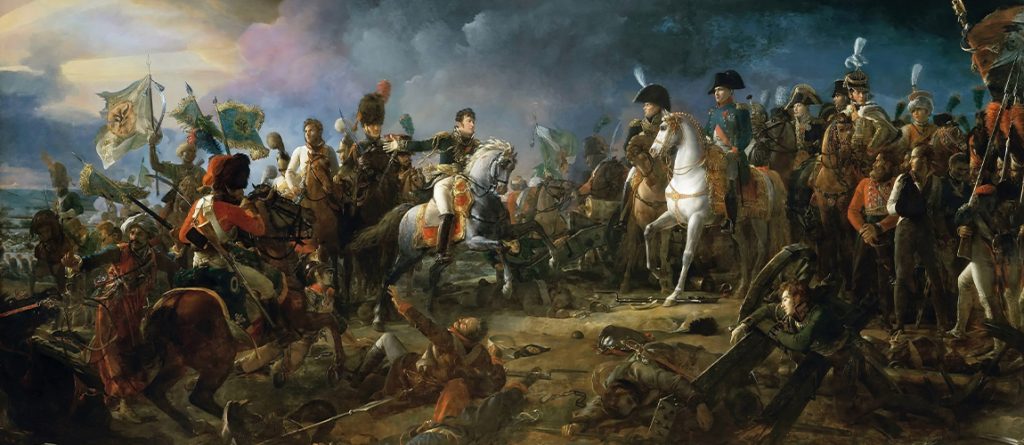
Napoleon I’s brilliant victory at Austerlitz on 2 December 1805, in the “Battle of the Three Emperors,” marked a major turning point in Europe’s balance of power. While the French Emperor showed a degree of magnanimity toward defeated Austria and Russia, his attitude toward Prussia — not directly involved in this battle, but soon to challenge French power — was of an entirely different nature.
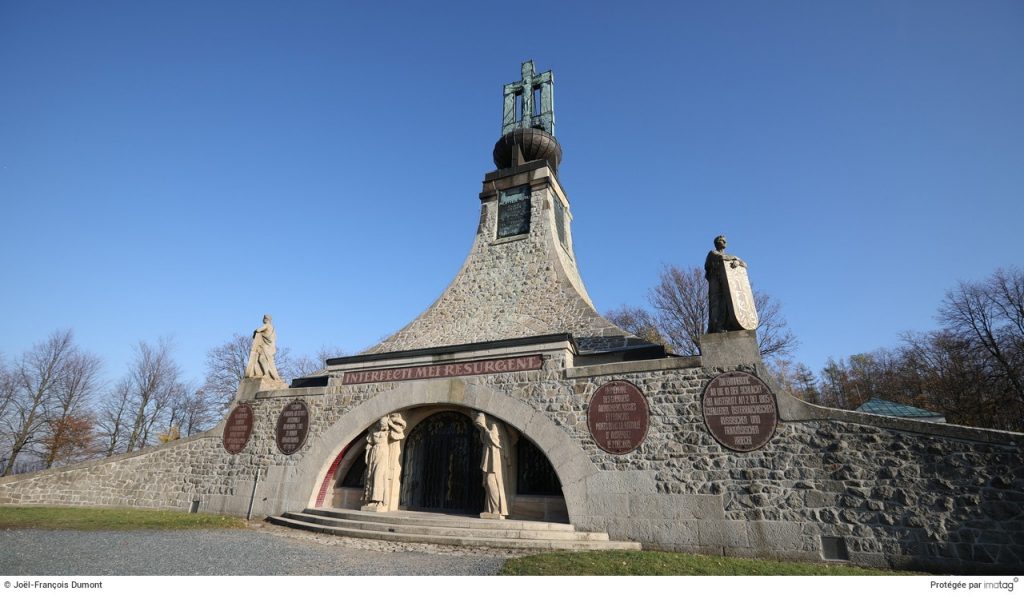
This difference in treatment already foreshadowed tensions to come and helped forge distinct perceptions within the German territories.
The Prussian defeats at Jena and Auerstedt (14 October 1806)
Prussia, which then regarded itself as possessing the foremost army in Europe, suffered an unpre-cedented military disaster in the twin battles of Jena and Auerstedt on 14 October 1806.
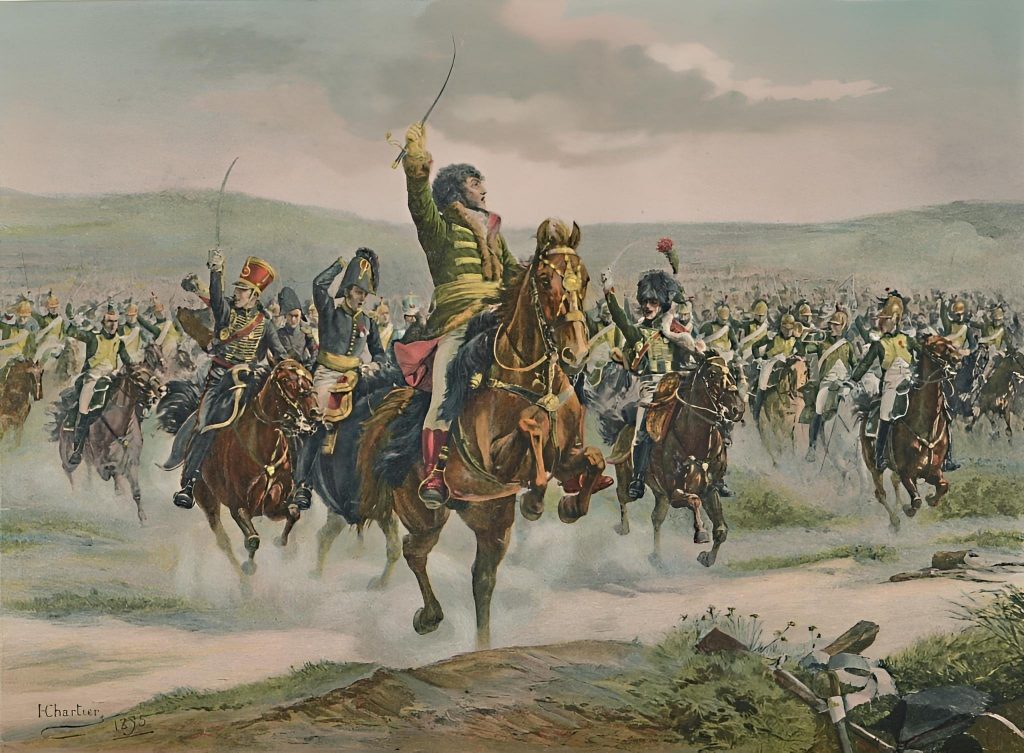
The Prussian army was literally annihilated by Napoleonic troops. Napoleon had hoped for a lasting peace, but a Prussian ultimatum demanding the withdrawal of French troops beyond the Rhine forced him to act. The French counter-strike was devastating. Prussian losses were considerable, including 10,000 dead and wounded, 3,000 prisoners and 115 cannon at Auerstedt alone, where Marshal Davout, against Napoleon’s own expectations, faced and defeated the bulk of the Prussian army.
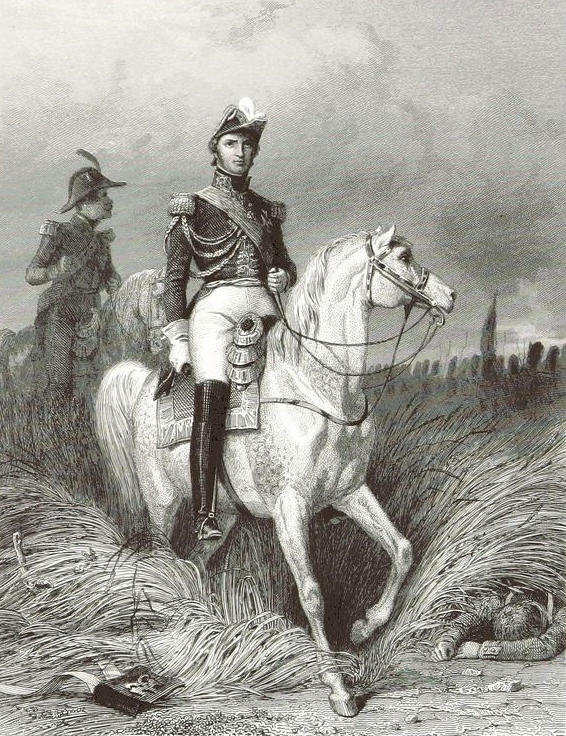
These defeats were not merely military; they constituted a profound psychological shock, a national humiliation for a state whose identity and pride rested largely on its military tradition and efficiency. Queen Louise of Prussia, a beloved and emble-matic figure, would die in 1810 of grief, it is said, in the aftermath of these events, becoming a symbol of the nation’s martyrdom.
This initial trauma fed a virulent anti-French sentiment and a desire for revenge that would smoulder for decades.
Marshal Louis Nicolas Davout at Auerstedt, by Karl Girardet
The entry into Berlin and the humiliation of Prussian power
The humiliation did not stop on the battlefield. On 27 October 1806, barely thirteen days after the disaster of Jena and Auerstedt, Napoleon made a triumphant entry into Berlin at the head of his Guard. King Frederick William III and Queen Louise had fled east, as far as Königsberg, leaving their capital without defence or authority.
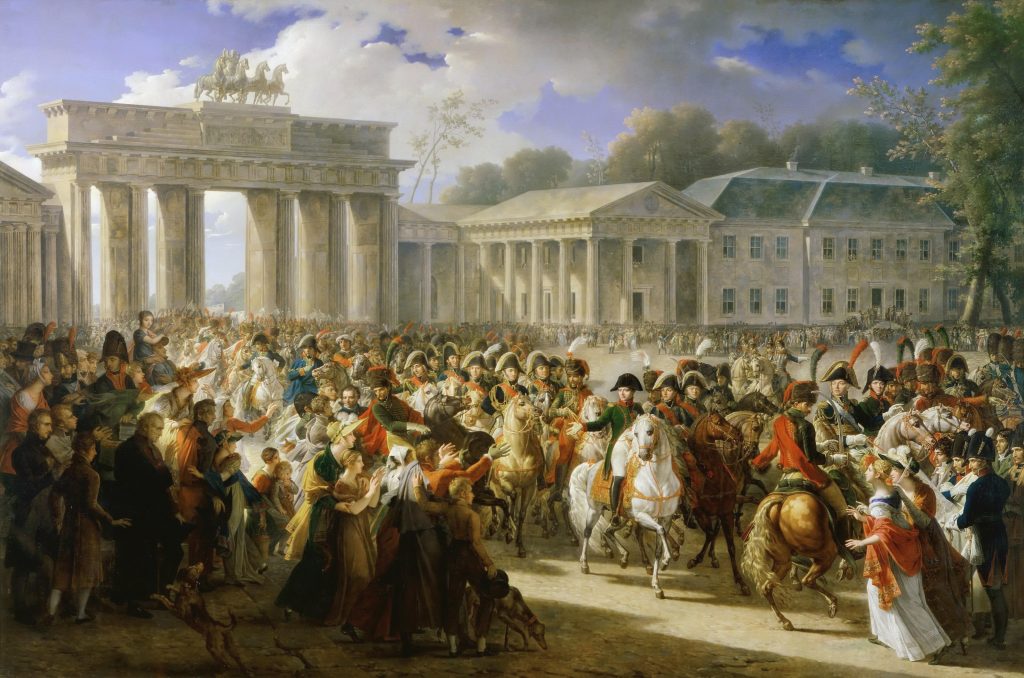
Napoleon took up residence at Charlottenburg Palace, the very seat of the Prussian sovereigns, thereby symbolically appropriating the seat of power he had just conquered. The choice of trophies sent to Paris was no accident: by claiming even the personal effects of Frederick the Great — the very founder of Prussian military power — Napoleon was not merely defeating Frederick William III’s army; he was humiliating the entire dynastic memory, down to its most glorious origin.
Even more striking: seven Prussian ministers and high dignitaries, who had remained in Berlin in their king’s absence, chose to pledge him allegiance rather than follow the court into exile — a gesture that, in the eyes of contemporaries and historians alike, sealed the complete collapse of Prussian authority, far beyond the military defeat alone.
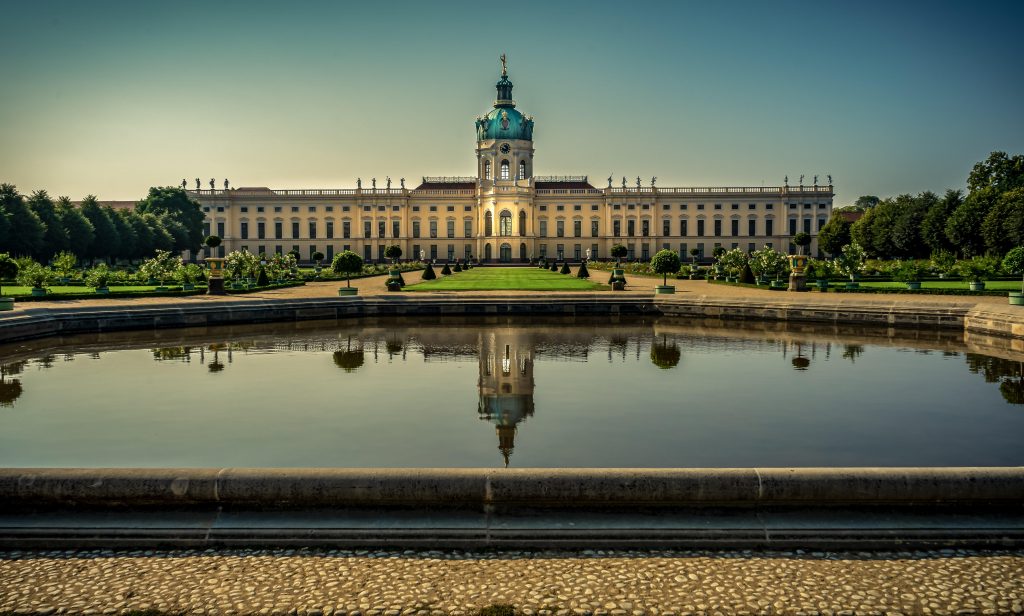
It was from occupied Berlin, on 21 November 1806, that Napoleon signed “the Berlin Decree” establishing the Continental Blockade against England — thus governing defeated Prussia from its own palace, even before the kingdom’s fate would be sealed a few months later at Tilsit.
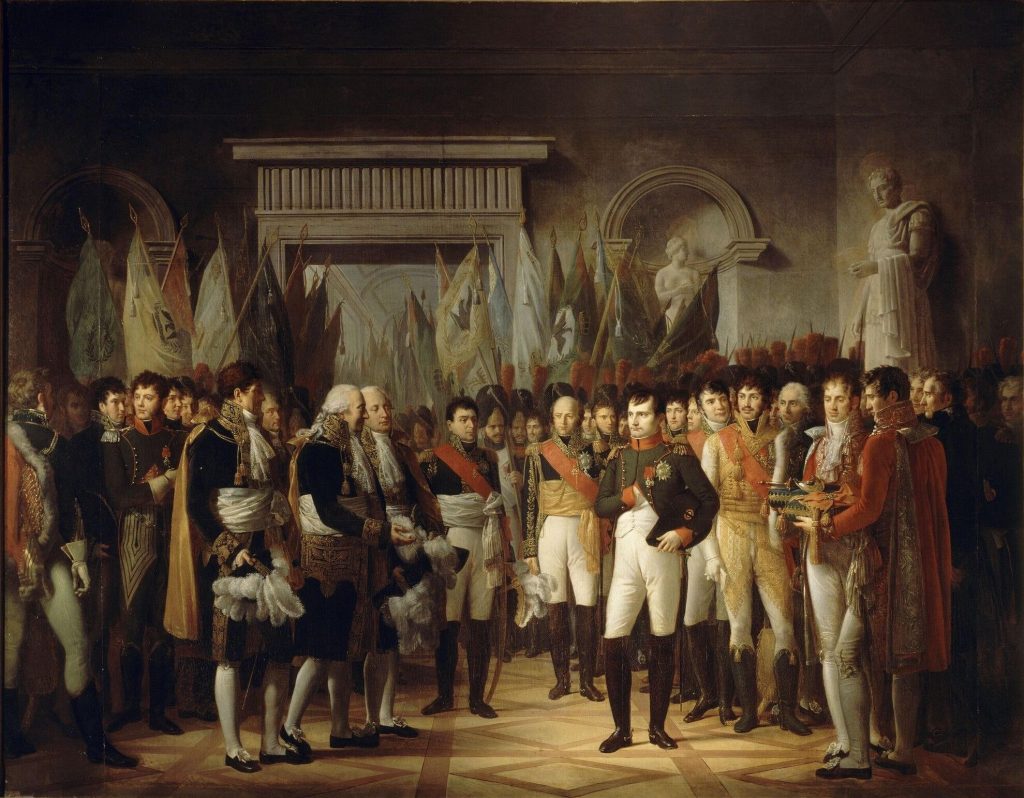
Napoleon’s admiration for Frederick the Great
While it was, on one level, yet another demonstration of Napoleon’s military genius, this Prussian and Polish campaign also destroyed the reputation the Prussian army had built through the great victories of Frederick II, known as “the Great” — a sovereign Napoleon himself deeply admired. One proof of that admiration: upon reaching Berlin, Napoleon visited the tomb of Frederick the Great and is said to have told his marshals: “Hats off, gentlemen; were he alive, we would not be here today.”
Portrait of Frederick the Great, aged 68, by Anton Graff
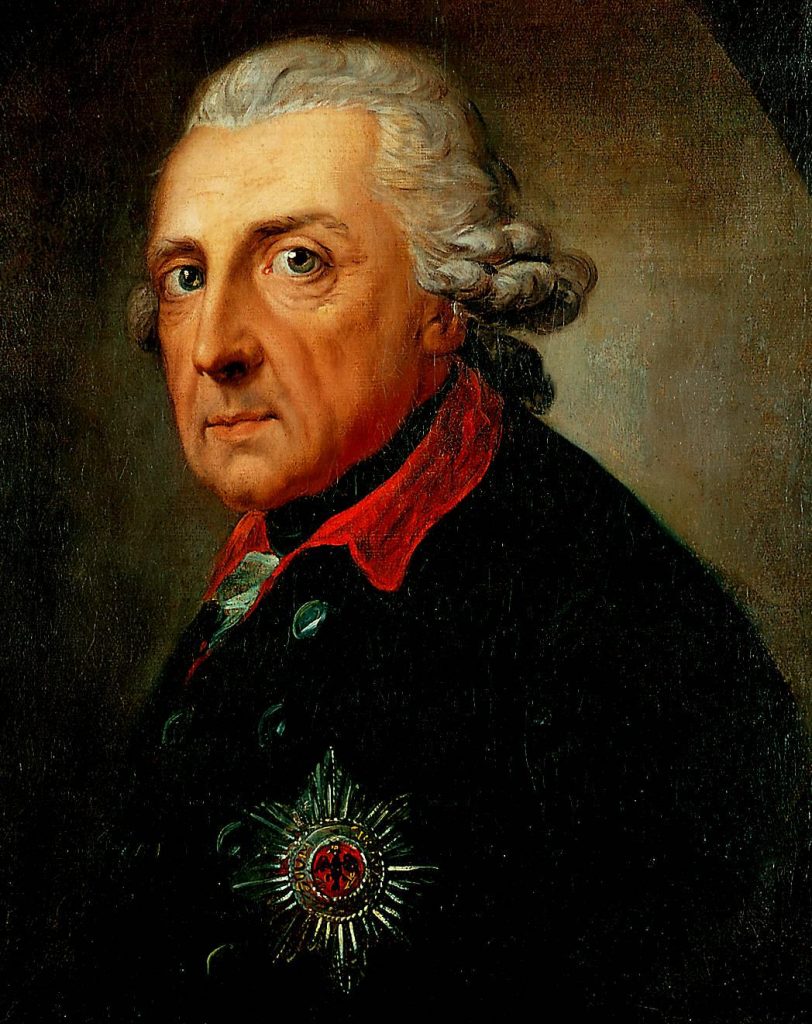
This paradox sums up all the ambivalence of the nascent Franco-Prussian relationship: one can humiliate a defeated nation while still revering the genius who built it — and it may well be precisely this contradiction, between admiration for Prussia’s past greatness and the contempt shown for its present defeat, that made the humiliation all the more unbearable in Prussian eyes.
The Treaty of Tilsit (July 1807) and its devastating consequences for Prussia
Prussia’s humiliation was sealed by the Treaty of Tilsit, signed in July 1807 between Napoleon, Tsar Alexander I of Russia, and King Frederick William III of Prussia. The terms imposed on Prussia were extremely harsh. The kingdom lost nearly half its territory and population (around 5 million inhabitants), as well as almost all of its fortresses. A crushing war indemnity of between 120 and 140 million francs was imposed, and its army was reduced to a contingent of 42,000 men. Prussia was also forced to join the Continental Blockade against England.
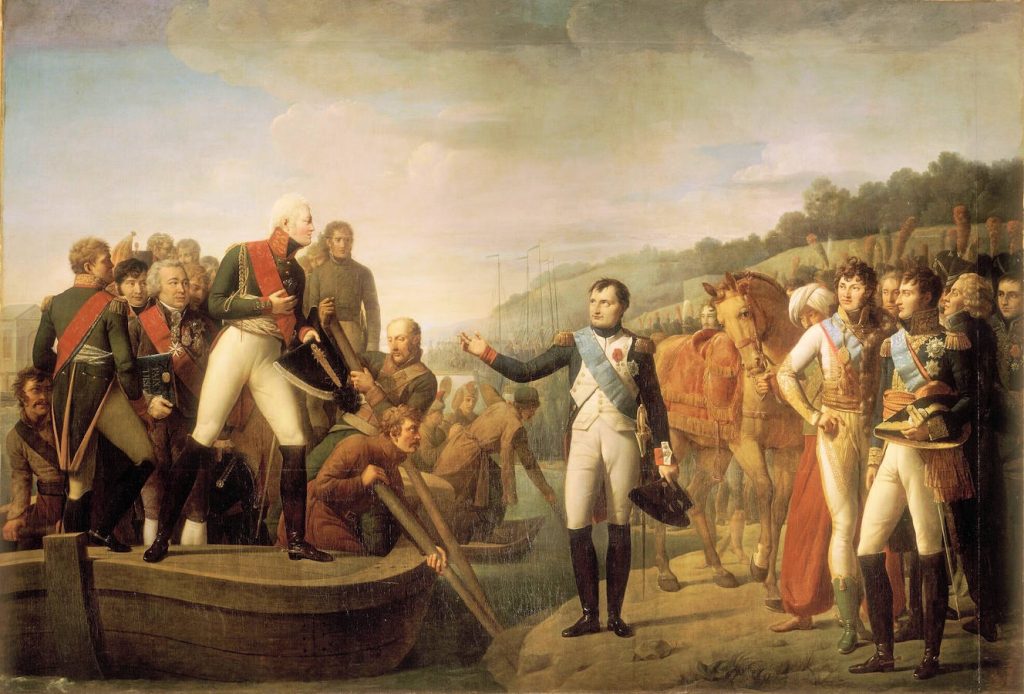
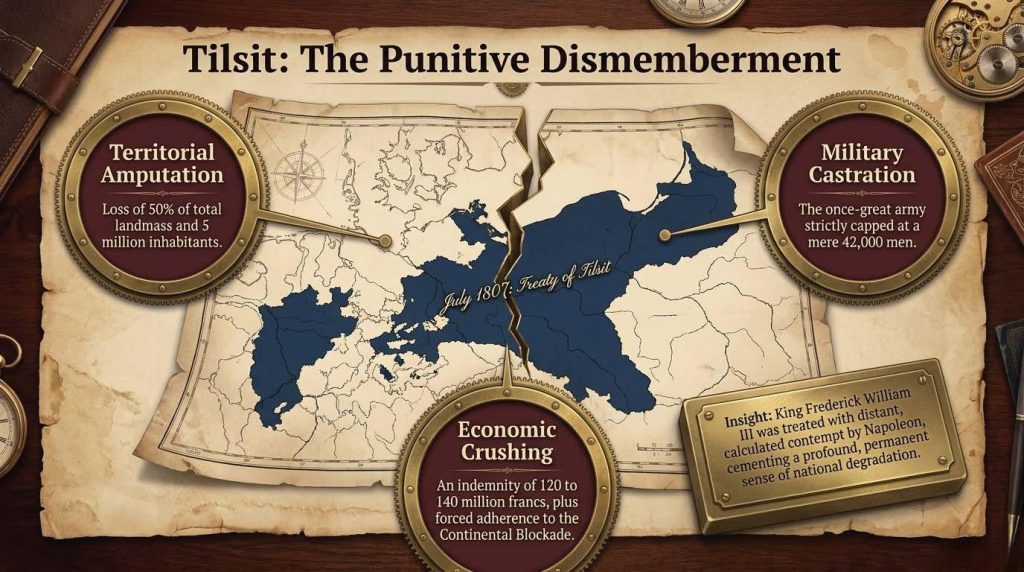
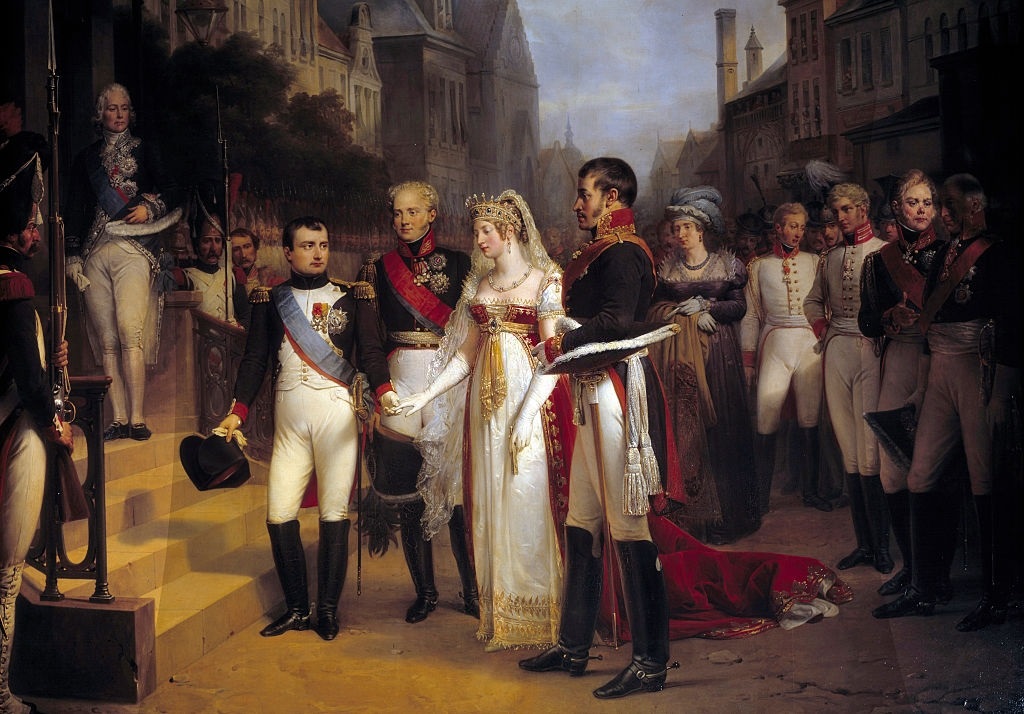
The personal treatment Napoleon meted out to King Frederick William III, described as contemptuous and distant, contrasted with the consideration shown to the Russian tsar — only sharpening the sense of humiliation.
The treaty’s provisions, such as the cession of vast territories to form the Kingdom of Westphalia under Jérôme Bonaparte, were plainly designed to dismantle Prussian power and neutralize it for years to come.
Far from securing a lasting peace, these draconian terms sowed the seeds of a tenacious resentment and a determination toward national restoration. Humiliated and dismembered, Prussia now aspired to nothing but the recovery of its sovereignty and the washing away of the affront.
The intellectual and cultural response: the awakening of German nationalism
Faced with French occupation and national humiliation, a profound intellectual and cultural reaction took hold in the German territories, particularly in Prussia. This period was a true crucible for the emergence of modern German national feeling.
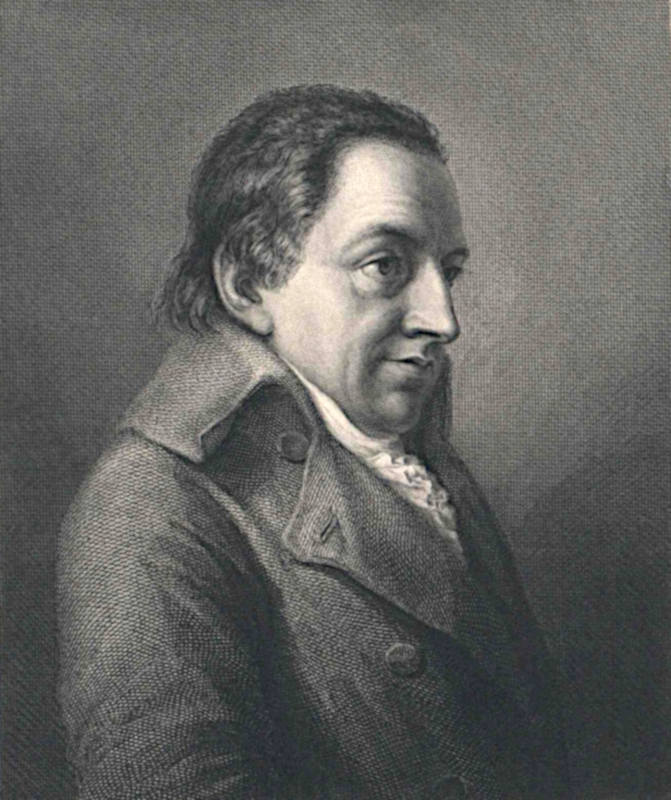
Leading intellectual figures played a decisive role in this awakening. Johann Gottlieb Fichte, with his Addresses to the German Nation, delivered in Berlin under French occupation during the winter of 1807-1808, is emblematic of this movement.
Initially sympathetic to the ideals of the French Revolution, Fichte, like many of his contemporaries, came to see in Napoleon the gravedigger of those ideals and the embodiment of a new tyranny.
Portrait of Johann Gottlieb Fichte, by Albrecht Fürchtegott Schultheiß
His addresses were a vibrant call for the moral, cultural, and political regeneration of the German people. Fichte exalted the German language and culture, regarding them as the foundations of a shared identity and of a specific, even superior, mission in human history.
He defined the German nation not on political and social grounds, as had been the case in France with the revolutionary idea of citizenship, but on cultural and ethnic criteria: a shared language, a shared origin and past, a geographical “space” in which this culture had flourished. This vision made it possible to transcend the existing political divisions among the many German states. The aim was to transform military defeat and political humiliation into a catalyst for national unity and a sense of a singular destiny.
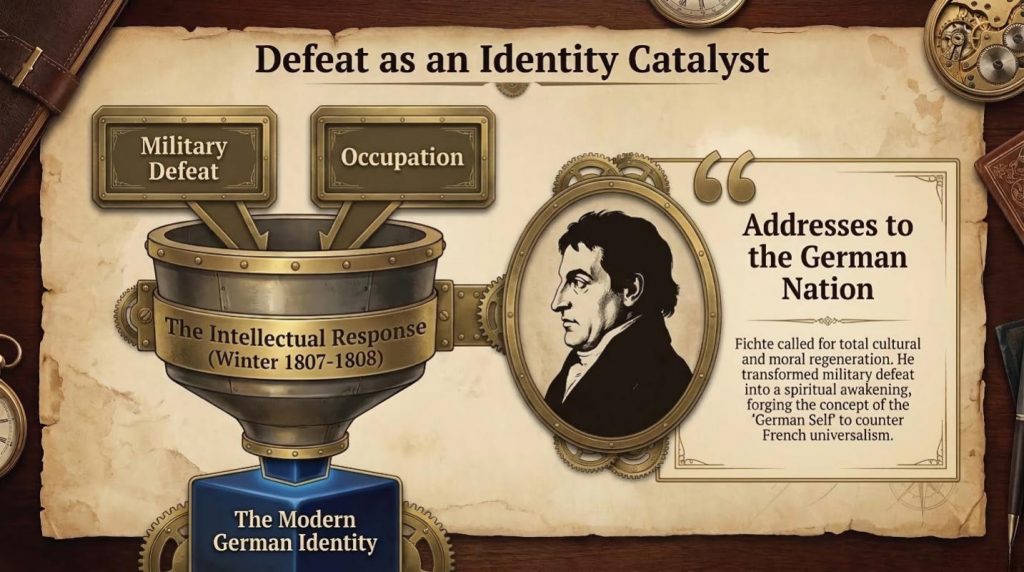
By positing the “German self” as a primary reality capable of generating universality, Fichte provided a powerful ideological foundation for cultural, and potentially political, resistance.
Thus, Napoleonic domination, through the brutality of its manifestation and the humiliation inflicted, particularly on Prussia, produced a paradoxical effect: it accelerated the emergence of a German nationalism that would, in time, seek to assert itself against France. The defeats at Jena and Auerstedt were not merely military setbacks; they became painful sites of memory, symbols of national shame later invoked to justify further conflicts, in a fateful logic of revenge.
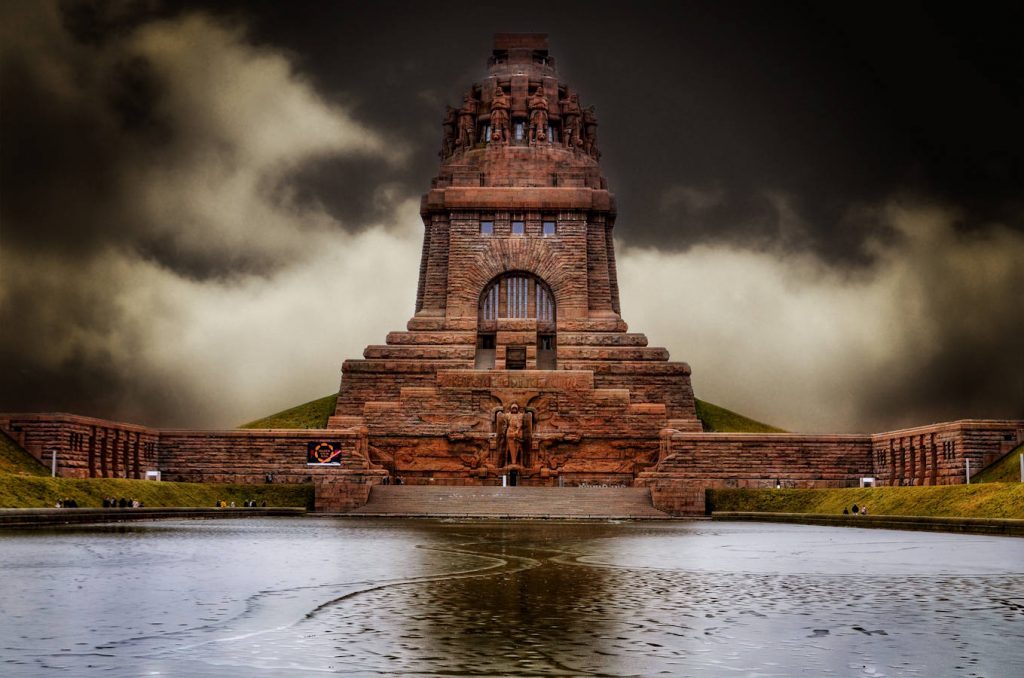
2. From 1815 to 1871: Rising Tensions and German Unification by Blood and Iron
The post-Napoleonic context and the Restoration
Napoleon’s fall in 1815 and the Congress of Vienna redrew the map of Europe, but ended neither German national aspirations nor Prussian resentment.
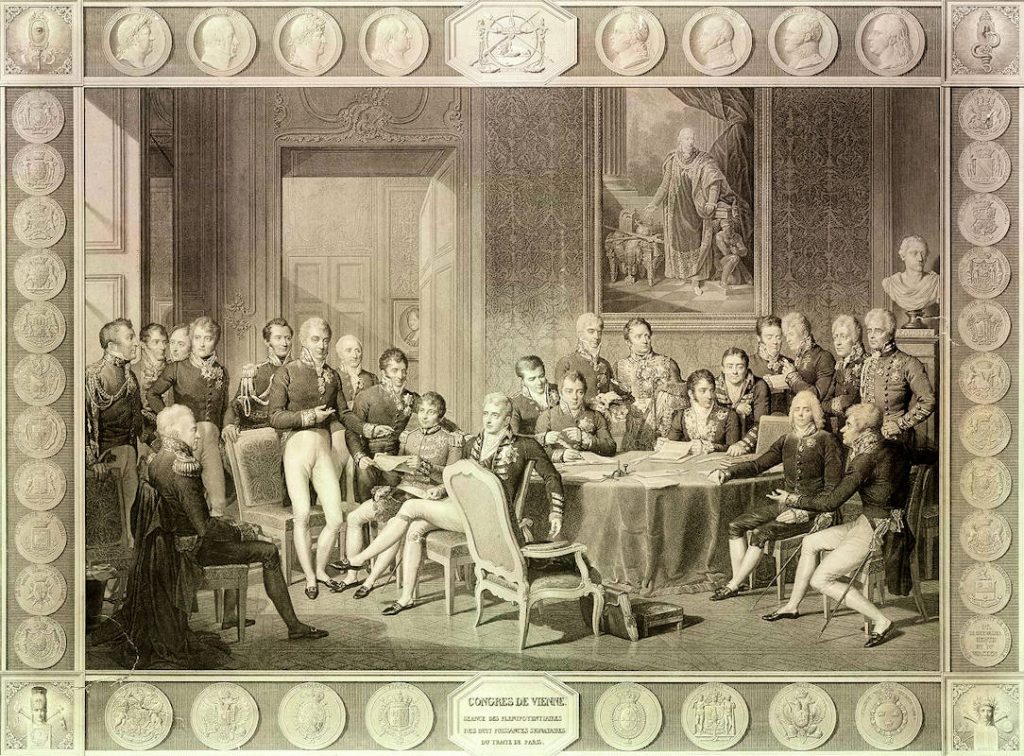
From November 1814 to June 1815, the Congress of Vienna brought together Europe’s great powers to redraw the continent after Napoleon’s fall. Orchestrated by the victors, it imposed a drastic restoration of the old order, sweeping away the gains of the Revolution and marking a return to the Europe of before 1792.
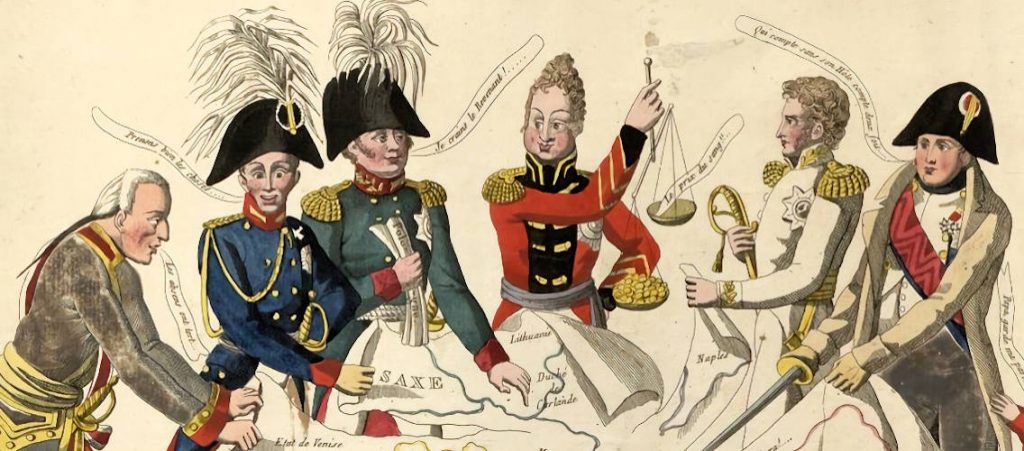
After 1815, Prussia recovered part of its lost territory and gained influence. Yet the humiliation suffered under Napoleon had left deep marks. The desire for German unity, carried by liberal and nationalist currents, ran up against the political divisions of the German Confederation and the rivalry between Prussia and Austria. Prussian attempts to seize the initiative, in 1830 and then in 1848 during the “Springtime of the Peoples,” testified to a persistent ambition, but conditions were not yet ripe to unify Germany by Prussian will alone.
The Franco-Prussian War (1870-1871)
Otto von Bismarck’s rise to power as Chancellor of Prussia in 1862 radically changed the picture.
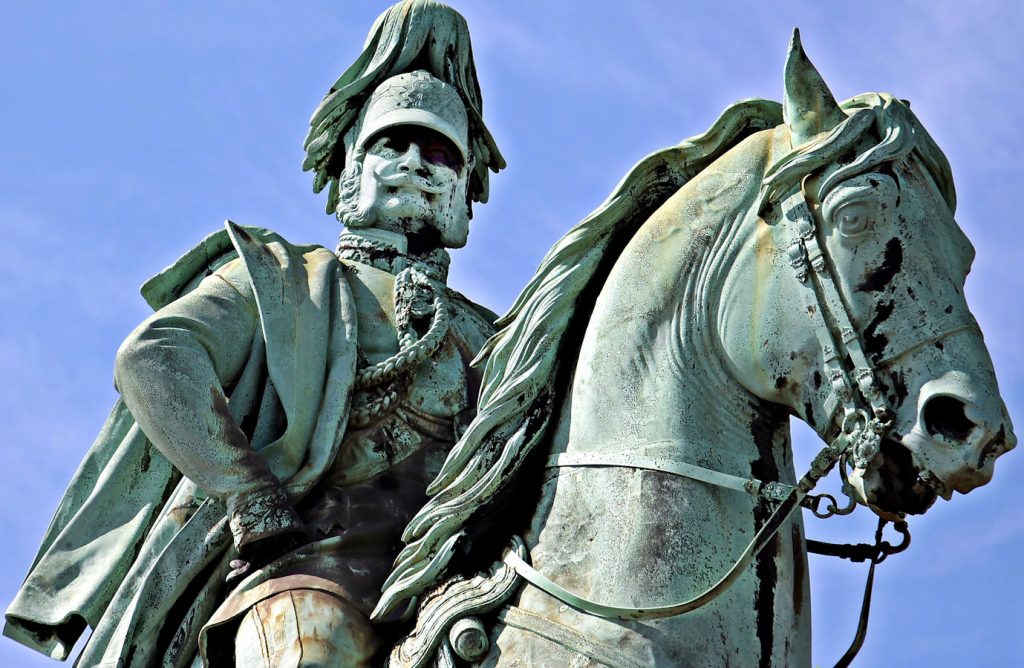
A practitioner of an unscrupulous Realpolitik, Bismarck was determined to achieve German unity around Prussia through “blood and iron” rather than speeches and majority votes. His strategy consisted in diplomatically isolating his opponents and provoking conflicts he judged favourable to Prussian interests.
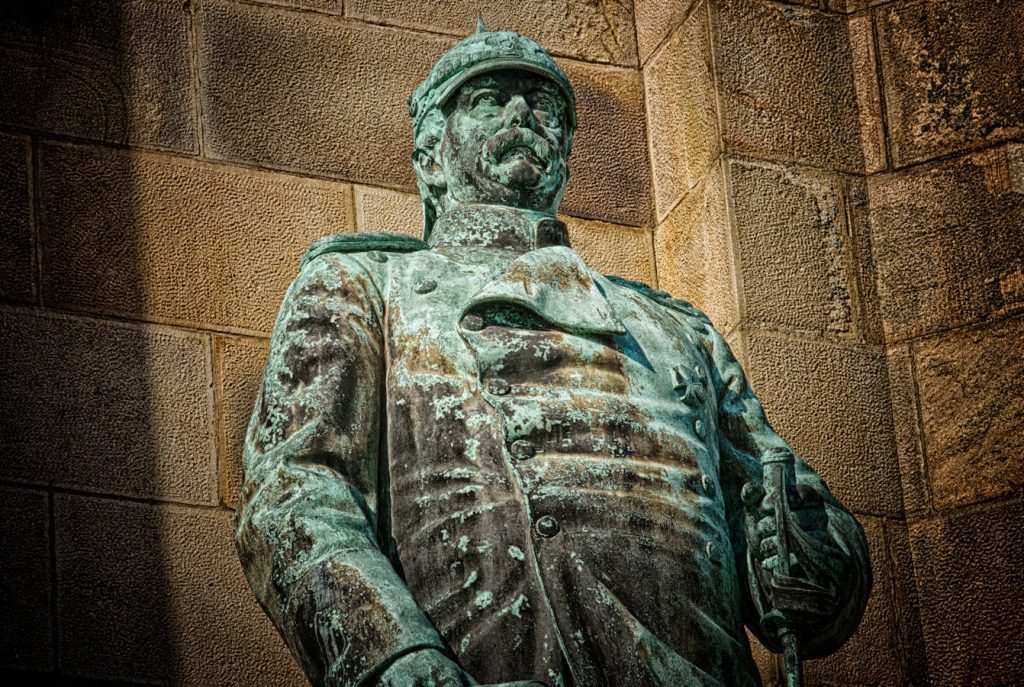
The causes of the Franco-Prussian War of 1870-1871 are complex, but the candidacy of a Hohenzollern prince for the Spanish throne served Bismarck as a pretext. Through skilful manipulation of the “Ems Dispatch,” he heightened tensions and pushed the France of Napoleon III, already anxious about Prussia’s rising power, into declaring war on 19 July 1870. In doing so, Bismarck succeeded in making France appear the aggressor, which helped rally the initially wary southern German states to the common cause.
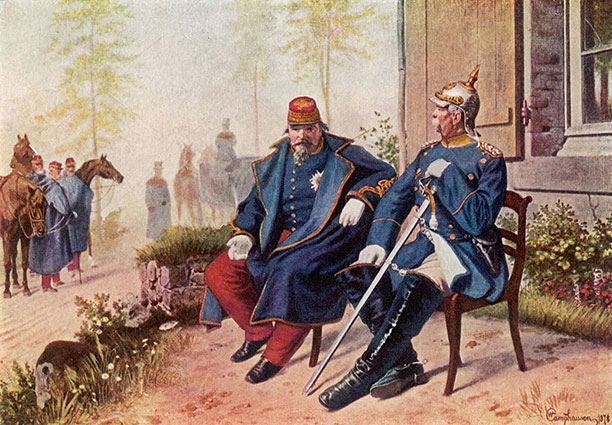
The war was a succession of disasters for France. The superiority of Prussian military organization, the quality of its artillery, and the strategy of its generals led to rapid victories. The Battle of Sedan, on 1 September 1870, was particularly decisive: a large part of the French army was encircled and forced to capitulate, and Emperor Napoleon III himself was taken prisoner. This defeat marked a seismic shift in the European balance of power.
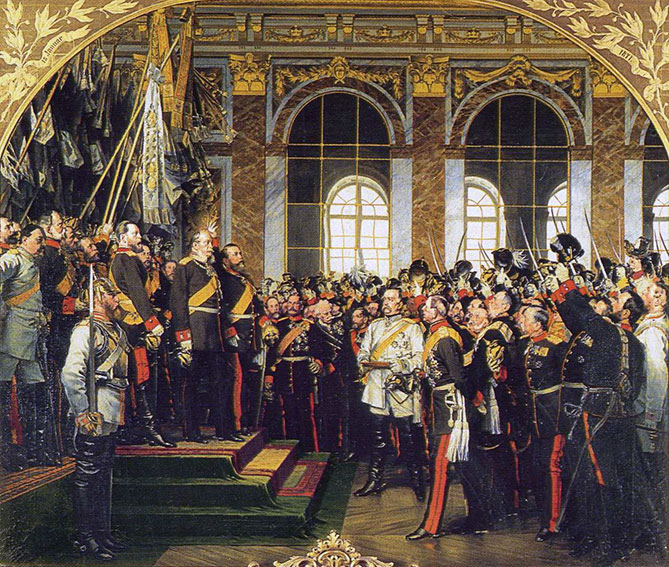
The proclamation of the German Empire, on 18 January 1871, in the Hall of Mirrors at the Palace of Versailles — a site of the highest symbolic significance for the French monarchy — completed France’s humiliation. The act was perceived as a humiliating ceremony for France, reversing the balance of power that had prevailed during the Napoleonic Wars. The phrase attributed to Bismarck — “There was Sedan because there was Auerstedt” — perfectly illustrates this logic of historical revenge, in which the victory of 1870 was seen as the answer to the defeat of 1806.
The Treaty of Frankfurt (10 May 1871)
The Treaty of Frankfurt, signed on 10 May 1871, formalized the German victory and imposed very harsh terms on France. The most painful was the cession of Alsace (except Belfort) and part of Lorraine (corresponding to today’s Moselle department) to the new German Empire. These territories were constituted as the “Reichsland Elsass-Lothringen,” administered directly from Berlin. France was also required to pay a colossal war indemnity of five billion gold francs, and part of its territory remained occupied until the sum was paid in full.
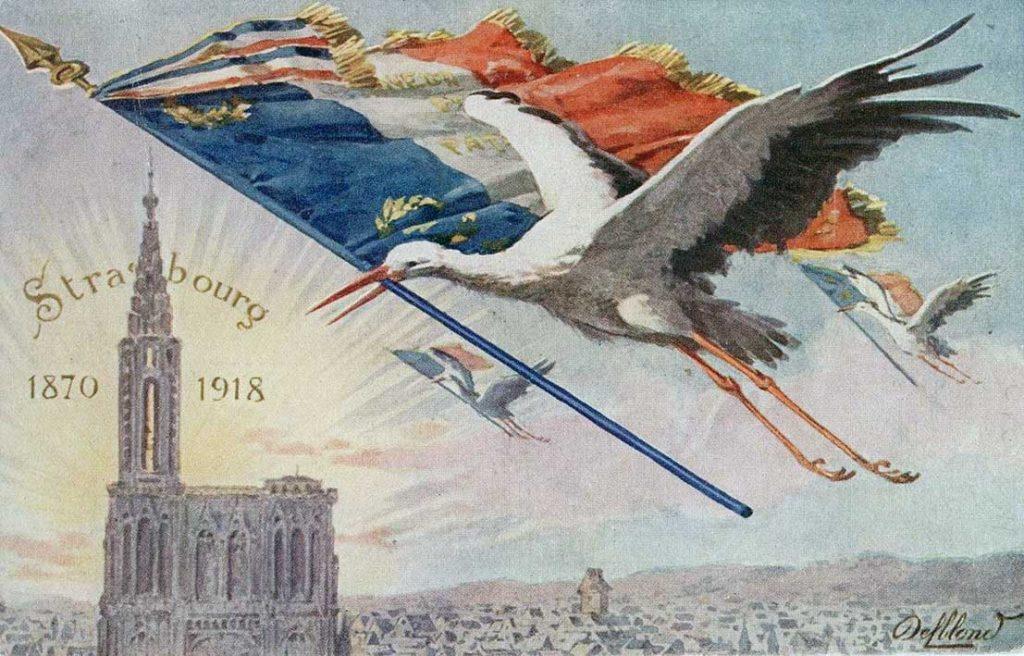
The annexation of Alsace-Lorraine was experienced in France as an amputation, a deep national wound, and a flagrant injustice. France, thus amputated, would think of nothing but washing away this affront. This sense of loss, and this desire for “revenge,” would durably shape French politics and Franco-German relations, creating lasting symbolic damage. The recovery of the “lost provinces” became a leitmotiv of the Third Republic and one of the deep-seated causes of the tensions that would eventually lead to the First World War.
The period from 1815 to 1871 thus saw Prussia take its revenge on France, unify Germany under its authority, and in turn inflict a national humiliation on its neighbour. The cycle of affronts and reprisals seemed to have reversed itself — preparing the ground, though no one yet knew it, for a confrontation of an altogether different magnitude. Though Bismarck’s objectives in 1870 were chiefly focused on German unification, the consequences of his victory, in particular the annexation of Alsace-Lorraine, would go far beyond that, entrenching an enmity that would define Franco-German relations for the next fifty years.
It is this same dynamic — humiliation, revenge, fresh humiliation — that the second instalment of this series will follow to its paroxysm: the “Diktat” of Versailles, Hitler’s rise to power, and the catastrophe of 1940.
Joël-François Dumont
See also:
- « France-Germany: The Machinery of Hatred 1805-1871 (1) » — (2026-0814)
- « France-Germany: The March Toward the Abyss 1871-1914 (2) » — (2026-0816)
- « France-Germany: The Paroxysm, 1914–1945 (3) » — (2026-0819)
- « France-Germany: From Ruins to an Emerging Europe, 1945-1959 (4) » — (2026-0820)
- « France-Germany: The Axis and Its Trials 1958-1989 (5) » — (2026-0821)
- « France-Germany: Love Me, Love Me Not 1990-2025 (6) » — (2026-0824)
- « France-Germany: Quo Vadis? 2025-2026 (7) » — (2026-0826)
Analysis: Memory as a Weapon
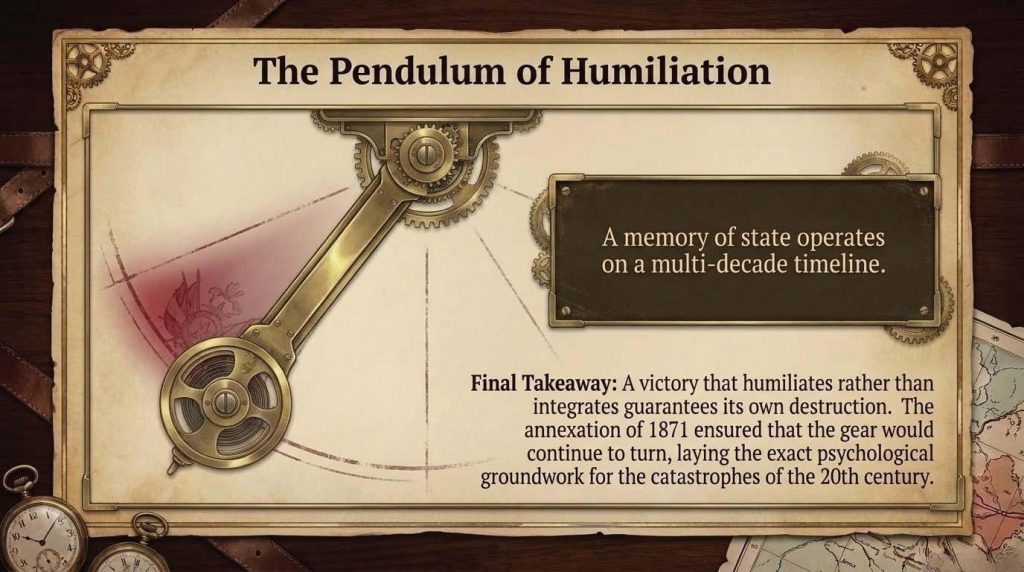
What this first sequence reveals is not so much a succession of battles as a precise psychological mechanism: national humiliation, once inflicted, does not fade away — it transforms itself. For the Prussia of 1806, it became a political project spanning decades, patiently sustained until conditions allowed it to be realized. This time lag matters: Jena and Sedan are separated by sixty-four years. This was not a hot-blooded reaction; it was a memory of state, transmitted, cultivated, institutionalized down to the level of education and culture — Fichte is the most striking proof of that.
It would be wrong to see this as a specifically German or Prussian trait. It is a mechanism found wherever a defeated nation retains the intellectual, cultural, and eventually material means for its revenge. The lesson of 1805-1871, even before turning to what comes next, may well be this: a victory that humiliates rather than integrates almost mechanically programs its own future undoing.